Build & Win: Web3 Marketplace Development 2026

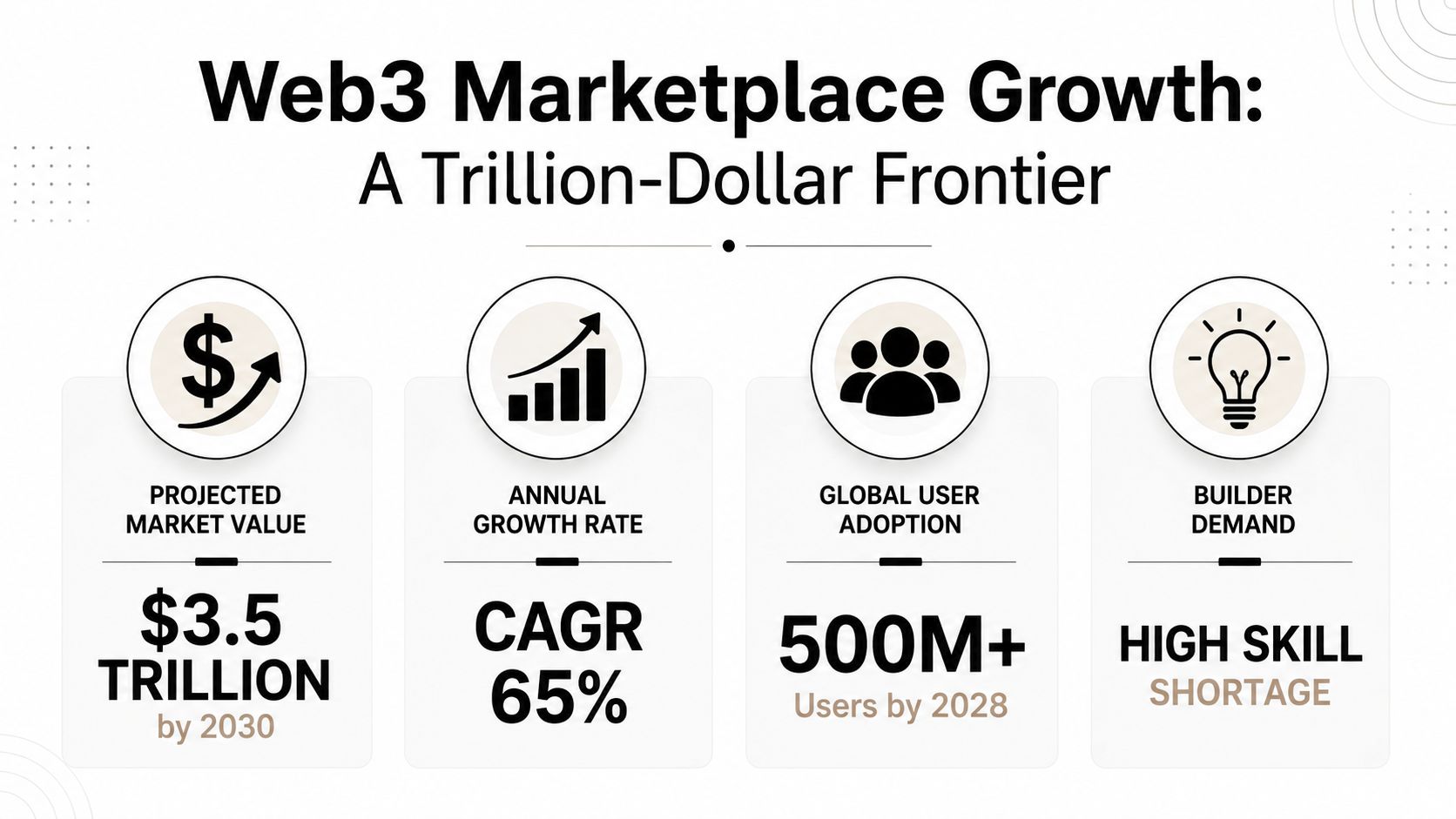
USD 4.97 billion in 2026, projected to reach USD 29.97 billion by 2031 at a 43.21% CAGR. That projection from Mordor Intelligence's Web3 market analysis changes how you should think about web3 marketplace development.
This isn't a side niche for NFT hobby projects. It's a serious product category where architecture, compliance, UX, and hiring decisions all compound. Teams that ship well-built marketplaces create revenue infrastructure. Builders who understand how those systems work become much easier to hire, promote, and retain.
I've seen one pattern hold across strong marketplace teams. The best engineers and product leaders don't talk only about contracts or chains. They explain trade-offs in terms of users, operations, risk, and growth. That's what hiring managers want, and it's what separates someone who can code from someone who can own a marketplace.
The Multi-Billion Dollar Opportunity in Web3 Marketplaces
Web3 marketplaces get budget, headcount, and executive attention because they sit directly on top of transaction volume. They are not side features. They are revenue systems, trust systems, and liquidity systems in one product.
That combination creates a strong career signal. Engineers, product managers, and founders who can design listing flows, settlement logic, fee capture, discovery, and abuse controls are working on the part of the business closest to money. Hiring managers notice that quickly because marketplace work forces you to make decisions with visible business consequences.
Why marketplaces attract outsized attention
A marketplace concentrates hard product problems into one surface. You have to handle wallet connection, asset metadata, pricing models, transaction signing, search, settlement, fee routing, and fraud pressure without losing user trust. Few Web3 products force this many trade-offs at once.
That is why strong marketplace builders become valuable beyond engineering tickets. In real teams, the people who can explain why a floor-price auction model changes liquidity, or why custodial checkout may improve conversion but raise compliance overhead, are often the same people trusted with roadmap decisions, partner conversations, and launch readiness.
Founders feel this pressure early. Capital is easier to pursue when the marketplace thesis is specific, such as gaming assets, tokenized RWAs, B2B digital goods, or creator commerce infrastructure. If you are mapping that fundraising path, Gritt.io's Web3 investor list helps narrow the investor pool to firms that already understand the category.
Why this matters for hiring
Marketplace experience gives candidates better interview material because the work is concrete. You can talk about failed transactions, liquidity gaps, royalty disputes, phishing risk, indexing delays, or the trade-off between fast iteration and contract immutability. Those stories are far more useful than generic enthusiasm for Web3.
The strongest candidates usually show four kinds of judgment:
- Business judgment: Explain how take rates, trading frequency, and liquidity shape the product.
- Product judgment: Show where users hesitate, especially during wallet connection, signing, and checkout.
- Technical judgment: Distinguish what belongs on-chain, what should stay off-chain, and what breaks at scale.
- Operational judgment: Describe how audits, monitoring, support workflows, and launch sequencing reduce risk.
For product roles, job descriptions make this expectation obvious. A posting like this senior marketplace product manager role at Binance shows that companies want ownership across growth, platform reliability, partner coordination, and monetization, not feature shipping in isolation.
Careers grow fast in this category because the work is hard to fake. If you can ship a marketplace that users trust and a business can scale, you become easier to hire, harder to replace, and more credible in every conversation that follows.
Architecting for Success and Your Career
Early architecture choices shape two things at once. They shape the product, and they shape your professional identity.
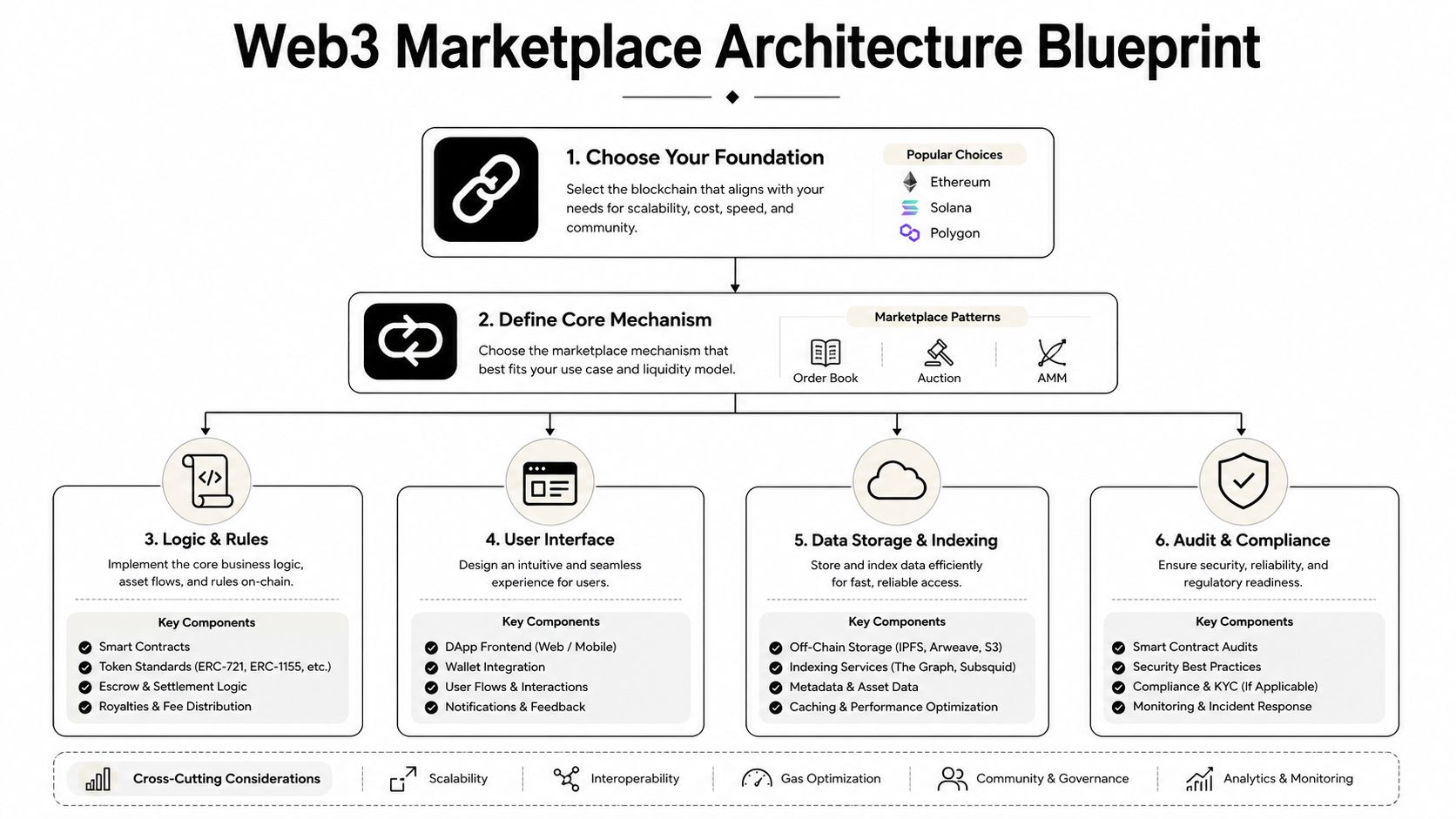
A standard web3 marketplace development lifecycle usually follows six stages: ideation and planning, blockchain platform selection, UX/UI design, backend development, rigorous testing, and deployment. In practice, simple NFT marketplaces typically cost $30,000 and take 2 to 5 months, medium projects range $50,000 to $100,000, and complex platforms can cost $200,000+ and take 6+ months, according to Rock'n'Block's marketplace development breakdown. Those numbers matter less as budgeting trivia and more as proof that architectural mistakes get expensive fast.
Choose a chain that matches the product
The wrong chain decision creates problems that no frontend polish can hide. If the marketplace depends on frequent user actions, you need predictable fees, fast confirmation expectations, and tooling your team can support. If the marketplace handles high-value assets, you may prioritize ecosystem trust, mature security tooling, and indexer support over novelty.
In interviews, don't say “I chose chain X because it's popular.” Say why the chain matched the product:
- User behavior fit: Frequent low-value actions need lower-friction transaction patterns.
- Developer fit: Your team's ability to test, deploy, and monitor the system matters as much as protocol features.
- Ecosystem fit: Wallet support, indexers, audit familiarity, and liquidity paths often decide whether shipping is smooth or painful.
Pick a market mechanism you can defend
Most candidates can describe a marketplace. Fewer can explain why they chose a mechanism.
An order book gives users precision but can create UX complexity and liquidity fragmentation. Auctions can work well when price discovery matters more than speed. AMM-style mechanics can simplify some flows but introduce pricing and liquidity design questions that many teams underestimate.
Hiring managers listen for reasoning, not buzzwords. They want to hear whether you can match the mechanism to behavior.
Practical rule: If you can't explain why a trade should happen through an order book, auction, or AMM, you're not ready to lead marketplace architecture.
Decide what goes on-chain and what stays off-chain
Seniority makes the difference. Junior teams often push too much on-chain because it feels more “Web3.” Strong teams isolate trust-critical logic on-chain and move everything else to systems that are cheaper, faster, and easier to iterate.
Use this mental model:
- Put settlement rules on-chain. Ownership transfers, fee distribution, and core execution logic belong where tamper resistance matters.
- Keep discovery off-chain. Search, ranking, filtering, and merchandising need iteration speed.
- Treat metadata carefully. If users depend on immutable references, design for verification even when storage is external.
- Separate protocol guarantees from app conveniences. Users don't need every interface behavior immortalized on-chain.
Turn architecture into an interview asset
The best architectural talking points are trade-off stories. Explain one hard decision, what alternatives you considered, what you rejected, and what happened after launch. That tells employers you don't just assemble tools. You make accountable decisions.
Good web3 marketplace development creates products. Good architectural storytelling creates careers.
The Tech Stack That Gets You Hired
The stack you choose is never just a delivery choice. It signals what kind of builder you are.
That matters because the hiring market is crowded. Some engineering roles get up to 450 applicants, and employers increasingly want candidates who can show shipped smart contracts and real portfolio work rather than a list of claimed skills, according to Bitget's Web3 job market coverage.
When a hiring manager sees Solidity, Foundry, Hardhat, Ethers.js, Viem, React, or The Graph on your profile, they aren't checking boxes. They're asking a deeper question. Did you use these tools to ship a marketplace with real constraints, or did you just complete tutorials?
What the stack says about you
If you lead with Solidity, your credibility comes from contract design quality, testing discipline, upgrade decisions, and event modeling. If you lead with Rust, teams will expect systems-level care and protocol fluency. If you list React and wallet libraries, they'll expect excellent transaction state handling and fewer broken signing flows.
That's why “familiar with” is weak language. “Built and deployed” is much stronger. “Maintained through testnet and mainnet changes” is stronger still.
For teams comparing trading infrastructure patterns, it also helps to study adjacent builds. A resource like DEX development Europe is useful because it shows how exchange-style requirements influence stack and architecture decisions, even when your own marketplace isn't a pure DEX.
Web3 Marketplace Tech Stack Comparison
| Component | Popular Choice | Alternative | Hiring Advantage |
|---|---|---|---|
| Smart contract language | Solidity | Rust | Solidity proves broad EVM readiness. Rust can signal deeper protocol specialization. |
| Local development and testing | Foundry | Hardhat | Foundry often stands out when candidates show strong testing habits. Hardhat still signals practical ecosystem fluency. |
| Chain interaction library | Ethers.js | Viem | Ethers.js is widely recognized. Viem can show modern TypeScript-first preferences. |
| Frontend framework | React | Next.js | React is expected. Next.js can suggest stronger app architecture and production frontend judgment. |
| Indexing layer | The Graph | Custom indexer | The Graph shows ecosystem familiarity. A custom indexer can prove you've solved data problems yourself. |
| Wallet connectivity | WalletConnect | Embedded wallet stack | WalletConnect signals baseline interoperability. Embedded flows can show product-led UX thinking. |
What actually gets attention
A strong portfolio for web3 marketplace development usually includes:
- One deployed contract system: Show listing logic, purchase or bid flow, fee handling, and admin controls.
- One frontend with wallet states: Include connected, disconnected, wrong-network, rejected-signature, and pending-transaction states.
- One testing story: Demonstrate unit tests, edge cases, and failure conditions.
- One operations story: Explain what changed after users touched the product.
A role like this smart contract bridge engineer opening at Stripe is a good benchmark because it reflects how serious teams evaluate real engineering depth, not just stack familiarity.
Don't optimize your stack for social media approval. Optimize it for proof of work that another team can inspect.
Mastering Smart Contracts and Wallet UX
Users don't experience your architecture diagram. They experience one moment. They click a button, connect a wallet, sign something, wait, and decide whether your marketplace feels trustworthy.
That moment is where many products lose people.
Average daily unique active wallets grew to 2.37 million, roughly 50% year over year, and gaming dApps processed 7.44 billion transactions, according to FindWeb3's Web3 statistics roundup. You don't need to guess whether wallet-heavy products can attract demand. The demand exists. The job is to build contract flows and wallet UX that can survive it.
Smart contract design that earns trust
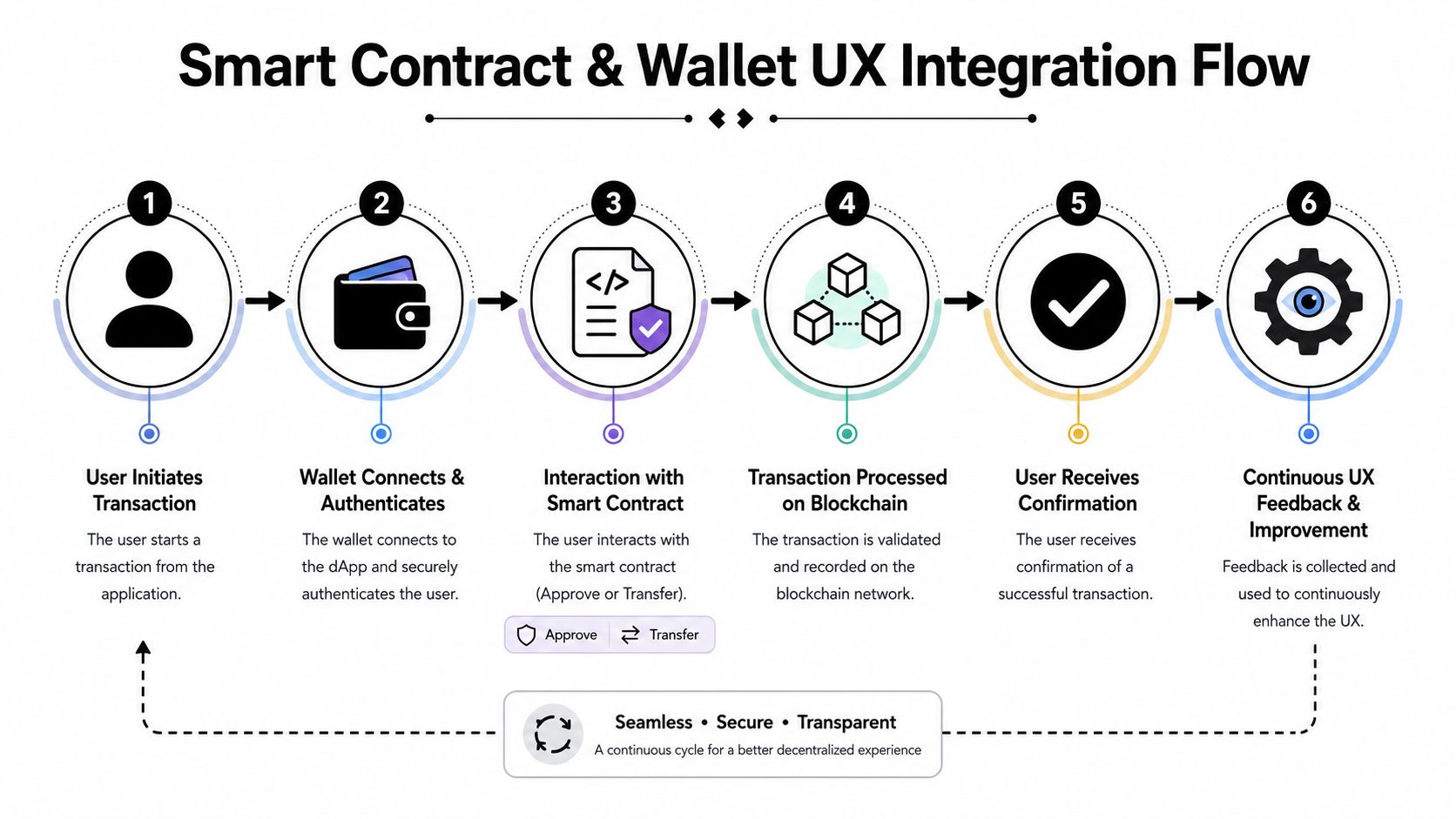
A marketplace contract usually starts simple. List an asset. Approve a transfer. Execute a purchase. Route the fee. Emit events. Then reality arrives.
You need to handle stale listings, unauthorized actions, partial failure scenarios, paused states, and upgrade decisions. You also need to think about how metadata references, royalty logic, and admin permissions can age badly.
The patterns that matter most are not flashy:
- Access control: Know exactly which functions are owner-only, operator-only, or permissionless.
- Reentrancy protection: Any external call path deserves scrutiny.
- Upgradeability discipline: Use proxy patterns only if the operational need justifies the governance and risk overhead.
- Event design: If your indexer and frontend depend on contract events, design them cleanly from day one.
Candidates often talk about security in abstract terms. Better candidates can describe one exploit class they designed against and what contract structure changed because of it.
Wallet UX is product work, not integration work
I've seen technically correct marketplaces fail because the wallet flow felt hostile. The user had to sign too many messages, switch networks manually with no explanation, and recover from rejected signatures without guidance. That's not a minor bug. That's a broken checkout.
Good wallet UX does a few things well:
- It explains the action before the wallet opens. Users should know whether they're approving, listing, buying, or canceling.
- It reduces signature surprises. Unexpected popups erode trust fast.
- It handles failure like a real product. A rejected signature is not an exception. It's a common path.
- It keeps state synchronized. Pending, confirmed, failed, and replaced transactions need clear interface treatment.
A user journey that exposes weak spots
Consider a normal listing flow. The user connects a wallet, signs authentication, approves an asset, signs a listing order, waits for indexer confirmation, and expects the item to appear immediately. Any inconsistency between those steps creates support tickets and abandonment.
The contract may be fine. The product still fails if the frontend doesn't explain what's happening.
A marketplace earns trust one transaction state at a time.
This is why strong frontend-Web3 engineers are so valuable. They can bridge asynchronous blockchain behavior and ordinary user expectations without pretending blockchain complexity doesn't exist.
What hiring managers want to hear
In interviews, the strongest stories connect smart contract rigor with UX judgment. Talk about one contract decision and one wallet decision in the same example.
For example:
- Contract side: You changed state transition ordering to reduce execution risk.
- UX side: You updated the transaction flow so users saw exactly what they were authorizing.
- Outcome side: Fewer confused retries, cleaner support patterns, and easier debugging.
That combination is rare. It's also why wallet-focused roles stay valuable. Reviewing a role like this lead software engineer opening for mobile crypto wallet development at Tether helps clarify how much teams value engineers who can own trust, signing flows, and mobile transaction UX.
What doesn't work
Some habits repeatedly hurt marketplace teams:
- Over-abstracted contract systems: They look elegant until no one can audit or maintain them confidently.
- Wallet-first onboarding with no context: Users don't connect just because the modal appeared.
- Invisible pending states: If users can't tell whether a transaction is alive, they click again.
- One-network assumptions: Users rarely arrive in the clean state your demo environment had.
The builders who fix these issues become the people everyone wants on launch-critical projects. That's how technical depth turns into a career advantage.
The Road to Production Security Audits and Scaling
Shipping to production is where theory stops helping.
A marketplace can look complete in staging and still fail the first time real users stress the edges. Security review, deployment discipline, monitoring, and data infrastructure decide whether launch week becomes a growth story or an incident report.

Audit readiness is a career milestone
Plenty of candidates say they've “worked on audited code.” That phrase means very little. What matters is whether you helped prepare a system for review and whether you understood the findings.
A serious pre-audit checklist usually includes:
- Specification clarity: Auditors need a crisp definition of intended behavior, privileged roles, and assumptions.
- Test coverage with edge cases: Happy-path tests don't prepare a contract for scrutiny.
- Dependency review: Imports, libraries, and inherited code all expand the risk surface.
- Operational controls: Pause permissions, upgrade authority, and treasury-sensitive functions must be explicit.
If you can talk through how an auditor challenged your assumptions, you'll sound far more credible than someone reciting security buzzwords.
Scaling is not just throughput
Many marketplace teams frame scale too narrowly. They think only about chain throughput or gas behavior. Production scale also means query speed, event consistency, inventory freshness, retry logic, and supportability.
That's where off-chain infrastructure becomes decisive. Indexers, queue-based workers, contract event processors, and caching layers often determine whether the product feels fast and coherent.
A few patterns help:
- Use an indexing layer intentionally: The Graph is common, but the key skill is understanding the query model your marketplace needs.
- Design for eventual consistency: The chain and the UI won't always agree in real time.
- Instrument failure paths: Canceled listings, replaced transactions, and metadata fetch failures should be observable.
- Prepare rollback thinking: Even when contracts are immutable, operations around them aren't.
Here's a useful technical explainer for teams thinking about release flow and environment hardening:
What employers infer from production work
Guiding a marketplace from testnet to mainnet proves a different kind of competence than building a prototype. It tells employers you understand accountability.
Production signal: A shipped system that survived audits, deployment friction, and post-launch fixes is more persuasive than a polished demo.
That's why launch and maintenance stories matter so much in interviews. Describe what broke, how you detected it, how you responded, and what process changed afterward. That's the language of a production engineer or product leader, not a tutorial follower.
Beyond Code Monetization and Compliance
A surprising number of builders still think their job ends when the contracts deploy. That mindset caps careers early.
Senior marketplace work includes business model design and regulatory architecture because both shape the product surface. If you don't understand how the marketplace makes money or how it stays operable in major jurisdictions, you're not building the whole system.
Web3 hiring in 2025 added 66,494 new roles, a 47% rebound from 2024, and non-technical roles in compliance, go-to-market, and product dominated hiring, according to Coincub's Web3 jobs report for 2025. That shift matters for engineers too. It means teams increasingly reward people who can translate code decisions into operational and legal consequences.
Monetization isn't a finance team problem
Every monetization model creates technical requirements.
Transaction fees require transparent calculation and routing. Subscription access may require token-gated or wallet-linked entitlement checks. Token sales introduce treasury, vesting, and governance design questions. Even creator royalties create edge cases around enforcement, marketplaces interoperability, and user expectations.
If you want to move into lead roles, be able to answer these questions:
- Where is revenue generated in the user flow?
- How is fee logic enforced and monitored?
- Which actors can modify monetization rules?
- What product behavior changes when revenue incentives change?
That's not “business stuff.” That's system design.
Compliance architecture is now a differentiator
One of the most underserved areas in web3 marketplace development is concrete compliance implementation. Teams talk about “regulatory uncertainty” all the time, but far fewer can explain how to implement compliance checks without collapsing the non-custodial experience.
A useful framing from this analysis of post-2024 NFT marketplace development is that the main problem is execution. Developers need a blueprint for adding compliance oracles, real-time checks, and KYC or AML layers that fit major markets such as the US and EU without turning the marketplace into a clumsy copy of traditional fintech.
What strong teams do differently
They stop treating compliance as a late legal review and start designing interfaces and permissions with it in mind.
That often means:
- Jurisdiction-aware access: Different flows for different users, assets, or transaction contexts.
- Composable identity checks: Verification systems that don't force every action into the same friction-heavy funnel.
- Clear separation of custody and control: Users and regulators both need predictable boundaries.
- Operational escalation paths: Human review still matters when automated checks surface edge cases.
Teams that understand compliance architecture can hire beyond engineering because they make legal, product, and operations work from the same system map.
For careers, this is one of the clearest advantage points in the market. A builder who understands both contract flows and compliance flows is much harder to replace than a builder who only writes Solidity.
Building Your Team and Your Career in 2026
The easiest way to get underpaid in Web3 is to describe yourself too narrowly.
If you say “I'm a smart contract engineer,” you may get filtered into a commodity lane. If you say “I build and ship marketplace systems, including contract logic, wallet UX, launch readiness, and compliance-aware product flows,” you sound like someone who reduces execution risk.
That difference matters because senior Web3 professionals commanded $120,000 to $250,000 in 2025, with Blockchain Developers at $130,000 to $270,000, and compensation often included token equity that could significantly change total upside, according to this 2025 Web3 compensation snapshot.
How candidates should package marketplace experience
Don't lead with a stack list. Lead with outcomes and ownership.
A strong resume or portfolio usually shows:
- System ownership: What part of the marketplace you owned end to end.
- Decision quality: Which trade-offs you made around chain choice, contract design, indexing, or wallet UX.
- Production maturity: Whether the product reached audit, deployment, or post-launch iteration.
- Cross-functional fluency: How you worked with product, design, compliance, or operations.
In compensation discussions, ask for a clear explanation of token vesting schedules and performance triggers. The base salary matters, but total compensation in Web3 often depends on structures outside salary alone.
What hiring managers should look for
Founders often hire too early for raw protocol prestige and too late for operational maturity. Marketplace teams need both builders and translators.
Look for people who can show:
| Signal | Why it matters |
|---|---|
| Shipped contracts | Proof they can move beyond local demos |
| Wallet UX examples | Evidence they understand user trust and transaction friction |
| Audit participation | Strong signal of production discipline |
| Product reasoning | They can explain why a mechanism fits a user need |
| Compliance awareness | They can build for real markets, not just crypto-native niches |
If you're a founder building the team, material on effective startup developer hiring can help sharpen the evaluation process, especially when you're balancing speed, budget, and specialization.
The builders who win
The strongest careers in web3 marketplace development won't belong only to the deepest protocol specialists or the smoothest product managers. They'll belong to people who can connect both layers and make hard decisions legible to everyone else on the team.
That means being able to say:
- Why the architecture fits the market
- Why the wallet flow fits the user
- Why the deployment process fits the risk
- Why the monetization and compliance model fit the business
That's how you become more than a contributor. That's how you become someone a team wants in every critical planning room.
If you're ready to turn marketplace experience into your next role, Blockchain Jobs is one of the best places to find focused Web3 opportunities across engineering, product, compliance, design, operations, and leadership. It's built for people who want work in the decentralized economy, not generic tech listings.