What Is Arbitrage Trading Guide for Blockchain Professionals
You're looking at the same token on two exchanges, and the numbers don't match. A trader's instinct is to ask whether the gap is real, whether it can be captured, and whether it's the kind of opportunity that belongs in a serious career path. That's exactly where arbitrage trading becomes more than a textbook phrase.
For blockchain professionals, arbitrage sits at the intersection of market structure, automation, and execution discipline. It's also a useful interview topic because it reveals whether you understand pricing, latency, costs, and risk controls, not just wallet mechanics or chart reading.
Getting Started with Arbitrage Trading
A common first encounter looks simple. You check a token price on one exchange, then compare it with another venue, and the numbers do not match. The temptation is to call that easy money, but the critical question is whether the spread survives fees, slippage, and execution delay.
That is where arbitrage starts to feel like a professional skill rather than a casual trade. The classic definition goes back to buying and selling in different places based on quoted rate differences, and modern finance traces statistical-arbitrage-style trading to the mid-1980s, when Morgan Stanley's Nunzio Tartaglia assembled a team of physicists, mathematicians, and computer scientists to systematically exploit temporary mispricings. That approach later became institutionalized at firms like D.E. Shaw, Renaissance Technologies, and Goldman Sachs proprietary desks, as described in this historical overview of arbitrage.
Why blockchain professionals care
If you work in DeFi, trading infrastructure, or protocol development, arbitrage knowledge helps you talk about systems, not slogans. You can explain how price gaps emerge across venues, why automation matters, and why a trade that looks profitable on screen can still fail in practice.
Career signal: hiring managers notice when you can separate a price discrepancy from a real executable edge.
For job interviews, that distinction matters. A candidate who can describe a cross-venue trade, identify the costs, and explain why speed changes the outcome sounds like someone who understands production systems, not just market hype. That skill also maps well to roles on trading desks, at market-making firms, and on teams building execution tools or DeFi infrastructure, including candidates who follow multi-chain options for global checkout because they already think about venue choice, routing, and settlement flow.
The deeper career value is progression. Arbitrage thinking builds habits around data quality, process discipline, and automation, and those habits carry into quant research, trading systems engineering, blockchain analytics, and protocol design. If you are comparing career paths, a practical place to look is Blockchain Jobs' algo trading and quant blockchain roles, since those listings make the connection between market logic and technical execution easy to see. Arbs are the discipline of asking, “Can this spread be monetized after reality takes its cut?”
Understanding Arbitrage Trading Concepts
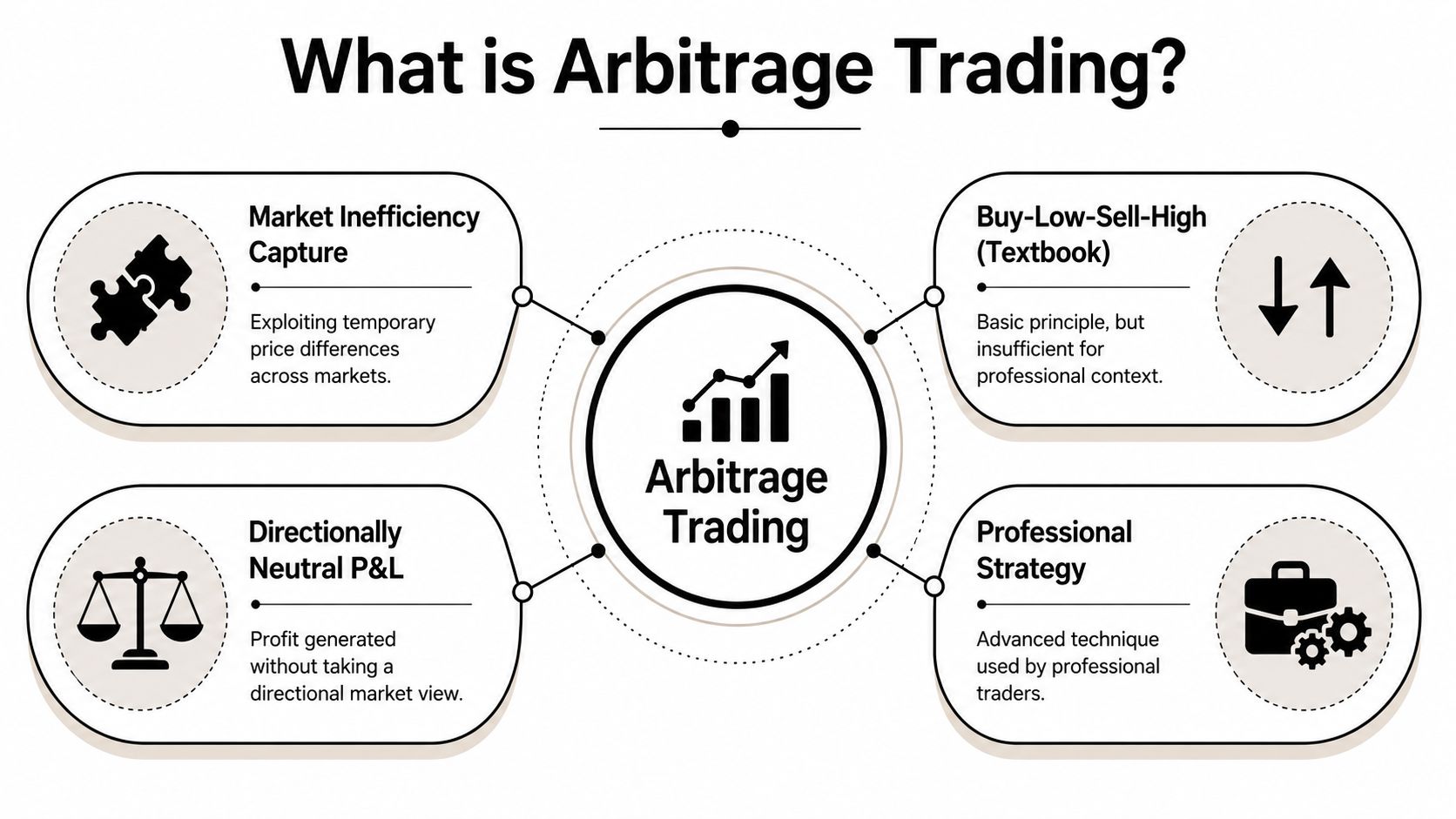
A trader sees the same asset quoted at different prices on two venues and acts on the gap before it disappears. Arbitrage trading is a market-inefficiency capture strategy, and the goal is to buy and sell at the same time so the position is directionally neutral, which means the profit comes from the spread rather than from predicting whether the market will rise or fall (market-inefficiency capture strategy).
The simplest analogy is retail pricing. If one store sells the same item for less than another, you buy where it is cheaper and place value on it where it is higher. Markets add extra costs that a shelf price does not show, so a complete evaluation accounts for exchange fees, the bid-ask spread, slippage, and sometimes funding or interest costs.
The part most beginners miss
The visible gap is rarely enough on its own. StoneX describes arbitrage as situations where the same asset, identical cash flows, or a known future price is mispriced relative to a risk-free discount rate, and it also notes that traders have to subtract fees, commissions, spreads, and interest costs before deciding whether the trade still works (StoneX arbitrage glossary).
Practical rule: if both legs do not cover every cost, there is no usable arbitrage.
That is why basic definitions can mislead people who are learning the field. Academic and finance sources separate pure arbitrage from near arbitrage and pseudo-arbitrage, because many real trades depend on imperfect convergence and execution limits, especially when the assets are similar rather than identical (NYU discussion of arbitrage boundaries).
A useful way to frame it is this. Pure arbitrage looks like a locked door. Real markets often leave a narrow opening that moves, shrinks, and closes fast. A professional edge comes from knowing whether the opening is wide enough, how long it will stay open, and whether your systems can act before other traders close it.
That idea translates directly into career skills. Interviewers often want to hear whether you can separate a price discrepancy from an executable trade, explain the cost stack, and describe why timing changes the outcome. Those same habits show up in trading desks, market-making teams, blockchain analytics, and execution tooling work, including roles that ask for systems thinking like Rust engineer trading systems roles at Keyrock, where speed, reliability, and clean implementation matter.
The same mindset also appears in adjacent monitoring workflows. A pricing gap only matters if the quote is real, current, and actionable, which is why teams often compare market data against monitoring tools such as Market Edge's guide on price monitoring when they build alerting and detection processes. The skill is not just spotting a difference, it is judging whether the difference can survive fees, latency, and execution risk.
Exploring Types of Arbitrage Trading
A good way to understand arbitrage trading is to see how the strategy changes with the market structure around it. A junior trader may focus on price gaps between venues, while a DeFi engineer may care about routing across pools, and a quant researcher may care about relationships that only show up in the data. The label is the same, but the work behind it can look very different.
Spatial, triangular, statistical, and crypto-specific
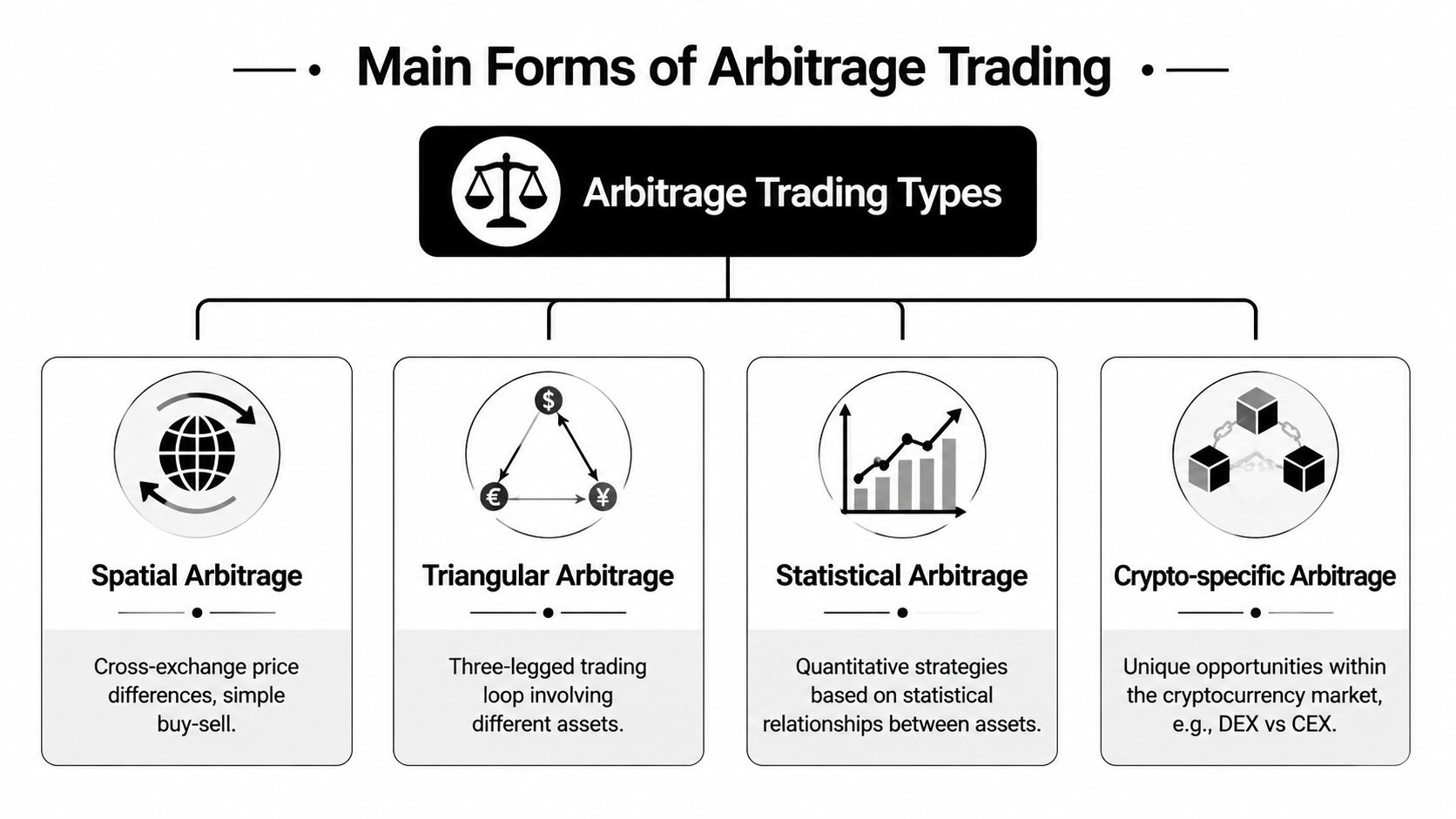
Spatial arbitrage is the simplest version to explain. You buy the same asset on one venue and sell it on another where it is priced higher. Triangular arbitrage follows a loop through three related assets or pools, then converts back to the starting point to capture a mismatch in implied pricing. Statistical arbitrage relies on observed relationships between assets and uses models instead of a visible spread. Crypto-specific arbitrage covers DEX-versus-CEX setups, on-chain price gaps, and fragmentation across exchanges and chains.
The operational demands change with each type. A spatial setup may only require balances on multiple venues and fast order placement. A triangular setup asks for careful price math and routing so the loop still works after fees. Statistical arb depends on data quality, model discipline, and patience with imperfect convergence, which is why institutional desks have used it for years, as shown in the historical material on statistical-arbitrage history.
Why persistence changes the job
Research on Bitcoin arbitrage found that exchange gaps can appear again and again, and that some of them can stay open for long stretches, sometimes for hours, days, and even months, with certain gaps persisting for up to 2 months. That means the work is not only about spotting a spread, it also involves account setup, monitoring, and execution discipline, as described in the Bitcoin arbitrage dissertation.
For career planning, that persistence matters. It shows employers that arbitrage is not just a fast reaction problem, it is also an infrastructure problem. A trader tracking recurring gaps has to manage balances, permissions, and alerts in a way that looks very close to operations engineering.
That overlap is useful if you are building a blockchain career. Roles in algo trading, execution engineering, and crypto market operations reward people who can reason in systems and stay calm under timing pressure. A posting like algo trading and quant work in decentralized markets reflects how this skill set shows up in hiring.
The same logic also appears in payment and settlement design. If a business is comparing rails or checkout flows, resources such as multi-chain options for global checkout show how venue fragmentation changes execution thinking in adjacent blockchain use cases.
Arbitrage Trading Tools and Data Sources
Arbitrage traders live or die by their inputs. If your data is stale, your order routing is slow, or your account setup is messy, the spread you saw a second ago is already gone. That's why tools matter as much as strategy.
What to put in your stack
At minimum, you need exchange APIs, price aggregation, execution logic, and monitoring. In practice, that often means connecting multiple venues, normalizing feeds, and calculating a breakeven threshold before the order ever fires. A technically important feature of arbitrage is speed of convergence, because once mispricing is detected, execution must be nearly simultaneous, and competitive arbitrageurs and market makers quickly close the gap (speed and convergence note).
| Tool | Data Type | Key Features |
|---|---|---|
| Exchange API client | Off-chain market data and orders | Pulls live quotes, submits orders, tracks fills |
| On-chain indexer | On-chain transaction and pool data | Helps monitor DEX state and settlement events |
| Price-feed dashboard | Aggregated market prices | Shows spreads across venues in one view |
| Execution engine | Orders and routing logic | Sends the two legs, handles timing and fill checks |
| Alerting system | Threshold and event data | Warns when spreads cross breakeven levels |
A good monitoring workflow looks less like guessing and more like triage. You define the spread you need, include fees and slippage, then watch for a signal that clears your threshold. If you want a practical reference point for building this habit, Market Edge's guide on price monitoring shows how disciplined monitoring workflows support multi-source comparisons in a non-crypto context, which is still relevant to arbitrage logic.
Resume-worthy skills and one job-board example
If you're building career capital, feature the tools you've used. Python, Rust, API integration, streaming data handling, backtesting, and alert design all signal that you can work in time-sensitive systems. Secure API key handling matters too, because employers want proof that you understand operational risk, not just code.
Interview answer angle: describe how you'd monitor a spread, validate the data, set a breakeven threshold, and stop the trade if fills don't match.
If you want to show how this connects to hiring, a platform like Blockchain Jobs lists roles across trading systems and crypto infrastructure, which makes it a practical place to study how these skills are described in real openings. For a focused example, a Rust engineer trading systems role reflects the kind of low-latency thinking arbitrage work demands.
Arbitrage Trading Risks and Costs
A spread can look easy on screen and still fail once real orders hit the market. Execution adds hidden drag, timing gaps, and price movement between the moment you click and the moment the trade fills.
The costs that erase the edge
The cost stack usually includes exchange fees, network fees, the bid-ask spread, slippage, and sometimes funding rates or interest costs. Before a trade is worth taking, those costs have to be subtracted from the headline spread, because the visible gap is only the starting point.
Slippage deserves special attention because many new traders only notice it after a fill comes back worse than expected. If the market moves while your order is traveling, the result can be less favorable than the quoted price. For a clearer explanation of that mechanism, understanding slippage for traders is a useful complement to the execution side of the topic.
The operational risks you can't ignore
Latency risk appears when one venue updates faster than another. Counterparty risk appears when an exchange freezes withdrawals or an account has balance constraints. Front-running is another issue, especially on-chain, where your transaction is visible before confirmation and other participants may react.
A trader needs a simple habit. Compare the visible spread, then subtract every known cost, then assume the fill will be slightly worse than the quote. If the opportunity still works after that haircut, it might be real.
Risk control rule: don't size a trade off the headline spread, size it off the worst plausible fill.
Risk management also shows up in interviews. Explain how you would set dynamic thresholds, keep balances on multiple venues, and stop trading when the execution environment deteriorates. That answer tells an employer you understand that arbitrage is not a guess on direction, it is an operations problem with price exposure attached.
For roles that value this kind of execution discipline, a crypto trader opening on Blockchain Jobs can help you see how venue management, speed, and risk controls are described in real listings.
Arbitrage Trading Legal and Tax Considerations
Legal and tax issues don't make headlines until they block the trade. In practice, the most dangerous mistake is assuming that a profitable pattern is automatically allowed everywhere you can access it.
Compliance starts before the trade
Major exchanges commonly require KYC and AML checks, and institutional desks may face additional licensing, surveillance, and reporting requirements depending on jurisdiction. Cross-border trading also adds restrictions around capital movement, access rules, and local market regulation. The underlying point is simple, your strategy can be technically sound and still be non-viable if the venue or jurisdiction creates a compliance barrier.
In crypto, this matters even more because decentralized platforms can blur the line between software access and regulated activity. If you're presenting this in an interview, talk about compliance as part of system design, not as an afterthought. That includes logging, account segregation, and clear record keeping for every venue you touch.
Records matter as much as profits
Tax treatment varies by jurisdiction, so you need to keep detailed trade logs, timestamps, and cost basis records. That's especially important when strategies involve multiple wallets, multiple exchanges, or rapid in-and-out transactions that can be hard to reconstruct later.
For professionals, the best habit is to document the trade logic as you go. Save the spread snapshot, the fee assumptions, the execution result, and the reason a trade was skipped. Those records help with tax reporting, internal review, and audit questions.
A concise compliance checklist usually includes these items:
- Venue eligibility: confirm the exchange or protocol can be used in your jurisdiction.
- Identity and account controls: keep KYC, wallet access, and permissions documented.
- Trade logs: record timestamps, fees, fills, and wallet movements.
- Tax handling: preserve records that show realized gains, losses, and cost basis.
- Internal review: make sure your employer's trading policy allows the strategy.
That framework also helps in hiring conversations. Employers don't just want someone who can find a spread, they want someone who won't create a legal or reporting headache while doing it.
Practical Next Steps for Arbitrage Trading Careers
The fastest way to learn arbitrage is to build something small and measurable. Start with a paper-trading workflow or testnet project that watches a spread, calculates costs, and logs whether the opportunity would have been profitable after execution friction.
Build the right kind of proof
A triangular arbitrage bot on a testnet is a strong portfolio project because it forces you to handle pricing logic, routing, and timing. Add a dashboard that shows the inputs and outputs. Then write down the assumptions, especially your fee model and the conditions that stop the trade.
Recent research on triangular arbitrage in crypto suggests exploitability is highly time-sensitive and constrained, with opportunities depending on fast monitoring, funds parked on multiple exchanges, and explicit fee/slippage calculations (triangular arbitrage research discussion). That makes it a good test of whether you can think like an operator instead of a theorist.
Skills employers actually notice
Use Python for data handling, Solidity if you're touching smart contracts, and Rust if you're aiming at lower-latency systems work. Pair that with backtesting, API integration, and a clear understanding of execution thresholds. If you can explain your logic cleanly, your GitHub project becomes an interview artifact instead of a side hobby.
Portfolio standard: one good project with logs, screenshots, and a short readme beats five vague repos.
Networking matters too. Trading desks, protocol teams, and market infrastructure firms often want people who can talk fluently about spreads, routing, and risk. A job board like Blockchain Jobs can help you compare how those roles are described and what skills get repeated across listings.
If you're preparing for interviews, be ready to answer three questions: how you found the spread, how you proved it was tradable, and what you did when the execution didn't match the model. That's the language of a professional.
Career Takeaways for Arbitrage Trading
The biggest lesson in what is arbitrage trading is that the idea is simple but the execution is not. The strategy begins with a price gap, but professional performance depends on data quality, automation, cost control, and an honest view of risk.
If you want to use arbitrage as a career lever, map each concept to a work skill. Market structure becomes venue analysis. Execution frictions become risk modeling. Automation becomes API integration and systems thinking. Compliance becomes operational discipline and record keeping. Those are the kinds of skills that hiring managers can recognize immediately.
The second takeaway is that pure arbitrage is rare enough to be interesting, but common enough to teach you how markets really behave. That's why the historical shift from niche relative-value trading to institutional stat-arb matters, and why capital concentration can compress returns over time, as the Harvard study on arbitrage growth and limits shows (growth and limits of arbitrage).
The third takeaway is career positioning. People who can explain arbitrage clearly tend to interview well for roles in trading systems, quant research, DeFi ops, and blockchain infrastructure because they can connect market logic to implementation detail. That combination is rare, and it travels well across the Web3 stack.
If you're serious about turning this topic into a career advantage, keep building projects, keep documenting decisions, and keep following roles that value automation and market microstructure. Blockchain Jobs connects blockchain professionals with roles across trading, engineering, compliance, and infrastructure, so visit Blockchain Jobs to find openings that match your arbitrage skills and start targeting the next step in your path.