
What Is Decentralized Governance: Understanding
You're probably staring at a Web3 job post that looks perfect until one line stops you cold: “experience with decentralized governance.” If you've built products, managed communities, shipped code, or worked in operations, that phrase can feel annoyingly vague. It sounds important, but job listings rarely explain what the team expects you to know.
In practice, decentralized governance isn't just a theory topic for protocol researchers. It shapes how teams ship upgrades, approve budgets, handle risk, and coordinate contributors without relying on a single executive chain of command. If you want to work in DAOs, DeFi, protocol operations, governance tooling, community strategy, or even crypto legal and compliance roles, you need to understand how decisions get made when authority is shared across token holders, delegates, multisigs, forums, and smart contracts.
That's why “what is decentralized governance” matters as a career question, not just a technical one. The people who can explain how governance works, where it breaks, and how to operate inside it tend to perform better in interviews and onboard faster once they're hired.
Why Governance Experience Is on Your Next Job Description
A lot of candidates assume governance experience only matters for protocol politicians, DAO founders, or Solidity engineers. That's too narrow. Governance touches roadmap decisions, treasury spending, incentive design, contributor accountability, incident response, and community trust. If a project is decentralized, or even trying to become more decentralized, someone has to translate messy human coordination into workable operating rules.
What hiring managers usually mean
When a hiring manager asks about governance experience, they usually aren't asking whether you've written a manifesto about decentralization. They want to know if you can operate inside a system where:
- Decision rights are distributed across token holders, delegates, contributors, or working groups
- Process matters as much as the outcome because legitimacy affects whether the community accepts a decision
- Execution may depend on code and consensus rather than one executive approval
- Stakeholders have conflicting incentives and someone has to manage those without breaking trust
That applies far beyond engineering. Product managers need to understand who can approve changes. Community managers need to guide proposal discussions without hijacking them. Operations leads need clean handoffs between governance decisions and execution. Legal and compliance professionals need to spot where decentralized claims don't match actual control.
Practical rule: If a protocol can't explain who proposes, who votes, who executes, and who's accountable when something goes wrong, it doesn't have mature governance. It has a coordination problem.
Why this translates into career growth
Governance literacy helps you sound credible in interviews because it shows you understand how Web3 organizations function. It also makes you more useful once hired. Teams trust people who can read a proposal, spot second-order effects, summarize trade-offs for a mixed audience, and keep a process moving without creating political damage.
That's especially relevant because DAO and blockchain roles increasingly span technical and non-technical functions. Approximately 45% of all roles in the blockchain sector are non-technical positions, including marketing, business development, and human resources, according to Axiom Recruit's crypto career overview. Governance isn't a niche specialty anymore. It's a working skill.
The Core Concept of Decentralized Governance
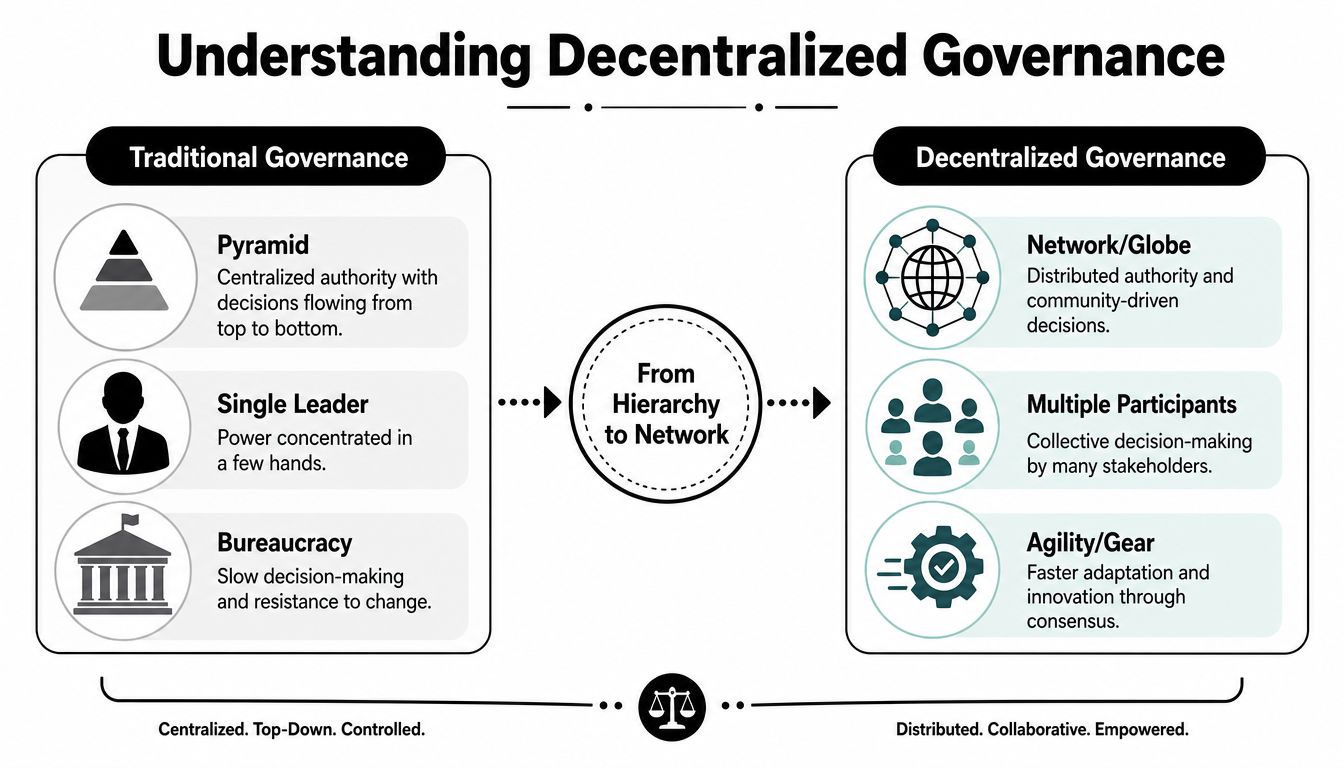
The simplest way to understand decentralized governance is to stop thinking about a company and start thinking about a digital co-op. In a traditional company, a manager reports to a director, the director reports to an executive, and major decisions move down a hierarchy. In a decentralized system, the goal is to spread decision-making power across a broader network of participants and enforce at least part of that process through transparent rules.
How authority shifts
In blockchain settings, governance often relies on smart contracts, token-based voting, public proposal systems, and shared ledgers. One practical definition matters here: decentralized governance in blockchain contexts delegates authority to distributed entities via smart contracts, enabling faster decision-making by eliminating intermediaries and creating a tamper-resistant, immutable ledger of decisions across peer-to-peer nodes, as described in TrustCloud's governance overview.
That changes the operating model in a few important ways:
- Rules can be automated. Smart contracts can encode voting thresholds, approvals, and execution logic.
- Records are visible. Participants can inspect proposals, transactions, and prior decisions on-chain.
- No single actor should rewrite history. The ledger is distributed across nodes, which makes unilateral changes much harder.
- Trust moves from personality to process. People still matter, but the system depends less on private authority.
What new team members need to understand fast
This doesn't mean “nobody leads.” It means leadership looks different. Strong decentralized teams still need proposal authors, delegates, forum moderators, domain experts, treasury operators, and contributors who can turn broad community intent into specific actions.
That's why the best working definition of what is decentralized governance isn't ideological. It's operational. It's a way of deciding who gets to make which decisions, under what rules, with what transparency, and how those decisions get executed without a traditional command chain.
If you're interviewing for a Web3 role, explain decentralized governance as a system for distributing authority through transparent rules, shared participation, and verifiable execution. That answer is more useful than abstract talk about freedom or disruption.
Where teams get confused
Many teams think decentralization starts with tooling. It doesn't. Governance design comes first. You need to define authority, escalation paths, proposal rights, conflict resolution, and execution controls before you write contracts or launch a token. If you skip that step, you don't get decentralization. You get public confusion with a voting interface on top.
On-Chain vs Off-Chain Governance Explained
One of the first distinctions that separates beginners from operators is the difference between on-chain and off-chain governance. You'll hear both terms constantly in interviews, proposal reviews, and protocol discussions.
On-chain governance
On-chain governance means the vote itself happens on the blockchain, and the outcome is usually enforceable through smart contracts. A participant signs a transaction, the network records it, and if the proposal passes under the encoded rules, the system can execute the result automatically or through a predefined on-chain process.
That model is strong when a protocol wants high integrity and clear finality. The decision path is visible. The rules are explicit. Execution is less dependent on a trusted middle layer.
But the trade-off is real:
- It's less forgiving. Poorly designed proposals can have binding consequences.
- It can be slower operationally. More formality usually means more process.
- Participation may feel heavier. Users need to interact with governance infrastructure directly.
Off-chain governance
Off-chain governance usually means discussion and signaling happen outside the blockchain. Teams use governance forums, Discord, Telegram, calls, and tools like Snapshot to collect sentiment or run structured votes before anyone executes the result.
That gives teams flexibility. It's easier to draft ideas, pressure-test them, revise language, and build consensus without committing every step to the chain. For many communities, that lowers the barrier to participation and improves proposal quality.
The weakness is legitimacy at the moment of execution. If the vote is only a signal, someone still has to carry it out. That introduces trust and process risk.
How to evaluate the trade-off in interviews
A strong interview answer doesn't say one model is better. It explains when each works.
| Governance model | Best for | Main strength | Main limitation |
|---|---|---|---|
| On-chain | Binding protocol changes, treasury actions, parameter updates | High transparency and enforceability | Less flexible and harder to reverse |
| Off-chain | Early discussion, signaling, rough consensus, community input | Fast coordination and lower friction | Depends on trusted execution and social legitimacy |
Here's the practical lens I use:
- If the decision changes code or assets, teams often want stronger on-chain controls.
- If the decision is exploratory, off-chain discussion is usually healthier.
- If the community is still immature, too much on-chain formality can freeze decision-making.
- If the decision has major implications, pure off-chain signaling can create ambiguity.
The best governance systems rarely live at one extreme. Good teams use off-chain discussion to sharpen proposals, then use on-chain execution where finality matters.
Common Governance Mechanisms You Will Encounter
This is the toolkit hiring managers expect you to recognize. You don't need to master every mechanism on day one, but you do need to know what problem each one is trying to solve, and what breaks when it's used badly.
The mechanisms that show up most often
Token voting is the default model many people learn first. One token usually maps to one unit of voting power. It's simple and easy to explain, which is why so many protocols start there. Its weakness is equally obvious. Large holders can dominate outcomes.
Delegation lets token holders assign voting power to someone else. That's useful when the average holder doesn't have time or expertise to review every proposal. Delegation can improve participation quality, but it can also create an informal political class if the same delegates accumulate too much influence.
Quadratic voting tries to give smaller holders a stronger voice by making additional votes progressively more expensive in voting terms. The idea is to reduce brute-force token dominance. In practice, teams have to think carefully about identity, gaming, and implementation complexity.
Multisigs are often misunderstood. They aren't broad community governance by themselves. They're an execution control where a defined group of signers must approve an action. In real operations, multisigs often serve as treasury safes, emergency controls, or administrative layers between governance intent and final execution.
The supporting coordination layer
Governance doesn't run on voting alone. It also runs on discussion infrastructure.
- Governance forums are where people debate proposals, ask for revisions, flag risks, and build consensus before a vote.
- Working groups and councils handle recurring functions like grants, risk review, or treasury analysis.
- Outcome-based models such as futarchy appear less often, but they matter in interviews because they show you understand alternatives to pure popularity contests.
If you want a feel for how governance fluency shows up in role design, even strategy-heavy openings like this DeFi strategist position often reward candidates who can connect token incentives, governance structure, and execution reality.
Comparison of Governance Mechanisms
| Mechanism | Vote Power Basis | Key Advantage | Common Weakness |
|---|---|---|---|
| Token voting | Token ownership | Simple and familiar | Whale dominance |
| Delegation | Tokens assigned to a representative | Better participation by specialists | Power can cluster around a few delegates |
| Quadratic voting | Voting weight adjusted to reduce dominance of large holders | Gives smaller participants more influence | Harder to implement and defend against gaming |
| Multisig | Approval by a defined signer group | Strong execution control | Not broad-based governance on its own |
| Futarchy | Preference filtered through outcome-oriented market logic | Tries to align decisions with measurable outcomes | Complex and difficult for many communities to use |
| Governance forums | Discussion and social consensus | Improves proposal quality before voting | No automatic enforcement |
What works in practice
The strongest governance stacks combine mechanisms instead of worshipping one. A common healthy pattern is forum discussion, delegate review, a signaling step, and then a binding action through on-chain or controlled execution. That gives people room to think before money, code, or critical permissions move.
Real-World Examples from Leading Protocols
The easiest way to build interview-ready understanding is to study protocols that have already gone through high-stakes governance decisions. You don't need to memorize every vote. You need to understand the pattern: proposal formation, stakeholder conflict, legitimacy, and execution.

Uniswap and the politics of protocol direction
Uniswap is one of the cleanest examples of governance becoming strategic, not ceremonial. Community decisions around deployment, incentives, and treasury use turn governance into a product and market question, not just a voting ritual. When a protocol decides whether to expand, how to allocate influence, or who controls a new initiative, the underlying issue is rarely just technical. It's about who the protocol is accountable to.
That's why Uniswap is useful in interviews. You can talk about how governance affects growth decisions, ecosystem partnerships, and community trust without pretending every token holder is equally engaged.
MakerDAO and governance as risk management
MakerDAO shows another side of the job. Governance there isn't just ideological participation. It's recurring operational judgment about collateral, risk, incentives, and system resilience. That makes it a great case study for product, ops, treasury, and legal candidates.
A smart way to discuss MakerDAO is to frame governance as a living control surface. The protocol needs people who can absorb complex inputs, debate trade-offs publicly, and support action under uncertainty. That's closer to real governance work than romantic ideas about fully leaderless systems.
Aave, Jito, and the value of reading the token layer
Aave is useful because it shows how community governance, delegation, and risk-sensitive decisions interact in a large protocol environment. If you're trying to build market context, comparing governance tokens across protocols can sharpen your understanding of incentives, participation, and influence. For that kind of research, this comprehensive Jito token overview is a useful example of how to inspect a governance token through a market and ecosystem lens.
If you're pursuing partnership or ecosystem roles, jobs like this business development opening at CoW DAO often benefit from candidates who can explain how governance shapes external collaboration. Protocols don't just negotiate with partners. They often negotiate with their own communities first.
Protocol governance is easiest to understand when you stop asking, “How do they vote?” and start asking, “What kinds of decisions require community legitimacy?”
The Challenges and Future of DAO Governance
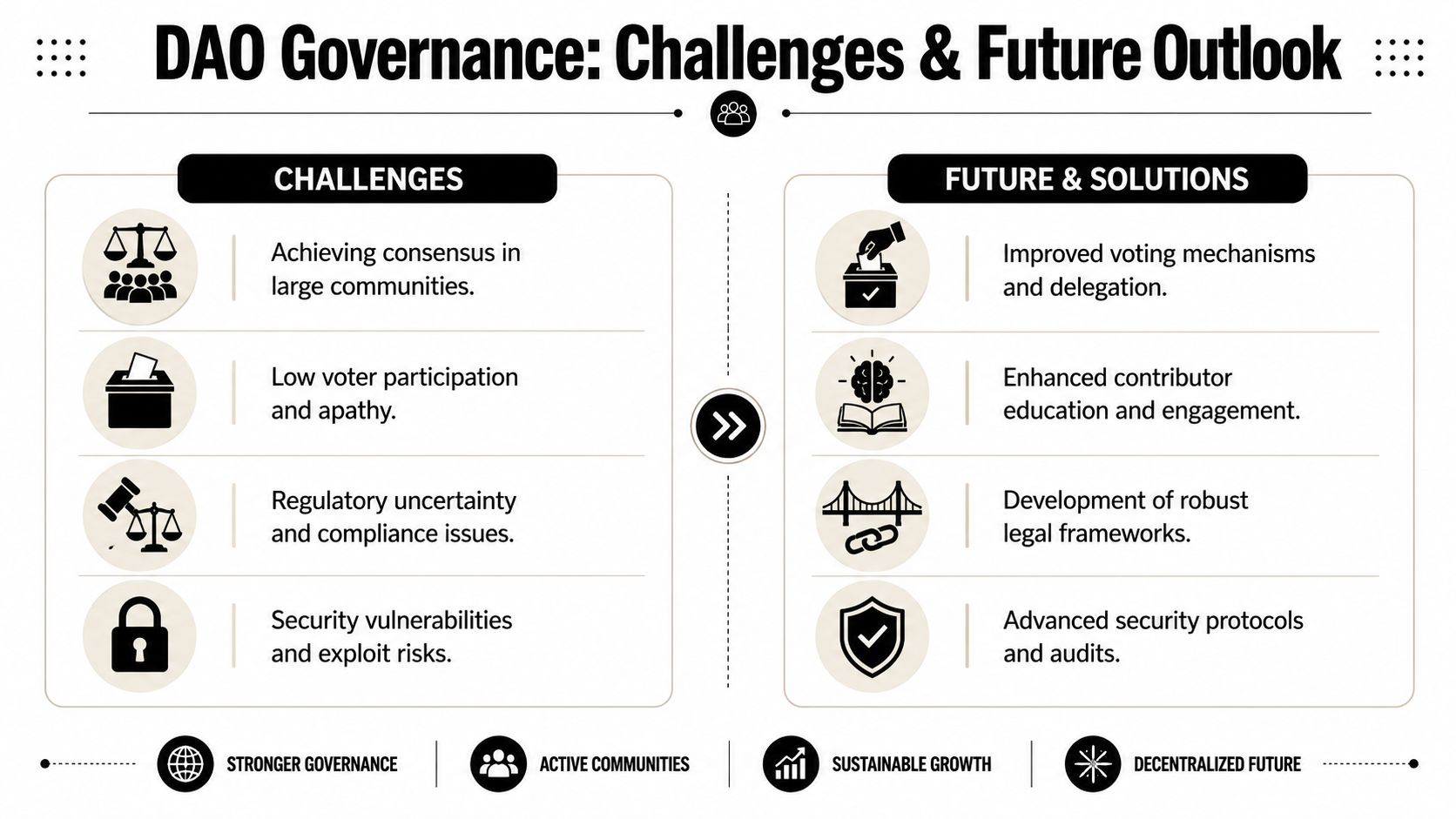
Most introductory content treats DAO governance like a solved upgrade over traditional management. It isn't. The practical reality is more complicated, and teams that ignore the failure modes usually end up rediscovering them the hard way.
Where the model breaks
The biggest structural problem is concentration of power. In a typical DAO governance proposal, the top decile of voters controls 76.2% of the voting power, according to research published by the American Finance Association journal site. That concentration surpasses traditional corporate governance and cuts directly against the common story that token voting naturally creates broad democratic participation.
That number matters in practice because it changes how you should evaluate governance systems. If a handful of large holders or highly organized delegates can decide most outcomes, then “community governance” may function more like an open-looking power structure with concentrated control underneath.
Another under-discussed problem is inclusion. In governance systems tied heavily to wealth, peripheral participants often have less influence than the rhetoric suggests. The broader decentralization debate has long wrestled with how decentralization can still advantage wealthier actors or regions over underserved ones, a tension explored in the Clingendael brief on decentralisation and unequal outcomes.
For readers new to the space, this explainer on digital co-ops is a helpful companion because it frames the aspiration clearly. The challenge is that real DAOs often fall short of that ideal.
What people are trying next
The future of governance work is likely to focus less on token-weighted purity and more on legitimacy. Teams are exploring ways to verify unique human participation, reward actual contribution, and reduce straight wealth dominance. One thread in that discussion is proof-of-personhood and proof-of-participation, ideas highlighted in a16z crypto's discussion of DAO governance principles.
These ideas matter for career growth because they change what strong operators work on:
- Governance designers need better incentive and identity systems
- Product teams need interfaces that make participation easier and less intimidating
- Community leads need contributor education, not just engagement theater
- Security and legal teams need controls that don't crush participation
The future winner won't be the DAO with the loudest decentralization branding. It'll be the one that can prove its decision process is legitimate, understandable, and resilient.
Building Your Career in Decentralized Governance
You don't need to become a full-time governance specialist to benefit from this skill. You need enough practical fluency to contribute, communicate well, and show hiring teams that you understand how decentralized organizations run.

What to do this month
Start with direct exposure instead of more theory.
- Join one active DAO community. Read the forum before you speak. Look at how proposals are structured, challenged, and revised.
- Follow a proposal from draft to outcome. Track who commented, who objected, who voted, and how execution happened.
- Review governance tooling. Spend time with Snapshot, a protocol forum, and a multisig workflow so the mechanics stop feeling abstract.
- Write your own analysis. Summarize one past proposal in plain language. That alone gives you portfolio material.
If you want to work in DAO roles specifically, job platforms make the required baseline fairly clear. To secure a DAO professional role, candidates must demonstrate a strong understanding of decentralized governance and decision-making models, alongside specific technical skills like knowledge of Ethereum and the Solidity programming language, as listed by CryptoJobsList's DAO roles page.
How to position this on a resume
Don't write “interested in DAOs.” Write evidence.
A stronger resume approach looks like this:
- Governance research and analysis instead of “community participation”
- Proposal review and stakeholder synthesis instead of “forum engagement”
- Treasury, voting, or delegate process familiarity instead of “crypto enthusiast”
- Ethereum and Solidity knowledge if you have it, alongside governance operations or tooling exposure
For senior candidates, connect governance to business outcomes. Show that you can reduce friction, improve clarity, manage stakeholder conflict, and move decisions toward execution.
Here's a useful benchmark role for understanding how serious firms frame strategic protocol leadership: director of crypto protocols.
What to say in interviews
A good governance answer sounds grounded. Talk about trade-offs. Mention that decentralization isn't binary. Explain how token voting, delegation, forums, and execution controls work together. Show that you understand both legitimacy and operational risk.
This short video is worth watching if you want a more intuitive mental model before your next interview.
If you can explain who holds power, how decisions are made, where the process can fail, and how execution happens, you already sound more hireable than most candidates claiming DAO experience.
The key is to treat governance as work, not as branding. Teams need contributors who can read the room, read the rules, and help the organization make legitimate decisions under pressure.
If you're ready to turn governance knowledge into a real role, start browsing current openings on Blockchain Jobs. It's one of the fastest ways to see how Web3 teams describe the skills they hire for, from protocol strategy and engineering to operations, legal, community, and product.