Blockchain Security Audit: A Practical Career Guide
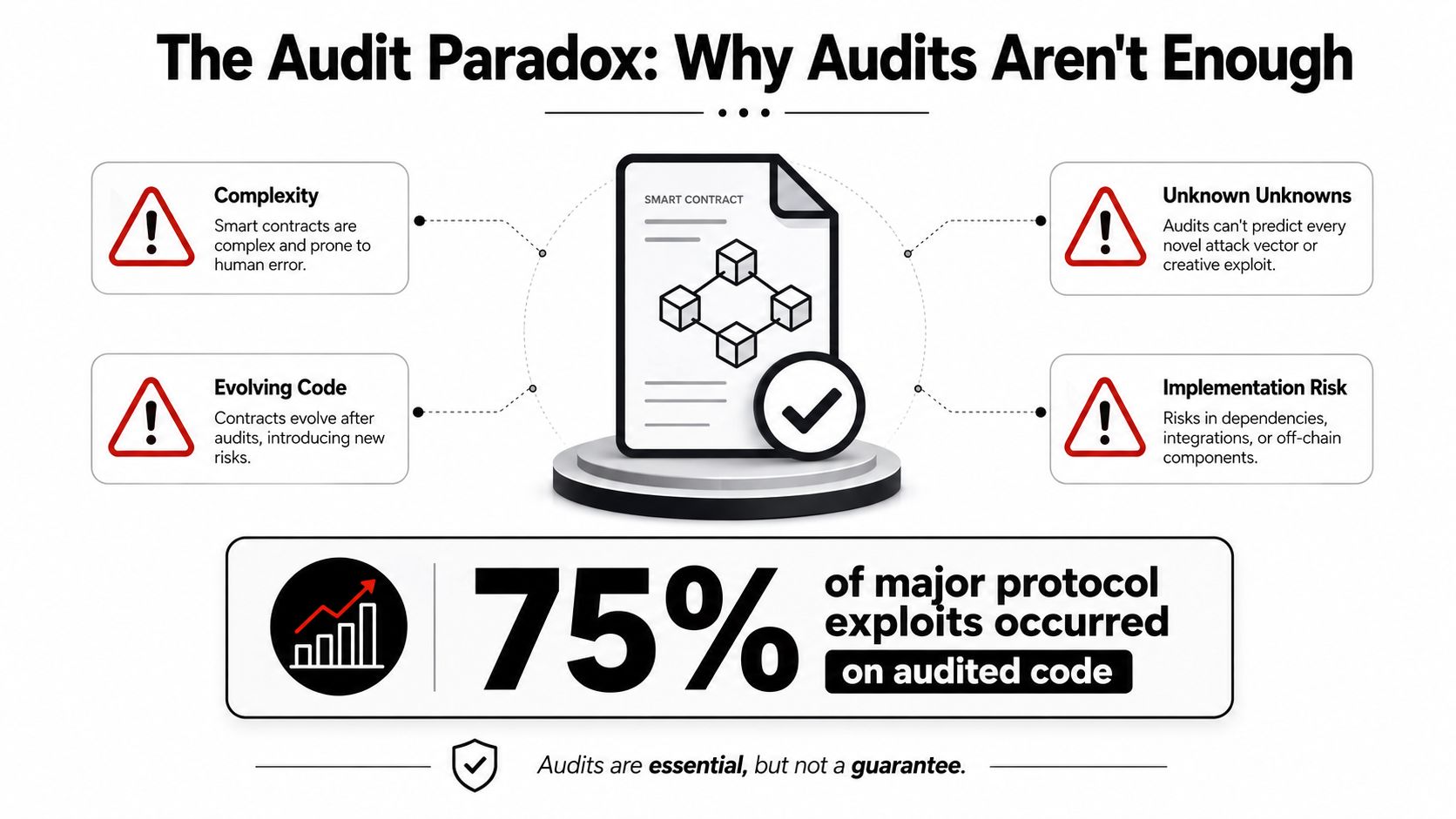
Audited code still sits behind about $4.3 billion in observed losses, representing 55% of the losses in a 2026 analysis of blockchain incidents. The same study examined 218 incidents and found 105 involving protocols with at least one public audit, so a signed report is evidence of review, not proof of safety (CryptoNews coverage of the empirical analysis).
That distinction now shapes hiring. Protocol teams need auditors who can reason about architecture, incentives, deployment processes, and incident response, not just identify familiar Solidity patterns. Candidates need public evidence that they can find, explain, and validate vulnerabilities. Hiring managers need a process that separates polished tooling knowledge from genuine security judgment.
Why Blockchain Security Audits Matter More Than Ever
Simple: an audit can miss a live exploit. A four-year empirical study assembled 23,818 public audit findings from 22 independent security firms alongside 218 real-world exploit incidents, with aggregate losses of about US$7.76 billion (the study's full analysis). Audit outputs can be plentiful while attackers still find paths through economic logic, integrations, governance, infrastructure, or code introduced after review.
Auditing has nevertheless moved from optional reassurance toward a baseline deployment control. A 2025 academic paper reviewed 4,108 protocols and found that 46% hired an auditor, including 23% using a top-tier centralized auditor and 24% using a bottom-tier auditor. The paper also cites an Ernst & Young white paper reporting that audit coverage by major blockchain tooling rose from 78% to 99%, a shift that signals how routine audit controls have become (the 2025 academic paper).
What this means for each audience
- Candidates: Treat auditing as a discipline, not a tool list. You'll need code-reading ability, threat modeling, testing judgment, and clear reporting.
- Hiring managers: Evaluate the person's reasoning under ambiguity. A candidate who can explain exploitability and remediation is more valuable than one who only recites vulnerability names.
- Protocol teams: Scope the engagement around architecture and change management. A report on a frozen contract doesn't cover a later upgrade, new oracle, or altered deployment process.
Legal and governance exposure also matters. Teams handling blockchain products should understand their legal obligations for blockchain use alongside technical controls. If you're hiring, start with a defined risk model and review the current security roles in blockchain, not a generic software engineering brief.
The Three Core Types of Blockchain Security Audits
A useful hiring decision starts with the system under review. Calling every engagement a smart-contract audit creates bad scopes and produces candidates with the wrong depth.
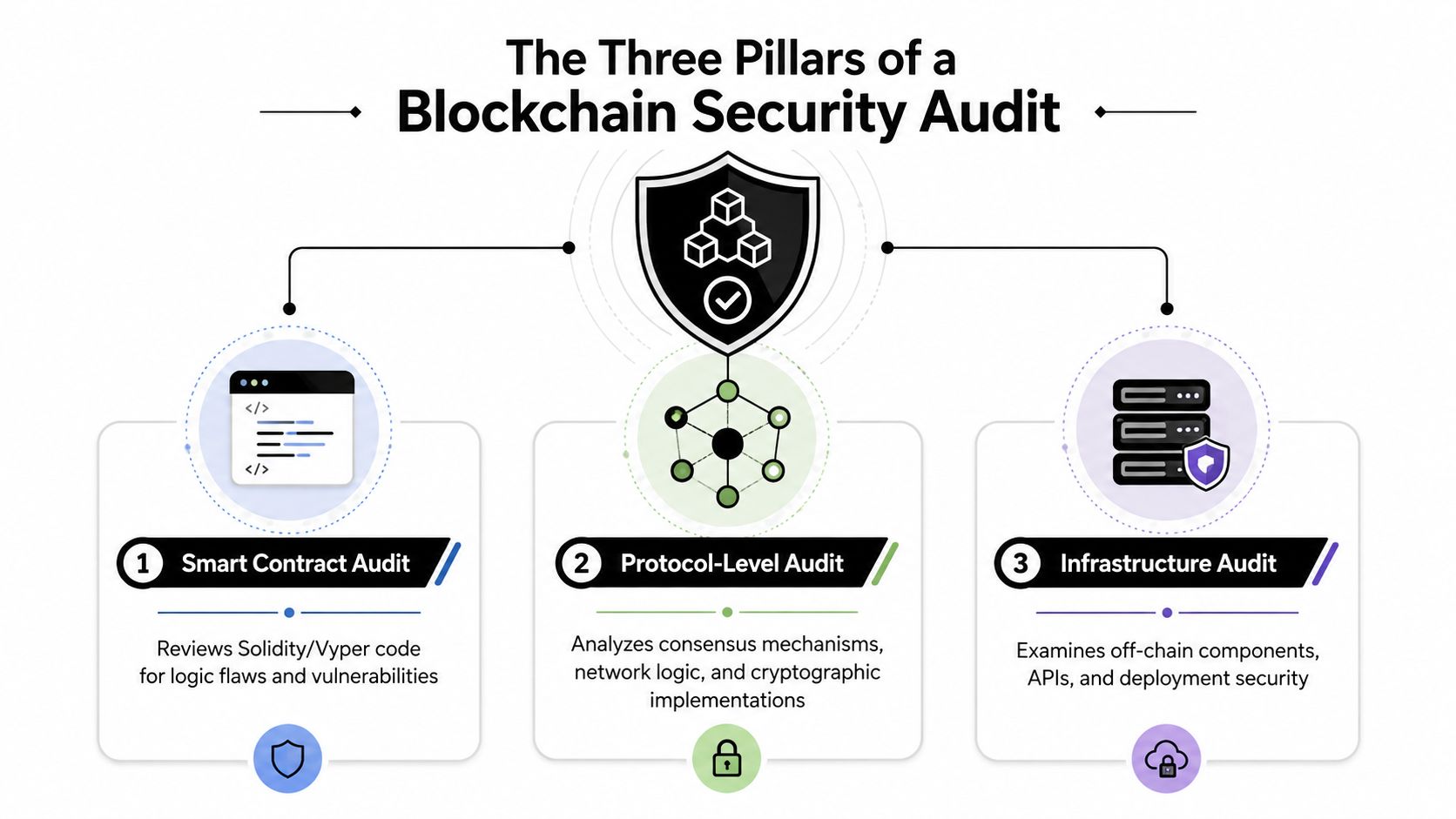
Smart contract audits
This is the familiar track. Reviewers inspect Solidity, Vyper, or Move code for authorization errors, unsafe external calls, accounting mistakes, upgrade risks, and flawed business logic. The strongest candidates don't stop at static findings. They trace fund flows, test adversarial state transitions, and explain how an attacker would satisfy every prerequisite.
Protocol type changes the workload. Recent Cyfrin data reports that Uniswap V4 hooks averaged 5.11 critical or high findings per audit, staking averaged 4.4, perpetuals and lending or borrowing averaged 4.0, while cross-chain audits averaged 1.0 (the 2025 literature review and audit data). The point isn't that cross-chain systems are safe. It's that finding density varies by architecture, so interview questions should follow the protocol's actual failure modes.
Protocol-level audits
This track examines consensus behavior, network logic, cryptographic validation, message handling, and economic assumptions. Candidates need more than EVM fluency. They should understand state machines, signature verification, validator incentives, chain reorganizations, and denial-of-service scenarios.
Hiring managers should ask for a threat model of the protocol, not a contract walkthrough. A strong answer identifies trust boundaries, privileged actors, assumptions about finality, and the consequences of malformed or delayed messages.
Infrastructure audits
Infrastructure work covers deployment pipelines, APIs, key management, monitoring, cloud permissions, relayers, indexers, and operational access. A protocol can have carefully reviewed contracts and still expose a dangerous signing workflow or compromised upgrade path.
This track suits engineers with DevOps, cloud security, incident response, and secrets-management experience. For teams, the right auditor may be a specialist who understands the off-chain system rather than the firm with the strongest smart-contract branding.
Inside the Audit Workflow From Scope to Sign-Off
An effective engagement begins before anyone opens a static analyzer. The client and audit lead must freeze the scope, identify commit hashes, document trust assumptions, list privileged roles, and record dependencies. Candidates who can explain what isn't being reviewed show mature judgment.
Threat modeling follows. For a bridge, an interviewer might ask, “How would you model a cross-chain withdrawal?” A good response covers message authenticity, replay protection, validator compromise, nonce handling, emergency controls, and what happens when one chain becomes unavailable.
Manual review remains central, but tools accelerate coverage. Static analysis can flag patterns, fuzzing can explore state transitions, and dynamic tests can validate behavior. None of those outputs replaces a reviewer who understands whether a finding is reachable, profitable, and damaging.
| Phase | What Happens | Skill to Demonstrate in Interviews |
|---|---|---|
| Scope | Define repositories, versions, integrations, and exclusions | Turn an ambiguous brief into explicit security boundaries |
| Threat model | Map assets, actors, trust assumptions, and attack paths | Explain attacker goals before naming bugs |
| Manual review | Trace logic, permissions, accounting, and state changes | Prioritize exploitable paths over noisy patterns |
| Automated testing | Run static analysis and targeted checks | Interpret tool output instead of copying it |
| Fuzz testing | Exercise edge cases and complex state transitions | Design useful invariants and input strategies |
| Reporting | Describe impact, likelihood, proof, and remediation | Write for engineers, executives, and users |
| Remediation | Re-test fixes and check for regressions | Verify that the patch closes the root cause |
| Sign-off | State residual risk and scope limitations | Communicate what the audit does and doesn't establish |
A junior auditor should practice every phase on public code. Hiring managers should use a small case study that requires prioritization, a reproduction path, and a remediation recommendation. Roles such as director of blockchain assurance and technology require that same process discipline at a broader organizational level.
High-Impact Vulnerabilities Every Auditor Must Catch
The best auditor doesn't memorize a checklist. They recognize how a protocol's architecture creates attack paths.
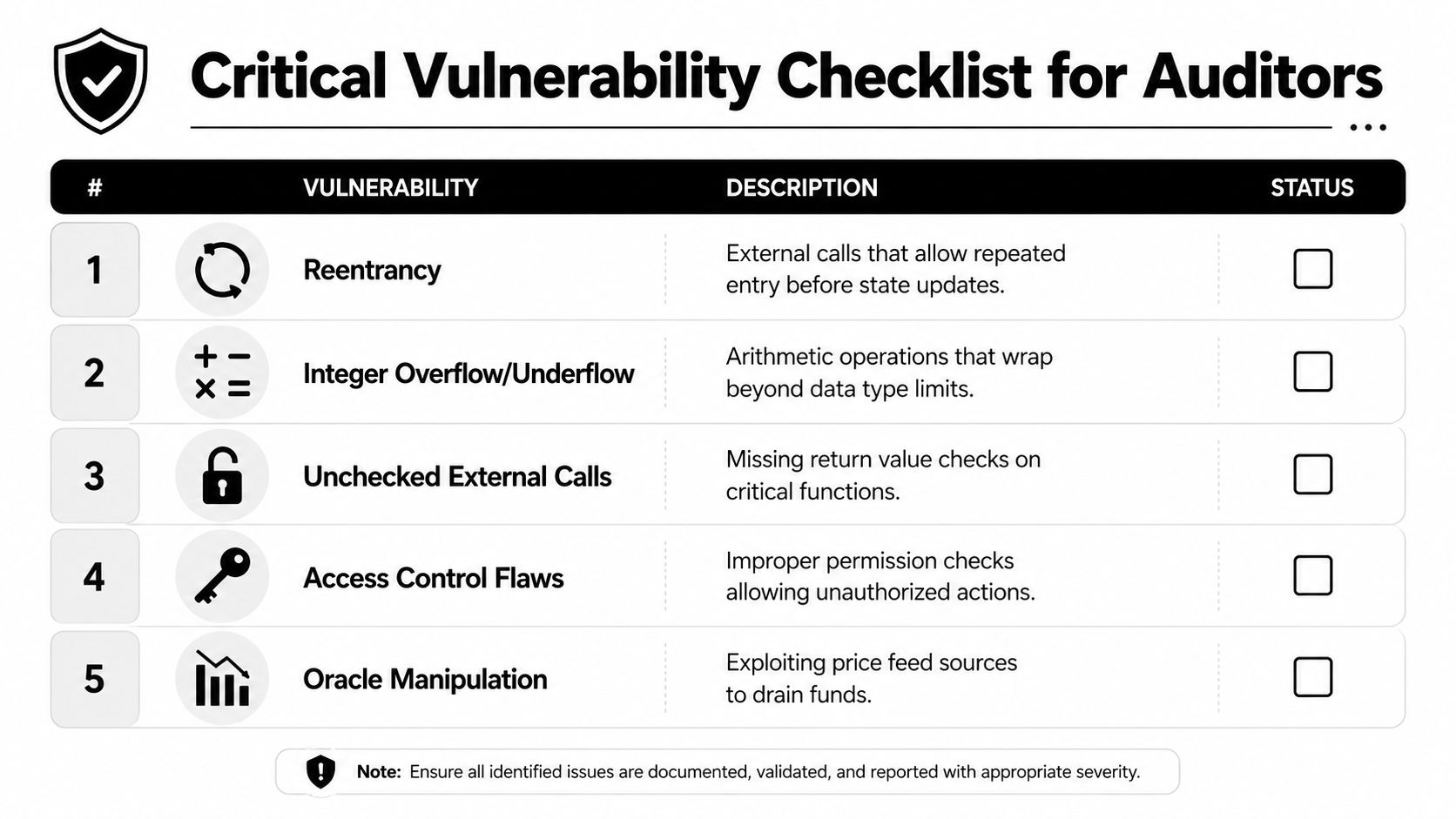
Reentrancy remains a question of control flow and state ordering. Reviewers should identify every external interaction, determine what state changes happen before and after it, and test whether callbacks can re-enter a sensitive function.
Integer overflow and unchecked external calls deserve special attention. An independent audited-versus-non-audited contract study reported that 75% of audited contracts showed no exploit history, compared with 55% of non-audited contracts. It also associated integer overflow with a 60% exploit rate and unchecked call patterns with a 50% exploit rate (the independent contract study). Those figures make arithmetic validation and return-value handling high-value interview topics.
The categories worth testing
- Access control: Check ownership, role administration, initialization, upgrade authorization, and emergency functions. Ask who can change parameters and whether that authority is constrained.
- Oracle manipulation: Trace price sources, update timing, liquidity assumptions, stale data handling, and fallback behavior. A candidate should distinguish a bad price from a valid price used in an unsafe context.
- Bridge-specific failures: Examine message verification, replay protection, validator thresholds, token accounting, and pause logic. Generic DeFi experience isn't enough for this track.
- Economic logic: Test caps, liquidation incentives, rounding, fee calculations, and composability. Many failures arise when individually reasonable functions interact.
- Privilege escalation: Review deployment scripts, proxy administration, multisig membership, and recovery paths. Operational authority is part of the attack surface.
Hiring rule: Ask candidates to reproduce one vulnerability, explain the attacker's prerequisites, and propose a test that would prevent regression. That reveals more than a list of certifications.
Candidates should specialize in two or three categories and publish clear writeups. Hiring managers should probe depth with a live review rather than accepting generic claims about “secure coding.”
Choosing the Right Auditor for Your Protocol or Team
The right model depends on risk, architecture, and the kind of credibility you need.
Boutique specialist firms often offer concentrated expertise in a protocol category. They can be a strong choice for novel DeFi mechanics, complex hooks, or bridge designs where reviewer context matters more than a broad consulting brand. Their reports should still show named scope, severity reasoning, reproducible evidence, and remediation status.
Large consultancies and Big Four-adjacent teams can provide structured governance, broader compliance support, and recognizable review processes. That reputation may help a protocol communicate with investors or enterprise partners. It doesn't eliminate the need to inspect reviewer expertise. Ask who will do the work, how much hands-on time they'll receive, and whether the team has audited your architecture before.
In-house teams provide continuity. Internal auditors see design decisions early, review upgrades repeatedly, and build relationships with engineering and operations. They also face independence risks and may lack specialist coverage during unusual engagements.
What hiring managers should test
- Technical range: Solidity or Move, EVM behavior, testing, cryptography, and infrastructure.
- Evidence of judgment: Public reports, contest findings, responsible disclosures, or detailed research.
- Communication: A concise severity explanation that an engineer can act on.
- Independence: Willingness to challenge a founder, lead engineer, or popular design.
- Follow-through: Remediation review, regression testing, and incident participation.
The 2025 academic review found both top-tier and bottom-tier auditor use among protocols, which means firm selection alone doesn't settle quality. Candidates should target firms whose work matches their specialty. Teams should hire for demonstrated architecture-specific skill, then use external review where independence or niche expertise is missing.
Timelines, Deliverables, and What Audits Actually Cost
Audit pricing isn't a meaningful number until the scope is precise. Codebase size, protocol complexity, upgradeability, integrations, documentation quality, and reviewer seniority all change the engagement. A small, stable contract and a cross-chain system shouldn't receive the same schedule or budget.
A defensible statement of work should identify the commit under review, included contracts, dependencies, assumptions, testing methods, communication cadence, and retest terms. Require a preliminary report, a final report after remediation, and a post-remediation review when the findings affect core logic.
Budgeting without false precision
Don't ask, “What does a blockchain security audit cost?” Ask:
- Which components hold or control value?
- Which integrations can alter security assumptions?
- What must be tested manually?
- What evidence will the team receive?
- What happens when the code changes during review?
- Is remediation review included?
A cheap report with weak scope can create more risk than a smaller engagement with clear exclusions. Hiring managers should compare deliverables and reviewer allocation, not just headline fees.
Compensation as a career benchmark
Available 2026 career guidance reports a practical ladder: entry-level firm employees earn $70K to $130K, mid-level auditors earn $130K to $200K, and senior auditors earn $180K to $280K plus bonus. It also reports that top contest performers can exceed $200K to $1M or more annually through contest winnings and retainers (the 2026 smart-contract auditor career guide).
A separate 2026 U.S. job-market snapshot lists blockchain auditor pay averaging $19.21 per hour, with most workers between $14.42 and $19.23 per hour as of May 25, 2026 (the ZipRecruiter blockchain auditor snapshot). Treat that figure as a market snapshot, not a universal senior-security benchmark. Your negotiation power comes from exploit quality, review ownership, client trust, and evidence that your work prevents repeat failures.
Building an Audit Career From First Audit to Senior Reviewer
Resume credentials open a door. Public proof gets you through the interview.
At junior level, employers want disciplined code reading, testing fundamentals, and the ability to write a precise finding. Mid-level reviewers need independent scope ownership, protocol reasoning, and reliable remediation analysis. Senior auditors lead threat models, challenge architecture, mentor reviewers, manage client communication, and make severity decisions under pressure.
A real lead-auditor listing asks for 2+ years of auditing or blockchain-security experience, Solidity or Move knowledge, familiarity with Ethereum and Binance Smart Chain, understanding of ERC-20 and ERC-721, fuzz testing, static and dynamic analysis, unit testing, and documentation (the lead auditor role requirements). Build directly toward those requirements.
The 30, 60, and 90-day plan
First 30 days: Choose one ecosystem and read production contracts daily. Reproduce known vulnerabilities in a local test environment, write findings in a consistent format, and learn one static analyzer well enough to explain false positives.
By 60 days: Join audit contests and publish polished writeups. Don't chase volume. Show the vulnerable code path, prerequisites, impact, proof of concept, remediation, and regression test. Contest work creates a public record that recruiters can inspect.
By 90 days: Complete a small end-to-end review of an open-source protocol. Publish the scope, limitations, findings, and retest notes. Practice defending severity decisions in a mock interview, including cases where you found no exploitable issue.
Career advice: A contest ranking or public report gives an interviewer something concrete to challenge. A certificate usually gives them a checkbox.
That's why I value demonstrated findings over a crowded resume. Career guidance for the field specifically identifies contest work as a credibility path, with top performers using results to move into stronger full-time roles or independent engagements (the career guidance on contest-based progression). Candidates can also monitor specialist roles such as this blockchain security expert audit track to compare recurring requirements.
Treating Audits as One Layer of a Real Defense System
A clean report doesn't mean the protocol is safe. The 2026 incident analysis found that the Critical-plus-High share of audit findings stayed within a 15% to 17% band each year, indicating that severe issues persist even in mature audit pipelines (the reported audit and incident comparison).
Protocols need layered controls because each control catches a different failure. Manual review examines intent. Fuzzing explores behavior. Monitoring detects unusual activity. Incident response limits damage after prevention fails.
The defense stack
- Continuous monitoring: Alert on abnormal withdrawals, privilege changes, oracle movement, and bridge messages.
- Formal methods: Apply formal verification to critical invariants and high-value accounting paths where practical.
- Bug bounties: Give independent researchers a safe disclosure route and a meaningful reason to report responsibly.
- Upgrade reviews: Re-audit material changes, new integrations, altered permissions, and migrations.
- Incident readiness: Drill pause authority, communication, key rotation, evidence preservation, and recovery decisions.
- Role separation: Combine auditors with detection engineers, threat researchers, and incident responders instead of expecting one reviewer to cover every function.
Candidates who start in auditing can expand naturally into security monitoring, threat intelligence, detection engineering, or incident response. That broader perspective makes senior reviewers better because they understand what happens after a finding reaches production.

Protocol checklist: Freeze scope, document assumptions, test remediation, monitor production, fund responsible disclosure, and review every meaningful upgrade.
Blockchain Jobs connects Web3 security candidates with roles across smart-contract auditing, protocol security, infrastructure, and related functions. Visit Blockchain Jobs to find security openings, compare career paths, or reach specialized blockchain talent for your next audit team.