Bootcamp Job Guarantee: Reality Check Before You Enroll

Most advice about a bootcamp job guarantee is too soft. It treats the guarantee like a bonus. It isn’t. It’s the contract that determines whether you’re buying career support or buying expensive hope.
If you’re changing careers into tech, a guarantee can help. If you’re aiming at a niche like blockchain, it can also distract you, because the strongest guarantees still cluster around mainstream paths like software engineering, data analytics, and QA. That gap matters.
I’m in favor of bootcamps that produce hires. I’m also skeptical of sales pages that blur “career support,” “placement help,” and “guaranteed outcomes” into one promise. Those are not the same thing. One gets you coaching. One gets you accountability. One might get you a refund. None of them gets you a job unless your skills, portfolio, interview performance, and search discipline are strong enough to beat other candidates.
What a Bootcamp Job Guarantee Really Means in 2026
Stop treating a bootcamp job guarantee like a hiring promise. In 2026, it usually means the school will refund tuition if you meet a long list of conditions and still do not get hired within a defined window.
That is a very different deal.
A guarantee tells you less about your odds of getting a job than about how the bootcamp handles risk, accountability, and complaints after graduation. Strong schools use guarantees to force follow-through on both sides. Weak schools use them as sales copy, then hide the actual terms in attendance rules, application quotas, reporting requirements, and narrow definitions of a qualifying job.
Stop asking, “Is there a guarantee?” Start asking, “What would disqualify me from using it?”
The promise versus the contract
Admissions calls sell reassurance. The contract sets the rules.
Read the guarantee as an enforcement document, not a marketing benefit. In practice, many programs require you to:
- Meet every deadline for forms, coaching sessions, and job-search logs
- Use the bootcamp’s career support and follow its job-search process
- Apply consistently to approved roles and keep proof of every application
- Accept limits on location, schedule, compensation, and job type
Miss one reporting deadline or reject a qualifying offer, and your refund path can disappear fast.
That is why the support model matters as much as the refund clause. If you want a clearer benchmark for what good career services in job search bootcamps include, start there before comparing guarantee language.
What this means for career changers in tech
A guarantee has real value for people who need structure. Career changers often do better with fixed milestones, resume reviews, mock interviews, and someone forcing consistency when motivation drops.
But do not confuse structure with placement strength. A school can enforce a disciplined search and still have weak employer demand.
That gap gets wider in niche paths. If you are coming from another field and aiming for blockchain, smart contract development, protocol engineering, or adjacent Web3 roles, a generic software engineering guarantee does not protect you much. Most guarantees are built around broader entry-level tech hiring. Very few are written around Web3 outcomes, crypto-native employers, or blockchain-specific portfolios.
So judge the guarantee for what it is. It is a safety valve for mainstream job-search processes, not proof that the bootcamp can place you into a specialized tech market.
If your target is Web3, treat the bootcamp as a training decision first and a placement decision second. Skills, shipped projects, open-source work, and niche credibility will matter more than a refund clause.
Four Types of Job Guarantees and Their Hidden Trade-Offs
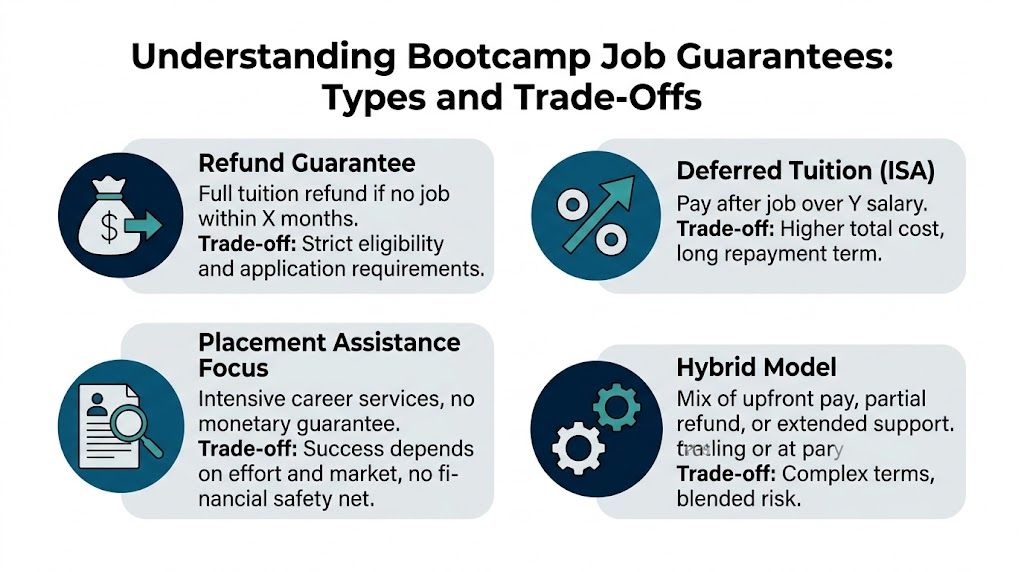
Not all guarantees work the same way. Some are closer to insurance. Others are financing products with marketing polish.
The mistake people make is treating every “job guarantee” as if it offered the same protection. It doesn’t.
Money-back guarantees
This is the version commonly pictured. You pay tuition upfront. If you don’t land a qualifying job within the required time window, the school refunds tuition.
Consider it an insurance policy with a strict claims process.
The upside is obvious. Your downside is capped if the school fails to help you get hired. The problem is eligibility. As noted in this breakdown of guarantee conditions, bootcamp job guarantees often require upfront tuition payment, active engagement in career services, and strict job-search metrics such as applying to 4 to 5 qualifying positions weekly within specified metro areas for 6 to 12 months after graduation, with exclusions that can include deferred tuition, income share agreements, prior degree holders, or incomplete participation.
If you miss one reporting deadline, your “guarantee” may disappear.
Tuition refund models with narrow definitions
This looks similar to the first category, but the contract can be tighter than the headline suggests.
The bootcamp might only refund tuition if you fail to get a role in a narrow set of approved job titles. That means your search flexibility drops. You may want product support, technical writing, implementation, or junior DevOps as stepping stones. The contract may only recognize software engineer, data analyst, or QA tester.
That’s a hiring problem, not a legal one. Early in your career, adjacent roles can still move you forward. A narrow guarantee can push you to chase “qualifying” jobs instead of smart jobs.
Income share agreements
An ISA isn’t really a guarantee. It’s a financing structure.
The pitch sounds attractive because you don’t carry all the cost upfront. The trade-off is that repayment can become expensive if you get hired quickly into a decent-paying role. It also changes your incentives. Instead of evaluating curriculum and outcomes, you’re evaluating a debt-like commitment tied to your future earnings.
I’m blunt about this. If a school uses financing language to make a weak outcomes story sound safe, walk away.
Deferred tuition plans
Deferred tuition is a cousin of the ISA, but the mechanics differ. You pay later, often after graduation or after hitting certain employment conditions.
This can help with cash flow. It can also create confusion. Some students hear “pay later” and assume “risk-free.” It’s not risk-free if the fine print still leaves you on the hook under broad conditions.
Placement assistance without financial protection
Some bootcamps avoid the refund promise and sell heavy career support instead. That means resume reviews, interview prep, networking help, employer introductions, and application strategy.
I prefer honest placement assistance to a flashy guarantee with traps.
A school that says, “We’ll work hard with you, but hiring still depends on your performance,” is often more trustworthy than a school that makes a loud promise and buries the exclusions.
Hybrid models
Some providers mix upfront tuition, partial refunds, extended support, or post-graduation coaching.
These can be reasonable. They can also be messy.
Use this quick comparison:
| Model | Best for | Main risk |
|---|---|---|
| Money-back guarantee | Career changers who want downside protection | Disqualification through fine print |
| Tuition refund with narrow rules | Students targeting a specific mainstream role | Limited career flexibility |
| ISA | Students avoiding upfront payment | Higher long-term cost |
| Deferred tuition | Students with short-term cash constraints | Confusing repayment triggers |
| Placement assistance only | Self-directed students who value coaching | No financial safety net |
| Hybrid | Students willing to read complex contracts carefully | Blended risk and unclear incentives |
Don’t choose based on the headline model alone. Choose based on how much career freedom you give up to get the protection.
The Fine Print That Can Invalidate Your Guarantee
The ugliest part of the bootcamp job guarantee isn’t the tuition. It’s the compliance burden.
Most students worry about learning Python, React, SQL, or system design. They should also worry about whether the school can later say, “You didn’t meet the guarantee requirements.”

Red flag one: vague “active job search” rules
“Active job search” sounds harmless until you see how a provider defines it.
One school might require weekly applications. Another may require applications plus networking activity, attendance at coaching sessions, customized resumes, mock interviews, and detailed tracking logs. If the contract leaves room for the school to decide whether your effort was “sufficient,” you’ve got a problem.
Ambiguity helps the school, not you.
Look for exact language around:
- Application volume
- Accepted job boards
- Required networking activity
- Whether recruiter outreach counts
- How often you must report activity
If those rules aren’t explicit, don’t assume the school will interpret them generously.
Red flag two: metro-area restrictions
A lot of guarantees were designed around the old assumption that hiring is tied to a major city. That still shows up in contracts.
If the school says you must live in or near a qualifying metro, ask what happens if your search is primarily remote or if you’re targeting distributed startups. This is a major issue for blockchain professionals, because many teams hire globally and remotely, and a metro-based guarantee may fit the contract better than it fits the labor market.
Red flag three: narrow definitions of a qualifying role
Some schools market broad career outcomes, then define qualifying jobs narrowly in the contract.
That means a role can be good for your actual career and still not count for the guarantee. A junior backend role using TypeScript may count. A technical solutions role at a strong company may not. A developer relations opening that gets you into Web3 may not.
That’s upside-down thinking. Your goal is not to satisfy the bootcamp’s spreadsheet. Your goal is to enter the market and gain advantage.
A contract that punishes reasonable stepping-stone roles is built for marketing, not for careers.
Red flag four: documentation traps
This one gets people more often than weak interviewing does.
You may need to save:
- Application confirmations
- Emails with recruiters
- Interview invitations
- Rejection notes
- Meeting attendance records
- Weekly submission logs
Miss a week. Upload late. Forget one screenshot. Some schools will use that to deny a claim.
If the refund depends on perfect admin work for months, treat that as part of the tuition price. You’re not just paying money. You’re paying with compliance labor.
Red flag five: completion standards inside the program
A lot of students focus on post-grad job-search rules and ignore what happens before graduation.
Read for clauses covering attendance, assignment completion, project quality, behavior, and participation in mentorship or career sessions. If the school can say you didn’t fully complete the program or didn’t engage with required support, they can often void the guarantee before your search even starts.
Why skepticism is justified
The industry has earned some distrust. Historical analysis of bootcamps found that early programs maintained 90% job placement rates with small cohorts, but aggressive scaling hurt results. One major example was Lambda School, where 2020 internal data showed only 30% of graduates landing qualifying jobs despite advertised 86% rates, leading to scrutiny over misrepresentation, as discussed in this historical analysis of placement claims.
That doesn’t mean every guarantee is fake. It means you should read every contract like a hiring manager reading a resume. Look for what’s missing, what’s inflated, and what gets excluded.
My standard for a fair contract
I’d consider a guarantee fair if it has:
| Contract area | What fair looks like |
|---|---|
| Job-search requirement | Specific, realistic weekly expectations |
| Role definitions | Broad enough to include adjacent entry-level tech roles |
| Geography | Remote-friendly, not locked to a small metro list |
| Documentation | Simple reporting, not forensic record-keeping |
| Refund process | Clear timeline and explicit steps |
| Exclusions | Short list, written in plain English |
If the school won’t send the full terms before enrollment, that alone is enough reason to move on.
Your Checklist for Verifying Bootcamp Placement Claims
You don’t need blind trust. You need a vetting process.
A strong bootcamp should survive uncomfortable questions. If the admissions rep gets slippery when you ask for methodology, refund qualification details, or alumni contacts, take that as data.
Start with the outcomes report
Ask for the most recent formal outcomes document, not the sales page.
You want to know:
- Who is counted in the placement data
- Who is excluded
- What counts as “placed”
- How long graduates were tracked
- Whether roles are in-field or merely employed
One provider with visible results is TripleTen. According to Course Report’s guide to coding bootcamps with job guarantees, 87% of graduates secure tech jobs within 3 months, 50% receive offers before graduation, and 61% land remote positions, with median salary increases of $42,300. That’s useful data. It’s still your job to ask how they define graduate, job-ready, and placed.
Check hiring reality outside the bootcamp bubble
Bootcamp marketing exists in a closed loop. Hiring doesn’t.
Go to LinkedIn. Search alumni. Filter by recent cohorts. Look for people who landed roles you’d want. Then compare that with current employer demand in the market you’re targeting.
If you’re trying to move into blockchain-adjacent engineering, don’t just ask whether graduates got jobs. Ask whether the bootcamp teaches skills that map to real openings from actual employers. Reviewing active hiring demand across blockchain companies helps you see which stacks, product areas, and role types show up consistently.
Contact alumni the school didn’t select
Admissions teams love curated success stories.
You want the uncurated version. Reach out to alumni with different outcomes:
- People who got hired fast
- People who needed longer
- People who changed role targets
- People who never mentioned the school again
Ask short, direct questions. Individuals will answer if you respect their time.
Questions that expose weak claims
Use these in admissions calls:
- How many students started the cohort, and how many were included in the outcomes report?
- What exact job titles count for placement?
- How many graduates qualified for the refund?
- How many received it?**
- What is the most common reason students lose eligibility?
- Can I review the full guarantee terms before I pay a deposit?
- Which employers have hired your grads recently, and into what roles?
- How much of the placement outcome comes from students finding jobs on their own?
If they answer with generalities, keep pressing.
The best admissions call is the one that leaves you with documents, not just confidence.
Look for consistency between curriculum and hiring
A strong guarantee doesn’t fix weak training.
If the program teaches toy projects, generic capstones, and shallow interview prep, the guarantee may just be a refund machine for a small number of disqualified students. What matters is whether the portfolio work looks like something a hiring manager could take seriously.
For software roles, review project quality. For analytics, inspect dashboards, SQL depth, and business framing. For anything adjacent to blockchain, check whether the school teaches backend fundamentals, APIs, security habits, and code quality that transfer into crypto-native environments.
Gauging Success with Real-World Data and Outcomes
Bootcamp outcomes matter more than guarantee copy.
The right question is not whether a school advertises a refund. The right question is whether graduates get hired into roles you would want, on a timeline and salary range that justify the cost, the time, and the career risk.
Course Report’s own outcomes reporting has pointed to a mixed but usable baseline. A meaningful share of graduates do find full-time work within months, and many report a salary increase after the program. Read that as a market reference point, not proof that any specific bootcamp deserves your trust.

What realistic success looks like
A serious outcomes review has three layers.
First, can grads get hired at all. Second, how long does it take. Third, what kind of job are they getting. That third point gets ignored too often. A placement rate means very little if it includes low-fit support roles, short-term contract work, or jobs unrelated to what you trained for.
Use a simple standard:
| Signal | What it should mean to you |
|---|---|
| Full-time role within months | Hiring is possible, but you should still expect a search, not a shortcut |
| Higher first-job pay | The program may improve your starting point if the role is relevant |
| Better pay later | Early placement only matters if it leads to stronger second and third roles |
For tech professionals changing lanes, the analysis gets sharper. If you already work in QA, IT, data, product, or operations and want to move into software or blockchain, generic placement numbers are not enough. You need evidence that grads moved into the kind of role you want, with a stack that matches the market. If you are aiming at crypto-adjacent work, compare the curriculum against live remote blockchain jobs. Check for backend engineering, APIs, security awareness, data pipelines, smart contract exposure, and production-grade tooling. A guarantee does not cover a skills mismatch.
Two very different outcomes
One student uses the bootcamp as a forcing function. They ship polished projects, ask for blunt feedback, fix weak spots fast, and treat the job search like a second course. They usually get the main benefit of the program, which is improved hireability.
Another student buys the headline. They assume the guarantee lowers the stakes, build forgettable projects, spray applications, and wait for career services to carry them. That path usually ends with no offer and no payout.
The difference is not luck. It is the gap between training completion and market readiness.
My advice
Judge a bootcamp by the quality of jobs its grads get, not by the confidence of its sales team.
If a school publishes outcomes, check whether they separate full-time salaried roles from contract work, whether they name common job titles, and whether they show the time window clearly. If a school claims strong results but cannot show role-level detail, treat the guarantee as marketing.
For Web3 candidates, be stricter. A school can post decent general software outcomes and still be a poor bet for blockchain career transitions. If the projects look generic and the employer list is thin on crypto, fintech, infra, or security-heavy teams, the guarantee has limited value.
Use outcomes data as screening material. Then make the decision based on curriculum depth, project quality, and whether the program gets you closer to the job you want.
Why Guarantees Fail for Web3 and What to Do Instead
Much bootcamp advice falters here.
If you want a mainstream junior software role, a bootcamp job guarantee can at least be evaluated on familiar terms. If you want to become a protocol developer, smart contract engineer, backend engineer in crypto, or a DeFi product operator, the normal guarantee model doesn’t fit.
The reason is simple. Bootcamp job guarantees rarely address blockchain and Web3 career pathways, even as the blockchain market is projected to grow at 87.0% CAGR through 2030, and no major bootcamp currently guarantees placement into roles like Backend Engineer or Smart Contract Engineer, according to this review of the gap in guarantee programs.
Why the mismatch exists
Web3 hiring is less standardized.
A traditional bootcamp can train for common junior pathways with familiar stacks, common interview loops, and a broad employer base. Web3 teams often hire for narrower skill mixes: smart contract security, protocol logic, backend reliability, token incentives, wallet integrations, Rust, Solidity, cryptography awareness, or onchain product intuition.
That makes guarantees harder to package. The path is less linear, and the employers are more varied.
What to do instead if you want a blockchain career
Stop looking for a refund-based safety net. Build market proof.
The strongest alternatives are practical:
- Build in public. Ship code on GitHub. Write technical breakdowns. Show architecture decisions.
- Contribute to open source. Even small pull requests signal you can work in real repos.
- Create role-specific projects. If you want smart contract work, write and test contracts. If you want backend work, build APIs and data pipelines around onchain data.
- Learn from live openings. Reverse-engineer actual job requirements from listings.
- Network where practitioners are. Protocol communities, engineering discussions, and niche founder circles matter more than generic bootcamp hiring fairs.
A real example helps. Review a live Web3 full stack developer role. Don’t just read the title. Study the expected stack, product scope, and likely interview demands. That’s how you build a preparation plan that matches hiring reality.
My recommendation for niche candidates
If you’re targeting Web3, use bootcamps selectively.
A general software bootcamp can still help if you need structure in JavaScript, Python, backend systems, SQL, testing, Git workflows, or team-based project work. Just don’t buy it because of the guarantee. Buy it if the training closes a real skills gap and gives you portfolio assets you can carry into crypto hiring.
If the sales rep leans hard on the guarantee while dodging questions about blockchain curriculum, smart contract tooling, security practices, or employer relevance, that’s your answer.
Final Verdict How to Decide if a Guarantee Is Worth It
My view is simple. A bootcamp job guarantee is worth considering, but only when the contract is fair, the outcomes are transparent, and the role target is mainstream enough for the guarantee to have real hiring value.
It’s a good fit if:
- You’re switching into a common tech path like software engineering, QA, or data analytics
- You need accountability to stay disciplined in a long job search
- The school shares real outcomes data and full contract terms
- The career services are strong enough to improve your interview performance
It’s a bad fit if:
- You’re targeting Web3 or another niche path where guarantees don’t map to actual hiring
- The terms are restrictive on geography, role type, or documentation
- You’re using the guarantee as emotional comfort instead of judging the curriculum and hiring relevance
- You haven’t verified alumni outcomes yourself
The decision test I’d use
Ask yourself three blunt questions:
- Would I still want this program if the guarantee disappeared?
- Can I realistically comply with every requirement for months after graduation?
- Does this program increase my odds of passing interviews for the jobs I want?
If the answer to any of those is no, keep looking.
Before you commit, spend time reading independent boot camp reviews and compare them against what admissions tells you. You’re not looking for perfect sentiment. You’re looking for consistency, specifics, and signs that graduates got real career value.
The guarantee should be the seat belt. It should not be the engine.
If you're aiming for a real role in crypto, DeFi, infrastructure, product, marketing, legal, or operations, use Blockchain Jobs to study live openings, understand what employers want, and find your next move in Web3.