
Crypto Marketplace Guide: NFTs, DeFi, and Web3 Hiring
You're reading a Web3 job listing that asks you to “operate a crypto marketplace,” but the title leaves out the part you need to understand: what are you operating? The answer isn't just a trading dashboard. A crypto marketplace combines venues where assets change hands, systems that hold or move value, smart contracts that enforce rules, and teams responsible for keeping the whole network reliable and compliant.
That broader definition matters for career planning. The same marketplace can need backend engineers, wallet-security specialists, protocol developers, liquidity strategists, compliance professionals, product managers, and operations leads. Once you can see the underlying system, job descriptions become easier to decode and interview questions become much less mysterious.
What a Crypto Marketplace Actually Means in 2026
Suppose a candidate sees an opening for a crypto marketplace operations lead. The role might involve monitoring deposits, investigating failed settlements, coordinating support during a token launch, reviewing liquidity conditions, or working with compliance on suspicious activity. “Marketplace operations” sounds like one function, but it can touch every layer beneath the customer interface.
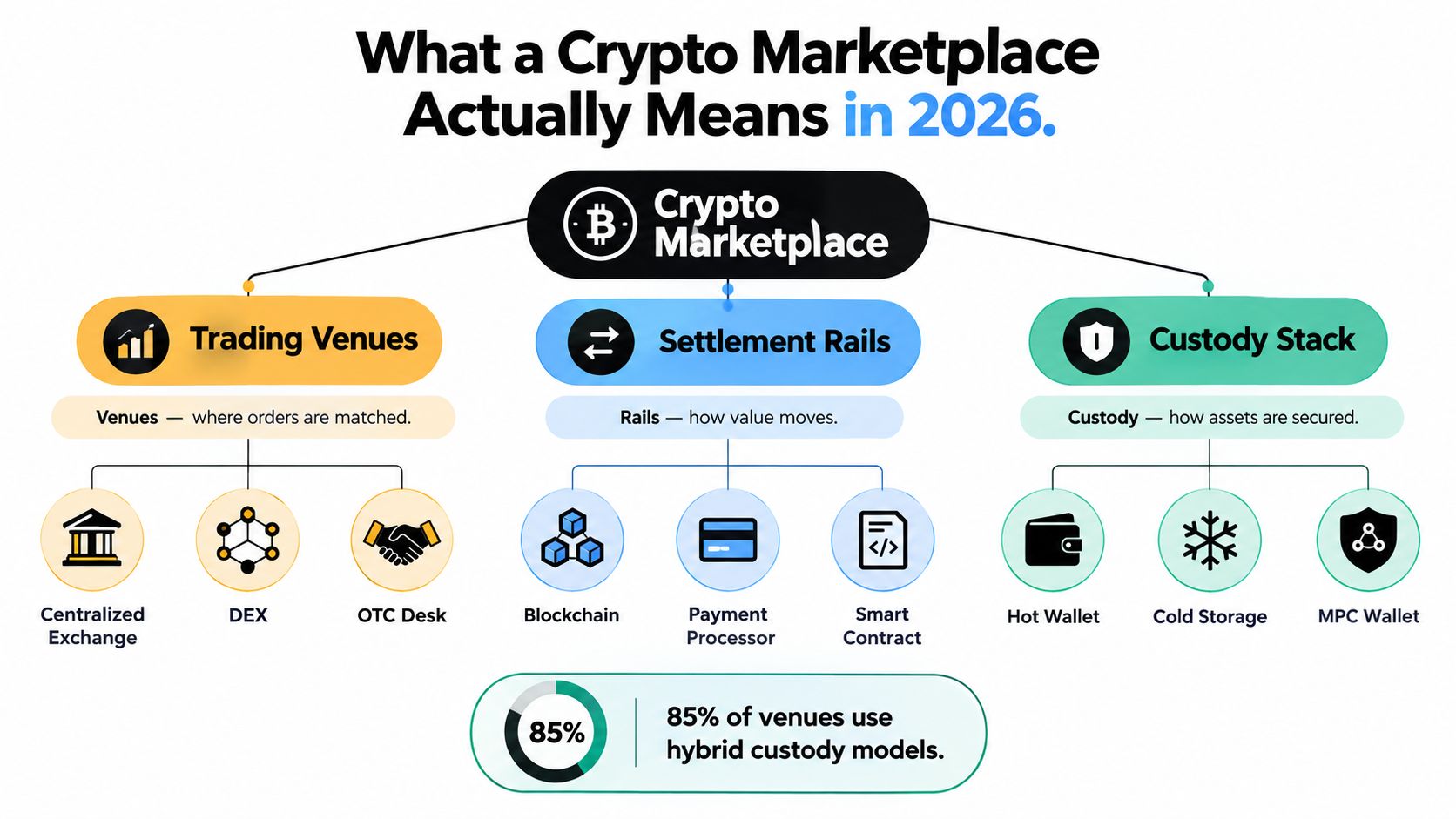
A crypto marketplace is best understood as a stack of venues, rails, and contracts. The architecture includes centralized exchanges, NFT platforms, decentralized finance protocols, token launchpads, and on-chain talent marketplaces. Market structure research describes this as a combination of trading venues, matching or execution engines, custody models, and settlement rails, rather than a single website (market structure and crypto marketplace architecture).
The three layers behind the interface
The first layer is the trading venue. Users submit orders, swap tokens, buy NFTs, join launches, or accept work here. A centralized exchange usually runs an internal order book. A decentralized exchange may use an automated market maker, an on-chain order book, or a hybrid model.
The second layer is custody and settlement. Custody answers who controls the assets before a trade completes. Settlement answers how ownership changes after execution. A centralized venue may update an internal ledger, while a decentralized venue relies on smart contracts and blockchain finality.
The third layer is discovery and reputation. Users need to find assets, creators, protocols, freelancers, and counterparties. Ratings, wallet history, governance participation, social signals, identity checks, and compliance workflows all influence trust.
Interview lens: If a role mentions marketplace operations, ask which layer owns the team's key metrics. The answer will reveal whether you're applying for exchange operations, payments infrastructure, protocol support, risk, or customer-facing product work.
Candidates who want broader industry context can supplement technical study with crypto coverage from Wonderment Apps, then review current role patterns through the blockchain career resource. The important shift is conceptual: a marketplace is an operating system for value exchange, not merely a place to watch token prices.
The Main Types of Crypto Marketplaces You Will Encounter
The easiest way to classify a crypto marketplace is to compare it with a consumer platform you already understand. The analogy gives you the basic mental model, then the custody and settlement model show where crypto changes the rules.
A centralized exchange resembles Amazon. One company provides the interface, manages accounts, maintains internal records, and usually controls custody while users trade. The experience can feel fast and curated because the venue handles much of the complexity. Roles often include exchange operations, fraud prevention, customer support, compliance, payments, and platform engineering.
A decentralized exchange, or DEX, is closer to peer-to-peer trading on eBay. Users connect their own wallets, smart contracts execute the swap, and the blockchain records the result. There may be no company manually approving every listing, so protocol engineers, smart contract auditors, governance contributors, and risk analysts become central to the operating model.
An NFT marketplace has similarities to Etsy. Creators list work, communities shape discovery, and buyers care about provenance as well as price. Product managers need to understand creator tools, metadata, royalties, moderation, wallet flows, and marketplace trust. A strong NFT product candidate doesn't need to be an artist, but they should understand why ownership history and creator identity affect user behavior.
Token launchpads resemble Kickstarter. A project presents a new asset or network, participants commit funds, and the platform may impose allocation rules, caps, eligibility checks, or vesting conditions. That creates demand for token operations, legal and compliance review, smart contract testing, investor communications, and treasury management.
On-chain talent marketplaces are closer to Upwork for crypto-native work. A client can post a task, a contributor can deliver work, and payment may move through stablecoins or escrow contracts. Operations specialists need to understand disputes, contractor verification, payment screening, and cross-border workflows.
| Marketplace Type | Consumer Analogy | Custody Model | Primary Fee Mechanism |
|---|---|---|---|
| Centralized exchange | Amazon | Platform-controlled or hybrid custody | Trading tiers, withdrawal charges, and service fees |
| Decentralized exchange | eBay-style peer-to-peer trading | User-controlled wallets and smart contracts | Protocol swap fees and network fees |
| NFT marketplace | Etsy | Wallet-based ownership, sometimes platform-assisted | Listing, sale, royalty, or transaction fees |
| Token launchpad | Kickstarter | Platform, contract, or participant-controlled custody | Launch participation, allocation, or service fees |
| On-chain talent marketplace | Upwork | Wallet, escrow contract, or payment provider | Service, escrow, or settlement fees |
These differences aren't cosmetic. They determine who controls funds, who can change rules, how fees are collected, and which teams must manage risk. In an interview, explain the venue in terms of custody, execution, settlement, and user trust, not just the type of asset it lists.
How Trading, Custody, and Settlement Actually Work
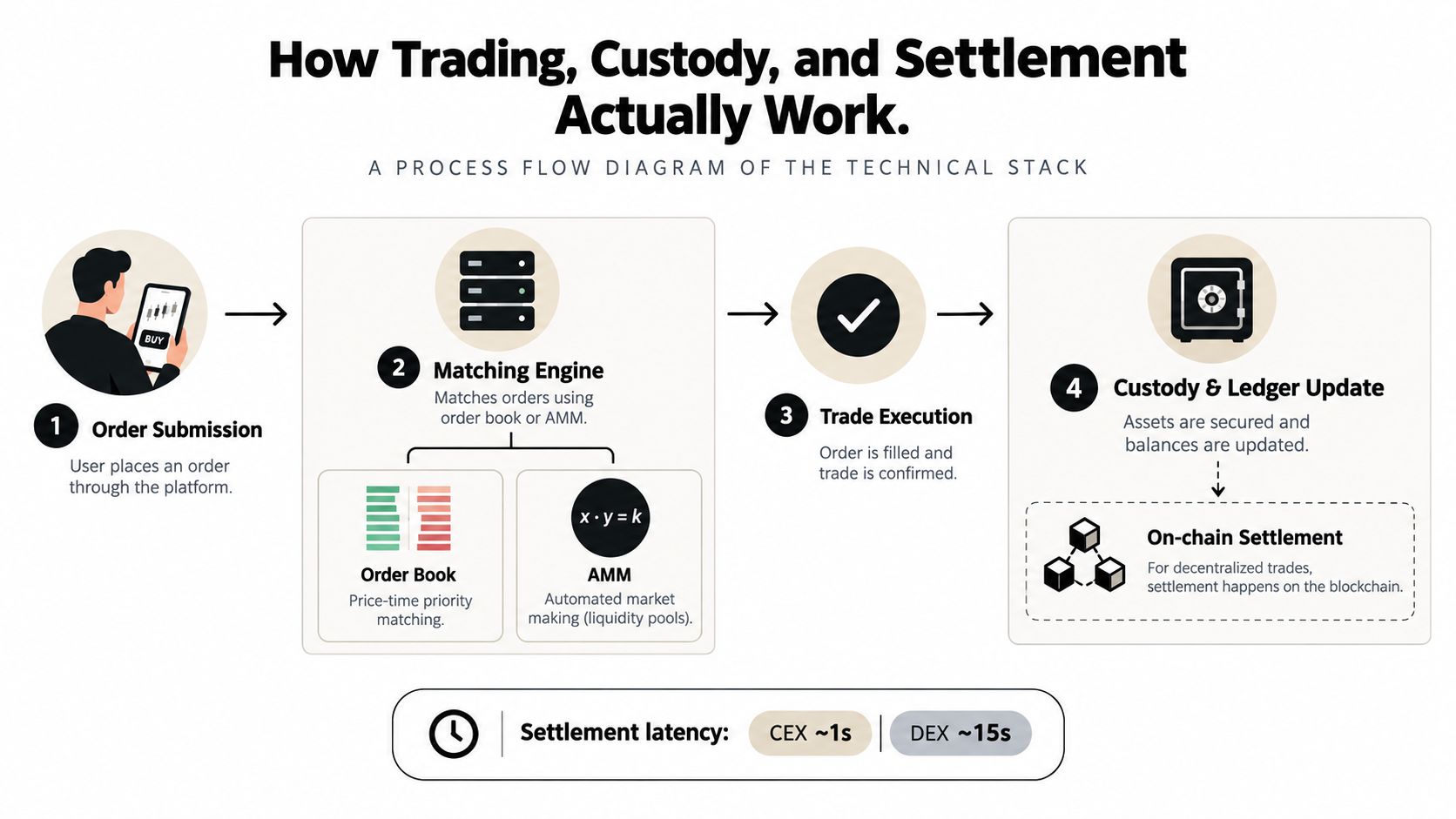
Every crypto marketplace has to answer three operational questions. How are orders matched? Who controls the assets during the process? How does the system prove that the trade completed?
The first answer sits in the matching or execution engine. A centralized exchange typically uses an off-chain order book, where bids and asks are stored and matched by the venue's infrastructure. A decentralized venue may use an automated market maker, an on-chain order book, or a hybrid design in which orders arrive off-chain but settlement occurs on-chain. The architecture source linked earlier identifies this split as a core distinction between centralized and decentralized venues.
What each layer is responsible for
Order submission begins when a user enters a trade or signs a transaction. The system validates balances, permissions, token addresses, and transaction parameters. A backend engineer may focus on request handling, while a risk engineer checks whether the action violates limits or signals abuse.
Trade execution occurs through an order book or pricing formula. Centralized systems optimize for predictable latency and throughput. Smart-contract systems prioritize verifiable execution, though users must account for block inclusion, gas conditions, and contract behavior.
Custody determines where assets sit. Hot wallets support frequent transactions but expose a live operational surface. Cold storage reduces online exposure but requires controlled procedures. Multi-party computation can distribute key control, while self-custodial contracts let users retain direct authority over funds.
Settlement is the ownership update. A centralized platform may record the result in its internal ledger before allowing withdrawals. A decentralized venue sends a transaction to the blockchain, where finality depends on the network and the smart contract completing successfully.
| Layer | Typical failure | Hiring lane |
|---|---|---|
| Matching engine | Queue congestion, incorrect order handling, or service lag | Backend, distributed systems, and quantitative engineering |
| Custody | Phishing, key compromise, access-control failure, or withdrawal abuse | Security engineering, wallet development, and key management |
| Settlement | Reverted transactions, node failure, or chain congestion | Protocol engineering, SRE, and DevOps infrastructure |
Candidates should describe these failures as operational scenarios, not abstract risks. For example, a matching-engine interview may ask how you'd preserve order sequencing under load. A custody interview may test access controls and incident response. A settlement interview may focus on node health, transaction retries, reorg handling, and observability.
A useful preparation exercise is to draw one transaction from wallet signature to final ledger state. Label every service that validates, routes, stores, signs, and reports the action. That diagram can become a strong interview artifact because it shows systems thinking without requiring you to claim experience you don't have.
Centralized vs Decentralized Marketplaces Compared
Centralized and decentralized marketplaces solve similar user problems through different trust arrangements. A centralized exchange asks users to trust the operator's systems, controls, and governance. A decentralized exchange asks users to trust code, wallet permissions, and blockchain finality.
Four differences hiring teams care about
Custody is the clearest dividing line. A centralized exchange generally holds customer assets in platform-controlled wallets or pooled custody systems. A DEX normally lets users retain control until a smart contract executes the trade. That changes the questions asked in interviews: centralized custody roles emphasize access control, withdrawal policy, reconciliation, and incident response, while DEX roles emphasize contract permissions, wallet signing, and transaction safety.
Governance also differs. A centralized venue has executives, product owners, compliance officers, and internal policies. A decentralized protocol may use governance contracts, token voting, delegates, forums, and emergency controls. Governance contributors and policy analysts need to understand both technical authority and social legitimacy.
Fees reflect the architecture. Centralized exchanges often use maker and taker schedules, account tiers, withdrawal costs, and other platform charges. DEX users pay protocol-level swap fees and blockchain network fees, with the protocol's design determining how the trading fee is distributed.
Counterparty risk moves rather than disappears. Centralized users face operator, custody, solvency, and account-control risks. DEX users face smart contract vulnerabilities, oracle issues, liquidity gaps, wallet mistakes, and blockchain execution risk. A candidate who says decentralized means risk-free will lose credibility quickly.
| Dimension | Centralized Exchange | Decentralized Exchange |
|---|---|---|
| Custody | Operator-controlled or hybrid wallets | User wallets and smart contracts |
| Governance | Company policies and management | Code, token governance, delegates, and community processes |
| Fee model | Trading tiers, withdrawals, and platform services | Swap fees, network fees, and protocol-defined distributions |
| Execution | Internal order book or matching engine | AMM, on-chain order book, or hybrid routing |
| Main operational risk | Counterparty, custody, compliance, and platform failure | Contract, oracle, liquidity, wallet, and finality risk |
| Common hiring needs | Exchange operations, security, compliance, payments, backend | Protocol engineering, audits, governance, DeFi risk, frontend wallet integration |
The role fit follows the design. A centralized venue needs teams that run a financial platform with controlled access and clear accountability. A DEX needs people who can make transparent code safe, communicate upgrades, monitor liquidity, and coordinate governance.
Practical rule: In an interview, never answer “CEX or DEX” as a technology preference alone. Explain which trust assumptions the model creates, then name the controls a team needs to manage them.
Liquidity, Fees, and Pool Design in DeFi Venues
A trader can find a pool, submit a swap, and still receive poor execution. The reason is simple: an automated market maker, or AMM, prices trades against token reserves held in a smart contract rather than against a traditional dealer or order book. Liquidity providers deposit those reserves, while traders swap against them. Pool depth affects price impact and slippage, so user activity alone does not guarantee useful execution.
The Bank for International Settlements' analysis of decentralized liquidity provision describes AMMs as pools that typically contain two reserves. Traders pay a fixed percentage fee for each swap. That fee compensates liquidity providers for inventory exposure and adverse-selection risk, while the protocol records activity directly on-chain.
Why pool design changes the job
A basic pool distributes liquidity across a broad price range. Concentrated-liquidity systems let providers place capital within a narrower range, which can improve capital efficiency while the market stays there. The cost is active management. If the price leaves the selected range, that position may stop earning fees until someone adjusts it.
Fee tiers add another operating decision. A relatively stable pair can use a lower fee because its price generally moves less dramatically. A volatile or thinly traded pair may need a higher fee to compensate providers for inventory risk and adverse selection. Choosing the tier requires analysis of volatility, trading volume, competing pools, trader behavior, and the protocol's routing logic.
Research on Uniswap v3 analyzed 4,069 pools and found highly concentrated liquidity. One provider often controlled 98 to 100% of a pool's liquidity on average. That finding changes how a hiring team should assess decentralization: the contracts may be public, yet execution can depend heavily on a small group of capital providers.
| Design decision | User-facing effect | Relevant role |
|---|---|---|
| Reserve depth | Changes slippage and price impact | DeFi product, protocol, and quantitative engineering |
| Fee tier | Balances trader cost with provider compensation | Protocol economics and market design |
| Liquidity range | Determines where capital remains active | Liquidity strategy and quantitative development |
| Routing logic | Chooses among available pools | Smart contract and backend engineering |
| Pool permissions | Controls upgrades and emergency actions | Security auditing and governance |
For a DeFi interview, explain impermanent loss, price impact, fee revenue, range management, and routing in operational terms. A small model can compare pool outcomes across fee tiers and price paths, supported by research on backtesting for liquidity providers. Candidates pursuing a DeFi liquidity lead role should connect that analysis to monitoring, reporting, position management, and risk limits. The work is partly financial modeling and partly system oversight.
Where the Market Is Growing Beyond Speculation
Trading headlines can make the crypto marketplace look dependent on token prices. That view misses a more durable direction: stablecoins, payments, settlement, and payroll can remain useful even when speculative trading weakens.
The Q2 2026 market data shows why this distinction matters. Total crypto market capitalization fell 12.6% to $2.1 trillion, and centralized exchange spot volume dropped 27.9% to $1.95 trillion, while stablecoin market capitalization remained $305.1 billion after a rare quarterly decline (Q2 2026 crypto market and stablecoin data). The data doesn't prove that every utility use case is expanding faster than every trading category, but it does show that stablecoin infrastructure deserves analysis separate from exchange speculation.
The payment rail behind the token
A freelancer may invoice an overseas client and request settlement in a stablecoin. A distributed company may pay contractors through a crypto-native payroll provider. A business may use stablecoins for treasury transfers or cross-border settlement, then convert through a regulated payment partner. In each example, the product challenge isn't “let users trade.” It involves identity, screening, reconciliation, wallets, accounting, conversion, and support.
Those requirements create career lanes with practical business exposure:
- Compliance teams design onboarding, transaction monitoring, sanctions controls, and escalation procedures.
- Payments product managers define payout flows, supported jurisdictions, conversion experiences, and failure handling.
- Integration engineers connect wallets, custodians, banking partners, payroll systems, and merchant tools.
- Treasury specialists manage liquidity, settlement timing, reconciliation, and counterparty exposure.
- Customer operations teams resolve payment delays, incorrect addresses, account restrictions, and disputes.
The Q2 report also places the marketplace in a longer market cycle. Earlier in 2026, total market capitalization fell 20.4% by $622 billion to $2.4 trillion, while centralized spot volume fell 39.1% to $2.7 trillion in Q1, according to Q1 2026 crypto industry reporting. By Q2, market capitalization had slipped to $2.1 trillion, and centralized spot volume had fallen again to $1.95 trillion, showing that the sector now moves through multi-trillion-dollar cycles.
For career longevity, follow the workflow that a business must operate repeatedly. Payment onboarding, compliance controls, settlement reliability, and payroll reconciliation solve recurring problems. That doesn't make speculative products irrelevant, but it does make utility rails an attractive specialization for candidates who want experience tied to real operational systems.
How Marketplace Concepts Map to Web3 Careers
The marketplace becomes a useful career map when you connect each technical layer to the person accountable for it. Custody isn't only a wallet problem. It creates security, operations, compliance, and product work. Liquidity isn't only a DeFi concept. It requires quantitative analysis, smart contract design, treasury decisions, and user communication.
The hiring data supports a strong engineering foundation. A 2026 analysis of 2,932 active crypto job postings found that engineering represented 34.1% of openings, while compliance and legal was the second-largest category at 10.4% (2026 global crypto hiring analysis). Another market report found active postings increased from roughly 4,800 in Q4 2025 to about 5,860 in Q1 2026, a 22% increase, while remote-first roles rose from 68% to 71% (crypto job-market report).
A practical role map
| Marketplace Layer | Key Roles | Core Skills | Remote Share |
|---|---|---|---|
| Matching and execution | Backend engineer, distributed-systems engineer, quant developer | Rust, Go, order books, concurrency, observability | Remote work is common across distributed engineering teams, with the market report placing remote-first roles at 71% |
| Custody and wallets | Security engineer, wallet developer, key-management specialist | MPC, access control, threat modeling, incident response | Remote availability varies by custody and operational controls |
| Settlement and payments | Protocol engineer, DevOps engineer, payments product manager | Nodes, transaction lifecycle, reconciliation, integrations | Remote-first teams increasingly need clear execution and documentation |
| Liquidity and DeFi | Quantitative developer, smart contract engineer, auditor | AMMs, pricing, Solidity, testing, risk analysis | Remote collaboration suits research and protocol development |
| Governance and policy | DAO contributor, policy analyst, legal and compliance specialist | Governance design, regulatory analysis, communication | Distributed governance work often depends on written decision records |
| Discovery and marketplace growth | Product manager, UX designer, community and DevRel lead | User research, wallet UX, creator tools, technical communication | Remote roles reward independent stakeholder management |
Engineering isn't the only entry point. The hiring analysis places compliance and legal directly behind engineering by category share, which makes regulatory knowledge valuable for candidates who understand financial operations but aren't protocol developers. Product, support, data, finance, security, and community roles also become stronger when applicants can explain the underlying transaction lifecycle.
Hiring teams increasingly evaluate distributed execution, documentation, async communication, and judgment under uncertainty. Candidates exploring how employers assess modern technical talent can review this vendor guide for hiring AI, while product candidates can examine Web3 product management roles to compare responsibilities across protocols, exchanges, and payment products.
Choose two marketplace layers that fit your existing strengths. Audit three job descriptions in those niches, identify repeated tools and responsibilities, then build one proof-of-work project before applying. That project might be a forked AMM script, a wallet test suite, or a governance proposal. In the interview, explain the user problem, the trust assumptions, the failure modes, and the controls you designed.
Blockchain Jobs offers a dedicated marketplace for Web3 roles across engineering, DeFi, NFTs, product, compliance, security, operations, and other specialist functions. Visit Blockchain Jobs to find fresh, remote-friendly opportunities and match your marketplace knowledge with a role where you can build, operate, or govern the next generation of financial and digital infrastructure.