What Is Staking in Cryptocurrency: A Web3 Career Guide

Staking is locking cryptocurrency to help run a proof-of-stake network in exchange for rewards. Ethereum's transition to proof-of-stake on September 15, 2022, and the network's estimated 99.95% reduction in energy use, turned staking into a major infrastructure and workforce story, not just a way to seek yield (Ethereum's proof-of-stake transition and significance, proof-of-stake energy analysis).
You may be researching staking because a job description mentions validators, slashing, liquid staking, or consensus clients and you need to understand what those words mean before an interview. The short version is simple. Your assets support transaction processing and network security, while the people and companies operating the underlying systems handle uptime, key management, monitoring, accounting, governance, and risk.
That workforce angle matters because a staking product can look passive from a customer's perspective while demanding continuous technical and operational work behind the scenes. This guide treats staking as a workforce problem. It explains what validators and delegators do, why rewards can be lost, how custody changes accountability, and which skills employers look for across protocol teams, staking providers, exchanges, and risk departments.
Staking in Plain English and Why It Matters for Web3 Careers
Staking means locking crypto to help run a proof-of-stake network in exchange for rewards. Instead of asking miners to compete with computing power, a proof-of-stake network asks participants to place assets at risk and follow the protocol's rules.
A bank-vault analogy makes the incentive easier to understand. Think of the staked tokens as a security deposit held in a vault, and the validator as the guard assigned to protect the bank. The guard earns pay for checking transactions, following procedures, and remaining available. If the guard colludes with a thief or repeatedly abandons the post, the bank can take part of the deposit.
That deposit is what gives staking its security function. A validator has something valuable to lose, so dishonest behavior becomes economically expensive. The network doesn't rely only on a participant's promise to behave. It combines software rules, financial collateral, and penalties.
Ethereum's proof-of-stake design makes this operational rather than symbolic. Validators earn rewards for attestations that agree with the majority, block proposals, and sync committee participation, while the protocol calculates rewards from a base_reward linked to active balance (Ethereum rewards and penalties).
Why hiring teams care about the analogy
A candidate who describes staking only as “earning passive income” misses the control system. A stronger candidate explains who holds the assets, who operates the validator, what behavior earns rewards, and which failure causes a penalty.
That distinction opens several career paths:
- Protocol engineering: Design consensus rules, validator incentives, and penalty logic.
- Infrastructure and SRE: Keep clients synchronized, monitor participation, and respond to incidents.
- Custody and security: Protect withdrawal credentials and separate customer assets correctly.
- Risk and compliance: Model operational, liquidity, custody, and regulatory exposure.
- Product management: Turn complex validator operations into understandable customer products.
Interview signal: Explain staking as collateral-backed network security before discussing yield. That framing shows you understand why the mechanism exists.
Ethereum's move to proof-of-stake became especially visible because it secured a major production network at scale. The transition followed years of design work and parallel testing, making The Merge on September 15, 2022 a defining adoption event for staking (Ethereum's proof-of-stake history). For job seekers, the lesson is practical: staking knowledge connects economic incentives to production systems.
Validators vs Delegators and Where Each Role Sits on the Org Chart
The cleanest distinction is control. A validator runs the infrastructure that participates directly in consensus. A delegator assigns stake to a validator and relies on that operator's systems and decisions.
Use a commercial flight analogy. The validator is the pilot flying the plane. The delegator is a passenger who chooses the pilot and pays for the journey through a share of rewards or fees. The passenger doesn't operate the navigation system, but the passenger still bears exposure to the pilot's reliability and the route's risks.
Ethereum makes the solo-validator threshold concrete. Running an Ethereum validator requires a minimum deposit of 32 ETH, along with an execution client, a consensus client, and a validator client (Ethereum proof-of-stake frequently asked questions). That requirement creates a clear infrastructure role, not merely a portfolio decision.
The comparison
| Dimension | Validator | Delegator |
|---|---|---|
| Infrastructure | Runs execution, consensus, and validator software where required | Relies on a chosen operator or service |
| Daily responsibility | Monitoring, updates, security, incident response, and consensus participation | Provider selection, reward review, and risk assessment |
| Main failure exposure | Downtime, client errors, key loss, and slashing | Operator performance, custody terms, fees, and shared penalties |
| Best career fit | Validator infrastructure engineer or SRE | Staking operations analyst, product specialist, or risk analyst |
| Interview focus | How would you monitor participation and prevent double-signing? | How would you compare providers and explain delegated risk? |
A validator infrastructure engineer may be asked to design redundant systems, manage client upgrades, and build alerting for missed duties. A validator operations analyst working with a large delegator pool may instead investigate reward discrepancies, review provider performance, and communicate incidents to customers.
A staking product manager sits at the boundary between both groups. That person needs enough technical understanding to explain validator performance, enough custody awareness to describe control of assets, and enough commercial judgment to present fees and liquidity constraints clearly.
Delegation reduces the operator burden for the customer, but it doesn't remove the operator burden from the ecosystem.
The org-chart position changes with the business model. A protocol team needs engineers who understand consensus. An exchange needs custody, product, compliance, and operations specialists. A dedicated staking firm needs infrastructure operators, security engineers, governance staff, and client-facing analysts. Before an interview, identify which side of the validator-delegator relationship the role owns.
Rewards Lock-Ups and Slashing Explained as Network Payroll
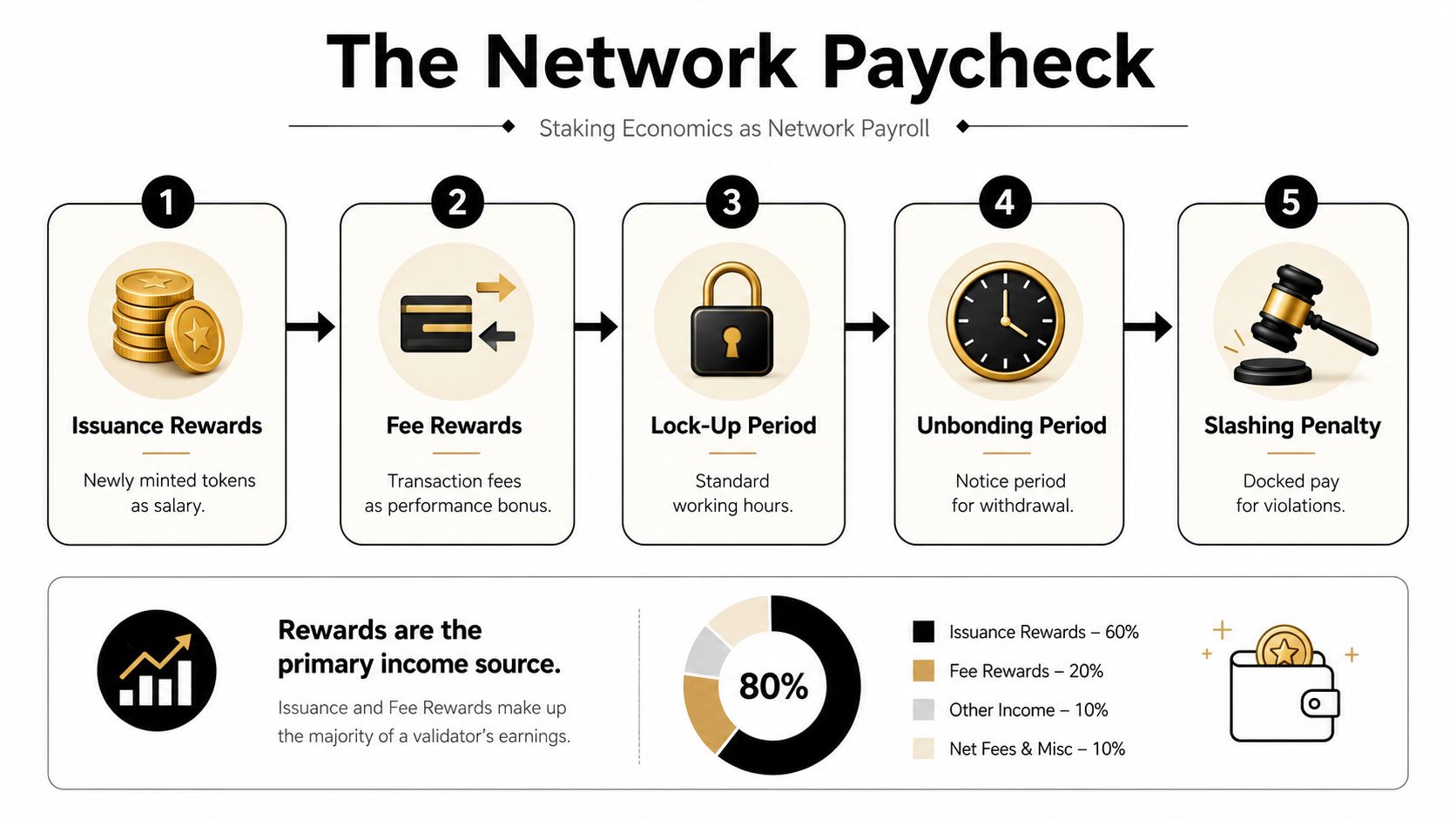
Think of the network as a payroll department. Validators perform assigned work, the protocol records whether they performed it correctly, and rewards compensate them. In Ethereum, that work includes attestations, block proposals, and sync committee participation, with rewards calculated using the protocol's base_reward and active balance (Ethereum's validator reward mechanics).
This payroll model separates earned compensation from capital at risk. A validator can receive rewards for correct participation, but the same system can impose penalties when the validator fails or violates protocol rules. The operator therefore manages both income and loss prevention.
The network paycheck
- Issuance rewards: Newly created protocol rewards compensate eligible participation.
- Transaction-related rewards: Network activity can create additional economic value for validators, depending on the chain's design.
- Lock-up: Staked assets remain committed rather than immediately available for transfer.
- Unbonding: A withdrawal request can involve a protocol-defined waiting period before assets become accessible.
- Slashing: The protocol can destroy or remove part of a validator's stake after defined misconduct.
The payroll analogy also clarifies the difference between downtime and deliberate misconduct. An offline validator may miss duties and lose expected rewards. A validator that signs conflicting messages or breaks a slashing rule can face a more direct capital penalty. Ethereum's documentation describes immediate effects in certain exit or slashing-related states and a delayed removal process, making misbehavior economically measurable (Ethereum penalties and delayed removal).
The exact reward outcome changes with network conditions, participation, validator performance, and protocol rules. Avoid treating a displayed annualized rate as a guaranteed salary. A staking analyst should reconcile expected rewards with actual records, fees, penalties, and changes in the network environment.
What interviewers test
For an operations or risk interview, prepare to answer three questions:
- How does the validator earn? Connect participation duties to rewards and accounting.
- How can the validator lose? Separate missed duties, technical failure, and protocol violations.
- Who absorbs the loss? Trace the allocation across the operator, delegator, custodian, or product provider.
The strongest answer includes controls. Mention key separation, deployment review, client monitoring, incident escalation, and post-mortem reporting. A payroll system needs timekeeping and approval controls. A staking system needs telemetry, signing safeguards, and an auditable record of rewards and penalties.
Ethereum Solana and Cosmos Compared Through a Staker's Day
Staking does not create the same job on every network. Protocol design determines what operators monitor, how quickly they respond, how delegation works, and which governance duties affect the role. For a candidate, the network name is only the starting point. The daily operating model matters more.
Ethereum
An Ethereum solo validator requires 32 ETH and three software components: an execution client, a consensus client, and a validator client (Ethereum validator requirements). An Ethereum validator SRE checks synchronization, attestations, proposals, client health, signing behavior, and upgrade readiness.
The role rewards careful production discipline. In an interview, explain how you would separate signing duties, detect missed participation, test client changes, and respond to incidents without producing conflicting signatures. That answer shows whether you understand staking as reliability work, not just as a reward product.
Solana
Solana staking commonly involves delegation. An operator's day therefore centers on validator performance, low-latency infrastructure, software updates, commission settings, and communication with delegators. The role suits an operations engineer who can connect system performance with customer rewards and network health.
A Solana interview may focus less on a single minimum-deposit explanation and more on reliable participation without excessive operational concentration. Governance awareness also matters because validator operators and delegators take part in decisions affecting the ecosystem. The practical question is how infrastructure choices influence both uptime and the people who delegate.
Cosmos
Cosmos staking is chain-specific across an IBC-connected ecosystem. A Cosmos operator must learn each zone's validator set, governance process, reward design, and unbonding behavior.
The job resembles a portfolio of protocol operations rather than one standardized workflow. A chain operator may coordinate governance votes, monitor multiple environments, and explain why customer outcomes differ across networks. Candidates exploring this path can review the Cosmos Labs general application to assess the range of protocol careers.
| Network | Min Stake | Unbonding | Consensus Family | Day-to-Day Operator Focus |
|---|---|---|---|---|
| Ethereum | 32 ETH for a solo validator | Protocol-defined withdrawal process | Proof-of-stake | Clients, attestations, proposals, signing safety |
| Solana | Delegation-oriented participation | Protocol-defined process | Proof-of-stake with delegated validation | Performance, latency, updates, delegator communication |
| Cosmos | Chain-specific | Chain-specific | Tendermint-family proof-of-stake systems | Zone operations, governance, validator-set management |
The career lesson is direct: “staking experience” needs a network attached to it. An Ethereum validator SRE, Solana operations engineer, and Cosmos chain operator share terminology, yet solve different production problems. Hiring teams should ask which systems a candidate operated, what failed, and how the response protected network participation and customer outcomes.
The Risks People Skim Past and the Jobs That Exist to Manage Them
Staking can look passive when a customer clicks a button in an exchange app. Behind that interface, someone controls keys, selects validators, accounts for rewards, handles unbonding, and responds to outages.
European supervisory guidance identifies custody failure, asset co-mingling, poor record-keeping, and ICT or operational risks as important staking hazards. The same guidance warns that market exposure can increase during lock-up or unbonding because assets may change in value before they become accessible again (EBA and ESMA crypto lending and staking factsheet).
Four risks and their owners
Custody risk begins with control. If a provider manages withdrawal credentials, the customer depends on that provider's security model, internal controls, and legal structure. Custody specialists, security engineers, compliance officers, and internal auditors test access policies, reconciliation, segregation, and incident response.
Concentration risk arises when too much participation depends on a small group of validators, clients, providers, or regions. Protocol engineers and governance analysts assess whether correlated failures could damage liveness, resilience, or censorship resistance.
Regulatory risk changes the product design. In May 2025, SEC staff guidance clarified that certain protocol-staking activities aren't securities transactions, while European supervisory materials continue to emphasize custody, operational, and disclosure risks (EBA and ESMA staking guidance). Legal and policy teams must still analyze the provider's service, jurisdiction, customer relationship, and marketing language.
Slashing and downtime risk connect infrastructure directly to capital. Operators need runbooks for outages, signing protection, controlled deployments, and escalation. SREs, validator operations leads, and risk officers earn their place here.
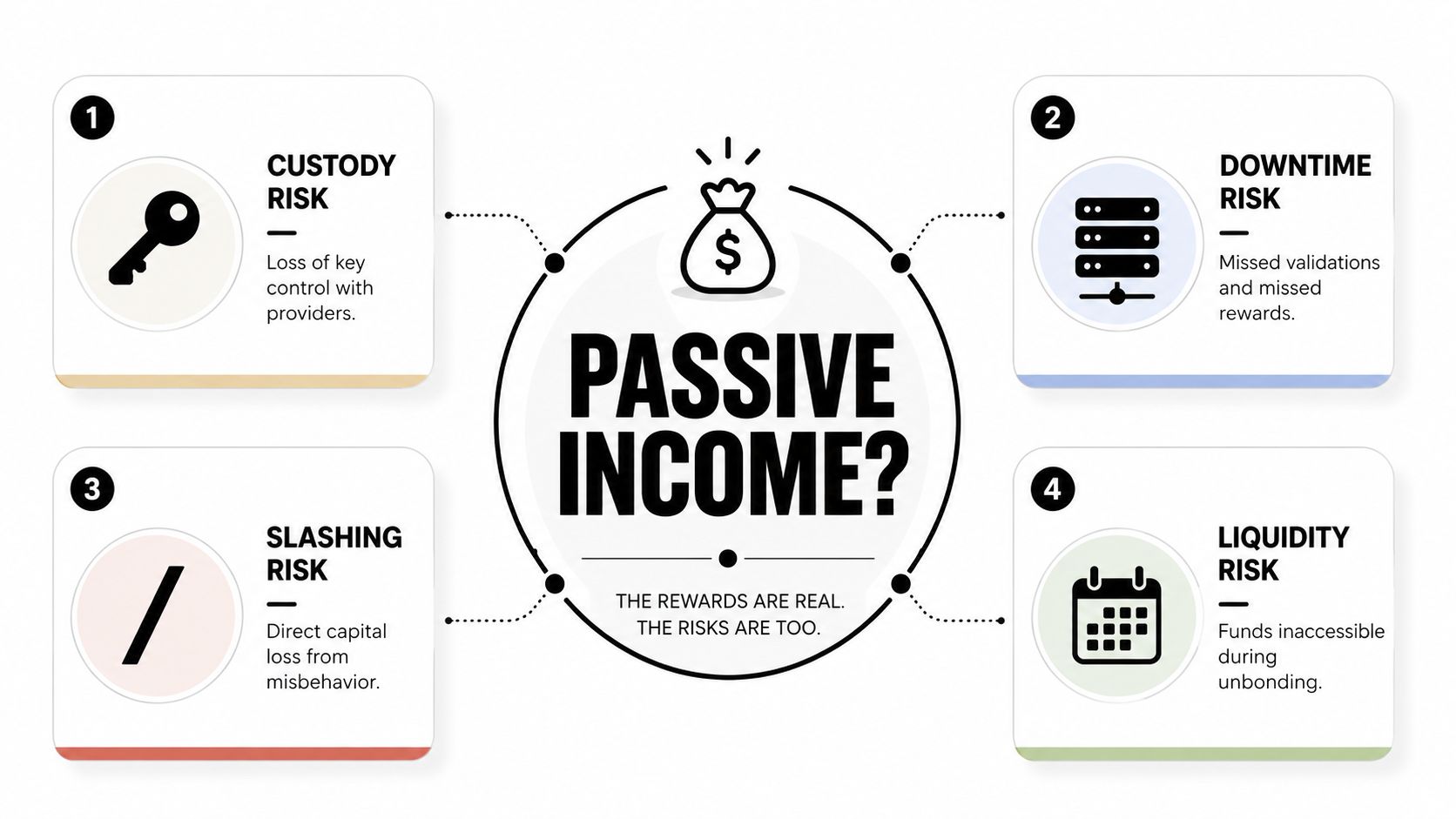
Career test: If you can name the control, the owner, and the failure response for each risk, you're thinking like a staking professional rather than a yield customer.
A risk manager may build a control matrix, review provider contracts, and document customer disclosures. Candidates targeting this path can examine a risk manager opportunity at Unlimit as a reference point for the broader risk function.
A Hiring-Ready Framework for Evaluating Staking Providers
The same checklist helps you choose a provider and answer an interview case study. Treat the provider as an operating system with financial consequences, not as a headline reward rate.
Start with operational evidence
Ask for uptime methodology, participation records, incident history, and explanations of missed duties. “High performance” isn't enough if the provider won't define its measurement method or show how it handles exceptions.
Then examine the slashing record. A credible provider should explain what happened, who investigated it, what controls changed, and how affected customers were treated. A refusal to provide a post-mortem is a serious red flag.
Client and geographic diversity deserve their own question. A provider that depends on one client implementation, one cloud environment, or one region may face correlated failure. A protocol reliability lead owns this review, while an SRE validates whether the proposed redundancy works in practice.
Use the provider's business model as evidence
- Custody model: Determine whether the service is non-custodial, bonded, pooled, or fully custodial. Unclear withdrawal-key control should disqualify the provider.
- Fee structure: Request a complete breakdown of commissions, MEV sharing, infrastructure pass-throughs, and other deductions. A single headline fee hides the complete accounting.
- Reporting: Look for dashboards that connect gross rewards, penalties, fees, and net customer outcomes. Manual or inconsistent records are a control warning.
- Legal coverage: Ask which entity contracts with the customer, where assets are held, and how disclosures describe lock-up and unbonding. Evasive answers belong on the rejection list.
- Incident governance: Confirm escalation paths, decision rights, and customer communication. A provider without a named incident owner isn't ready for serious stake.
These questions apply when researching providers such as Allnodes, Figment, Chorus One, P2P, Anchorage, and Fireblocks, but the names never replace due diligence. The hiring equivalent is a case exercise: compare two providers, identify the hidden failure mode, and recommend controls.
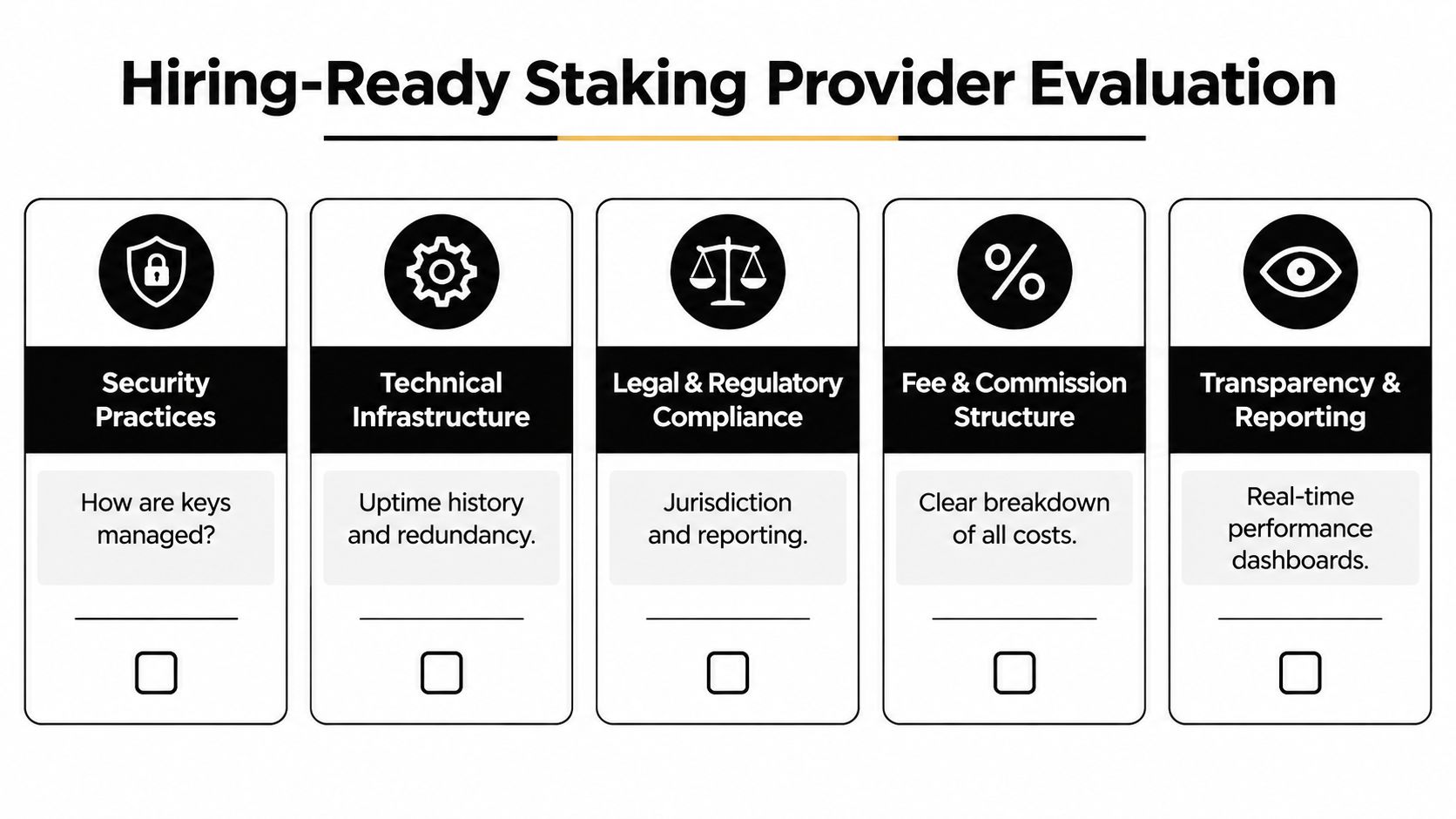
A strong candidate doesn't ask, “What's the yield?” They ask who operates the validator, who signs, how incidents are reported, how fees are calculated, and what happens when customers need liquidity.
Your Next Move From Staking Concepts to a Web3 Interview
Staking knowledge becomes employable when you turn it into evidence. Choose a role, build a small artifact, and practice explaining the trade-offs to someone who understands either the technology or the business, but not necessarily both.
Match the role to the proof
- Protocol engineer: Revisit proof-of-stake mechanics, attestations, rewards, and penalties. Build a concise design note explaining validator incentives and prepare to answer how a protocol discourages dishonest behavior.
- Validator operator or DevOps/SRE: Focus on clients, uptime, signing safety, incident response, and diversity. Produce a monitoring design, an incident runbook, and a testnet validator report.
- Smart-contract auditor: Study custody interfaces, delegation flows, withdrawal logic, and accounting boundaries. Create a review checklist that identifies authorization, accounting, and state-transition risks.
- Risk and compliance analyst: Revisit custody, co-mingling, record-keeping, liquidity, and regulatory questions. Write a staking risk memo that maps each risk to an owner, control, and customer disclosure.
- Liquid-staking product manager: Analyze the difference between customer convenience and operational responsibility. Draft a product requirements document covering validator selection, fees, liquidity expectations, penalties, and reporting.
- Growth or partnerships lead: Learn enough infrastructure to sell responsibly. Prepare a plain-language explanation of rewards, lock-up, unbonding, custody, and provider risk without promising fixed outcomes.
Practice both technical and behavioral questions. Expect prompts such as, “How would you respond to a validator outage?”, “Who bears a slashing loss?”, “How would you compare two custody models?”, and “Tell me about a time you explained a complex system to a nontechnical customer.” Tools that help organize practice, deadlines, and feedback can make it easier to choose interview prep tools that fit your preparation style.
A systems-focused candidate can also study the expectations around a senior systems engineer role at Staking Facilities. The point isn't to copy a job description. It's to compare your current evidence with the operational depth employers expect.
A practical 30-60-90 day plan
Days 1 to 30: Learn the vocabulary and diagram one proof-of-stake flow from deposit to reward, penalty, and withdrawal. Write down the role of each client and identify the custody boundary.
Days 31 to 60: Run a testnet validator or reproduce a validator workflow in a controlled environment. Document setup decisions, monitoring signals, failure scenarios, and the steps you'd take before signing or upgrading software.
Days 61 to 90: Publish a slashing-risk memo or compare liquid-staking protocols in a public post. Include assumptions, questions for providers, and a clear explanation of who controls assets and who owns operational risk.
Your portfolio should make the hiring manager's decision easier. Show the diagram, the runbook, the memo, and the reasoning behind your choices. Staking is a technical system, a financial product, and an operating function. The candidates who connect all three are the ones most likely to move from Web3 curiosity to a credible interview.
Blockchain Jobs connects candidates with opportunities across Web3, including engineering, DevOps and infrastructure, security, product, legal and compliance, and operations roles that intersect with staking. Visit Blockchain Jobs to find relevant openings, review fresh listings, and turn your staking knowledge into a focused career move.