Master Crypto Accounting Software: A Career Guide for Web3 Finance

Wondering what it really takes to land a top finance role in Web3? If you're scrolling through job postings, you'll notice a common thread: proficiency in crypto accounting software. This isn't just a "nice-to-have" skill anymore—it's the ticket to the show.
Your Gateway to High-Impact Web3 Finance Careers
Think of this software as the Bloomberg Terminal for the digital asset world. It’s the essential toolkit that finance pros use to cut through the noise of on-chain data and translate it into clean, auditable financial statements. For anyone in accounting or finance, getting your hands dirty with these platforms is the most direct path into a meaningful career in Web3.
This is what bridges the gap between classic accounting principles and the often-chaotic reality of DeFi, NFTs, and corporate treasuries holding millions in tokens.
Hiring managers at the leading crypto companies aren’t just looking for people who know their debits and credits. They’re desperate for experts who can tackle the unique headaches of the blockchain, from tracking the cost basis of an asset across five different wallets to properly accounting for staking rewards. This is exactly where you can stand out from the crowd and demonstrate you're the right hire.
The Career Opportunity in Numbers
This isn't just a hunch; the market growth tells the whole story. A key piece of this ecosystem, the crypto tax software market, has seen incredible growth. It jumped from $0.72 billion in 2020 and is on track to hit $2.5 billion by 2026.
Some analysts are even more bullish, predicting a $2.5 billion valuation by 2027 on the back of a 22.5% compound annual growth rate. This rapid expansion is fueling an urgent need for finance experts who can actually use these tools. You can dig into the specifics in this detailed market report on crypto tax software.
This guide will give you a practical roadmap for gaining the skills that employers are actively searching for. The knowledge you pick up here directly applies to the growing wave of finance and accounting jobs you'll find across the industry.
Interview Tip: When asked why you want to work in Web3, mention that mastering crypto accounting software proves you can deliver the financial clarity and risk management that every Web3 company—from a bootstrapped DAO to a major protocol—needs to survive and grow. This frames you as a solutions-oriented candidate.
This is your chance to evolve from a traditional bookkeeper into a strategic financial partner in one of the world's most dynamic industries. We’ll break down everything you need to know to talk confidently about these platforms in your next interview and become the candidate they can't afford to pass up.
Why Crypto Accounting Software Skills Matter for Your Career
Understanding these platforms is more than just a line item on your resume; it's a fundamental shift in how you can provide value. It signals to employers that you're not just familiar with crypto, but that you have the hands-on ability to manage it professionally. Framing these skills correctly on your resume and in interviews is key to career progression.
| Key Skill | Impact on Your Career | What Employers Are Looking For |
|---|---|---|
| Transaction Classification | Moves you from data entry to strategic analysis, enabling you to interpret complex on-chain activities. | Someone who can accurately label trades, staking rewards, NFT mints, and airdrops—not just log them. This is a core competency for any finance role. |
| Wallet & Exchange Syncing | Makes you the single source of truth for a company's entire digital asset footprint. Essential for leadership and treasury roles. | The ability to manage and reconcile hundreds of wallets and exchange accounts into one coherent view. This is a skill you must demonstrate for any senior position. |
| Tax Lot & Cost Basis | Positions you as a critical risk manager, saving the company from major tax headaches and unlocking senior-level responsibility. | Expertise in applying accounting methods (FIFO, LIFO, HIFO) to minimize tax liability legally and accurately. This is a highly sought-after skill. |
| DeFi & NFT Reporting | Establishes you as a forward-thinking expert who can handle the industry's newest financial products, putting you on the fast track for promotions. | Deep understanding of how to account for liquidity pools, yield farming, and NFT royalty streams. This shows you're ready for the future of finance. |
Ultimately, these skills demonstrate that you're prepared for the future of finance. You're not just keeping the books; you're building the financial foundation for the next generation of digital-native companies, making you an indispensable asset.
What Crypto Accounting Software Actually Does
Let's cut through the jargon. At its heart, crypto accounting software is the bridge between the wild, chaotic world of blockchain and the structured, orderly world of finance. It takes the high-volume, often confusing stream of data from DeFi, NFTs, and staking rewards and translates it into the clean financial statements every business needs.
If you’re a finance pro looking to move into Web3, getting your head around these tools is non-negotiable. I've seen teams try to track thousands of transactions across a dozen wallets and three different blockchains with a spreadsheet. It never ends well. This is precisely the nightmare that crypto accounting software is designed to fix, and it's a critical point to bring up in any interview.
A hiring manager isn't just testing your knowledge. They're looking for someone who understands the real-world pain points. When they ask how you'd manage a corporate treasury with assets on Ethereum, Solana, and multiple exchanges, your answer needs to revolve around using a dedicated platform to create a single, reliable source of truth.
Where Spreadsheets Break Down
Think about it this way. A traditional accountant might record a simple bank wire. A crypto accountant, on the other hand, has to track a token that was staked in a liquidity pool, earned rewards, got swapped for another asset, and was then bridged to a completely different blockchain. Every single one of those steps is a taxable event with its own cost basis.
Interview Tip: Use this analogy to show you grasp the core problem: "A crypto accountant trying to work without this software is like a translator attempting to interpret five languages at once, in real-time, without a dictionary. It's not just a struggle—it's impossible to do accurately at scale." This demonstrates practical understanding.
This is where automation becomes your best friend. The software handles the most complex and error-prone parts of the job, giving finance teams the clarity and control they desperately need. Knowing exactly how these tools solve specific problems is what will set you apart from a junior bookkeeper and mark you as a candidate ready for a senior finance role.
These platforms are built to tackle challenges that simply don't exist in traditional finance, including:
- Cost Basis Tracking: Automatically calculating the original value of an asset to determine capital gains or losses, even after thousands of trades, swaps, and transfers.
- Impermanent Loss: Properly accounting for the fluctuating value of paired assets in a DeFi liquidity pool—a concept that gives most traditional accountants a headache.
- Transaction Categorization: Identifying and tagging income from staking, airdrops, and even gas fees without someone having to go through each line item manually.
Being able to speak confidently about these functions shows you have a practical, hands-on grasp of the job that goes far beyond just knowing the theory.
The infographic below shows the career path that opens up once you master these platforms. It’s a clear progression from traditional finance skills to the most in-demand roles in Web3.
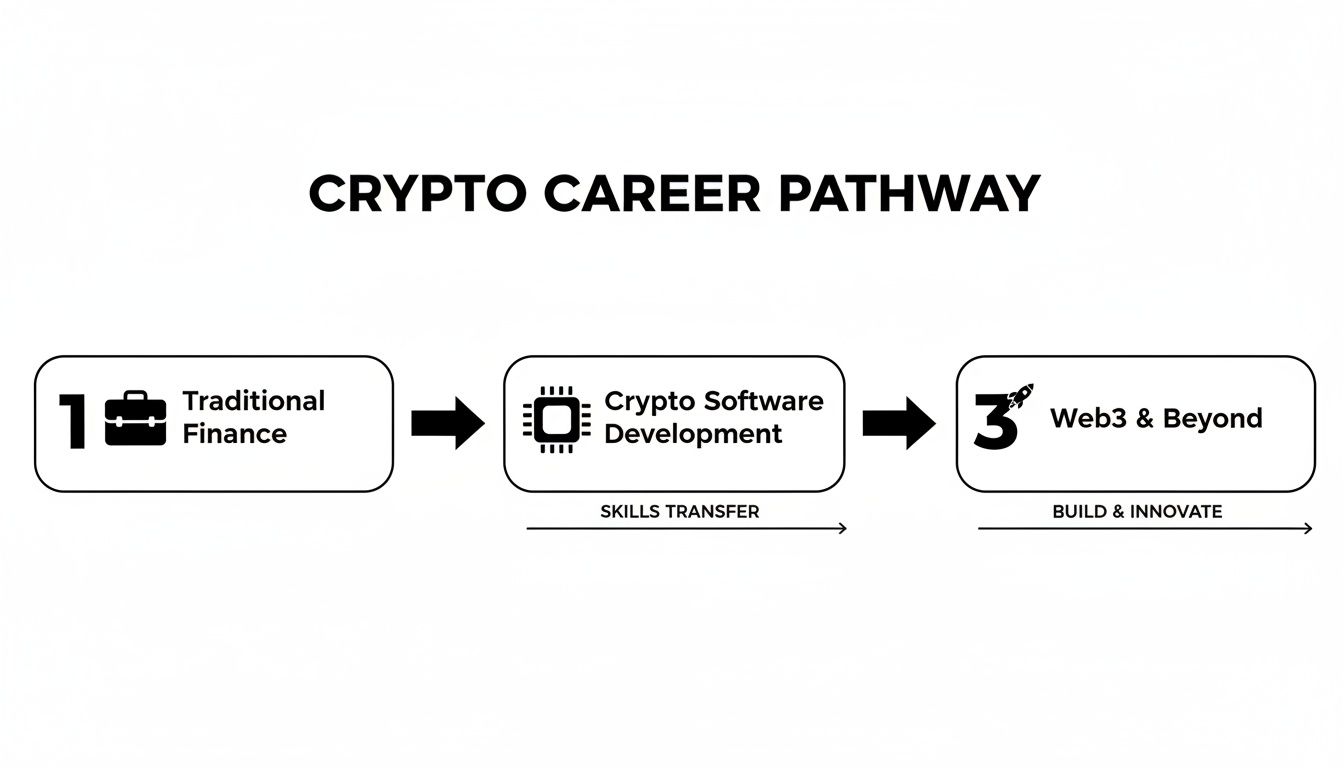
As you can see, proficiency with crypto accounting software is the critical link. It’s what turns your existing finance expertise into a launchpad for a successful Web3 career.
Becoming the Person Who Provides the Proof
Ultimately, this software delivers one thing every Web3 company needs to survive and grow: proof. It’s how you prove financial health to investors, prove compliance to auditors, and prove tax liabilities to regulators. As a finance professional, your ability to run these systems makes you the person who delivers that essential proof.
So, when you walk into an interview, you're not just a candidate who "knows crypto." You're the person who can step in on day one and build the financial integrity the business needs. You’re the one who can produce auditable reports, manage a multi-million dollar treasury, and give the leadership team the confidence to make big strategic moves. That’s how you go from being just another applicant to an indispensable hire.
Core Features That Get You Hired

Walking into a job interview and saying you've "used" crypto accounting software isn't going to set you apart. To really impress a hiring manager, you need to show you understand how specific features solve the real-world financial headaches that Web3 companies face every day. They want to know you can translate the chaos of on-chain data into clean, defensible financials.
Mastering this conversation proves you’re not just a bookkeeper; you’re a strategic thinker who can provide value from day one. Let’s break down the key features and how to talk about them like you’ve been in the trenches.
Automated Transaction Categorization
At its heart, this is all about creating order. Blockchains spit out a relentless stream of data—simple transfers, complex smart contract calls, and everything in between. Trying to manually label thousands of these transactions as income, expenses, or capital gains is a surefire way to burn hours and introduce costly errors.
This is where you can showcase your practical expertise. Explain that automated categorization isn't just a convenience; it's a fundamental risk management practice. These software platforms use rules to automatically identify and tag transactions based on patterns and wallet addresses.
Interview Tip: Frame it this way to show strategic thinking: "Automated categorization is key because it stops one person from calling staking rewards 'Other Income' while someone else logs it as 'Interest.' That kind of inconsistency is a nightmare during an audit. Establishing clear, automated rules is the first thing I'd do to ensure data integrity."
This shows you're thinking ahead, focusing on accuracy, scalability, and building a financial record that can withstand scrutiny.
Wallet and Exchange Reconciliation
Web3 businesses rarely have one simple bank account. Their funds are typically spread across dozens of self-custody wallets, multiple exchanges, and various Layer-2 networks. This creates a reconciliation nightmare.
Your ability to explain how modern software tames this beast is a major plus for any hiring manager. The platform acts as a command center, pulling in data from all these different sources using API keys and public wallet addresses.
It then pieces everything together, ensuring the company has a single, unified source of truth for its entire treasury. When you discuss this, connect it to specific business needs:
- For Treasury Management: "It gives leadership a real-time, consolidated dashboard of all digital assets. This is critical for managing liquidity and making smart capital allocation decisions."
- For Financial Reporting: "It ensures the balance sheet actually reflects the company's complete and accurate asset portfolio, which is non-negotiable for investors and auditors."
Talking this way shows you know how to build the data integrity that any serious Web3 company needs to function. This kind of operational insight is exactly what teams look for in roles like a Product Owner with a crypto focus.
DeFi and NFT Tracking
Here’s where you can really prove you’re ahead of the curve. Your average accounting system has no idea what to do with liquidity pools, yield farming, or NFT mints. This is easily the most complex corner of crypto finance, and if you can demonstrate a solid grasp of it, you’ll stand out.
The best crypto accounting platforms are built to decode these unique on-chain activities. They connect directly to smart contracts to properly identify and account for:
- Income from staking rewards and yield farming.
- Impermanent loss from providing liquidity.
- The cost basis of newly minted or acquired NFTs.
- Royalty payments generated from secondary NFT sales.
So, when a hiring manager asks how you'd handle the company's DeFi strategy, you can confidently explain how the software tracks these novel revenue streams and asset transformations. You're not just an accountant who can close the books; you’re a strategic partner who can help the business make sense of its most innovative—and profitable—ventures.
How to Speak the Language of Compliance and Audits

Let’s be honest, the word "audit" can send a shiver down the spine of even the most seasoned Web3 founder. This is where a sharp finance professional moves from being a helpful team member to an absolutely essential one. As regulators get more serious about crypto, companies are scrambling for experts who can build a true fortress of financial integrity.
When you walk into an interview and can confidently discuss compliance, the entire dynamic shifts. You’re no longer just talking about bookkeeping; you're showing them how you can protect the company from its biggest risks. This is how you prove you're ready for a senior finance position.
The trick is to position your knowledge of crypto accounting software as the company's first and best line of defense. This software is what builds the transparent, verifiable audit trail that regulators and auditors need to see.
Creating the Indisputable Audit Trail
In theory, every transaction on the blockchain is public. But in reality, raw blockchain data isn't an "audit trail"—it's a chaotic mess of alphanumeric strings that’s nearly impossible to interpret. A real audit trail connects every single on-chain event to a clean, corresponding entry in the general ledger.
This is the exact capability you need to be able to explain. Your crypto accounting software is the bridge that makes this connection possible. It works by:
- Ingesting Raw Data: Automatically pulling every transaction from all company wallets, exchanges, and smart contract interactions.
- Enriching with Context: Labeling those transactions with meaningful business context, like identifying staking income, NFT minting fees, or a payroll distribution.
- Generating Verifiable Reports: Creating financial statements where every number is interactive. You can click on a line item and trace it all the way back to the original on-chain transaction.
Interview Tip: Say this to demonstrate your value: “My goal is to create an unbreakable link between our books and the blockchain itself. If an auditor questions a revenue number, I won’t spend days digging through block explorers. I can show them the exact on-chain transaction that proves it in seconds. That level of transparency is our best defense and my primary responsibility.”
Mitigating Tax Risk and Demonstrating Controls
With agencies like the IRS sending out tens of thousands of crypto-related notices, tax compliance has become a huge source of anxiety for any business in this space. This is a massive opportunity for you to stand out. Being fluent in the tax features of these platforms shows you can tackle this risk head-on.
This isn't a small problem. The crypto tax software market is projected to swell to $47.6 billion by 2035. With cloud-based tools already making up 72.5% of the market and some claiming to reduce audit risks by up to 90% with smart categorization, mastering these platforms is no longer optional. You can dig into these trends in this comprehensive market analysis.
To really impress, take the conversation beyond simply calculating capital gains. Talk about how you’d use the software to set up and enforce strong internal controls. For instance, explain how you would configure the system to automatically flag large or unusual transactions for a manual review. This demonstrates a proactive approach to risk management that hiring managers love.
Speaking this language of compliance and control proves you're not just waiting for problems to happen. It shows you have the foresight and the technical skill to build a financial operation that’s compliant by design, making you a vital asset to any leadership team.
Choosing the Right Software to Learn and Recommend
Picture this: you're in the final interview stage. The hiring manager looks at you and asks, "If we had to build our crypto accounting function from scratch today, what software would you recommend, and why?" This is the moment of truth. It’s not just a technical pop quiz; it's their way of seeing if you think strategically.
Nailing this question is what separates a candidate who knows about crypto accounting software from one who can actually build with it. The rookie answer is to just name a popular tool. The pro move is to show you understand the process of choosing the right tool for their specific business needs.
This is more than just good interview advice—it's a critical skill for moving up in your career. It shows you can think like a finance director, evaluating solutions not just for today's mess, but for where the company is headed tomorrow.
Beyond Brand Names: A Strategic Evaluation Framework
When you're asked to recommend a solution, your first step shouldn't be to give an answer, but to ask a few smart questions. A small startup with only a hundred transactions a month has completely different needs than a massive protocol handling millions. Showing you get this distinction is incredibly powerful.
Any solid evaluation of crypto accounting software really comes down to three core pillars: scalability, coverage, and integration.
- Scalability: Can the platform handle a massive transaction volume without slowing down or crashing? A tool might seem fine for managing a small treasury, but you need to know if it will fall apart when the company launches a new token or dives into high-frequency DeFi trading.
- Coverage: How many blockchains, exchanges, and DeFi protocols does it actually support? A business that only operates on Ethereum has simple needs. But what about a company with assets scattered across Solana, Arbitrum, and half a dozen centralized exchanges?
- Integration: How well does it play with the company's existing financial systems? If a tool can't connect directly with the main ERP—whether it's NetSuite, QuickBooks, or Xero—you're just creating more manual work and opening the door for costly errors.
Answering with this kind of framework proves you're not just a technician. You're a strategic partner who can help design a financial system that’s built to last. That’s the kind of director-level thinking that hiring managers are desperate to find.
The Business Case for the Right Tool
Choosing the right platform isn't just about convenience; it's a fundamental driver of efficiency and risk management. There's a reason businesses make up 68.3% of the crypto tax software market—enterprises have found they can slash their financial reporting time by a massive 70-80% with the right setup. As new regulations like Europe's MiCA and clearer rules in Asia expand compliance needs beyond North America, that efficiency becomes non-negotiable.
With cloud-based solutions now dominating the market at 72.5%, their ability to handle the sheer complexity of DeFi through features like built-in blockchain analytics is a huge selling point. You can dig deeper into these crypto tax software market dynamics and their business impact to see the trends for yourself.
This data isn't just trivia; it’s ammunition for your job interview. It gives you the power to confidently explain that investing in the right crypto accounting software delivers a direct and measurable return on investment.
Interview Tip: When an interviewer asks you to recommend a tool, flip the script. Start by asking about their transaction volume, the blockchains they use, and their current ERP system. This turns your answer into a strategic consultation and instantly proves you see the bigger picture.
Crypto Accounting Software Evaluation Checklist for Your Career
Here’s a practical checklist to guide your evaluation process, whether you're making a recommendation in an interview or selecting a tool for your own team. Thinking through these questions will help you match the software's capabilities to real-world business needs, demonstrating senior-level thinking.
| Evaluation Criteria | Key Questions to Ask | Why It Matters for Your Career |
|---|---|---|
| Scalability & Performance | How many transactions can it process per hour? Does performance degrade with volume? | Shows you plan for growth, not just current needs. A key trait for senior roles. |
| Blockchain & Protocol Coverage | Which L1s, L2s, CEXs, and DeFi protocols are supported? How quickly are new ones added? | Demonstrates your understanding of the diverse Web3 ecosystem and its operational realities. |
| ERP & System Integration | Does it offer native, one-click integration with our ERP (NetSuite, QuickBooks, etc.)? | Proves you value efficiency and data integrity, key concerns for any finance leader. |
| Reporting & Analytics | Can it generate GAAP/IFRS-compliant reports? Does it provide chain analytics for forensics? | This is your ability to deliver audit-ready financials and actionable insights, not just data. |
| Tax Calculation | What cost basis methods does it support (FIFO, LIFO, HIFO)? Can it handle complex scenarios like airdrops and staking? | Tax is a critical function. Knowing the details shows you can manage compliance and risk. |
| Team Collaboration | Does it have role-based access controls and audit trails for multiple users? | Shows you think about security, process, and how a real finance team operates. |
| Pricing & Total Cost of Ownership | Is the pricing based on transaction volume, AUM, or a flat fee? Are there hidden implementation costs? | Understanding budget impact and ROI is a core skill for anyone moving into management. |
Using a structured approach like this ensures you're not just picking a tool, but making a sound business decision. It’s this consultative mindset that truly sets you apart. If you want to see how these skills apply in the real world, check out a role like this Enterprise Solution Consultant opening. It requires this exact blend of technical depth and strategic thinking—the very combination that helps you land a job where you can make a real impact.
Building Your Future as a Web3 Finance Leader
The most valuable finance professional in Web3 is a rare hybrid. They’re someone who can talk GAAP principles and tokenomics in the same breath, balancing debits and credits with smart contracts. Crypto accounting software is the critical piece of kit that bridges those two worlds. Getting comfortable with these platforms is the single most important thing you can do to build a career in this space.
This isn't just about learning to click buttons in a new program; it's a fundamental shift in perspective. The opportunities out there for finance pros who genuinely understand digital assets are massive. If you get the skills right, you're not just aiming for a job—you're on a clear path to a leadership role.
Charting Your Path to Leadership
So, where do you go from here? Becoming a leader in Web3 finance means moving past the basics of bookkeeping. Think of your skills with crypto accounting software as the foundation. Now it's time to build the rest of the house.
To really stand out and move up the career ladder, concentrate on these areas:
- Go Deeper On-Chain: It's one thing to track transactions. It's another to truly understand what's happening. Dig into the mechanics of major DeFi protocols, learn how DAOs are managing their treasuries, and get your head around the economic models that make different tokens tick. This is how you move from providing operational reports to strategic financial guidance.
- Master Data Storytelling: The best accounting platforms spit out a mountain of data. Your job is to make sense of it. Learn how to use tools like Dune Analytics or even advanced Excel features to find the story in the numbers. Turning raw data into a clear dashboard that tells a CEO what to do next is a true leadership skill.
- Learn to Be a Translator: You'll have to explain concepts like impermanent loss or NFT royalties to people who don't live in spreadsheets—like marketers, developers, and the C-suite. Being able to break down complex financial topics into plain English is a superpower that gets you noticed by senior management.
How to Frame Your Experience for Your Next Role
Think of your resume and LinkedIn profile as your personal marketing campaign. They need to tell a hiring manager exactly why you’re the person they need for their Web3 finance team. Don't just list the software you've used; show the problems you’ve solved with it.
Resume Pro Tip: Your resume shouldn't say, "Proficient in Bitwave." It should say, "Managed a multi-chain treasury using Bitwave, cutting the month-end close time by 40% by building automated reconciliation rules." That shows real, measurable impact and immediately grabs an interviewer's attention.
Here's how to position your skills to get noticed:
- Action-Oriented Resume Bullets: Kick off every point with a strong verb that demonstrates impact. Use words like: "Reconciled," "Audited," "Automated," "Modeled," "Optimized," and "Streamlined."
- A Project-Based LinkedIn Profile: Even without direct job experience, you can create it. Sign up for a free trial of a crypto accounting tool and use it to reconcile your own wallet. Document your process, the snags you hit, and the reports you created in a LinkedIn post. This shows initiative and proves you can solve real-world problems.
- A Mindset of Constant Learning: Make it clear you're committed to keeping up. Mention relevant certifications you're pursuing, newsletters you read religiously, or Web3 communities you're active in. This tells employers you're adaptable and ready for whatever comes next in this fast-moving industry.
In the end, becoming a leader in Web3 finance comes down to your own curiosity and drive. The software is just the tool. Your ambition is what will decide how far you take it.
Frequently Asked Questions
If you're looking to build a career in Web3 finance, you probably have some practical questions about getting up to speed with crypto accounting software. Here are the answers to the questions we hear most often from finance pros ready to make the jump.
Can I learn this without a formal accounting background?
Yes, you absolutely can. While being a CPA is a huge plus for senior finance roles, plenty of other jobs in Web3 need people who are skilled with these platforms. If you're in operations, product management, or compliance, understanding how these tools work is a major advantage.
When you can show a hiring manager that you know your way around transaction categorization and wallet reconciliation, you’re proving you understand the financial engine of a Web3 company. Many crypto accounting software providers offer free tutorials and certifications—these look great on a resume and will make you a much stronger candidate for a variety of roles.
Which single software is best to learn for getting a job?
It’s actually much smarter to understand the core principles of crypto accounting rather than focusing on just one tool. That said, getting familiar with industry leaders like Bitwave, Tres, or Cryptio is a great career move.
Interview Tip: It's far more impressive to discuss how you would solve a problem—like tracking complex DeFi rewards or accounting for NFT minting costs—rather than simply listing the software you know. Always check job descriptions for any specific tools a company mentions to tailor your learning.
This approach shows you’re a problem-solver, not just someone who knows how to click buttons. That’s what companies are really looking for.
How does this software handle DeFi and NFTs?
This is where these tools really shine, and it’s a critical topic to nail in interviews. The best crypto accounting software plugs directly into wallets and reads smart contract data to automatically sort out complex on-chain activity.
- For DeFi: It can identify and calculate income from staking, liquidity pools, and yield farming, turning chaotic data into clean entries for your general ledger.
- For NFTs: It tracks the cost basis of every mint and purchase, which is essential for calculating accurate capital gains or losses when an NFT is sold.
Showing that you get how this automation works is a must if you want to land a role at an NFT marketplace, a Web3 gaming studio, or a DeFi protocol.
How do I get hands-on experience without a job?
Start with your own wallet. It’s the easiest way to begin. Connect one of your personal wallets to a free version or free trial of a popular crypto accounting tool and just start playing around.
Try to categorize your transactions, track any DeFi activity you’ve participated in, or figure out the cost basis of an NFT you own. Document what you did and any problems you had to solve along the way. You can then talk about this project in interviews to show you’re proactive, a good problem-solver, and genuinely interested in the space. It’s a powerful way to prove your skills and stand out from the crowd.
Ready to find your place in the future of finance? Blockchain Jobs is the leading platform for discovering roles in the Web3 ecosystem. Explore thousands of curated opportunities in finance, engineering, marketing, and more to find your perfect fit. Start your search today.