Your Guide to Modern Web Designer Jobs in 2026
You're probably in one of three spots right now. You're sending applications into a black hole, getting interviews but not offers, or staring at job descriptions that say “web designer” while asking for half a front end team, a content marketer, and a customer-facing account manager.
That confusion is real. The market for web designer jobs is crowded, and the title has become sloppy.
The good news is that the career itself is still durable. The U.S. Bureau of Labor Statistics projects employment for web developers and digital designers to grow 7% from 2024 to 2034, with about 14,500 openings per year over that decade, according to the BLS occupational outlook for web developers and digital designers. That tells you something important. This isn't a fading niche. It's a formal career path with steady hiring demand.
If you want a better role in 2026, stop treating your job search like a vague creative pursuit. Treat it like product positioning. Your title target, portfolio, resume, and interview story all need to line up. That's how you get hired.
The Evolving Landscape of Web Designer Jobs
You open a job post for a “web designer” role and the company wants landing pages, conversion copy instincts, Webflow or Shopify experience, basic HTML and CSS, stakeholder management, analytics awareness, and enough product sense to improve flows after launch. That title is doing too much work.
Treat job titles as loose labels, not accurate definitions. Hiring teams write “web designer” when they need someone who can make the website perform, ship with less friction, and work well with marketers, developers, founders, or product teams. If you interpret the title strictly, you will apply to the wrong roles and frame your experience the wrong way.
That is why strong designers still miss interviews. Their portfolio shows taste. The job description is screening for business judgment, production readiness, and evidence that they can turn messy requirements into pages and flows that go live.
Why the title feels messy now
“Web designer” used to mean page design. Now it often covers brand sites, CMS systems, responsive UI, CRO work, light SEO, design systems, and collaboration with engineering. In one company, the role sits inside marketing. In another, it supports product growth. In a smaller startup, it can span both.
The split gets sharper in high-growth crypto and blockchain teams. A company may post for a web designer and need someone who can design onboarding for wallets, explain token mechanics on a landing page, and keep trust high in a category where clarity matters more than visual flair. If you need context on how those hiring environments differ, read this explanation of Web2 vs Web3 roles and products.
Read the verbs in the job description. They tell you what the company values. “Own,” “ship,” “test,” and “collaborate” usually signal a hands-on role tied to outcomes. “Create beautiful assets” usually signals a narrower visual production role. Your job search gets easier once you stop sorting roles by title and start sorting them by expected impact.
Your first decision is not where to apply. It is which version of the role you want to win.
What hiring managers actually look for now
Hiring managers want range, but not random range. They want a designer who can make strong visual decisions, explain those decisions in plain language, and work within real delivery constraints. That means content hierarchy, responsive behavior, CMS reality, accessibility basics, and enough technical understanding to avoid handing engineering a fantasy.
For Web3 roles, the signal is even more specific. Teams want designers who can reduce risk and confusion. Users are often skeptical, product concepts are unfamiliar, and trust is fragile. A polished hero section is nice. Clear information architecture, readable transaction states, plain-language onboarding, and consistent interface patterns get people hired.
If your UX foundation is weak, fix that before you send another batch of applications. Start with the basics and learn UX design with Solo AI.
The designers getting offers in 2026 will present themselves like operators, not decorators. They show how they think, how they ship, and how their work supports growth. That is the standard now.
Decoding Modern Designer Roles Web vs UI vs Product
Most candidates apply too broadly because they don't understand how these roles differ in practice. That costs interviews. A hiring manager can tell in five minutes when a portfolio says “product thinker” but the work is mostly static marketing pages.
Think of the three roles like a building project.
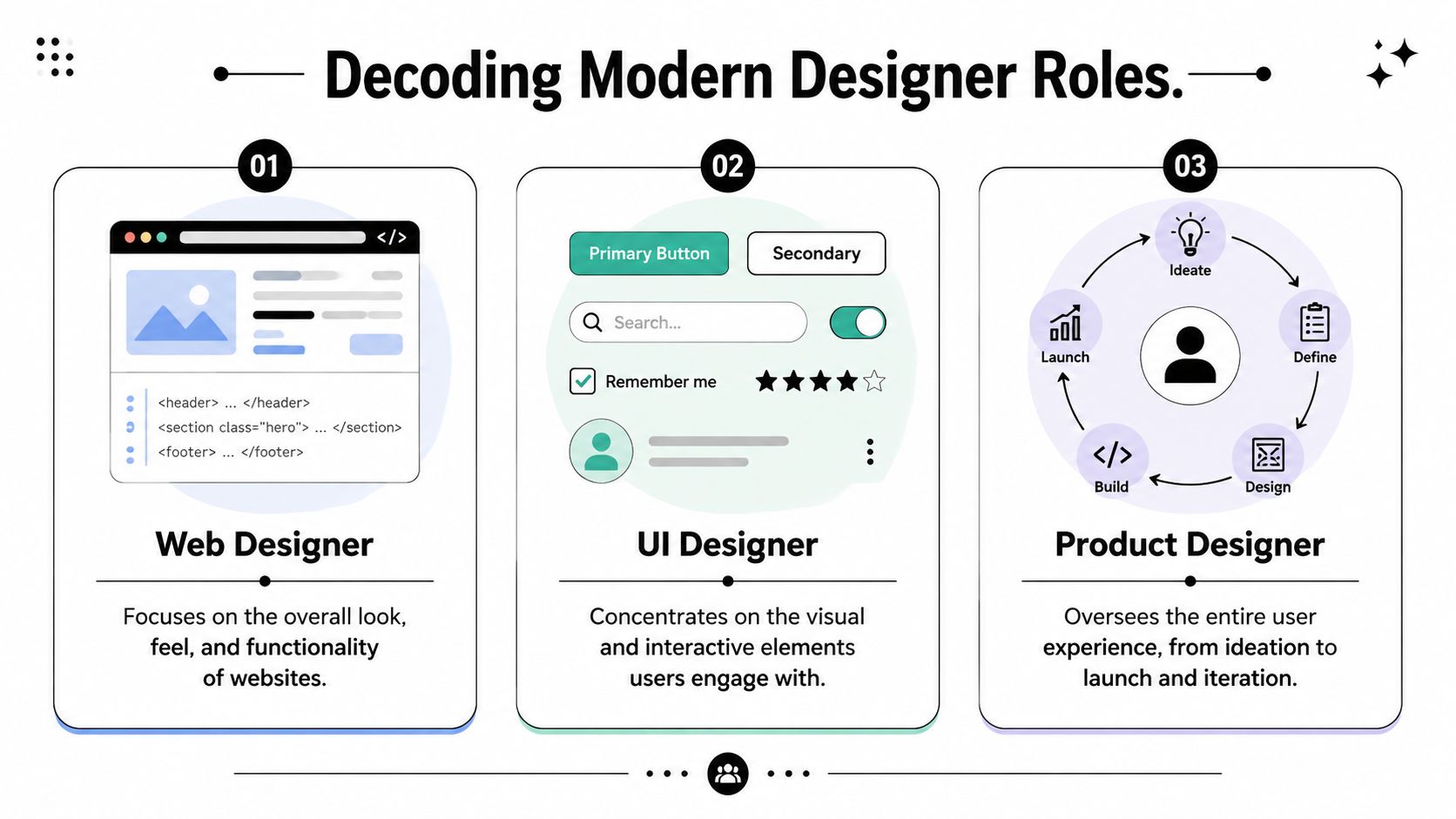
A web designer is closest to the architect working on the public-facing structure. A UI designer is shaping the surfaces and controls people interact with inside. A product designer is thinking about the whole system, how people move through it, where they get stuck, and how the experience improves over time.
What a web designer actually does
A web designer usually works on websites. That includes marketing sites, brand sites, campaign landing pages, editorial layouts, CMS-driven pages, and smaller business websites.
Success in this role usually means you can:
- Create clear page structure that supports content, navigation, and calls to action
- Design responsive layouts that hold up across desktop, tablet, and mobile
- Work with CMS realities such as WordPress, Webflow, Shopify, or custom systems
- Think beyond visuals so the site loads cleanly, scales, and doesn't break in production
A lot of these jobs now ask for overlap with front-end implementation and content operations. If you're targeting this track, you should also understand who typically hires for it. Agencies, in-house marketing teams, startup growth teams, and smaller companies all define the role differently.
What a UI designer owns
A UI designer is more focused. They care about the interface layer itself. Buttons, form states, component styling, spacing systems, visual hierarchy, iconography, interaction states.
They often work inside product teams, but not always. Their strength is polish and consistency. If a product feels coherent, legible, and easy to scan, a strong UI designer probably had a hand in it.
If that path appeals to you, this guide on hiring a UI designer is useful because it reveals how companies think about the role from the hiring side, not just the candidate side.
For many designers, a stronger foundation in UX helps here. If your interface work looks good but lacks reasoning, spend time to learn UX design with Solo AI. That kind of study makes your UI decisions easier to defend in interviews.
What product designers do differently
Product designers operate at a wider scope. They don't just ask whether a page looks good. They ask whether the feature should exist, how it fits into the user journey, what problem it solves, and how the team will iterate after launch.
Here's the practical difference:
| Role | Main surface | Core concern | Typical team context |
|---|---|---|---|
| Web Designer | Websites and landing pages | Clarity, responsiveness, brand, conversion | Marketing, agency, growth |
| UI Designer | Interface components and screens | Visual consistency and interaction design | Product, design systems, apps |
| Product Designer | End-to-end product flows | User outcomes, feature logic, iteration | Cross-functional product teams |
Don't chase the title with the highest status. Chase the work you can actually prove.
If your portfolio is mostly website redesigns, call yourself a web designer or UI designer. If you've mapped flows, handled feature tradeoffs, and collaborated closely with PMs and engineers, then product designer may fit. Be honest. Clear positioning gets more interviews than inflated positioning.
The Skill Stack That Actually Gets You Hired in 2026
The pure visual web designer is fading as a hiring category. Not completely, but enough that you shouldn't build your career around that fantasy.
A recent Dallas job post for a web designer asked for WordPress, Elementor, basic SEO, HTML/CSS, Photoshop/Illustrator, creative copywriting, and phone skills, according to Indeed job listings for web designer roles in Dallas-Fort Worth. That's the reality now. Employers often want a hybrid operator.
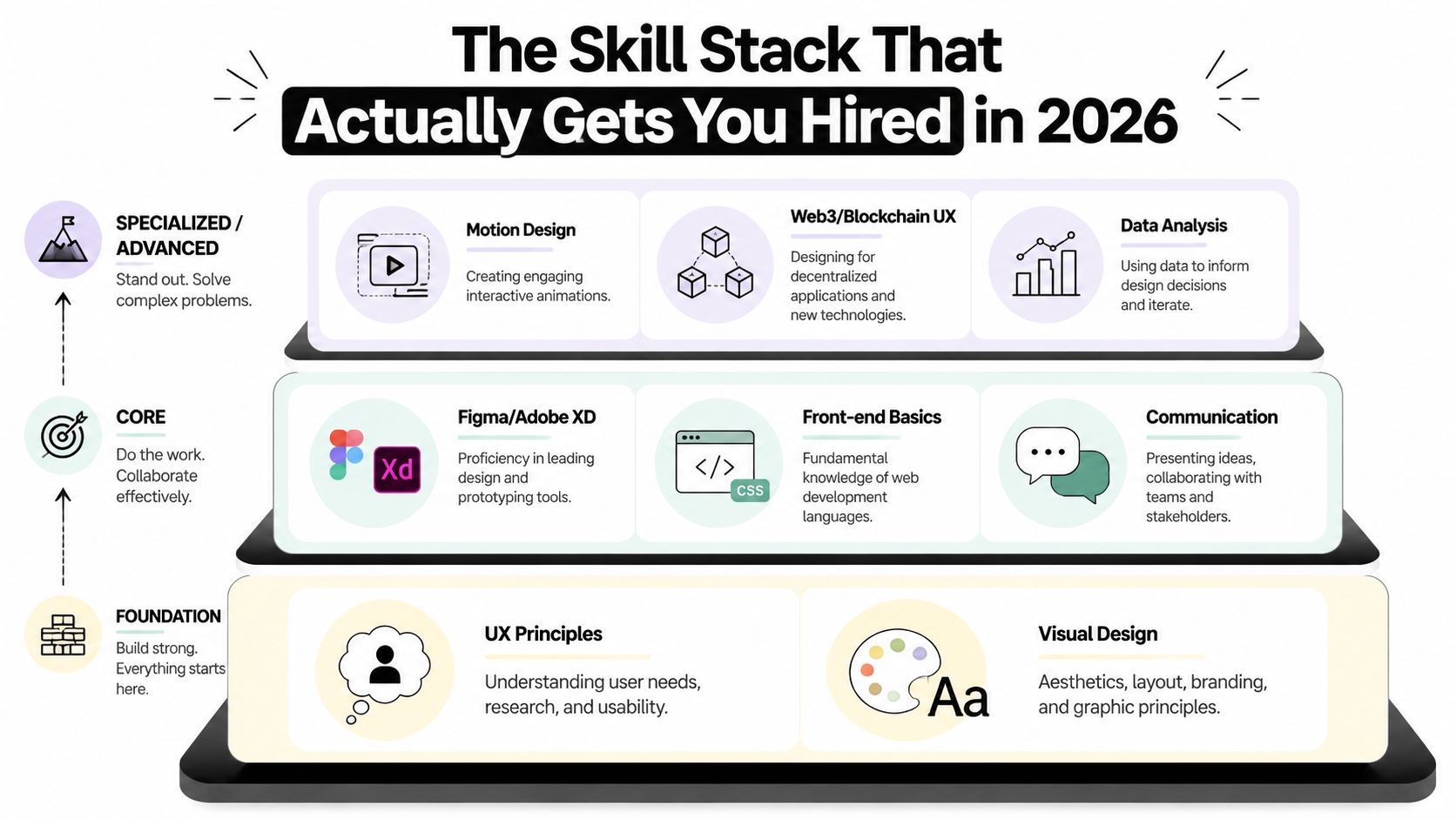
Must-have skills
These are essential if you want serious interviews for web designer jobs.
Visual fundamentals
You need command of hierarchy, typography, spacing, contrast, layout, and responsive composition. If your pages look noisy or inconsistent, you're out.UX basics
You don't need to be a full-time researcher, but you do need to understand task flow, clarity, accessibility, and friction points. A pretty page that confuses users is weak design.Figma fluency
Not just drawing frames. You should know components, variants, auto layout, prototyping, and how to organize files so another designer or developer can work with them.Responsive thinking
Show desktop, tablet, and mobile logic. Don't just shrink the desktop design and call it done.
Should-have skills
These are the filters that separate finalists from the pile.
A lot of employers expect web designers to understand implementation constraints. That means you should know enough front end to avoid designing nonsense.
- HTML and CSS literacy
You should understand structure, layout behavior, spacing systems, and what tends to break. - CMS familiarity
WordPress matters in many traditional web roles. Webflow, Shopify, and headless content systems matter in others. - SEO awareness
Not technical SEO depth. Basic page structure, content hierarchy, metadata awareness, and search intent. - Content judgment
You should know when a headline is weak, when a CTA is vague, and when a page is trying to say too much.
Nice-to-have skills
These won't rescue a weak candidate, but they can push you ahead.
- Motion and micro-interactions for modern interfaces
- Analytics literacy so you can read behavior signals and iterate
- AI-assisted workflow habits for faster ideation, copy exploration, and production support
If you want a practical look at current tooling, this roundup of top AI design tools is worth scanning. Don't treat AI as your value. Treat it as a tool.
How to prioritize your learning
Use this order:
- Fix your design fundamentals
- Learn responsive layout thoroughly
- Get competent with HTML and CSS
- Build in Figma like someone else must inherit your files
- Add CMS and SEO awareness
- Then specialize
Practical rule: If you can't explain how your design will behave in the browser, you're not ready for many modern web designer jobs.
For Web3 roles, the stack shifts slightly. You still need the basics, but then you add wallet flows, trust cues, transaction states, and clarity around unfamiliar concepts. That's where many traditional web designers can stand out, because the space still needs people who can simplify messy experiences.
Building a Portfolio That Closes Interviews
Your portfolio isn't a gallery. It's evidence.
Most designers still present work like they're waiting for applause. Hiring managers aren't looking for applause material. They're looking for proof that you can take a messy problem, make strong decisions, collaborate with others, and ship something that fits the brief.

Many employers ask for at least a bachelor's degree or equivalent portfolio-backed experience, and some job descriptions recommend a minimum of three years' experience while emphasizing tools such as Figma, Sketch, and Adobe Creative Suite, according to Coursera's overview of web designer career expectations. Read that carefully. Portfolio-backed experience isn't a side note. It's often your real credential.
What hiring managers want to see
They want answers to basic questions:
- What was the problem?
- Who was the user?
- What constraints did you face?
- What did you do?
- Why did you choose that direction?
- What changed because of your work?
If your portfolio skips those questions and jumps straight to polished screens, you're making the reviewer do extra work. Most won't bother.
Build each case study like a business story
A strong web design case study usually needs these parts:
| Section | What to show |
|---|---|
| Problem | The business or user issue you were solving |
| Context | Team, timeline, platform, constraints |
| Process | Research, exploration, wireframes, decisions |
| Execution | Final layouts, responsive states, components |
| Outcome | What the work improved or enabled |
You don't need to write a novel. You do need to prove judgment.
The mistakes that kill interviews
These show up constantly.
Too much final UI, not enough reasoning
Nice screens don't explain your thinking.No indication of your role
If it was a team project, say exactly what you owned.Password walls everywhere
If every interesting project is locked, many recruiters will move on.No responsive views
For web designer jobs, this is a major miss.No business context
A homepage redesign for what purpose? Brand refresh, conversion improvement, clearer navigation, better onboarding? Say it.
If I finish reviewing your portfolio and still don't know how you think, the portfolio failed.
What to include if you're junior
You don't need famous clients. You need credible work.
A junior portfolio can include:
- A real client project from freelance or internship work
- A strong self-initiated redesign with clear rationale
- A CMS-based website build that shows practical execution
- One experimental project if it reveals process and taste
If you want Web3 work, include at least one concept project in that direction. Redesign a wallet onboarding flow. Improve a token dashboard. Rework a decentralized app landing page. Don't wait for permission to demonstrate relevance.
Nailing the Resume and Design Interview
A good portfolio gets you considered. A good resume gets you seen. A good interview gets you hired. They're different jobs, and you need to handle all three.
Your resume is not the place for vague identity statements like “passionate designer with a keen eye for detail.” Everyone writes that. It says nothing. Use the space to match the hiring brief.
Fix your resume first
Read the job description like a parser. Pull out the recurring requirements and reflect them accurately if you have them.
Employers commonly expect proficiency in HTML, CSS, and JavaScript because the role goes beyond visuals into functional delivery, speed optimization, and scalability, as noted in Randstad's web designer job profile. That means your resume should not hide technical literacy if you have it.
Use a structure that helps both recruiters and applicant tracking systems.
Headline
Use a clear target, such as “Web Designer with Figma, WordPress, and HTML/CSS experience.”Skills block
Keep it relevant. Figma, Adobe Creative Suite, HTML, CSS, JavaScript, WordPress, Webflow, responsive design, prototyping, SEO basics.Experience bullets
Focus on what you designed, what you improved, how you collaborated, and what tools or systems you used.Portfolio link
Make it obvious and clickable.
Prepare for the three interview formats that matter
Most web designer jobs use some mix of these.
Portfolio walkthrough
It's common for candidates to ramble. Don't narrate every screen. Tell a sharp story.
Use this sequence:
- Problem
- Constraints
- Options considered
- Decision made
- Tradeoffs
- What you learned
Keep each project to a few minutes unless they ask for depth.
Live critique
You'll be shown a website or product and asked what you'd improve. Don't perform taste. Diagnose.
Start with:
- User goal
- Primary friction
- Priority issue
- Suggested change
- Expected effect
That structure makes you sound like a designer who can work on a team, not a critic on the internet.
Whiteboard or working session
Some companies want to see how you think under pressure. They don't expect perfection. They do expect structure.
Say your assumptions out loud. Interviewers can forgive an imperfect solution. They won't forgive chaotic thinking.
The answer that lands when they ask about process
When they ask, “Tell me about your design process,” don't recite a textbook. Give a practical version:
- Clarify the objective
- Understand users and constraints
- Map the structure
- Explore a few directions
- Get feedback early
- Refine with implementation in mind
- Test and adjust after launch
If you can tie your process to collaboration with content, product, engineering, or marketing, even better. That's what mature hiring teams want to hear.
How to Find Web Designer Jobs from Web2 to Web3
You apply to 40 roles, hear back from two, and both interviews drift toward the same question. Why should we hire you for this specific kind of design work? That is the core job search problem. The issue is rarely effort. It is weak targeting.
Web designer jobs still exist in large numbers across agencies, SaaS companies, ecommerce brands, and startups. Web3 adds another lane with less title standardization and more hiring noise. That creates an opening for designers who can read between the lines of a job description and spot what the team needs.
Search by hiring signal, not just by title
If you search only for “web designer,” you will miss a lot of relevant roles and waste time on weak fits. Hiring teams use messy labels. Your job is to decode them.
Search in clusters:
- Web designer
- UI designer
- Marketing designer
- Webflow designer
- WordPress designer
- Digital designer
- Product designer, if your portfolio shows product thinking and interface depth
Then read for signals.
A listing that talks about landing pages, CMS updates, conversion, and brand consistency is usually a growth or marketing design job. A listing focused on flows, edge cases, onboarding, and usability issues is closer to product or UI work, even if the title still says web designer.
The strongest applications mirror the company's actual need, not the headline on the posting.
Treat Web3 as a strategy move, not a trend bet
Web3 is worth your attention for one reason. A lot of products in the category still communicate poorly. Confusing wallet setup, unclear transaction states, weak security messaging, and overloaded dashboards create obvious room for good designers.
That is why Web2 designers can break in faster than they think.
A Web3 team is often hiring for judgment more than pedigree. They want someone who can reduce friction, write clearer interface language, improve trust cues, and make a technical product feel usable to a normal person. If you already know how to simplify forms, structure pages, and guide users through high-stakes actions, you already have part of the skill stack.
If you want to study where demand is showing up, review current Web3 job openings across product, design, and growth roles. Look for repeating patterns in responsibilities, not just titles.
A practical route from Web2 into Web3
Do not wait to be invited. Build proof.
Use this roadmap:
Learn the common product patterns
Study wallets, swaps, staking flows, dashboards, governance screens, transaction confirmations, and failure states.Build two focused case studies
Redesign wallet onboarding. Simplify a portfolio page. Fix a confusing transaction review step. Show how you handled trust, hierarchy, and error prevention.Study live products with a hiring lens
Look at how teams explain fees, approvals, permissions, and risk. Weak explanations usually point to the exact design problems companies are trying to hire for.Use specialist boards with mainstream platforms
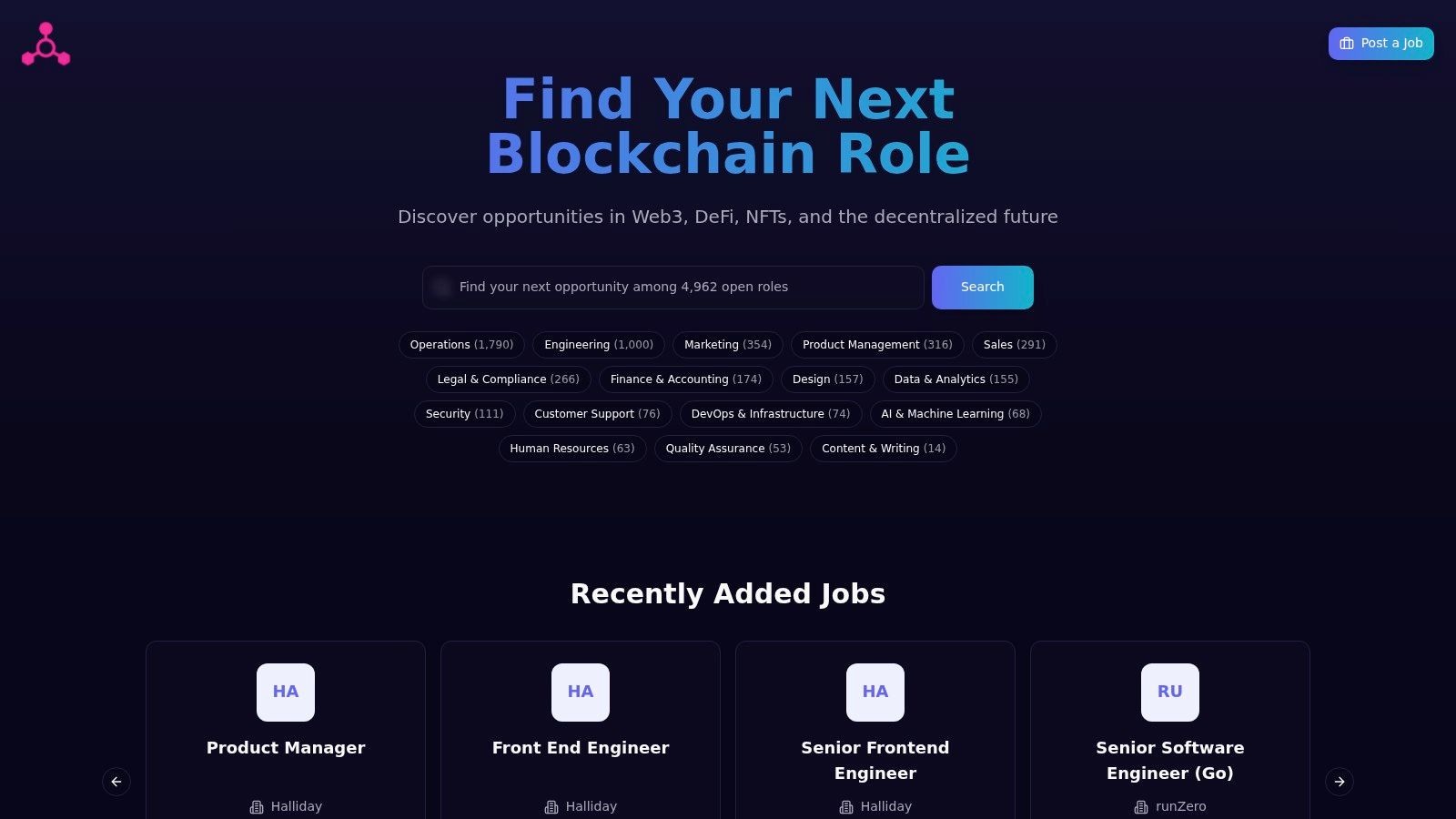
LinkedIn and Indeed are still useful. Specialist sources help you find earlier-stage teams and more specific role language. Blockchain Jobs is one example used by companies hiring across the Web3 category.
The space also benefits from context, so this video is worth a quick watch before you start positioning yourself for blockchain-facing work.
What to emphasize in your application
Your application should change based on the business model.
For Web2 roles, highlight responsive design, CMS comfort, design systems, and conversion-aware page structure. For Web3 roles, highlight complex flows, trust-building UI decisions, error handling, onboarding clarity, and your ability to make technical actions understandable.
Do not present yourself as “passionate about crypto” unless you can back it up with actual work or informed product analysis. Hiring managers see through that instantly. Show that you understand the user problems, the friction points, and the business risk of bad design. That is the signal that gets interviews.
Charting Your Career Path in Web Design
A strong design career doesn't come from collecting tools. It comes from building a reputation for useful judgment.
That's the thread connecting everything here. Titles are messy. Skills overlap. Job descriptions are often bloated. The people who keep moving forward are the ones who understand what companies are really hiring for and then present themselves with precision.
The career moves that compound
Early in your career, breadth helps. You should know enough design, front end, content structure, and stakeholder communication to be useful in messy environments.
Later, you can lean harder into a lane:
- Web specialist for high-performing marketing sites and CMS ecosystems
- UI specialist for polished interfaces and design systems
- Product designer for broader ownership and cross-functional product work
- Web3 designer for decentralized apps, dashboards, and trust-heavy flows
Each path is valid. What matters is that your portfolio, resume, and interview story all point in the same direction.
What not to do
Don't keep rebranding yourself every few months based on whatever title looks hottest. Hiring managers can smell that instantly.
Don't hide technical literacy because you think it makes you look less creative. In modern web designer jobs, implementation awareness makes you more valuable.
Don't wait for a company to hand you the perfect brief either. Build the work that proves the next role you want.
The market rewards designers who reduce risk for a hiring team. Show that you can do that, and you'll keep finding opportunities.
The long view
You're not trying to win one application cycle. You're trying to become the kind of designer people remember when a strong role opens up.
That means better case studies, sharper positioning, stronger communication, and smarter targeting. It also means adapting when the web changes. It will keep changing. That's not a threat if you build the habit of learning through real work.
If you want the blunt version, here it is. Pick the lane you fit, tighten your portfolio, stop applying blindly, and start showing employers how you think. That's how you move from being “interested” in web designer jobs to getting one.
If you're targeting design work in blockchain, crypto, or adjacent product teams, browse Blockchain Jobs for current openings. It's a straightforward way to spot design, product, and hybrid roles across the Web3 ecosystem without digging through generic job boards.