
Legal Compliance Qualifications: A 2026 Career Guide
The most valuable legal compliance qualifications in blockchain combine AML/CFT expertise, knowledge of FATF and MiCA, and practical on-chain analytics experience. No single certificate replaces the ability to assess wallet risk, interpret local rules, and defend a control decision in an interview.
You may already have a law degree, an AML certificate, or several years in financial services. Yet a hiring manager at an exchange can still ask you to trace a transaction from a customer wallet through a mixer exposure, explain when enhanced due diligence is appropriate, or distinguish a virtual asset from a virtual-asset service provider. If your answer stays theoretical, the interview usually ends there.
Web3 employers hire for applied judgment. They want someone who can translate regulation into onboarding controls, transaction-monitoring rules, escalation records, board reporting, and regulator-ready evidence. The strongest candidates build a role-specific qualification profile instead of collecting certificates without a clear connection to the job.
How Blockchain Compliance Hiring Works in Practice
You are halfway through an interview for a compliance officer role at a centralized exchange. The interviewer displays a transaction flow: a customer deposits funds from an external wallet, moves them through several addresses, swaps one token for another, and requests a fiat withdrawal. The question is simple: “What would you do first?”
A weak answer recites KYC, sanctions screening, and suspicious-activity reporting. A strong candidate starts with the customer's risk profile, wallet exposure, transaction purpose, source of funds, counterparty risk, and the exchange's escalation thresholds. They explain how they would preserve the investigation record, avoid tipping off the customer, and decide whether the activity needs further review or a report.
That distinction drives hiring decisions. Employers advertising crypto compliance jobs are not hiring for legal vocabulary alone. They want proof that you can connect a blockchain transaction to a control, a control to a policy, and a policy to accountable action.
What Interviewers Test
Hiring managers usually probe four capabilities:
- Regulatory interpretation: Can you identify the applicable perimeter and explain why a business may be a VASP, CASP, financial institution, or another regulated entity?
- Blockchain fluency: Can you follow wallet movements, understand custody arrangements, and use blockchain analytics without treating an alert as proof of misconduct?
- Operational execution: Can you turn requirements into KYC/KYB, sanctions, transaction-monitoring, investigations, and reporting procedures?
- Professional judgment: Can you escalate proportionately, document uncertainty, protect customer rights, and communicate clearly with senior leaders?
A degree or certificate helps establish credibility, but hiring teams give greater weight to evidence of decisions. A documented wallet investigation, mock suspicious-activity report, or regulatory mapping exercise can demonstrate job readiness more clearly than a long list of short courses. Candidates without a crypto-specific degree should build this evidence around MiCA, FATF, or FCA expectations and show how each framework changes a control decision.
Hiring rule: A qualification gets you into the conversation. Demonstrated control ownership gets you hired.
Technical literacy does not require becoming a protocol engineer. You need enough knowledge of wallets, bridges, smart-contract interactions, custody, and transaction paths to challenge weak assumptions. At a DeFi protocol, assess governance, front-end access, sanctions exposure, and whether the operating model creates a regulated service.
Preparation must match the role. A KYC analyst should present consistent customer-risk decisions. An MLRO should demonstrate investigation governance and reporting judgment. Regulatory counsel should explain licensing scope and the evidence required for authorization. Treating every compliance position as interchangeable is the first mistake to remove.
Essential Regulatory Frameworks You Must Know
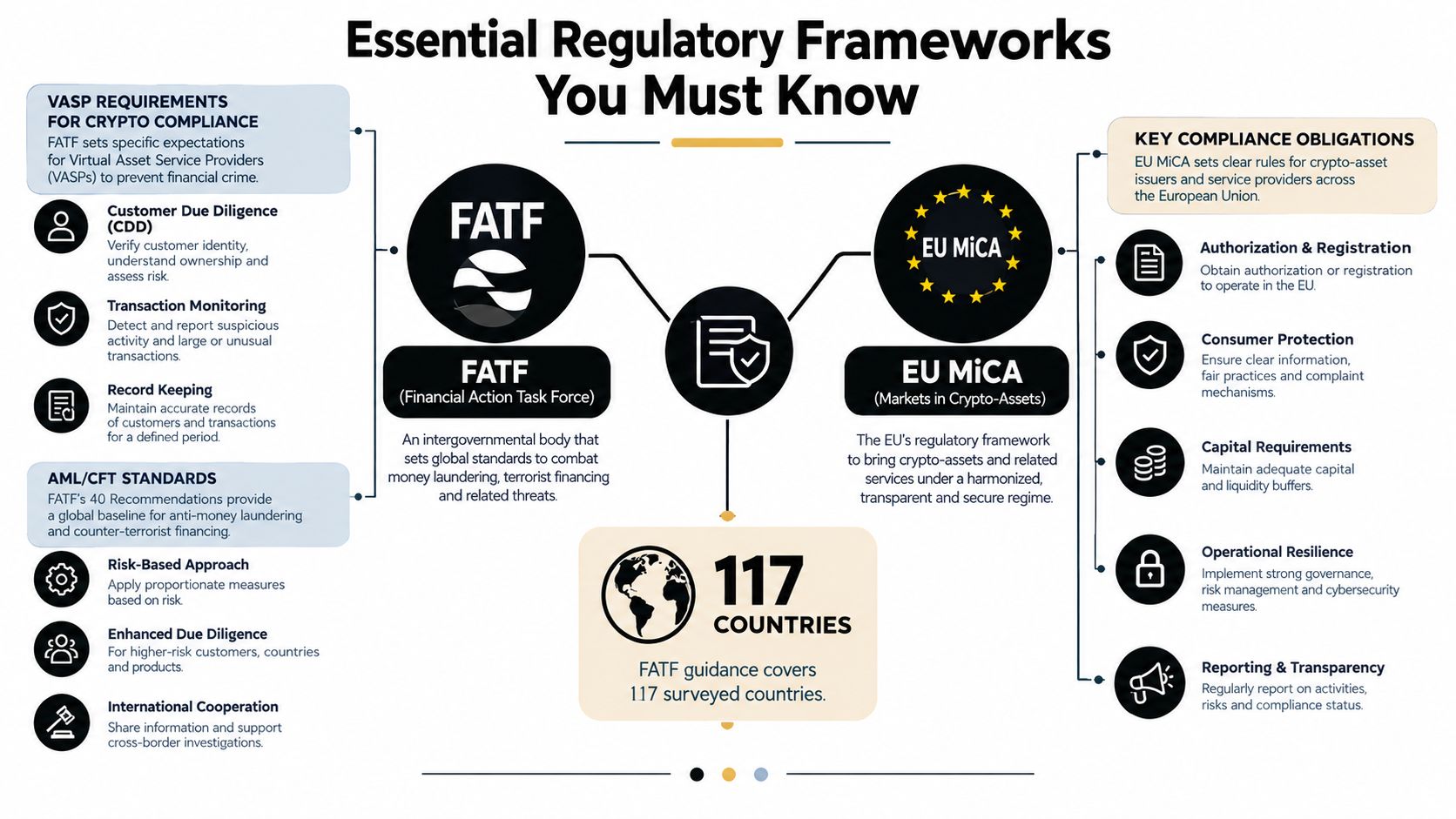
Two regulatory pillars should anchor your legal compliance qualifications: the Financial Action Task Force framework and the European Union's Markets in Crypto-assets Regulation. They serve different functions. FATF establishes an international baseline for virtual-asset AML/CFT controls, while MiCA sets a detailed EU authorization and conduct framework for covered crypto-asset services.
FATF expanded Recommendation 15 in 2018 to require countries to identify and assess risks involving virtual assets and VASPs, then apply measures such as licensing or registration. In 2019, FATF clarified that VASPs must follow relevant AML/CTF requirements, including customer due diligence, recordkeeping, suspicious-transaction reporting, and supervision. The FATF guidance for virtual assets and VASPs explains the baseline that employers expect candidates to understand.
FATF knowledge must become operational
For an interview, don't stop at naming FATF. Show how you'd apply it:
- Classify the business: Separate a virtual asset from the VASP providing exchange, transfer, custody, or related services.
- Assess risk: Map products, customer types, jurisdictions, wallet behavior, and transaction patterns to money-laundering and terrorist-financing risks.
- Build controls: Explain KYC, beneficial-owner identification, sanctions screening, transaction monitoring, recordkeeping, escalation, and reporting.
- Test effectiveness: Describe how alerts are investigated, decisions are documented, and control gaps reach management.
FATF guidance also covers exchanges between virtual assets and fiat currency, crypto-to-crypto exchange, transfers, custody, and certain issuance-related financial services. For qualifying occasional transactions above USD 1,000 or EUR 1,000, customer due diligence includes reliable identity verification and collection and retention of required customer information, as set out in the FATF updated guidance.
MiCA creates a different interview standard. Its principal crypto-asset service-provider regime became applicable on December 30, 2024, after the regulation entered into force in 2023. Covered services can include exchange, custody and administration, trading-platform operation, brokerage, portfolio management, advice, and crypto-asset transfers. Firms generally require authorization as a CASP from a national competent authority.
MiCA turns qualifications into evidence
A MiCA-focused candidate should be able to discuss:
- Governance and management competence
- Internal controls and risk management
- AML/CFT procedures
- Business continuity and ICT security
- Client-asset segregation
- Complaints handling
- Authorization files and supervisory communication
- Prudential safeguards
MiCA requires safeguards equal to the higher of the applicable permanent minimum capital requirement or one-quarter of the preceding year's fixed overheads, as explained in this MiCA regulatory overview. You don't need to memorize every provision, but you must know how capital, governance, conduct, custody, and authorization fit together.
For adjacent legal research, candidates can also review practical material on crypto tax compliance. Don't confuse tax knowledge with AML or licensing competence, though. Treat it as a complementary skill that may matter for products, clients, and jurisdictions with tax-reporting exposure.
Building Your Qualification Profile
Stop asking, “Which certificate should I buy?” Start with, “What evidence does this role require?” A compliance qualification only has hiring value when it supports a specific responsibility, product, and jurisdiction.
Build your profile in four layers:
- Foundation: Use your degree, legal training, finance background, or general compliance experience to establish core knowledge.
- Specialization: Add AML/CFT, sanctions, securities regulation, licensing, data protection, or blockchain-analytics training based on the target role.
- Application: Produce work samples that show how you make decisions.
- Verification: Prepare references, employment records, and clear explanations of your responsibility level.
CAMS offers a useful benchmark for financial-crime careers. Candidates need active ACAMS membership and 40 eligibility credits. The published structure awards 10 credits for an associate degree, 20 for a bachelor's degree, 30 for a master's degree, and 40 for a JD or PhD. Relevant work experience contributes 10 credits per year, while relevant training contributes 1 credit per hour, according to the CAMS eligibility and examination document.
Choose credentials by job family
A CAMS pathway makes sense for compliance officers, MLROs, BSA officers, KYC analysts, risk managers, internal auditors, and heads of compliance. The exam contains 120 questions, lasts 3.5 hours, and requires a passing score of 75, so preparation should cover practical financial-crime judgment, not just memorization.
Use a different decision rule for other jobs:
- AML and sanctions: Prioritize CAMS or equivalent financial-crime training, then prove alert review, sanctions escalation, and investigation skills.
- Licensing and regulatory affairs: Prioritize jurisdiction-specific legal experience and authorization-file work.
- Transaction monitoring: Prioritize on-chain analytics, typology development, alert tuning, and documented investigations.
- Customer-facing roles: Build product, conduct, disclosure, and competence knowledge. You may still face formal competence expectations even if you're not a lawyer.
- Governance and senior leadership: Demonstrate accountable ownership of controls, reporting, incidents, outsourcing, and board materials.
A candidate with a bachelor's degree, four years of compliance experience, and targeted AML training should map those inputs directly to the CAMS threshold rather than just writing “CAMS candidate” on a résumé. The same candidate should also explain what they've done with that knowledge.
Practical rule: Every certificate on your résumé should point to a responsibility you can perform, explain, and defend.
Build a proof portfolio
Create three concise work samples. First, document a blockchain investigation with the customer profile, wallet path, risk indicators, decision, escalation, and recordkeeping approach. Second, draft a mock suspicious-activity report using fictional facts. Third, map a hypothetical exchange or wallet product to FATF and MiCA obligations.
Keep confidential information out of the portfolio. The aim is to show method, not reveal an employer's data. If your background includes legal services or law-firm operations, you can also find the right law firm finance course to strengthen the financial literacy that supports compliance budgeting, client analysis, and business judgment.
A crypto-specific degree can help, but it isn't mandatory for every role. Practical evidence, strong conventional compliance experience, and the ability to learn the technical layer often create a more credible profile than a blockchain label without operational depth.
Navigating Jurisdictional Differences
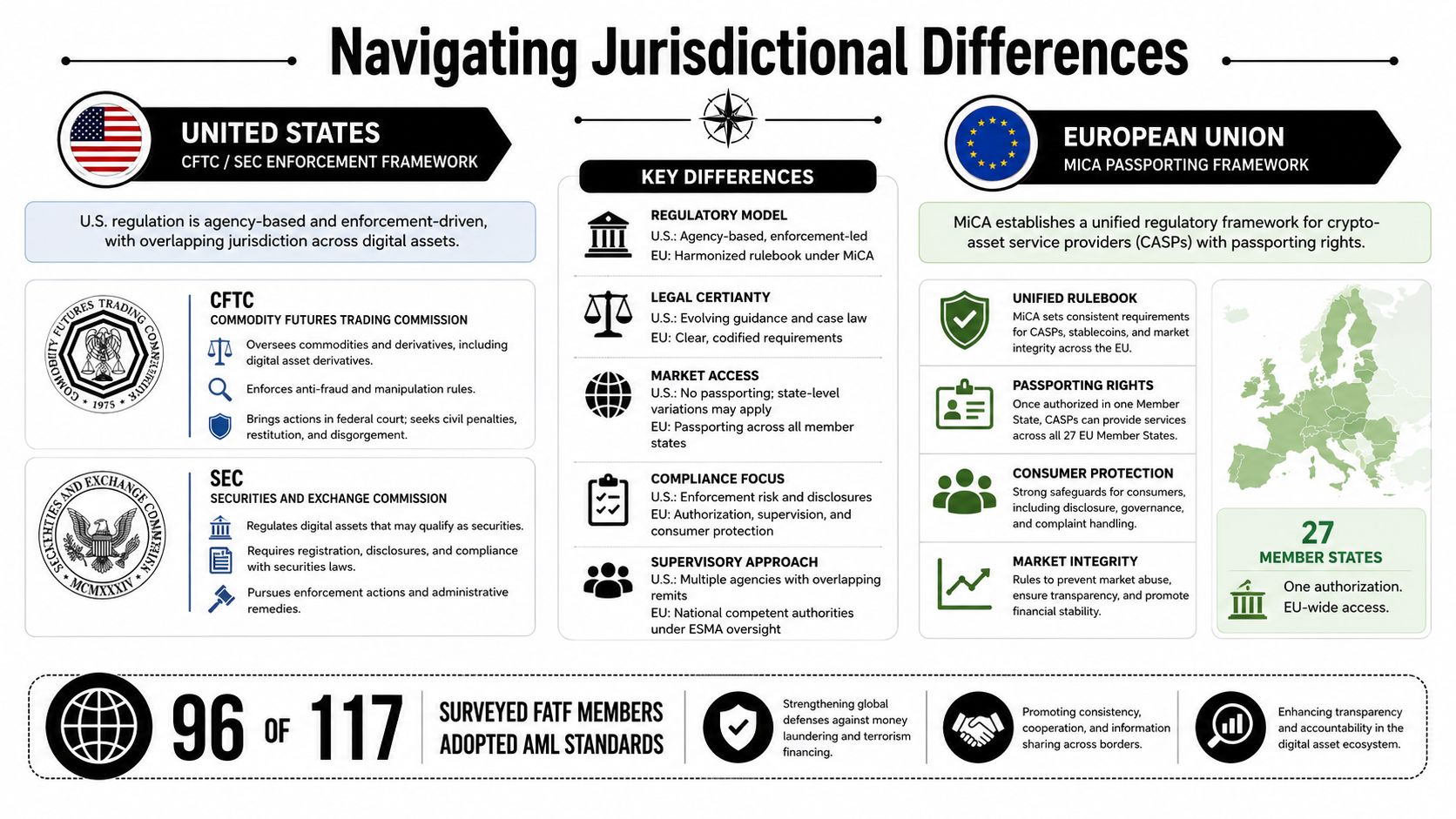
A qualification rarely travels intact across borders. The portable part is your method. The non-portable part is the local rulebook, regulator process, reporting format, licensing perimeter, financial-promotion regime, sanctions implementation, travel-rule expectations, and data-protection constraints.
The global picture demonstrates why judgment matters. In the 2025 update, FATF-related reporting indicated that 96 of 117 surveyed jurisdictions required virtual-asset providers to be licensed or registered, while only 33% were reported as requiring licensing in practice, as summarized in this compliant crypto trading platform analysis. A certificate can show structured learning. It cannot prove that you understand how enforcement operates in a specific market.
Separate portable skills from local knowledge
| Portable foundation | Knowledge you may need to relearn |
|---|---|
| Risk assessment and customer-risk methodology | Local licensing and registration procedures |
| Transaction monitoring and investigations | Regulator reporting forms and submission channels |
| KYC, KYB, and beneficial-owner analysis | Travel-rule implementation details |
| Sanctions screening and escalation | Financial-promotion and client-communication restrictions |
| Governance, recordkeeping, and control testing | Token classification and product perimeter |
| Incident response and management reporting | Local data-protection and outsourcing requirements |
An EU-trained professional may understand MiCA authorization and passporting, where an authorization in one member state can support cross-border activity across the EU's 27 member states, subject to the regulation's conditions. That knowledge doesn't automatically answer how a U.S. employer handles federal and state analysis, how a UK firm applies FCA expectations, or how Singapore and Gulf regulators define local obligations.
What mobility looks like in practice
Before accepting an international role, ask the employer:
- Does the position require local legal authorization or a regulated-person approval?
- Which regulator owns the relationship?
- What reporting, travel-rule, sanctions, and privacy duties differ from your current market?
- Will the employer train you on local procedures, or expect immediate independence?
- Which parts of your previous experience can be evidenced through comparable controls?
Your interview answer should be candid and specific. Say, “My transaction-monitoring and investigation methodology transfers, but I'd need to validate local reporting, licensing, and promotion rules before owning the process.” That answer shows judgment. Claiming that one global certificate makes you fully portable does the opposite.
Operational enforcement experience is especially valuable because it teaches you how policies behave under pressure. Hiring managers prefer a candidate who can identify what must be relearned over one who treats regulatory change as a footnote.
Competency Matrix for Legal Compliance Roles
The strongest career plan links each job title to a measurable capability, a suitable qualification, and an interview artifact. This prevents two common errors: buying credentials that don't match the job and applying for senior roles without evidence of ownership.
| Role | Qualification emphasis | Evidence employers want | Interview focus |
|---|---|---|---|
| KYC analyst | AML/KYC training, sanctions knowledge, product literacy | Customer-risk reviews, KYB files, escalation notes | Explain an inconsistent customer profile and your decision |
| Transaction-monitoring analyst | Financial-crime training plus on-chain analytics | Alert investigations, typologies, wallet tracing | Separate a false positive from a reportable concern |
| Compliance officer | CAMS or equivalent, AML/CFT program experience | Policies, control testing, investigations, training | Design controls for a new exchange or wallet product |
| MLRO or BSA officer | Senior AML expertise and reporting judgment | Suspicious-activity governance, regulator interaction, board reporting | Defend escalation thresholds and independence |
| Regulatory counsel | Jurisdiction-specific legal experience, MiCA or local licensing knowledge | Authorization applications, legal analyses, regulator correspondence | Define the regulatory perimeter and licensing path |
| Risk manager | Risk governance, controls, prudential and operational knowledge | Risk registers, incident reviews, capital or safeguarding analysis | Prioritize competing risks and report them clearly |
| Senior management | Appropriate knowledge, skills, experience, and good repute | Accountable control ownership and governance evidence | Explain how you'd oversee compliance under pressure |
The framework reflects ESMA's position that CASP management-body members must demonstrate sufficiently good repute, appropriate knowledge, skills, and experience individually and collectively, plus enough time for their functions. ESMA supervisory material indicates that executive management-board members should be able to devote at least half of their time to the CASP, as set out in the ESMA supervisory briefing on CASP authorization.
Build the matrix around accountability
For each target role, write down the control you'd own, the decision you'd make, and the evidence you can show. A compliance officer might own the AML program and present testing results. An MLRO might decide whether an investigation meets the reporting threshold. A regulatory counsel might own the authorization workstream and coordinate responses to supervisory questions.
Senior candidates must also prepare for fit-and-proper checks. Reputation and criminal-record considerations can affect an individual appointment and the firm's authorization prospects. If your résumé hides a gap, disciplinary issue, or regulatory conflict, the omission can become more damaging than the underlying event. Prepare a factual explanation, identify the remedial action, and show what changed in your professional practice.
For more role-specific opportunities and context, professionals can review crypto AML jobs, but the application should follow the matrix, not replace it. Job titles vary. Responsibilities reveal the seniority.
Interview Strategies and Career Advancement
A senior compliance interview often turns on a difficult scenario, not a credential. The interviewer may ask what you'd do after discovering that a high-value customer has exposure to a sanctioned wallet, or how you'd respond when a product team wants to launch before monitoring controls are complete.
A credible answer has a sequence. Preserve the facts, restrict unnecessary access, assess immediate customer and regulatory risk, escalate through the correct channel, document the decision, and communicate what the business can and cannot do next. Don't promise a report before completing the assessment, and don't let commercial urgency erase the control record.

Use evidence, not adjectives
The UK FCA assesses people in crypto-related financial services against fitness-and-propriety expectations covering honesty, integrity, reputation, competence, and capability. The FCA says competence and capability depend on the experience and necessary qualifications required for the role, while its standards for cryptoasset firms also reflect the importance of conduct and regulatory history.
Prepare four interview stories:
- Escalation: Describe a time you stopped or delayed activity because the evidence required further review.
- Recordkeeping: Show how your notes allowed another reviewer to reconstruct the decision.
- Customer protection: Explain how you balanced investigation needs with fair treatment and clear communication.
- Conflict handling: Demonstrate how you challenged a commercial, executive, or product decision without losing independence.
Use the situation, action, result, learning format, but keep the result factual. Don't invent performance percentages or claim an enforcement outcome you didn't control. If confidentiality limits detail, explain the control and your responsibility without naming the customer.
You can prepare for interviews by recording concise answers and checking whether each one proves a competency from your matrix. Avoid rehearsed speeches. Hiring managers want to hear how you think when facts are incomplete.
A promotion case requires the same discipline. Move from executing controls to owning them. Then move from owning controls to explaining risk to the board, coordinating with regulators, supervising outsourced providers, and making decisions during incidents.
The video below can serve as a further interview-preparation resource. Use it as a prompt for practice, then adapt your answers to the specific product and jurisdiction.
Your legal compliance qualifications matter most when they support a visible record of integrity, progressively responsible work, and technical understanding. Review five target roles, build a competency matrix for each, select only the training that closes a real gap, and create three work samples before your next interview.
Blockchain Jobs connects Web3 candidates with opportunities across Legal & Compliance, Finance, Security, Risk, and other specialist teams, including remote-friendly roles. Visit Blockchain Jobs to search current openings, compare role requirements with your competency matrix, and position your qualifications for the next step.