Crypto Community Manager Jobs: A Hiring-First Playbook
Most advice about crypto community manager jobs starts in the wrong place. It tells candidates to post more often, grow follower counts, and sound enthusiastic about Web3. That framing gets people screened out. Hiring managers aren't looking for an “engagement hacker.” They're hiring someone who can protect trust during a failed mint, interpret community signals, coordinate contributors, and turn public frustration into product intelligence.
The role has become more demanding as Web3 communities have expanded beyond simple product announcements. Community management now sits between trust and safety, operations, analytics, content, support, growth, and governance. Competition reflects that shift. One Web3 salary index reports an average of 374 applicants per Community Manager job, making applicant pressure unusually intense for the category (Web3 Career salary data).
If your résumé presents you as someone who can schedule posts, you'll blend into the largest applicant pool. If it proves that you can run moderation systems, explain sentiment changes, coordinate ambassadors, and communicate during incidents, you'll look like the operator teams need.
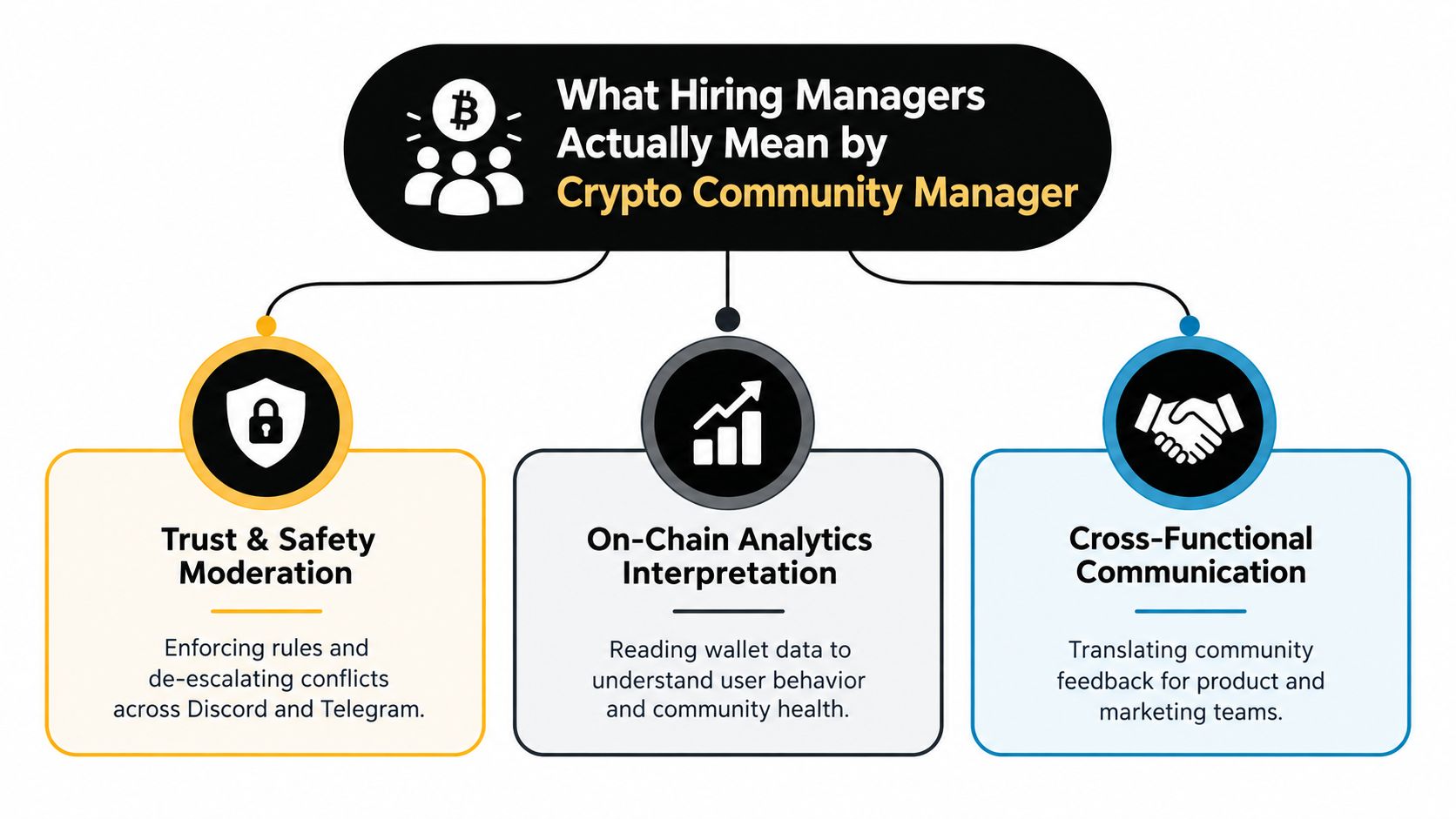
What Hiring Managers Actually Mean by Crypto Community Manager
A crypto community manager is not a social-media scheduler with token vocabulary. The role is a hybrid trust-and-safety and growth lead. Hiring managers screen for judgment under pressure, operational discipline, and enough analytical fluency to explain why community behavior changes.
The four functions behind the title
Sentiment triage comes first during token events, governance votes, launch delays, exploits, and market shocks. Separate a legitimate product complaint from coordinated FUD, a confused newcomer from a scammer, and criticism from a threat. Hiring managers want evidence that you can set an escalation path before a channel becomes unmanageable.
Discord and Telegram policy forms the operating layer. Write rules moderators can apply consistently, configure bots, define permissions, document bans and appeals, and preserve evidence during raids or impersonation campaigns. Tools matter, but policy judgment matters more.
Contributor pipeline building turns an audience into an ecosystem. Identify dependable moderators, ambassadors, developers, translators, educators, and governance participants. Then give each group a clear contribution path, ownership, and feedback loop. A large member count means little if useful contributors have no way to start.
Community-to-product translation closes the loop. Product teams need structured feedback rather than a transcript of angry messages. Group recurring requests, separate usability problems from token speculation, and present evidence that helps product and marketing leaders choose what to change. This is growth work because better feedback improves retention and participation, not just engagement metrics.
Use this community management glossary to distinguish moderation, engagement, and relationship management when describing your experience.
Context changes by protocol type
An L1 foundation usually needs education, ecosystem coordination, developer support, and governance communication. A DeFi protocol places more weight on risk communication, incident response, user support, and behavior around incentives. An NFT project may prioritize launch operations, holder communications, creator relationships, and scam suppression. An exchange typically emphasizes support workflows, compliance-sensitive communication, and rapid escalation.
Read job descriptions for the operating model, not only the title. A posting focused on daily posting quotas while omitting governance access, incident ownership, moderation authority, analytics, or escalation routes deserves scrutiny. It may be a content role carrying a community title, or a one-person support function with unrealistic expectations.
Ask three interview questions: who owns the community during a crisis, who approves public statements, and what information the manager can access? If nobody can answer, the role is under-scoped. In your own interview, explain the systems you would establish first, the signals you would monitor, and the point at which you would escalate. That answer beats generic social-media experience.
Skills and a Sample Project That Prove Crypto-Native Execution
Generic social-media experience won't carry you through a serious hiring process. Build evidence around the tools and decisions that make Web3 communities difficult to operate.
| Skill | Proof Point |
|---|---|
| Discord and Telegram administration | A documented permission model, bot setup, verification flow, and moderation escalation process using tools such as MEE6, Collab.Land, or Guild.xyz |
| On-chain literacy | A public Dune dashboard, an Etherscan walkthrough, and a written interpretation of wallet behavior |
| Moderation policy writing | A concise policy covering spam, impersonation, scams, harassment, appeals, and moderator handoffs |
| Crisis communication | A sample response sequence for an exploit, mint failure, delayed launch, or sudden outage |
| Ambassador program design | A contributor ladder with responsibilities, review criteria, recognition, and feedback loops |
You don't need to claim that you're an analyst if you can't read a wallet cohort or explain a governance proposal. You do need to show that you can investigate before making a public claim. Open Etherscan, inspect transaction patterns, read governance forums, and explain what the evidence does and doesn't establish.
Build one serious mini-project
Choose a public protocol with an active Discord or Telegram presence. Create a 30-day community health report that a hiring lead could use in an internal meeting.
Your report should include:
- Sentiment scoring: Define a repeatable tagging method for positive, neutral, frustrated, confused, and hostile messages.
- Contributor counts: Separate moderators, ambassadors, educators, developers, and other recurring contributors from passive members.
- Governance participation rate: Show how many eligible or visible participants engaged with relevant governance activity, using a clearly stated method.
- Three interventions: Recommend specific changes to moderation, content, onboarding, ambassador operations, or product feedback.
- Limitations: Explain what your sample misses, such as private channels, deleted messages, or off-platform discussion.
Package the work in a Notion document, a public Dune dashboard, and a Loom walkthrough. The Loom should explain your choices, not merely read the document aloud. A reviewer should see how you move from raw signals to an operational decision.
This artifact beats a certificate because it demonstrates the complete workflow: instrument the community, segment behavior, interpret evidence, and recommend action. In an application, write: “I built a 30-day community health report for [protocol], including sentiment categories, contributor segmentation, governance participation analysis, and three interventions. The Notion report, Dune dashboard, and Loom walkthrough are available here.” Replace the bracket with the actual project and attach the portfolio.
Resume, Portfolio, and CV Templates That Pass the First Scan
Your résumé has to communicate scope before a reviewer starts decoding it. For senior community hiring, a manager may spend roughly 60 seconds on an initial CV review, so the top third needs to answer three questions quickly: what kind of community did you operate, what problems did you handle, and what evidence supports your claims.

Put proof above the fold
Use a one-line positioning statement such as:
Community lead who scaled a 40k-member protocol Discord through two governance votes.
That example works because it names the environment, the operating channel, and a meaningful event. Don't copy it unless it's true. Use the same structure with your own evidence.
Your experience bullets should follow a metrics-first pattern:
- Moderation scope: “Moderated Discord and Telegram across launch, support, and governance channels, with documented escalation rules.”
- Sentiment movement: “Introduced message tagging and weekly reporting to identify recurring product frustration and escalation themes.”
- Response operations: “Built a handoff process between moderators, support, and product during incident communications.”
- Contributor activation: “Designed an ambassador intake and review process for education, translation, and event support.”
Avoid “managed engagement,” “posted content,” and “grew the community” unless you explain how, across which channels, and toward what business or ecosystem result. A follower screenshot without context tells a hiring lead almost nothing about trust, retention, governance, or operational judgment.
Give the portfolio its own block
List three case-study URLs, each with a descriptive label:
- Moderation system: rules, permission architecture, escalation flow, and a redacted incident example.
- Community health report: sentiment method, contributor analysis, dashboard, and recommendations.
- Launch or ambassador program: objectives, operating calendar, contributor roles, and post-launch review.
Your skills line should prioritize Discord, Telegram, MEE6, Collab.Land, Guild.xyz, Etherscan, Dune, governance forums, crisis communication, and moderation policy. Put soft skills lower, then demonstrate them through your work.
Use one page when you're applying for junior or mid-level roles and your experience is focused. Use two pages when senior scope, multiple protocols, incident ownership, or team leadership needs the space. Don't expand to two pages by adding adjectives. Improve the evidence first.
For profile presentation, a practical LinkedIn profile asset strategy can help you align your headline, featured work, and résumé language. You can also review relevant role and career resources through the Blockchain Jobs blog, but your application should still lead with verifiable operating proof.
Where to Find the Openings That Don't Get 374 Applicants
The obvious job board is often the noisiest route. The reported 374 applicants per Community Manager job explains why mass-applying should not be your default (Web3 Career community manager index). Treat public listings as market research: study which companies are hiring, the language they use, and whether they need trust and safety, growth, governance support, or all three.
| Channel | Applicant Pressure | Signal Quality | Response Speed |
|---|---|---|---|
| LinkedIn Web3 job posts | High | Mixed | Slow to moderate |
| Dedicated boards | High on generic listings | Mixed to strong, depending on the listing | Moderate |
| Crypto-native communities | Lower among qualified candidates | Strong | Fast when trust exists |
| Web3-specialist recruiters | Lower public competition | Strong for matched profiles | Moderate to fast |
Use public boards to identify hiring companies, then contact the people closest to the work. Platforms such as Blockchain Jobs marketing roles help surface community, growth, and ecosystem openings. Tailor your message to the operating problem in the listing, such as moderation coverage, contributor retention, governance education, or incident response.
Use a weekly sourcing routine
- Monday: Scan two dedicated boards. Save roles mentioning Discord, Telegram, governance, moderation, community health, or ecosystem operations.
- Daily: Spend time in three project Discords. Study verification guidance, moderator decisions, recurring questions, and contributor behavior. Look for signs of staffing needs.
- Wednesday: Contact two Web3-specialist recruiters with a targeted portfolio link and a clear role profile.
- Friday: Review governance proposals and protocol forums for staffing, grants, ecosystem, or community-operations signals.
Read the work before you apply. A protocol with confused verification flows needs a trust-and-safety operator. A project with weak contributor participation needs someone who can connect community signals to growth actions. Your outreach should name that gap and point to one relevant artifact.
The strongest openings may appear first in moderator channels, contributor groups, governance forums, or private referrals. Earn access by answering useful questions, documenting an operational improvement, or contributing consistently. A résumé dropped into every channel creates volume, not credibility.
Outreach and Networking Scripts That Get Replies
A candidate with a strong portfolio can still fail by sending a vague message. The successful sequence is concrete: identify a real operational need, show one relevant artifact, and ask for a small next step.
Suppose you've built the 30-day community health report described earlier. You notice a protocol's Discord has unclear verification guidance and recurring questions around governance participation. Your first message should address that observation without pretending to know the team's internal situation.
Three opening messages
Discord cold DM to a community lead
“Hi Maya, I've been following the governance discussion in the protocol Discord and noticed that new-member questions and proposal questions are appearing in the same flow. I built a short community health report for a public protocol, including sentiment tagging and contributor segmentation. I'd be glad to share the relevant page and suggest a lightweight channel and escalation structure if you're reviewing community operations.”
Reply on a hiring thread
“Your post mentions Discord and Telegram growth, but the role also sounds closely tied to moderation and incident communication. I've built a public Dune dashboard and a Notion report that show how I turn community signals into interventions. If the role is still open, I can send the one-page portfolio and a short Loom.”
LinkedIn request to a recruiter
“Hi Jordan, I'm targeting crypto community manager roles that combine moderation, analytics, governance support, and contributor programs. My portfolio includes a public Dune dashboard, a moderation policy sample, and a community health report. I'd like to connect and send the one-page version if you recruit for protocol or ecosystem teams.”
Keep each opening under 90 words. Personalization should refer to a real channel, proposal, product, or job requirement. General guidance on structured contact can also be found in this resource on outreach for support teams, but your message should remain human and role-specific.
Follow up over 14 days
Use one subject line consistently: “Community operations portfolio for [Protocol]”.
- Day 3: Add new context. “I saw the latest governance discussion and thought the contributor segmentation page might be relevant to your moderator workflow.”
- Day 7: Send the one-page portfolio link. Make the ask explicit: “Would you be open to a brief conversation about the role?”
- Day 10: Send a short Loom introduction. Explain the project and the decision it demonstrates.
- Day 14: Send a respectful break-up email. “I'll close the loop here, but I'm happy to reconnect if community operations becomes a priority.”
Don't assign invented response-rate expectations to this cadence. Track your own replies, referrals, and booked calls in a simple spreadsheet, then adjust the message based on evidence.
For a referral, ask a current moderator: “I'm applying for the community role because my experience matches the team's Discord operations and incident-response needs. Would you feel comfortable referring me, or introducing me to the hiring lead if you think my portfolio is relevant?” That wording gives them a clear choice and a reason to evaluate you.
The rule: Vague asks get ignored. Offer-anchored asks get replies.
Interview and Assignment Prep With Salary Benchmarking
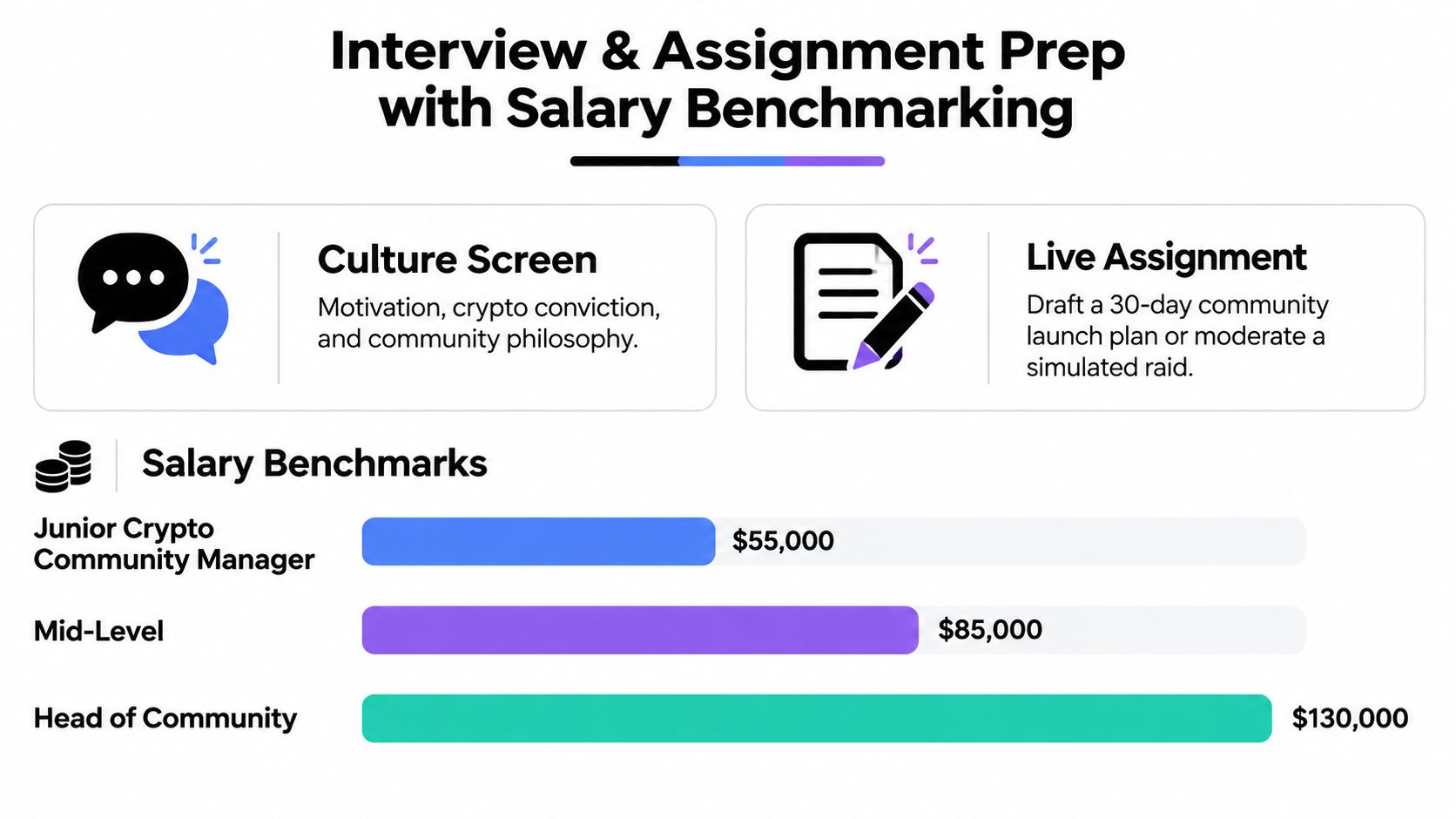
Treat the interview as a trust-and-safety and growth review, not a test of how often you can post. The first conversation probes motivation, crypto judgment, communication, and your ability to support a community without performing for it. The second usually uses a take-home or live assignment.
Typical assignments include:
- Drafting a 30-day community launch plan.
- Moderating a simulated raid involving scams, impersonation, or hostile messages.
- Reviewing community data and presenting a health diagnosis.
- Writing an incident update for a failed launch, exploit, or service disruption.
Hiring leads score the same underlying capabilities: prioritization, consistent policy enforcement, evidence handling, tone under pressure, escalation judgment, and recommendations tied to product or ecosystem outcomes. Promise unrestricted engagement, dismiss scam suppression, or label every negative message FUD, and you create immediate concern. Show how you protect user trust while preserving useful channels for growth.
Use salary data as a range, not a script
Market figures vary with scope, geography, seniority, and methodology. One salary index reports an average of $85,000 per year, a base range of $50,000 to $180,000, average hourly pay around $44, and 61% of roles remote as of September 10, 2026. Use those figures as a reference, not a promise, and compare compensation with the level of applicant competition reported by the same source.
Other datasets provide different baselines. Cryptocurrency Jobs salary data reports a U.S. average base salary of $80,000, compared with $57,000 in Europe and $61,000 for remote roles. Its listed figures include Switzerland at $118,500, France at $99,833, the Netherlands at $63,000, and the United Kingdom at $53,600.
Seniority guides place junior roles at $45,000 to $70,000, mid-level roles at $70,000 to $110,000, and senior or Head of Community roles at $110,000 to $160,000 or more, sometimes with token allocations (Web3 Vacancy salary guide). A U.S.-focused dataset reports an average of $58,937, with most roles between $47,000 and $67,000 as of May 20, 2026 (ZipRecruiter crypto community manager data).
Separate cash from tokens in your answer: “Based on the role's scope, my experience with moderation systems, analytics, and contributor programs, I'm targeting the upper part of the stated base range. I'd like to evaluate the token component separately, including vesting, cliff, strike or grant terms where applicable, liquidity assumptions, and what happens if the role ends.” Get those terms in writing. An unspecified token promise is not compensation.
Review current U.S.-focused openings through Blockchain Jobs USA listings, then compare each description's actual responsibilities before selecting a benchmark.
From Community Manager to Head of Community Next Steps
Promotion doesn't come from being the busiest person in Discord. Hiring leads promote managers who own outcomes, build systems, and make community work legible to the rest of the company.
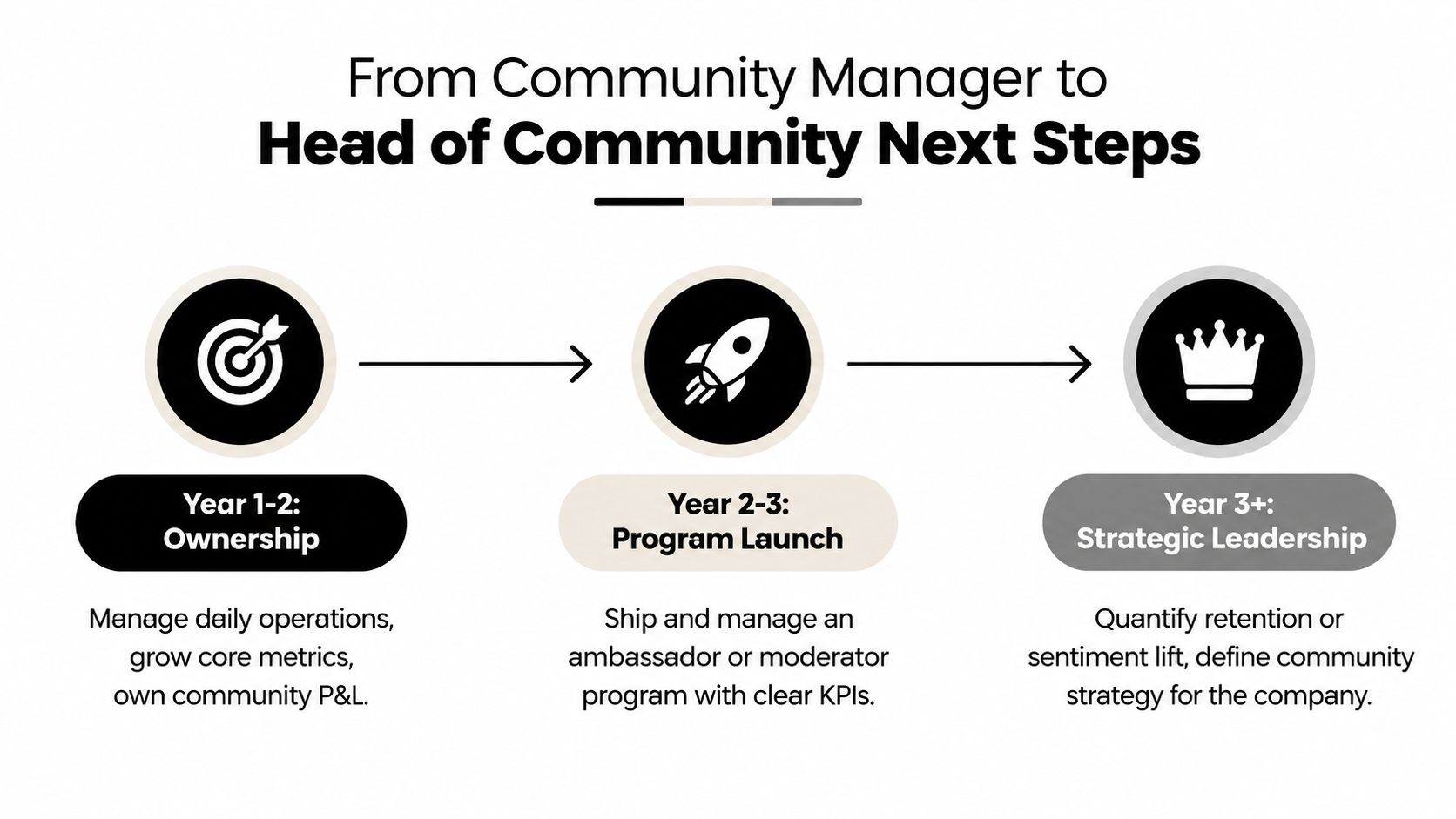
The first trigger is operational ownership. That can include responsibility for a community P&L, budget control, vendor decisions, staffing, or a measurable resource plan. The second is a shipped ambassador or moderator program with clear recruitment, training, review, and recognition processes. The third is quantified evidence of retention or sentiment lift, supported by a dashboard and an explanation of what you changed.
Choose the track that matches your leverage
Management is the natural route if you enjoy headcount planning, moderator coaching, budget control, and operating rhythms. Your evidence should show that other people performed better because you built the system.
Product fits managers who turn recurring community signals into roadmap input. The milestone is cross-functional influence, where product teams use your synthesis to prioritize onboarding, support, governance, or feature changes.
Growth suits operators who connect contributor programs, education, events, partnerships, and user conversion. Your work should show how community activity supports a broader ecosystem funnel without reducing members to a vanity metric.
Create a promotion packet with a dashboard, incident reports, program review, and a written strategy document. Include what happened, what you owned, what changed, what didn't work, and what you'd do next. A senior title without this record won't convince a hiring committee.
This roadmap is useful as a planning tool:
- First phase: Own daily operations and one quantifiable community goal.
- Second phase: Ship a public-facing launch or ambassador program and mentor a junior moderator.
- Third phase: Complete a DAO or protocol governance project and connect community strategy to company priorities.
Keep the next 12 months focused on those four signals: one quant goal, one public-facing launch, one junior moderator you mentor, and one governance project. That portfolio gives a hiring lead something stronger than activity. It shows judgment, ownership, and readiness for strategic leadership.
If you're ready to move from generic applications to evidence-led searching, Blockchain Jobs offers curated Web3 listings across community, marketing, operations, product, engineering, and other functions. Visit the platform to find crypto community manager jobs, compare role requirements, and apply with a portfolio that proves you can operate under pressure.