10 AI Machine Learning Jobs Sites for Web3 Careers
You've built models, tuned pipelines, and can explain precision and recall under class imbalance. Then you open a general job board and get hundreds of AI machine learning jobs that have nothing to do with Web3, half of them mislabeled and most of them already flooded with applicants. That's the situation for strong candidates right now. Specialist roles are scarce, titles overlap, and the wrong source wastes the exact time you should spend tailoring evidence and preparing for interviews.
Use a tighter system. Start where AI machine learning jobs already sit inside blockchain work, then widen out only where a board adds something different, such as startup access, local market depth, or employer research. Judge every source on five things: role fit, listing quality, employer research, interview relevance, and long-term career growth.
Demand supports that discipline. The World Economic Forum Future of Jobs Report 2025 survey of employers identifies AI and Machine Learning Specialists as one of the three fastest-growing job categories by percentage through 2030, from a survey of more than 1,000 companies representing more than 14 million workers. The same source reports 86% of surveyed employers expect artificial intelligence and information-processing technologies to transform their businesses by 2030. Don't chase volume. Chase precision, then convert each shortlisted role into interview preparation and a progression plan.
1. Blockchain AI & Machine Learning Jobs
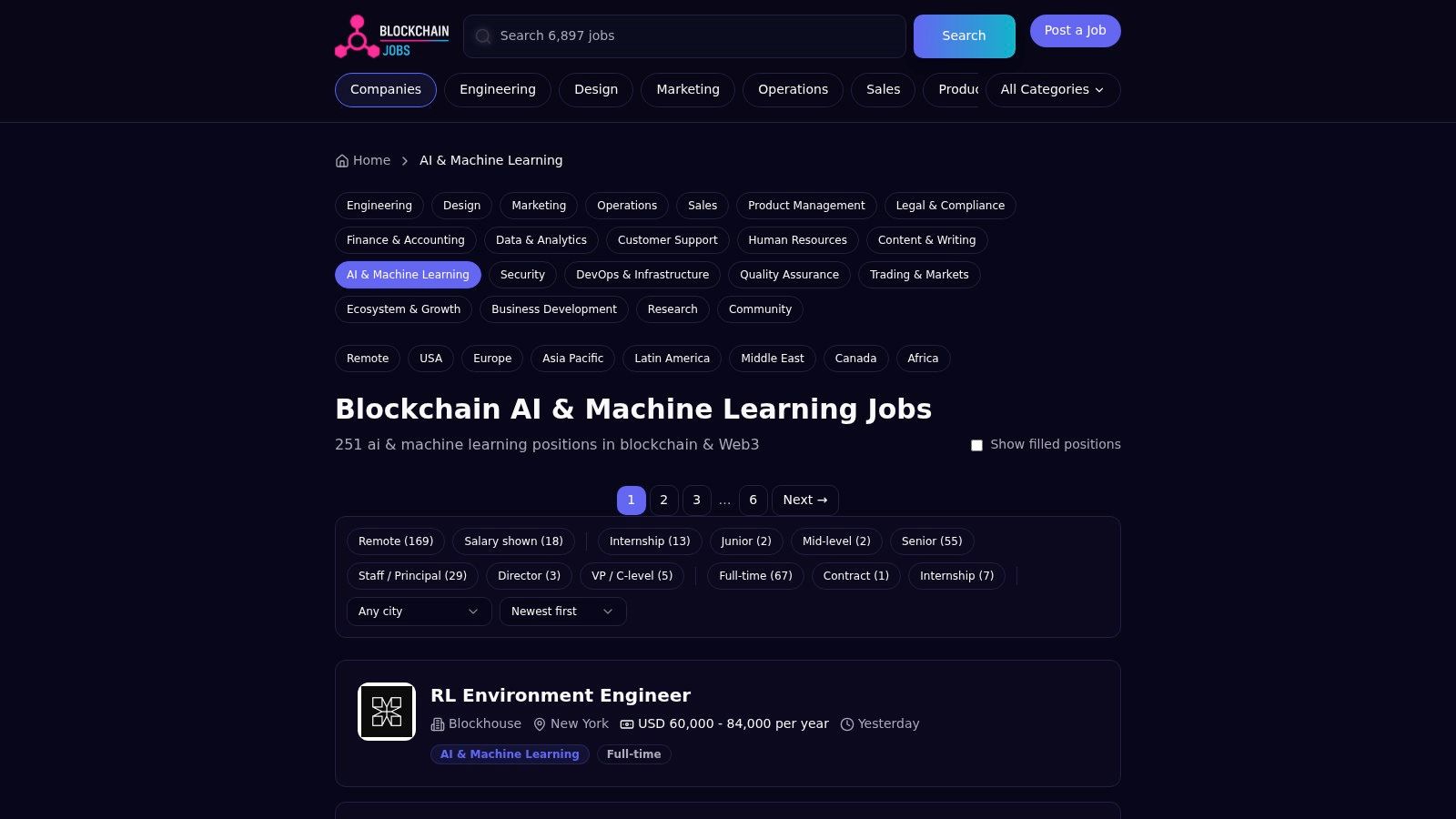
You want Web3 first and AI second. General boards make you weed out SaaS analytics and mislabeled automation roles before you can judge fit, and that filtering eats the hours you owe to interview prep. The Blockchain Jobs AI and Machine Learning category removes that step by collecting 221 opportunities where intelligent systems meet decentralized projects, so your AI machine learning jobs shortlist starts inside the domain instead of outside it.
Treat every posting as an interview brief.
The board carries AI engineer, machine-learning engineer, and data scientist roles tied to protocol analytics, fraud detection, automated compliance, and AI-enabled decentralized applications. For each listing, note the data environment, deployment expectations, and domain risk, then map your résumé to those exact problems with measurable outcomes such as latency, inference cost, dataset scale, or production uptime. That mapping is what turns a Web3 application into a credible interview story.
Best Fit and How to Use It
Pick this board first when you already hold, or intend to build, crypto-native context. It is the weakest fit for a candidate running a broad enterprise ML search, because a generalist source serves that strategy better. Early-career applicants should study adjacent entry points, including the AI research intern route into Web3 teams, since an internship or applied research role can prove production judgment faster than another generic chatbot project.
The World Economic Forum digest on fastest-growing roles projects 39% of workers' existing skill sets will change by 2030. Use that as a résumé instruction. Show recent learning, new infrastructure, and adaptation to unfamiliar data, not a framework name and a certification.
- Pros: Focused Web3 AI collection, 221 positions listed, and roles spanning engineering to data science inside a specialist board.
- Cons: Listing count and availability change over time, so verify requirements, pay, and work arrangement on each posting.
If stakeholder interviews with US based teams expose a communication weak spot, address it head on. Working with top American accent coaching for ML pros beats hoping technical depth alone carries the room.
2. LinkedIn Jobs
Use LinkedIn Jobs for breadth and for people, not just postings. It's a broad professional network with substantial US coverage across corporate, startup, and research-oriented employers. You can filter by location, remote work, experience, employment type, and posting date, then identify hiring managers and team members before you apply.
That network layer is the advantage. A posting tells you what a company wants. Profiles of future teammates tell you the stack they use, the seniority mix, and whether the team leans research, platform, or product. Build interview stories from that research instead of sending the same application everywhere.
Use the Market Signals
An analysis covered in LinkedIn reporting on AI and machine learning job trends lists Machine Learning, AI, Python, PyTorch, TensorFlow, and communication among the most frequently requested skills, across approximately 5,000 postings from January through June 2025, with an 89% increase in postings from January to June. It also reports average compensation of about $137,444 at the minimum, $175,709 at the midpoint, and $213,973 at the maximum across analyzed roles. Treat those figures as directional market context, not an offer promise.
- Pros: Broad selection, natural-language search beyond exact titles, alerts, and direct visibility into hiring teams.
- Cons: Results can be loosely related, popular roles attract heavy competition, and some features require an account.
Set narrow alerts for ML engineer, applied scientist, and data scientist variants. Don't rely on one title, because employers don't standardize them.
3. Indeed
Indeed is your volume sweep. It's a large general purpose site with US listings for machine-learning engineers, applied AI engineers, data scientists, and adjacent roles across regions and employer sizes. Job searching is generally free, and filters for job type, experience, pay, location, and remote work help you cut a very large database down fast.
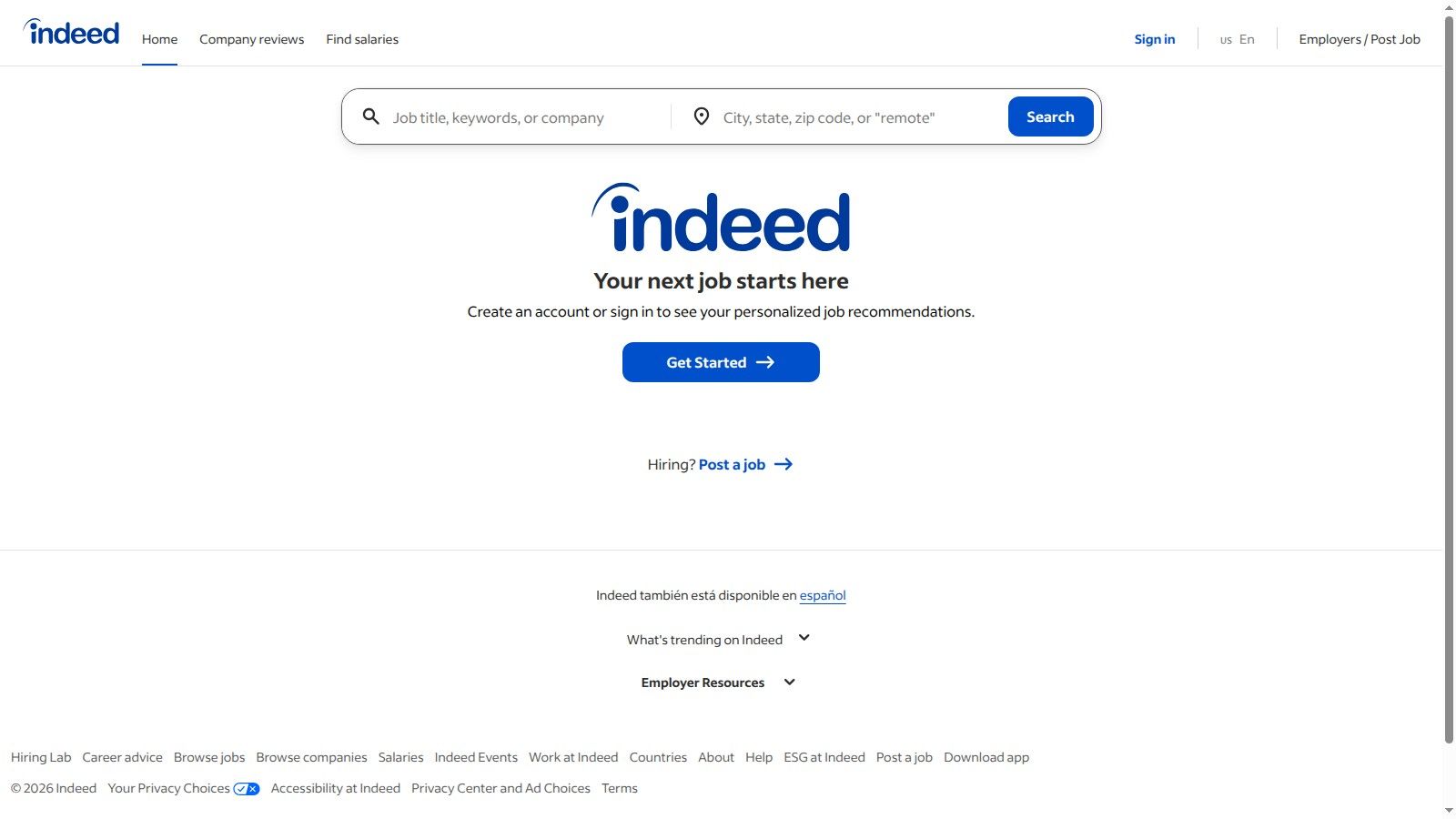
Its blind spot is precision. AI and ML labels can be imprecise, duplicates appear, and staffing-agency listings may hide the employer until late. Verify the hiring company, check whether the role involves model development or just uses AI tools, and confirm the application destination before you invest time tailoring materials.
Where Indeed Earns Its Place
It surfaces employers that don't post on tech-only boards, including firms building internal risk, forecasting, or automation teams. That matters for career changers. Figures attributed to the US Bureau of Labor Statistics in US News coverage of data scientist careers project 36.0% growth for Data Scientist employment from 2023 to 2033, with approximately 73,100 job openings expected during that period. Search overlapping titles, not just ML engineer.
If remote work is your priority, pair alerts here with guidance on remote machine learning jobs and location strategy. Then check time zone, travel, and on-call expectations in the first screen.
- Pros: Broad US coverage, strong filters, email alerts, and résumé upload for employer discovery.
- Cons: Variable listing quality, duplicates, and inconsistent AI labeling.
4. Dice
Go to Dice when the stack matters more than the sector. This technology-focused board lets you search by technology and specialty, including machine learning, artificial intelligence, deep learning, and Python. Candidate profiles and job-search tools are free, and the audience is technical enough that postings more often name tools, infrastructure, and engineering constraints.
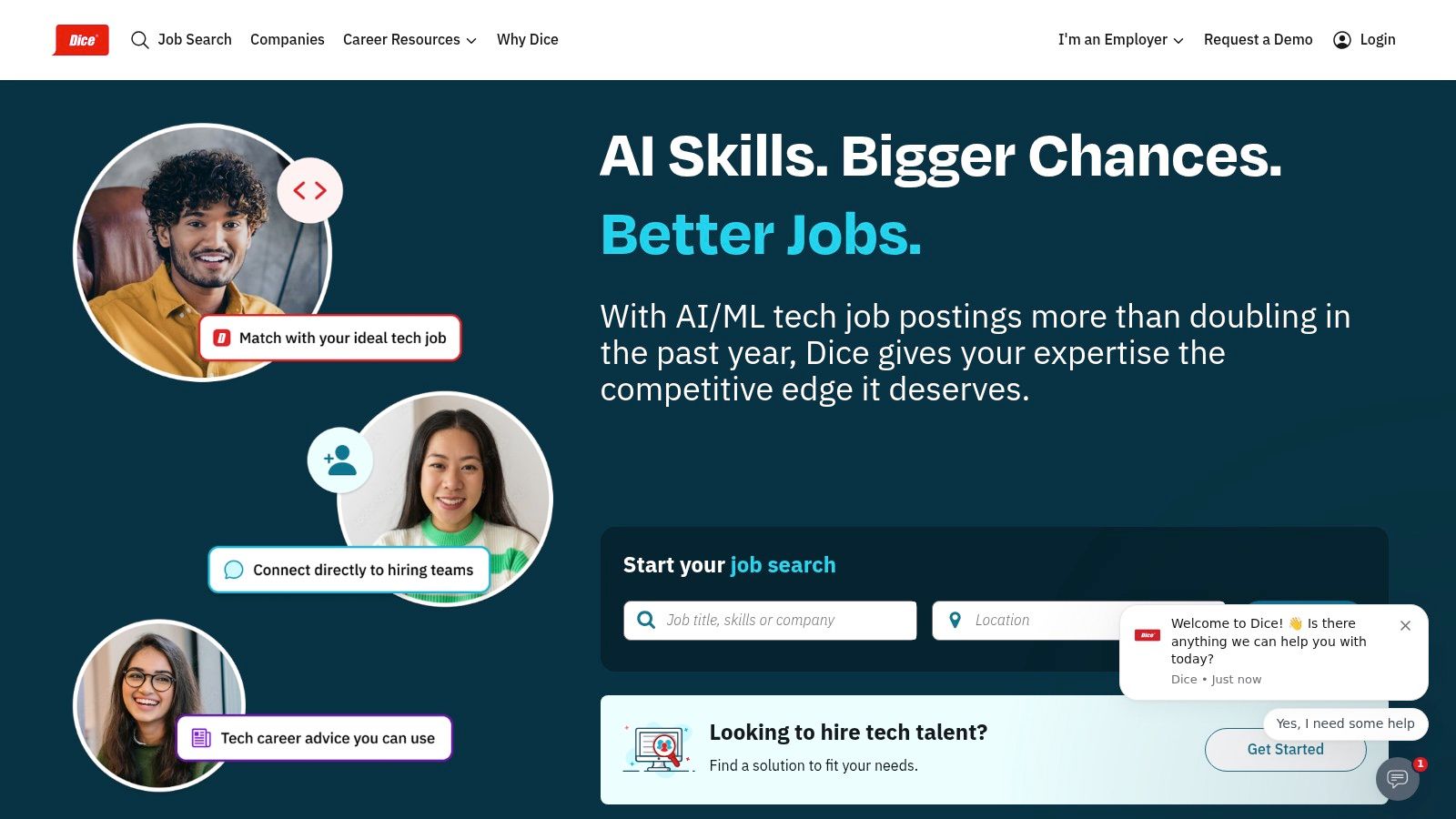
That's useful for interview preparation. If a listing stresses pipelines, cloud deployment, and monitoring, prepare an end-to-end story. Walk through ingestion, leakage prevention, evaluation, drift checks, and rollback. If it stresses modeling only, prepare baseline selection and metric trade-offs. Let the posting set your revision plan.
The Skill Stack Employers Test
The World Economic Forum skills outlook through 2030 ranks AI and big data as the fastest-growing skill area, followed by networks and cybersecurity and then technological literacy, and identifies analytical thinking as essential for seven in ten companies in 2025. Dice is a good place to spot that cross-functional stack in real postings, especially where ML touches security, data engineering, or distributed systems.
Practical rule: If you can't explain accuracy, interpretability, throughput, and cost trade-offs for a model you shipped, you're not ready for a production ML interview.
- Pros: Technology-oriented listings, skill-based search, and career content for technical professionals.
- Cons: Weak for policy or business AI roles, and recruiter postings require employer verification.
5. Wellfound
Wellfound is the direct route into startups. It lists early-stage and growth companies, including AI-focused businesses, and some postings show salary and equity information. You can create a profile, apply for free, and let companies discover you, which changes the dynamic compared with anonymous application queues.
Use it if you want breadth of responsibility. Startup ML roles often combine data work, product judgment, deployment, and customer feedback in one job. That can accelerate progression quickly, but only if the company has real data, real users, and enough runway for you to ship and learn. Ask those questions early and bluntly.
Company profiles help you assess stage and focus before applying. Still, compensation and equity details aren't present for every role, and hiring processes vary widely. Confirm reporting line, technical mentorship, compute budget, and who owns model decisions in production. A founding ML title without support can stall a career as easily as it can launch one.
A Route for Early-Career Candidates
The UK government Digital and Technologies Jobs Plan reports employment in UK AI companies grew from approximately 50,000 people in 2022 to approximately 86,000 in 2024, while organisations hiring apprentices into AI roles rose from 3% in 2020 to 19% in 2025. It also reports apprentices represented only 3% of the AI workforce and just 13% of graduate schemes included AI training. Startups may offer responsibility, but don't assume they'll provide structured training.
- Pros: Startup access beyond major employers, company context, and some pay and equity transparency.
- Cons: No full corporate or public-sector coverage, and resources differ sharply by company stage.
6. Built In
Built In works best when location is part of your strategy. It organizes technology and startup roles by market, industry, and specialty, including AI, machine learning, and data categories. Some listings include location, work arrangement, salary, and technical skills, and browsing is free.
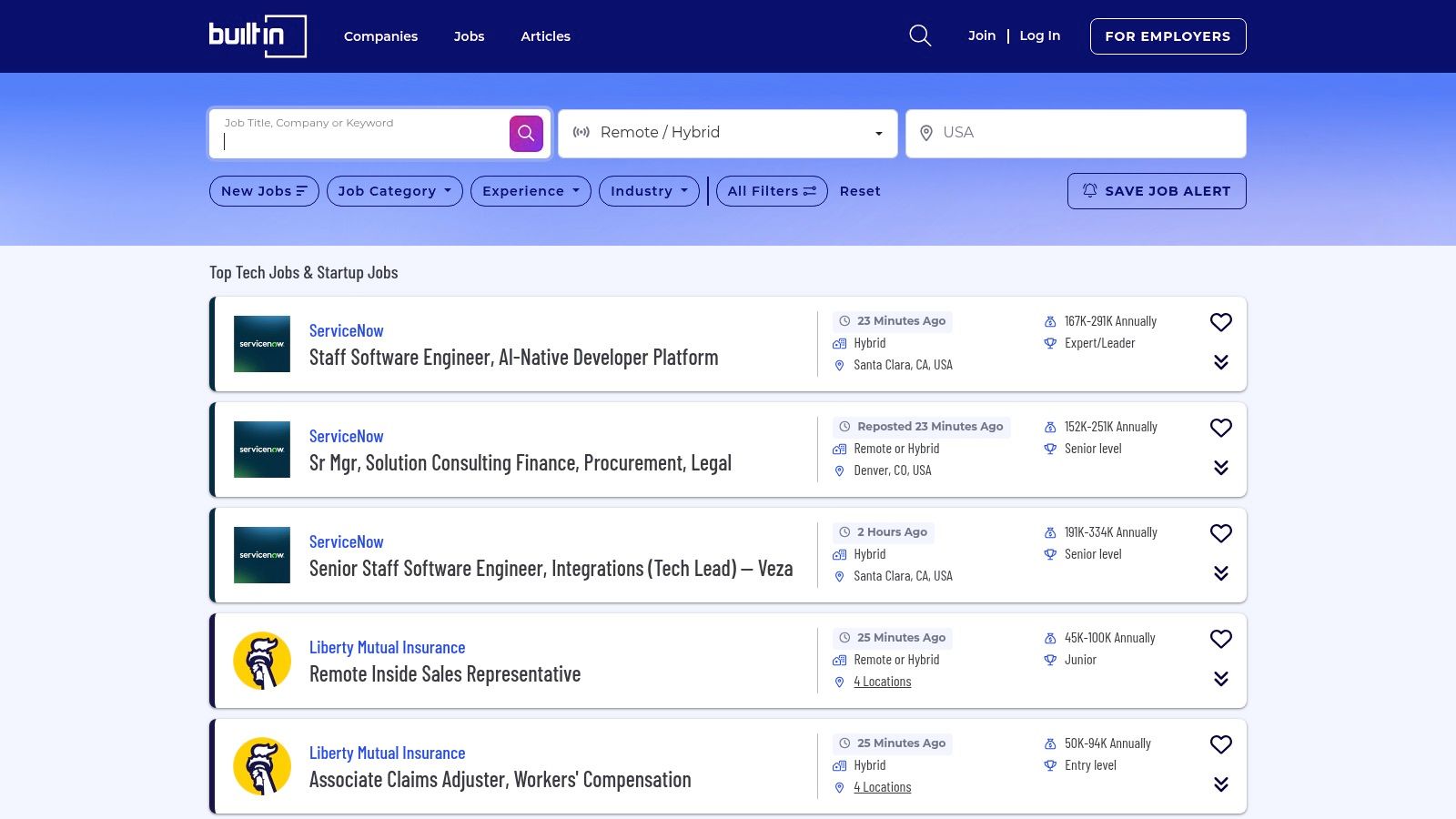
Compare cities deliberately. A hybrid role in a strong local market can give you mentorship, meetups, and future employers within reach. A remote role can give you wider choice but weaker informal learning. Neither is automatically better. Pick based on your stage. Early-career candidates often benefit from proximity to senior engineers, while experienced specialists can trade location for scope.
Regional coverage is uneven, so don't treat absence here as absence in the market. Categories may also include adjacent data or software jobs. That's not always a flaw. Analytics engineering, data engineering, and ML platform roles can be credible stepping stones if they build production data and deployment experience.
Broaden the Target Without Losing Direction
OECD analysis of AI and skills needs reported fewer than 1% of workers need advanced AI skills, while most workers need digital skills and the ability to use, analyse, and interpret data. Use Built In to find adjacent roles where you can prove data quality, validation, privacy, and human oversight judgment, then move toward specialization.
- Pros: Strong local comparison, detailed listings in covered markets, and company profiles with tech context.
- Cons: Regional depth varies, freshness varies, and categories can blur into general data roles.
7. Glassdoor
Don't use Glassdoor as your primary discovery engine. Use it as your validation layer. It combines US job listings with employer reviews, company profiles, and compensation information, plus alerts and saved searches. That context helps you decide whether a promising role sits inside a team you'd stay in.
Read reviews for patterns, not anecdotes. Repeated comments about reorganization, unclear promotion criteria, weak management, or unrealistic roadmaps deserve direct questions in interviews. Salary information can help you prepare for compensation discussions, but estimates may not match a specific team, level, or location. Confirm range, bonus, equity or token components, and review cycle with the recruiter.
Listings may overlap with other sites, so the value isn't exclusivity. It's an advantage. You can spot mismatches between a polished job description and employee experience, then test those gaps with the hiring manager. Ask about attrition on the team, model ownership, incident responsibility, and how success is measured after launch.
Interview for the Skills Gap
The UK government AI Labour Market Survey 2025 executive summary found 97% of surveyed respondents identified at least one skills gap, with 57% reporting a technical skills gap and 30% reporting a non-technical skills gap. Bring evidence for both. Explain decisions clearly, show collaboration with product and engineering, and connect model work to business or protocol outcomes.
Research the employer as hard as they research you. A strong title in a dysfunctional team is a bad career trade.
- Pros: Listings plus reviews and pay context in one place, useful for offer preparation.
- Cons: Reviews aren't representative by default, and salary estimates are directional only.
8. Artificial Intelligence Jobs
Artificial Intelligence Jobs is a specialist board for the wider AI industry, covering engineering, research, product, operations, policy, and safety. It presents remote and US opportunities and says listings are curated from company career pages. That curation can reduce noise compared with a general database, but you still need to verify recency and apply through the employer's process.
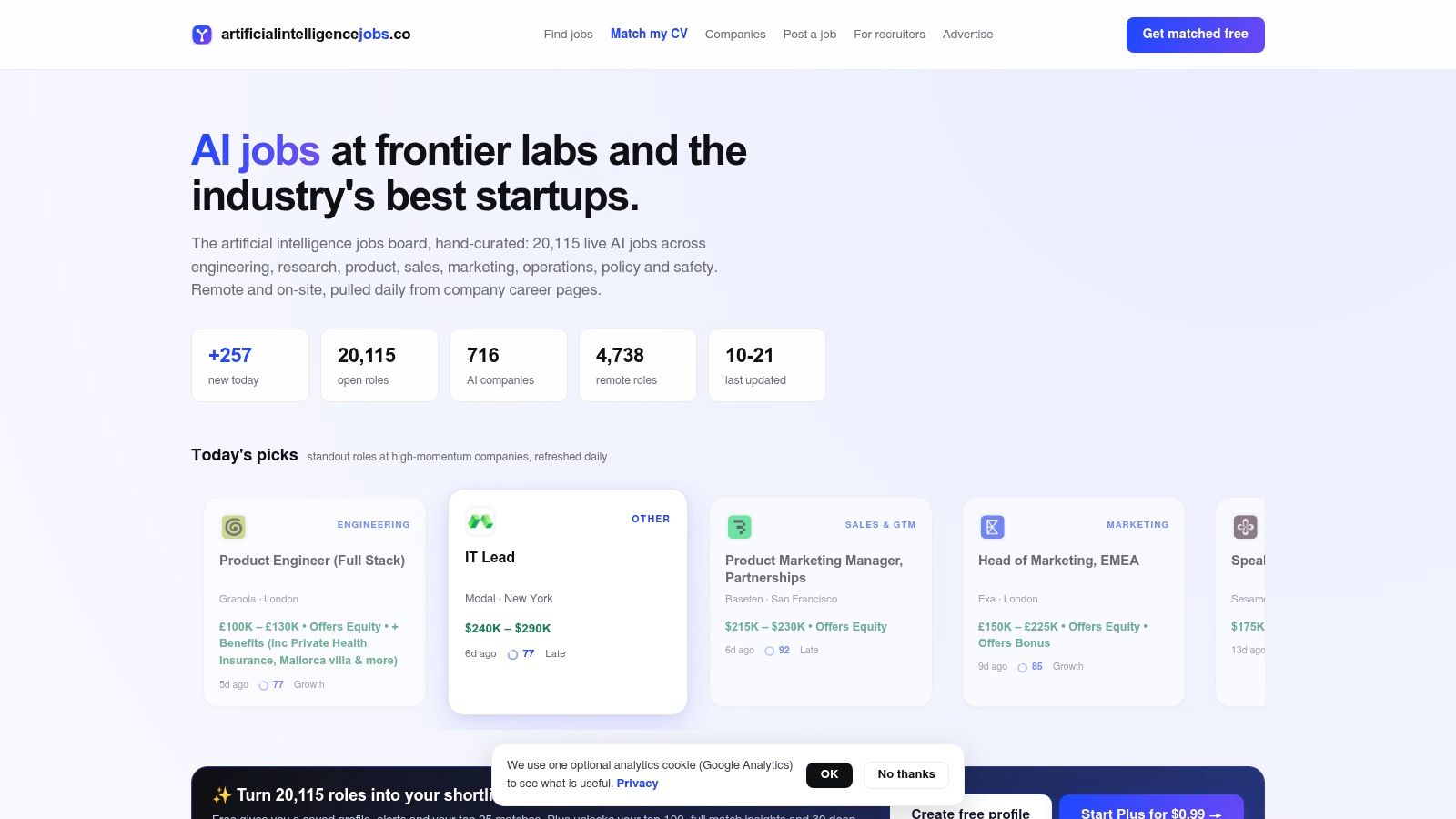
Its real strength is career mapping. You can see ML engineering next to AI product, safety, and operations roles, which helps you plan a move instead of only chasing the next title. A data scientist might target AI evaluation. An ML engineer might move toward safety or platform work. A domain expert in compliance might enter through governance rather than model research.
Check relevance carefully. An AI-focused listing isn't necessarily a machine-learning engineering role. Read for ownership of data, models, evaluation, and deployment. If those elements are absent, classify it clearly as adjacent and decide whether that adjacency helps your progression.
The Junior Candidate Problem
PwC analysis in its 2026 Global AI Jobs Barometer findings reports AI-exposed junior jobs are seven times more likely than the least-exposed junior jobs to request traditionally senior capabilities such as leadership and strategic thinking, and skills in jobs most exposed to AI are changing 66% faster than in less-exposed jobs. Build proof of judgment. Contribute to an evaluation suite, document failure modes, and present trade-offs to nontechnical stakeholders.
- Pros: AI-specific discovery across technical and nontechnical functions, useful for adjacent career paths.
- Cons: Narrower selection than national sites, and not every AI role involves ML work.
9. MoAIJobs
A useful MoAIJobs scan starts with restraint. Treat it as a specialist supplement inside a wider pipeline: categories for machine learning, data science, research, and AI engineering make focused browsing faster, and fields for location, work arrangement, and salary range help you screen before tailoring a resume.
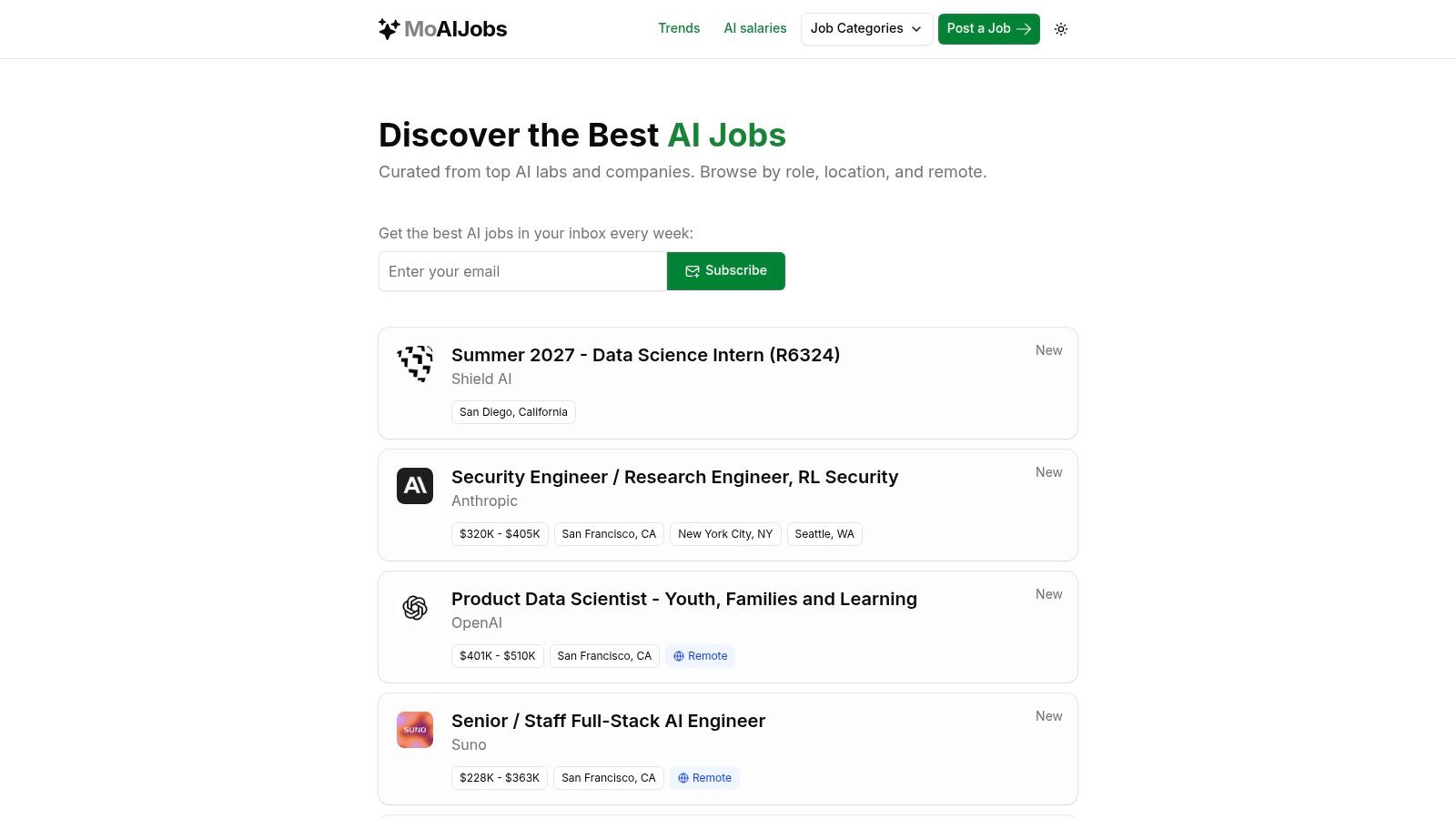
Volume is the trade-off. Expect fewer openings than national platforms and uneven depth by category, so use MoAIJobs for discovery, then confirm the role on the employer page. Run it beside the Blockchain Jobs AI and machine learning board covered earlier: MoAIJobs widens AI category discovery, while the Web3 board tests whether the role needs blockchain fluency.
Read employer spend as a signal, not a verdict. The employer page lists a $199 job submission and an optional $49 highlight; that proves distribution budget, and it does not prove strong management, fair pay, or an approved headcount. If a listing mentions interim senior oversight, budgeting for fractional AI leadership can help you infer whether the company has scoped mandate and budget before you spend interview time. Judge postings by data access, model ownership, evaluation standards, and deployment responsibility.
- Pros: Focused AI categories, useful salary and arrangement fields where provided, and clean specialist discovery.
- Cons: Lower volume, uneven category depth, and paid highlighting that can be mistaken for quality.
10. AIE Jobs
AIE Jobs keeps the scope narrow. It focuses on AI and machine-learning engineering roles, including machine-learning engineer listings at AI companies and other employers. For hands-on technical candidates, that clarity cuts irrelevant results and makes a short weekly scan worthwhile.
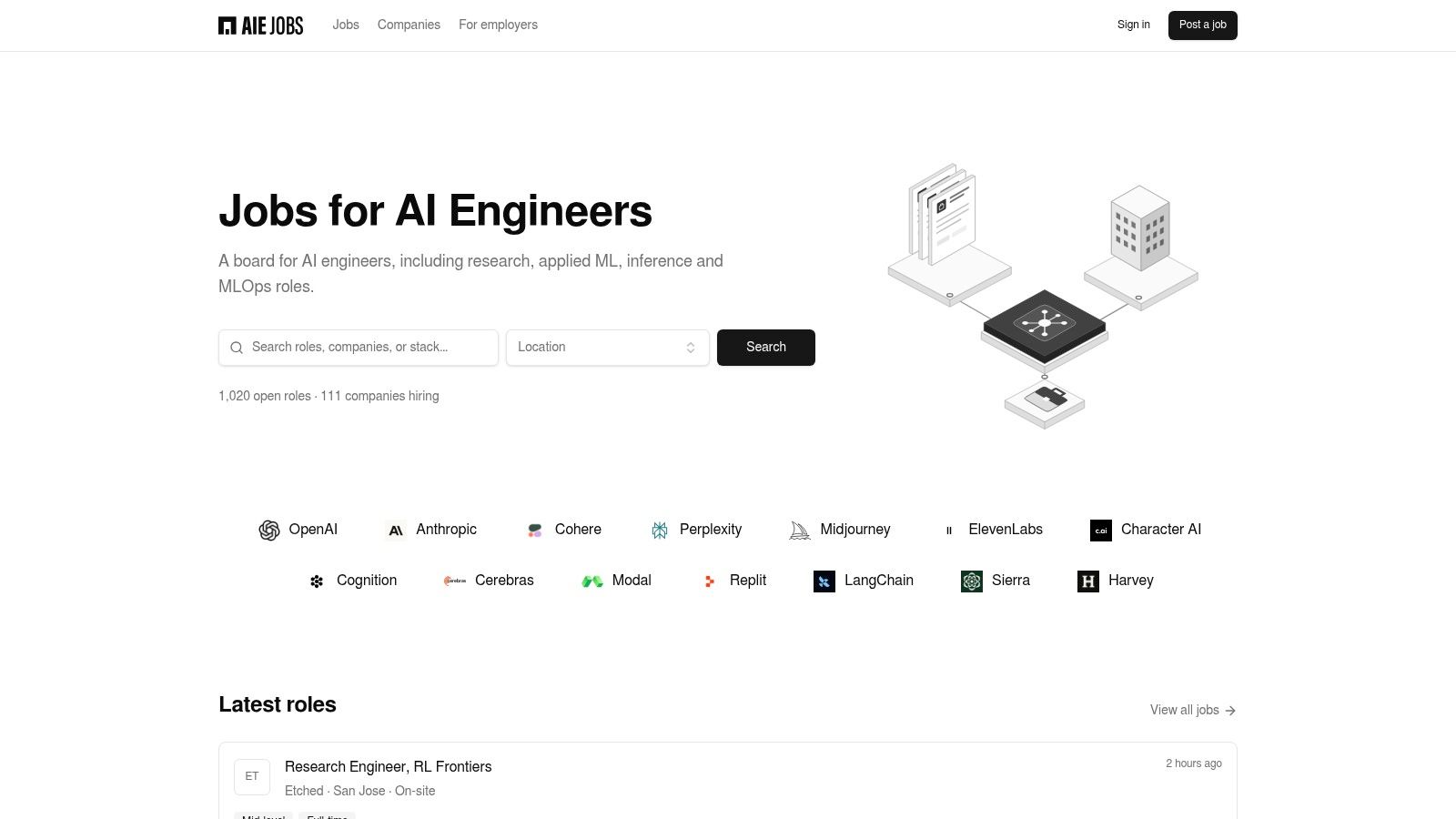
Don't expect it to serve a broad career pivot. It's less suited to general tech, policy, product, or nontechnical business searches. Role volume and US-local availability can fluctuate, so verify location, seniority, and application status for every listing. A focused board with stale or mismatched seniority helps no one.
Use it to sharpen your technical positioning. Compare repeated requirements across postings, then close the gaps that appear most often in roles you want. If postings keep asking for production deployment, feature pipelines, and evaluation under imbalance, build one reproducible project that proves all three. Generic model notebooks won't compete with that evidence.
For Web3 progression, translate that project into domain terms. Use public blockchain data, handle temporal leakage, detect anomalous transactions, and propose monitoring and rollback steps. That single artifact can support applications across specialist and general boards, and it gives interviewers something concrete to probe.
- Pros: Clear engineering focus, less noise, and useful specialist discovery alongside larger boards.
- Cons: Narrow coverage, fluctuating volume, and limited value for nontechnical AI career paths.
Top 10 AI and Machine Learning Job Resources Compared
| Platform | Focus & Coverage | Standout Features | Best For | Price / Value |
|---|---|---|---|---|
| Blockchain Jobs, AI & Machine Learning | 221 AI/ML and data science roles in blockchain and Web3 | 🏆 Web3-specific listings; curated categories | 👥 Candidates targeting AI/ML careers in crypto | 💰 Job search pricing not stated |
| LinkedIn Jobs | Broad AI/ML roles across industries and seniority levels | ✨ Job alerts, personalized search, professional networking | 👥 Candidates seeking broad options and connections | 💰 Job search is free; optional paid services |
| Indeed | US-wide AI/ML and data science listings | ✨ Location, remote, pay, and job-type filters; alerts | 👥 Candidates comparing roles across employers | 💰 Job search is generally free |
| Dice | Technology-focused AI/ML and engineering jobs | ✨ Skill-based search and tech career resources | 👥 Technical candidates focused on specific tools or skills | 💰 Candidate tools are free |
| Wellfound | AI roles at startups and growth companies | ✨ Startup profiles; salary and equity details on some roles | 👥 Candidates interested in startup environments | 💰 Candidate profiles and applications are free |
| Built In | Tech and startup roles organized by market and specialty | ✨ Company profiles; some listings include salary and work setup | 👥 Candidates comparing local tech opportunities | 💰 Browsing is free |
| Glassdoor | Job listings paired with employer and compensation information | ✨ Company reviews, salary estimates, and job alerts | 👥 Candidates researching employers and pay | 💰 Job-search pricing not stated |
| Artificial Intelligence Jobs | AI roles across engineering, research, product, policy, and more | ✨ AI-specialist listings; remote and location-based roles | 👥 Candidates exploring technical and nontechnical AI careers | 💰 Job-search pricing not stated |
| MoAIJobs | AI, ML, data science, research, and engineering roles | ✨ Specialist categories; some listings show salary and work setup | 👥 Candidates seeking focused AI opportunities | 💰 Candidate search available; employer post $199, highlight $49 |
| AIE Jobs | Focused on AI and machine-learning engineering | ✨ Narrow scope may reduce unrelated results | 👥 Hands-on AI/ML engineering candidates | 💰 Job-search pricing not stated |
Build a Job-Search System That Compounds Your Career
Stop treating each application as a separate event. Build a three-part system and run it every week. Use specialist boards to discover focused AI and Web3 roles, use broad platforms to widen the pipeline and catch overlapping titles, and use employer-review tools to validate team quality before you invest in a full interview loop.
Start with precision. Blockchain-focused and AI-specific sources show you where your skills meet a defined problem, such as transaction-risk modeling, on-chain behavior analysis, protocol monitoring, or security analytics. Then expand to LinkedIn, Indeed, Dice, and Built In with saved searches for title variants. End with validation on Glassdoor and the employer's own materials. If the story doesn't align across sources, ask direct questions or move on.
Turn Listings Into Interview Preparation
Tailor your résumé around measurable impact, not tool lists. Name the dataset scale, baseline, evaluation metric, latency or cost constraint, deployment environment, and result. Then prepare one role-specific story for each priority posting. Cover how you defined the problem, prevented leakage, chose metrics, handled failure modes, and decided when a simpler system beat a complex model.
That preparation compounds. The same evidence can support progression into production ML, ML operations, analytics leadership, AI product management, or governance, depending on your domain strength. Communication is part of the technical asset. If you need structure while you execute the plan, find an AI accountability partner and set weekly targets for applications, outreach, project work, and interview drills.
Career standard: Every search should leave you with better market knowledge, stronger proof of work, or a sharper target list. If it leaves you with only more tabs open, change the system.
Confirm details early. Ask about work arrangement, time zones, compensation range, equity or token terms, compute resources, data access, on-call duties, and promotion criteria. Set alerts so new AI machine learning jobs come to you, review them against a written scorecard, and archive strong job descriptions even after they close. Those descriptions become your skills roadmap for the next move, not just the current one.
Choose roles for the problems they'll let you own in two years, not only the title they'll give you now. That's how a job search becomes career progression.
Start your focused search with Blockchain Jobs, where dedicated AI and machine learning listings sit inside a specialist Web3 board covering engineering, data, security, product, and more. Set your target roles, compare fresh blockchain openings, and apply with evidence that matches the exact protocol, data, and deployment problems employers need solved.