What Is a Contract Engineer? Roles, Skills and Hiring Tips

What happens to your code, your taxes and your reputation on the day the engagement ends? Ask a room of engineers what is a contract engineer and the common answer is "a temp." Almost nobody mentions who owns the shipped code, who carries the tax bill, or where the deployment runbook lives once that person walks out the door.
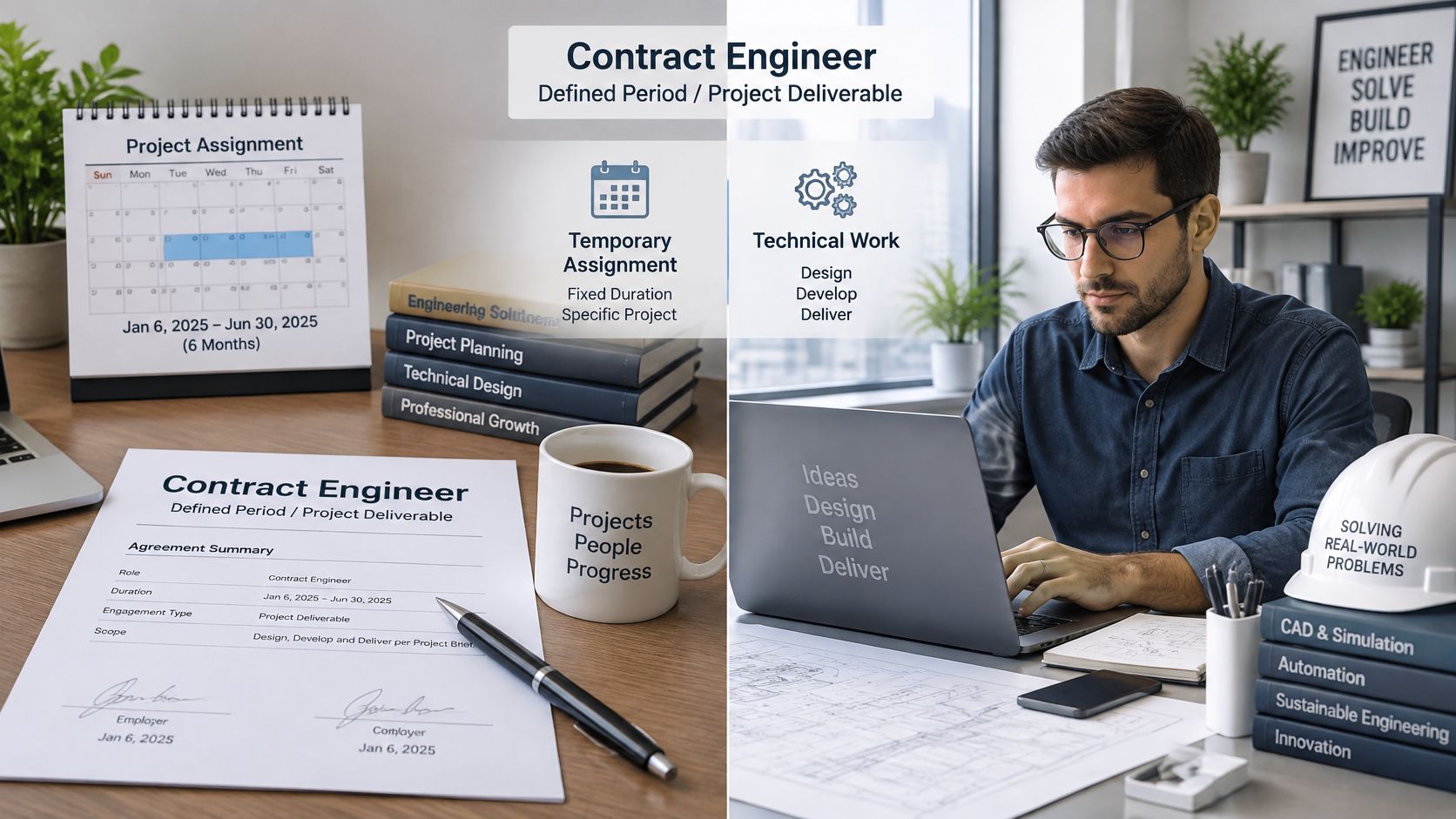
A contract engineer does the same engineering work as a permanent hire, under an agreement tied to a period, project or deliverable. The market behind that arrangement is large and still growing.
Those three questions decide whether a contract becomes a career move or a slow financial leak. In Web3 the stakes climb higher. A defect in a smart contract or a wallet integration can drain a pool before anyone ships a fix, so the work gets judged on irreversible financial risk rather than release velocity. Read the contract label as a legal, financial and career question, and the job title finally makes sense.
A Contract Engineer Defined in Plain Terms
A contract engineer is an engineering professional hired for a defined period, project or deliverable rather than as a permanent employee. The phrase has two halves and each does different work. Contract describes the engagement model, usually a statement of work or a fixed-term agreement. Engineer describes the technical responsibility. The contractual format changes the employment relationship, never the technical standard, which is why the same person can move between a payroll seat and a contract seat without changing a line of code.
Civil construction runs on this split already. An owner brings in a specialist to deliver one span of a bridge, with drawings, an inspection regime and a payment schedule, instead of keeping a foreman on payroll for every future road. The specialist still builds to the same engineering code; only the commercial wrapper differs.
The demand behind the model is structural. The U.S. Bureau of Labor Statistics projects about 106,100 openings per year for software developers, quality-assurance analysts and testers across 2025 to 2035, a hiring pace that permanent headcount alone rarely absorbs. Defined engagements close the gap because a company can buy a finished deliverable instead of a permanent seat.
Four routes, four different deals. The identical scope can arrive through a staffing firm, a consultancy, a freelance arrangement or a direct business-to-business contract, and each route changes who pays you, which benefits follow and what protections apply.
| Model | Who pays | Term | Protections | Typical use |
|---|---|---|---|---|
| Permanent employee | Employer payroll | Open-ended | Full benefits and paid leave | Long-term product ownership |
| Direct contract engineer | Client, via 1099 or B2B invoice | Defined project or term | No employer benefits, usually a higher hourly rate | Launches, audits, protocol upgrades |
| Staffing-firm contractor | Staffing firm, often on W-2 | Defined term, often extended | Payroll taxes withheld; workers' compensation through the firm; benefits possible on longer assignments | Temporary capacity and fast hiring |
| Freelance engineer | Several clients | Project by project | Full control and full risk | Specialized one-off deliverables |
Three checks identify the model from any offer before you sign: who pays you, whether an end date exists, and whether the scope is written down. If the answer to the second is "we'll see how it goes," you are closer to a probationary employee than a vendor, whatever the paperwork says. The difference matters because vendors invoice and employees have taxes withheld, and confusing the two hands you the obligations of one with the protections of neither.
In Web3, contract engineers often work on smart contracts, wallets, exchange infrastructure or cryptographic systems where defects create irreversible financial losses, so duration, payment, intellectual property, confidentiality, security responsibilities, termination and legal status all need explicit terms. Each clause answers a question the work makes urgent: who owns the code that moved funds, who carries the liability when it fails, and who can end the engagement while a deployment is live.
One warning about the search term. In construction and public procurement, "contract engineer" means the technical-commercial interface that builds tender packages, coordinates bidder questions, issues addenda and administers payment and change orders, as the Port Authority contract unit review standards describe. This article covers the software and Web3 meaning.
What a Contract Engineer Does Day to Day
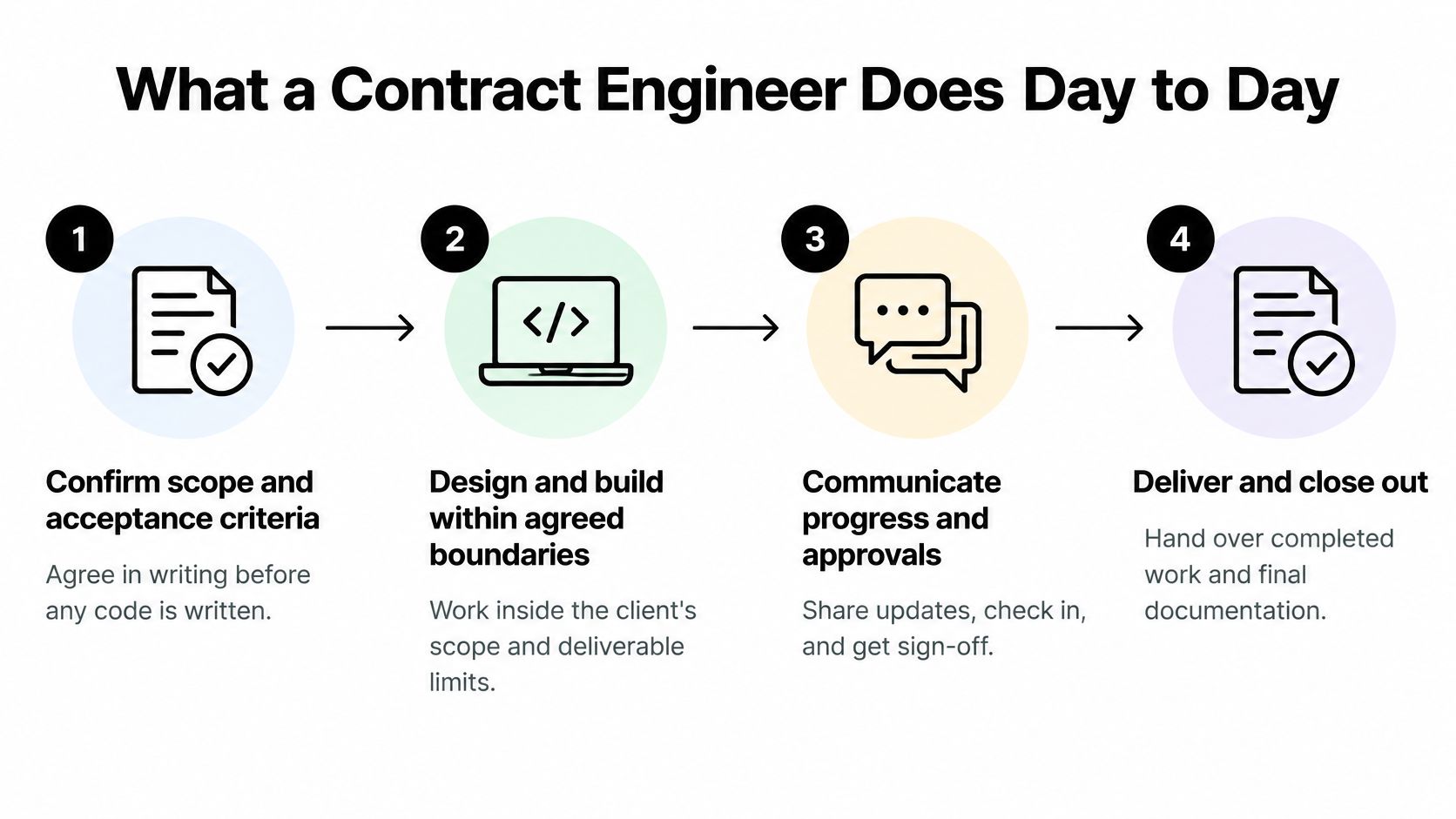
A contract that runs well looks boring from the outside, and that's the point. The work follows six steps, and each one exists because skipping it creates a dispute later. In Web3 the stakes behind every step are higher than in ordinary software work: a defect in deployed code can move real money permanently, so the daily routine is built around preventing irreversible errors, not just shipping features.
- Confirm scope and acceptance criteria in writing. Nobody writes code until both sides agree what "done" means, because an unwritten definition always resolves in favor of the person paying.
- Design and build inside the agreed boundaries. The client's architecture decisions govern, even where you'd choose differently, since a contractor who re-architects hands over a system the team can't maintain.
- Test and review, with a security pass on anything touching value. Agree the coverage target before you start, then test against real chain state rather than mocks, because mocks can't reproduce the liquidity, oracle data or attacker behavior your code will face on mainnet.
- Document decisions as you go. Deployment steps, environment variables, admin keys and known risks captured during the work cost minutes; reconstructed three months later they cost days.
- Manage changes through written requests. Every change states its effect on schedule, cost and risk, which converts a hallway request into a priced decision.
- Close out by handing over code, access, runbooks and knowledge. A contractor's value is measured at handover, not at commit.
There is also a protective role newcomers miss, and Web3 borrowed it from contract administration in the engineering trades. The contract engineer protects the technical basis of the deal without taking over the contractor's means and methods, reviewing submissions, clarifying requirements and recording approvals and deviations so there's an auditable trail for payment and claims. The National Society of Professional Engineers guidance compiled by CED Engineering frames the engineer as advising the owner, reviewing submissions and payment requests, managing changes, and confirming at completion that requirements were met and value received. In a Web3 engagement, that same discipline is what lets a client verify a milestone before releasing funds for code that, once deployed, cannot be recalled.
A DeFi lending protocol hires a contract engineer for a fixed three-month audit-remediation project. Day-one scope covers four audit findings, a test-coverage target and a testnet deployment. Three weeks in, someone asks for a new collateral type. That's a change request with an estimate attached, not a ticket: plus two weeks, plus a re-audit of the liquidation path. The engineer who names the cost keeps the project on schedule. The one who says yes to everything delivers neither.
Practical rule: if a change isn't written down with its schedule and cost effect, it isn't approved. It's a favor, and favors don't survive a missed deadline.
A clean close-out has five parts: merged code with passing tests, transferred access and admin keys, a runbook covering deploy and rollback, a list of open risks with severity, and a short note on what you'd do next with another month.
The six steps map onto a delivery cycle like this.
Skills and Tools Web3 Contract Roles Require
Web3 hiring reads repositories before résumés. A hiring manager will open your GitHub before finishing your CV, and a public repo with real tests outranks a certification every time.
The technical layer is narrower than people expect. Solidity covers most EVM contracts, Rust covers several non-EVM chains and their tooling, and TypeScript handles the scripting and front-end glue around both. Development and testing usually run through Foundry or Hardhat, and for serious protocol work, fork testing against live mainnet state is now the baseline rather than a nice extra. If you can't demonstrate a test that runs against a forked chain, assume the interview will stall there.
The judgment layer is what separates a hire from a near-miss. You need to recognize reentrancy, access-control mistakes and arithmetic errors on sight, and, harder still, to know when a fix introduces a new risk of its own. Add documentation discipline, scope literacy (turning acceptance criteria into tasks, and noticing when a change request is hiding inside a fresh ticket), and the ability to explain exploit risk to legal and finance people without jargon.
If the vocabulary around chains, wallets and nodes still feels loose, Web 3 basics for software teams from Bridge Global covers the fundamentals in plain language before an interview.
| Skill | Web3 example | Evidence to show |
|---|---|---|
| Smart contract development | Writing and testing Solidity or Rust contracts | Walk through a deployed contract and its test suite |
| Security judgment | Spotting reentrancy or access-control flaws | Explain a past bug, the fix and the new risk it avoided |
| Testing and tooling | Unit and fork tests with Foundry or Hardhat | Share a test setup or CI pipeline |
| Documentation | Decision logs, runbooks and handoff notes | Show a sample one-page handoff document |
| Scope and contract literacy | Turning acceptance criteria into tasks | Describe how a changed requirement was priced and approved |
| Stakeholder communication | Explaining exploit risk to legal or finance | Share a short risk memo written for non-engineers |
Two artifacts do most of the persuading. First, a public repository with tests and a short write-up of one bug you fixed, including how you found it and what you changed. Second, a one-page handoff document for any past project, real or sanitized. That second item is rare enough that it ends arguments about seniority on its own. Knowing the wider blockchain development tools environment helps you pick the right one for each client rather than defending a favorite.
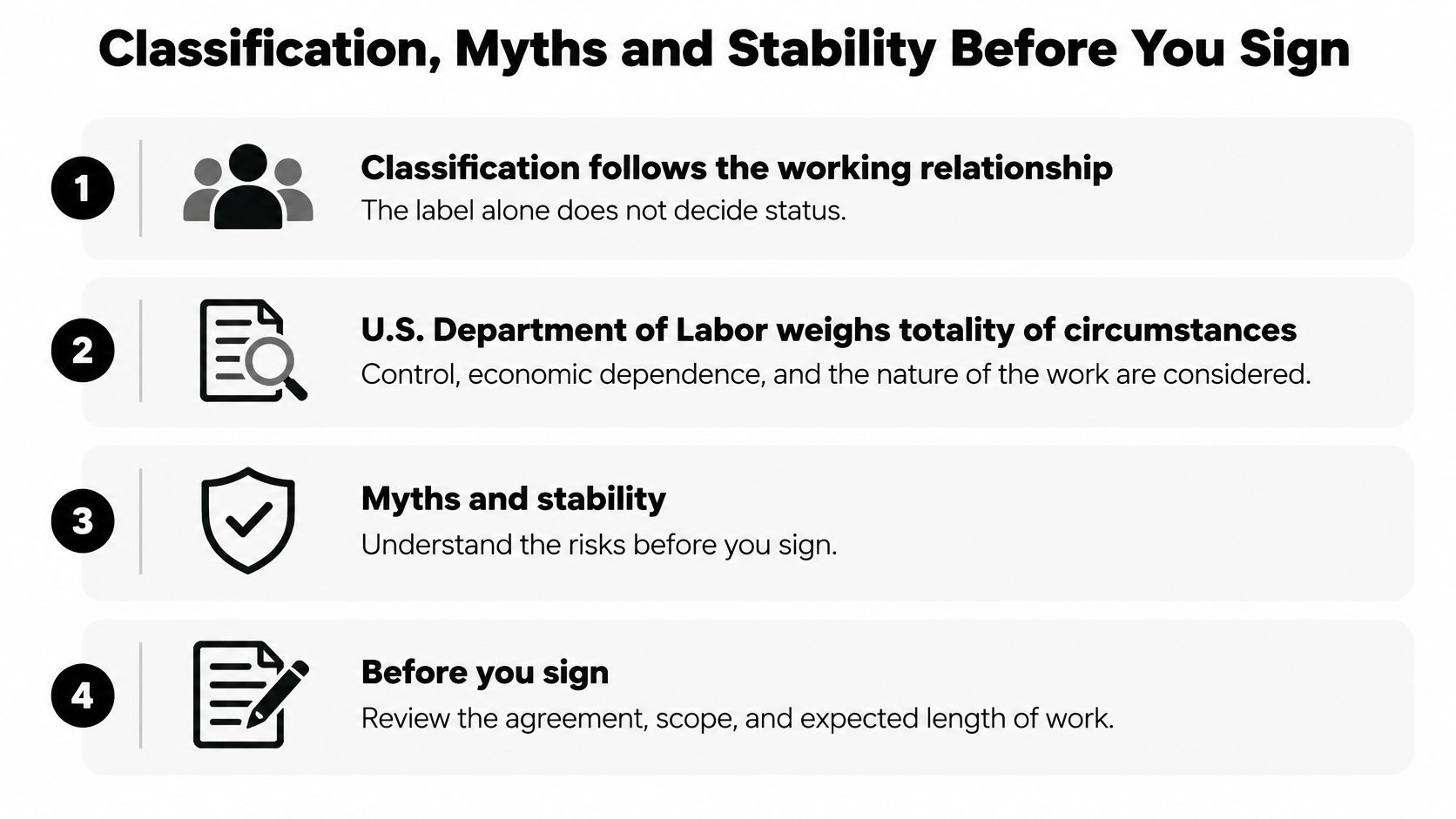
Classification, Myths and Stability Before You Sign
The label on the contract doesn't decide your status. The working relationship does. In the United States, the Department of Labor's economic-reality approach weighs the totality of circumstances, including economic dependence, control and the nature of the work, and no single factor automatically settles it.
That's why the question worth asking isn't "what is a contract engineer" but "am I self-employed, or am I an employee receiving fewer protections?" Work through six checks in order before you sign anything.
- Who controls how the work gets done. Fixed hours, daily supervision and mandatory standups describe an employee relationship wearing a vendor hat.
- Whether you can serve other clients. A clause that blocks outside work for the term is a strong signal of dependence.
- Who supplies the tools. Employer-provided laptops, licenses and hardware point one way.
- How you're paid and taxed. Direct 1099, W-2 through a staffing firm, or corporation-to-corporation. Each route changes your taxes, benefits, liability and protections.
- Who owns code and inventions. Assignment language should be explicit, and it should carve out pre-existing libraries you bring with you.
- What happens on early termination. Notice periods, kill fees and payment for work in progress belong in writing.
Remote work alone does not make you an independent contractor. Supervision, fixed hours, employer equipment, training and a role inside the company's core business can all indicate employee status, whatever the contract says.
Cross-border Web3 work raises the stakes. Tax, benefits, intellectual property ownership, confidentiality, immigration and data-security duties differ by jurisdiction, so get local advice rather than assuming your home country's rules travel with you. If you're modeling runway between engagements, budgeting tools for independent contractors from AI2Fin help you plan for the gap instead of discovering it.
Four myths worth correcting
- Contract means low-skill. The technical bar is identical, and contract scopes often cover audits, migrations and protocol upgrades, the work companies least want to get wrong.
- Remote means freelance. Nothing about a home office changes a classification test. Check the relationship, not the postcode.
- Contracts always end on schedule. Bridgeview IT's guide to hiring software engineers reports that 87% of its contractors are extended beyond their initial term, so ask about extension criteria, conversion options, end dates and notice periods before the first interview.
- Companies hire contractors to save money. The stronger driver is scarce, time-sensitive expertise and peak capacity, which is why a smart-contract specialist can command a premium during a launch window and nothing at all three months later.
The stability question is really a documentation question. An engineer who fixes an urgent problem and leaves behind an undocumented system has created a dependency, not a deliverable. Put the handoff in the contract, with a named format and a date.
Pay, Rates and Career Path for Contract Engineers
Compare the rate with the whole package, never with salary alone. A hiring guide summarised by daily.dev's contractor hiring guide reports that engineering contractor rates commonly run 30% to 50% above the equivalent W-2 salary when converted to an hourly basis, reflecting self-employment taxes, missing employer benefits, business overhead and uncertainty between engagements.
Run the arithmetic once and it sticks. A $100,000 salary is about $48 per hour across 2,080 hours. A 30% to 50% premium puts the equivalent contract rate at roughly $62 to $72 per hour. Below that band, you're likely funding the client's flexibility out of your own pocket.
Then adjust for reality. Subtract unpaid gaps between contracts, health insurance, retirement contributions, equipment and tax set-asides. A three-month engagement at a headline rate can earn less over a year than a steady salary once two idle months land in the middle.
The market isn't only moving in one direction. Electronic Design's freelance-engineering survey reported that self-employed and contract engineers accounted for 10.2% of surveyed engineers in 2024, down from 13.9% in 2021, per Electronic Design's industry insights. Selective hiring doesn't remove the premium, it just puts more weight on proof.
| Stage | Typical scope | Signal you are ready to move up |
|---|---|---|
| Junior contractor | Defined tasks under code review | Ships tested code with little rework |
| Mid-level contractor | Owns a module or integration | Leads a deliverable from scope to handover |
| Senior contractor | Architecture, audits and handoffs | Scopes and prices projects for other engineers |
| Lead or contract-to-hire | Team-level ownership | Converted to permanent or runs a security function |
Demand on the hiring side is visible in the listings themselves. Engineering carries 1,624 open roles on Blockchain Jobs, and the site currently lists 102 contract-type jobs, a useful read on how much of that demand is project-shaped rather than permanent. If you're benchmarking your number against staff roles, this breakdown of smart contract developer salary ranges is a sensible starting point.
Hiring and Interviewing a Contract Engineer
Contract interviews should be shorter and sharper than permanent-hire loops. You're testing whether someone can contribute in your actual environment next Monday, not whether they'll grow into a promotion in two years.
- Define the first-month deliverable before you schedule anything. Write it down, because a vague deliverable attracts vague candidates.
- Verify the basics. Availability, rate, work authorization, identity and one recent reference take twenty minutes and save a quarter.
- Run a 45-minute technical discussion with the engineer who'll work alongside the contractor, not a panel of people who won't.
- Run a 60- to 90-minute working session on a real system or codebase, redacted as needed.
- Decide within 48 hours of the working session. Good contractors have two other conversations running, per Kore1's contractor interview process.
For blockchain teams, technical skill is table stakes. Assess protocol security judgment, the habit of documenting decisions, awareness of open-source licensing and IP boundaries, incident-response readiness, and genuine willingness to transfer knowledge. A contractor who resolves an urgent vulnerability but leaves the system undocumented has traded one risk for another. Structured work-sample tests help here, and practical hiring assessments for HR teams from MyCulture.ai cover how to score them fairly.
Candidates should run their own checklist: is this project-only, extendable or convertible, what's the end date and notice period, and who owns the deliverables. Ask who else has worked on the codebase and where the last handoff document lives. The answer tells you more than the job description.
Two prompts that separate real experience from rehearsed answers. Walk me through a bug you found in a deployed contract, covering how you found it, what you changed and what the fix could have broken. How would you hand this system to a team that has never seen it, covering what you'd write, what order you'd write it in and what you'd delete first. If you're weighing a move into this kind of work, this overview of contract software developers covers how the day rate and scope usually fit together.
Start Your Search for Contract Engineering Roles
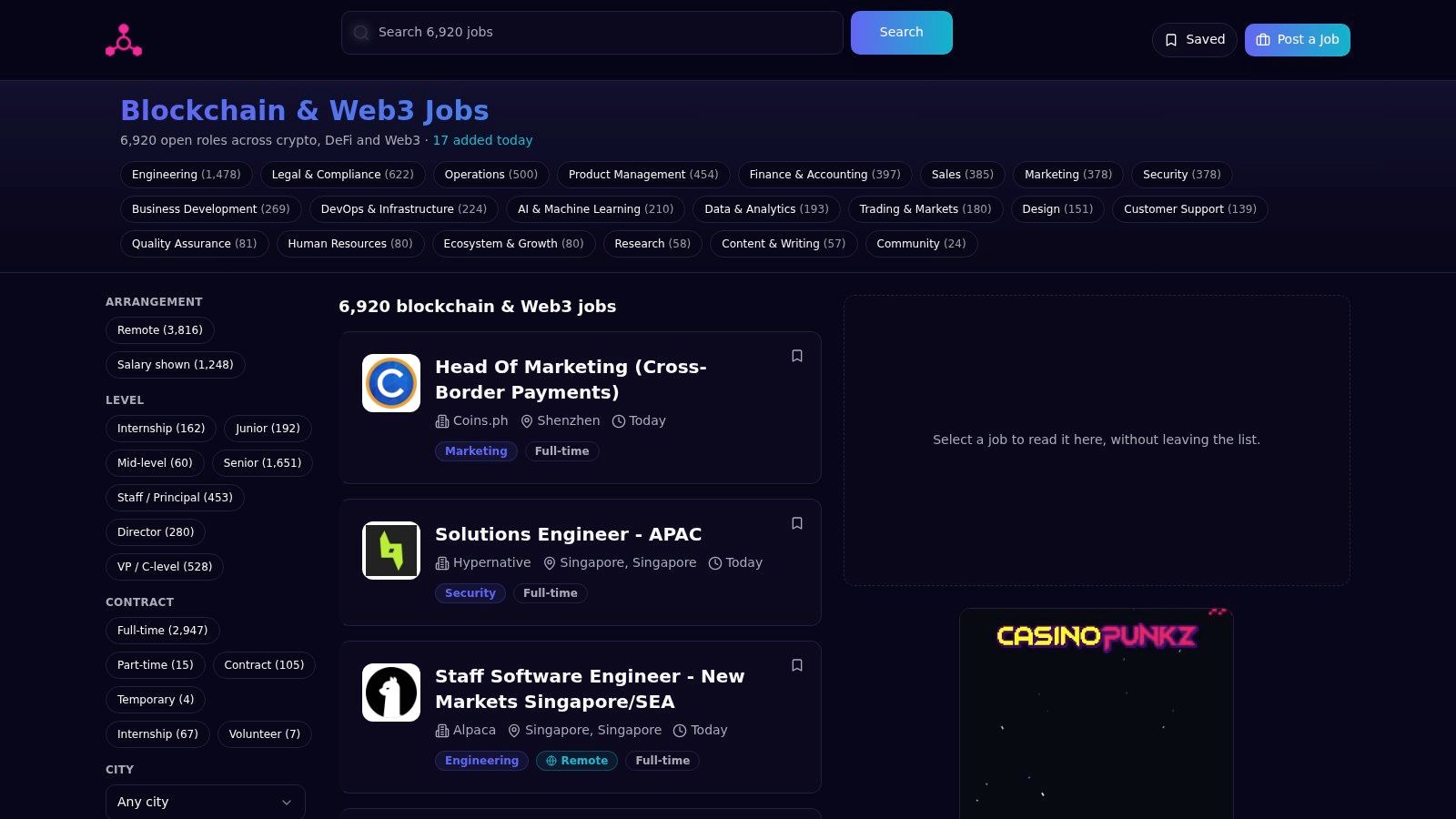
Contract listings are easy to filter and easy to misread. Blockchain Jobs tags every role by contract type, so Full-time, Part-time, Contract, Temporary, Internship and Volunteer become a click rather than a keyword guess. Full-time is the largest category at 2,883 listings, while Contract roles number 102, which tells you the contract market is real but selective.
Work it in five steps:
- Open the Engineering category, the largest on the site with 1,624 roles, and set contract type to Contract.
- Read each listing for employer, location, salary range where given, category and contract type.
- Prepare two artifacts before you apply: a public repository with tests and a one-page handoff example.
- Ask the classification and extension questions from the checklist before you accept anything.
- Set your target hourly rate using the premium calculation, not a salary comparison.
This week, shortlist three roles and send one question to each employer about extension criteria and deliverable ownership. The answers will tell you which of the three is a real contract and which is permanent work with a shorter calendar.
Blockchain Jobs is a dedicated job board for the Web3 ecosystem, with roles grouped into 21 categories and a contract-type filter that separates project work from permanent headcount. If you're ready to compare contract engineering roles on scope, rate and handoff expectations rather than job title alone, visit Blockchain Jobs and start with the Engineering category.