
Your Guide to Landing Crypto Marketing Jobs

The demand for skilled crypto marketers is absolutely booming. If you're looking for a way into one of the most exciting and fast-paced industries out there, a career in crypto marketing is your ticket. This guide will walk you through everything you need to know to move your career forward, from understanding the key roles to acing the interview.
Why Crypto Marketing Is A Golden Opportunity

First things first: throw out the old marketing playbooks. The world of Web3—which covers everything from decentralized finance (DeFi) to NFTs and beyond—runs on a completely different engine. In this space, your "customers" are more like co-owners and community members, deeply invested in the project's success. For your career, this means hiring managers are looking for a completely different mindset.
This shift creates a massive need for marketers who can do more than just manage ad spend. Web3 companies are on the hunt for people who can cultivate genuine communities, explain complex tech in a simple way, and drive authentic growth. This is your chance to build a career on the cutting edge.
The Surge in Demand For Web3 Marketers
This isn't just a feeling; the data backs it up. The Web3 ecosystem is expanding at a dizzying pace, and the demand for marketing talent has shot up right along with it. A report from Web3.Career highlights just how big the opportunity is, showing over 80,000 active job listings across 15,000 companies worldwide. Marketing and communications roles saw a particularly sharp increase.
What this means for your job search is that opportunities are everywhere, whether you're a seasoned marketer looking to transition from Web2 or just starting out. Companies desperately need your skills to help them navigate this new landscape.
This isn't just another tech boom; it's a fundamental shift in how we create and share value online. For marketers, it's a rare chance to get in on the ground floor of a technological movement and help write the next chapter of the internet.
High Stakes and Higher Rewards
The upside in crypto marketing can be huge. Because the work demands a unique mix of classic marketing principles and deep Web3 knowledge, companies are willing to pay top dollar to attract and retain the right talent. Understanding this dynamic is key to your salary negotiations.
Salaries for crypto marketing jobs often outpace their Web2 equivalents. Plus, compensation is rarely just about the base pay. Many offers include token packages or equity, giving you a real stake in the project's success and aligning your incentives with the company's. This can lead to significant financial rewards, making it an incredibly attractive career path.
If you're ready to see what's out there, you can find a ton of openings on industry-specific platforms, like our own curated listings on Blockchain Jobs. It's the perfect place to start your search and see where your skills fit in.
What Do Crypto Marketers Actually Do?
If you're looking for a job in crypto marketing, the first thing to realize is that the job titles can be a bit misleading. While they might sound like roles you'd find at any tech company, the day-to-day reality in Web3 is a whole different ballgame. Forget everything you know about traditional product marketing; in crypto, you're not selling a product—you're building a movement.
Let's pull back the curtain on the most common roles. This isn't just a list of job descriptions. Think of it as your guide to understanding what hiring managers are really looking for and what you'll be doing day-to-day.
The Community Manager: The Heartbeat of The Project
In crypto, the Community Manager is arguably one of the most vital roles. They're much more than a social media moderator; they are the living bridge between the core team and the project's most dedicated supporters. Their domain is the digital town square—usually Discord and Telegram.
Their mission is to cultivate, grow, and defend the community. That means creating a welcoming space, patiently answering tough questions about the protocol, and channeling crucial feedback from the ground up. To succeed, you must be part diplomat, part teacher, and part cheerleader, tasked with keeping spirits high and making everyone feel invested.
Heads up: in an interview for this role, you'll definitely be asked how you'd handle FUD (Fear, Uncertainty, and Doubt) or defuse a tense argument in a public channel. Companies want to see that you can be the calm in the storm. For a real-world example, check out this Senior Marketing and Community Manager role at Doublezero to see what a top team is looking for.
The Growth Marketer: The Architect of Adoption
A traditional growth marketer obsesses over metrics like Customer Acquisition Cost (CAC) and Lifetime Value (LTV). A Web3 Growth Marketer lives in a different world. Their North Star metrics are things like user adoption for a decentralized application (dApp), Total Value Locked (TVL) in a DeFi protocol, or the number of new wallet connections.
These are the data-driven strategists who design and run campaigns to pull new people into the ecosystem. One day they might be orchestrating a targeted airdrop, the next they're negotiating with DeFi aggregators to get their protocol listed. They are constantly tweaking the user journey, from the first landing page visit to the first on-chain transaction.
A Growth Marketer needs to prove they can navigate on-chain analytics. In an interview, a hiring manager will want to see that you don't just know how to get users in the door, but that you can actually measure and understand their behavior once they're inside the protocol.
The Content Strategist: The Builder of Trust
In an industry full of complex tech and, let's be honest, a lot of scams, trust is the single most valuable asset a project can have. The Content Strategist is the person responsible for building it. They do this by creating clear, honest, and genuinely helpful content that demystifies the project and explains why it matters.
This goes way beyond just writing a few blog posts. A great Content Strategist builds a whole educational ecosystem, which could include:
- Educational Articles: Simple explainers on how the protocol actually works.
- In-depth Guides: Practical walkthroughs showing people how to use the dApp.
- Video Tutorials: Step-by-step videos that hold the user's hand through complex features.
- Technical Documentation: Collaborating with developers to ensure docs are clear for other builders.
To get hired for this job, you must demonstrate a rare skill: the ability to translate deeply technical ideas into stories that connect with both crypto die-hards and total beginners.
The Influencer Marketer: The Relationship Navigator
Finally, we have the Influencer Marketer, who sometimes goes by Partnerships Manager. This person is the project's diplomat to the wider Web3 world of creators and key opinion leaders (KOLs). Their goal isn't just to pay for a few promotional tweets; it's to find and build real, long-term relationships with authentic partners whose followers are a natural fit for the project.
This strategic focus on community and relationships is a global trend. Industry reports show that over 60% of crypto marketing budgets go directly toward digital marketing, influencer campaigns, and community-building efforts. This shows hiring managers where the value is. You can find more data on crypto marketing budget allocation to understand how this shapes the job market.
Building a Skillset That Gets You Hired
Having the right skills is your direct ticket into a high-demand Web3 career. To land the best crypto marketing jobs, you need a specific blend of traditional marketing expertise and a deep, authentic understanding of the blockchain world. Think of it as having two toolkits: one filled with the marketing fundamentals you already know and another packed with Web3-native knowledge. Your ability to combine them is what will get you hired.
A common mistake candidates make is assuming their Web2 experience is a simple copy-paste. It's not. The context is entirely different. How do you run an SEO campaign when your target audience is searching for hyper-technical terms like "zero-knowledge proofs"? How do you manage a community when your "customers" are also token-holding stakeholders who have a direct say in the project's future? Answering these questions in an interview is how you'll stand out.
This concept map breaks down the core pillars of crypto marketing teams, showing the distinct but interconnected roles that drive a project's growth.
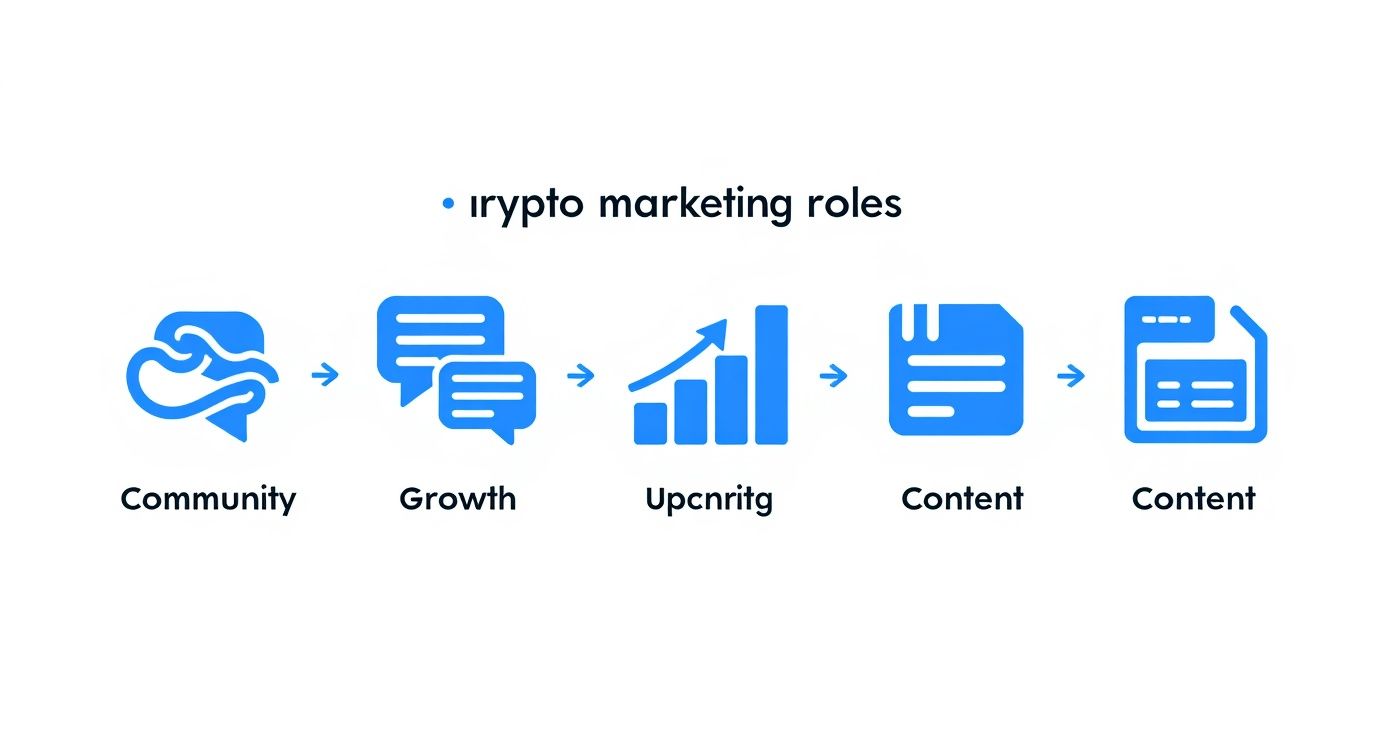
As you can see, Community, Growth, and Content form the strategic foundation. To advance your career, you must understand how these functions work together to build a strong brand and a loyal following.
Translating Your Existing Skills to Web3
The good news is you probably have more relevant experience than you realize. The trick is learning how to translate it for Web3. A hiring manager wants to see that you can adapt what you know to the unique challenges and opportunities of the crypto space.
This table shows how your existing marketing skills map directly to Web3 roles—and what you'll need to learn to bridge the gap.
Translating Traditional Marketing Skills to Web3 Roles
| Traditional Skill | Web3 Application & Required Adaptation | Key Tools |
|---|---|---|
| Social Media Management | Fostering genuine, 24/7 engagement in real-time hubs like Discord and Telegram, not just scheduling posts on a calendar. | Discord, Telegram, Collab.Land |
| SEO & Content Marketing | Creating educational content that demystifies complex topics like DeFi or NFTs, optimizing for niche, high-intent keywords. | Ahrefs, Google Search Console |
| Data Analysis | Moving beyond web traffic to analyze on-chain data—tracking wallet activity, transaction volume, and token holder distribution. | Dune Analytics, Nansen, Glassnode |
| Brand Partnerships | Building authentic relationships with Key Opinion Leaders (KOLs) and other Web3 projects, focusing on mutual value over transactional campaigns. | Twitter (X), Lens Protocol |
Your core abilities in communication, strategy, and analysis are still incredibly valuable. The key difference is in the channels you use, the communities you serve, and the data you measure. For example, a role like a Brand Partnerships Marketing Intern at Coinbase would require adapting traditional partnership skills to the unique landscape of crypto influencers and protocols. Frame your resume to highlight this adaptability.
Mastering the Web3-Specific Toolkit
Beyond adapting your current skills, there are specific tools and concepts you must understand to be credible in an interview. You don’t need to be a developer, but you absolutely need to speak the language fluently.
In Web3, your audience is often more technically savvy than the average consumer. Demonstrating that you understand the underlying technology isn't just a bonus—it's the baseline requirement for building trust and executing effective campaigns.
To get ready for your job hunt, start getting hands-on with the essential tools of the trade. This is your actionable checklist:
- Community Hubs: Spend real time in Discord and Telegram. Learn how bots, roles, and channels are used to manage huge, active communities. Don't just lurk—participate.
- On-Chain Analytics: Create a free account on Dune Analytics. Get comfortable reading basic dashboards that track project health, user growth, and token activity. This shows you're data-driven in a Web3 context.
- Social & Content Platforms: Master Twitter (X). It’s the undisputed center of crypto discourse. You need to understand its culture of threads, memes, and rapid-fire news.
- Wallets: Set up and use a non-custodial wallet like MetaMask. This is non-negotiable. You have to understand the user experience of connecting to dApps and signing transactions firsthand.
By actively using these tools, you move from a passive observer to an active participant. This hands-on knowledge is what separates a good candidate from a great one, giving you the confidence and credibility to ace your interviews.
What Can You Earn as a Crypto Marketer?
Let's get right to it: the money. One of the biggest reasons people are flocking to crypto marketing is the potential for some seriously impressive paychecks. But what does "well-paid" actually look like? Knowing the numbers is key to making a smart career move and having the confidence to negotiate your worth.
The salaries in this space are aggressive, and for good reason. It's a field that demands a unique mix of skills, and the industry is growing at a breakneck pace. For many seasoned marketers, making the jump from Web2 to Web3 comes with a significant pay bump.
A Look at the Numbers
The global average salary for a Web3 professional hovers around $103,000 per year. Marketing roles often sit at the higher end of that spectrum, simply because building a strong brand and an engaged community is the lifeblood of any successful project.
In the United States, it’s common to see experienced crypto marketing managers and directors pulling in between $120,000 and $180,000 annually, though this can vary based on the company's size and the scope of the role. Even entry-level marketing gigs in crypto tend to start around $70,000—often a good deal higher than what you'd find in more traditional industries. For a deeper dive, you can explore more crypto compensation trends to get the full market picture.
While these base salaries are compelling, they're really just the beginning of the story. The truly exciting part of a Web3 offer often lies in what comes next.
Thinking Beyond the Base Salary
In the world of crypto marketing, a job offer is rarely just a number. Total compensation is usually structured to give you a real, tangible stake in the project's success. This aligns your incentives with the company's growth and is a crucial part of the Web3 ethos. Bringing this up in an interview shows you get it.
When you're looking at a Web3 job offer, think of yourself less as an employee and more as a potential stakeholder. The right package can offer life-changing upside that goes far beyond a traditional salary.
So, what does a typical offer look like? Here’s a breakdown of what you can expect to see, which should give you a solid framework for any negotiation:
- Base Salary: This is your guaranteed cash, usually paid out in a standard currency like USD or a stablecoin like USDC. It's the stable foundation of your income.
- Token Packages: This is where things get interesting. You'll often receive a grant of the project’s own native tokens. These usually come with a vesting schedule, meaning you earn them over time (say, four years with a one-year "cliff" before you get your first batch). Their value is tied directly to how well the project performs, giving you a shot at massive upside.
- Equity: If you’re joining a more established, incorporated company—think a major crypto exchange or a venture-backed startup—you might also get traditional stock options or RSUs, just like in a Web2 tech job.
- Performance Bonuses: These are typically tied to hitting specific goals (KPIs), like growing the user base, boosting community engagement, or nailing a big campaign launch. Bonuses can be paid in fiat, stablecoins, or more project tokens.
Knowing these components is your secret weapon in an interview. When you start asking smart questions about tokenomics, vesting schedules, and bonus structures, you’re signaling that you're not just looking for a job. You're looking for a long-term partnership. It shows you’re invested in the project's future, and that’s exactly the kind of person they want on the team.
How to Nail Your Crypto Marketing Interview
An interview is where you prove you belong in Web3. A strong resume might get your foot in the door, but the interview is your chance to show the hiring manager you don't just know the lingo—you actually get the culture. This is your playbook for turning that application into a job offer.

Build a Portfolio That Speaks Web3
If you want to impress a crypto hiring manager, the single best thing you can have is a portfolio that proves you’re genuinely involved in the space. This is especially true if you don't have direct professional experience yet. A traditional marketing portfolio with Web2 case studies is fine, but a Web3-native one is a game-changer.
Think of it this way: anyone can say they're passionate about decentralization. Very few can actually prove it. Your portfolio is that proof.
Here are a few powerful ways to build one from the ground up:
- Contribute to a DAO: Join a Decentralized Autonomous Organization and get your hands dirty. Even small contributions—like helping moderate a Discord or writing a quick summary of a governance proposal—are tangible proof of your commitment and understanding.
- Create Speculative Work: Pick a crypto project you admire and create a hypothetical marketing campaign for it. You could write a blog post analyzing their growth strategy, design a sample influencer campaign, or map out a launch plan for their next feature. It shows you’re a self-starter who thinks strategically.
- Analyze On-Chain Data: Get familiar with a tool like Dune and build a simple dashboard. You could analyze a protocol's user growth or a competitor's token distribution. This shows you're data-driven in a way that’s truly native to Web3.
Answering Common Crypto Interview Questions
Expect a mix of standard marketing questions and some Web3-specific curveballs. Hiring managers want to see how you think on your feet and apply what you know to real crypto problems. Be ready for questions that test both your strategic mind and your cultural fit.
"How would you build a community from zero for a new DeFi protocol?"
This is a classic. It’s designed to test your understanding of grassroots growth. A great answer isn’t just a list of tactics; it’s a phased strategy.
- Phase 1: The Foundation. Start by digging deep into your target audience. Where do they hang out online? What are their biggest pain points? Your first moves should be creating high-value educational content (think blog posts and deep-dive Twitter threads) that actually solves their problems, not just shilling a project.
- Phase 2: Engagement. Find and connect with key opinion leaders (KOLs) and micro-influencers who genuinely align with the project’s mission. Focus on building real relationships, not just transactional promotions. At the same time, set up shop in community hubs like Discord and make it a valuable place for discussion before you have a huge user base.
- Phase 3: Scaling Up. Now you can roll out community-focused initiatives, like an ambassador program or small, targeted airdrops to reward your earliest supporters. Use analytics to see what’s working and double down on those channels, whether it's hosting AMAs on Twitter Spaces or creating tutorials on YouTube.
What Hiring Managers Are Really Looking For
Beyond your skills and portfolio, the interviewer is trying to figure out three crucial things about you.
- Genuine Passion: Do you live and breathe this stuff? They want to see that your interest goes far beyond a paycheck. Mention the podcasts you listen to, the newsletters you read every morning, and the DAOs you’re an active member of.
- Adaptability: Crypto moves at a breakneck pace. A strategy that worked six months ago might be totally obsolete today. Show them you're a quick learner who is comfortable with uncertainty and can pivot without missing a beat.
- Cultural Fit: Web3 has its own unique culture—it’s built on memes, inside jokes, and a shared belief in transparency and decentralization. Proving you understand this culture shows you can connect with the very community you’ll be hired to serve.
Mapping Your Long-Term Career Path in Web3
https://www.youtube.com/embed/kWAEPlpUn_k
Getting your foot in the door with that first crypto marketing job is a huge win. But what’s next? The real game is building a career that’s not just sustainable but genuinely fulfilling.
Forget the rigid corporate ladders you see in traditional industries. Web3 is far more fluid. Your career growth here isn't about how many years you've put in; it's about the tangible impact you make. It’s a journey that demands constant learning and rewards those who are truly passionate about the space. The skills that land you a Community Moderator role are just the starting point for becoming a Head of Growth.
From Entry-Level to Leadership
The path forward in crypto marketing can be a wild, fast-paced ride. While everyone's journey is different, there's a common trajectory that shows how roles stack on top of each other, each one demanding more strategic thinking than the last. Think of this less as a strict roadmap and more as a sketch of what's possible for your career.
Here’s what that progression often looks like:
- Community Moderator / Manager: This is where it all starts—on the front lines. You'll master community engagement, learn how to handle FUD (Fear, Uncertainty, and Doubt), and become the project's pulse. Your main job is to build trust and keep the vibes positive.
- Marketing Manager: After mastering community fundamentals, you'll step into a broader role. This is where you start running campaigns, coordinating content, and digging into analytics. You learn to tie every marketing action back to real growth metrics.
- Head of Growth / Marketing Director: At this stage, you're not just running the plays; you're designing the entire playbook. You own the budget, lead the team, and set the high-level strategy that drives user adoption and, ultimately, token value.
- Chief Marketing Officer (CMO): As a CMO, you're in the driver's seat of the project's brand, story, and market position. You're working side-by-side with founders and other execs to make sure marketing is perfectly synced with the protocol’s long-term vision and tokenomics.
The secret to moving up? Always think one level ahead of your current job. If you're a Community Manager who's already offering strategic feedback from user conversations, you're showing you have the mind of a Marketing Manager. That's how you get promoted.
Specializing for Deeper Impact
As you build experience, you’ll naturally gravitate toward specific areas of Web3. This is your chance to specialize, become a sought-after expert, and carve out a niche for yourself. This is how you build a powerful personal brand and start commanding a premium.
Think about diving deep into high-impact specializations like these:
- DeFi Marketing Expert: You become the go-to strategist for launching and growing complex financial protocols. You'd be mastering everything from liquidity mining campaigns to tactics for increasing Total Value Locked (TVL).
- NFT Launch Strategist: You specialize in the art and science of dropping NFT collections. It's a world of building hype, managing mint day chaos, and cultivating dedicated collector communities.
- DAO Communications Lead: You tackle the unique challenge of marketing and governance for Decentralized Autonomous Organizations, figuring out how to align and motivate thousands of token-holding members.
Picking a specialty lets you sharpen your expertise until it’s razor-sharp. It’s what turns you from a marketing generalist into an indispensable player in the world of crypto marketing jobs.
Your Crypto Marketing Questions, Answered
Jumping into a new field always brings up a ton of questions. For crypto marketing, they usually boil down to a few key things: Do I need to be a coder? How do I get my foot in the door without crypto on my resume? And is this whole thing just a bubble?
Let's clear things up so you can move forward with a solid plan for your job search.
Do I Really Need to Be Technical?
Nope, you don't need to write code. But you absolutely need to understand the fundamentals of blockchain. Think of it this way: you wouldn't market a car without knowing what an engine does.
Hiring managers will expect you to comfortably explain concepts like DeFi, NFTs, and DAOs in simple terms. They want to know you can translate complex tech into compelling stories for a non-technical audience.
The best way to get there? Get your hands dirty. Start using dApps, mint an NFT, join a few project communities, and make reading industry news a daily habit. This shows you’re not just looking for a job—you’re genuinely curious and can speak the language of the people you'll be marketing to.
How Can I Stand Out if I Don't Have Crypto Experience?
You have to prove you belong here. Don't just say you're a quick learner; show it.
Your first move should be to immerse yourself in the culture. Jump into Discord servers for projects you find interesting and actually participate. Ask smart questions. Help newcomers. This is you, building community skills in real-time, and it's something hiring managers look for.
Next, translate your past experience. Reframe your resume and talking points. "Managed customer relationships" becomes "grew and nurtured a user base for a new product." Even better, create a small, relevant portfolio. Write a blog post breaking down a project's marketing strategy or draft a sample launch plan for a new dApp. This kind of initiative screams passion and resourcefulness.
In an interview, talking about the DAOs you participate in or the on-chain analytics dashboards you’ve explored is way more powerful than just listing your Web2 wins. It proves you're already part of the world you want to work in.
Is This a Stable Career Path?
Let's be real: the market is famous for its wild swings. But underneath the price charts, the technology is constantly being built, improved, and adopted. Serious, well-funded projects don't stop hiring when the market dips—in fact, that's often when they double down on building for the long term.
For the most stability, look at roles with established players like major crypto exchanges or the foundations behind big Layer-1 blockchains. At the end of the day, the demand for marketers who truly get this space is incredibly high. That demand creates a pretty strong career safety net, even when the market gets choppy.
Ready to find your place in the future of marketing? At Blockchain Jobs, we connect talented marketers with the most exciting opportunities in the Web3 ecosystem. Explore curated listings and find your next big move today.