Crypto Security Jobs: 7 Places to Land Your Next Role

4,763,963 additional cybersecurity professionals were needed globally in 2024, according to the ISC2 Cybersecurity Workforce Study. That's a measure of unmet organizational need, not advertised vacancies, but crypto employers compete in that same talent pool. At Blockchain Jobs, our Security category lists 353 openings, giving candidates a focused view of the opportunity.
Where crypto security careers get hired depends on the specialty. Crypto security jobs span smart-contract auditing, security engineering, incident response, on-chain monitoring, and bug bounty research. An auditor needs to prove exploitability; a platform engineer needs to secure production systems; an incident responder needs to make defensible decisions under pressure.
Specialized boards help you discover employers, aggregators help you compare requirements, and direct career pages provide the clearest application destination. Use each for a different purpose. The strongest search isn't the one with the most applications, it's the one that connects your evidence of competence to the right security team.
1. Blockchain Security Jobs | Smart Contract Auditor Roles
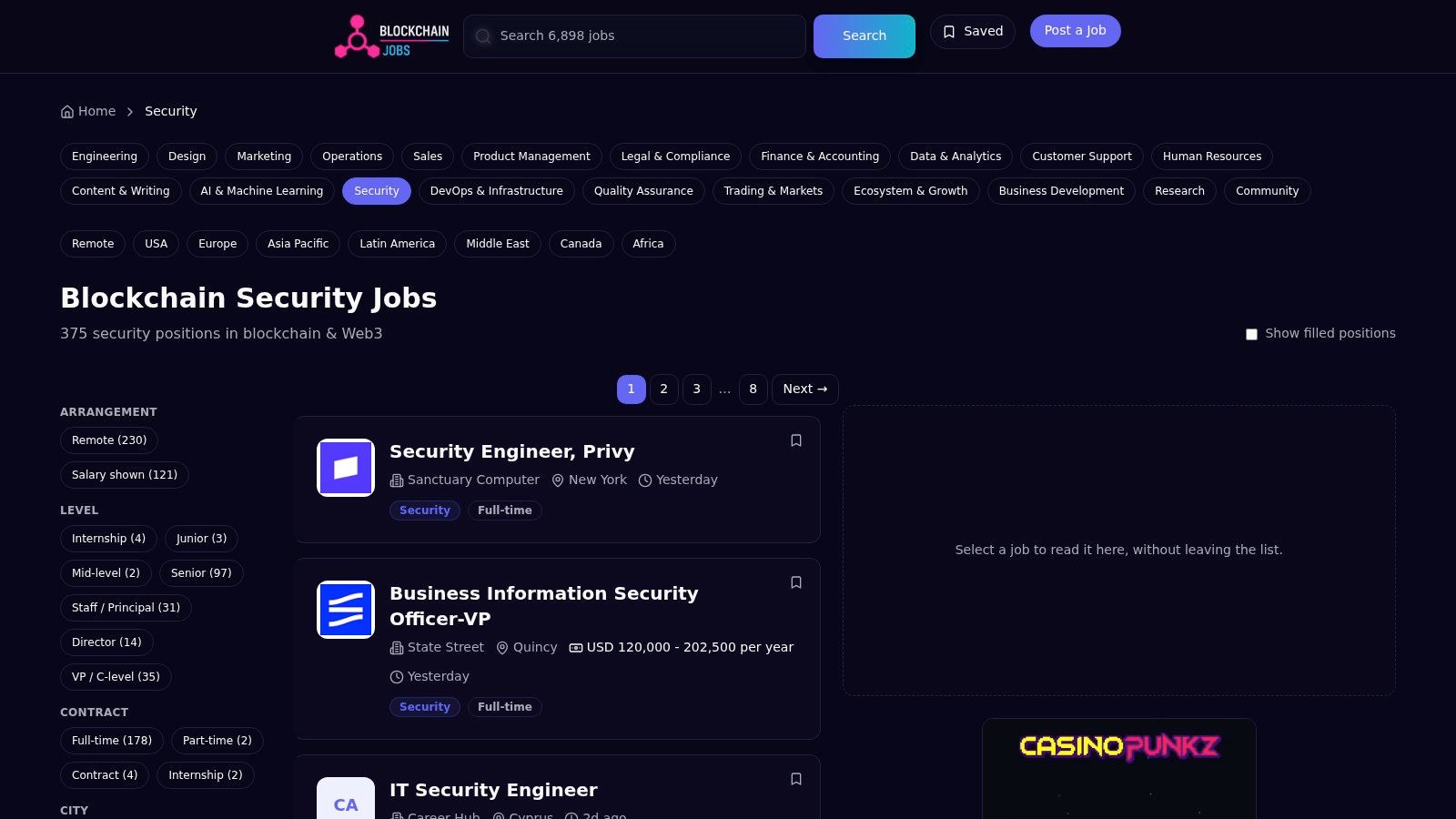
The Blockchain Jobs Security category is the focused starting point for candidates who want blockchain work rather than a general cybersecurity search with occasional crypto employers. Listings span security engineering, penetration testing, and blockchain security engineering. Filters for remote work, seniority, and contract type help separate plausible applications from interesting but unsuitable roles.
The main advantage is specialization, not the listing count. A penetration tester moving into digital assets can explore infrastructure-facing work without pretending to be a protocol researcher. A Solidity developer can concentrate on contract assurance rather than corporate identity administration.
Turn the posting into portfolio requirements
Read the responsibilities before the title. If a role emphasizes upgradeability, authorization, and protocol integrations, prepare evidence that you can reason about those attack surfaces. Our guide to smart-contract security provides a useful foundation for organizing that preparation.
Build an application around concrete artifacts:
- For auditing: Include a reproducible exploit, the violated invariant, and a regression test demonstrating the fix.
- For penetration testing: Explain scope, attack paths, business impact, and remediation without exposing confidential systems.
- For security engineering: Show a threat model, deployment control, or monitoring implementation that another engineer can inspect.
Hiring rule: A finding without a clear explanation of exploitability is weaker evidence than a smaller finding with a convincing reproduction and fix.
The trade-off is that a category page can't establish whether every opening remains active or suits your background. Review the individual employer, compensation terms, and application destination before investing in a take-home assignment.
For progression, look beyond the next title. Prefer responsibilities that expand your ownership from identifying issues to validating remediation, improving development practices, and explaining risk to decision-makers.
2. Web3.career
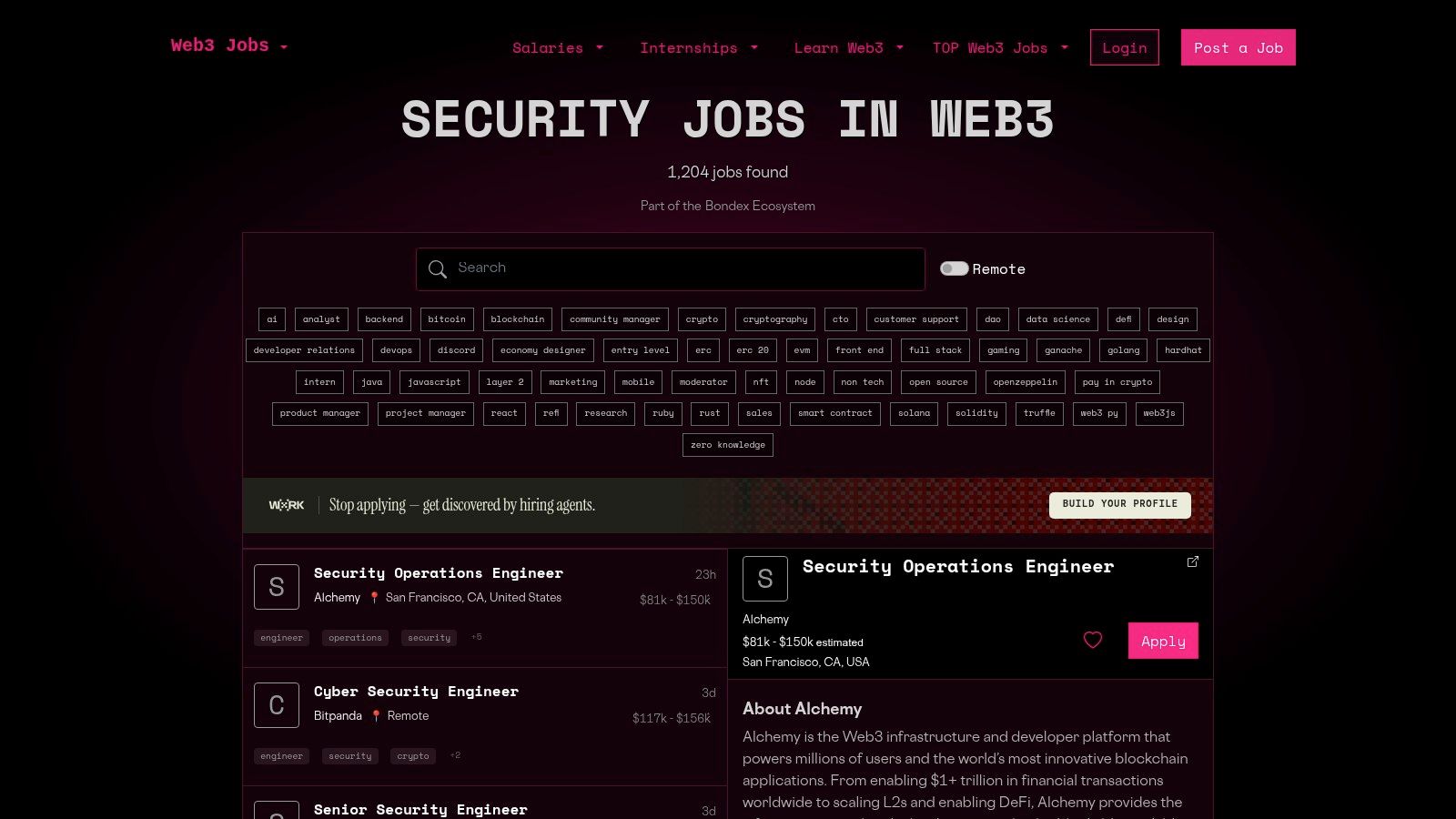
Use Web3.career's security-jobs page when you're still deciding which security specialty fits your experience. Its broad employer coverage, tags, and filters make it useful for comparing security engineering, infrastructure, incident response, and leadership openings. Some listings include salary ranges, and related career and learning resources support that exploration.
The useful comparison isn't auditor versus security engineer. Compare what you'll protect, what you'll own, and who will evaluate your work. A wallet team may prioritize transaction authorization, while an infrastructure team may prioritize cloud permissions and deployment integrity.
Compare scope before compensation
The FindWeb3 security-engineer salary dataset reports a $194,000 median across 30 blockchain-security-engineer listings. Treat that as listing-based negotiation context, not a guaranteed salary for any role carrying a security title.
When comparing openings, record:
- Technical scope: Contract review, cloud security, detection engineering, or a mixture.
- Compensation structure: Base salary, equity, tokens, and any terms that remain unspecified.
- Growth path: Deeper technical ownership, incident leadership, or people management.
Web3.career's breadth is also its limitation. The security category can include adjacent cybersecurity positions, and salary information isn't universal. Verify the opening and application requirements on the employer's careers page before tailoring your submission.
For interviews, prepare the work sample that matches the actual responsibilities. Sending the same audit report to every employer wastes the comparison advantage this board gives you.
3. OpenFrom
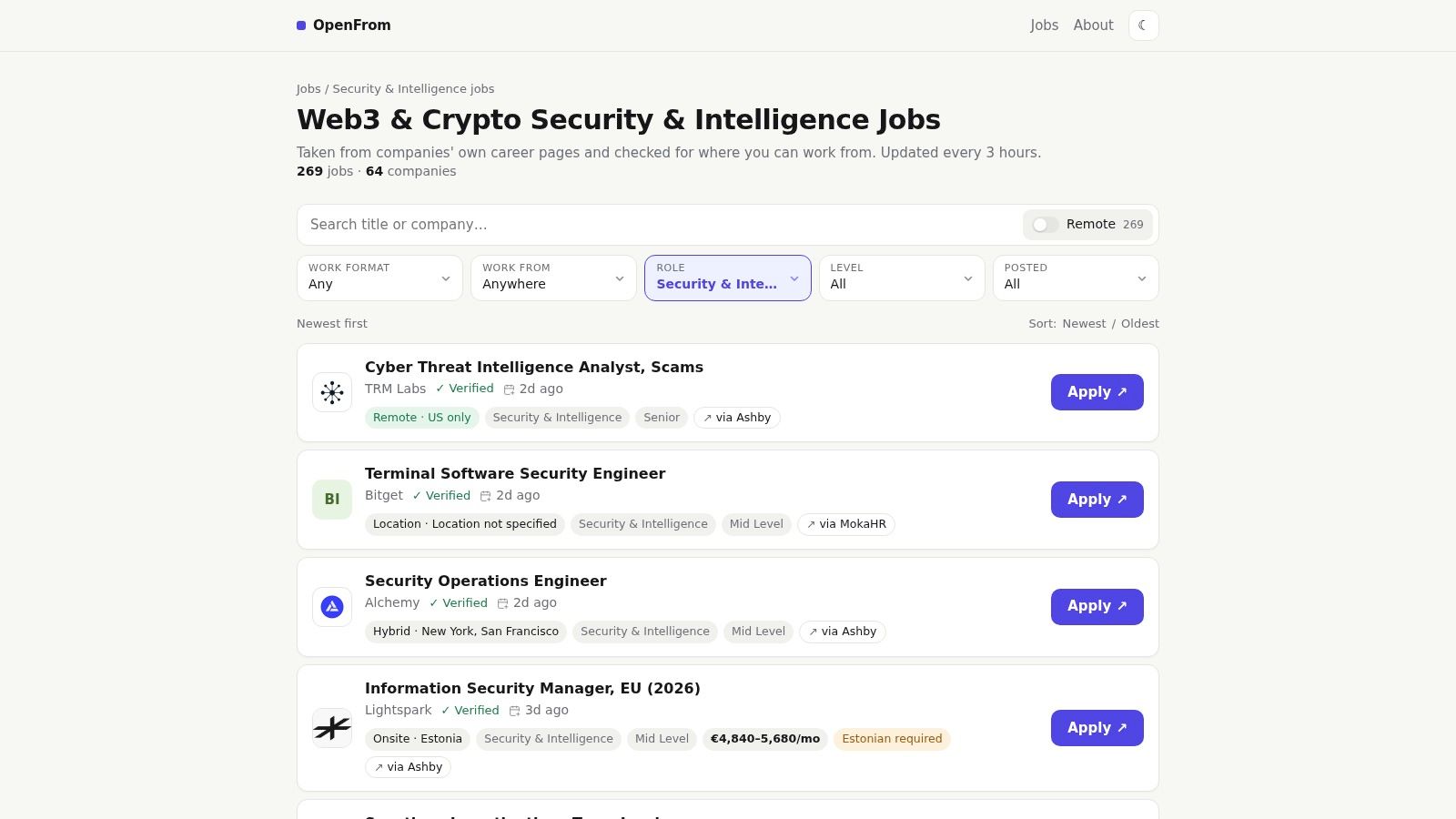
Remote doesn't mean eligible from anywhere. OpenFrom's Security & Intelligence category is useful because its location labels distinguish some U.S.-eligible remote openings from other arrangements. It collects opportunities from company career pages and identifies application systems such as Ashby, Greenhouse, and Lever.
That makes it practical for candidates who want to resolve location restrictions before preparing an application. Added-date information and verification markers offer discovery context, but the destination posting still controls the requirements. Some locations remain unspecified or unconfirmed.
The category also extends beyond hands-on security engineering into investigations, fraud, compliance, and leadership. That breadth helps adjacent candidates, provided they don't mistake every intelligence role for exploit research.
Choose the role by its expected output: production controls, investigative findings, detection rules, or risk decisions.
Prepare for investigation-heavy screening
A blockchain security analyst posting on Indeed combines transaction analysis, smart-contract investigation, Python or JavaScript, and written reporting. It also names tools including Slither, Mythril, and Echidna, illustrating how investigative and code-level requirements can coexist.
For a portfolio, trace a public transaction sequence and separate observed facts from hypotheses. Include a script that reproduces your analysis, explain attribution limits, and write an executive summary that doesn't require the reader to understand every opcode.
That exercise supports progression toward investigation ownership. It demonstrates not just that you can find suspicious activity, but that you can produce findings another team can act on.
4. Coinbase Careers
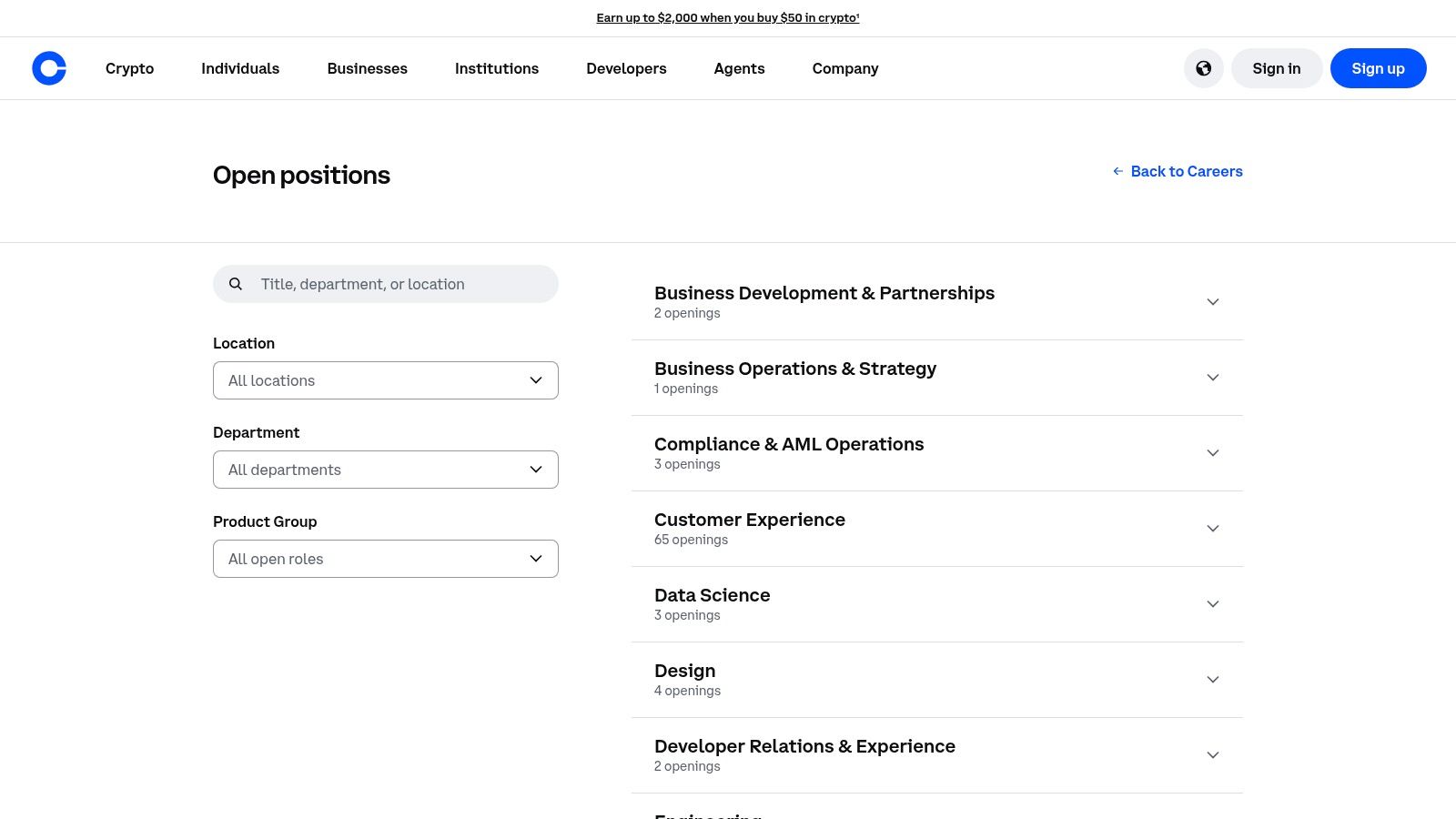
Go directly to Coinbase Careers when you know you want security work at a large crypto platform. The searchable positions page includes engineering security, privacy, and threat-intelligence opportunities, with some roles labeled U.S. remote. It's the direct source for published requirements and applications.
Unlike an aggregator, a company page lets you compare related openings within the same organization. Read adjacent roles to understand where application security ends and infrastructure, privacy, or detection responsibilities begin. Don't assume an exchange security role involves protocol auditing.
Translate offensive skills into operational value
For platform-facing interviews, prepare to explain how you would test a system without endangering customer assets. A useful exercise is to threat-model an account-recovery flow, identify authorization boundaries, and describe safe validation methods. The blockchain penetration-testing guide can help structure that preparation.
The distinction matters because a Cointelegraph analysis of crypto losses attributed approximately 59% of losses in the first half of 2025 to access-control exploits. An application focused only on contract bugs won't demonstrate readiness for identity, privileged-access, and signing-workflow risks.
- Strong evidence: A documented attack path paired with prevention, detection, and recovery controls.
- Weak evidence: A tool list without an explanation of what you tested or why it mattered.
The trade-off is employer concentration. Openings change with Coinbase's hiring needs, and remote eligibility varies by role. For career progression, examine whether the responsibilities expand technical ownership or mainly add operational workload.
5. Gemini Careers
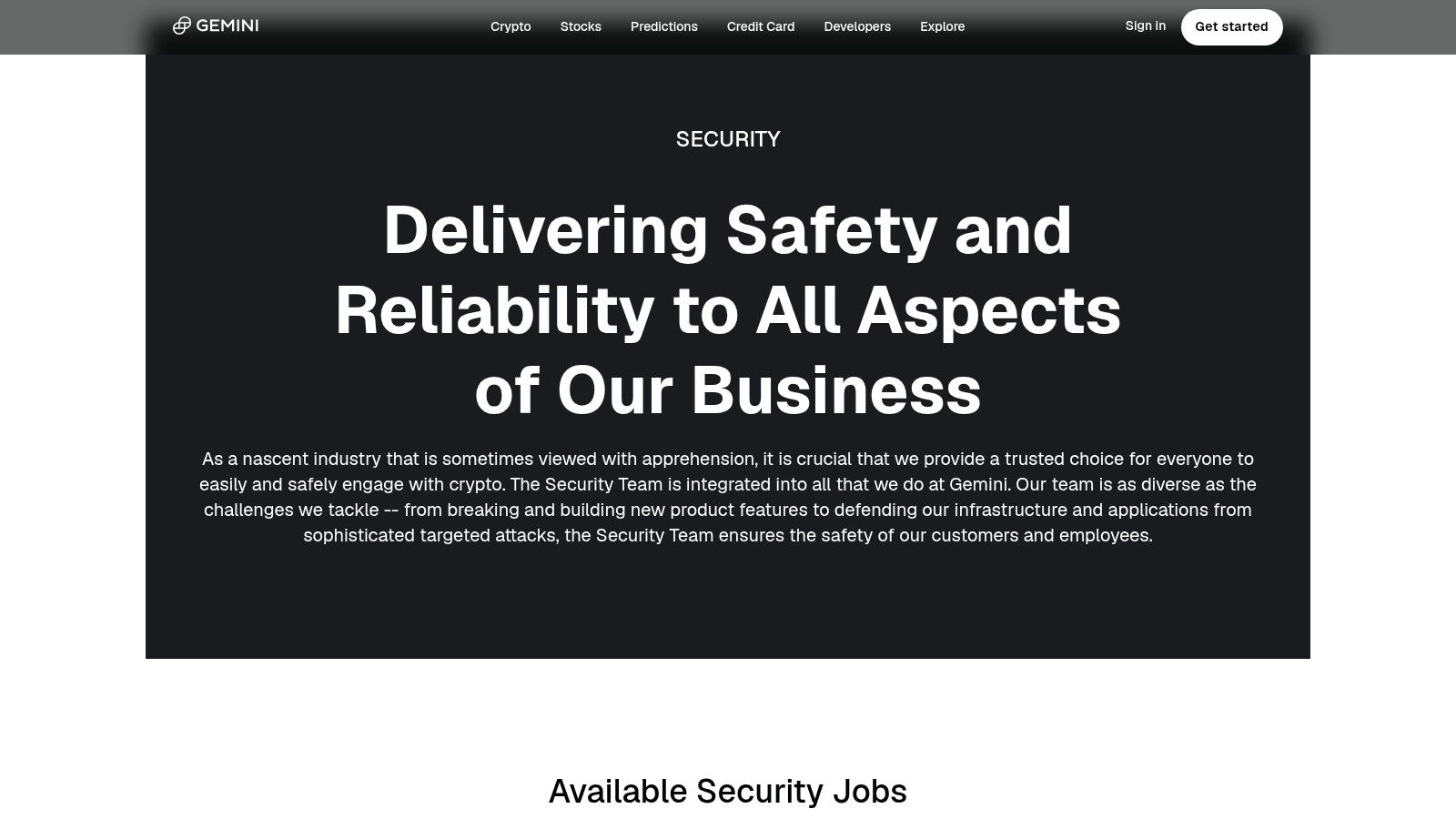
An exchange-security interview can ask a different question from an audit interview: Can you protect the service while people are actively using it? Gemini's security careers page describes work across product security, infrastructure, and defense against targeted attacks. Its openings include platform and corporate security, with some positions explicitly designated remote within the U.S.
This is a better destination for candidates interested in crypto products and operating environments than for those seeking only smart-contract review. The security-specific page also makes it easier to understand the team's remit without searching an entire general job feed.
Practice decisions, not just detection
Prepare a scenario involving a suspicious privileged session or unexpected withdrawal activity. Explain what evidence you'd preserve, which access you'd restrict, and how you'd coordinate with engineering and customer-facing teams. Avoid jumping straight to shutting everything down without explaining the consequences.
ISC2's workforce findings identified cloud-computing security as a major skills shortfall for 30% of respondents, and digital forensics and incident response for 25%. Those are broader cybersecurity findings, but they help explain why transferable operational skills deserve space in a crypto application.
Interview advantage: Explain what you'd do with incomplete evidence, then identify what additional information would change your decision.
Gemini's limitations are straightforward: openings may be limited, and available positions may favor experienced or leadership candidates. Read the responsibilities for evidence of escalation authority, engineering collaboration, and ownership of long-term improvements. Those details tell you more about progression than the title alone.
6. CertiK Careers
CertiK Careers is the direct-employer option when blockchain and smart-contract security should be central to your working day. Its career tracks include security engineering, audits, AI security, chain evaluation, and research, alongside internships and related engineering positions. Listings include U.S. and remote options, subject to the individual posting.
Compared with a large exchange, this is a more specialized search. That's an advantage if you want sustained technical depth, but a less natural fit if you want to rotate across corporate security, identity administration, and general platform operations.
Show how you reason about correctness
For audit-facing applications, prepare a repository containing a vulnerable contract, an exploit test, and a patched implementation. Explain the trust assumptions, severity rationale, and limitations of your review. Understanding what a security audit involves helps you present that work as an assessment rather than a collection of tool outputs.
Useful evidence differs by track:
- Audit work: An invariant, a concrete violation, and remediation that preserves intended behavior.
- Chain evaluation: A clear account of consensus assumptions, finality, and failure conditions.
- Research: A narrow question, reproducible method, and explicit limitations.
A longitudinal analysis of blockchain-engineering postings found security and privacy competencies in approximately one-quarter of postings in 2025. Security knowledge can therefore support broader engineering progression, not only a dedicated auditor title.
Many positions require relevant technical expertise, so match your application to the named specialization. Confirm that the opening remains active, and ask how reviewers receive feedback, validate fixes, and progress toward owning more complex assessments.
7. Maneki
If your search has become scattered across employer tabs, Maneki offers a consolidated feed of crypto, blockchain, and Web3 opportunities collected from public company career pages. Filters cover job function, location, seniority, skills, and minimum salary. Listings link to employer application pages.
Its strength is cross-employer comparison. Search security and IT roles, then compare whether a familiar title means application review, infrastructure ownership, or internal systems support. Salary and location filters can reduce irrelevant results, although unspecified compensation requires closer reading rather than an assumption.
Use the feed as a screening tool
Maneki describes daily refreshes and automatic deactivation of closed roles, but confirm availability at the destination before applying. It isn't exclusively a security board, and the feed can include jobs outside the U.S.
Use a compact comparison process:
- Filter by responsibility: Search for incident response, application security, or infrastructure rather than relying only on security.
- Check prerequisites: Separate mandatory experience from technologies you could reasonably learn on the job.
- Inspect the destination: Confirm employer identity, location restrictions, and the actual application route.
For a concrete preparation benchmark, a Bitcoin security-engineer posting emphasizes offensive security, cryptography, blockchain knowledge, and Python tooling. A candidate targeting that combination should bring an adversarial test harness, not just a generic certification summary.
Protect your own environment during screening. Review recruiter-provided repositories before executing them, inspect dependency and editor-task configuration, and use an isolated environment without wallet material or production credentials. A technically demanding interview still needs a safe, credible hiring process.
Crypto Security Job Sources at a Glance
| Source | Security Focus | Salary Info | Best For |
|---|---|---|---|
| Blockchain Security Jobs | Blockchain and Web3 security roles, including penetration testing and security engineering | Not stated; check individual postings | Candidates seeking a specialized Web3 security job board |
| Web3.career | Security engineering, infrastructure, incident response, and leadership | Some postings include salary ranges | Exploring security specialties across Web3 employers |
| OpenFrom | Security and intelligence, including engineering, investigations, fraud, and compliance | Not stated | Candidates comparing location eligibility and employer listings |
| Coinbase Careers | Engineering security, privacy, and threat intelligence | Not stated | Candidates targeting security roles at a large crypto platform |
| Gemini Careers | Product, platform, infrastructure, and corporate security | Not stated | Candidates interested in crypto product and infrastructure security |
| CertiK Careers | Smart-contract audits, blockchain security, research, and chain evaluation | Not stated | Candidates seeking dedicated Web3 security work |
| Maneki | Aggregated security and IT roles across crypto and Web3 employers | Salary filter available; specific pay not stated | Candidates comparing roles across Web3 employers with filters |
Turn Browsing Into Offers, Your Next Move
Pick two boards to monitor: a focused security category and a broader discovery feed. Then use direct employer pages to validate the shortlist. This keeps discovery broad without turning your search into repetitive browsing.
Set up daily email alerts wherever available so newly posted security roles reach you promptly. Our alerts send new blockchain and Web3 jobs once a day as they're posted. Respond with an application written specifically for each role, not a rushed generic résumé.
Match the evidence to the specialty
Your application should make the hiring decision easier:
- Audit roles: Lead with exploit reproductions, invariant reasoning, and remediation tests.
- Platform security: Show threat models, access controls, deployment protections, and measurable ownership.
- Incident response: Present detection logic, investigation notes, containment decisions, and clear communication.
Prepare to discuss an artifact in depth. Explain what you assumed, where your approach could fail, and what you would change with more time or access. Use the guidance to prepare for interviews with confidence, then rehearse against the responsibilities in the actual posting.
The broader opportunity extends beyond dedicated security titles. We list 6,934 open roles across crypto, DeFi, and Web3, including 4,171 remote roles, so most listed opportunities are remote. That breadth gives candidates room to consider adjacent engineering, infrastructure, and compliance work without losing their security direction.
Start with our Security category, then follow the strongest matches to the employer's application page. Employers hiring auditors, security engineers, or incident responders can post a job there to reach a crypto-native security audience.
Choose your target specialty, identify a credible opening, and attach the work sample that proves you can do it. That's a stronger next move than sending another undifferentiated application.
Blockchain Jobs connects candidates with category-tagged opportunities across blockchain, DeFi, and Web3, including specialized security roles. Visit Blockchain Jobs to find your next crypto security position or post an opening for the professionals who can help protect your product.