
Web3 Job Board: What It Is and How to Use One
You've got twelve tabs open, three general job sites returning the same vague "blockchain engineer" results, and a promising remote role that turns out to be remote only if you live in one unnamed country. You're not short of listings. You're short of listings that tell you the chain, the contract type, the hiring entity, and whether you're eligible to apply. That's the problem a good Web3 job board solves, but only if you know how to read it like a recruiter does.
What a Web3 Job Board Is and How It Differs
A Web3 job board is a listing site built around blockchain, DeFi, NFT and decentralized technology roles. Listings are tagged by function, ecosystem and location so crypto native candidates and hiring teams can find each other quickly.
The niche exists because the talent pool isn't in one hub. Electric Capital's 2024 Developer Report counted 23,613 monthly active crypto developers in November 2024, with the United States at 19% of developer share and India supplying 17% of new crypto developers in 2024. When qualified people are spread across countries and chains, a searchable, remote friendly board fits the market structure better than a city based listing site.
Blockchain Jobs serves both job seekers and companies, with separate sections for each. That split matters in hiring because candidates filter for eligibility and proof, while employers filter for deployable skill, and one generic search box serves neither well.
Web3 Job Boards Compared With General Job Sites
| Factor | Web3 job board | General job site |
|---|---|---|
| Role categories | Specialist tags such as DeFi, Security, DevOps and Infrastructure, Smart Contracts | Broad industry and function filters such as IT or Finance |
| Remote roles | Remote filter alongside regional groups such as USA, Europe and Asia Pacific | Remote is often one keyword among many |
| Ecosystem context | Chain, protocol and product exposure described in the listing | Rarely mentioned |
| Candidate pool | Crypto native professionals and career switchers into Web3 | Generalist applicants across all industries |
| Listing freshness | Recently Added feed and email alerts for fast moving teams | Posting dates shown inconsistently, with alerts tied to broad keywords |
Don't treat that as a reason to abandon general sites entirely. A large exchange hiring a corporate accountant may advertise well there, and you'll still find good roles. The trade off is precision. A keyword filter can't tell a Solidity auditor from a marketer who once wrote about Solidity, and it can't express whether a role needs mainnet deployment experience or testnet familiarity.
A Web3 board is the better search when your role depends on protocol knowledge that a generic keyword filter cannot express.
For career progression, use that precision deliberately. Search by the function you want next, not the title you hold now, then read ten listings to map the recurring tools, seniority signals and portfolio demands before you apply to any of them.
Listing Features That Matter Most
With 6,934 open roles on Blockchain Jobs across crypto, DeFi and Web3, filters aren't decoration. They're how you avoid spending an afternoon on roles you'd never take. Run this checklist in order of impact.
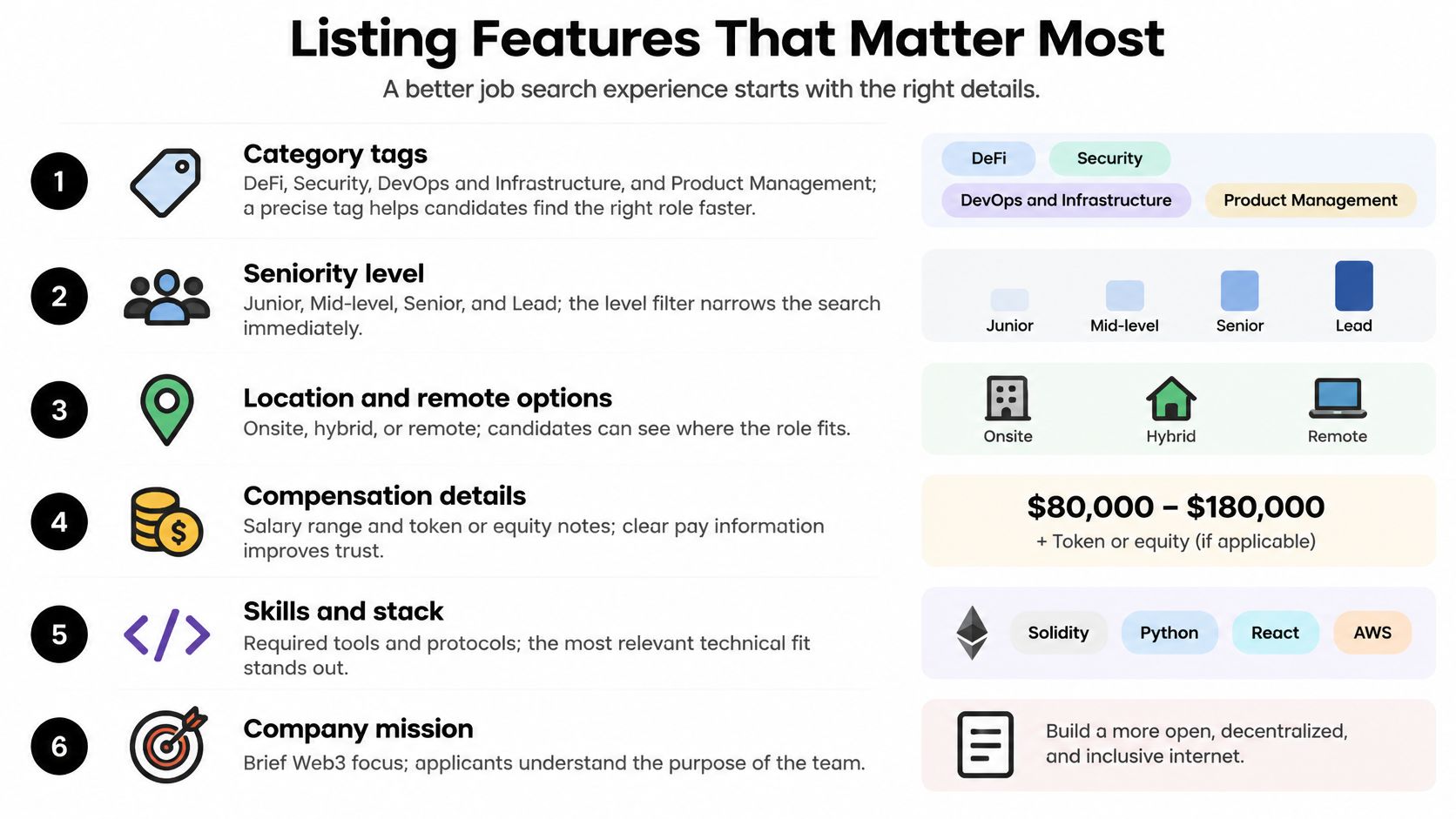
- Category tags first: Start with DeFi, Security, DevOps and Infrastructure, or Product Management rather than a keyword search for blockchain, because a precise tag removes adjacent noise immediately.
- Seniority level second: Filter to your level before you read descriptions, so you don't tailor applications for roles screening on years you'll never satisfy.
- Location and remote third: The board's filter shows 4,171 remote roles, and listings are grouped by Remote, USA, Europe, Asia Pacific, Latin America, Middle East, Canada and Africa, so combine remote with a region instead of trusting the label alone.
- Compensation next: Read the salary range plus any token or equity notes together, because token heavy packages change your risk and tax position.
- Skills and stack: Match the named tools and protocols against proof you can show, not tools you've only read about.
- Company mission last: A brief Web3 focus should tell you what the team ships, which shapes your interview questions.
The Remote Eligibility Check Most People Skip
Remote demand is real, as CoinLaw's crypto employment statistics counted 26,925 remote listings, approximately 40% higher year over year, in one 2025 dataset. That doesn't make every remote role open to you. Before applying, confirm the hiring entity, permitted countries, contractor versus employee status, required working hours, travel expectations, and whether you need a local licence or compliance experience.
Practical rule: Remote availability does not equal location independence.
Regulated exchanges, custodians and stablecoin firms often restrict hiring by jurisdiction even when the team is distributed. If a listing won't answer those six points, ask in your first message. You'll save yourself a polished application that fails on payroll, not merit.
Signals That Separate Strong Boards From Weak Ones
Freshness is the first signal I'd check, because stale listings waste more candidate time than any other flaw. A board with dated postings lets you prioritise teams hiring now and spot roles that have been reposted without explanation, which often signals an unclear brief or a frozen budget.
Depth at the top is a useful second check. A board listing 486 VP and C-level jobs is attracting employers who hire across the org chart, not only chasing junior volume. Pay disclosure tells a similar story, and 1,100 jobs with salary shown gives you a concrete sense of how often employers on that board state terms upfront rather than at offer stage.
Quality Signals on a Web3 Job Board
| Signal | Credible board shows | Red flag |
|---|---|---|
| Listing dates | Recently Added feed with posting dates | Old roles reposted with no date |
| Employer detail | Named company and hiring entity | Anonymous postings only |
| Location and hours | Stated eligible countries and working hours | Remote label with no eligibility rules |
| Contract type | Full time, contract, internship or volunteer labelled | No contract type given |
| Salary | Salary shown where the employer discloses it | No pay information on any listing |
Category depth matters for interviews too. If titles don't map to any recognisable category, you can't research comparable roles or benchmark requirements, and you're guessing at what the hiring manager wants. Compare how boards organise the wider ecosystem by browsing examples of Web3 websites and how they structure information, then judge whether a board's categories match how teams hire.
A credible board should also let you save roles and set alerts, so you can act on new listings quickly. Before you create an account or post a role, ask three questions. Can I see when this was posted, who the hiring entity is, and exactly where I must be based to take it?
Career Routes Beyond Developer Roles
A stablecoin firm hiring for payments operations needs settlement, reconciliation and vendor knowledge alongside an understanding of how crypto payment flows work. That kind of role is one of many routes into Web3 without writing smart contracts. Product, operations, compliance, finance, marketing, community, legal and customer success roles make up a large share of Web3 hiring.
A payments operations specialist can map issuers, custodians, and on- and off-ramp partners before an interview. That gives hiring managers a concrete way to assess how the candidate would handle real payment flows, rather than recall industry terms.
A SaaS marketer moving toward community management brings experience in onboarding and retention. The work differs: protocol communities often gather in Discord and governance forums, not email sequences. A 30-day event plan with moderation rules and success measures gives the hiring manager something specific to question.
Compliance analysts can carry KYC, transaction monitoring and case-writing skills into regulated exchange roles. A short memo on a licensing question, with the relevant rule and a proposed operational control, demonstrates how those skills apply to the job.
Sales is another route. Crypto firms building outbound capacity may need specialist support such as Hire BDR, rather than expecting a community hire to own the revenue engine. The required skills and interview evidence differ by role.
Employers often look for hybrid capability: professional execution paired with ecosystem fluency. Compare Web3 careers across technical and business functions, choose a role that fits your existing skills, then build one focused example of how you would do the work.
Building Interview-Ready Proof of Work
Credentials open fewer doors here than artifacts do. The Consensys and YouGov Web3 workforce survey found 73% of respondents considered technical knowledge the development they most needed to enter Web3, with participation in ongoing or new projects highlighted as a route to gain it. Treat project work as your interview material, not a side quest.
This image captures the working setup behind most credible portfolios, a small project in progress surrounded by the material used to build it.

Build one or two of these well rather than six shallow clones. Good candidates include a contract deployed on testnet or mainnet, a resolved open source issue, a security review, an onchain dashboard, or a documented product experiment with a real user decision at its centre.
The Four Line Template for Every Item
For each item, write four lines covering the problem, the tools, the constraint, and the outcome. Name what you personally contributed, especially in team or hackathon work, because interviewers will probe the boundary between your work and everyone else's. Then explain your architectural choices and trade offs in plain language, including what you'd change with more time.
- Problem: State the user or protocol failure you addressed.
- Tools: Name the language, framework, chain and testing setup.
- Constraint: Name the gas, security, data or time limit that shaped the design.
- Outcome: Give the result, a deployment address, a merged pull request, or a measured improvement.
The video below is useful background for how builders present project work, so watch it for narration structure rather than copying its examples.
Practise a three step progression. Learn one protocol concept, apply it in a small project, then document the result so it qualifies you for a more technical role. Employers use that sequence in reverse when they screen, starting from your documented result and working back to whether you understand the concept underneath it.
Run the four move sequence on your own repository before any interview. Verify the artifact, explain its architecture, introduce a failure or security scenario, and describe how you'd diagnose and fix it.
Practise aloud until each portfolio item becomes a narrated answer rather than a bare link. That narration is what converts a job board application into an interview, and an interview into progression.
How Employers Post and Screen Roles
Post one role properly before you post five vaguely. This sequence keeps your listing findable and your screening evidence based.
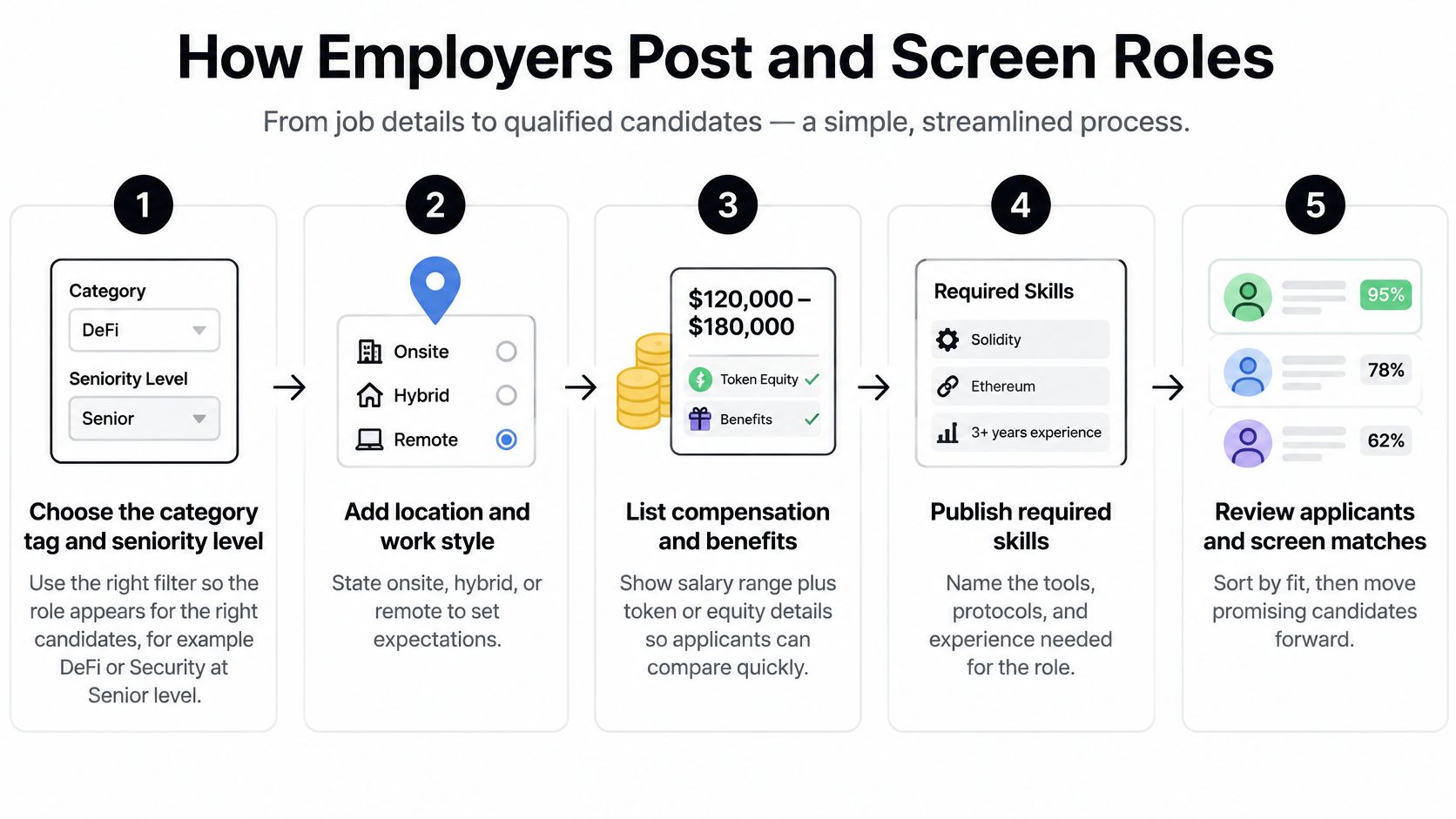
- Choose the category tag and seniority level, for example DeFi or Security at Senior level, so the role appears in the right filter.
- State the arrangement, contract type and salary where you can disclose it, covering remote, regional or on site work and full time, part time, contract, temporary, internship or volunteer terms.
- Name the hiring entity, permitted countries and any licence requirement, because remote eligibility is the first question serious applicants ask.
- Publish through the Post a Job option and manage applicants from your dashboard, applying the basics of understanding recruitment tracking workflows so stages, owners and decisions don't live in inboxes.
- Screen with evidence before lengthy interviews, asking for deployed contract addresses, repository links, test coverage and security notes.
That final step follows Pin's blockchain recruiting guide, which recommends checking whether a candidate has deployed contracts to a mainnet and asking for wallet or contract addresses associated with prior work. Test AI assisted workflow separately from core protocol skill, since fast tool use can hide weak fundamentals. For role specific detail, read the guidance on how to hire a Web3 developer with a structured screen, then check applicant quality against your evidence bar before posting more roles.
Confirm Your Board and Set Up Job Alerts
Choose a board that covers your target roles, then keep your search focused. A short list of relevant applications makes it easier to match each role with evidence from your portfolio.
Blockchain Jobs offers daily email alerts for new blockchain and Web3 jobs as they are posted. Sign up for the alert and review new listings together each morning instead of repeatedly refreshing search pages.
The board lists 851 roles in New York, its highest city count, followed by 377 in San Francisco and 330 in London. Use these counts as a starting point for location searches, then check each listing for its hiring entity and whether remote work is available to you.
Save roles that fit your experience and send one relevant portfolio item with each application. A contract address, market map or compliance memo gives the hiring manager evidence tied to the work, rather than a generic CV alone.
Employers can post a role through the site's Post a Job option. Before applying or publishing, check the listing's dates, hiring entity and eligibility requirements.
Browse current openings and sign up for daily email alerts at Blockchain Jobs.