Web3 Product Manager Role Explained and How to Get Hired
You've spent years shipping products, aligning engineers, and defending roadmap decisions with imperfect data. Now you're looking at Web3 roles and wondering whether your experience transfers, or whether recruiters will dismiss you because you haven't worked inside a protocol, DAO, or token economy.
That uncertainty is reasonable. A Web3 product manager isn't a conventional PM with a crypto vocabulary. The role combines product judgment with smart contract constraints, governance coordination, tokenomics, compliance awareness, and multichain trade-offs. Hiring managers want evidence that you can make sound decisions when users, engineers, tokenholders, validators, signers, and regulators all influence the product.
This guide takes a hiring-first view. You'll learn what the job involves, which skills affect your candidacy, how to describe adjacent experience, what interviewers probe for, and how compensation varies across the market. If you're evaluating products such as stablecoin subscriptions, this resource on monetize with stablecoins offers useful commercial context. You can also review the wider Web3 product management job market while shaping your target list.
Introduction to the Web3 Product Manager Career
The strongest transition story usually starts with a familiar problem. A Web2 PM who has managed payments, fintech onboarding, marketplaces, or other transactional products already understands trust, conversion, risk, and operational failure. Web3 adds a different execution environment, where ownership may sit in a wallet, the product may depend on a smart contract, and a community may influence decisions through governance.
That changes what “shipping” means. A polished interface won't rescue a product if users can't connect a wallet, understand a gas fee, switch networks, or complete a transaction. The PM must connect user needs to protocol behavior and define what success looks like at every point in the transaction lifecycle.
Hiring reality: Recruiters rarely hire enthusiasm for crypto. They hire judgment that survives technical, financial, and governance constraints.
The market now treats Web3 product management as a well-compensated specialty, not merely an entry-level niche. A 2026 United States salary snapshot reports average annual pay of $159,405, an hourly equivalent of $76.64, and a typical range of $141,000 to $197,000, with the top 10% reaching $197,000 annually, according to ZipRecruiter's Web3 Product Manager salary data. These figures are a benchmark, not a promise. Location, company maturity, protocol complexity, leadership scope, and token or equity terms can move an offer substantially.
You should use this guide to make four practical decisions. First, decide whether your current experience maps to Web3 problems. Second, identify the domain gaps that weaken your applications. Third, build interview stories around real product trade-offs. Finally, target roles where your background gives you an advantage instead of applying indiscriminately to every crypto listing.
What a Web3 Product Manager Actually Does
A conventional PM turns customer problems into priorities, requirements, experiments, and launches. A Web3 PM does the same work, but the product includes systems that users may not see directly. Smart contracts, token standards, wallets, gas fees, confirmations, chain switching, and transaction lifecycles become part of the product specification.
Think of a wallet connection as the Web3 equivalent of account creation. In a traditional app, you control the authentication flow. In a decentralized application, the user may connect through MetaMask, Coinbase Wallet, Phantom, or another provider, reject a signature, connect to the wrong network, or lose the session. Your acceptance criteria must account for those outcomes, not just the happy path.
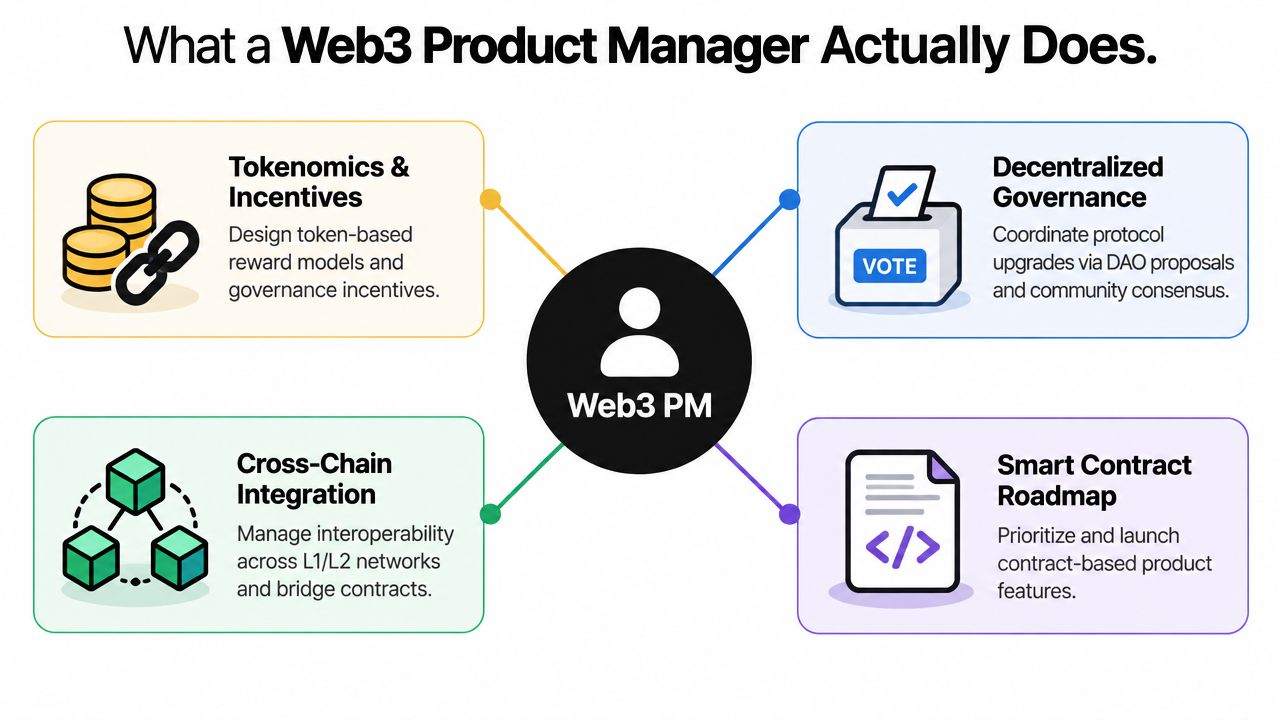
Protocol behavior becomes product behavior
Suppose a user deposits assets into a DeFi application. The experience includes approval, signing, gas estimation, transaction submission, block confirmation, indexing, and balance refresh. A delay or failure at any stage can look like a broken interface, even when the front end is functioning correctly.
That's why product quality often depends less on visual polish than on protocol-level reliability. The Blockchain Council overview of the blockchain product manager career path highlights the need to translate blockchain primitives into product requirements. In practice, that means writing acceptance criteria for confirmation states, rejected signatures, stale balances, reverted contracts, insufficient gas, and unsupported networks.
Metrics must follow the transaction
A Web2 PM might focus on signup conversion, activation, retention, and revenue. A Web3 PM still needs those outcomes, but must add operational metrics that explain where users fall out of the flow:
- Wallet connect success: Can the intended user establish a usable wallet session?
- Failed transaction rate: How often do submitted actions revert, reject, or fail before confirmation?
- Transaction completion: Do users reach confirmed completion rather than abandoning during signing or waiting?
- Chain and asset clarity: Can users understand which network and asset they're using?
These metrics aren't engineering trivia. They tell you whether the product delivers its promised value. Before you find product manager jobs, learn to explain how you'd diagnose a drop in completed transactions and which teams you'd involve.
Core Responsibilities and How Hiring Managers Evaluate Them
Hiring managers don't assess a Web3 PM by asking whether you can repeat industry terminology. They look for proof that you can make decisions under decentralized constraints and communicate those decisions to people with different incentives.
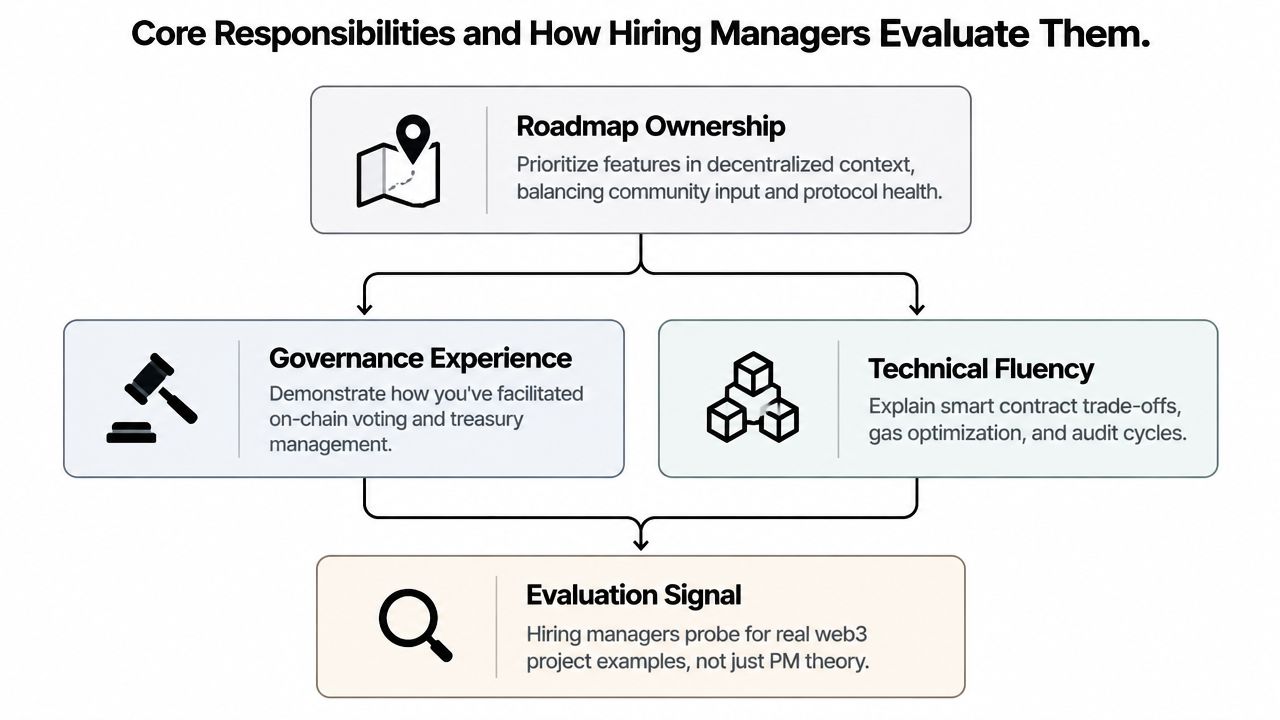
Roadmap ownership without central control
Roadmap ownership still means choosing what to build and why, but the decision process may include a DAO forum, tokenholders, core developers, auditors, foundation staff, and commercial partners. You need to show that you can separate useful community input from loud opinions, then turn the decision into an executable sequence.
Prepare a story that answers:
- What user or business problem did you prioritize?
- Which stakeholders disagreed?
- What evidence changed or reinforced your decision?
- How did you define a safe launch?
- What did you stop doing to make room for it?
A generic “I managed the roadmap” statement is weak. A stronger version explains the constraint, the trade-off, the decision mechanism, and the result.
Governance orchestration is a real product responsibility
Governance-heavy teams may expect PMs to draft proposals, analyze voter sentiment, and coordinate multisig signers. Public commentary cited in the available research claims that 78% of DAO-funded projects require this type of work, but that claim comes from a public industry post rather than a verified dataset, so treat it as a directional hiring signal rather than a dependable market statistic. The underlying point remains important: some roles require decision orchestration, not just backlog management.
Interviewers may ask how you'd move a proposal from an idea to execution. Explain how you'd write the proposal, expose assumptions, gather feedback, prepare voters, coordinate signers, define execution conditions, and communicate after the vote. If you've worked with boards, risk committees, steering groups, or distributed contributors, translate that experience into governance language without pretending it was a DAO.
Multichain prioritization requires trade-offs
A product spanning Ethereum, Base, Arbitrum, Solana, and bridges doesn't have one deployment context. Each ecosystem can introduce different liquidity conditions, tooling, user expectations, transaction costs, contract patterns, and operational dependencies.
The hiring signal isn't naming every chain. It's showing how you'd choose. Explain whether your priority is user concentration, liquidity, reliability, developer capacity, compliance exposure, or a specific product capability. Public commentary claims that 43% of DeFi users bridge assets weekly and that 70% of protocols are multichain by 2026, but these figures aren't part of the verified market data, so don't present them as established facts. Discuss the strategic problem qualitatively instead: fragmented UX, liquidity, and upgrade coordination create product risk.
On-chain analytics must support decisions
Hiring teams want PMs who can connect blockchain data to product questions. You should be comfortable discussing wallet cohorts, contract interactions, transaction outcomes, retention behavior, and suspicious activity patterns without confusing raw addresses with human users.
A useful interview answer might begin with a funnel: wallet connection, signature, transaction submission, confirmation, repeat action. Then explain how you'd segment by chain, wallet type, asset, transaction error, and user intent. That shows you can move from dashboard observation to a prioritized product intervention.
Essential Skills That Get You Hired as a Web3 Product Manager
The skill that separates strong candidates from attractive resumes is translation. You must explain protocol mechanics to design and marketing, customer behavior to engineers, token incentives to executives, and regulatory constraints to community participants.
A live Web3 product manager posting requires at least five years of professional product management experience, a bachelor's degree in computer science, business, or a related field, and familiarity with Ethereum, Solana, rollups, and DeFi, according to Built In's Web3 product manager listing. Requirements vary, but the pattern is clear: classic PM fundamentals remain the baseline, while blockchain fluency differentiates you.
Use this decision matrix
| Skill Category | Why Hiring Managers Value It | How to Prove It in Interviews |
|---|---|---|
| Product strategy and execution | You still need to identify users, prioritize outcomes, and align teams | Walk through a decision with competing goals, evidence, and a measurable definition of success |
| Technical blockchain literacy | Smart contracts and transaction states directly shape usability and risk | Explain approvals, signatures, gas estimation, confirmations, reverts, audits, and failure recovery in plain English |
| Tokenomics | Incentives can attract usage while also creating distortion, speculation, or unsustainable behavior | Describe how you'd evaluate emissions, utility, user incentives, treasury effects, and unintended behavior |
| Governance operations | Protocol decisions may require proposals, community alignment, and multisig execution | Present a process for drafting, socializing, voting on, and executing a proposal |
| Compliance and regulatory literacy | Products involving custody, payments, tokens, or financial activity face legal and operational constraints | Show how you'd involve legal and compliance early without turning them into a late-stage approval gate |
| On-chain analytics | Product teams need evidence about behavior that occurs across wallets and contracts | Explain a funnel using wallet activity, transaction outcomes, cohorts, and repeat usage |
| Multichain strategy | Expansion can fragment liquidity, infrastructure, support, and user experience | Compare chains using explicit criteria rather than popularity or personal preference |
Tokenomics and governance are often the pay-driving differentiators because fewer candidates can operate confidently across incentives, voting, and execution. Compliance literacy matters for the same reason. A PM who can identify a regulatory dependency before a launch protects the roadmap and improves executive trust.
Technical depth doesn't mean replacing engineers. It means asking better questions. You should know when a feature requires a contract upgrade, when an audit is necessary, how an upgrade affects users, and which failure states need customer communication.
Practical rule: If you can't explain the user impact of a protocol decision, you're not yet demonstrating product fluency.
Resume Interview and Job Description Examples That Win Offers
Your resume should mirror the employer's risk. If the role manages transactional infrastructure, emphasize reliability, trust, compliance, and scale of responsibility. If it supports a DAO, emphasize stakeholder alignment, governance processes, and execution across distributed contributors.
One current posting asks for 12+ years in product management and at least 7+ years in product leadership, alongside business growth and collaboration with engineering, sales, and marketing, as shown in current Web3 product manager job listings. That's a senior leadership search, not an invitation for an entry-level candidate to compensate with crypto enthusiasm.

Rewrite bullets around decisions and risk
Weak:
- Managed the roadmap for a fintech application.
- Worked with engineers to launch payment features.
- Improved the customer experience.
Stronger, if accurate:
- Prioritized payment flows by separating onboarding friction from transaction failure, then aligned engineering, risk, and support around release criteria.
- Defined requirements for authentication, authorization, exception handling, and reconciliation across a transaction-heavy product.
- Presented trade-offs between conversion, fraud exposure, operational effort, and customer trust to executive stakeholders.
Don't add blockchain terms to work that wasn't blockchain work. Instead, make the transferable judgment visible. A recruiter can teach you ecosystem vocabulary more easily than they can verify that you've owned difficult decisions.
A remote posting requires five or more years of product management experience in high-growth consumer fintech, neobanks, or retail broker platforms, plus experience shipping transactional infrastructure, according to remote Web3 product manager listings. If that's your background, lead with it. Transaction reliability, compliance, and trust are stronger evidence than a shallow list of protocols.
Build interview stories that survive follow-ups
Use a STAR structure, but don't stop at the polished summary. Be ready to explain the metric, the rejected alternatives, the stakeholder conflict, and what you'd change now.
Prepare stories for:
- A failed or delayed transaction flow: Explain diagnosis, user communication, and the fix.
- A compliance trade-off: Show how you preserved product momentum while addressing legal or risk constraints.
- A governance conflict: Describe how you handled competing stakeholders and reached an executable decision.
- A multichain choice: Explain why you selected one ecosystem or delayed expansion.
- A technical disagreement: Show how you worked with engineers without pretending to own implementation details.
For a concrete example of how junior opportunities can be framed, review this junior Web3 product manager role at 1inch. Then use the media below as interview preparation, not as a substitute for project evidence.
When answering a product case, state your assumptions, identify the user, define the transaction or governance event, and choose metrics that reflect both growth and safety. A strong candidate doesn't hide uncertainty. They make uncertainty explicit and show how they'd reduce it.
Career Path Salary Expectations and Where to Find Openings
Career progression depends less on collecting certifications than on increasing the scope of decisions you can own. An adjacent fintech PM may enter through wallet, payments, compliance, or data products. A domain specialist can then move toward protocol features, incentives, governance, or ecosystem growth. Senior candidates are expected to manage ambiguity across functions, not merely write better tickets.
The compensation market is broad. A 2026 United States benchmark reports average Web3 Product Manager pay of $159,405, with a typical range of $141,000 to $197,000, according to ZipRecruiter's salary snapshot. Broader Web3 compensation data places Product Manager roles at an average of about $180,000, with a minimum base of $115,000 and a maximum of $265,000, while another dataset reports a base range of $135,000 to $170,000 and total compensation of roughly $170,000 to $240,000 when equity or token allocations are included, as reported by Web3.career's Product Manager compensation data.
Treat token allocations as uncertain upside, not guaranteed salary. Ask about vesting, liquidity, valuation methodology, lockups, tax treatment, and whether the company can explain the grant in writing. For broader salary comparison outside Web3, the LatoJobs product manager salary guide can help you calibrate your expectations.
Remote hiring remains common in Web3 listings, but remote doesn't mean location-neutral. Time zones, employment structure, regulatory restrictions, and travel expectations still affect eligibility. Search specialized boards by product category, chain ecosystem, seniority, and recently added roles, then investigate the company's protocol activity, governance forum, funding, and leadership before applying.
A practical workflow is simple:
- Choose a wedge: Target payments, wallets, DeFi, infrastructure, governance, or analytics.
- Filter for fit: Match your experience to the company's actual operating problem.
- Research compensation: Separate base pay from equity or token upside.
- Tailor evidence: Put the most relevant transaction, compliance, or protocol story first.
- Track applications: Record role scope, location, compensation structure, interview stage, and follow-up questions.
For focused searches, review current product management openings and compare the requirements with your evidence before submitting an application.
Your Next Steps to Landing a Web3 Product Manager Role
The best candidate positioning is clear: you're a cross-functional translator, not a crypto enthusiast. You can connect regulation, token design, governance operations, on-chain data, and user experience into decisions that a team can safely execute.
Use the next 30 days to create proof:
- Close one skill gap: Study wallets, transaction lifecycles, tokenomics, governance, or on-chain analytics based on your target role.
- Rewrite your resume: Replace activity statements with decisions, constraints, stakeholders, and outcomes.
- Prepare one portfolio story: Document a product choice, a technical trade-off, and how you'd measure success.
- Practice senior-level questions: Rehearse governance conflict, failed transactions, compliance constraints, and multichain prioritization.
- Apply selectively: Start with roles where your fintech, infrastructure, marketplace, compliance, or analytics experience directly transfers.
Governance and multichain fluency will keep separating capable PMs from surface-level applicants. Build those skills deliberately, then show them through concrete decisions rather than vocabulary.
Blockchain Jobs offers a focused way to find Web3 product roles alongside opportunities across blockchain, DeFi, infrastructure, and related functions. Visit Blockchain Jobs to search fresh, category-tagged openings and apply where your product evidence matches the hiring need.