
Land Crypto Research Jobs: Your 2026 Career Guide

Most advice about crypto research jobs is outdated on arrival. It treats the field like a content role for people who can summarize tokenomics, post a market thread, and sound smart in a Discord server.
That still exists, but it's no longer the center of the market.
The hiring picture is narrower and more demanding. Teams hiring for crypto research jobs often want someone who can reason from first principles, handle code, work with data, and turn research into an asset a desk, protocol team, or product team can use. In many cases, “research” now sits much closer to engineering, trading, and infrastructure than to publishing.
That shift matters because candidates keep preparing for the wrong interviews. They build reading lists when they should be building artifacts. They polish resumes when they should be shipping analysis, models, dashboards, or protocol writeups. If you want to get hired, the first step is dropping the generic “crypto researcher” identity and choosing the track you're pursuing.
The Evolution of Crypto Research Jobs
Crypto research jobs didn't mature because the industry suddenly decided it liked analysis. They became visible when crypto hiring itself became more professional and more specialized.
During the 2020 to 2021 hiring surge, the share of crypto and blockchain job postings rose 118%, and non-technical functions such as finance and research reached 16.8% of postings by mid-2021, nearly double the prior year's share, according to Indeed's analysis of crypto and blockchain hiring trends. That was the inflection point when research stopped looking like an informal side function attached to trading communities and started becoming a defined hiring lane.
What changed in practice
Earlier crypto research roles were often loose mandates. A founder wanted market coverage. A DAO wanted governance analysis. A fund wanted token memos. The work could be interesting, but the hiring bar was inconsistent and the output was often hard to evaluate.
Now the bar is clearer. Teams expect research to support a business or technical decision.
That means a protocol team may want someone who can evaluate design tradeoffs. A trading firm may want someone who can test hypotheses against market structure. An exchange may want a researcher who can translate noisy data into positioning, listings, or risk decisions. The title might still say “researcher,” but the work product is more operational than many candidates expect.
Most candidates still picture a report writer. Most teams are screening for judgment plus execution.
Why the old advice fails
The old playbook says to learn basic blockchain concepts, follow news, and publish thought pieces. That's not enough for most serious crypto research jobs.
What works now is sharper:
- Pick a lane early: Quant, protocol, market intelligence, and AI/ML research engineering are different labor markets.
- Build visible work: Hiring managers want proof of thinking, not just claims of interest.
- Learn the tradeoffs: You won't get far if you can't discuss decentralization versus performance, or security versus usability, in concrete terms.
Candidates who understand this evolution make better choices faster. They stop applying broadly and start presenting themselves as a fit for one real category of work.
Decoding the Four Crypto Research Archetypes
The biggest mistake candidates make is assuming crypto research jobs form one category. They don't. Live listings show the split clearly. Some roles look like trading research, including a Systematic Options Researcher / Trader. Others ask for heavy systems work such as LLM or VLM inference optimization and distributed inference experience, which Web3 Career's research job listings make hard to ignore.
That's why broad self-labels hurt applicants. “Crypto researcher” is too vague unless the market already knows your work.
The four archetypes that actually matter
| Archetype | Primary Focus | Essential Skills | Typical Employers |
|---|---|---|---|
| Quant Researcher | Alpha, execution, derivatives, market structure | Python, statistics, stochastic thinking, options logic, data pipelines | Trading firms, market makers, hedge funds, exchanges |
| Protocol Researcher | Mechanism design, consensus, incentives, protocol tradeoffs | Cryptography fundamentals, distributed systems, specification reading, modeling | L1s, L2s, research labs, protocol foundations |
| Market Intelligence Analyst | Narrative tracking, on-chain interpretation, ecosystem mapping | Data analysis, writing, dashboarding, market judgment | Exchanges, research firms, investment teams, ecosystem teams |
| Research Engineer AI and ML | Models in production, inference performance, tooling | Python, ML systems, GPU and distributed infra knowledge, experimentation discipline | Infra startups, AI x crypto teams, advanced product and tooling teams |
Quant Researcher
This is the least understood track by candidates coming from generic crypto media or investing communities. A quant researcher doesn't get hired because they have opinions on tokens. They get hired because they can frame a hypothesis, test it, and decide whether it survives contact with real market data.
Day to day, the work often includes cleaning messy datasets, building signal pipelines, evaluating execution constraints, and deciding whether an observed pattern has any chance of surviving fees, slippage, inventory pressure, or changing regime. If the team is options-focused, you may be working on volatility modeling, hedging logic, or quoting behavior.
Bad candidate signal: polished market commentary with no evidence of rigorous testing.
Good candidate signal: a notebook, backtest, or short technical memo that shows assumptions, limitations, and next steps.
Protocol Researcher
Protocol research is where many intellectually strong candidates aim too early without enough implementation depth. Reading specs and papers matters, but protocol teams rarely want a purely theoretical observer. They want someone who can reason about mechanism design and then stay grounded in implementation constraints.
That can mean evaluating validator incentives, analyzing consensus assumptions, studying fee-market behavior, or turning an abstract proposal into a prototype or specification-ready artifact. If you're targeting this lane, your writing needs to be precise, but your credibility usually comes from technical depth rather than style.
For candidates exploring protocol-heavy openings, it helps to look at roles close to formal research environments such as this PhD Research Fellow opening at Uniswap Labs, because those listings reveal the level of rigor many serious teams expect.
Market Intelligence Analyst
This is the closest match to what is commonly imagined as “crypto research,” but even here the hiring bar has changed. Strong market intelligence analysts don't just summarize public information. They filter noise, identify what matters, and present a usable conclusion for operators, investors, or BD teams.
A solid analyst can connect on-chain behavior, token incentives, exchange activity, ecosystem developments, and governance changes into one coherent view. The best ones also know when not to overstate a conclusion.
This track rewards speed and clarity, but weak candidates drift into content marketing. If your deliverable reads like a newsletter with charts, you're competing in the wrong pool.
Research Engineer AI and ML
This category catches people off guard, but it's becoming one of the most important. Some of the most technical crypto research jobs now blend experimentation with systems engineering. You may be asked to optimize inference, manage distributed workloads, or build tooling that supports model deployment inside production environments.
The common feature across these roles is simple. Research isn't finished when the idea looks good. It's finished when the model, pipeline, or system works under real constraints.
If your preferred output is a PDF, you probably don't want the jobs now labeled “research engineer.”
Building Your Essential Researcher Skill Stack
The hiring market doesn't reward abstract enthusiasm. It rewards a visible stack of skills that map to a specific research track.
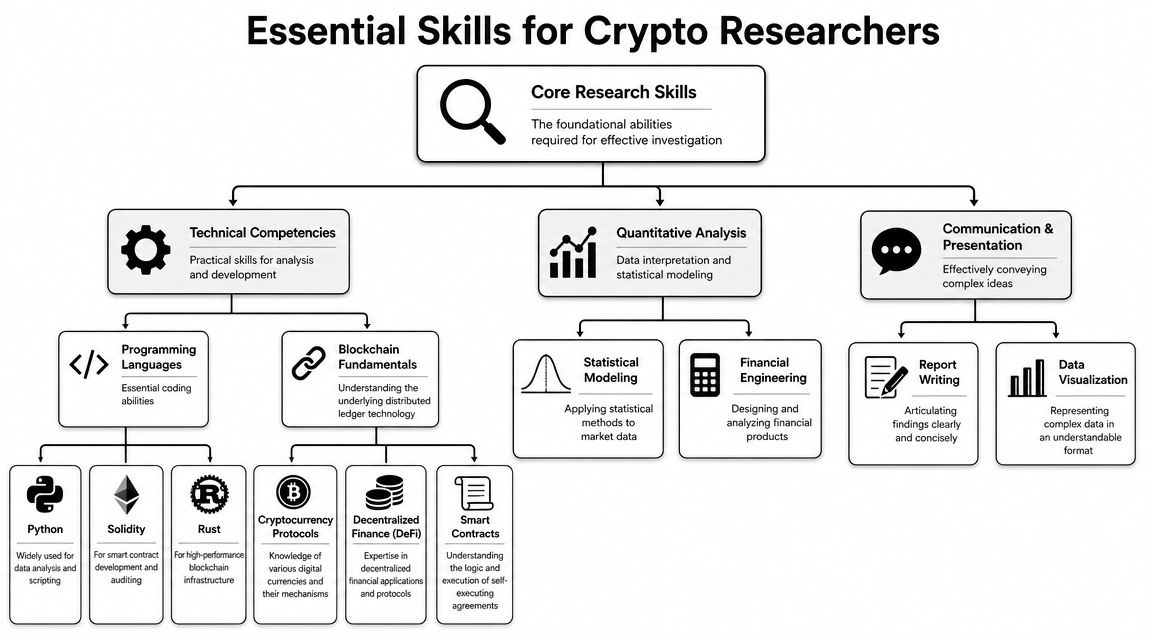
Employers hiring for crypto research jobs screen for a mixed profile: programming, data analysis, engineering, and cryptography, plus the ability to publish tangible work and explain core tradeoffs such as decentralization versus performance and security versus usability, as described in Crypto Recruit's hiring guide for crypto roles.
Skills every serious candidate needs
Some capabilities are essential across tracks, even if the depth changes.
- Programming fluency: Python is the baseline because it lets you work with data, automate analysis, and prototype quickly.
- Data judgment: You need to know when a dataset is incomplete, biased, stale, or structurally misleading.
- Crypto fundamentals: Consensus, smart contracts, DeFi primitives, wallets, bridges, and token design shouldn't feel like separate topics.
- Communication: Not polished branding. Clear reasoning. Can you explain what you tested, why it matters, and what you still don't know?
A lot of candidates underestimate the last one. Research interviews often hinge on whether you can defend your assumptions under pressure.
For candidates trying to strengthen the data side of their profile, browsing active roles in Web3 data and analytics hiring is useful because it reveals which tools, workflows, and outputs employers keep asking for.
What changes by track
The stack becomes more specialized once you choose your lane.
For quant research, you'll need stronger statistical thinking, cleaner experiment design, and comfort with market microstructure. If you can't explain why a signal may fail outside a backtest, you're not ready.
For protocol research, cryptography and distributed systems matter more, but so does specification literacy. You should be able to read a design proposal and identify tradeoffs, attack surfaces, and implementation consequences.
For market intelligence, writing still matters, but weak writing is rarely the main reason someone gets rejected. More often, they get rejected because the underlying analysis is shallow. You need enough technical and market fluency to know what's signal and what's recycled narrative.
A quick visual helps frame how these skills fit together.
What candidates should stop doing
A lot of effort goes into low-signal activity. That includes endless certification hunting, generic Twitter threads, and “research” pieces that never reach a falsifiable conclusion.
Better alternatives:
- Build one strong artifact per month: A protocol memo, dashboard, model, or market teardown.
- Keep your work reproducible: If someone can't inspect your logic, it carries less weight.
- Write with constraints in mind: Every good crypto researcher understands that elegant ideas still have to survive real systems.
Where to Find Top Crypto Research Opportunities
A lot of candidates search for crypto research jobs as if they're looking for a single category on a generic board. That approach misses how fragmented the market is.
By 2025, the crypto labor market had grown to more than 1.6 million professionals worldwide, with about 66,000 new openings and an 18% year over year salary increase. North America accounted for 38% of the global crypto professional base, while Asia reached 32%, according to the Gate Research 2025 crypto employment market report. That scale changes how you should search. These roles are spread across exchanges, infrastructure teams, protocol foundations, funds, and remote-first startups.
Match the venue to the archetype
If you want quant research roles, spend time where trading firms, market makers, and derivatives-focused teams post jobs. Generic “research analyst” searches will bury you in the wrong listings.
If you want protocol research, go directly to protocol foundations, core dev organizations, research collectives, and grant-driven ecosystems. Those teams often care more about demonstrated technical reasoning than polished application materials.
If you want market intelligence, look at exchanges, ecosystem teams, research boutiques, and investment organizations. These roles often sit close to listings, BD, product, or strategic ops, even if the title says research.
And if you're targeting AI/ML research engineering, search in infra-heavy corners of the market. Many of these positions are posted under engineering, ML, or systems titles rather than pure research.
Practical channels that produce better leads
A focused search usually combines job boards, direct company pages, and ecosystem monitoring.
- Specialized job boards: Use a Web3-native board like Blockchain Jobs when you want category filters and current listings across multiple crypto functions.
- Protocol and exchange career pages: Many strong roles never circulate widely before they're filled.
- Research labs and funds: Some of the highest-signal openings sit inside technical funds, ecosystem research arms, or builder-oriented labs.
- Event and announcement tracking: If you're studying where hiring may emerge, tools that analyze Binance announcements can help you monitor listing, ecosystem, and product signals that often precede research, strategy, or market-structure hiring.
The best openings usually don't look generic. They're tied to a team with a specific problem, not a broad idea of “needing research.”
Remote still changes the search
Crypto research jobs remain unusually compatible with distributed teams. That means your search shouldn't be restricted to one city unless the employer clearly needs it.
But remote access also increases competition. You're not competing with only local applicants. You're competing with specialists who already have a body of visible work. That's why targeted positioning matters more than ever.
Nailing the Application and Interview Process
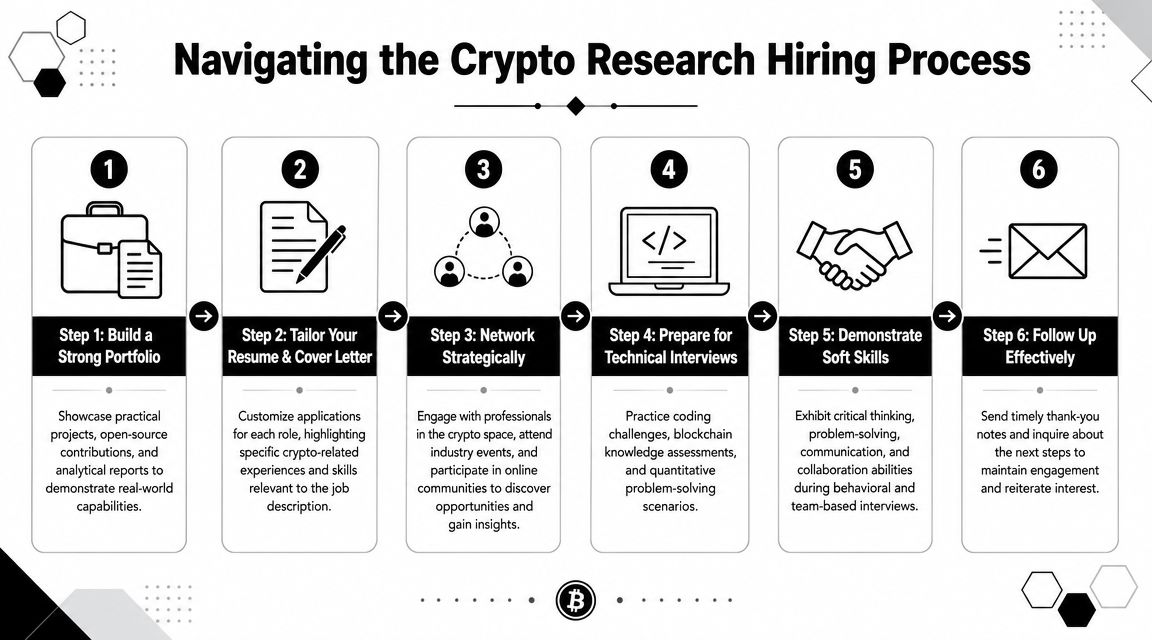
Most candidates still overinvest in resumes and underinvest in evidence. That's backwards.
In crypto research hiring, a portfolio of relevant projects materially improves outcomes because employers judge demonstrated analytical output, including the ability to analyze market structure from data, rather than credentials alone, as explained in CryptoJobs.com's guide to becoming a crypto analyst.
What a strong portfolio looks like
A strong portfolio is not a folder of opinions. It's a set of artifacts that lets a hiring manager see how you think.
For quant roles, good portfolio pieces include signal research, execution analysis, derivatives breakdowns, or well-scoped backtests with clear caveats. Don't hide bad results. Good quants know many ideas fail.
For protocol roles, publish technical memos, mechanism critiques, implementation notes, or contributions to specs, audits, or open-source repositories. If you've reviewed an improvement proposal and identified a subtle tradeoff, that's often more valuable than a broad essay.
For market intelligence roles, focus on decision-quality outputs. A sharp ecosystem map, governance analysis, or on-chain behavior memo beats a generic market roundup every time.
How to tailor the application
Most applicants write one crypto resume and spray it across every kind of research opening. That makes them look unfocused.
A better approach:
- Change the headline: “Quantitative Researcher” and “Protocol Researcher” signal different identities.
- Reorder projects: Lead with the work that matches the role's deliverables.
- Cut unrelated crypto enthusiasm: Hiring teams don't need proof that you're passionate. They need proof you can do the job.
- Name the tools and outputs: If you built a dashboard, parser, simulation, or model, say so directly.
Practical rule: If someone removed your degree from the resume, the rest of the application should still make a convincing case.
How interviews usually break down
The interview format usually exposes whether you prepared for the right subtype of crypto research jobs.
For quant interviews, expect case work around market behavior, assumptions, and testing discipline. You may be asked how you'd evaluate a signal, interpret a volatility regime, or structure a research pipeline.
For protocol interviews, expect technical discussion. Teams often probe whether you understand tradeoffs thoroughly or only recognize the vocabulary. If you can't reason clearly about constraints, your reading list won't save you.
For market intelligence interviews, expect a live or take-home brief. The challenge is often deciding what matters and defending your conclusion. Clarity matters, but judgment matters more.
For AI/ML research engineering, interviews often drift toward systems design, model deployment constraints, experimentation habits, and performance tradeoffs. If you only know the model side, you'll struggle.
A better prep loop
The strongest candidates practice in public before the interview. They publish, revise, get challenged, and tighten their work. By the time the interview starts, they aren't improvising a research identity. They've already built one.
Your Career Path Beyond the First Research Role
The first job matters less than the track you're compounding in. That's the career decision many applicants miss.
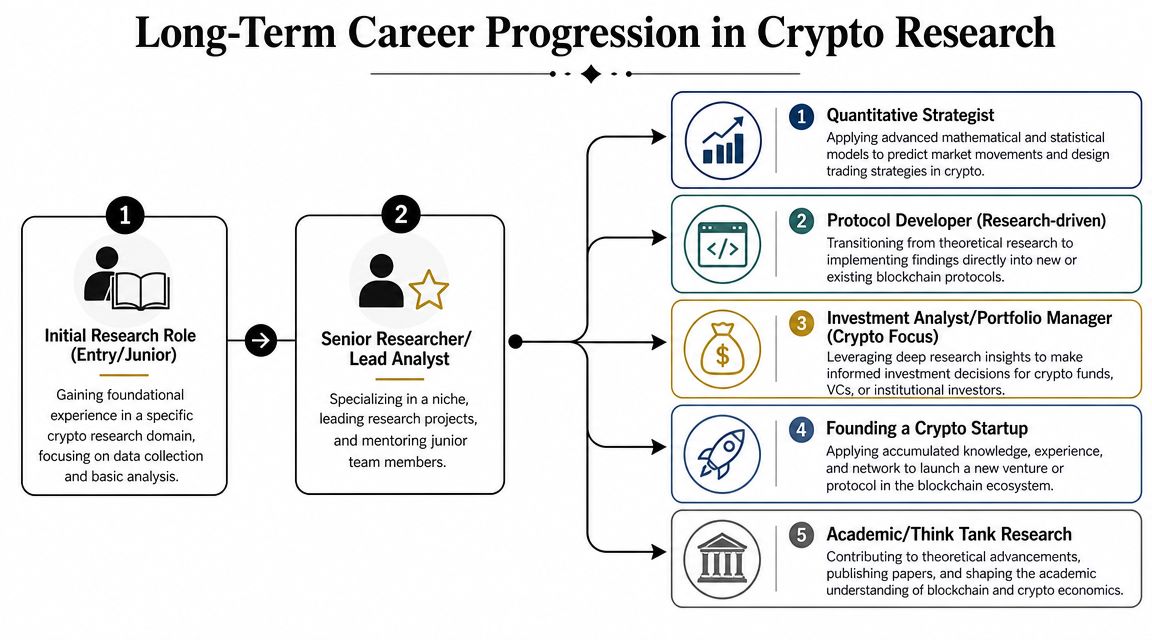
The market for crypto research jobs is broad, but the underlying subtracks differ materially. Some roles ask for options pricing and trading systems experience. Others lean toward protocol design or distributed AI inference. That's why candidates need to choose whether they're building toward quant trading, protocol research, AI/ML research, or market intelligence, as noted in CryptoJobs.com's research and analysis job overview.
What progression actually looks like
A quant researcher can move toward strategist, desk lead, or portfolio decision-making roles. The people who advance aren't always the ones with the fanciest math. They're the ones who consistently generate usable work under uncertainty.
A protocol researcher can grow into research lead, protocol architect, product-minded technical leadership, or ecosystem strategy. This path rewards people who can connect theory, implementation, and coordination.
A market intelligence analyst often has the widest set of exits. Strong analysts can move into investment research, listings, ecosystem growth, founder office roles, product strategy, or venture work. The skill that travels is decision support, not report writing.
How to future-proof your path
The safest long-term move isn't staying broad. It's becoming legible in one hard area while keeping enough adjacent literacy to work across teams.
That means:
- Choose a core identity: Quant, protocol, market, or AI/ML.
- Build adjacent range: A protocol researcher should still understand market incentives. A market analyst should still be technically credible.
- Upgrade your output, not just your title: Senior people are trusted because their work changes decisions.
Career progression in crypto research usually follows demonstrated leverage. The people who move up reduce uncertainty for the rest of the team.
A Note for Recruiters How to Hire Top Research Talent
Recruiters often miss top research talent by writing broad job descriptions for narrow jobs. “Crypto researcher” is usually too vague to attract the right candidates and too broad to filter them well.
Start with the actual mandate. Is this a quant seat tied to live trading decisions? A protocol role tied to design and specification work? A market intelligence role supporting product, listings, or investment teams? Or a research engineering role embedded in ML and infrastructure? Until the job is specific, the candidate pool won't be.
What to change in the hiring process
Write the description around deliverables, not buzzwords. Good candidates want to know what they'll own, what systems they'll touch, and how their work gets evaluated.
Then test for the actual work. If the role is protocol research, use a mechanism or design critique. If it's quant, use a market-structure or modeling exercise. If it's market intelligence, ask for a short decision memo, not a personality-heavy panel loop.
A useful comparison comes from adjacent technical education fields. Teams hiring for learning and applied technology roles have similar problems around vague role definitions and skill mismatch, which is why resources like this comprehensive guide for instructional technology careers are helpful as a framing device. Clear job architecture improves candidate quality in any specialized field.
Where recruiters usually go wrong
- Overvaluing pedigree: Prestigious employers and degrees help, but they don't replace visible work.
- Running generic screens: Specialist candidates drop out when the process doesn't reflect the role.
- Blending multiple jobs into one: “Researcher” plus “full-stack engineer” plus “token growth lead” usually means the scope wasn't defined.
The best hires happen when the company knows which archetype it needs, writes for that archetype, and evaluates with technical realism.
If you're hiring or exploring your next move, Blockchain Jobs is a practical place to track active Web3 roles across research-adjacent categories, from data and analytics to AI, engineering, and protocol-focused teams.