7 Remote Frontend Engineer Jobs to Watch in 2026

You have a dozen tabs open, and they all look like remote frontend engineer jobs. One is a payments console. One is a blockchain-intelligence dashboard. Another is compiler work wearing a frontend label.
Crypto roles are easy to find, and a clean match is not. Use this roundup to spot fit fast. For each listing, note the likely screen, the portfolio proof that maps to it, and how a Web3 signal turns into an interview instead of a generic apply. Then browse frontend developer jobs and verify location eligibility, stack expectations, and freshness on Blockchain Jobs and company career filters before you prep.
Some posts are product UI, some are data-heavy dashboards, and a few are compiler or infrastructure roles wearing a frontend label. Treat each one as a positioning choice, not a link to click.
Distributed hiring is already normal. Stack Overflow's 2025 Developer Survey reported that 32.4% of respondents worked fully remotely, and the United States had the highest fully remote share among top-reporting countries at 45%. A remote label still doesn't tell you citizenship, overlap hours, or whether frontend means product UI.
1. Saifuro - Frontend Engineer
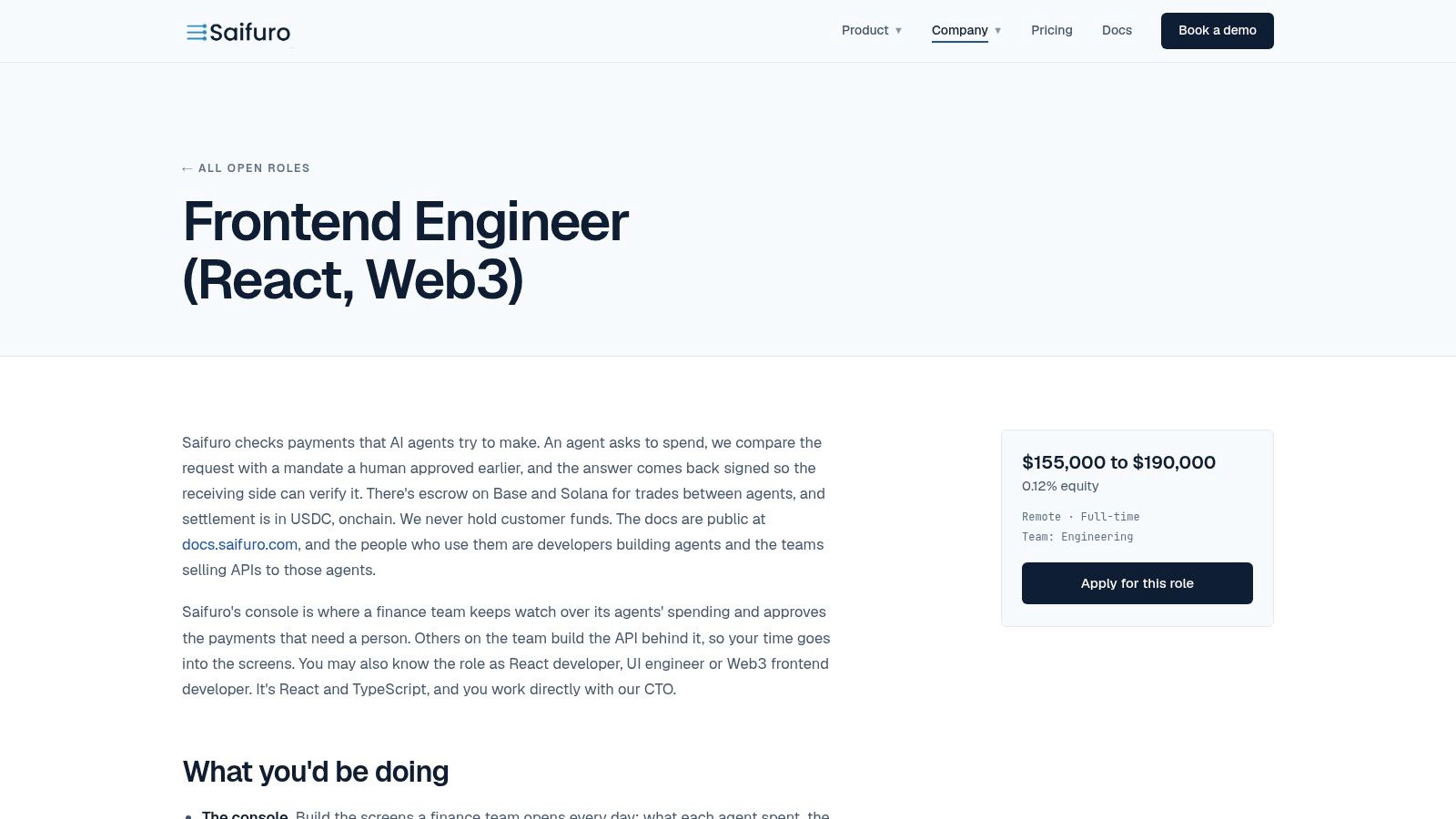
An AI agent moves real USDC, and your UI is the last checkpoint before it does. That framing tells you what Saifuro screens for. The role is full-time and fully remote for eligible U.S. candidates, on React and TypeScript, building a console to monitor and approve AI-agent payments with USDC and escrow on Base and Solana. Pay is listed at $155,000 to $190,000 with 0.12% equity, plus health coverage, paid leave, a workspace allowance, and a learning budget. Saifuro publishes all of this on its careers page, which is rarer than it should be in crypto.
What a hiring screen rewards
The listing doesn't name a level, so state yours in the first lines of your application. Early-stage payments work means broad ownership and thinner process than a large fintech org, and the screen will test whether you've shipped interfaces where a wrong click moves money. Show policy-editing UI, approval states, and chain-specific failures a hiring manager can trace on their own.
- Money states: Pending, approved, escrowed, and failed, each with a clear next action.
- Chain clarity: Base versus Solana in language a non-protocol teammate can follow.
- Scope honesty: Say you want hands-on product work across payments, approvals, and chain logic.
Practical rule: Attach one payments interface and a short decision note. Walk through the confirmation path for an irreversible transfer.
For how remote screens read ownership, use this frontend engineer remote guide, then mirror the console in your application instead of pasting a generic summary.
2. TRM Labs - Senior Software Engineer, Frontend
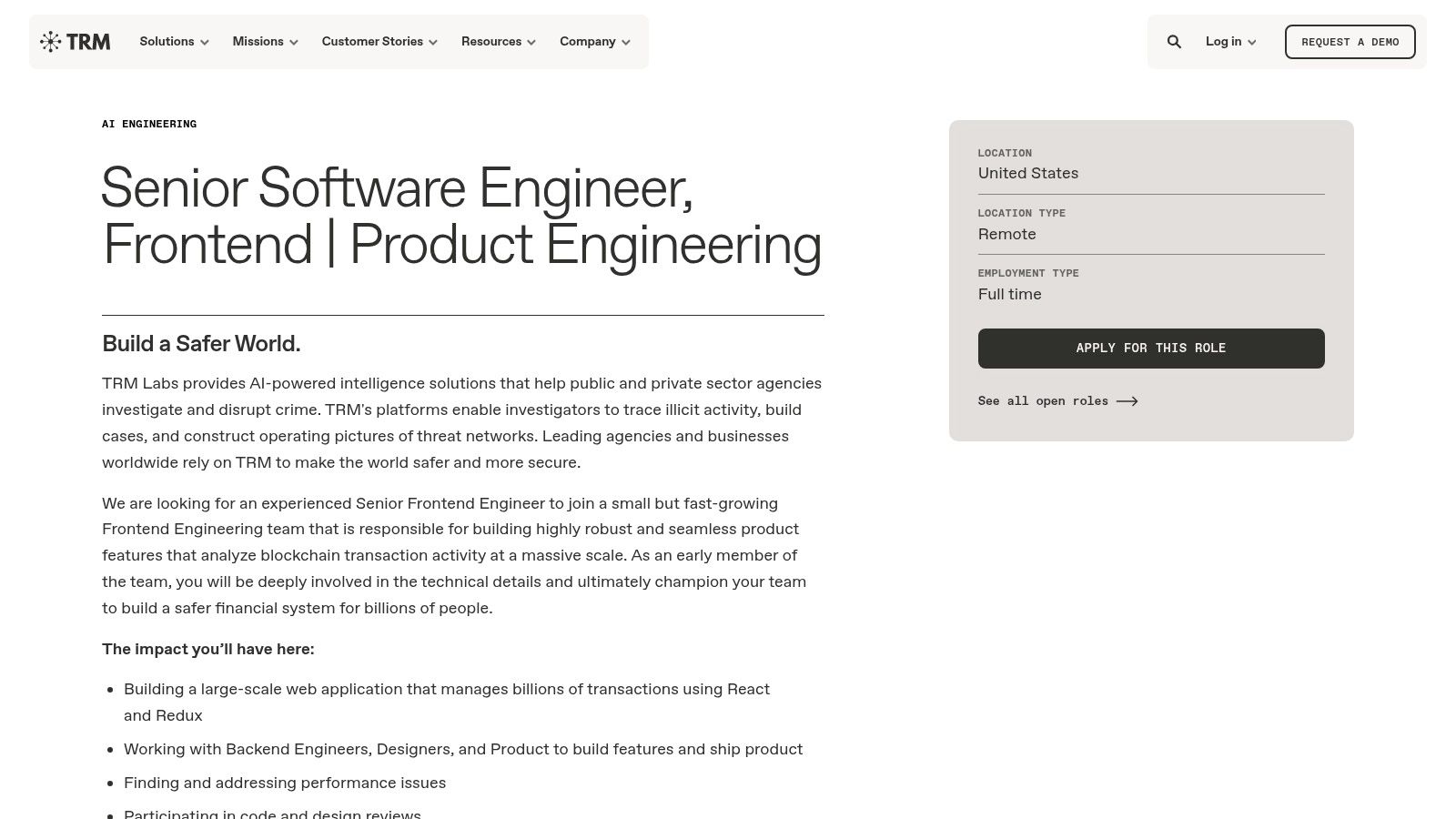
Eligibility decides this role before anyone reads your code. TRM Labs lists a senior, full-time, U.S.-remote seat that requires U.S. citizenship, so confirm that box first. The work itself is a React and Redux application for blockchain transaction analysis, on a product the team describes as handling billions of transactions, with product, design, engineering, and customers all in the loop.
Portfolio proof for investigative UI
Senior scope is explicit in the posting. Investigative tools screen for trust in dense data, and coursework dashboards don't carry that proof. Send evidence a reviewer can check without a call.
- Performance story: What you changed so a large table stayed usable.
- Analyst path: How someone moves from a noisy result to a decision.
- Async notes: A spec or pull request a designer can review offline.
Remote seniority here is work a teammate can review without a meeting.
If your background is fintech rather than crypto, map your fraud-detection or risk-UI work onto transaction tracing. That translation is the key. Prep with this remote front end developer note, then lead with analysis examples and leave marketing-site work out.
3. Coinbase - Senior Frontend Engineer, Portfolio
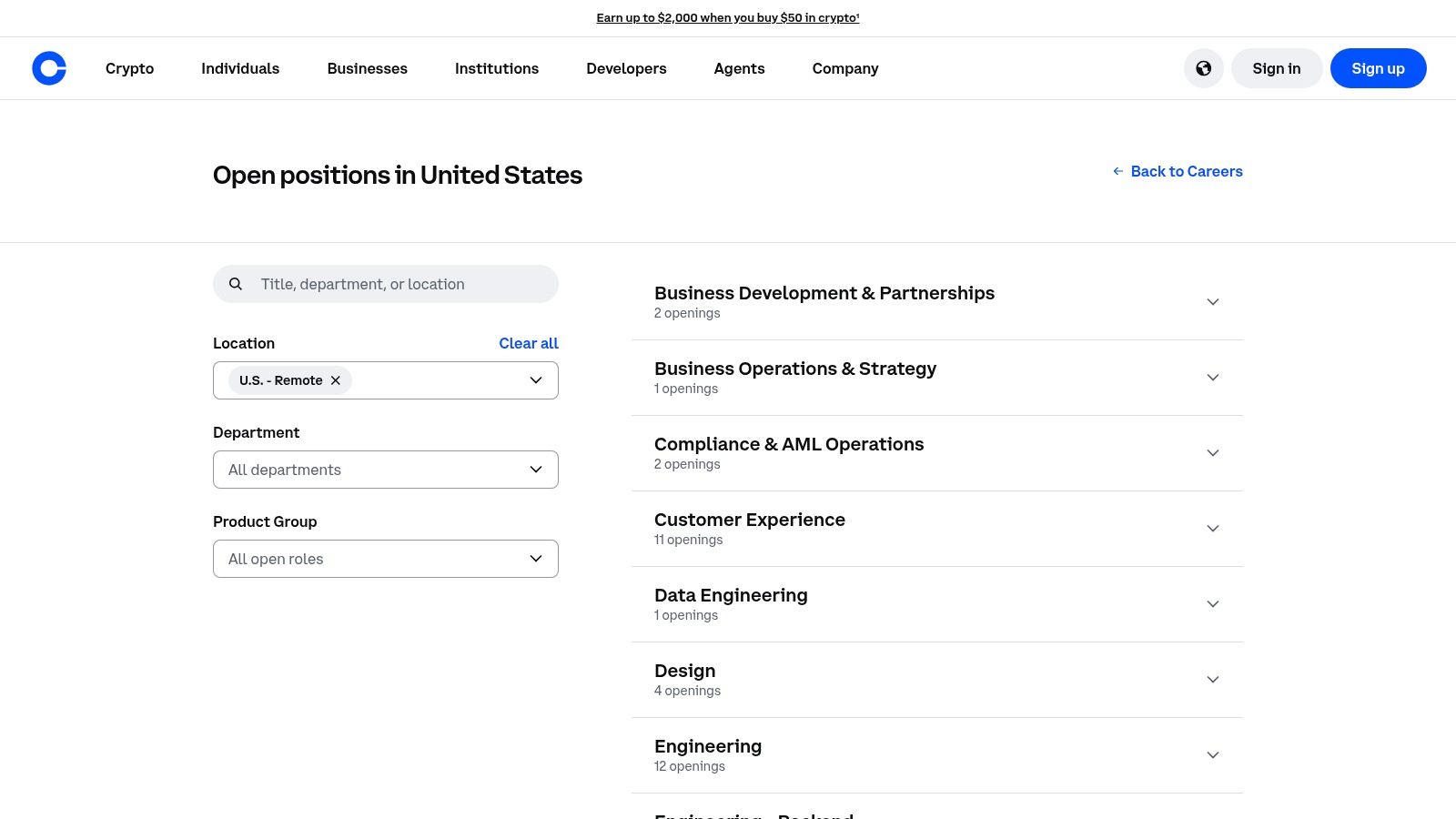
A portfolio role can mean very different work from one Coinbase team to another. The U.S.-remote careers board has listed this title alongside frontend roles in consumer products, payments, identity, and advanced trading. Open the Coinbase careers filters for Remote USA and check that the role is still live before tailoring your application.
Match your case study to the product
For Portfolio, show how you made balances and positions understandable and trustworthy. A payments or identity case study should focus on risk states and recovery paths; an advanced-trading example should show how you handled dense information and fast updates. Choose one product area and make the fit clear.
- Show the interface: Include a case study for the specific product surface you want to work on.
- Explain the user risk: Describe how you prevented a confusing balance, stalled identity check, or unclear trade status.
- Prepare for team-specific interviews: Seniority and interview stages can vary by opening, so confirm the process with the recruiter.
Salary was not listed in the roles reviewed. Your application should make clear what you owned, how you made product decisions, and how your UI helped users act confidently on a crypto platform.
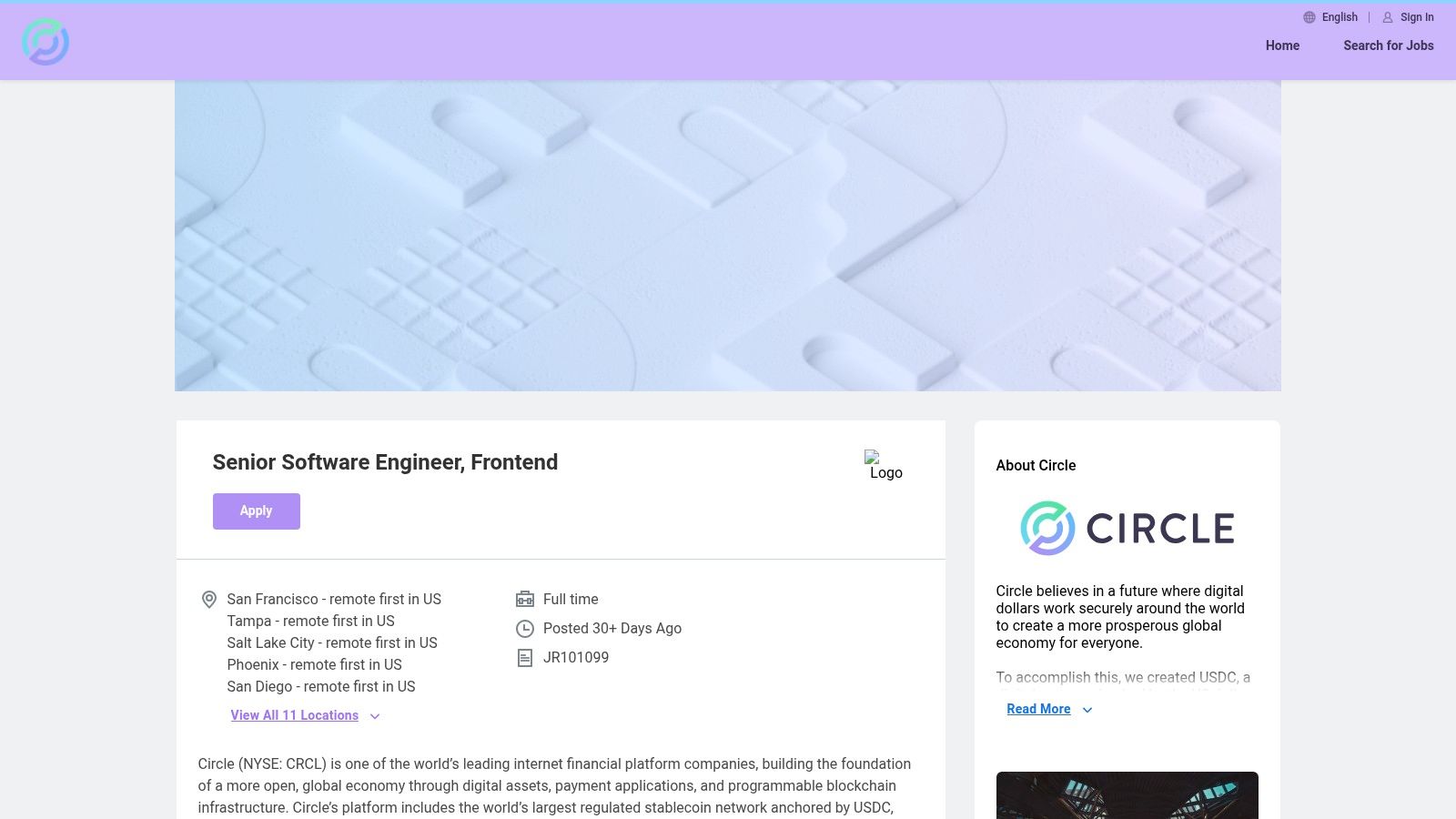
4. Circle - Senior Software Engineer, Frontend
A "remote first" label can still pin you to specific states. Circle's senior, full-time frontend req carries that label across several named U.S. locations and describes responsive Web3 applications spanning digital assets, payment applications, and blockchain infrastructure. Check the live listing's location line against where you can work before you build prep around it.
Position for payment-grade UI
This seat trades seed-stage ownership for established product and engineering functions, plus the senior bar that comes with them. The screen I would prepare for is payment surfaces under stress: wallet prompts, network switches, and failed or pending transactions rendered cleanly at phone width.
Three proofs carry weight here. The same checkout or transfer flow at two breakpoints, with the tradeoffs written down. Error copy that tells a user what happened to their money without inventing protocol depth you don't have. A straight answer on hubs too: name the U.S. locations you can work from, then ask whether a listed city is a preference or a requirement. No salary band was published in the listing.
Remote first still has a map. Confirm it before you rehearse system design.
When you weigh Circle against other remote web dev jobs, the fit question is whether payment-grade UI inside a larger org beats greenfield ownership at a smaller one.
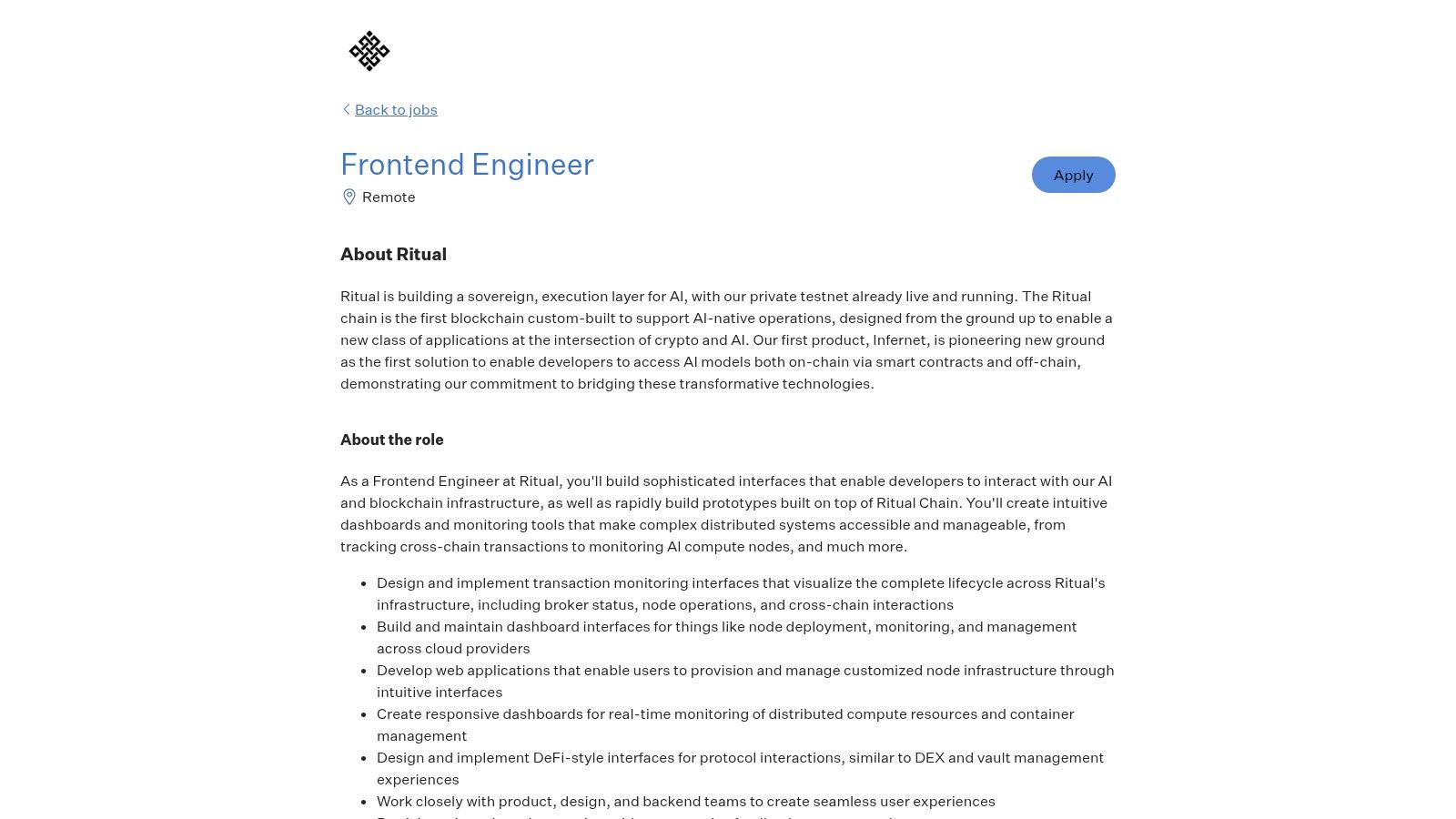
5. Ritual - Frontend Engineer
Ritual puts the frontend on AI infrastructure and blockchain at the same time. The full-time role covers developer interfaces, dashboards, and monitoring for cross-chain transactions and AI compute nodes. The post names React, blockchain interaction patterns, and wallet libraries such as wagmi or ethers, and it describes remote or hybrid work. U.S. eligibility and pay weren't in the details reviewed, so confirm both on the live Ritual listing before you invest in a take-home.
Portfolio proof: signing flow over landing page
Assume the screen starts at the wallet boundary. A connect flow that handles rejection, a transaction state machine that separates signing, pending, confirmed, and failed, and a monitoring view that stays legible when a node degrades will say more than a polished marketing page. GreatFrontEnd's write-up of recent survey reporting notes that 84% of developers were using or planning to use AI tools, while more developers distrusted AI accuracy than trusted it, and it describes DORA's 2025 research as treating AI as an amplifier of existing strengths and weaknesses. On a product that can move value and compute, generated UI that nobody reviewed is a liability.
Pick Ritual if you can prototype a developer tool quickly and explain degraded states in plain writing. Skip it if you need a settled process, a narrow ticket, or a product where the frontend stays far from the nodes.
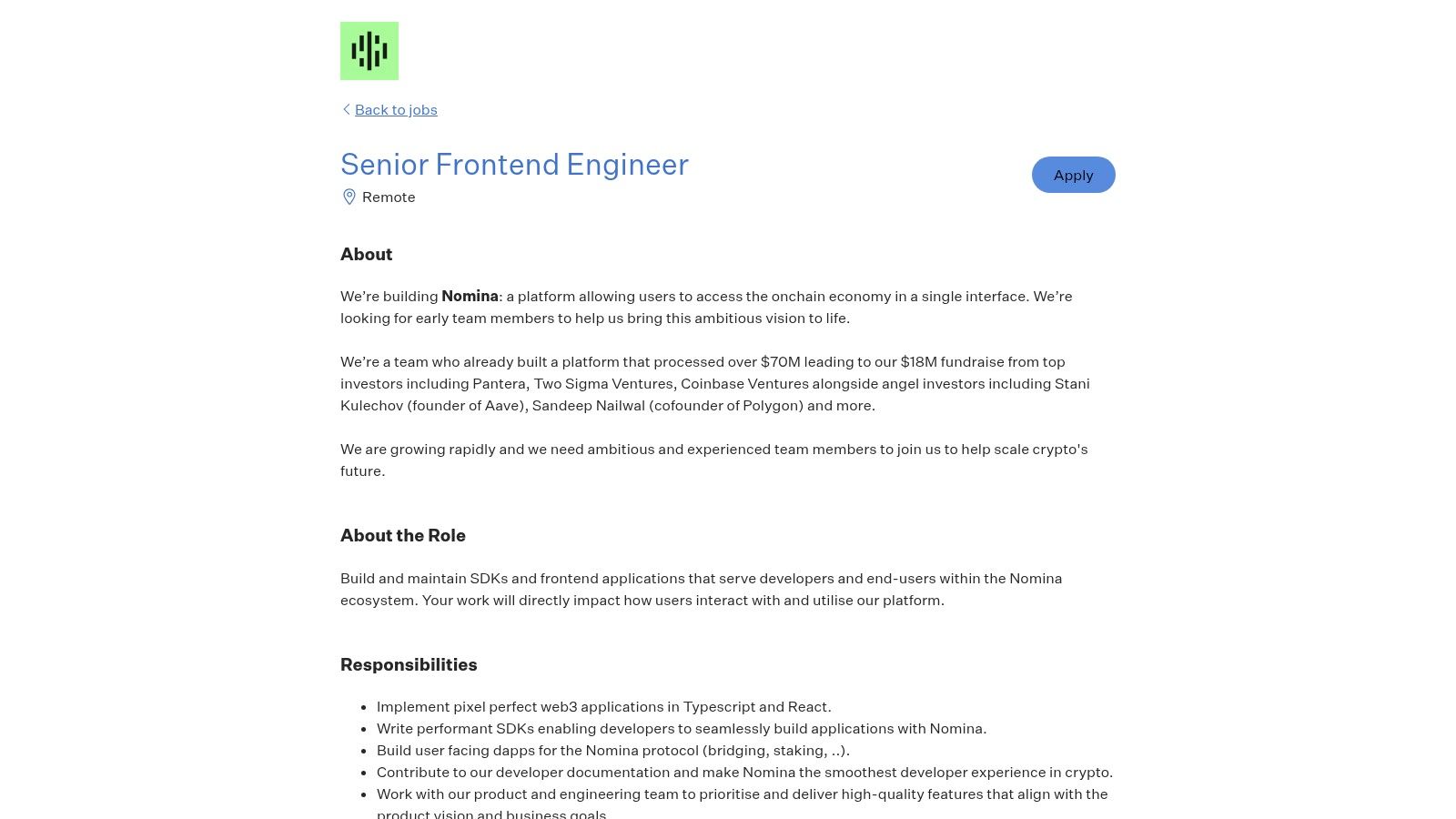
6. Nomina - Senior Frontend Engineer
Nomina states the constraint a lot of candidates skip: daily overlap with 9 a.m. to noon Eastern Time. The role is remote and senior. You build React and TypeScript applications, SDKs, and user-facing products for on-chain services, including dApps for bridging and staking. The bar is 5+ years of frontend experience and 3+ years of Web3 experience. U.S. hiring eligibility and salary weren't in the details reviewed, so verify both on the posting before you apply.
What the screen probably rewards
A senior title plus SDK work means the team likely reads your repo before your resume. The fit is engineers who've shipped an end-user flow and a developer-facing surface. A hackathon wallet button isn't three years of Web3.
- Chain actions: Pending, success, revert, and wrong-network states for a bridge or stake flow.
- SDK empathy: A README an outside integrator can follow.
- Clock fit: You can make that Eastern window, or you don't apply.
HackerRank's 2025 Developer Skills Report surveyed 13,732 people across 102 countries and found that 74% of developers still struggled to land jobs. Global remote hiring widens the pool and the competition. Nomina's year counts and overlap window are how you self-select before that funnel wastes a week.
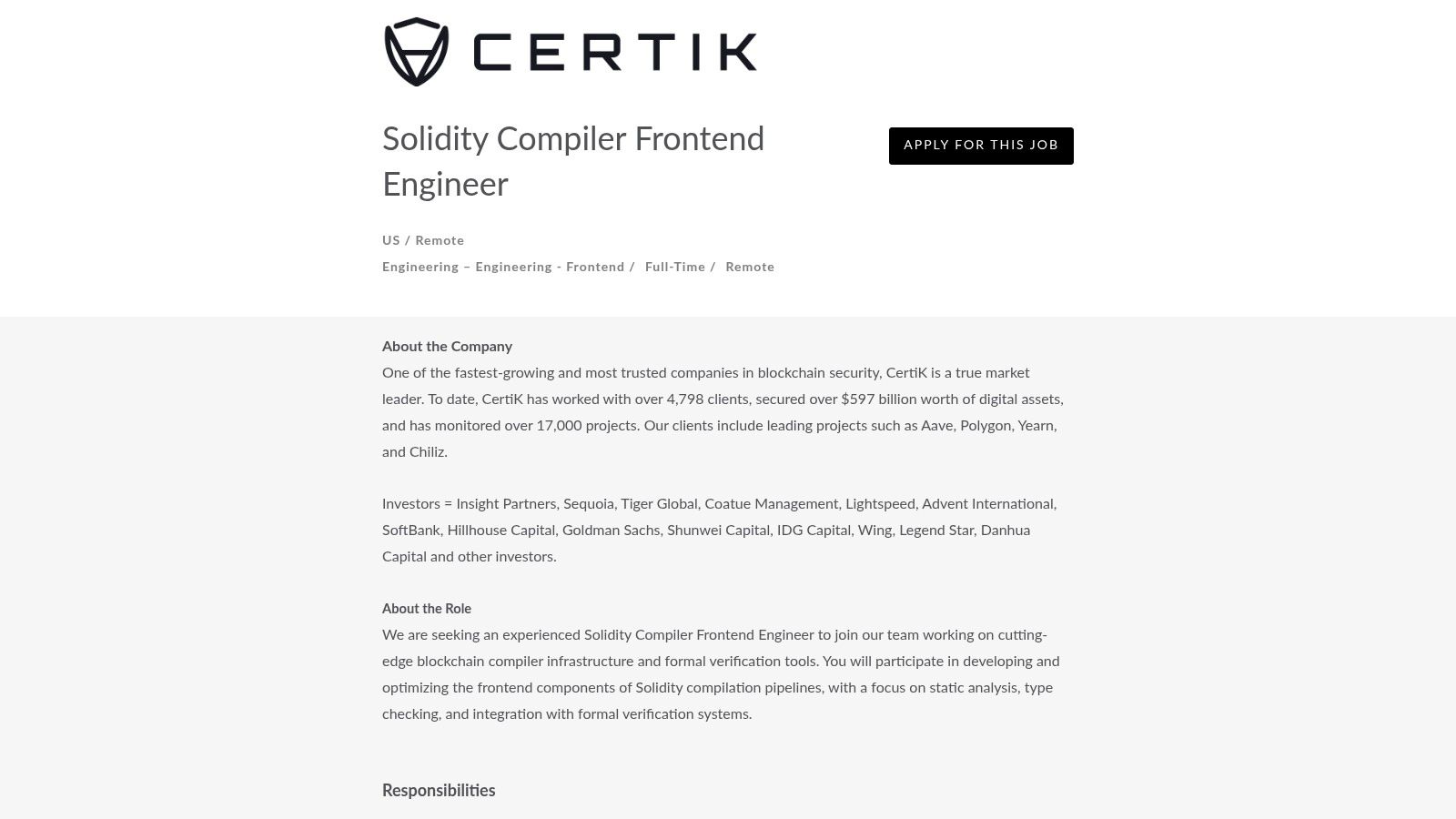
7. CertiK - Solidity Compiler Frontend Engineer
You have built React interfaces for years, but your strongest portfolio work is a parser or type checker. That distinction matters for CertiK's full-time Solidity Compiler Frontend Engineer role, listed as U.S. remote. The work centers on compiler infrastructure and formal-verification tooling, including parsing, type checking, and static analysis. The listing expects relevant compiler-development experience, and the salary was not provided. Check the CertiK compiler frontend posting for current requirements.
Who should take the interview
Build your application around evidence that you understand grammars, type systems, and Solidity semantics. A tested parser, type checker, or static-analysis project gives reviewers concrete work to assess. A dashboard or design system can show web skills, but it is less relevant proof for this compiler-focused role.
- Portfolio proof: Link to a compiler project and explain its tests, design decisions, and handling of edge cases.
- Interview preparation: Be ready to discuss Solidity language behavior and how your tooling detects errors.
- Location: The role is listed as U.S. remote. Confirm your eligibility before applying.
JavaScript, HTML/CSS, and TypeScript remain useful web skills, but the screen is more likely to reward compiler artifacts than UI stack proof. If your experience is primarily product interfaces, explain any language-tooling work directly rather than relying on the word “frontend” in the title.
7 Remote Frontend Engineer Jobs Compared
Each row here is a screening decision. The scope column shows what the team will test in the technical loop; the eligibility column shows whether you can legally take the seat. Read both before you spend an evening on one application.
| Role | 🔄 Scope & complexity | Requirements & eligibility | 📊 Expected impact | 💡 Best fit & key advantage |
|---|---|---|---|---|
| Saifuro, Frontend Engineer | React/TypeScript dashboards and payment-policy tools; broad ownership in an early-stage team | U.S.-eligible; experience level unspecified; $155K–$190K + 0.12% equity | Build tools for AI-agent USDC payments and escrow on Base and Solana | Product-minded engineers who want hands-on fintech work with published compensation |
| TRM Labs, Senior Software Engineer, Frontend | Complex React/Redux interfaces for billions of blockchain transactions | Senior experience; U.S. remote; U.S. citizenship required | Improve performance and usability of blockchain investigation tools | Engineers with data-heavy product experience and strong cross-functional stories |
| Coinbase, Senior Frontend Engineer, Portfolio | Frontend roles across multiple product areas; scope depends on the opening | Remote USA roles have been listed; availability and requirements vary | Contribute to consumer, payments, identity, or trading products | Candidates who want a major platform and will check which openings are live |
| Circle, Senior Software Engineer, Frontend | Senior-level responsive Web3 application development | U.S. remote-first locations listed; confirm location eligibility | Support digital-asset, payment, and blockchain infrastructure products | Senior engineers drawn to payments infrastructure at an established company |
| Ritual, Frontend Engineer | Dashboards and developer tools involving AI infrastructure and blockchain | Remote or hybrid; U.S. eligibility and compensation not specified | Monitor cross-chain transactions and AI compute infrastructure | Engineers who want varied AI/blockchain scope and can show relevant work |
| Nomina, Senior Frontend Engineer | React/TypeScript dApps plus SDK and developer-experience work | 5+ years frontend and 3+ years Web3; daily 9 a.m.–noon ET overlap | Build products for on-chain bridging, staking, and services | Web3 engineers comfortable splitting time between user-facing apps and SDKs |
| CertiK, Solidity Compiler Frontend Engineer | Specialized compiler work: parsing, type checking, and static analysis | U.S. remote; compiler-development experience expected | Advance Solidity compiler and formal-verification tooling | Compiler specialists; expect a language-theory loop, not a UI review |
Two patterns matter in this list. Saifuro is the only posting reviewed with a published band, so treat compensation everywhere else as a first-call question rather than a filter. Four of the seven titles carry "Senior," which means those loops will probe judgment and ownership stories. Saifuro and Ritual leave the level open, so the work you show sets the ceiling there.
CertiK sits outside the pattern entirely. It is a compiler job wearing a frontend title, so weigh it against compiler roles elsewhere rather than against the other six.
Turn Listings Into Interviews
Shortlist two or three roles that match your stack and where you can legally work. Saifuro fits if you want payments UI and a published band. TRM or Coinbase fits if you clear U.S. constraints and senior data or consumer scope. Circle fits if remote-first U.S. locations are real for you. Ritual fits if AI-plus-chain monitoring is the sample you can defend. Nomina fits only when the years and Eastern overlap are true. CertiK fits only if compilers are the job you want.
Rebuild the portfolio around the interface problem in those posts. For product roles, ship approval flows, transaction tables, or wallet state machines. For the compiler role, ship language tooling. Then rewrite resume bullets as outcomes, such as a safer payment review, fewer wrong-network mistakes, or a monitoring view an operator can use. Adapt your resume for remote applications so each line names the result, the constraint, and how you write across time zones.
Before you prep, verify citizenship, overlap hours, seniority, and whether frontend means product UI, dashboards, or compiler tooling. GitLab's remote work report found that 81% of 3,900 remote professionals were satisfied with productivity and teamwork, while only 37% said their organization aligned work effectively across projects. Ask how decisions are recorded and how design, backend, and frontend hand off.
U.S. web-skill demand isn't an easy offer. The Bureau of Labor Statistics reports 220,100 jobs for web developers and digital designers in 2025 and projects 5% growth from 2025 to 2035, about 11,300 additional jobs. Show accessibility, performance, and cross-device behavior. Blockchain Jobs is a Web3 board with an engineering section and a remote filter, useful after you've already cut roles you can't legally or technically take.
Blockchain Jobs lists Web3 engineering roles you can filter by remote arrangement, including frontend seats that are easy to confuse with compiler or dashboard work. Use it to recheck stack, seniority, and location after you shortlist from this roundup, then open a live posting only when the fit is real. Visit Blockchain Jobs and scan the engineering listings before your next application cycle.