
A Job Seeker's Guide to Crypto Venture Capitalists and Web3 Careers

Crypto venture capitalists are the architects and talent scouts of the Web3 world. They do more than just write checks; they actively mold the future of the decentralized internet and, by extension, the jobs within it. If you want to find the most promising and stable careers in blockchain, learning to read their investment patterns is your roadmap to getting hired.
How Crypto VCs Shape the Web3 Job Market

Think of crypto venture capitalists (VCs) as the mission planners for a new digital frontier. They don’t just provide the fuel—the capital—for ambitious projects to get off the ground. They're also deeply involved in assembling the elite crew needed to make sure the mission succeeds.
For anyone looking to build a career in Web3, this connection is everything. When a crypto VC firm pours millions into a startup, it’s a massive vote of confidence.
That signal means more than just financial validation; it’s a blaring siren for an upcoming hiring spree. That investment is almost always earmarked for scaling teams, from protocol engineers and community managers to legal minds and product designers. Following the money trail left by crypto VCs is one of the smartest job search strategies you can use.
From Funding Rounds to Job Postings
The path from a funding announcement to a "we'd like to offer you the job" email is shorter than you might think. A startup that just closed a big seed or Series A round from a respected crypto VC is under intense pressure to deliver on its promises. That means one thing: they need to hire, and they need to do it now.
Actionable Insight: For job seekers, a VC's portfolio is more than a list of logos. It's a curated directory of companies that are actively building, growing, and—most importantly—hiring. These are the teams with the cash to innovate and the momentum to offer stable, meaningful careers.
This direct line between capital and careers is why understanding the VC space is so critical. It flips your job search from a passive scroll through job boards into a proactive hunt for companies on the verge of explosive growth.
Why This Matters for Your Career Progression
Landing a role at a company backed by top-tier crypto venture capitalists is more than just a job; it's a launchpad for your career. These startups are usually tackling the industry's gnarliest problems, which means you get hands-on experience with technology that's still being defined.
By targeting VC-backed companies, you place yourself right at the heart of innovation. This has some immediate perks for your career:
- Skill Development: You’ll get your hands dirty with pioneering protocols, new tokenomics models, and governance structures that are literally writing the rules for the future of the internet. This is how you build a resume that stands out.
- Network Expansion: You're instantly plugged into an exclusive ecosystem of investors, advisors, and other top-tier professionals, which can open doors for your next career move before you even start looking.
- Career Stability: The crypto market is a rollercoaster, but VC backing provides a financial runway. This buffer gives teams the breathing room they need to focus on building real, long-term value instead of worrying about next month's payroll.
At the end of the day, tracking crypto VCs isn't just about finding a job. It's about strategically positioning yourself in an environment built for rapid professional growth and making a real impact on the industry.
Decoding the Crypto VC Investment Mindset
If you want to land a job in Web3, you have to learn to think like the people funding it. A traditional venture capitalist is laser-focused on things like revenue, profit margins, and customer acquisition costs. But crypto venture capitalists? They're playing a completely different game. Their playbook values decentralized networks and community ownership far more than a tidy quarterly earnings report.
Getting this mindset is the key to framing your skills and experience correctly during a job interview. It’s not that business fundamentals go out the window, but you have to recognize the new metrics that signal real, long-term value in a decentralized world. For a crypto VC, a project's strength isn't just in its code; it's in its ability to spark a self-sustaining digital economy.
This fundamental shift explains why the smartest money keeps flowing into the space, even when the markets get choppy. In one recent banner year, venture capitalists poured a massive $25 billion into crypto companies. That’s a 73% jump from the previous year's $14.5 billion—all during a broader market downturn. It’s proof that crypto VCs are betting on the deep-seated fundamentals, not just fleeting hype. You can dig into more VC funding trends and predictions on Crunchbase.
The Pillars of a Crypto Investment Thesis
Crypto VCs look at startups through a unique lens. When you're in an interview, speaking their language shows you get what really drives value and, more importantly, where you fit in.
- Tokenomics: This is the project's economic soul. VCs will pick apart how a token is created, distributed, and used. They’re searching for smart, well-designed incentives that encourage people to participate and secure the network, not just pump and dump.
- Protocol Strength: How solid is the tech? Investors want to see elegant, efficient code that can actually scale without giving up on decentralization. They're making bets on these protocols becoming the new bedrock of the internet.
- Community and Governance: In Web3, a passionate, engaged community is the ultimate competitive advantage. VCs look at how active a project's Decentralized Autonomous Organization (DAO) is and how dedicated its users are. A strong community isn't just a marketing engine; it's a fortress.
Interview Tip: A traditional VC invests in a company that builds a castle and sells tickets at the gate. A crypto VC invests in a project that gives a community the blueprints and tools to build its own city. Frame your skills around how you would help build that city and empower its citizens.
From Traditional Metrics to On-Chain Data
For anyone on the job hunt, this means you need to change your vocabulary. Instead of just talking about "revenue growth," you need to be fluent in "on-chain metrics." This is the transparent, real-time data pulled straight from the blockchain that shows a network's true health and activity.
This table breaks down how the priorities differ, giving you a better sense of what each world values in a potential hire.
Crypto VC vs Traditional VC Key Differences for Job Seekers
| Focus Area | Crypto Venture Capitalists | Traditional Venture Capitalists |
|---|---|---|
| Primary Metric | On-chain activity (e.g., daily active users, transaction volume) | Revenue and Profitability (e.g., ARR, EBITDA) |
| Valuation Model | Network value, token utility, and total value locked (TVL) | Discounted cash flow (DCF) and market comparables |
| Team Focus | Technical founders, crypto-native experience, community leaders | Experienced management teams with a track record of exits |
| Exit Strategy | Token liquidity on exchanges, M&A, long-term network growth | IPO, strategic acquisition by a larger corporation |
Ultimately, a candidate who can speak to on-chain activity and community governance will be far more compelling than one who only knows traditional business metrics.
How to Apply This in Your Job Search
Once you grasp this framework, you can position yourself as the perfect fit for what crypto VCs—and their portfolio companies—are looking for.
- Frame Your Experience: If you're a marketer, don't just talk about growing a social media following. Talk about how you’d drive real participation in the project’s DAO.
- Show Your Work: If you’re an engineer, highlight your open-source contributions or your deep understanding of smart contract security. Prove you've been in the trenches.
- Demonstrate Crypto-Native Insight: In an interview, go beyond the surface. Intelligently break down a project's token utility. Explain why its design creates a sustainable economic loop for both users and developers. That's the kind of insight that makes you stand out.
When you start speaking this language, you stop being just another candidate for a job. You become a potential partner in building the decentralized future.
For more guides on navigating your Web3 career, check out our other articles on the Blockchain Jobs blog.
Finding Your Niche: A Guide to the Top Crypto VC Firms
Not all crypto venture capitalists are cut from the same cloth. Just like a developer wouldn't use the same programming language for every project, different VC firms carve out specific niches in the vast Web3 world. If you want to land a job in this space, figuring out these specializations is your secret weapon.
Instead of just blasting your resume to any company with "crypto" in its name, you can be much more strategic. Think of it this way: the VC landscape is like a collection of different continents, each with its own unique culture and economy. An expert in tropical agriculture (say, a consumer growth marketer) isn't going to find many gigs in the arctic tundra (a deep infrastructure protocol). Knowing the terrain is everything.
The chart below breaks down the fundamental split between the crypto and traditional VC mindsets. It’s a simple but crucial starting point for understanding where you might fit in.
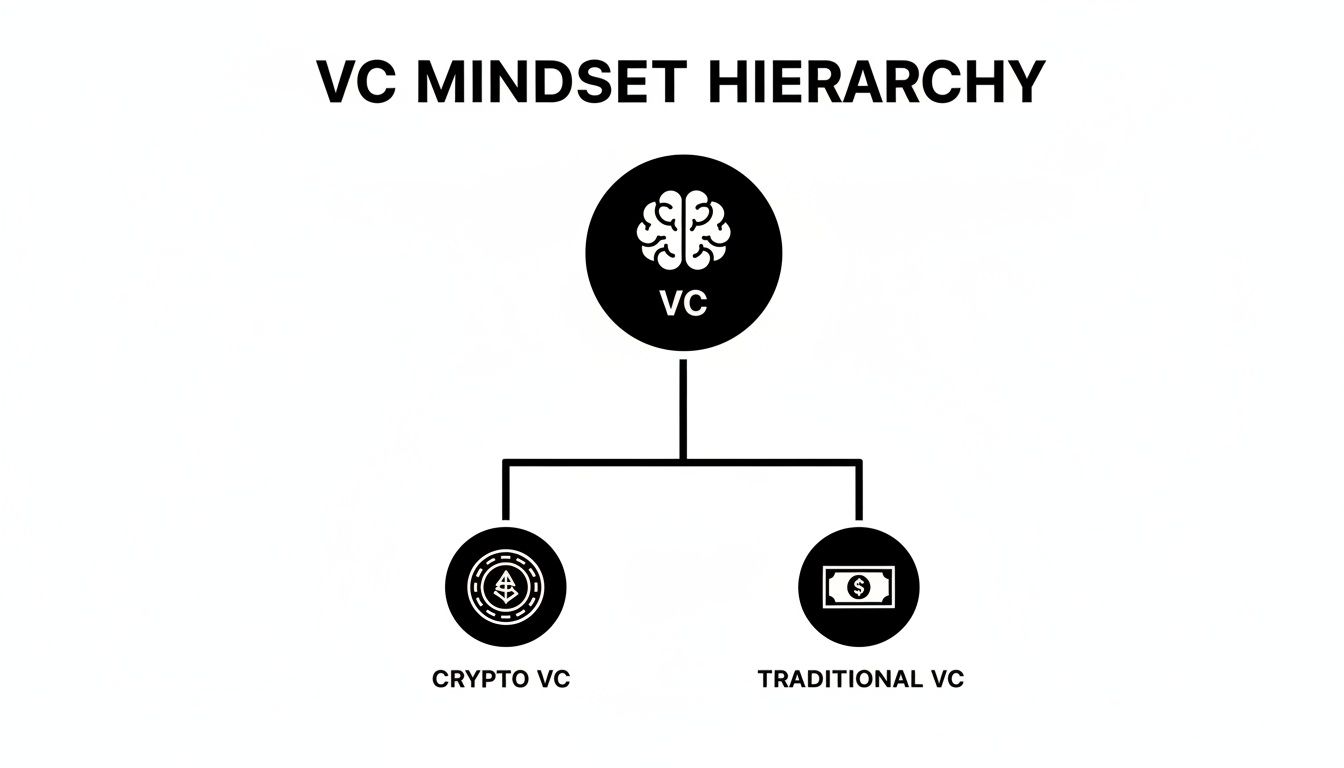
As you can see, even though they both fall under the broad "venture capital" umbrella, their core focus—tokens versus traditional equity—spawns entirely different investment philosophies. And that, in turn, dictates who they hire.
The Infrastructure and Protocol Specialists
Some of the biggest names, like a16z crypto, Polychain Capital, and Electric Capital, are essentially the architects of Web3's foundation. They invest in the "picks and shovels" of the decentralized world: Layer 1 and Layer 2 blockchains, interoperability protocols, and the core tools developers need. Their portfolio companies are building the highways and power grids of the new internet.
For job seekers, this signals a need for very specific, deep technical talent.
- Who Thrives Here? Protocol engineers, cryptographers, compiler developers, and systems architects. This is home base if your expertise is in low-level code, consensus mechanisms, or zero-knowledge proofs.
- Career Alignment: These companies are tackling incredibly complex technical problems. Your career path here is tied directly to shipping core protocol features, locking down network security, and contributing to open-source standards. Success isn't measured in clicks; it's measured in network uptime, transaction throughput, and developer adoption.
The DeFi and Financial Primitives Investors
Next, you have the DeFi-native funds, with firms like Paradigm and Dragonfly Capital leading the charge. These investors have a profound grasp of financial markets and are laser-focused on building a completely new, open financial system on the blockchain. They back everything from decentralized exchanges (DEXs) and lending protocols to highly sophisticated derivatives platforms.
The startups they fund need a potent mix of technical skill and financial savvy.
Actionable Insight: These firms aren't just funding technology; they're funding new forms of capital markets. A candidate who can fluidly discuss both smart contract security and the latest yield farming strategies is going to stand out immediately.
- Who Thrives Here? Smart contract engineers (especially those obsessed with security), quantitative analysts, financial modelers, and product managers who have a background in traditional finance (TradFi).
- Career Alignment: Jobs in this corner of the industry involve building, securing, and scaling financial products that often manage billions of dollars in assets. When you prep for an interview, you need to go deep on the top DeFi protocols, understand their mechanics inside and out, and be ready to articulate their risks and opportunities.
The Consumer, Gaming, and NFT Trailblazers
Finally, you have the firms that concentrate on the user-facing layer of Web3—the apps that will hopefully bring the next billion people on-chain. Investors like Animoca Brands and Pantera Capital often place big bets on blockchain gaming, NFT marketplaces, decentralized social media, and other consumer-focused platforms.
These startups are in a street fight for user attention, which makes certain non-technical roles absolutely essential to their survival and growth.
- Who Thrives Here? Growth marketers, community managers, UX/UI designers, brand storytellers, and business development pros.
- Career Alignment: If your passion lies in building buzzing communities, designing beautiful user experiences, or telling a story that clicks, this is your world. In an interview, expect to talk about user acquisition in a tokenized economy, how to build real engagement on Discord, and how you'd make complex blockchain ideas simple for a mainstream audience. Success here is measured in daily active users, community sentiment, and brand recognition.
By figuring out which of these VC archetypes best matches your skills and interests, you can turn your job search from a game of chance into a well-calculated strategy.
How to Land a Job in the Crypto VC Ecosystem
Breaking into the world of crypto venture capitalists isn't a one-size-fits-all journey. There are two primary career paths you can take: you can either land a job directly inside a VC firm or join one of their well-funded portfolio companies. Figuring out which of these paths aligns with your skills and career goals is the critical first step.
For some, the dream is to be the investor—the person sourcing deals and shaping the future of Web3 from the inside. For others, the real thrill is in building. They'd rather join a VC-backed startup, getting their hands dirty creating groundbreaking products with the stability that a big funding round provides. Both are fantastic ways to build a career.
The current funding climate makes either option attractive. Global venture capital deployment just recently nudged past the low $400 billion mark, a 17.6% jump from $340 billion the year before. And forecasts are predicting another 10-25% climb. While AI has been grabbing all the headlines, the crypto world still pulled in a massive $25 billion. That's a strong signal that VC-backed crypto companies are well-funded, have clear roadmaps, and are hiring. You can get more insights on the future of VC investments in crypto on DL News.
Path 1: Working for a Crypto VC Firm
Getting onto the investment side of the table is tough. It takes a unique mix of skills that go way beyond what they teach you in a traditional finance program. A great crypto VC needs to be part analyst, part community insider, and part tech auditor, all rolled into one. It’s a demanding gig that rewards people who are genuinely, deeply involved in the ecosystem.
Firms are on the hunt for people with a verifiable track record of "proof of work" in the crypto space. This isn’t about a perfectly formatted resume; it's about proving you’ve actually been in the trenches.
Actionable Insight: A crypto VC firm wants to see that you've done more than just read about Web3—they want to see that you've lived it. Your on-chain activity, contributions to a DAO, or insightful analysis on social media can be more valuable than an MBA from a top-tier school.
If you want to stand out, you need to cultivate a few key skills:
- Deep Protocol Analysis: You have to be able to tear apart a whitepaper, find the flaws in a project's tokenomics, and actually understand the technical trade-offs of different consensus mechanisms.
- Financial Modeling for Web3: Forget P&E ratios. This is about valuing networks using on-chain metrics like Total Value Locked (TVL) and daily active users.
- Community Engagement: The best crypto VCs are practically part of the communities they invest in. They live on Discord, follow the right people, and have a real feel for the culture of different ecosystems.
Path 2: Joining a VC-Backed Portfolio Company
For most people, the most direct path into this world is to join a startup that a crypto VC has already given its stamp of approval to (and its cash). This route offers the excitement of a high-growth startup with the much-needed stability of a VC's backing.
Using a company’s VC backing as a filter in your job search is a brilliant strategy. It immediately narrows your search to companies that have survived a rigorous due diligence process and have the cash to build something that lasts. When you apply to these roles, you can feel confident that a team of experienced investors believes the project has a real shot at succeeding.
Nailing the Web3 Interview
Whether you're talking to a VC firm or one of its portfolio companies, the interview will feel different. Your mission is to prove you're "crypto-native"—that you get the culture, the tech, and the unique economic principles that make this space tick.
Here are a few actionable tips to prepare:
- Discuss Tokenomics Intelligently: Be prepared to talk about how a project’s token actually works. You need to articulate how it creates a sustainable economic flywheel that incentivizes users, developers, and investors to stick around and contribute.
- Showcase Your "Proof of Work": Don't just tell them you're passionate; show them. Have examples ready. Talk about a governance proposal you voted on, a smart contract you audited (even for fun), or a piece of analysis you published on a blog or Twitter.
- Connect Your Experience to Web3 Challenges: Frame your past work in the context of Web3's unique problems. If you're a marketer, explain how you'd build a community from scratch without a massive ad budget. If you're an engineer, talk about your experience building secure, scalable systems that can withstand a decentralized world.
If you adopt this mindset and prepare with a clear strategy, you’ll position yourself as someone who can bring real value to the Web3 ecosystem. Start by exploring the opportunities on platforms dedicated to connecting talent with top Web3 companies, and check out some of the latest roles on Blockchain Jobs.
Key Roles and Career Paths in Web3 Startups

If you're looking to build a career in Web3, you need to get familiar with the real jobs that make this ecosystem tick. Forget the generic job titles you see elsewhere. The roles that crypto venture capitalists and their portfolio companies are scrambling to fill demand a totally unique mix of skills.
These aren't just old-school jobs with "blockchain" tacked on. They're entirely new functions born at the crossroads of technology, finance, and community.
Success in this space isn't about starting from scratch; it's about translating your current experience into the language of Web3. Whether your background is in tech, marketing, or finance, the trick is to pinpoint where your skills align with the market's needs and figure out what new abilities you need to pick up along the way.
High-Demand Roles Inside Web3 Companies
Certain roles are the absolute backbone of fast-growing, VC-backed crypto startups. Getting a handle on what these jobs actually involve day-to-day will help you zero in on the right opportunities and walk into interviews with genuine confidence.
- Protocol Specialist/Engineer: These are the master builders. Their job is to design, code, and maintain the blockchain protocol itself. You'll need some serious expertise in systems programming, cryptography, and distributed systems. A career here means you’re quite literally laying the foundation for a new digital economy.
- Smart Contract Auditor: In a world where one tiny bug can lead to millions in losses, these pros are the gatekeepers. They painstakingly comb through smart contract code, hunting for security holes, potential exploits, and sloppy coding. It’s the perfect path for detail-obsessed people who love security and think like a hacker.
- Community and Governance Manager: Think way beyond social media management. This person is part diplomat, part strategist, and part community organizer. They guide DAO governance proposals, steer conversations on Discord, and cultivate a genuinely engaged user base. To nail this role, you need top-tier communication skills and a deep intuition for what motivates token holders.
Strategic and Operational Functions
It’s not all deep tech. Startups backed by crypto venture capitalists also need a solid operational crew to turn their big vision into a real business. These roles connect the complex technology with real-world execution, making them a great fit for professionals moving over from other industries.
Career Tip: Your ability to frame traditional experience in a Web3 context is your greatest asset. A portfolio manager becomes a treasury manager for a DAO; a brand strategist becomes a narrative weaver for a new NFT project. The core skills are transferable if you learn the new language.
The table below breaks down some of these crucial roles and what it takes to succeed in them. For a real-world look at what top-tier firms are searching for, check out job postings like the Coinbase Ventures Principal role to see how these responsibilities are framed.
In-Demand Roles at Crypto VC Firms and Portfolio Startups
This table outlines some of the most sought-after positions in the Web3 space, detailing what the job entails and the skills you'll need to excel. It's a great starting point for matching your background to the industry's biggest needs.
| Job Role | Core Responsibilities | Essential Skills for Success |
|---|---|---|
| Product Manager | Defines the product roadmap, prioritizes features based on user feedback and on-chain data, and works with engineering to ship new functionalities. | Deep understanding of tokenomics, user experience (UX) for dApps, and data analysis of on-chain metrics. |
| Tokenomics Designer | Creates the economic model for a project's token, balancing incentives for users, investors, and the core team to ensure long-term network health. | Advanced financial modeling, game theory, behavioral economics, and a strong grasp of monetary policy concepts. |
| Business Development | Forges strategic partnerships with other protocols, exchanges, and companies to drive ecosystem growth and user adoption. | Strong negotiation skills, a wide network within the crypto industry, and the ability to articulate complex technical value propositions. |
As you can see, the opportunities are diverse, blending classic business functions with a deep, native understanding of how decentralized systems work.
What's Next for Crypto VCs—And Your Career
To get ahead in your Web3 career, you've got to figure out where the industry is heading next. One of the best ways to do that? Follow the money. Specifically, follow the investment theses of top crypto venture capitalists. They're placing bets today on the sectors that will be hiring tomorrow.
Think of their investment patterns as a roadmap for your own professional development. By seeing where they're allocating capital, you can anticipate which skills and roles will soon be in high demand. These aren't just abstract theories; they're creating real jobs and defining the next wave of must-have expertise.
Tangible and Intelligent Assets Are Taking Center Stage
The crypto conversation is shifting. For a long time, it was all about purely digital assets, but two major narratives are now attracting serious VC funding and creating entirely new career paths.
- Real-World Assets (RWAs): This is all about bringing physical assets—things like real estate, private credit, and even fine art—onto the blockchain through tokenization. This movement creates a huge need for professionals who can bridge the gap between traditional finance (TradFi) and the decentralized world. We're seeing a surge in demand for compliance experts and legal analysts who can navigate securities law in this new, tokenized context.
- Decentralized Physical Infrastructure (DePIN): DePIN projects are fascinating; they use crypto incentives to build out real-world infrastructure like wireless networks, data storage, and energy grids. This sector needs people who can work at the intersection of hardware and blockchains, opening up jobs for hardware engineers, supply chain specialists, and network operations managers.
What this tells us is that the industry is growing up. It's moving beyond pure speculation and toward creating tangible, real-world utility. For you, this means your experience in more traditional sectors is suddenly becoming incredibly valuable in Web3.
The Inevitable Fusion of AI and Blockchain
The other massive frontier is the convergence of Artificial Intelligence and blockchain. VCs are pouring money into projects using AI to make smart contracts smarter, automate governance in DAOs, and build more intelligent decentralized applications. This trend is minting a new kind of professional with a rare, interdisciplinary skill set.
Career Insight: The next generation of Web3 talent won't just be an expert in code or finance. They'll need to understand how these complex systems interact. Professionals who can speak the language of both AI and blockchain will have a serious advantage in the job market of tomorrow.
This fusion is already creating brand new roles for machine learning engineers who understand blockchain principles and for data scientists who can analyze on-chain data to train powerful AI models.
This optimism from crypto venture capitalists isn't just talk; it's translating directly into a healthier job market. Recent data shows VC funding has hit its strongest levels in years, with a staggering $205 billion invested in H1 alone—that's a 32% jump from the first half of last year. Much of this capital is flowing into stablecoins and RWA infrastructure, meaning well-funded companies are actively scaling their teams right now. For a deeper dive, check out the latest global venture capital trends on Bain & Company.
Burning Questions
Let's tackle a few of the most common questions we hear from founders and job seekers trying to break into the world of crypto venture capitalists. The goal here is to give you straight, practical answers that you can actually use to move forward.
What’s the Best Way to Get a Crypto VC's Attention?
Forget the polished resume for a moment. In this world, your "proof of work" is everything.
You need to show genuine, hands-on engagement. That could mean contributing to a DAO, publishing deep-dive analyses of new protocols on platforms like X (formerly Twitter) or Mirror, or being an active voice in developer communities on GitHub. This shows you're not just looking for a job—you're already part of the ecosystem they’re building.
Do I Need to Be a Hardcore Coder?
It definitely helps, but a deep technical background isn't a hard requirement for every single role. We see plenty of superstars in this space who came from finance, community building, or marketing.
What is non-negotiable is a solid conceptual understanding of how blockchain, smart contracts, and tokenomics actually work. You absolutely have to speak the language and grasp the fundamentals to be effective, no matter what your job title is.
Is an MBA My Ticket into Crypto VC?
Not really. Unlike the old guard in traditional finance, an MBA is far from a golden ticket here.
Crypto VC firms almost always value crypto-native experience and a true passion for Web3 far more. Your on-chain history, the value you've added to online communities, or your time spent grinding at a crypto startup will impress them much more than a traditional business degree.
Ready to find your place in the fast-growing Web3 ecosystem? At Blockchain Jobs, we connect top talent with leading companies backed by the industry's best crypto venture capitalists. Explore curated roles in engineering, product, marketing, and more. Find your next opportunity and start building the future today at https://blockchain-jobs.com.