
DeFi Solutions Careers: 2026 Guide to Roles and Salaries

A recruiter opens your application for a "DeFi solutions" role and spends 15 seconds trying to work out what market you want. Your resume says payments, risk, Python, and product launches. Your cover note mentions Web3, but your examples come from bank operations. That mix can work, but only if you show you understand the difference between fintech that borrows the language of DeFi and crypto-native work built around smart contracts, tokens, and on-chain users.
That distinction trips up good candidates all the time.
Some companies use "defi" in the brand name and still operate like traditional financial software businesses. defi SOLUTIONS is one example. It serves a conventional finance use case, not a crypto-native protocol environment. The point is not that one path is better. The point is that they hire for different judgment, different operating habits, and different proof of competence.
If you target traditional fintech, hiring managers usually care about process control, delivery in regulated environments, stakeholder management, and reliability at scale. If you target crypto-native DeFi, they look much harder at security awareness, on-chain product intuition, comfort with public markets, and your ability to work without the guardrails common in banks and SaaS firms.
That gap is where strong applicants separate themselves.
A backend engineer from fintech often has the systems discipline DeFi teams want, but may not understand liquidation mechanics, collateral risk, or governance incentives. A finance candidate may understand markets and exposure, but fail interviews because they cannot explain how a protocol routes value or where a smart contract failure would hit users first. Hiring managers notice those gaps fast.
The candidates who get hired bridge both sides. They translate prior experience into DeFi-specific value instead of assuming the title match is enough. They also understand the money conversation early. If you are coming from finance and expect bonus-heavy compensation, or from tech and expect clean salary bands, it helps to review practical guidance on salary negotiation for finance roles before you start taking calls.
Starting Your DeFi Career Journey
Most candidates arrive late to the right conclusion. Your current skills are useful, but they're not complete.
A backend engineer already understands systems thinking. A finance analyst already understands risk, incentives, and market behavior. A compliance manager already knows how controls fail in practice. What changes in DeFi is the surface area. Code, custody, governance, token design, and regulation interact in one operating environment instead of living in separate departments.

What counts as a good starting point
You do not need to become a smart contract engineer to start a DeFi career. You do need to understand how value moves through a protocol.
That means learning to answer practical questions:
- How does the product create trust: Through code, audits, governance, collateral design, or legal wrappers.
- Where does risk sit: In smart contracts, token incentives, liquidity, compliance exposure, or user behavior.
- Who the user is: Retail traders, DAOs, treasury managers, institutional allocators, or developers building on top.
- What failure looks like: Exploits, bad debt, governance capture, poor UX, unclear disclosures, or weak controls.
If you can't explain those points in plain English, interviews get hard quickly.
The mindset shift that matters
In traditional companies, you can often specialize narrowly and still advance. In DeFi, narrow specialists still get hired, but promotion usually goes to people who connect disciplines. The best candidates don't just ask whether something can be built. They ask whether it should be shipped, how it can fail, and who absorbs the downside.
Practical rule: Don't position yourself as “interested in Web3.” Position yourself as someone who understands one business problem deeply and has started solving it in an on-chain context.
Compensation conversations change too. If you're moving from finance into crypto-facing work, it helps to review a grounded framework for salary negotiation for finance roles before you enter a process. You'll negotiate better when you know how to separate base salary, performance upside, and riskier components like tokens or equity.
Mapping the DeFi Career Landscape
Generic job titles hide what teams need. Hiring managers don't think in abstract categories. They think in functions that protect assets, ship product, and keep a protocol alive.
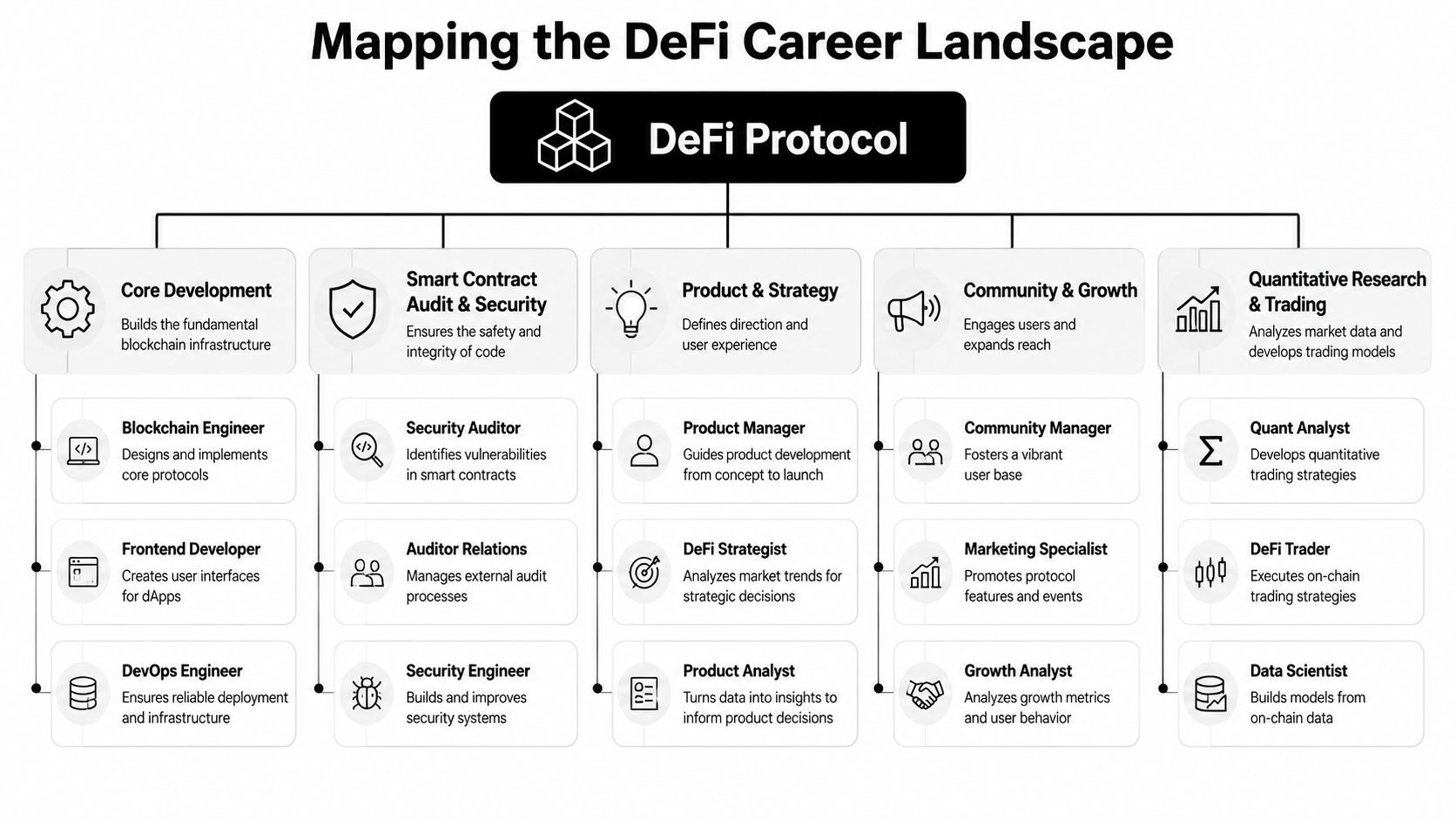
A good way to orient yourself is to study active ecosystems and role patterns across top DeFi projects hiring in the market. You'll notice that titles vary, but the core work clusters into a few repeatable verticals.
Smart contract engineering
This team writes the money-moving logic. That includes lending markets, AMMs, vaults, liquidation mechanics, oracle integrations, and upgrade patterns.
What hiring managers screen for isn't just Solidity familiarity. They want engineers who understand state changes, attack surfaces, gas trade-offs, and protocol invariants. If your résumé says “built dApps,” expect follow-up questions on reentrancy, access control, oracle assumptions, and how your contracts behave under stress.
The mission is simple. Ship code that holds up when capital hits it.
Protocol security
Security isn't a cleanup crew. It's a design function.
These hires review smart contracts, model exploit paths, validate assumptions, and pressure-test economic behavior. In stronger teams, security also includes incident response playbooks, bug bounty coordination, and review of governance actions that could introduce risk.
A weak candidate talks about “finding bugs.” A strong candidate explains how they define critical assets, prioritize review scope, and assess blast radius if an assumption fails.
The security interview usually turns when the candidate stops reciting vulnerabilities and starts reasoning about treasury protection.
Product and UX
Product managers and designers in DeFi do more than ship interfaces. They turn complex financial logic into flows users can trust enough to use.
That means thinking about wallet connection friction, approval flows, risk disclosures, slippage comprehension, staking mechanics, and governance participation. Product leaders also spend time reconciling what users want with what the protocol can safely support.
Hiring teams look for judgment here. Can you simplify a borrow flow without hiding important risk? Can you reduce user error without pretending the product is safer than it is?
Quantitative finance and tokenomics
This vertical sits closest to incentives, market design, and capital efficiency. Depending on the protocol, that can mean emissions design, liquidity incentives, collateral parameters, pricing models, treasury strategy, or market research.
The key screen is whether you can connect theory to mechanism design. A candidate who only speaks in valuation buzzwords usually struggles. The candidate who can explain why a parameter change alters borrower behavior or liquidity depth gets taken seriously.
Here's a simple view of how the six main verticals differ in hiring focus:
| Vertical | Core mission | What gets screened hard |
|---|---|---|
| Smart Contract Engineering | Build protocol logic safely | Solidity depth, architecture, testing discipline |
| Protocol Security | Protect assets and assumptions | Threat modeling, exploit reasoning, audit mindset |
| Product and UX | Make complex finance usable | Risk communication, user flows, prioritization |
| Quant and Tokenomics | Design incentives and parameters | Market logic, modeling, behavioral understanding |
| Legal and Compliance | Reduce regulatory and operational exposure | Controls thinking, policy judgment, documentation |
| Growth and Community | Acquire and retain credible users | Clear communication, ecosystem fluency, trust building |
Legal and compliance
This is one of the most misunderstood paths in defi solutions careers. People assume compliance is a blocker role. In reality, good compliance hires help teams ship responsibly in environments where legal certainty is uneven and counterparties may be pseudonymous.
Strong candidates can interpret AML and CFT requirements, identify where controls break in decentralized settings, and work with product and engineering instead of throwing problems over the wall. They know that “decentralized” doesn't remove obligations. It usually changes where the operational burden sits.
Growth and community
Community isn't just social posting. In DeFi, it often includes governance comms, user education, partner coordination, Discord or Telegram moderation, campaign execution, and reputation management during incidents.
The best growth hires know how to create signal. They can explain protocol changes clearly, handle hard questions in public, and avoid overpromising. Hiring managers watch for credibility. If you sound like a generic crypto promoter, you won't last long.
Building the Hybrid Skillset That Gets You Hired
The biggest gap in DeFi hiring is not motivation. It's cross-functional competence.
A risk analysis study on DeFi protocol development found that 60-70% of DeFi developers come from non-financial backgrounds, which creates a meaningful capability gap. The same study points candidates toward three practical priorities: foundational financial services compliance training, smart contract security auditing certifications, and understanding composability risks. That tracks with what hiring teams already see. Developers who lack financial judgment build fragile products. Finance professionals who can't reason through contract logic struggle to influence product decisions.

If you come from engineering
Your edge is execution. Your gap is often financial context.
I've seen talented developers ace implementation details and then miss the business logic entirely. They can optimize a function but can't explain what happens to solvency if collateral quality deteriorates, or how incentive design can attract mercenary liquidity that disappears under stress.
Build financial fluency in layers:
Start with market structure
Learn how lending, collateral, liquidation, market making, and derivatives work in traditional settings before mapping them to on-chain variants.Move into protocol-specific risk
Study oracle dependency, collateral correlation, bad debt, liquidation cascades, and governance attack paths.Add compliance basics
You do not need to become a lawyer. You do need enough AML/CFT awareness to understand why product decisions create downstream obligations.Practice mechanism explanation
Take one live protocol and write a brief memo explaining how value enters, moves, and exits the system, plus where the top failure points sit.
A strong engineer in DeFi can explain both the code and the capital path.
If you come from finance or compliance
Your edge is judgment around risk, controls, and incentives. Your gap is usually technical fluency.
That doesn't mean you need to become a full-time developer. It means you need enough comfort with blockchain architecture and smart contract behavior to ask better questions. If you can't read a simple contract, decode a transaction at a high level, or understand how protocols compose, you'll stay dependent on others for basic interpretation.
Use this progression:
Learn chain fundamentals
Understand wallets, transactions, gas, token standards, multisigs, and oracles.Read before you write
Start reading Solidity contracts line by line. You're not trying to author elegant code yet. You're trying to understand permissions, flows, and assumptions.Study composability as a risk source
In DeFi, products don't live in isolation. One dependency can change your protocol's risk overnight.Translate controls into code-aware questions
Ask how upgrades are governed, who controls pause functions, what assumptions depend on off-chain actors, and how incidents get handled.
Candidates break through when they can translate their home discipline into the language of protocol risk.
What works and what doesn't
Here's the hiring reality.
What works
- Shipping a small project that demonstrates both technical and financial reasoning
- Writing concise research notes on protocol mechanics
- Completing security-oriented learning that shows seriousness
- Explaining trade-offs clearly in interviews, especially where usability and safety conflict
What doesn't
- Listing “passion for crypto” without artifacts
- Treating tokenomics as branding
- Assuming traditional finance experience automatically transfers
- Memorizing exploit names without understanding root causes
The hybrid candidate signal
The best résumés in defi solutions careers rarely look perfect on paper. They look connected.
A backend engineer may show a lending simulation, a protocol write-up, and a basic audit report. A compliance analyst may show an AML risk memo for a pseudonymous system and enough technical fluency to discuss smart contract permissions intelligently. A product manager may present a redesigned staking flow that improves clarity around lockups, approvals, and exit conditions.
That's the signal. Not “I've done everything.” More like, “I can bridge rooms that usually miscommunicate.”
Crafting Your Proof-of-Work Portfolio and Resume
DeFi hiring still rewards credentials less than evidence. If I'm screening candidates, I care far more about what you've built, audited, modeled, researched, or explained than how polished your summary statement sounds.
Build artifacts, not just bullet points
A useful portfolio has a few compact pieces of work that show judgment.
One good project is a yield dashboard that pulls on-chain data and explains what the displayed returns depend on. Another is a forked frontend for a lending or swap interface where you've improved transaction clarity, approvals, or risk messaging. If you're more finance-oriented, build a tokenomics model in a spreadsheet that shows emissions scenarios, treasury implications, and user behavior assumptions.
None of these need to be large. They do need to be finished.
Good proof-of-work examples
Use a mix of technical and analytical artifacts:
- Smart contract sample: A small contract system with tests, comments, and a short note on threat assumptions.
- Security review memo: Pick a public contract and document potential risks, even if they're low severity.
- Product teardown: Record a walkthrough of a DeFi app and point out where users can make expensive mistakes.
- Governance contribution: Write a forum post responding to a proposal with operational or economic analysis.
- Compliance mapping: Draft how AML/CFT concerns could surface in a decentralized user flow and where controls become difficult.
The common trait is proof that you can think in context.
Make the portfolio easy to scan
A lot of candidates hide good work inside cluttered Notion pages, overdesigned websites, or GitHub repos with no explanation. That's a mistake. Recruiters and hiring managers scan quickly. Your strongest work should be visible in minutes.
If you need help tightening the presentation layer, these dynamic design tips for online portfolios are useful because they focus on clarity, structure, and navigation rather than decoration.
Your portfolio should answer three questions fast. What did you make, why did it matter, and how did you think through the trade-offs?
Resume framing that gets interviews
For DeFi roles, rewrite experience in terms of systems, risk, incentives, and outcomes.
Instead of saying you “managed product launches,” say you defined approval flows, reduced user confusion in transaction steps, or coordinated engineering and compliance on high-risk releases. Instead of saying you “worked in financial operations,” highlight control design, reconciliation, exception handling, and fraud or risk exposure.
A clean way to structure your résumé is:
- Headline aligned to the role: Smart contract engineer, protocol product manager, compliance analyst, growth lead
- Selected proof-of-work: Two or three linked projects
- Core stack or domain tools: Solidity, Foundry, Hardhat, Dune, SQL, Figma, governance forums, risk analysis
- Experience bullets rewritten for DeFi relevance: Focus on mechanisms, decisions, and risk ownership
If a recruiter has to infer your fit, you've already made the process harder than it needs to be.
Navigating the DeFi Job Hunt and Interview Process
Most candidates spend too much time applying and not enough time vetting. That's backwards.
The DeFi market includes serious teams, underprepared teams, and teams that market themselves well but operate loosely. Your job search should filter for signal before you invest in a long process. A good starting point is to understand how crypto hiring differs from conventional recruiting, especially around process speed, portfolio expectations, and role ambiguity. This overview of what a job in crypto really involves is a useful orientation if you're still calibrating the market.

How to vet an opportunity before interviews
Start with public artifacts. Read docs, governance posts, security disclosures, and product releases. If a team has no clear writing, no visible decision history, and no coherent explanation of risk, that usually shows up internally too.
A separate issue is transparency. SEC Commissioner Caroline Crenshaw argued that DeFi investing can operate with less transparency than traditional finance, and that this can create uneven outcomes between professional insiders and retail participants in the SEC speech on DeFi risks and investor protection. For candidates, the lesson is practical. You need to ask how the company handles disclosure, controls, governance, and user protection when external guardrails are thinner.
Ask direct questions:
- How are incidents disclosed to users and counterparties?
- Who can pause contracts or push upgrades?
- How does the team evaluate new integrations?
- What documentation exists for compliance and risk review?
- How are governance disputes handled when key stakeholders disagree?
Remote culture claims need testing
This matters in both fintech and crypto-facing roles. Public job posts often promise flexibility but tell you little about the actual operating model.
That gap shows up even in traditional fintech contexts. FlexJobs notes remote-friendly positioning and benefits for defi SOLUTIONS, but available information also leaves open questions about lived experience, workload, and remote realities in functions like collections and cash management, according to the FlexJobs company page for defi SOLUTIONS. The point isn't to single out one employer. It's to remember that career pages are marketing documents.
So ask:
- What does a normal workday look like across time zones?
- Are meetings concentrated in one region's hours?
- Is remote work async-friendly or meeting-heavy?
- How does the team handle urgent incidents after hours?
- What does performance management look like for remote staff?
If the answers are fuzzy, assume the operating model is still fuzzy.
Prepare for DeFi-specific interviews
A lot of candidates prepare for generic behavioral interviews and then get knocked out by domain exercises.
Common formats include:
- Contract review sessions: You'll be asked to spot vulnerabilities, bad assumptions, or upgrade risks.
- Product case studies: You may need to redesign a staking, borrowing, or governance flow while balancing UX and risk.
- Tokenomics discussions: Expect trade-off questions around incentives, lockups, treasury use, or liquidity behavior.
- Crisis handling prompts: Teams may ask how you'd communicate during an exploit, governance conflict, or major outage.
For structure and rehearsal, these Secta Labs' professional interview preparation strategies are a solid supplement, especially if you need a better system for story-building and mock practice.
Don't answer DeFi interview questions like a spectator. Answer like someone who'd have to own the consequences after launch.
Understanding DeFi Salaries and Career Progression
You get an offer from a DeFi team with a base salary below your fintech package, plus tokens that could be worth a lot or very little by the time they vest. That is a common fork in the road. Strong candidates do not compare headline numbers. They compare risk, cash flow, liquidity, and how fast the role can expand their scope.
That matters because compensation in DeFi is rarely clean. A traditional employer usually pays you in salary, bonus, and maybe equity. A DeFi employer might split value across base pay, tokens, vesting schedules, and upside that depends on treasury discipline, token design, and actual market demand. If you come from banking, SaaS, or enterprise tech, this is the gap to close fast. I see good candidates misprice token packages all the time because they understand code or operations, but not dilution, lockups, or liquidity risk.
How to read a DeFi package
Review offers across four parts:
- Base salary: Your dependable cash compensation.
- Equity: More common when the company has a standard startup structure behind the protocol or product.
- Token allocation: Real upside in some cases, dead weight in others.
- Vesting and liquidity terms: The terms that decide whether the upside is usable or just theoretical.
A bigger token grant is not automatically a better offer. Ask when tokens vest, whether there is a cliff, where liquidity is expected to come from, what rights the token carries, and how previous grants have been handled. If the team cannot explain those points clearly, treat the package as higher risk.
Promotion works the same way. DeFi teams pay more for judgment under uncertainty than for polished titles. An engineer gets paid more by owning architecture, security review standards, and incident response quality. A product manager gets paid more by understanding market structure, incentive design, and user behavior, not just shipping tickets. A legal, finance, or compliance hire gets paid more when they help the team ship faster without creating hidden regulatory or treasury problems.
Candidates from traditional finance and tech can separate themselves here. Developers who can read a balance sheet, question a yield model, or spot treasury risk move up faster. Finance candidates who can follow smart contract logic, governance processes, and protocol incentives become much more valuable than pure spreadsheet operators.
If you want a directional benchmark for roles that can reach stronger compensation levels, review these crypto and adjacent jobs that make 150K a year. Use it to frame your target range, then adjust for token risk, seniority, and how close the role is to revenue, protocol security, or capital allocation.
The people who get promoted fastest reduce expensive mistakes and increase output the team can trust. In DeFi, that combination gets noticed early and paid for quickly.