Definition of Jobs: Computing & Web3 Careers 2026

You're probably here because the word job stopped feeling simple.
A software engineer searches for blockchain roles and sees three different meanings at once. Labor statistics talk about employment. DevOps teams talk about cron jobs and batch jobs. Web3 companies post for smart contract engineers, protocol developers, compliance leads, and security auditors, all under the broad label of “jobs.” That mix can slow down a real career decision. It can also lead recruiters to write vague descriptions that attract the wrong candidates.
The definition of jobs matters more than it sounds. If you're interviewing, it shapes how you describe your experience. If you're hiring, it shapes how you scope a role, what skills you test, and who applies. In computing and Web3, a fuzzy definition usually leads to a fuzzy match.
Framing Job Definitions Across Contexts
A common scenario goes like this. Someone has a solid background in backend engineering, maybe with experience in Python, TypeScript, Kubernetes, or cloud infrastructure. They start exploring blockchain because they've built curiosity around smart contracts, on-chain systems, or DeFi products. Then the search results get messy fast.
One page defines jobs in the labor market sense. Another uses “job” to mean a scheduled computing task. A third talks about blockchain jobs as if every role were just “Solidity developer.” None of those uses are wrong. They're just operating at different layers.
That's where people get tripped up in interviews. A candidate says, “I've worked on production jobs,” meaning scheduled data pipelines. A recruiter hears “professional roles.” Or a hiring manager says, “We need a blockchain developer,” when the team needs a protocol engineer, not a dApp builder. Small wording errors create big mismatches.
The practical fix is to separate the term into three buckets:
- Employment jobs describe paid human work.
- Computing jobs describe tasks executed by systems.
- Web3 jobs describe specialized roles built around protocols, applications, security, operations, and compliance.
Precision helps twice. It helps candidates target the right openings, and it helps employers test for the right skills.
Once you see those buckets clearly, the rest of the market becomes easier to read.
Understanding the Core Concept of Jobs
At the broadest level, a job means work performed for pay or profit. In labor statistics, that idea is more precise than commonly understood.
The foundational ILO definition considers a person “employed” if they perform work for pay or profit for at least one hour during a reference period, known as the “one-hour rule,” which remains the global benchmark for labor data collection, as summarized in Eurostat's explanation of international labour standards.
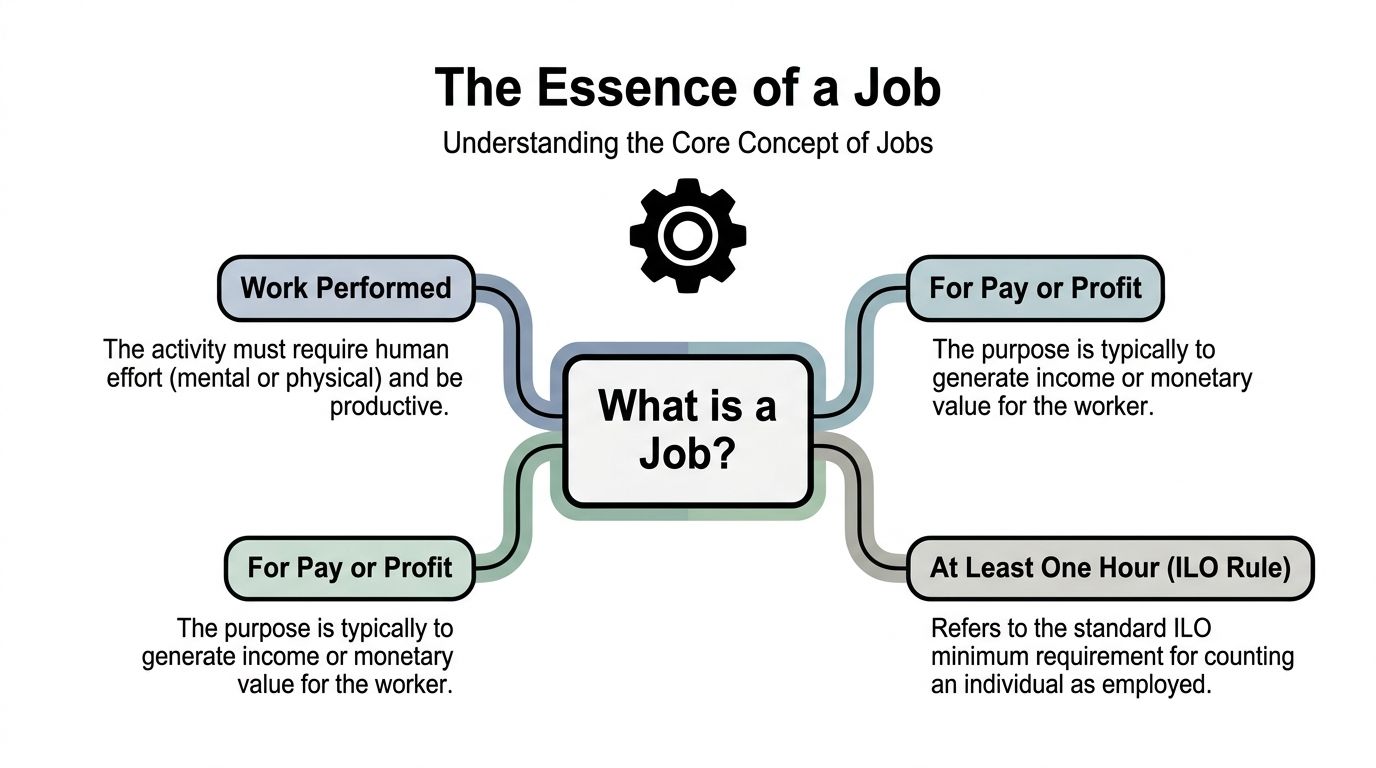
That sounds almost too simple, but it's important. The rule exists so statistical agencies can classify people consistently. If someone did paid work during the reference period, they count as employed. If they didn't, and they're actively seeking work and available to start soon, they may count as unemployed. If they're not looking or not available, they're outside the labor force.
Human jobs versus system jobs
In computing, the word job usually means something else. It can mean a scheduled task, a queue item, a build pipeline, or a batch process. A cron job that runs nightly backups is a job. A CI task in GitHub Actions is a job. A Spark batch run is a job.
The easiest analogy is this:
| Context | What “job” means | Example |
|---|---|---|
| Labor market | Paid human work | A security auditor employed by a crypto company |
| Computing | A unit of system work | A nightly ETL pipeline |
| Web3 hiring | A specialized role in a blockchain org | A smart contract engineer or compliance lead |
People often blur these meanings because both involve tasks, tools, and outcomes. But they operate at different levels. A person may hold a job as a data engineer while also managing many automated jobs in Airflow or Kubernetes.
Why this matters in hiring
This distinction becomes useful the moment you update your resume or prepare for an interview.
If you say, “I optimized jobs,” specify whether you mean:
- you redesigned a human role,
- you improved workload planning, or
- you sped up automated system tasks.
That extra precision changes the impression you make. It's one reason a strong role description should preview the actual day-to-day work before anyone reaches the interview stage. A useful reference is WorkSignal's RJP guide, which explains why realistic job previews help candidates and employers align earlier.
Practical rule: When you use the word “job,” attach the layer. Say “employment role,” “scheduled compute job,” or “blockchain role.”
That one habit clears up a lot of confusion.
Exploring Key Aspects of Blockchain Jobs
Blockchain roles add another layer because they aren't just generic software jobs with a crypto label. The work is structurally different. The tooling is different. The risk profile is different. The interview process should be different too.
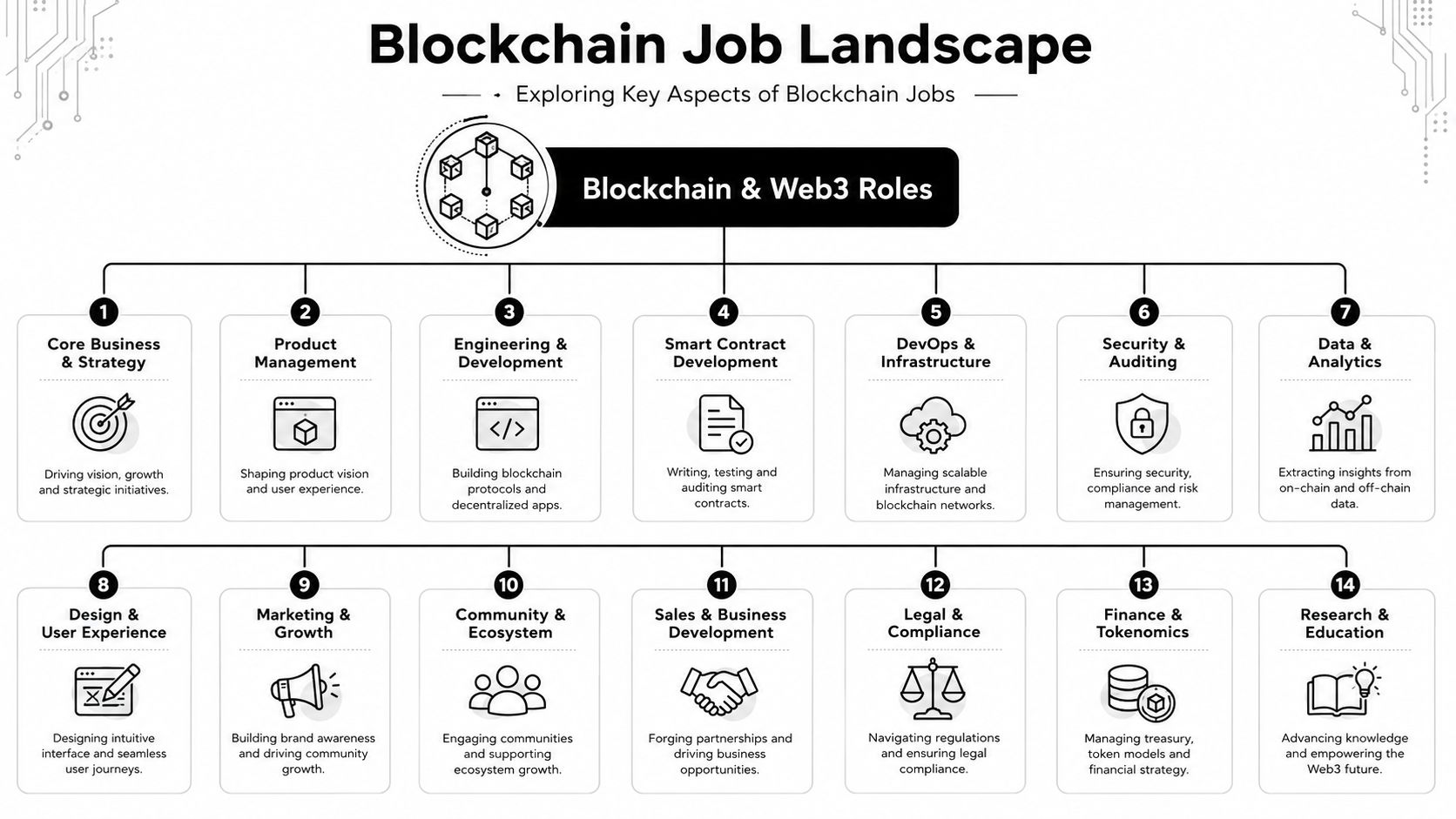
Empirical analysis of advertised roles grouped blockchain work into 14 distinct job families, and the field split sharply between core blockchain development and dApp development. That same analysis linked the category to 320% growth in U.S. postings and 5,743 full-time postings specifically for blockchain skills in the U.S., according to the CFTE Blockchain Job Report 2022.
Two technical tracks that people confuse
This is the split that causes the most hiring mistakes.
Core blockchain development deals with protocol-level systems. Think consensus mechanisms, ledger architecture, node behavior, networking, and cryptographic primitives. The work can involve changing how the chain itself operates.
dApp development sits above the protocol. It focuses on applications built on existing chains. That usually means smart contracts, wallet interaction, front-end integration, indexing, and user workflows.
A recruiter may post “blockchain engineer” and expect both. That's usually too broad.
Here's a clearer comparison:
| Track | Main focus | Common skills |
|---|---|---|
| Core blockchain development | Protocol logic, consensus, ledger systems | Rust, systems programming, cryptography, node architecture |
| dApp development | Applications on existing chains | Solidity, web stacks, wallet integration, contract deployment |
If you're interviewing, ask which side the role sits on. If the answer is vague, the team may not have scoped the role properly.
What the work actually looks like
The term blockchain developer also has a more specific technical meaning than many job ads suggest. The role centers on distributed ledger architecture, consensus mechanism implementation, cryptographic enforcement, smart contract development, node management, system integration, and tools such as Ganache, Remix, and Truffle, as outlined in the GSDC overview of blockchain developer skills.
That affects daily work. In Web3, developers often spend a lot of time testing and reviewing because deployed code can be difficult or impossible to reverse safely. Security and auditability aren't side concerns. They're core job requirements.
A typical blockchain team may include:
- Protocol engineers who work on chain internals, clients, and performance.
- Smart contract engineers who write and test on-chain business logic.
- Security auditors who review contracts, permissions, and attack surfaces.
- Product managers who define user and protocol requirements.
- Risk and compliance specialists who handle controls, policy, and legal exposure.
- DevOps and infrastructure engineers who run nodes, observability, and deployment systems.
For candidates interested in defensive work, browsing security roles in Web3 helps clarify how broad security hiring has become.
A short explainer helps anchor the field:
How decentralized teams change the role
Web3 work is often remote-friendly, but remote doesn't mean informal. Teams still need clear ownership, handoff practices, and decision rules. In decentralized settings, written communication matters more because teams coordinate across time zones, wallets, repositories, and governance processes.
That changes interviews too. Candidates who can explain a protocol choice in writing, reason through incident response, or document assumptions usually stand out. The strongest applicants don't just say they “know blockchain.” They can point to one stack, one chain family, one toolset, and one kind of problem they solve well.
The best blockchain resumes read narrower, not broader. Specificity signals credibility.
Common Job Categories and Examples
The blockchain labor market is broad, but it doesn't reward vague positioning. Candidates get more traction when they sort themselves into a category first, then tailor their story to that lane.
One useful signal is that technical positions make up more than 50% of crypto jobs, with AI × Crypto, RWA, and security auditing identified as top-paying areas in the Gate Research 2025 crypto employment market report. That doesn't mean non-technical roles don't matter. It means technical depth still anchors much of the market.
Blockchain Job Categories Overview
| Job Family | Typical Titles | Mode (Remote vs On-Chain) |
|---|---|---|
| Engineering | Smart Contract Engineer, Protocol Engineer, Backend Engineer | Mostly remote, sometimes on-call for chain operations |
| Security | Smart Contract Auditor, Security Engineer, AppSec Lead | Remote-friendly, often high-stakes review cycles |
| Product | Product Manager, Tokenisation Product Manager, Technical PM | Mostly remote, cross-functional |
| Compliance and Legal | Compliance Analyst, On-Chain Compliance Specialist, Counsel | Remote or hybrid, policy-heavy |
| Infrastructure | Node Operator, DevOps Engineer, Site Reliability Engineer | Remote, with operational responsibility |
| Research | Protocol Researcher, Tokenomics Researcher | Remote, writing-intensive |
| Data | Blockchain Data Analyst, On-Chain Analyst | Remote, tooling-heavy |
| Design | Product Designer, UX Designer for wallets or DeFi apps | Remote, user-testing driven |
| Operations | Ecosystem Operations, Governance Operations | Remote, coordination-focused |
| Community and Marketing | Community Manager, Content Lead, Growth Marketer | Remote, always communication-heavy |
The labels matter because they hint at interview style. Engineering interviews may include Solidity, Rust, distributed systems, or security reasoning. Product interviews often test prioritization, protocol understanding, and tradeoff thinking. Compliance interviews usually focus on policy interpretation, workflows, and risk judgment.
How to choose the right category
A simple filter helps:
- If you build systems, start with engineering or infrastructure.
- If you review failure paths, security may fit better than product engineering.
- If you translate regulation into process, compliance can be a stronger lane than legal generalism.
- If you connect user needs to protocol behavior, product may be the right bridge role.
For candidates searching active openings, blockchain engineering jobs are a useful way to compare titles and see how employers describe adjacent roles.
Interview lens: Don't apply as “open to anything in crypto.” Apply as someone who solves one class of problems well.
That framing helps recruiters understand where you belong and makes your progression easier to plan.
Mapping Career Paths in Web3
Career growth in Web3 is less linear than in older industries, but the paths still have structure. The biggest mistake candidates make is trying to jump straight into “senior blockchain” branding without showing stack-specific depth.
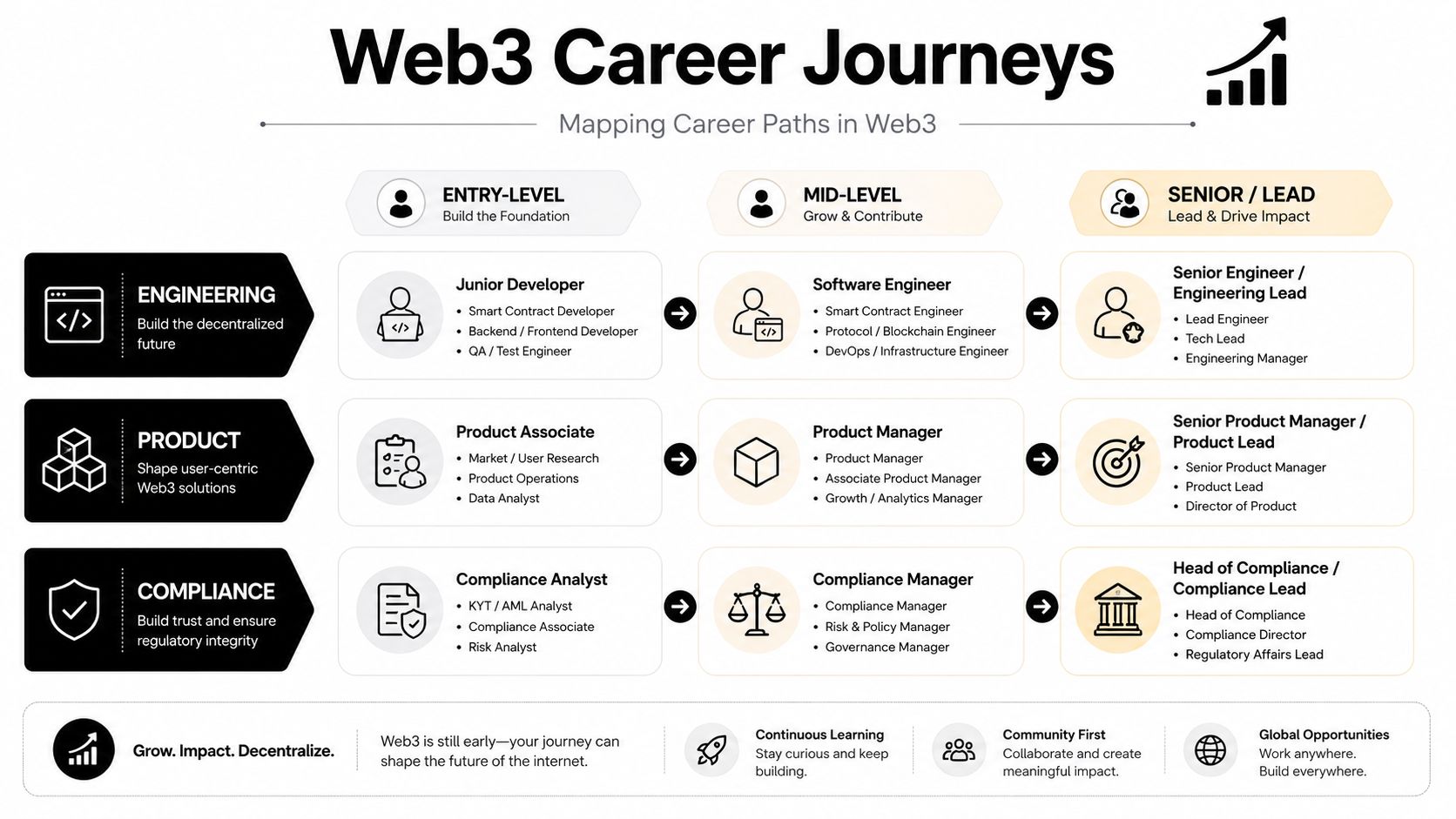
In engineering, the path often starts with application work. Someone may begin with smart contract integration, testing, wallet flows, or backend services around an existing chain. Mid-level growth usually comes from owning deployments, debugging production incidents, and making architectural decisions. Senior progression depends on judgment. Not just code output, but security review, design tradeoffs, and system reliability.
Engineering, product, and compliance paths
Here's a simple roadmap:
| Domain | Entry-level focus | Mid-level focus | Senior or lead focus |
|---|---|---|---|
| Engineering | Contracts, integrations, testing | Ownership of services and deployments | Architecture, security judgment, protocol decisions |
| Product | Requirements, user flows, delivery support | Roadmapping, protocol-feature tradeoffs | Cross-functional strategy, ecosystem alignment |
| Compliance | Research, monitoring, documentation | Controls, workflow design, risk coordination | Policy leadership, regulatory interpretation, operating model |
Salary is one reason these paths attract attention. In the U.S., blockchain developers earn between $120,000 and $250,000+ annually, with entry-level roles starting around $121,000 and senior professionals with over 5 years of expertise earning up to $187,000, according to CryptoCareers on blockchain compensation in 2025.
What selective hiring means for candidates
Market growth doesn't automatically make hiring easier. Some reports describe stronger demand alongside more selective screening. In practice, that means broad enthusiasm won't carry you far. Employers want evidence.
Strong signals include:
- A narrow portfolio with audited contracts, protocol contributions, or incident writeups.
- Tool fluency in the stack you claim. Solidity and Foundry, or Rust and protocol tooling, or node operations and observability.
- Decision-making evidence such as postmortems, architecture notes, or governance proposals.
- Domain familiarity in areas like AI × Crypto, RWA, compliance operations, or security review.
Hiring managers rarely ask, “Do you like Web3?” They ask, “What kind of Web3 work can you do safely and well?”
That's why career progression in this field is really progression in trusted scope. The more risk a company can trust you to handle, the more senior your role becomes.
Actionable Next Steps for Job Seekers and Recruiters
If you're job hunting, tighten your language first. Replace “blockchain experience” with the exact work you've done: protocol research, smart contract testing, wallet integration, node operations, audit support, or compliance workflow design. Then match your resume to one job family. A focused application usually performs better than a broad one.
Use interview prep that mirrors the actual role. For engineering, that may mean contract testing, secure coding review, or explaining architecture choices. For product, prepare to discuss tradeoffs between user experience and on-chain constraints. For compliance, be ready to turn policy into process.
Recruiters should do the same kind of tightening. State whether the role is protocol-level or application-level. Name the stack. Name the seniority. Say whether the person will own reviews, deployments, architecture, or documentation. Vague posts attract volume. Clear posts attract fit.
For ongoing market context and hiring guidance, the Blockchain Jobs blog is a practical place to track how roles are described across the ecosystem.
Conclusion
The definition of jobs changes with context. In labor statistics, it means paid human work. In computing, it means a unit of system work. In Web3, it means a specialized role shaped by protocol design, application layers, infrastructure, security, and compliance.
That distinction isn't academic. It affects hiring, interviews, resumes, role design, and career progression. When you define the job clearly, you can prepare for it clearly. And when teams scope roles accurately, they hire better.
If you're ready to turn that clarity into action, explore Blockchain Jobs to find focused Web3 roles across engineering, security, product, compliance, and more, or to post a role that speaks clearly to the candidates you want to reach.