Your Guide to Landing High-Paying Digital Asset Jobs

Jumping into the world of digital asset jobs can feel like you're learning a whole new language. But here's the thing: it's also one of the most explosive career sectors out there today. These jobs are all about working with assets that only exist digitally—think cryptocurrencies and NFTs—for companies building the future of finance and the internet.
If you come from a more traditional background, this is a rare chance to get in on the ground floor of a truly innovative industry. Your goal is to position your existing skills as the solution to their biggest challenges.
Your Entry Point Into Digital Asset Jobs
When companies in this space hire, they’re not just looking for coders. They desperately need sharp marketers, organized project managers, savvy legal minds, and detail-oriented operations pros who get the big picture. The key to getting hired is showing how your experience can help them grow, stay compliant, or operate more efficiently.
Think of a digital asset like a digital version of a house deed or a stock certificate. Instead of being a piece of paper in a filing cabinet, its ownership is secured by powerful cryptography on a blockchain. It's a fundamental shift in how we prove ownership.
This one simple idea opens up a massive world of opportunity. You've got everything from Bitcoin, the original decentralized currency, to Non-Fungible Tokens (NFTs) that represent ownership of digital art. The field is constantly growing. A job here could mean you're helping a company manage its crypto holdings, marketing a new decentralized finance (DeFi) app, or making sure a digital collectible launch follows all the rules.
Why the Hiring Boom Is Happening Now
The surge in demand for talent isn't just a fleeting trend. It’s tied directly to serious market growth and mainstream adoption. As more big companies and everyday consumers start using blockchain technology, the need for skilled people to build and run these systems has skyrocketed. We're well past the early-stage startup phase; major banks and global brands are now building out their own digital asset teams, creating stable, high-impact career paths.
The real draw of a career in digital assets is the chance to solve problems that no one has ever tackled before. In an interview, frame your motivation around this: you're not just taking a job; you're helping build an entirely new economic and technological system.
The job market has shown incredible resilience and growth. Industry reports show that Web3 and crypto companies added around 66,000 new roles in 2025, which marks a 47% year-over-year rebound from 2024. Even better, global crypto salaries also jumped by about 18% year-over-year in 2025, proving just how much value companies place on top talent. You can read the full research about these employment market trends to see the full scale of the opportunity.
It's Not Just About Technical Skills
While blockchain developers are definitely hot commodities, the industry has grown up and now needs a much wider set of skills. Companies are hunting for people who can connect this new technology to the traditional business world.
This opens doors for professionals from almost any background. To get a feel for what’s out there, you can check out our regularly updated job blog. The secret to landing one of these digital asset jobs is showing you have a genuine curiosity and a drive to learn the unique ins and outs of the industry. Your ability to learn quickly is often more valuable than your existing knowledge.
Mapping the Most In-Demand Web3 Roles
To find your footing in the digital asset world, you first need to understand the core roles that keep projects alive and kicking. Unlike traditional tech, Web3 jobs are often fluid and deeply interconnected. Still, most fall into a few key categories where companies are hiring aggressively. Figuring out where you fit starts with knowing what these functions are.
The chart below shows how digital assets are generally categorized—Crypto, NFTs, and DeFi. These are the main sectors where you'll find these job opportunities.
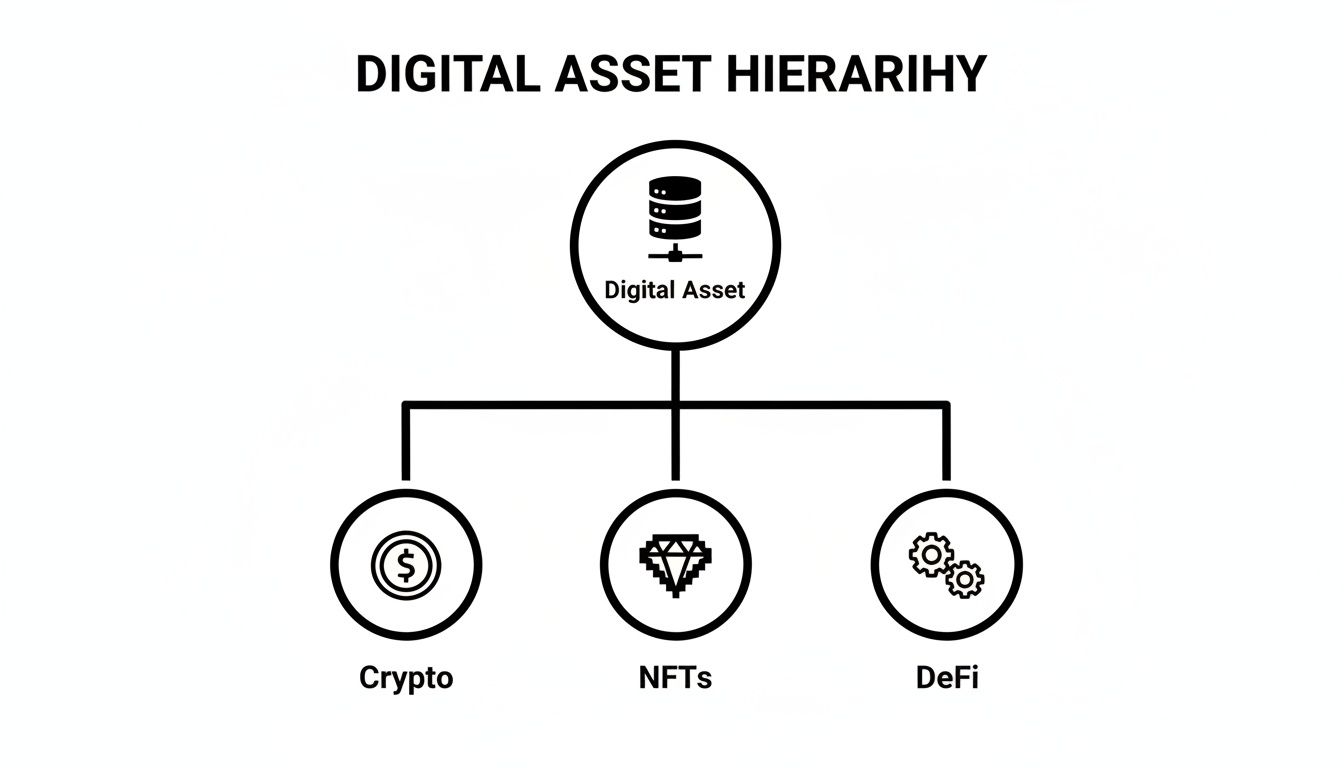
While the assets themselves are different, the kinds of jobs needed to build, secure, and grow them are remarkably similar across the board. The first step in your journey is deciding which of these areas sparks your interest the most.
Below is a breakdown of some of the most common roles you'll encounter, along with a look at what they do day-to-day.
Common Digital Asset Job Roles and Core Responsibilities
| Job Role | Primary Responsibilities | Key Skills to Showcase in Interviews |
|---|---|---|
| Blockchain Developer | Writing, testing, and deploying smart contracts and protocols. | Solidity, Rust, Go; Portfolio of projects, understanding of gas optimization. |
| Security Auditor | Analyzing smart contracts for vulnerabilities and security flaws. | Deep knowledge of exploits, attention to detail, adversarial mindset. |
| Product Manager | Defining product vision, strategy, and feature roadmaps. | Tokenomics, UX design for dApps, community feedback synthesis. |
| Community Manager | Engaging with and growing the project's user base on social platforms. | Crisis management, empathy, content strategy, Discord/Telegram moderation. |
| Marketing Lead | Developing and executing campaigns to drive user acquisition and adoption. | Performance marketing, SEO for Web3, narrative building, KOL partnerships. |
| Legal Counsel | Navigating the complex regulatory landscape of digital assets. | Securities law, IP, compliance (KYC/AML), international regulations. |
| Operations Manager | Overseeing day-to-day business functions like finance and HR. | Treasury management, process optimization, stakeholder communication. |
These roles represent the engine room of the digital asset industry. Whether you're a builder, a strategist, or a communicator, there's a place for your skills. Let's dig a little deeper into what these roles look like in practice.
The Builders: Engineering and Security
Engineering is the absolute foundation of any Web3 project. These are the people who actually build the protocols, smart contracts, and apps that we all use. Simply put, without them, there is no product.
Blockchain Developers are the architects of this new, decentralized world. They write the code that brings everything from layer-1 blockchains to complex DeFi applications to life. To make it here, you need to be skilled in languages like Solidity (the go-to for Ethereum) or Rust (popular for Solana and other modern chains). Interviews will be tough, testing your grasp of blockchain fundamentals, data structures, and security best practices.
Success in this role boils down to writing code that is efficient, gas-optimized, and, above all, secure. For a developer, a GitHub profile is more valuable than any resume. Hiring managers want to see your actual contributions to open-source projects or impressive personal builds.
Working hand-in-hand with them are the Security Auditors, who act as the guardians of the entire ecosystem. It's their job to hunt down vulnerabilities in smart contracts before bad actors can exploit them. This role is in constant, high demand because a single undiscovered flaw can cost a project millions of dollars overnight.
A great security auditor thinks like a hacker. During an interview, explain how you would try to break a system to make it stronger. This adversarial mindset is a high-stakes, high-reward skill.
To become an auditor, you need a profound understanding of how smart contracts work and all the clever ways they can be attacked. This career path often leads to senior security research positions or even starting your own auditing firm. To see what a real posting looks like, check out this example for a Smart Contract Auditor at leading companies.
The Strategists: Product and Growth
If engineers are focused on the "how," the product and growth teams are all about the "what" and "why." These roles are the bridge between the technology and the user, making sure that what's being built is actually useful, easy to use, and gets in front of the right people.
Web3 Product Managers are essential for steering a project's vision. They work at the crossroads of technology, business, and user experience, but with a uniquely Web3 spin. It’s not just about tracking engagement metrics; they also have to master tokenomics, decentralized governance, and community dynamics.
A typical day might involve:
- Gathering feedback from the community on platforms like Discord and X (formerly Twitter).
- Writing detailed specifications for new features for the engineering team.
- Analyzing on-chain data to understand user behavior and protocol health.
To get hired, you need to show you can think from the ground up and have a real empathy for the unique hurdles users face in a decentralized world.
On the other side of the coin, you have the growth professionals. Community Managers are the heart and soul of a project. They cultivate a vibrant, engaged, and supportive community, which is the lifeblood of any Web3 success story. This is so much more than just posting updates—it's about building real relationships and turning casual users into passionate advocates.
A DeFi Marketing Lead pushes this even further, concentrating on user acquisition and boosting the total value locked (TVL) in a protocol. They use a creative mix of content marketing, strategic partnerships, and community-powered campaigns. For these growth-focused digital asset jobs, hiring managers want to see proof that you get the Web3 user mindset and can create campaigns that connect with a crypto-native audience. Your portfolio should highlight tangible community growth metrics or marketing campaigns you've successfully led.
What It Takes: Skills and Salaries in the Digital Asset World

It’s one thing to understand the landscape of digital asset jobs, but what you really need to know is which skills get you hired—and paid well. The good news is that compensation in this industry often blows past traditional tech salaries. The catch? It demands a pretty unique mix of technical chops and less tangible, non-technical abilities.
To succeed in a Web3 interview, you have to prove you have both the hard skills and a genuine grasp of the decentralized ethos. It’s not just about what you can build; it’s about how you think about building an open, user-owned internet. For many hiring managers, that mindset is the real tie-breaker.
The High-Value Technical Skills
Technical expertise is still the foundation of the digital asset world. While a wide range of skills can get you in the door, a few specific ones consistently command the highest salaries and have recruiters constantly calling.
When you're prepping for a technical interview, your goal should be to show you can apply your knowledge, not just recite theory.
- Solidity and Smart Contract Development: This is the language of Ethereum, the biggest player in the space. If you want a role in on-chain development, knowing Solidity is pretty much non-negotiable. You’ll need to prove you can write secure code that doesn't waste money on gas fees.
- Rust for Modern Blockchains: As the language behind high-speed chains like Solana and Polkadot, Rust is in huge demand. Its focus on memory safety makes it perfect for building protocols that are both fast and secure.
- Cryptography and Security: Writing code is only half the battle. A deep understanding of cryptographic principles and how to spot vulnerabilities in smart contracts is critical. This is the domain of auditors and security engineers, who happen to be some of the highest-paid people in the industry.
The demand for these core skills is intense. Data shows that technical roles like developers and security specialists made up over 50% of all job openings in 2025. On top of that, overall salaries in the crypto sector jumped 18% year-over-year in 2025, with specialized technical skills earning an even bigger premium. You can dig deeper into these crypto hiring trends and opportunities to see the full picture.
The Critical Non-Technical Abilities
While developers build the products, it’s the non-technical pros who make sure they actually succeed. These skills bridge the gap between complex technology and the community, making them essential for anyone in growth, strategy, or operations. Don't sleep on their importance.
Hiring managers for product or marketing roles are looking for people who can explain complicated ideas in simple terms and build real connections with users. These soft skills are incredibly valuable because they're so hard to teach.
A project can have the best code in the world, but without strong community governance and clear communication, it will fail to gain traction. When interviewing, emphasize your ability to be the bridge between technical teams and the user community.
Here are the non-technical skills that will make you stand out:
- Tokenomics and Economic Design: Knowing how to design a token model that encourages people to participate, keeps the network secure, and creates lasting value is a rare and highly sought-after skill.
- Decentralized Governance: In a world of DAOs, understanding how to guide community decisions through proposals and voting is a must-have for anyone in protocol management.
- Community Building and Management: The ability to grow an active, positive community on platforms like Discord and X is the lifeblood of any Web3 project.
Understanding Web3 Compensation Packages
One of the most unique things about working in digital assets is the way you get paid. A competitive base salary is usually part of the deal, but the real upside often comes from other components you won't find in a traditional job offer.
It helps to think of your total compensation as a portfolio. Your base salary provides stability, while token grants offer high-growth potential tied directly to the project you're helping build. It's a powerful way to align everyone's incentives.
A typical offer usually breaks down like this:
- Base Salary: Paid in regular currency (like USD or EUR), this is the stable, predictable part of your income.
- Token Grants or Options: This is often a large chunk of the project's native token that you gain access to over several years (known as "vesting"). It gives you a direct stake in the network's future.
- Performance Bonuses: These can be paid in fiat, stablecoins, or project tokens and are usually tied to hitting specific goals.
When you get an offer, don't just fixate on the base salary. Look closely at the vesting schedule for the tokens, the project's long-term vision, and the health of its treasury. A slightly lower base salary at a project with a strong token could end up being far more valuable down the road.
How to Find and Land Top Digital Asset Jobs

Knowing the roles and skills is one thing, but actually navigating the job hunt is a whole different ballgame. The old-school approach of just spraying your resume across massive job boards rarely works in the Web3 space. To land one of the top digital asset jobs, you need a focused strategy.
Hiring managers in this world want to see more than a list of past jobs; they want proof of your passion for the ecosystem. Your entire job search should be built around demonstrating that you're genuinely committed to the decentralized world, not just chasing a trend.
Where to Find the Best Opportunities
Forget endlessly scrolling through irrelevant listings on huge, generic sites. The best digital asset roles are almost always hiding in plain sight within niche communities and on specialized platforms where recruiters are actively hunting for crypto-native talent.
Think of these places as your high-signal channels for finding hidden gems.
- Niche Job Boards: Platforms dedicated entirely to Web3 are your absolute best bet. They cut through the noise and connect you directly with companies that live and breathe this stuff. To get started, you can explore the latest roles on Blockchain Jobs right here: https://blockchain-jobs.com/
- Developer and Project Communities: Places like GitHub are more than just code repositories—they're living, breathing portfolios. Actively contributing to open-source Web3 projects is one of the most effective ways to get noticed by top engineering teams.
- DAO Contribution Platforms: Many Decentralized Autonomous Organizations (DAOs) offer paid bounties or part-time contributor roles. This is a fantastic way to get real-world experience, build your on-chain resume, and network directly with core team members who might be hiring for full-time positions down the line.
It also pays to know where the action is. While remote work is common, certain cities are magnets for talent and capital. The United States continued to be a major hub for full-time crypto jobs in 2025, with big clusters in New York, San Francisco, and Miami.
Globally, North America was home to roughly 38% of crypto professionals in 2025. At the same time, Asia's share climbed to about 32%, signaling a major acceleration in hiring. You can find more insights about the global crypto job market in 2025 to see where opportunities are heating up.
Crafting a Web3-Native Application
A standard resume often feels flat and doesn't capture the experience that truly matters to a Web3 hiring manager. You have to adapt your application to speak their language and highlight what they really care about.
Your goal is to build a portfolio that tells a story of genuine engagement.
Think of your application as a "proof-of-work" for your career. Instead of just listing past jobs, you need to provide tangible evidence of your skills, passion, and participation in the decentralized economy.
Here’s how to put together an application that will actually get noticed:
- Lead with Your Web3 Identity: Right at the top of your resume, next to your LinkedIn, include links to your GitHub profile, a personal portfolio site showcasing Web3 projects, and even your public wallet address (if you're comfortable and it shows relevant activity like DAO voting or NFT collecting).
- Highlight On-Chain and Community Activity: Create a dedicated section for "Web3 Contributions & Projects." This is where you list your open-source code contributions, participation in DAOs, articles you’ve written about a protocol, or even a Discord community you helped manage.
- Translate Your Traditional Skills: Reframe your past experience through a Web3 lens. Don't just say you "managed a marketing budget." Instead, describe how you "executed a user acquisition campaign that grew a user base by X%, measured through on-chain analytics."
- Show, Don't Just Tell: For developers, a link to a deployed smart contract or a dApp you built is infinitely more powerful than any bullet point. For marketers, a case study on a successful community-building initiative will make a huge impact.
By tailoring your application this way, you shift from being a passive applicant to an active participant in the ecosystem—and that's exactly the kind of person Web3 companies are dying to hire.
Mastering the Web3 Interview and Growing Your Career
So you’ve polished your resume, hunted down the right opportunities, and now you’ve landed the interview. This is your moment. It’s where you prove your passion and skills are more than just words on a page.
The hiring process for digital asset jobs is a different beast altogether. Think of it as a blend of a classic tech interview, a philosophical debate, and a genuine vibe check to see if you’re truly part of the decentralized world.
Success isn't about perfectly reciting technical definitions from a textbook. It's about showing you have a practical, deeply-held understanding of why this technology matters and how you can help push it forward.
Navigating the Web3 Interview Process
Unlike traditional interviews that might get hung up on past job titles, Web3 interviews really dig into your way of thinking and whether you fit the culture. Hiring managers are trying to figure out if you "get" the ethos of decentralization, user ownership, and radical transparency.
Expect a few stages. It usually starts with a screening call, followed by a technical or role-specific challenge, and wraps up with a culture-fit chat with the founders or core team. You need to be ready for questions that test both your hard skills and your personal take on the industry's future.
Here’s a taste of what you should be ready to tackle:
- Technical Deep Dives: For developers, this could mean whiteboarding smart contract logic or explaining how you’d defend against a known exploit. For non-tech roles, you might be asked to analyze the tokenomics of a popular project.
- Protocol and Ecosystem Knowledge: They're testing your curiosity. You might hear, "What’s your favorite DeFi protocol, and how would you make it better?" or "Explain the scaling challenges Ethereum is facing right now."
- Cultural and Philosophical Alignment: Questions like, "What does decentralization actually mean to you?" or "Tell me about a time you voted in a DAO and why," are very common. They want to see if your values line up with building an open, community-first ecosystem.
Your ability to articulate a clear, opinionated, and well-reasoned view on a complex topic like MEV (Maximal Extractable Value) or the future of DAO governance will set you apart far more than a perfect answer to a textbook question.
Charting Your Long-Term Career Growth
Landing your first digital asset job is just the start. The real adventure is building a long-term career in a field that reinvents itself every few months. Growth here isn’t always a straight line up a corporate ladder; it's about constantly learning new skills, contributing to projects that matter, and building a solid reputation.
The industry moves so fast that career paths are incredibly flexible, giving you the power to carve out your own unique trajectory.
From Contributor to Core Team Lead
Interestingly, many of the most respected careers in Web3 don't start with a formal job application at all—they begin with getting involved in a community. A common and highly-valued path is to go from a part-time DAO contributor to a core team lead.
- Start with Bounties: Dip your toes in by completing small, paid tasks (bounties) for a DAO. This is your chance to build a portfolio of on-chain work.
- Take on Contributor Roles: Once you've proven yourself, you can slide into a more consistent, part-time contributor role, maybe managing a specific workstream or project.
- Evolve into a Core Lead: As you build trust and show your value, you can be elected or appointed to a full-time leadership position, steering a key part of the protocol. This is a common path to senior roles.
The Technical Path from Developer to Architect
For the engineers in the room, career progression is all about expanding your scope and impact. You'll move from writing code that implements features to designing the fundamental architecture of entire protocols.
- Junior Developer: Your focus is on writing clean, secure, and efficient smart contract code, usually with guidance from more senior engineers.
- Senior Developer: You'll start owning major features, mentoring junior devs, and having a real say in architectural decisions.
- Protocol Architect: This is the top of the technical mountain. You're designing the core logic, tokenomics, and security models for new, incredibly complex decentralized systems. It demands a profound grasp of both blockchain mechanics and economic incentives.
Transitioning to DeFi Leadership
If you're coming from traditional finance (TradFi), you have a golden opportunity to become a leader in decentralized finance (DeFi). Your background in risk management, financial modeling, and market structure is pure gold here.
The trick is to pair that experience with a deep understanding of DeFi building blocks like liquidity pools, automated market makers (AMMs), and yield farming. By bridging these two worlds, you can step into roles like Head of DeFi Strategy, Head of Treasury Management, or Chief Risk Officer at a major protocol and genuinely shape the future of finance.
No matter where you start, a career in digital assets is a marathon of learning and active participation. Stay curious, build your network, and consistently show your value, and you'll be well on your way to building a meaningful career on the front lines of technology.
Got Questions About Digital Asset Jobs? We've Got Answers.
Jumping into a new field always brings up a ton of questions, and when that field is as fast-moving as digital assets, you want to get clear answers before making a move. Here, we'll tackle some of the most common things people ask when they're thinking about building a career in this space.
Think of this as your practical guide to managing expectations, understanding the culture, and planning your entry into the world of Web3.
How Can I Land a Job with No Direct Crypto Experience?
This is probably the number one question we hear, and the answer is encouraging: it’s entirely possible, especially if you're not a developer. You just need to be smart about how you connect your current skills to the needs of the Web3 world.
The trick is to prove you're not just a tourist. You need to show genuine curiosity and initiative. Start by finding roles that look a lot like what you already do—marketing, finance, legal, operations, you name it. Then, dive headfirst into the ecosystem. Follow the big names and news on X (formerly Twitter), join a few active Discord or Telegram communities, and get your hands dirty by trying out a DeFi app or setting up a digital wallet. Firsthand experience, even as a user, is invaluable.
When you update your resume, add a section called something like "Web3 Projects & Interests." This is where you can mention contributing to a DAO, managing a community server, or even just articles you've written. Frame your traditional skills, like project management or data analysis, in a Web3 context.
A hiring manager in this space would much rather see a resume that mentions you helped organize a DAO's documentation than one that only lists your corporate experience. It shows you're already part of the culture.
And don't forget to network. The Web3 world is built on communities. Show up to virtual meetups and start conversations. Those connections are often what turn a job application into a job offer.
Are Most Digital Asset Jobs Remote?
Absolutely. The vast majority of jobs in the digital asset world are either fully remote or offer a very flexible hybrid setup. The industry was practically built on the idea of decentralization, and that philosophy bleeds right into how companies operate. It’s a remote-first culture, through and through.
This approach lets companies hire the best person for the job, no matter where they live. It’s all about skills and culture fit, not your zip code. You'll find teams spread across every time zone imaginable. While some of the bigger, more established players might have physical offices in major hubs like New York or Singapore (especially if they're tied to traditional finance), it's far from the norm. Just look at any job board—you'll see "Remote" and "Remote (Global)" everywhere.
How Stable Are Careers in the Digital Asset Industry?
Let's be real: stability here doesn't look the same as it does in a traditional 9-to-5. The industry is famous for its boom-and-bust cycles. Periods of explosive hiring can be followed by downturns, often called "crypto winters," where companies pull back.
But here's the important part: even when the market is down, the work doesn't stop. People are still building the core technology and infrastructure. Your job stability often comes down to the kind of company you join. A well-funded project with a product people actually use and a healthy treasury is going to be a much safer bet during a downturn.
On top of that, if you have in-demand technical skills—like smart contract development or security auditing—you'll find that your expertise is always needed, bull or bear market.
To build a lasting career, you need to be strategic:
- Never stop learning. The tech changes fast, so you have to keep your skills fresh.
- Build your network. The people you know can be a lifeline during industry shifts.
- Choose projects wisely. Look for companies with a clear, long-term vision and a solid business model.
If you play your cards right, you can build a career that's not only resilient but incredibly rewarding.
Ready to find your place in the future of finance and technology? At Blockchain Jobs, we connect top talent with the best opportunities in the Web3 ecosystem. Explore thousands of curated roles in engineering, product, marketing, and more. Start your search today.