What Is Intellectual Property Protection and How Does It
Intellectual property protection is a portfolio of legal rights, including patents, trademarks, copyright, trade secrets, and related rights, that let creators and companies control how inventions, brands, and creative works are used, licensed, and defended. The framework became globally significant when TRIPS was adopted on April 15, 1994, entered into force on January 1, 1995, and established minimum IP standards across WTO members, which today include 164 economies.
You may be facing the practical version of this question during your first hire cycle. A protocol team has shipped a staking contract, published its repository, hired contractors to improve the frontend, and selected a memorable token symbol. Then a competitor launches a similar product with the same visual language, a copied interface, and a confusingly similar name. The team has code, documentation, brand assets, and confidential deployment knowledge, but nobody can answer a basic question: who owns what, and what can the company enforce?
That question affects more than litigation. It shapes employment agreements, open-source decisions, product launches, acquisition diligence, and how candidates explain their previous work in interviews. A strong engineer doesn't need to act as a lawyer, but should understand invention disclosure, IP assignment, license compatibility, confidentiality, and the limits of ownership claims.
Why IP Protection Matters for Web3 Teams and Careers
A five-person protocol team releases its smart-contract repository under an open-source license. Months later, another project reuses the core logic, adds a polished frontend, and launches with a distinctive brand. The first team may still have enforceable rights, but each right covers a different part of the situation. Copyright may apply to expressive code and documentation. Trademark law may protect the original brand. Patent law may matter for a qualifying technical invention. Trade-secret protection, however, may be lost once the team intentionally publishes the information.
Intellectual property protection isn't one legal switch. It works more like a set of labels attached to different assets. The team must identify what it created, determine which right fits that asset, and document ownership before a dispute or hiring event exposes a gap. A WIPO's intellectual property overview page explains how patents, copyright, trademarks, related rights, and trade secrets address different kinds of output.
The same classification affects hiring, interviews, and career progression. A candidate who can describe the asset, its license, and its owner gives the team useful evidence about how they work.
Ownership becomes a hiring issue
Hiring managers need to know whether a candidate can build without bringing an ownership dispute into the new company. An engineering interview may ask:
- Prior inventions: Did you create a technical method at a previous employer, and did you disclose it through that employer's process?
- Assignment terms: Did your employment or contractor agreement assign relevant rights to the company, while preserving rights to your independent work?
- Open-source contributions: Did you contribute under MIT, Apache, GPL, or another license, and did you check whether its terms fit the product?
- Confidential information: Can you explain how you keep a former employer's source code, customer data, and deployment knowledge out of a new project?
Precise answers show more than legal awareness. They show that the engineer understands how implementation choices affect commercialization, due diligence, and team trust. A candidate can explain their contribution without revealing a former employer's confidential implementation.
Interview habit: Explain what you built, identify who owned the work, name the license or agreement that governed it, and separate public contributions from confidential details.
The framework for career progression
Use four questions whenever a project, portfolio item, or interview answer raises an IP issue:
- What is the asset? Code, a logo, a technical method, a dataset, artwork, or operational know-how.
- Which right fits it? Copyright, trademark, patent, trade secret, or a related right.
- How was ownership documented? Registration, assignment, license, employment agreement, or confidentiality controls.
- What happens if someone uses it without permission? Monitoring, notice, negotiation, takedown, arbitration, or litigation.
For a junior developer, this framework turns abstract doctrine into repeatable team decisions. It also creates a practical path toward senior engineering, product counsel, compliance, or IP operations work, where explaining ownership is part of shipping responsibly.
The Core Forms of Intellectual Property Protection
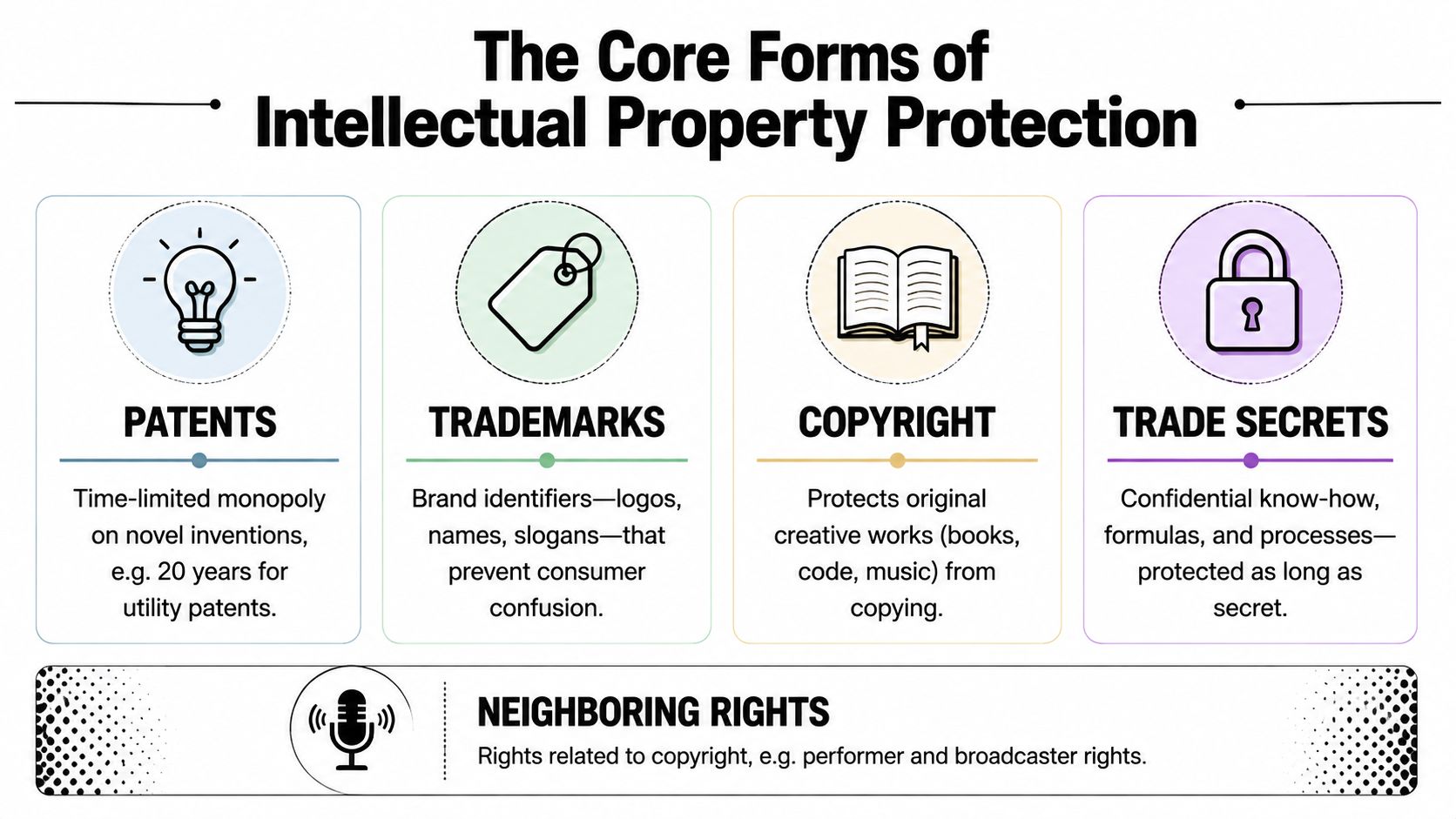
Think of IP rights as different tools in a workshop. A patent isn't a stronger version of copyright, and a trademark doesn't protect the underlying technology. WIPO's framework distinguishes the main rights by the kind of output they protect, which matters when an engineering or product team decides what to document, register, license, or keep confidential.
| IP right | What it usually protects | Web3 example | Interview angle |
|---|---|---|---|
| Patent | A qualifying invention, often a technical method or system | A novel protocol mechanism | Explain invention disclosure and prior-art review |
| Trademark | A source identifier used in commerce | Protocol name, token symbol, or logo | Describe clearance, brand use, and enforcement |
| Copyright | Original expression fixed in a tangible form | Code, documentation, artwork, or interface copy | Explain authorship, assignments, and license terms |
| Trade secret | Confidential information with commercial value | Private keys, deployment procedures, or internal models | Describe access controls and confidentiality practices |
| Neighboring rights | Rights related to copyright | Performer or broadcaster rights in media projects | Identify rights beyond the author or developer |
Patents and trademarks
A patent can provide an exclusive right to make, use, sell, or import an invention. In the United States, patents generally last about 20 years from the filing date, as described by the Congressional Research Service's patent and intellectual property overview. Patents require formal filing and examination, so a candidate who casually posts a potentially important invention may create avoidable disclosure problems.
A trademark protects an identifier that helps people recognize the source of goods or services. Names, logos, and slogans can matter as much as contract code because a confusingly similar brand can divert users even when the underlying implementation differs. A frontend engineer might therefore be asked how they used approved logos, while a community lead may need to explain how trademark permissions are handled in Discord, documentation, and conferences.
Copyright and trade secrets
Copyright can arise automatically for original expression, including code, written documentation, music, images, and interface content. It protects the expression, not an abstract idea or general product concept. Registration or other formal steps can improve enforcement options in some jurisdictions, but registration doesn't turn an unprotectable idea into protected code.
A trade secret depends on secrecy and reasonable protective measures. A formula, private process, security procedure, or internal dataset may qualify only if the company treats it as confidential. The Dentons overview of trade-secret protection notes that the Uniform Trade Secrets Act has been adopted at least in part by 48 states and the District of Columbia, illustrating how widely this mechanism is used across the United States.
For candidates, the useful preparation is concrete. Bring examples of code you authored, brands you helped deploy, documentation you created, and confidential information you handled. Then explain the limits of each right rather than claiming that the company owns everything automatically.
How IP Rights Are Obtained and Enforced
Protection follows different routes depending on the right. Copyright may arise when original expression is created, while patents require filing and examination, and trademarks typically depend on use, registration strategy, and examination in the relevant jurisdiction. Trade-secret protection doesn't come from a certificate. It depends on whether the company can demonstrate that it used sensible measures to preserve confidentiality.
The protection lifecycle
A startup can map the lifecycle like this:
- Creation: An engineer develops a mechanism, a designer creates a visual system, or a writer produces documentation.
- Classification: The team identifies whether the asset is patentable subject matter, copyrighted expression, a trademark, confidential know-how, or a combination.
- Ownership review: The company checks employment agreements, contractor assignments, founder documents, and third-party licenses.
- Registration or control: The team files a patent or trademark where appropriate, records copyright information when useful, and limits access to trade secrets.
- Maintenance: The owner tracks renewals, license conditions, attribution requirements, and changes in personnel.
- Enforcement: The company monitors use, gathers evidence, sends notices, negotiates licenses, or brings a claim where the expected value justifies the cost.
The global scale of this system is substantial. The OECD analysis of public policies supporting innovation records that patent applications filed in the European, U.S., and Japanese patent offices exceeded 850,000 in 2002, up from about 600,000 a decade earlier. The same analysis links stronger patent protection with higher inward foreign direct investment, merchandise imports, and services imports, showing why governments treat IP rules as trade and investment policy rather than paperwork alone.
Enforcement has limits
A cease-and-desist letter can start a conversation, but it doesn't guarantee compliance. A company may need to prove ownership, identify the infringing act, establish jurisdiction, and choose a remedy. A defendant's location, the location of the developer or node, and the location of the affected users can all complicate enforcement for decentralized products.
Teams sometimes skip license headers, fail to renew registrations, or assume that publishing source code means others can use it without conditions. Those choices can weaken exclusivity, create compliance exposure, or reduce bargaining power during a financing or acquisition process. Arbitration clauses, escrow arrangements, and on-chain dispute mechanisms may help allocate risk, but they can't erase jurisdictional limits or replace careful drafting.
For a suspected online copying incident, a team may need a practical evidence and takedown workflow. A resource such as file a DPP copyright claim can help a rights holder understand one route for documenting and reporting alleged copyright misuse. It should complement, not replace, advice specific to the governing law and the relevant platform.
Practical Steps for Teams and Startups
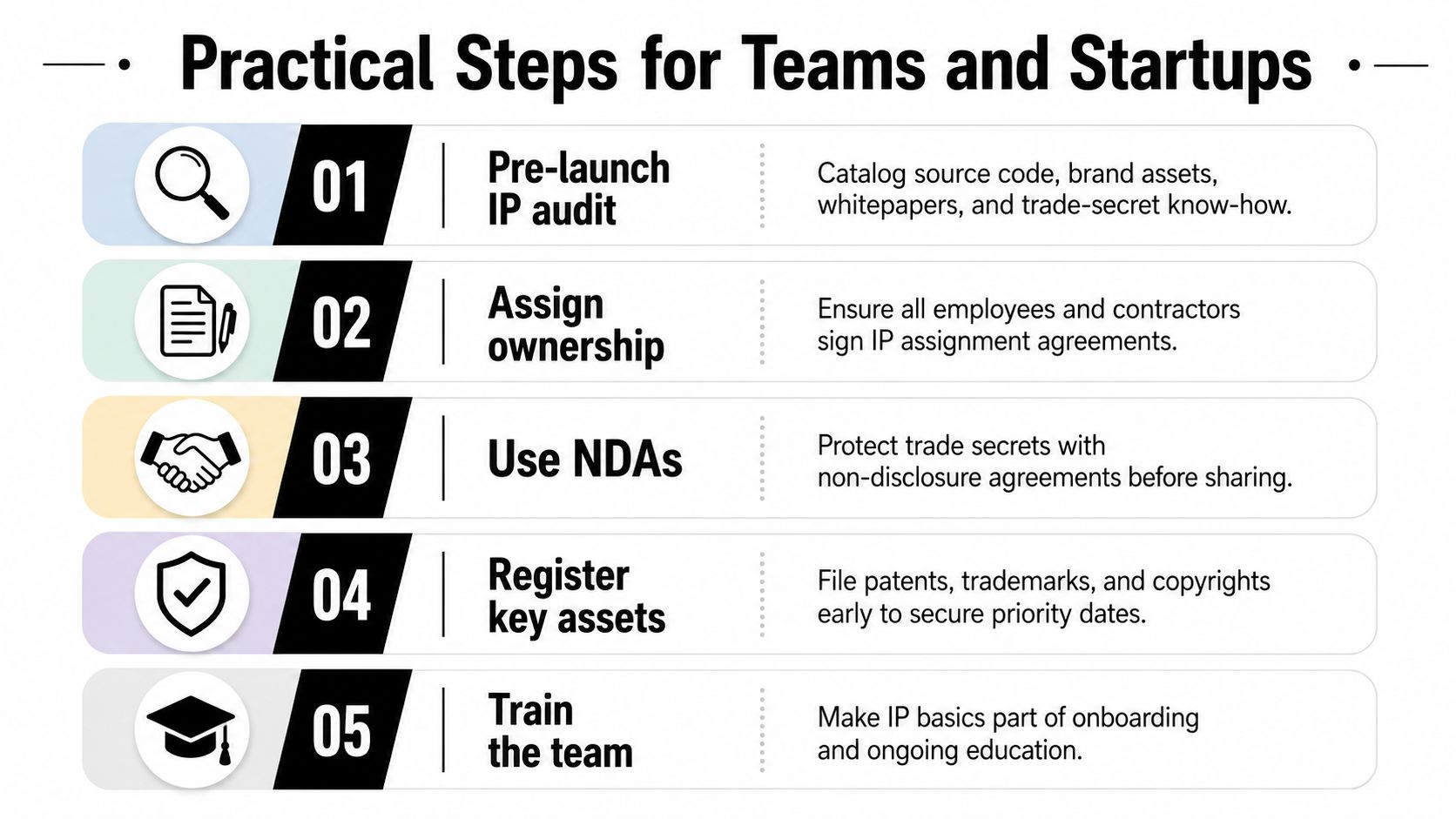
A useful IP program looks less like a binder of legal documents and more like an operating system for hiring, onboarding, and product delivery. The team should know what it owns, what it has licensed, what it must keep secret, and who is responsible for each decision.
Start with an asset map
Before launch, inventory the source repository, deployment scripts, whitepaper, website copy, design files, token imagery, datasets, vendor materials, and internal know-how. Record the creator, creation date, employer or contractor relationship, applicable license, and proposed protection method.
An engineering lead should own the code inventory. Design and marketing should flag brand assets. Product should identify third-party components and data dependencies. Legal or operations can turn those inputs into a risk register instead of waiting for an investor, acquirer, or hostile user to ask basic ownership questions.
Make ownership explicit
Employees and contractors should sign agreements that address IP assignment, confidentiality, prior inventions, and permitted open-source work. The language should distinguish work created within the job from independent work, because an overbroad clause can deter candidates while an incomplete clause can leave the company without clear ownership.
Use an invention disclosure workflow for potentially patentable work. Ask the contributor to record the problem, the technical solution, the contributors, the date, and any public disclosure. That record helps counsel decide whether to file, publish defensively, keep the information secret, or release it under a defined license.
Onboarding rule: Don't rely on a repository's commit history to solve an ownership problem. Pair contribution records with signed agreements and an approved license policy.
Protect secrets through operations
A non-disclosure agreement can't protect information the company freely exposes. Limit repository access, separate production credentials from development environments, label sensitive documents, and remove access promptly when someone leaves. Exit processes should collect company devices, confirm return or deletion of materials, and revoke credentials.
Open-source use needs the same discipline. Using a dependency isn't the same as contributing to it, and contributing code doesn't mean the company can relicense the project however it wants. Maintain a software bill of materials, review license notices, and ask every engineering candidate how they check compatibility before shipping.
Red flags include missing contractor assignments, a repository forked without license review, a brand chosen before clearance searches, and a hiring manager who can't explain who owns inventions made on personal time. Those aren't merely legal annoyances. They reveal process maturity, and process maturity is a meaningful career signal.
IP in Blockchain, Smart Contracts, and NFTs
Blockchain products expose the gap between technical ownership and legal ownership. A wallet may control a token, a repository may be publicly visible, and a community may treat a symbol as its identity. None of those facts alone answers who owns the code, artwork, brand, or commercial rights attached to the product.
A smart contract is software, so its code can contain copyrightable expression. A technical method might also raise patent questions, while an open-source release may grant permission under an MIT, Apache, or GPL license. Each license creates different obligations around notices, modifications, redistribution, and downstream use. Protocol engineers should choose the release posture with product counsel, not copy a license file into the repository at the last minute.
NFTs separate the token from the work
Buying an NFT generally transfers control of the token, not automatic ownership of the underlying illustration, music, video, trademark, or copyright. The buyer's rights depend on the applicable terms, which may grant limited display rights, commercial rights, or no broad right to create derivatives.
The same distinction matters for resale. A marketplace may transfer the token while the original creator retains copyright and trademark control. If the smart contract contains royalty logic, that technical mechanism may not guarantee the legal result in every jurisdiction or marketplace. Product, legal, and community teams should document what the purchaser receives in plain language.
| Asset Type | Applicable IP Right | Typical License | Key Enforcement Risk |
|---|---|---|---|
| Smart-contract code | Copyright, possible patent rights | MIT, Apache, GPL, or proprietary terms | License incompatibility and copied expression |
| Protocol name and token symbol | Trademark | Brand-use guidelines or trademark permission | Confusingly similar projects and unauthorized promotion |
| NFT artwork | Copyright and possible trademark rights | Display, commercial, or restricted license | Buyers assuming token ownership includes copyright |
| Private deployment process | Trade secret | Confidentiality and access controls | Insider disclosure or weak exit procedures |
| Open-source protocol documentation | Copyright | Project license with attribution terms | Uncredited copying and incompatible reuse |
A candidate working on smart contracts should be ready to discuss license selection, dependency review, and contributor agreements. A community lead should know how the project permits brand use in Discord, events, and social media. Legal counsel should review patent exposure, trademark clearance, and the consequences of publishing technical details.
For a role where these decisions are part of the daily job, review the expectations in this smart contract engineer opportunity. The point isn't to turn every developer into patent counsel. It's to ensure that the person making a release decision understands what the release gives away and what it preserves.
International filing and information systems can help businesses protect inventions, trademarks, and designs across multiple countries. WIPO's global IP services publication describes that coordinated approach, while enforcement still depends on the jurisdictions where developers, infrastructure, users, and businesses operate.
AI, Training Data, and Shifting IP Boundaries
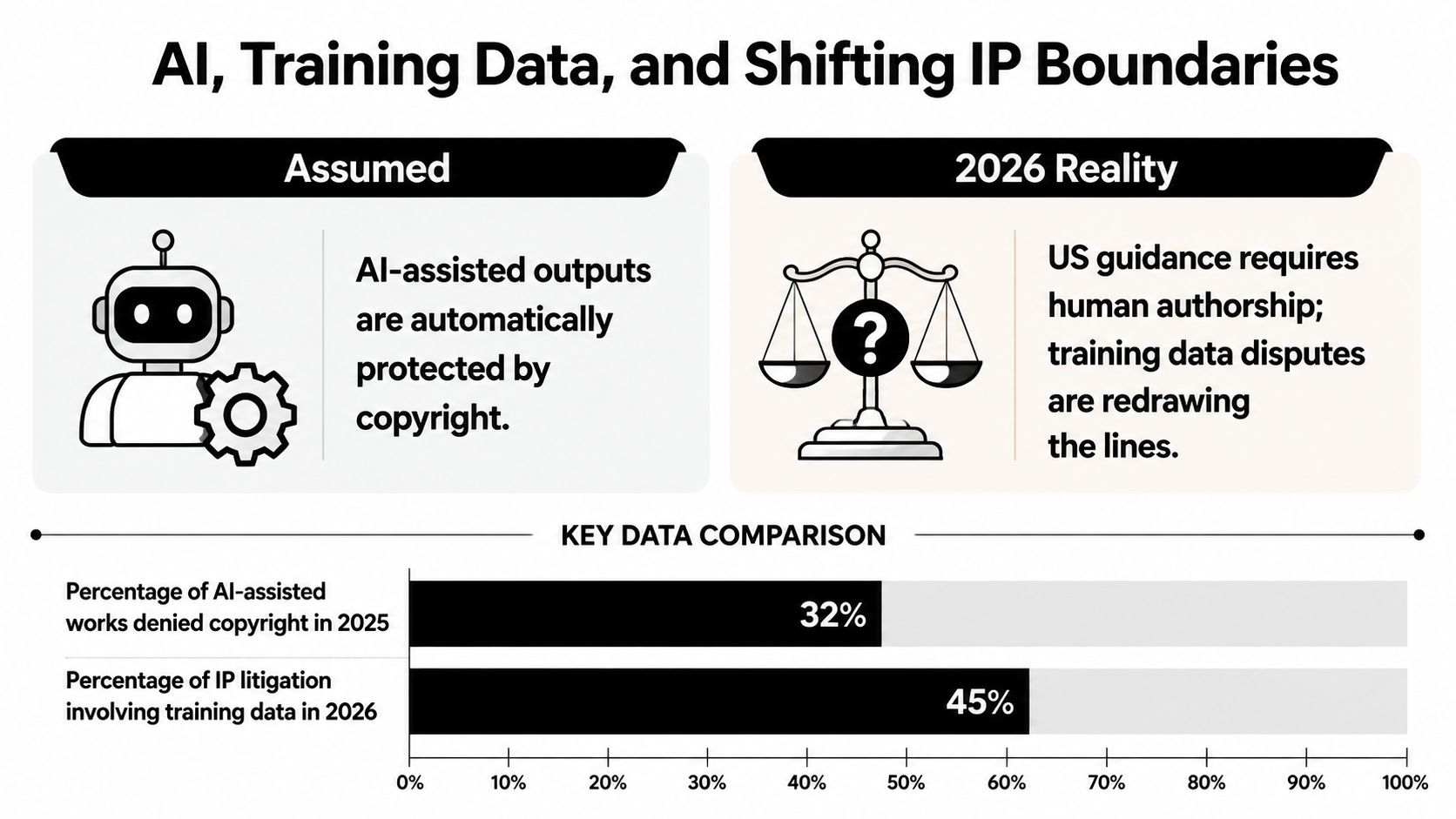
The statement “the model wrote it, so we own it” is an unsafe assumption. U.S. Copyright Office guidance continues to reject copyright claims for AI-generated content that lacks meaningful human authorship, so a company needs to distinguish machine output from the human selection, arrangement, editing, and transformation that may support a claim.
The same caution applies to patents. Patent eligibility and inventorship questions remain unsettled as companies use generative systems in research and development. A hiring team should therefore ask where an invention came from, which person made the inventive contribution, and what records support that account.
Build provenance into the workflow
Training data creates a separate exposure. Teams may use copyrighted code, art, books, or other material in a model pipeline, and disputes can focus on whether the collection, training, or output involved infringement. The practical response isn't to stop using AI. It's to create a defensible record.
- Log prompts and model versions: Preserve the context behind material outputs.
- Retain human edits: Keep drafts that show meaningful human contribution.
- Review training corpora: Record sources, permissions, exclusions, and data-lineage decisions.
- Disclose AI tools: State which tools employees may use and what information they can't submit.
- Separate confidential inputs: Never paste proprietary code, credentials, customer information, or trade secrets into an unapproved service.
Recent coverage also shows that the pressure is moving toward outputs and ownership boundaries, not only training inputs. Survey data reported by Fitz Cheven found that 21% of respondents expect higher IP exposure in the next 12 months, and 38% of those expecting change cite trademark and licensing as the most exposed areas. Those figures make AI governance relevant to brand, product, engineering, and legal hiring rather than only machine-learning teams. Read a practical guide from Digital Footprint Check when assessing how data ownership and provenance fit into an AI workflow.
AI literacy now appears in technical interviews because provenance affects commercial reliability. A candidate for an AI and machine learning role should be able to explain data lineage, model-output review, human authorship, and the company's policy for confidential inputs.
This video provides another way to frame the human-authorship and data questions:
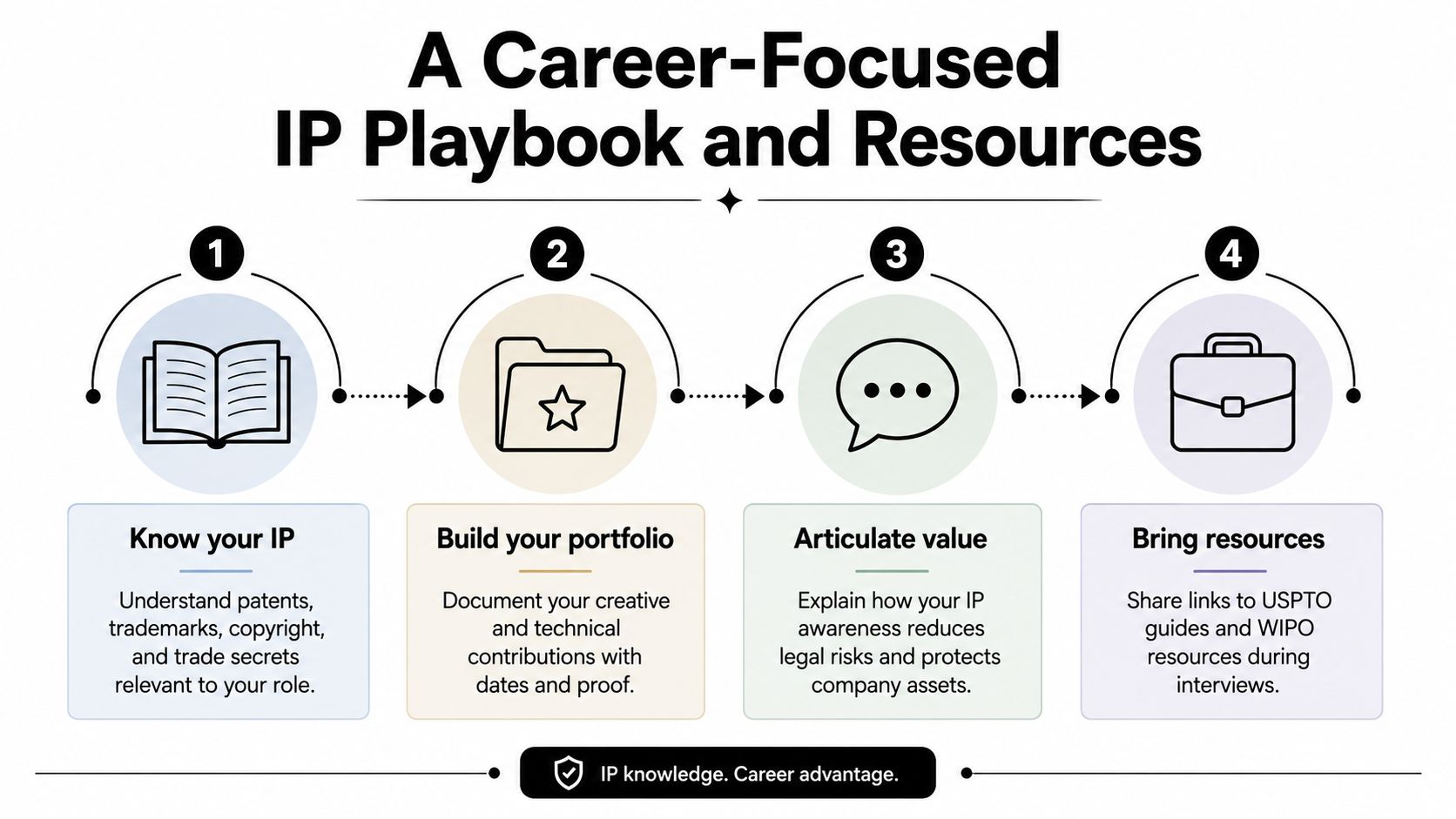
A Career-Focused IP Playbook and Resources
A Web3 engineer is reviewing an offer while preparing to launch a smart-contract feature. The assignment clause, open-source policy, and rules for protocol contributions may shape both the product and the engineer's career. IP protection becomes useful when you connect each legal right to a decision made at work.
Use this checklist in interviews
- Read the assignment clause: Confirm what the offer letter assigns, how prior inventions are handled, and whether independent projects are clearly excluded.
- Ask about invention disclosure: Find out how engineers submit new ideas, who evaluates them, and whether contributors receive attribution or internal recognition.
- Check the open-source posture: Ask which licenses the company permits, how dependencies are reviewed, and who approves releases.
- Test trade-secret hygiene: Look for access controls, confidentiality training, credential removal, and procedures for handling former employees' materials.
- Clarify AI governance: Ask whether the company tracks model inputs, requires tool disclosure, and reviews human contribution to generated work.
- Raise Web3 ownership questions early: For NFTs, tokens, smart contracts, and protocol forks, ask what users receive and what the company retains.
Vague language such as “everything you build is ours,” unpaid idea submissions, or policies that omit AI training data deserve careful questions. A strong employer should explain its ownership model in plain English and connect the terms to the role. Candidates can also ask whether legal and compliance work is part of onboarding, rather than appearing only after launch.
For structured learning, begin with WIPO's intellectual property fundamentals resources and relevant USPTO materials. Creative Commons and SPDX license selectors support content and software decisions, while the GitHub Open Source Guides, the American Bar Association's IP materials, and Web3 legal communities add practical context. Candidates moving toward policy, contracts, or risk ownership can review legal and compliance opportunities.
WIPO's careers portal shows the field's range. The organization describes itself as a specialized United Nations agency focused on innovation and creativity. Its listings include IP lawyers, patent examiners, economists, IT specialists, translators, and programme officers. IP knowledge can support progression in engineering, product, cybersecurity, design, compliance, legal operations, and policy.
Use one repeatable method: identify the asset, select the fitting protection, document ownership, control confidential information, choose licenses deliberately, and plan enforcement before a dispute. Bring that method to interviews, onboarding discussions, and protocol launch reviews.
Blockchain Jobs helps Web3 candidates find opportunities across engineering, product, legal and compliance, security, AI, and other crypto-native functions. Visit Blockchain Jobs to search current roles, compare career paths, or connect with specialized talent that understands the IP decisions behind decentralized products.