Enterprise Blockchain Consultant: Your 2026 Career Guide
You're probably in one of two places right now. You're either trying to break into a role that sounds promising but still feels fuzzy, or you're hiring for a blockchain initiative and realizing you don't need another person who only talks in protocols and buzzwords.
That's where the enterprise blockchain consultant sits. Done well, this role isn't just technical. It's commercial, operational, political, and architectural at the same time. The best consultants don't start by asking which chain to use. They start by asking where trust breaks, where reconciliation is slow, which partners don't share clean data, and whether blockchain is even warranted.
That's also why this role has become valuable in hiring markets. Companies want someone who can move between executive conversations, systems design, compliance constraints, and implementation planning without losing the business case.
The Rise of the Enterprise Blockchain Consultant
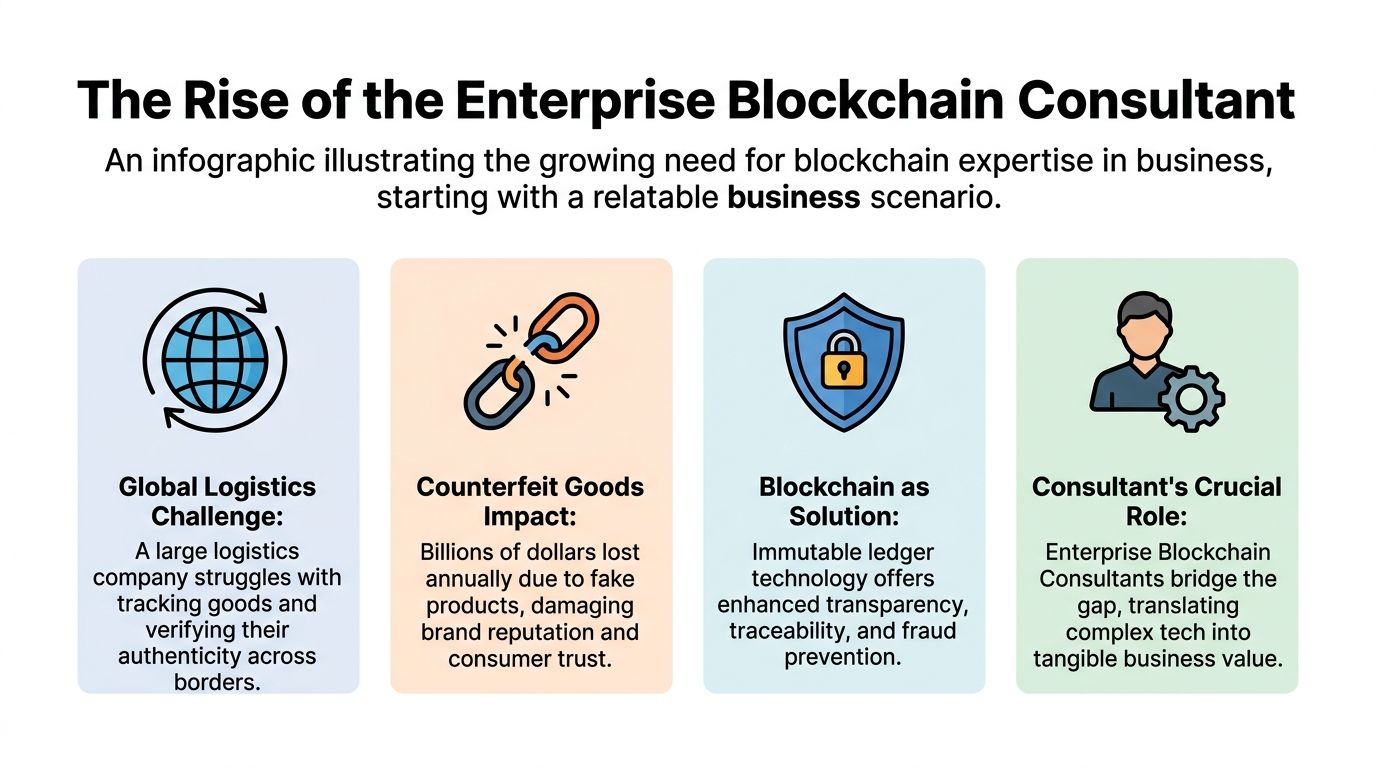
A familiar enterprise problem looks like this. A global logistics company can't reliably verify product origin across suppliers, freight partners, customs intermediaries, and distributors. Everyone has a system of record. No one trusts the other party's version when disputes happen. Counterfeit goods enter the flow, audits take too long, and executives get pitched “blockchain” before the company has even defined the operating problem.
That gap is where an enterprise blockchain consultant earns their keep. Not by evangelizing a ledger, but by turning a vague mandate into a concrete operating model. The consultant's job is to find where shared truth matters, where multiple parties need controlled visibility, and where automation can reduce manual reconciliation.
The market trajectory tells you why this role has become more visible. The enterprise blockchain consulting market is projected to grow from USD 3.84 billion in 2026 to USD 123.1 billion by 2035, at a 29.7% CAGR, according to Business Research Insights on blockchain consulting market growth. That projection matters for both sides of the table. Candidates are looking at a specialty with real upside. Employers are competing for people who can de-risk enterprise adoption before budgets get wasted.
Why demand keeps rising
This role keeps expanding because enterprise blockchain projects fail for predictable reasons:
- Weak problem definition: Teams start with technology selection before they define the trust and coordination problem.
- Poor executive translation: Architects explain nodes and consensus, but not governance, cost, or process impact.
- Legacy integration blind spots: A pilot looks clean in isolation, then collapses when ERP, identity, and workflow systems enter the picture.
- Compliance mismatches: Public-chain assumptions don't fit enterprise control requirements.
Practical rule: When a company says it wants blockchain, the consultant should treat that as a hypothesis, not a requirement.
For job seekers, that means your edge isn't just chain knowledge. It's the ability to frame a business decision. For hiring managers, it means screening for judgment, not hype tolerance.
If you're exploring adjacent technical paths while evaluating this role, it helps to compare openings across blockchain engineering roles and see where consulting sits relative to pure implementation work.
What an Enterprise Blockchain Consultant Actually Does
This job is often described too loosely. The typical description states the consultant advises on blockchain strategy, then stops there. This overlooks the actual work. In practice, the role has three distinct operating modes. Strategist. Translator. Validator. A strong consultant can switch between them in the same week.
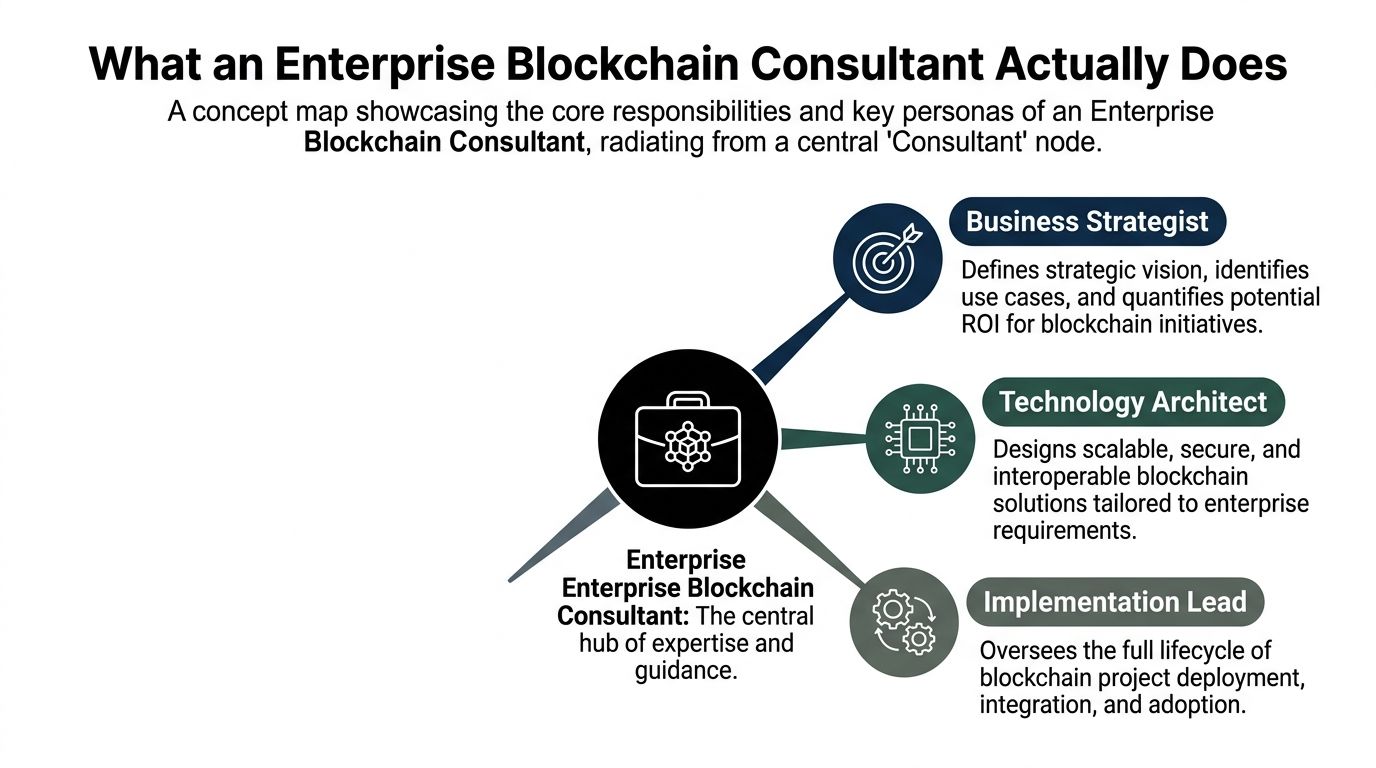
The strategist
Typically, the engagement commences. The consultant maps the current process, identifies the parties involved, and isolates where trust, transparency, or reconciliation breaks down. That isn't abstract analysis. It often means workshops with operations leads, finance teams, compliance staff, and system owners.
The key technical function is blunt and useful. An enterprise blockchain consultant maps existing business processes, identifies where trust or transparency failures occur, and validates whether a distributed ledger is necessary before architecture begins, which helps avoid expensive deployments where a standard database would do the job, as outlined in Blockchain Australia's enterprise blockchain development guide.
For a candidate, this should shape your resume bullets. “Defined blockchain strategy” is weak. “Mapped multi-party settlement workflow, identified reconciliation bottlenecks, and recommended permissioned data-sharing model” is better because it shows business diagnosis.
The translator
Once the business case survives scrutiny, the consultant has to convert business language into buildable requirements. Executives talk about auditability, partner trust, fraud controls, and settlement visibility. Engineers need network topology, participant roles, API boundaries, identity model, smart contract logic, and integration rules.
This translation work usually includes:
- Requirements framing: Turn business outcomes into architecture constraints and delivery priorities.
- Stakeholder alignment: Get legal, security, finance, and product teams to agree on what the system must and must not do.
- Implementation scoping: Define what belongs in a proof of concept versus what waits for production readiness.
A junior consultant usually talks about features. A senior consultant talks about operating constraints, governance boundaries, and failure modes.
That distinction matters in interviews. Hiring managers should ask candidates to explain a blockchain design to both a CTO and a finance executive. The best people adjust the same idea without distorting it.
A good benchmark for role expectations is a live senior blockchain consultant opening at Berkeley Research Group, because it shows how employers blend advisory depth with implementation credibility.
The validator
This is the least glamorous part of the job and often the most important. A consultant has to prove the proposal can work in an actual environment, not just on a whiteboard. That usually means a proof of concept, architecture blueprint, API plan, and a realistic view of integration risk.
A validator asks questions such as:
| Evaluation area | What the consultant is testing |
|---|---|
| Process fit | Does shared state improve coordination across known parties? |
| Governance | Who can read, write, approve, and dispute transactions? |
| Integration | Can ERP, core banking, identity, or cloud systems connect without brittle workarounds? |
| Adoption | Will business users and partner organizations actually follow the new workflow? |
For candidates, the interview lesson is simple. Don't only tell success stories. Be ready to describe a time you said no, narrowed scope, or redirected a project toward a simpler architecture. Hiring managers should value that answer more than an enthusiastic but careless “yes.”
The Dual-Threat Skillset Every Consultant Needs
The fastest way to fail in this role is to lean too far to one side. Pure technologists often overdesign. Pure strategists often under-specify. The consultant who gets hired, and keeps getting hired, can operate with both technical depth and business fluency.

The technical toolkit
Enterprise deployments usually don't look like open participation public networks. They rely on controlled access, explicit governance, and identity-aware transaction models. Permissioned networks such as Hyperledger Fabric, Quorum, and Corda Enterprise dominate enterprise use because they support the governance and access controls corporate environments require, as explained in NMS Consulting's overview of blockchain for enterprise.
That fact should shape both hiring criteria and interview prep. If someone wants to work as an enterprise blockchain consultant, they need more than a general understanding of blockchain mechanics. They should be comfortable discussing why one permissioned platform fits a consortium model better than another, how confidential data is segmented, and how participant identity is handled.
A practical technical checklist looks like this:
- Platform literacy: Understand the design trade-offs of Hyperledger Fabric, Quorum, Corda Enterprise, and enterprise-focused Ethereum variants.
- Smart contract judgment: Know what business logic belongs on-chain and what should stay in off-chain services.
- API and systems integration: Be able to explain how blockchain services connect to ERP, cloud systems, identity providers, and reporting layers.
- Architecture artifacts: Produce sequence diagrams, participant models, permission maps, and proof-of-concept plans that non-developers can still review.
Technical interviews should test applied reasoning, not trivia. Ask candidates to design a shared record system for suppliers, banks, or insurers and explain where they'd avoid putting data on-chain.
The business acumen
The hard part of this job usually isn't the chain. It's the organization. Enterprise blockchain projects involve multiple decision-makers, mixed incentives, and uneven tolerance for process change. A consultant who can't manage stakeholders will struggle even if their architecture is sound.
What matters here:
- Stakeholder management: You need to keep legal, IT, operations, and executive sponsors aligned without pretending they want the same thing.
- Change management: A technically correct workflow still fails if users won't adopt it or partners resist governance terms.
- Commercial framing: You need to explain cost, sequencing, risk, and operating impact in language procurement and leadership teams respect.
- Executive communication: C-suite leaders don't want protocol jargon. They want to know what problem is being solved, what changes operationally, and where the decision points sit.
Hiring signal: If a candidate can explain consortium governance clearly, they're often more valuable than someone who can recite every consensus model from memory.
This short overview is worth watching because it reinforces how enterprise consultants need to bridge business design and technical execution:
What works and what doesn't
A few patterns separate effective consultants from decorative ones.
| What works | What doesn't |
|---|---|
| Starting with process mapping | Starting with chain selection |
| Framing governance early | Treating governance as legal cleanup later |
| Designing for integration from day one | Building an isolated pilot with no system dependencies |
| Speaking differently to executives and engineers | Using the same jargon-heavy explanation for every audience |
For candidates, that means interview stories should show range. For employers, it means your rubric should score communication and system thinking as heavily as blockchain knowledge.
Salary Benchmarks and Common Engagement Models
Compensation matters, but a single number doesn't tell you much. In this niche, salary is tied to how much ambiguity you can handle, how credible you are with senior stakeholders, and whether you can move from discovery to architecture to delivery without needing hand-holding.
A useful anchor is this. Enterprise blockchain consultant salaries average $107,000 per year globally, with variation based on education, company size, and location, according to 101 Blockchains on the blockchain consultant career path. That's enough to make the role attractive. It's not enough to price a specific hire or negotiate an offer by itself.
2026 Enterprise Blockchain Consultant Compensation
| Experience Level | Average Annual Salary (Full-Time) | Typical Hourly Rate (Contract) |
|---|---|---|
| Associate Consultant | Varies by market and employer | Often lower than senior specialist rates |
| Senior Consultant | Can exceed the global average with strong enterprise experience | Often higher when scoped to architecture, discovery, or compliance-heavy work |
| Principal or Practice Lead | Typically negotiated based on commercial ownership and domain specialization | Frequently structured as premium advisory, retainer, or transformation support |
The table is qualitative by design because precision beyond the verified global average would be guesswork. That's exactly how compensation conversations should be handled in real life too. Don't anchor on internet ranges unless they match your geography, delivery model, and scope.
Choosing the right engagement model
For companies, the wrong engagement model causes more hiring pain than the wrong title.
- Full-time hire: Best when blockchain capability needs to become institutional. This works for firms building a repeatable internal function across strategy, architecture, and partner management.
- Project-based contractor: Useful for discovery work, proof-of-concept design, or a specific transformation phase where deep expertise is needed fast.
- Retainer advisor: Often the best fit when leadership needs senior judgment across governance, vendor selection, and executive steering, but not a full implementation owner.
For candidates, this changes how you position yourself. Full-time roles reward internal influence, cross-functional patience, and long-cycle delivery ownership. Contract work rewards speed, clarity, and the ability to create artifacts others can execute after you leave.
If your value is diagnosis and decision support, a retainer can make more sense than forcing yourself into a build-heavy contract.
Hiring managers should also be realistic about level. A company that needs consortium design, compliance alignment, and board-ready communication is not hiring a “blockchain developer with good people skills.” It's hiring a consultant. Budget accordingly.
How to Hire or Get Hired in This Role
This market punishes vague hiring and vague candidacy. Enterprise blockchain roles take about 40 days to fill on average, according to Evan Sohn's analysis of the blockchain career paradox on LinkedIn. That longer cycle usually means companies are screening for a rare mix of capabilities, then slowing themselves further with unclear evaluation criteria.
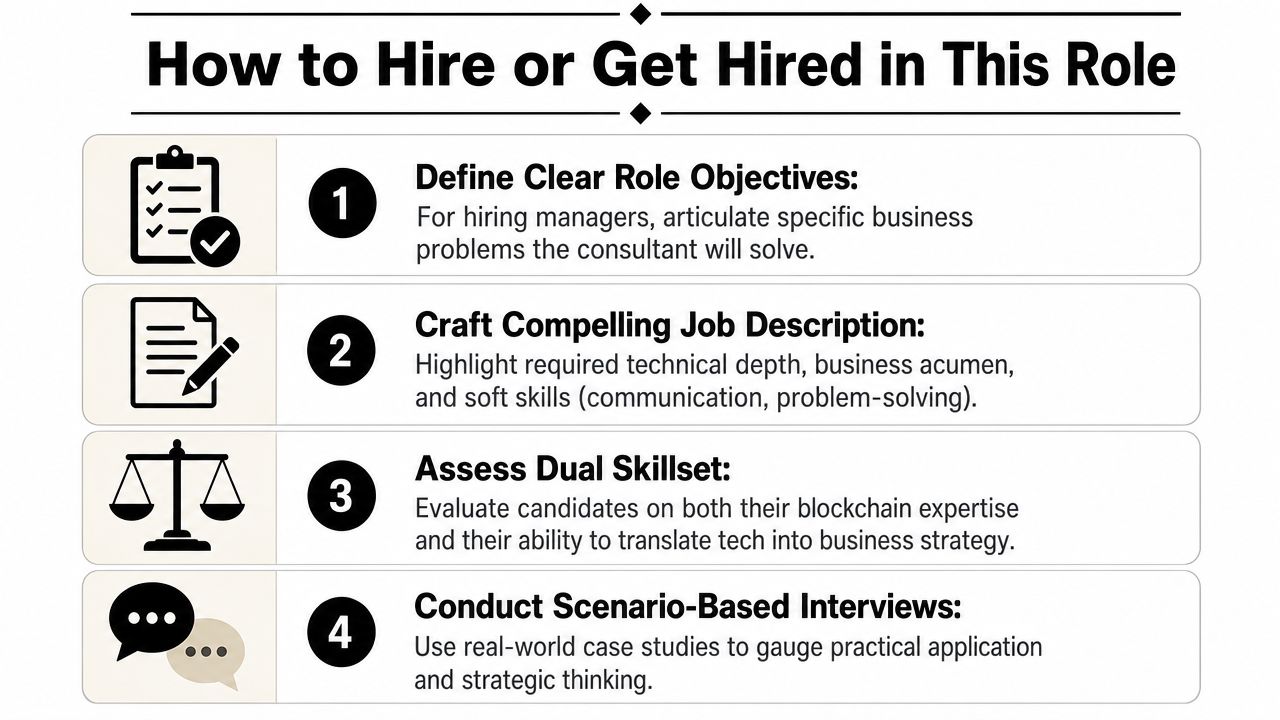
For hiring managers
Start with the operating problem, not the title. If your job description says “enterprise blockchain consultant” but never names the actual business challenge, strong candidates will either ignore it or assume your leadership team is still shopping for buzzwords.
Write the role around decisions and deliverables:
- Business diagnosis: Define whether the hire must assess use cases, lead discovery, or validate blockchain fit.
- Architecture responsibility: Clarify whether they'll recommend platforms, design access models, and shape proof-of-concept scope.
- Stakeholder burden: State who they must influence. CIO, COO, compliance, legal, partner consortium members, or delivery teams.
- Success artifacts: Ask for roadmaps, governance proposals, process maps, and implementation blueprints. Don't overfocus on code samples.
Interview design matters more than clever questions. Use scenario-based exercises. Give the candidate a supply chain, trade finance, or identity-sharing problem and ask them to walk from business issue to architecture recommendation to adoption risk. That reveals judgment much faster than asking them to define consensus models.
A live market reference like this senior consultant digital assets and enterprise strategy role at Deloitte is useful because it shows how top firms evaluate strategy, risk, and operating model design together.
For candidates
You need to present yourself as someone who reduces decision risk. That's the hiring manager's real concern. Your resume should make it obvious that you can assess fit, shape a roadmap, and communicate with mixed audiences.
A stronger candidate package usually includes:
- Outcome-based resume bullets: Lead with the business problem you addressed, then the architecture or advisory contribution.
- Short case summaries: Show how you scoped a proof of concept, aligned stakeholders, or prevented a weak use case from moving forward.
- Interview stories with tension: Talk about trade-offs, resistance, integration constraints, or governance disputes. Easy wins don't prove consulting maturity.
- A clear point of view: Be able to say when a centralized database is the better answer and why.
“Tell me when you advised against blockchain” is one of the best interview questions in this field. Good candidates welcome it.
Shared mistakes on both sides
Employers and candidates often create the same failure pattern from opposite directions.
| Hiring mistake | Candidate mistake |
|---|---|
| Asking for a unicorn without defining scope | Claiming broad expertise without concrete examples |
| Screening mostly on protocol knowledge | Preparing only for technical questions |
| Treating the role like a developer position | Ignoring governance, legal, and change management issues |
| Waiting too long to align internal stakeholders | Failing to tailor stories to business outcomes |
Companies should tighten the process early. Candidates should assume every serious interview will test business judgment, not just blockchain fluency.
Your Career Path and Learning Roadmap
Few individuals begin their careers directly as an enterprise blockchain consultant. They grow into it from adjacent roles such as solution architecture, enterprise integration, product strategy, compliance transformation, or consulting in regulated systems. The job rewards people who can combine those backgrounds into a sharper specialty.
A simple career path looks like this.
Analyst or associate stage
At this level, the goal is pattern recognition. Learn how enterprises operate. That means process mapping, workshop support, requirements gathering, and proof-of-concept documentation. If you come from engineering, spend time improving your business writing. If you come from consulting, close the technical gap on permissioned architecture and API-level integration.
Consultant stage
You start owning discovery, use-case evaluation, stakeholder interviews, and architecture recommendations. You should be able to run working sessions, produce decision documents, and defend a platform recommendation under executive scrutiny. You also need to know when to narrow scope and when to stop a weak initiative.
Senior consultant or practice lead stage
Now you're responsible for more than project output. You shape governance, mentor junior staff, influence budget decisions, and often help define a firm's service offering. Strong people at this stage can move into broader digital transformation leadership, enterprise architecture leadership, or executive strategy roles.
A practical learning roadmap should mix technical and commercial material:
- Build platform fluency: Study Hyperledger Fabric, Quorum, and Corda Enterprise from an enterprise architecture perspective.
- Practice documentation: Write process maps, decision memos, governance models, and proof-of-concept scopes.
- Learn adjacent regulated domains: Finance, supply chain, identity, and audit workflows make you more credible than blockchain knowledge alone.
- Study neighboring advisory careers: If you want a useful contrast in how licensing, sales, regulation, and client trust shape another finance-facing career, this guide on how to become a stock broker is worth reading. It's not the same profession, but it highlights how structured career paths and regulated client work reward clarity and discipline.
The best next step is usually not “learn more blockchain.” It's narrower than that. Pick one enterprise use case, one permissioned platform, and one business domain. Then get good enough to explain all three in the same meeting.
If you're ready to find your next role or hire someone who can bridge strategy and implementation, Blockchain Jobs is one of the best places to start. It gives candidates a focused way to find blockchain and Web3 opportunities, and it gives employers direct access to specialized talent without wading through generic tech applicants.