
How to Land Entry Level Cryptography Jobs

If you're aiming for a career in cryptography, you've picked a fantastic time to jump in. The field is absolutely booming. It's not just a slow and steady growth, either—the demand for sharp, new talent is accelerating, and companies are actively looking to hire for entry-level roles.
Companies in every major sector—finance, big tech, defense, you name it—are on the hunt for people who can build and protect the secure systems we all rely on. This isn't just about maintaining old code; it's about building the future of digital trust. For someone just starting out, this translates into incredible opportunities to build a career that's both challenging and financially rewarding, right from your first role.
So, Why All the Hype Around Cryptography Jobs?
Let's get straight to it: the need for skilled cryptographers is exploding, and hiring managers are struggling to fill seats. Cryptography is the invisible engine running behind the scenes of our digital lives.
Every time you buy something online, send a message on a secure app, or interact with a blockchain, you're using cryptography. This constant, fundamental need for security is what’s driving the incredible job growth. As we connect more of our lives to the internet, the number of potential weak points for attackers grows, too. That’s why data security has shifted from being an obscure IT task to a critical priority discussed in boardrooms and during hiring strategy meetings.
The Big Trends Pushing the Industry Forward
A few massive trends are converging to create a perfect hiring environment for anyone looking to get into cryptography.
The Blockchain & Web3 Revolution: This is a huge one. Decentralized technologies are, at their core, applied cryptography. Everything from securing cryptocurrency transactions to verifying smart contracts relies on cryptographic principles. The entire Web3 space needs a deep roster of crypto talent to innovate and stay secure, creating a constant stream of new job openings.
The Internet of Things (IoT) Takeover: Think about it—billions of devices are now online, from your smart thermostat to massive industrial sensors. Every single one is a potential entry point for an attack. Securing them all requires clever, lightweight, and super-efficient cryptographic solutions, and companies need engineers who can build them.
The Rise of Data Privacy Laws: With regulations like GDPR in Europe and CCPA in California, companies are legally required to protect user data—or face massive fines. Cryptography is one of the primary tools for meeting these compliance standards, forcing companies to hire experts who know how to implement robust data protection.
The Job Market, by the Numbers
This isn't just a feeling; the numbers back it up. The U.S. Bureau of Labor Statistics predicts an 8% increase in overall employment for related roles by 2034, which is much faster than the average for all occupations.
Even more telling, recent data from CyberSeek highlights an incredible 457,398 cybersecurity job openings across the nation in 2025. A huge chunk of these roles demand strong cryptographic skills for everything from data protection to building secure communication channels. If you want to dive deeper into the career outlook, cybersecurityguide.org has some great information.
What does this all mean for you? Companies are more willing than ever to bring on and train junior talent. They're looking for candidates with a solid grasp of the fundamentals and a genuine passion for security. It’s an ideal climate for launching your career.
What Hiring Managers Actually Want to See
Getting that first job in cryptography isn't just about acing a theory exam; it's about proving you can apply that theory to solve real-world security challenges. Companies are on the hunt for people who can do more than just name algorithms. They need someone who understands why they work, how to implement them securely, and what happens when they fail.
The Bedrock: Math and Cryptographic Primitives
You can't build a secure system without a solid foundation, and in cryptography, that foundation is math. Don't worry, you don't need to be a pure mathematician, but a comfortable grasp of concepts from linear algebra and number theory is non-negotiable. Concepts like modular arithmetic and finite fields aren't just abstract ideas; they are the very gears that make modern algorithms like RSA and Elliptic Curve Cryptography (ECC) turn.
Hiring managers test for this because it shows you can think critically about the why behind the code. It’s the difference between simply using a tool and truly understanding it.
Beyond the math, you need a practical, hands-on familiarity with the core tools of the trade. This is what you'll be working with day-to-day. You should be able to confidently explain the use cases, strengths, and weaknesses of:
- Hashing Algorithms like SHA-256 for ensuring data integrity.
- Symmetric Encryption like AES for efficiently securing large datasets.
- Asymmetric Encryption like RSA for key exchange and digital signatures.
A classic interview stumble is reciting textbook definitions. A standout candidate, on the other hand, can clearly explain why you’d use AES to encrypt a file but use RSA to securely send the AES key to someone else. That’s the kind of practical insight that gets you hired.
The Essential Skills in Practice
To give you a clearer picture, here's a breakdown of what hiring managers look for in an actual entry-level role.
| Skill Category | Specific Knowledge/Language | Why It's Critical for an Entry Level Job |
|---|---|---|
| Foundational Mathematics | Number Theory, Linear Algebra, Probability | You'll use this to understand algorithm design, analyze potential weaknesses, and contribute to security protocol discussions in team meetings. |
| Programming | Python, Rust, C/C++ | Python is for scripting and prototyping, while Rust and C/C++ are for building high-performance, memory-safe cryptographic libraries. Job postings often list at least one of these as a hard requirement. |
| Core Primitives | AES, RSA, ECC, SHA-3, Digital Signatures | These are the fundamental building blocks. You're expected to know when and how to apply each one correctly to avoid common security pitfalls. This is a frequent topic in technical interviews. |
Having these competencies shows you're ready to move beyond theory and start contributing to real-world projects from day one.
The Programming Languages of Trust
Theory is one thing, but you have to be able to build things. Securely. That means getting your hands dirty with the right programming languages that appear on job descriptions.
- Python: It’s the swiss-army knife for cryptographers. Thanks to powerful libraries like PyCryptodome, it's perfect for quickly building prototypes, scripting security analyses, or working through problems in a technical interview.
- Rust: This one is a game-changer and a huge plus on a resume. Rust's focus on memory safety helps eliminate entire categories of nasty bugs (like buffer overflows) right at the compiler level, making it a top choice for security-critical code. Highlighting Rust skills can make you a more competitive candidate.
- C/C++: These are the old guards for a reason. For core cryptographic libraries where every nanosecond counts, you need the low-level control and performance that C/C++ provide. Knowing them shows you understand how things work under the hood.
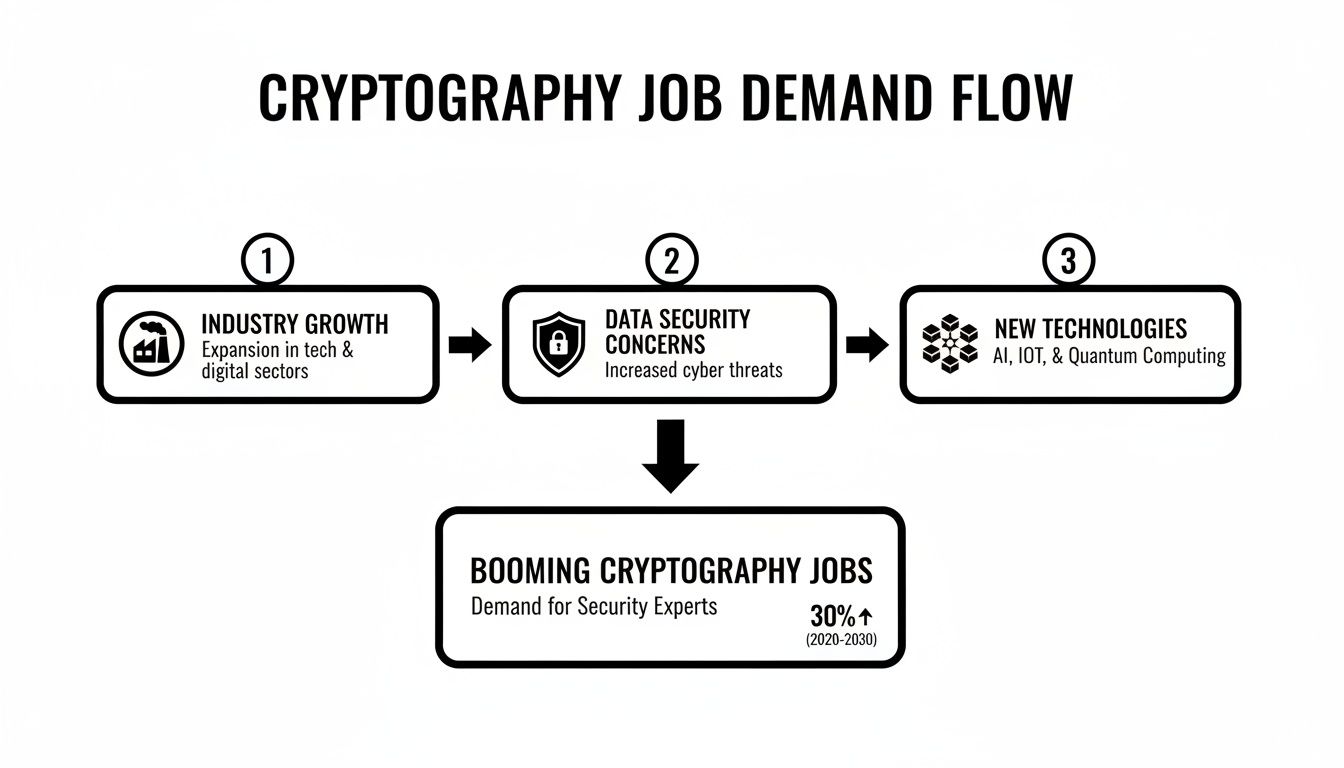
This massive demand means the industry is hungry for talent. And while a traditional degree path is common, it’s not the only way to get hired anymore.
An analysis from Cyberseek.org found that while 60% of cybersecurity jobs requested a four-year degree, a full 40% were open to candidates with alternative qualifications. This is a huge shift, proving that demonstrable skills, a strong portfolio, and relevant certifications are gaining serious ground with recruiters. You can see these evolving requirements in job postings on ZipRecruiter.
Ultimately, your goal is to show you can combine theory with practical application. For example, many of these foundational skills are exactly what you'd need for a role like this Offensive Security Engineer position in the Web3 space.
Building a Portfolio That Proves Your Abilities
A solid resume might get your foot in the door, but it’s a compelling portfolio that will actually land you the job. When you're aiming for entry-level cryptography jobs, your portfolio is your single most important asset. It’s the bridge between knowing the theory and proving you can apply it.
This isn’t about just listing a bunch of online course certificates. It's about getting your hands dirty and building projects that show you can think like a cryptographer and solve real-world security problems. Your goal is simple: show, don't just tell.

From Theory to Tangible Projects
The best portfolio pieces are the ones that move past cookie-cutter tutorials. They should tackle a specific challenge and document your entire thought process. Hiring managers get excited when they see someone who can build something from the ground up because it demonstrates a much deeper understanding.
Need some ideas? Here are a few high-impact projects that will make any recruiter take notice:
Implement a Simple Block Cipher: Try building a basic version of a cipher like AES from scratch. Using a language like Python or Rust, this project forces you to grapple with substitution-permutation networks, key scheduling, and different block modes of operation. It's a classic for a reason and immediately signals to a hiring manager that you're serious.
Build a Secure Chat Application: Put together a simple client-server chat program that uses end-to-end encryption. This is a fantastic way to showcase your handle on key exchange protocols (like Diffie-Hellman), symmetric encryption for the messages themselves, and digital signatures for authentication.
Develop a Password Manager with Hashing: Create a basic command-line or GUI password manager. This project will make you properly implement password hashing and salting with a modern library like Argon2 or bcrypt—a non-negotiable skill for almost any security-focused role.
Your GitHub is your new resume. A hiring manager will absolutely look at your profile. Make sure it's clean, organized, and highlights your best work. Don't just dump code; curate it. It's your primary tool for proving you can do the job before you even get an interview.
Documenting Your Work for Maximum Impact
Code without good documentation is a job half-done. Your ability to clearly explain what you built and why you built it that way is just as critical as the code itself. Every single project in your GitHub needs a detailed README.md file.
A truly great README should contain:
- A Clear Project Description: What problem does this project actually solve?
- Cryptographic Concepts Involved: Be explicit. Name the algorithms and protocols you used (e.g., "Implemented RSA-4096 for key exchange...").
- Challenges and Solutions: Briefly talk about a roadblock you hit and how you overcame it. This is a huge indicator of your critical thinking skills and something you can discuss in an interview.
- How to Run the Code: Give simple, clear instructions so a technical recruiter or engineer can get it up and running.
This level of detail helps a non-technical recruiter grasp the project's value while giving a technical interviewer plenty to dig into. For instance, demonstrating that you understand how to audit and secure smart contracts would be a massive advantage for a Smart Contract Auditor position in the Web3 space.
Leveraging CTFs and Competitions
Don't overlook your achievements in Capture The Flag (CTF) competitions. Spending time on platforms like Hack The Box or TryHackMe is an amazing way to sharpen your problem-solving skills under pressure.
When you crack a particularly tough challenge, do a full write-up on it. Explain your methodology, the vulnerability you found, and the tools you used to exploit it. Publishing these write-ups on a personal blog or as a GitHub Gist adds another layer of concrete proof to your portfolio, showing you have practical, hands-on security chops that hiring managers love to see.
How to Find Openings and Ace the Technical Interview
Your portfolio is polished and your skills are sharp. Now comes the exciting part: turning all that hard work into actual interviews. Landing an entry-level cryptography job takes a bit more finesse than just blasting your resume out on the big job boards. While general tech sites are a decent starting point, the real gems are usually tucked away in more specialized corners of the security world.
I always tell people to start with niche cybersecurity and Web3 job boards. These are the places where companies go when they know they need security talent. Your application is much more likely to be seen by the right people, rather than getting buried under a mountain of general software engineering resumes.
Another pro-tip: make a "dream list" of companies whose security you admire. This could be cloud providers, innovative fintech firms, or well-regarded blockchain protocols. Go directly to their career pages and check them often. Many of the best entry-level roles get filled before they ever make it to a public job board.

Finally, don’t ever discount the power of showing up. Getting yourself to security conferences like DEF CON or even a local BSides event puts you face-to-face with the people who do the hiring. Don't just network to collect contacts; be genuinely curious. Ask smart questions about the projects they're working on. That's how a quick chat by the coffee station turns into a serious interview opportunity down the line.
Navigating the Interview Gauntlet
The interview process for a cryptography role is less about what you've memorized and more about how you think. It's a multi-stage gauntlet designed to test your reasoning and problem-solving skills.
It usually breaks down like this:
- The Recruiter Screen: This first call is mostly a vibe check. They want to confirm your background and, more importantly, hear your passion for the field. Be ready to talk about why you're drawn to cryptography and what excites you about their company specifically.
- The Hiring Manager Chat: Here, you'll talk to your potential future boss. They're trying to figure out if your skills line up with the team's current projects and challenges. This is your moment to connect the dots between your portfolio and their real-world problems.
- The Technical Deep-Dive: This is the main event. It could be one session or several, often involving engineers, a whiteboard, and a shared coding environment. Expect a healthy barrage of technical questions that test your foundational knowledge.
I can't stress this enough: the most critical skill in a technical interview is thinking out loud. Even if you blank on the perfect answer, walking the interviewer through your approach shows them how you reason. That problem-solving ability is far more valuable to them than just reciting facts.
Answering Core Technical Questions
For entry-level roles, interviewers need to see that you have a rock-solid grasp of the fundamentals. They aren't going to ask you to invent a new cipher on the spot, but they will absolutely expect you to explain core concepts and why they matter.
Get comfortable talking through questions like these:
- "Explain the Diffie-Hellman key exchange to me like I'm a project manager." This is a test of your communication skills. The paint-mixing analogy is a classic for a reason—it brilliantly shows how two parties can create a shared secret without ever sending it over the wire. Practice this explanation.
- "Why is salting passwords so important?" A good answer goes beyond just saying "it stops rainbow table attacks." Explain the mechanism. A unique salt per user means that even if two people have the same simple password, their stored hashes will be completely different, making those pre-computed tables of hashes totally useless.
- "What's a hash collision, and why should we care?" You’d start by defining it: two different inputs creating the exact same hash output. Then, explain why this is a deal-breaker for security. For an algorithm like SHA-256, a collision is theoretically possible but should be so computationally expensive to find that it's not a practical threat. This property is what underpins data integrity and digital signatures.
A deep understanding of these principles is a must-have for any role in this space, including for some really cool openings like this University Grad Product Engineer position at a leading Web3 company. In the end, a great interview feels less like an interrogation and more like a conversation where you prove you can think critically, communicate your ideas, and apply cryptographic theory to solve real problems.
Your Earning Potential and First Career Steps
Let’s talk about compensation. Knowing your value is crucial, and the great news is that even at the entry level, cryptography skills are in high demand and come with a premium. Companies understand they need specialized talent to protect their most valuable digital assets, and they’re willing to invest in it.
This demand translates into strong starting salaries right out of the gate. For entry level cryptography jobs, you can generally expect to earn between $60,000 and $90,000 globally. Of course, location plays a huge role. If you land a job in a major U.S. tech hub, those numbers jump significantly—think averages around $125,000 in California or $120,000 in New York. You can find more insights on cryptographer salaries and what drives these figures, but the bottom line is clear: there's a real scarcity of professionals who can properly implement and analyze encryption, and that works in your favor during salary negotiations.
Mapping Your Career Trajectory
Your first job is just the beginning. Cryptography offers a really clear and rewarding path for growth, and you can move up quickly if you’re smart about the skills you build.
Here’s what a typical career progression often looks like:
Junior Cryptographer / Cryptographic Engineer (Years 1-3): In your first role, you'll be focused on implementation and analysis, working closely with senior team members. Expect to spend your days writing and testing secure code, implementing cryptographic protocols, and helping out with security audits. This is where you build your hands-on, foundational skills and prove your value to the team.
Cryptographer / Security Engineer (Years 3-6): After a few years in the trenches, you’ll start taking on more responsibility. You might be given ownership of specific security features, tasked with designing crypto solutions for new products, or even begin mentoring junior engineers. Your role evolves from simply implementing to actually designing and architecting secure systems.
The real key to fast-tracking your career is to specialize. Don't try to be a generalist forever. Find a high-growth niche that you're genuinely passionate about and focus on becoming the go-to expert in that space. This is how you differentiate yourself for promotions and future job opportunities.
High-Impact Specializations for Future Growth
Once you’ve got a solid foundation, diving deep into a high-demand area can seriously boost your career and earning potential. Think about steering your professional development toward one of these emerging fields:
Post-Quantum Cryptography (PQC): With quantum computers on the horizon, the race is on to develop and deploy encryption that can withstand their power. Experts in PQC are becoming incredibly valuable as organizations look to future-proof their security.
Secure Hardware Design: This is all about embedding cryptographic functions directly into silicon. It’s a fascinating field that involves creating tamper-resistant hardware for everything from your smartphone to IoT devices.
Blockchain and Zero-Knowledge Proofs: The Web3 space is an absolute hotbed for cryptographic innovation. If you can master technologies like zero-knowledge proofs and other privacy-preserving techniques, you'll be a top candidate for companies building the next generation of decentralized applications.
Answering Your Questions About Cryptography Careers
Stepping into the world of cryptography, you're bound to have some questions. Let's tackle a few of the most common ones I hear from people just starting out, so you can focus on what really moves the needle with hiring managers.
Do I Really Need a PhD to Get Hired in Cryptography?
Short answer: absolutely not. At least, not for most entry level cryptography jobs you'll find in the industry.
While a PhD is pretty standard for deep research roles at places like Microsoft Research or in academia, the private sector is a different beast. Companies building products are far more interested in what you can do.
A solid Bachelor's or Master's in Computer Science or Math gives you a great theoretical launching pad. But what really gets a hiring manager's attention is a portfolio showcasing practical projects, clean code, and a real understanding of how cryptographic primitives are applied in the wild. Focus on building, not just studying.
Cryptographer vs. Cryptanalyst: What's the Difference?
Think of it this way: a cryptographer is the builder, and a cryptanalyst is the breaker.
A cryptographer designs and builds the secure systems. They're the architects creating the algorithms and protocols—the digital locks—that protect our data.
A cryptanalyst, on the other hand, spends their time trying to pick those locks. They probe systems, hunting for weaknesses and vulnerabilities that a real attacker might exploit. While the job titles are different, many modern roles, especially in areas like penetration testing, blend skills from both sides of the coin.
In an interview, here's a simple way to show you get it: "A cryptographer builds the safe, and a cryptanalyst's job is to figure out how to crack it." This tells them you understand the complete security lifecycle, not just one piece of it.
What's the Best Programming Language for a Cryptography Job?
There’s no single "best" language, as the right tool always depends on the specific task. That said, a few languages pop up constantly on job descriptions, and you'll want them in your toolkit.
- Python: This is your go-to for quick prototyping and scripting. Its massive collection of libraries makes it ideal for security automation and is often the language of choice for technical interview challenges.
- C/C++: When performance is everything, C and C++ are king. The core cryptographic libraries that everything else is built on are almost always written in these languages for raw speed and direct memory control.
- Rust: This one is a huge up-and-comer, and for good reason. Rust is built from the ground up for memory safety, which eliminates entire categories of common security bugs. Putting Rust on your resume is a massive signal that you're serious about building secure software.
My advice? Get comfortable with Python for general-purpose work and then dive deep into either C++ or Rust for the heavy-lifting implementation side. That combination makes you a versatile and highly attractive candidate.
Ready to put your skills to the test in the fast-paced world of Web3 security? Blockchain Jobs is the top job board for connecting with leading companies in the decentralized space. You can browse hundreds of roles in blockchain security, DeFi, and more. Find your next opportunity at https://blockchain-jobs.com.