Crypto Jobs NYC: Top Opportunities 2026
Roughly a subway ride can separate three very different crypto career paths in New York: a protocol team in Manhattan, a trading firm near midtown, and a fintech employer hiring for digital asset work with institutional constraints. That concentration changes how you should approach crypto jobs in NYC.
New York rewards specificity fast. Hiring managers here can usually tell within a few minutes whether a candidate understands the difference between exchange growth, token research, infra sales, onchain analytics, compliance operations, and market structure work. A generic “I'm passionate about Web3” pitch rarely survives that filter. Clear positioning does.
The practical upside is range. You can target native crypto startups, trading shops, research teams, infrastructure vendors, and go-to-market roles tied to real revenue. For example, a NYC-based account executive role at Dune points to a part of the market many candidates miss. New York crypto hiring is not limited to engineers and traders. Strong operators in sales, product, partnerships, and customer-facing roles can build serious careers here too.
The mistake I see from early-stage candidates is simple. They apply to everything, keep one generic resume, and send cold messages that could have been written for any city. That approach wastes time in New York because the local market is dense, fast, and reputation-driven. The candidates who get traction usually pick a lane, learn which firms hire in person, show they understand the city's mix of startup urgency and institutional expectations, and reach out with context that feels local, not copied.
New York City The Epicenter of Your Web3 Career
For crypto jobs in NYC, start with a simple market fact. New York brings native crypto startups, trading firms, data companies, and regulated financial players into the same hiring pool. That concentration changes the career math.
In practice, NYC rewards candidates who can operate across functions and still speak clearly about one lane. A protocol team may care about shipping speed. A market-making firm cares about precision, risk, and research quality. An exchange or infrastructure company may care just as much about compliance operations, enterprise sales, or customer success as pure engineering depth. In New York, those worlds sit close together, and hiring managers expect you to know which one you want.
That is why the city remains such a strong place to build a Web3 career. You can start in one part of the stack and move with intention. I have seen candidates go from fintech operations into stablecoin work, from data roles into GTM, and from traditional market research into crypto-focused trading and analytics. The advantage is not just volume. It is proximity to decision-makers, customers, investors, and peers who already work in the field.
That proximity also changes how to run your search. In NYC, generic outreach underperforms. Local context matters. Referencing the right meetup in SoHo, a hiring team's office cadence in Flatiron, or the kind of clients a firm serves often gets more traction than a polished but city-agnostic message.
One practical way to calibrate your search is to study live roles that reflect how New York firms frame the work. For example, this NYC-based account executive role at Dune shows a side of the market that candidates often miss. The city hires for revenue, partnerships, analytics, and client-facing roles alongside engineering and trading.
Practical rule: In New York, the candidate who understands the business model usually beats the candidate who only understands the technology.
Decoding the NYC Crypto Job Market
New York's crypto market is broad, but it isn't random. If you map it correctly, the search gets easier and your applications get sharper.
Where the openings actually cluster
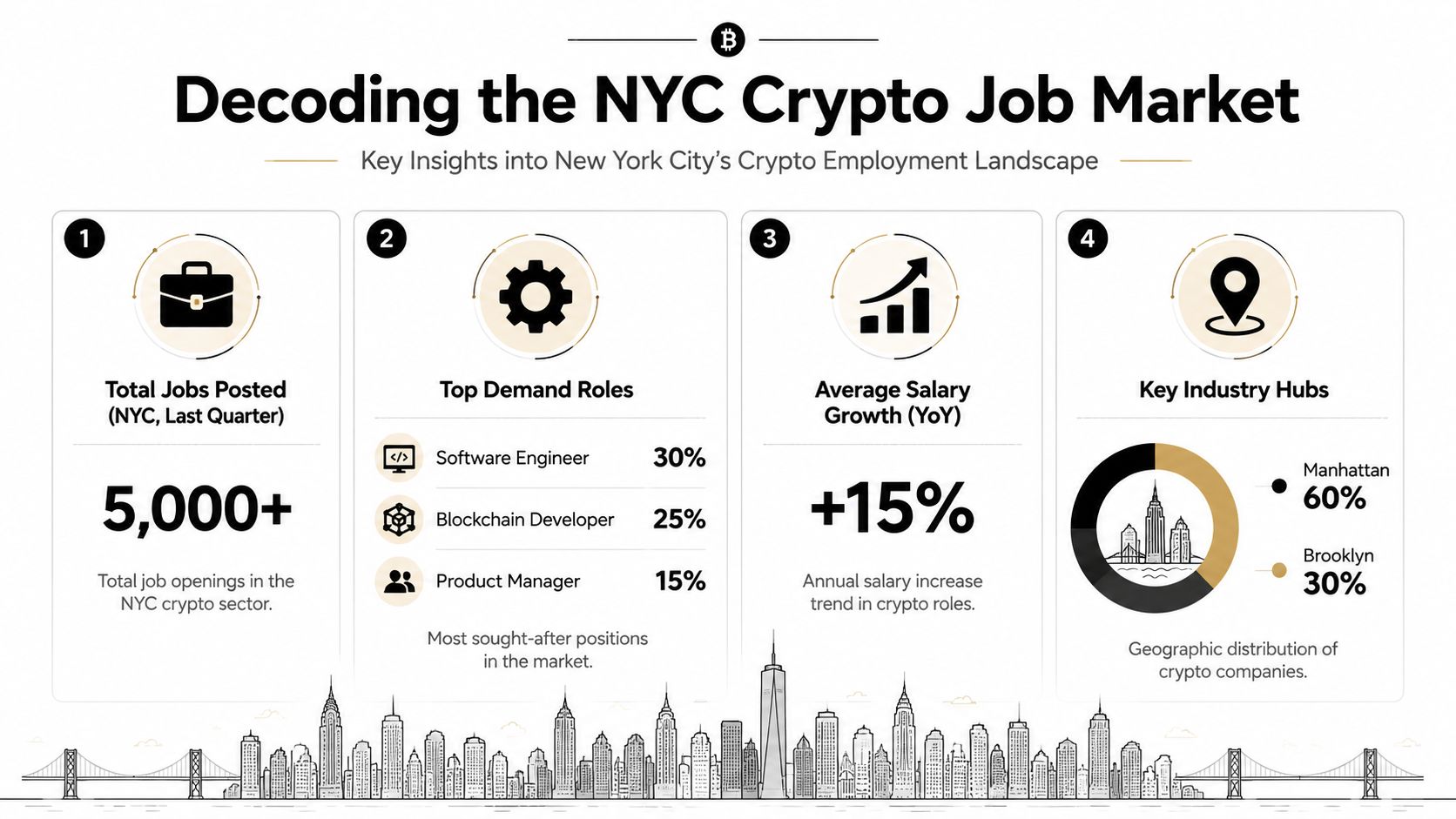
As of early 2026, New York City had 261 open crypto positions, with salaries ranging from $35,000 to $400,000, a median compensation of $182,500, and a typical pay band of $153,419 to $205,173, according to SailOnchain's New York crypto jobs page. That same dataset said the most active categories were Engineering, Marketing, Operations, Business Development, and Finance.
That category mix matters. A lot of candidates still think crypto hiring means Solidity engineer or nothing. That's not how NYC works. The market needs engineers, yes, but it also needs operators who can handle listings, onboarding, partnerships, treasury workflows, customer lifecycle work, and institutional support.
The companies mentioned there also tell you something about the local ecosystem. Polymarket, Gemini, Galaxy Digital, and FalconX point to a market that spans exchanges, trading, infrastructure, and DeFi-adjacent work. That's useful because your job search strategy should change depending on which lane you're targeting.
A practical map of company types
Use this framework when sorting crypto jobs in NYC:
| Company type | What they tend to value | What usually gets interviews |
|---|---|---|
| Exchanges and brokerages | Reliability, regulated operations, user trust | Operations depth, product judgment, compliance awareness |
| Trading and market firms | Speed, data quality, systems thinking | Quant background, low-latency mindset, rigorous analysis |
| Infrastructure and tooling | Developer empathy, technical precision | Strong GitHub, architecture thinking, clear writing |
| Protocol and DeFi teams | Onchain fluency, community credibility | Public work, governance familiarity, ecosystem participation |
This isn't a hard rule. But it helps you stop sending the same resume to every employer.
What compensation really means in this city
The headline numbers in New York are attractive, but they can distract people. A role can look strong on paper and still be weak in practice if the company can't explain reporting lines, product direction, token upside, or what success looks like in the first months.
Use compensation as a filter, not a finish line. If the median is meaningful, your next question should be whether the work builds a durable career asset. In NYC, that usually means one of three things:
- Brand signal: A recognizable company that helps the next move.
- Skill compounding: Work that deepens a hard-to-replace capability.
- Network proximity: Daily exposure to strong operators, founders, or investors.
A high salary in crypto is useful. A role that gives you better judgment, better references, and better market access is usually worth more over time.
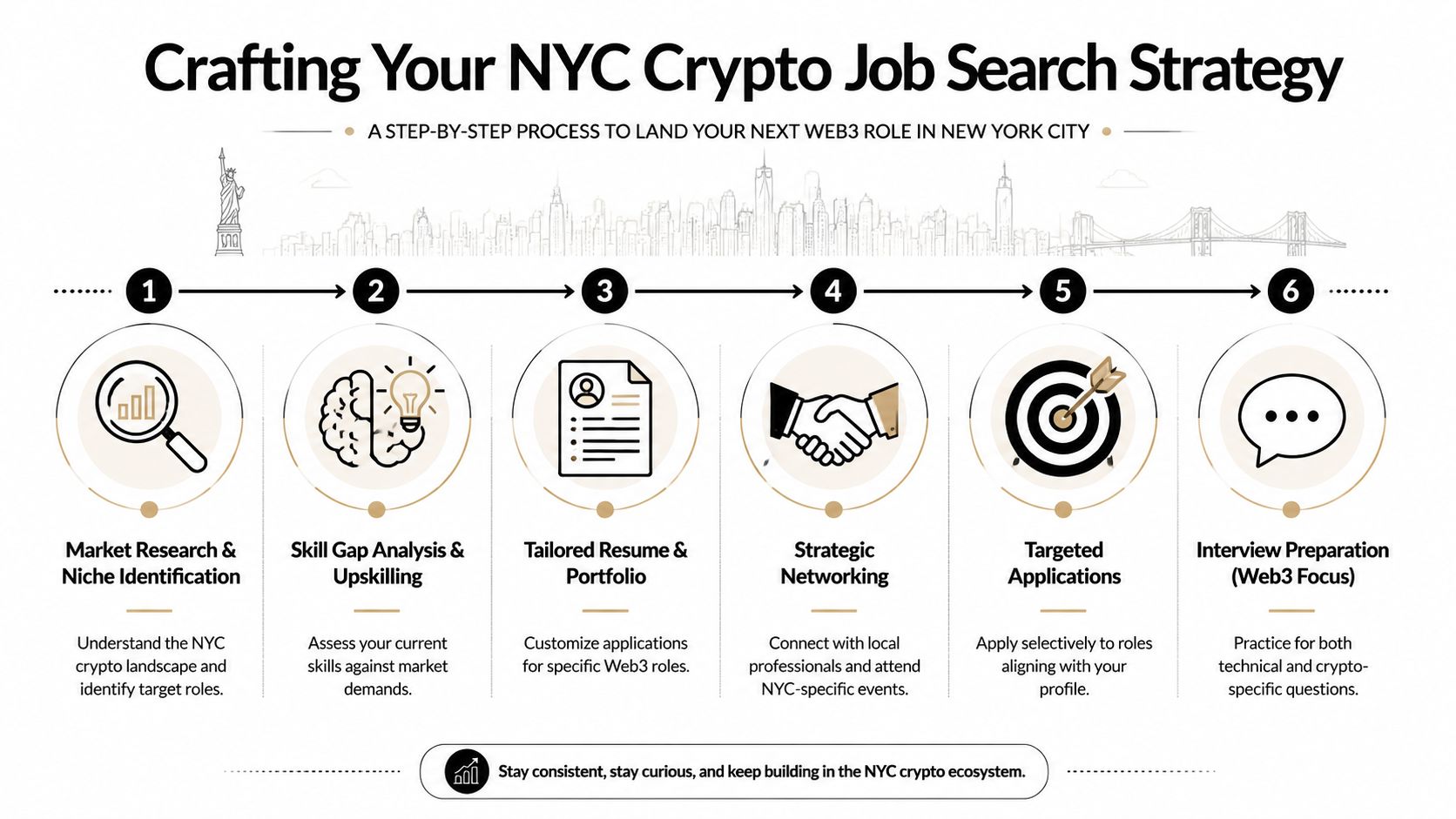
Crafting Your NYC Job Search Strategy
The spray-and-pray method doesn't work well in crypto, and it works even worse in New York. The reason is simple. Scarce talent gets found, not just filtered through inbound applications.
Use a sourcing strategy, not just an application strategy
A blockchain hiring guide described a 17:1 job-openings-to-qualified-developer ratio and recommended sourcing from GitHub contributions, hackathons, developer communities, and specialized Web3 job boards because traditional boards underperform for scarce talent, according to 23stud's blockchain developer hiring guide.
Even if you aren't an engineer, the lesson still applies. Strong candidates don't wait to be discovered through the same funnel as everyone else. They show work, enter conversations early, and make it easy for hiring teams to place them.
Here's the framework I'd use for crypto jobs in NYC:
Pick one lane first
Don't search “crypto jobs” as one undifferentiated market. Decide whether you're targeting trading, infrastructure, product, operations, compliance, growth, or BD.Build a target list Aim for a focused set of companies where your background fits. Not every crypto company wants the same profile.
Work parallel channels
Apply, but also reach out to employees, recruiters, and adjacent teams. One channel is too thin in a competitive market.Show public signal
For technical roles, that can be GitHub. For product, write teardown notes. For growth, publish campaign thinking. For compliance, comment intelligently on frameworks and risk trade-offs.
Where to look and how to filter
Use specialist job boards before you default to broad ones. On Blockchain Jobs engineering listings, for example, you can quickly review crypto roles by function and then narrow for NYC, hybrid, or remote-eligible patterns depending on how employers structure the role.
Then go direct. If you identify a company you want, check its careers page and compare the language there to aggregator postings. Often the careers page gives better clues about priorities, reporting lines, and whether the role is core or experimental.
A few tactical rules matter:
- Apply early when you can. New York teams often move quickly once they see a credible candidate.
- Mirror the company's language. If they talk about market structure, protocols, custody, data pipelines, liquidity, or institutional onboarding, your materials should too.
- Don't over-index on title matching. Crypto companies frequently use nonstandard titles. Read the actual work.
What doesn't work
A weak search in NYC usually has one or more of these problems:
- Generic resume language that could fit any SaaS role.
- No public proof of interest in crypto beyond “I'm passionate about Web3.”
- Mass outreach with zero specificity about why that company, that role, or that team.
- No market point of view on what part of crypto you understand.
The candidates who move fastest tend to be legible. A hiring manager should know within a minute what you do, what domain you understand, and why you belong in that seat.
Networking in the New York Crypto Scene
New York networking is valuable when it's specific. “Go to more events” is weak advice. The pertinent question is where you'll meet people who can pull you into an interview loop, refer you internally, or sharpen your understanding of the market.

Which rooms are worth your time
In NYC, the highest-value rooms usually fall into three groups.
First, there are major industry conferences. Events like NFT.NYC and Mainnet attract a broad crowd, which is useful if you're trying to understand the ecosystem or meet recruiters, founders, and vendors in one place. These are noisy environments, so they're rarely where deeper connections are forged. They're where the first contact happens.
Second, there are smaller recurring meetups found through platforms like Eventbrite, Luma, company events, and operator circles. These are often better for serious conversations because the room is smaller and the attendees usually share a function or theme.
Third, there are digital side doors. Discord servers, Telegram groups, and tightly followed X circles often surface opportunities before jobs become widely visible. If you only network in person, you'll miss half the market.
One useful shortcut is to browse crypto companies hiring through Blockchain Jobs. Not because every role will fit you, but because company lists help you identify who exists in the ecosystem, which names keep appearing, and where to focus your networking energy.
How to act at an event without sounding junior
The best event conversations in New York usually start with one of these:
- An informed question: Ask how a company is thinking about product distribution, institutional demand, compliance workflow, or user trust.
- A market observation: Share a concise point of view on something real, like exchange UX, wallet onboarding friction, token incentives, or data tooling.
- A useful follow-up angle: Mention a relevant article, product experience, or niche expertise that connects directly to their work.
What doesn't work is the vague “I'd love to pick your brain” opener. It puts all the work on the other person.
Bring one sharp question and one credible opinion. That's enough to start a strong conversation.
For follow-up mechanics, Scalelist's guide to LinkedIn networking is a practical reference because it focuses on message quality, relevance, and timing instead of generic “build your brand” advice.
A message template that actually gets replies
Use something like this on LinkedIn or X after a real point of contact:
Hi [Name], good meeting you at [event]. I appreciated your point about [specific topic]. I'm exploring crypto roles in NYC focused on [function], and your work at [company] stood out because of [specific reason]. If you're open to it, I'd value a short coffee chat or a few questions over message about how your team thinks about [relevant topic]. Happy to keep it brief.
That works because it's grounded, respectful, and easy to answer.
A stronger version, if you didn't meet in person:
Hi [Name], I've been following [company/team] and liked your perspective on [specific topic]. My background is in [brief summary], and I'm focused on moving into a crypto role in NYC around [function]. I'm not asking for a referral upfront. I'd just love to ask one or two thoughtful questions if you're open.
Later in the process, video can help you tighten your pitch and understand how others frame the market. This is a useful one to study before outreach or events:
Mastering Your Application and Outreach
A large share of applications never earn a first conversation because the resume reads like a job description, not proof of judgment. In New York, where crypto teams often review candidates in tight batches after a meetup, intro, or founder post, that gap gets exposed fast.
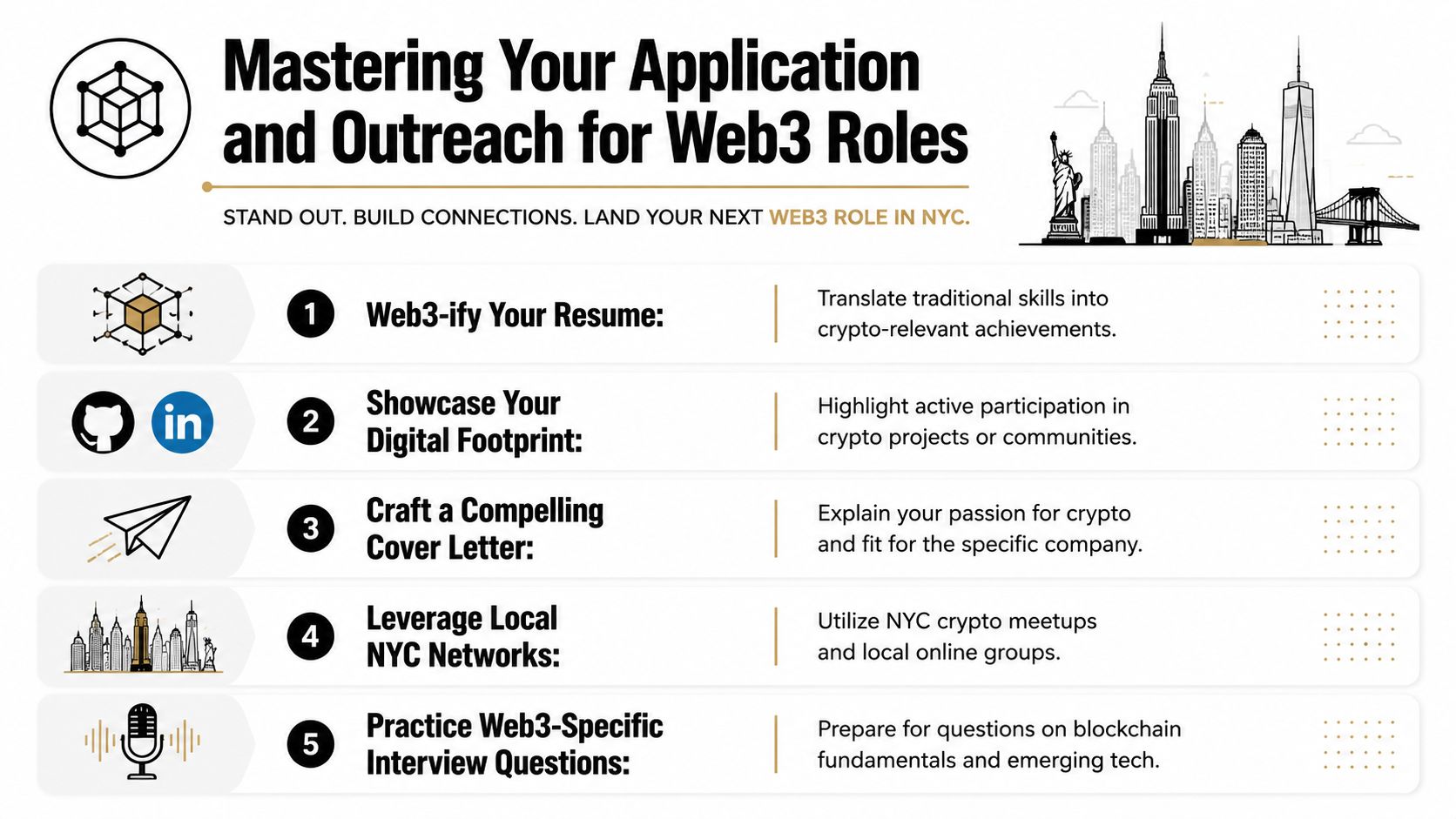
Fix your resume before you send another application
NYC hiring managers usually scan for four things in under a minute. They want to know whether you can work through ambiguity, whether you understand the product or market, whether you can communicate across technical and business teams, and whether you have delivered results.
That means every bullet needs a point of view.
Candidates from fintech, SaaS, trading, data, and regulated industries often undersell themselves because they describe responsibilities instead of decisions. Crypto teams care about how you handled messy launches, cross-functional conflict, user trust, operational risk, or shifting requirements. Those are transferable.
Here's the difference:
| Weak wording | Better wording |
|---|---|
| Managed partnerships | Built and maintained partner workflows across onboarding, reporting, and issue resolution |
| Worked on product launches | Coordinated cross-functional product release with engineering, operations, and customer-facing teams |
| Led analytics efforts | Turned user and performance data into roadmap inputs, retention analysis, or trading-support insights |
Tailor the top third of the resume for the role and the city. If you are applying to a Manhattan market maker, your version should read differently than one sent to a Brooklyn wallet startup or a compliance-heavy exchange team downtown. The strongest candidates make that adjustment without rewriting their entire background.
Build a portfolio a hiring team can inspect in five minutes
A crypto portfolio does not need polish for its own sake. It needs to reduce doubt.
For engineers, that usually means repos, shipped projects, architecture notes, smart contract work, or open-source contributions with enough context that a reviewer can see your judgment. For product candidates, it means specs, teardown memos, user-flow critiques, prioritization docs, or market maps tied to real products. For operations, BD, and growth roles, include process docs, onboarding flows, campaign strategy, incident writeups, ecosystem research, or partner materials that show how you think under pressure.
Keep it easy to review:
- Put your best two or three pieces first.
- Add one sentence of context for each artifact.
- Explain your role, the constraint, and the outcome.
- Remove anything that reads like filler.
Hiring teams trust work they can click.
It is also smart to assume some employers use structured screening before a human conversation. If you want to understand how these systems think about evaluation categories, question formats, and role-fit signals, WorkSignal's overview of automated candidate screening is worth reviewing before interviews.
Two effective outreach templates
The previous section covered networking mechanics. Application-stage outreach is different. At this point, the goal is to make it easy for a recruiter, hiring manager, or team member in New York to place you quickly: who you are, why this team, and why now.
Good outreach is specific to the local market. Mention the product, the team's recent hiring pattern, a panel you attended in SoHo or Flatiron, a founder comment from X, or a problem the company is likely dealing with. Generic enthusiasm gets ignored. Inboxes here are too crowded.
Template one: cover letter for a formal application
Dear [Hiring Manager / Team],
I'm applying for the [Role] position because your team is working on a problem with real relevance to [market, user type, or workflow]. My background is in [field], with hands-on experience in [specific capability], especially in environments that require fast judgment, clear communication, and close work across functions.
I'm interested in [Company] for a specific reason: [product insight, market observation, regulatory angle, or team strength]. I would be excited to contribute to [specific challenge], where my experience in [relevant experience] would be useful from the start.
In prior roles, I've owned work such as [brief concrete example]. I'd welcome the chance to discuss how I could help your team.
Best, [Name]
Template two: respectful cold outreach to a team member
Hi [Name],
I'm exploring crypto roles in NYC focused on [function], and I reached out because your team stood out for [specific reason]. My background is in [brief summary], with experience in [relevant skills or domain].
I spent time looking at [product, announcement, feature, or market segment], and I have a few questions about how your team approaches [specific topic]. If you're open to it, I'd appreciate a short conversation or a few messages. I'm not asking for a referral upfront. I'm trying to understand where my experience would translate well in New York's crypto market.
Thanks either way, [Name]
These templates work because they respect context. They do not ask for too much, and they give the other person a reason to respond.
Tighten your follow-up and submission process
In NYC, strong candidates separate themselves. They do not spray applications across every exchange, protocol, and infra company with the same materials. They keep a short target list, track who they contacted, note where they met them, and follow up with a relevant point.
A simple system is enough:
- Save one resume version per role type.
- Track every outreach message in a sheet or CRM.
- Follow up once after five to seven business days.
- Reference a real trigger, such as a new job post, funding news, product launch, or event conversation.
- Stop if there is no response after a reasonable second touch.
The city rewards precision. A thoughtful note to the right operator at the right firm will beat ten generic applications every time.
Securing the Offer and Advancing Your Career
By the time you reach interviews, the question changes. It's no longer “can you get noticed?” It's “can the team trust you with real work?”
What interviewers in NYC usually test for
Crypto firms in New York often mix domain depth with execution pressure. Engineers may face code reviews, systems questions, or take-homes tied to real product constraints. Product candidates usually get case-style discussions around user flows, market structure, prioritization, or protocol design trade-offs. Operations, BD, and growth candidates often get tested on judgment, communication, and whether they understand how this industry works.
Prepare for questions like these:
- How would you explain our product to a skeptical institutional client?
- What trade-off would you make between speed and control in a high-risk workflow?
- Which crypto products do you use, and what frustrates you about them?
- What part of the market do you think is overbuilt, and what's still missing?
Those questions aren't looking for slogans. They're checking whether you've done the work to form a real point of view.
Think beyond the offer letter
The first role matters, but the second and third moves matter too. A smart career decision in crypto jobs in NYC usually improves one of these: domain expertise, brand credibility, or access to better operators.
That's why the first 90 days matter so much. Learn the company's vocabulary fast. Understand how decisions get made. Figure out which metrics, workflows, or user problems drive internal trust. Then become useful in a way that's visible.
If you need help tightening recruiter communication during a live search, BAMF recruiter message tips are useful because they push you toward concise, relevant messages instead of long introductions.
The best long-term crypto careers in New York don't come from chasing titles. They come from becoming the person teams call when the work is hard, ambiguous, and commercially important.
If you're actively searching, Blockchain Jobs is a practical place to track open roles across the Web3 ecosystem, including functions beyond engineering. Use it to build a target list, compare role language, and spot where your experience fits before you start outreach.