
Top 7 Web3 Growth Marketer Jobs Sites for 2026

You open five tabs, save twelve roles, and by the end of the hour you still cannot tell which company needs a real growth marketer and which one just wants someone to post on X and call it acquisition. That is the first filter in Web3 hiring. Titles are noisy, scope is inconsistent, and a strong-looking role can hide a weak team or a mismatched mandate.
Growth marketers who come from SaaS or consumer apps usually spot the pattern fast. The work is familiar, but the operating context is not. A Web3 team may expect one person to own paid acquisition, onboarding, lifecycle, partnerships, community loops, and token-related launch support. Hiring managers also screen for market fluency. They want someone who understands wallets, on-chain user behavior, incentive design, and the difference between product usage and speculative attention.
The demand signal is still strong. As noted earlier, growth marketing has held up better than many adjacent marketing functions, even in a tighter hiring market. In Web3, this is even more pronounced because smaller teams cannot afford specialists who only manage one channel. They hire operators who can diagnose a funnel, ship tests quickly, and tie community activity back to adoption.
That changes how to job hunt.
A generic search across major job sites will surface some good openings, but it will not tell you how to prioritize niche crypto boards versus broad platforms, where early-stage teams post first, or how your application should change depending on the source. Even the same title can require a different pitch. A role found through a crypto-native board often rewards proof that you already understand the ecosystem. A role found on a larger platform may require translating your Web3 experience into business language a recruiter can screen quickly.
This guide covers both sides of the market. It shows where to find high-signal Web3 growth roles, including crypto-native listings like the Blockchain Jobs marketing jobs board, and how to use larger platforms as intelligence channels, networking surfaces, and entry points into teams that do not always hire in public for long. The goal is not to send more applications. It is to spend time where the signal is highest, shape your pitch for each platform, and get into interview loops that lead to meaningful ownership.
1. Blockchain Jobs The Specialist's Starting Point
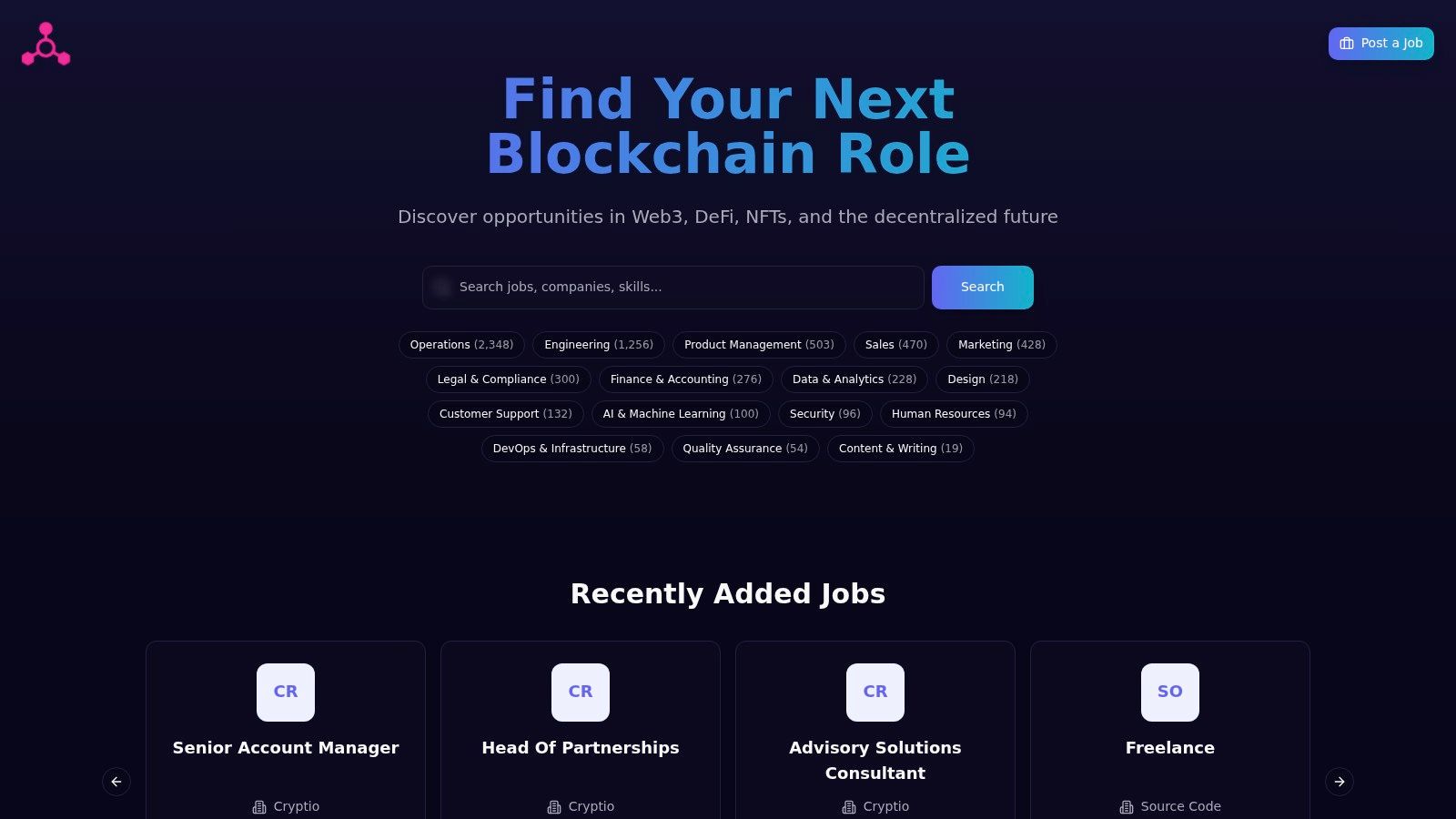
If you only have time to check one site daily, make it Blockchain Jobs.
The signal is highest for Web3 growth marketer jobs. You’re not digging through irrelevant SaaS listings or “crypto adjacent” companies that still don’t know what they want. You’re looking at teams already hiring inside the ecosystem across DeFi, infrastructure, NFTs, AI, and community-heavy products.
The advantage isn’t just relevance. It’s speed. In crypto hiring, being early matters because many teams interview in tight loops and move fast once they find someone who speaks the language.
How to use it like an operator
Start with the dedicated marketing jobs on Blockchain Jobs page and don’t search only for “growth marketer.” Search for adjacent titles too:
- Head of Growth: Often a true full-funnel owner in smaller protocols.
- Growth Lead: Usually a hybrid of product marketing, analytics, and acquisition.
- Community Marketing Manager: Frequently a growth role wearing a community label.
- Lifecycle or CRM roles: Often underused entry points into strong Web3 teams.
- Content roles with distribution ownership: Good bridge positions if the product is early and education-heavy.
Then read the listing for what the company values. If the brief talks about Discord, ambassadors, KOLs, governance, and launches, they want community-led growth. If it emphasizes funnels, activation, experimentation, and attribution, they want a classic growth operator with Web3 fluency.
Practical rule: Rewrite your résumé for this platform. A generic “drove paid social efficiency” bullet won’t carry much weight in a crypto-native stack.
Translate your experience into terms a protocol team understands. If you’ve never worked in crypto, don’t fake it. Reframe accurately:
- Paid acquisition background: Position it as channel experimentation, creative testing, and user-quality optimization.
- Lifecycle experience: Tie it to activation, retention, and re-engagement loops.
- Community work: Show how you’ve moderated feedback, nurtured advocates, or supported user education.
- Analytics ownership: Emphasize cohort thinking, funnel diagnosis, and rapid iteration.
What works in applications and interviews
A lot of candidates lose here by trying to sound “crypto native” instead of sounding useful.
Hiring managers on specialist boards usually want two things. First, proof you can learn the space fast. Second, proof you can ship without a giant support team.
Your application should include a short, role-specific note. Not a broad cover letter. Give them a mini growth thesis for their product. Mention one acquisition idea, one activation risk, and one retention opportunity.
For interviews, expect practical prompts. How would you grow a wallet product with low trust? How would you activate dormant community members? How would you launch a campaign around a protocol upgrade without attracting low-quality users?
The best answers aren’t the flashiest. They show channel judgment, user empathy, and an understanding that Web3 incentives can attract the wrong behavior if you optimize badly.
The trade-off with Blockchain Jobs is that it’s primarily a listings platform, not a full career CRM. That’s fine. Treat it as your top-of-funnel source for relevant roles, then run your own process in a tracker. For serious blockchain growth marketer jobs, this is still the cleanest place to start.
2. LinkedIn Jobs Your Web3 Intelligence and Networking Hub
LinkedIn Jobs is noisy, but that’s not the reason to ignore it. It’s the reason to use it differently.
Many job seekers treat LinkedIn as a giant apply button. That’s the weakest use case. For Web3 growth marketer jobs, LinkedIn is better as a research surface and relationship map.
Use search for pattern recognition
Search by title, not just company. “Head of Growth,” “Protocol Growth,” “Community Lead,” “Lifecycle Marketing,” and “Product Marketing” will reveal how different teams describe similar work. That helps you decode vague listings elsewhere.
You should also study people who’ve already moved from Web2 into crypto. Their profiles tell you what hiring managers accepted as transferable experience. Sometimes it’s performance marketing. Sometimes it’s developer marketing. Sometimes it’s community and content stitched together into a stronger story.
A cleaner LinkedIn profile helps that process because recruiters often check your profile before replying. This guide on how to improve your LinkedIn profile to attract recruiters is worth using as a cleanup pass before outreach.
Don’t apply cold unless the role is fresh
LinkedIn gets crowded fast. If a listing is old, your application often lands in a pile. The better move is to identify the hiring manager, growth lead, founder, or recruiter tied to the role and send a short note with a relevant angle.
Keep it simple:
- State your fit clearly: Mention your core growth strength in one line.
- Show product awareness: Reference the company’s protocol, app, or audience.
- Offer one useful idea: A test, funnel observation, or messaging angle.
- Ask for context, not a favor: “I’d love to understand what success looks like in this role.”
That gets better responses than asking strangers to “hop on a call.”
LinkedIn is also where you’ll spot bridge opportunities. Some banks, fintechs, gaming companies, and infrastructure players are building digital asset teams without advertising themselves as pure crypto employers. Those roles can be ideal if you want Web3 exposure with more structure.
The downside is real. There are stale listings, recruiter fishing expeditions, and jobs labeled “growth” that are basically general marketing. That’s why LinkedIn should support your search, not anchor it.
3. Wellfound The Early-Stage Web3 Playground
Wellfound is where early-stage startup hiring still feels direct.
If you want broad ownership and you’re comfortable building while the product, positioning, and even category are still settling, this platform can be a strong source of Web3 growth marketer jobs. It’s especially useful when a startup is hiring its first dedicated growth person. That’s messy work, but it’s also where careers accelerate.
Why startup context matters here
A mature exchange or analytics company can hire specialists. A seed-stage wallet, infrastructure tool, or consumer crypto app usually can’t. They need someone who can write landing page copy in the morning, shape onboarding in the afternoon, and spend the evening reviewing acquisition tests.
That means your résumé should emphasize range without sounding scattered. Show a growth system, not a bag of channels.
The compensation discussion also works differently in these roles. Equity and token exposure may matter more than in traditional startup hiring. You need to ask better questions:
- How does the team think about token incentives versus salary?
- Who owns growth decisions today?
- What does the first successful quarter in role look like?
- Is this a product with retention potential, or is the company still solving discovery?
If you want a concrete reference point for how crypto-native roles can be framed, review a live example like this Growth Manager role at Binance in Australia. Even if it isn’t your target market, it’s useful for seeing how platform growth expectations get described in a Web3 setting.
Interview for ambiguity, not polish
Founders hiring through Wellfound often care less about polished corporate storytelling and more about whether you can create order from ambiguity.
Bring a lightweight operator mindset into the process:
- Talk in experiments: What would you test first, and why?
- Prioritize constraints: What can be learned before budget is committed?
- Separate channels from mechanics: Don’t just say “I’d run paid.” Explain what behavior you’d want to create.
- Show how you learn a category: If you’re newer to crypto, explain your research habits and how you’d get user insight quickly.
A founder will forgive that you haven’t marketed a DeFi product before. They won’t forgive vague thinking.
The trade-off is obvious. Early-stage startups can change direction fast. Some don’t yet know whether they need performance, product marketing, content, or community. You have to diagnose that before joining. But if you want your work tied closely to product adoption, Wellfound is one of the better hunting grounds.
4. Y Combinator's Work at a Startup The Bleeding Edge
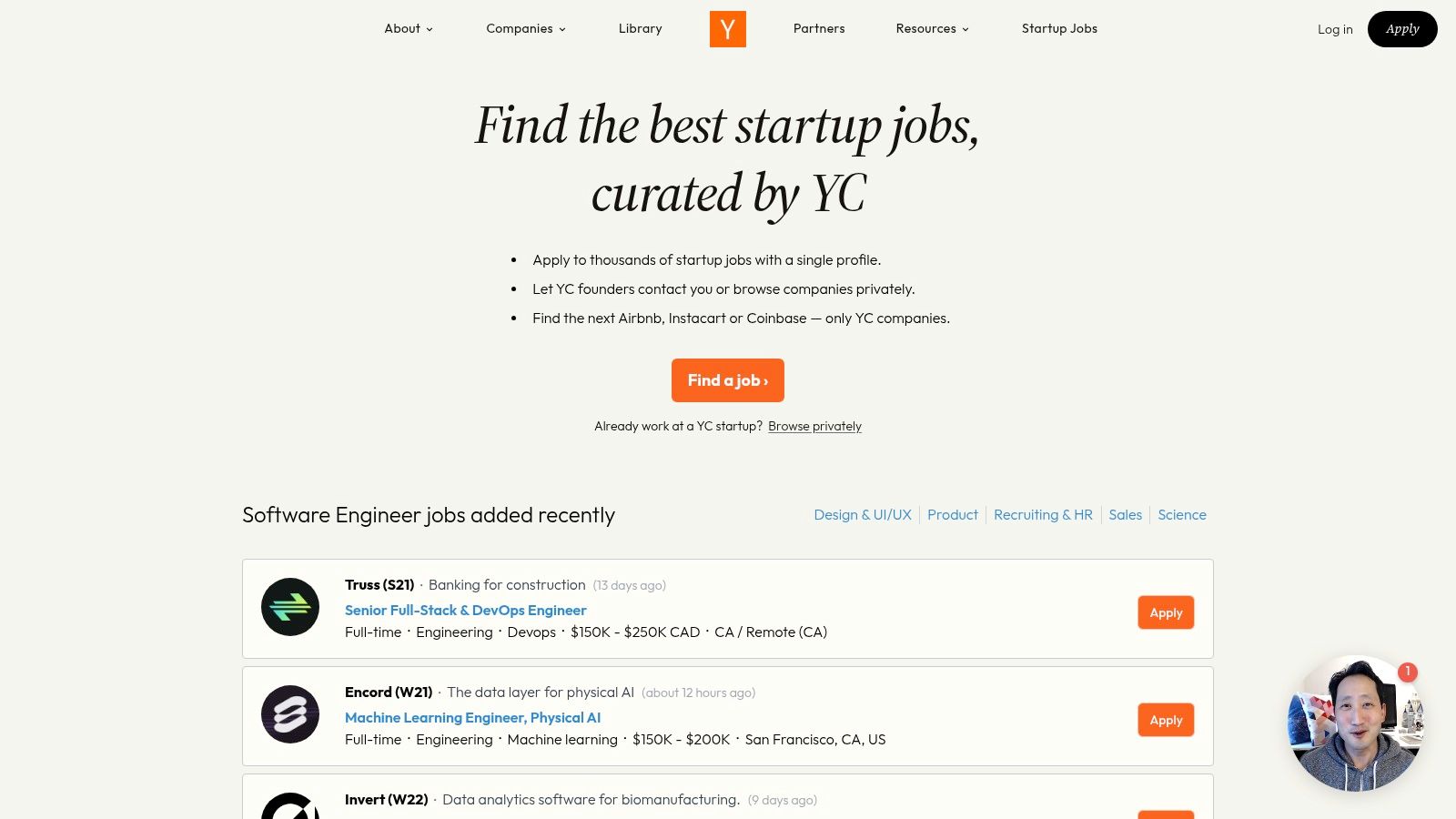
A founder opens your application at 11 p.m. between product bugs, user support, and a fundraising update. That context shapes how YC roles should be approached.
YC’s Work at a Startup gives growth candidates a direct path to technical founders and early operators. For Web3 jobs, that matters because many of these teams are still deciding what growth means for their product. One company needs activation for a wallet. Another needs developer adoption for infrastructure. Another needs sharper positioning for a data product that good engineers built but few buyers understand.
The best applications are specific enough to prove judgment and short enough to respect the reader’s time.
A strong YC application usually covers three things:
- Why your background matches this product and user.
- What growth friction you already see from the outside.
- What you would test in the first 30 to 90 days.
That last piece matters more than polished buzzwords. Founders want to see whether you can diagnose a problem before asking for budget, headcount, or a big channel mix.
I usually recommend bringing a one-page operating memo to the interview. Keep it plain. No deck unless they ask. Include the acquisition channels worth testing, the activation event that likely predicts value, the retention behavior that would signal product pull, and the open questions that need user research before anything scales. If you can discuss trade-offs clearly, you separate yourself from applicants who only talk in generic growth language.
A role like this associate growth marketer opening at CoinGecko is a useful benchmark for the kind of startup-side thinking that plays well here. The title is only part of the story. What matters is whether you can connect product usage, audience behavior, and a practical testing plan.
The trade-off with YC jobs is straightforward. You often get proximity to founders, product decisions, and real influence early. You also get ambiguity, shifting priorities, and job scopes that can slide from lifecycle to content to partnerships in a single quarter. Candidates who need clean role boundaries usually struggle. Candidates who can create structure fast tend to do well.
5. Built In For Growth Roles at Mature Web3 Companies
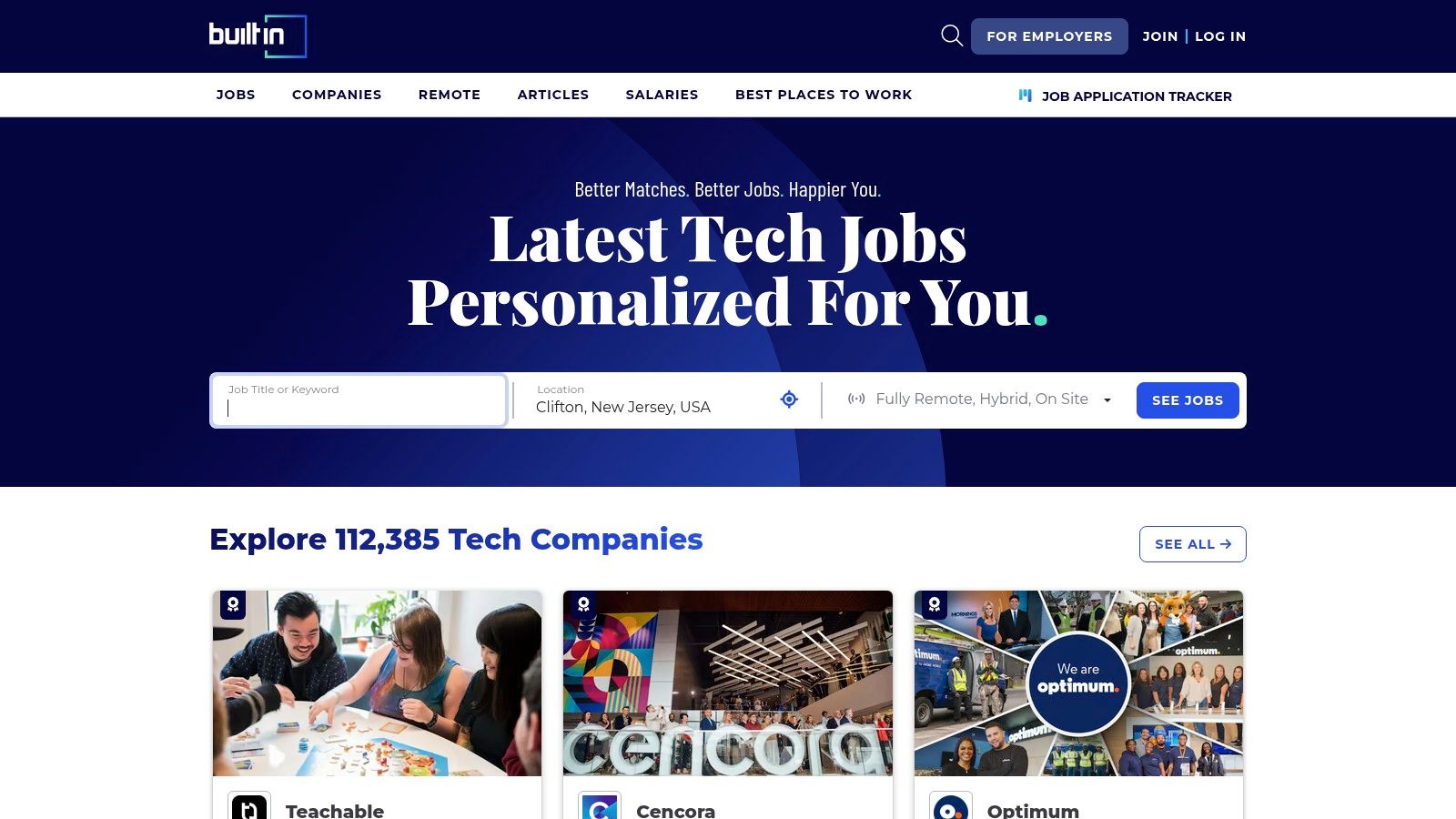
A common miss happens here. Candidates spend all their time on crypto-native boards, then wonder why they keep finding either very early protocol roles or vague “growth” jobs with no operating context.
Built In is stronger for the other side of the market. It surfaces growth roles at companies that already have a product team, a reporting line, some budget discipline, and clearer expectations around what growth is supposed to own. In Web3, that usually means exchanges, infrastructure companies, analytics products, fintech firms with digital asset exposure, and later-stage startups that no longer hire marketers as general-purpose utility players.
That changes how you should search and how you should pitch yourself.
Built In works best for specialists crossing into crypto. If you come from lifecycle, paid media, product marketing, SEO, content, or growth ops, this platform gives you better odds of finding a role where that craft is understood. Hiring managers at more mature companies are usually not asking one person to run community, partnerships, brand, content, and performance from day one. They want someone who can own a defined part of the funnel and work well with product, analytics, sales, and compliance.
Your application should reflect that reality. Skip the “full-stack growth” framing unless you did the work. Show depth, then show range around it.
A practical way to position yourself:
- Lifecycle marketers: Tie your work to onboarding, activation milestones, retention loops, and churn signals for wallet, app, or platform users.
- SEO and content operators: Show how you build educational content around technical products, capture intent, and support category education without drifting into fluff.
- Performance marketers: Explain how you judged lead or user quality in regulated or policy-sensitive acquisition environments.
- Growth analysts and ops hires: Highlight instrumentation, cohort analysis, experiment design, and how your reporting changed decisions.
A listing like the Associate Growth Marketer role at CoinGecko API shows the type of position that often fits this lane. It sits close to product, requires clean communication, and rewards candidates who can connect user behavior to measurable growth work.
Built In also gives you more useful company context than a lot of startup-first boards. Use that before the first interview. Review the company profile, recent product launches, team structure, office and remote setup, and the way they describe the business. That material helps you answer the questions mature teams care about: where growth sits in the org, whether success is measured by pipeline, activation, revenue, or retention, and how much freedom the role really has.
I’d prepare differently for a Built In company than for a seed-stage protocol. Bring channel ideas, but also bring operating judgment. Be ready to explain which metric you would own, what dependencies would slow execution, which experiments need engineering support, and where compliance or legal review could block a fast test. That level of specificity plays well with more established teams because they have already felt the cost of messy growth work.
The trade-off is straightforward. Built In usually has fewer strange, experimental, crypto-native roles. What it offers instead is clearer scope, better-defined progression, and a hiring process that lets strong operators stand out on judgment, not just enthusiasm.
6. Otta The Curated Feed for High-Signal Web3 Roles
Otta, now under Welcome to the Jungle, helps when your problem is not job volume. It helps when your search is getting polluted by vague growth roles, recycled startup posts, and companies that cannot explain what they need.
I use Otta differently from specialist Web3 boards. I would not rely on it as the core of a crypto-native search. I would use it as a quality filter running alongside a broader search on blockchain-specific platforms and large job sites. That combination matters. Niche boards show where the market is active. Otta helps you spot the companies that know how to hire.
That curation is useful for growth marketers because messy hiring copy usually signals a messy role. If the listing cannot explain the product, the audience, or what growth owns, expect confusion once interviews start.
Where Otta fits in a Web3 job search
Otta works best for candidates who already know their lane.
Maybe you want a growth role at a wallet, infra product, analytics company, or developer platform with a real product story and a team that has thought through reporting lines. Otta can surface those better than high-volume boards that mix strong roles with a lot of noise.
What to screen for fast:
- Product clarity: Can the company explain what it sells without jargon?
- Ownership clarity: Does the role name a funnel, audience, or KPI?
- Team maturity: Is growth a function with peers and process, or a catch-all hire?
- Cross-functional reality: Will you work with product, sales, content, community, or lifecycle?
Those details matter more in Web3 than polished branding alone. A sharp careers page can hide a role with no budget, no analytics support, and no agreement on whether growth means acquisition, activation, or partnerships.
How to use Otta without wasting time
Use the listing as a pre-interview diagnostic.
Read the company description, then test it against the rest of the internet. Check the product, recent launches, founder posts, and whether the company speaks clearly everywhere or only on the job page. If the Otta listing is thoughtful but the product is hard to understand after ten minutes of research, treat that as a warning.
I would also tailor applications more aggressively here than on a broad board. Curated platforms usually attract fewer random applicants and more candidates who can write. That raises the standard. A generic crypto-growth resume will blend in. A tighter application that shows you understand the company’s user motion, likely bottleneck, and first useful experiment gives you a real edge.
One interview tactic works especially well with Otta companies. Ask how the team defines growth before you pitch ideas. If the answer is precise, the role often is too. If three interviewers describe three different mandates, save yourself the headache.
The trade-off is straightforward. Otta will not give you the depth of a dedicated Web3 board or the breadth of LinkedIn. What it can give you is a cleaner short list of higher-signal opportunities, which is valuable when you want fewer applications, better conversations, and a stronger shot at a role worth taking.
7. AMA Job Board The Bridge Role Opportunity
A common Web3 job search problem looks like this. You have real growth experience, a track record in regulated or technical markets, and enough curiosity about crypto to know where the category is going. Yet the specialist boards keep filtering for candidates who already speak fluent protocol.
AMA Job Board helps with that gap.
It is the least crypto-native source on this list, but that is the value. You are not using it to find the hottest onchain startup before everyone else. You are using it to find companies that need a marketer who can connect traditional growth discipline with an emerging Web3 product, initiative, or business line.
The best opportunities here usually sit inside larger organizations. Look for teams working on blockchain products, digital asset education, tokenized loyalty, gaming ecosystems, fintech innovation, or partnerships tied to ownership and identity. These roles often sound more conservative on paper, but they can be a smart entry point if you want exposure to Web3 without joining a team that still confuses growth with posting memes and buying KOL shoutouts.
That distinction matters.
AMA listings can reward a candidate who knows how to build trust, explain a new category, and operate well with product, legal, and brand in the same room. For marketers coming from finance, gaming, ecommerce, enterprise SaaS, or loyalty, that profile can be more attractive than a thin claim of crypto-native experience.
How to win bridge-role interviews
Position yourself as the person who can make an unfamiliar product understandable and adoptable.
That means showing four things clearly:
- Audience education: Explain how you turned a complex product into messaging, onboarding, or lifecycle campaigns that a broader market could understand.
- Cross-functional execution: Show how you worked with legal, compliance, product, sales, and brand when growth could not be separated from risk.
- Disciplined experimentation: Talk through tests you ran in categories where trust mattered and sloppy acquisition could create downstream problems.
- Category creation: Give examples of launching products that needed market education before demand capture was even possible.
The interview tactic I like here is simple. Ask what the company needs translated. If they answer with a real business problem, such as helping traditional customers understand wallet-based loyalty or reducing friction in a blockchain-powered onboarding flow, the role is probably grounded in reality. If the answer is vague language about "driving Web3 innovation," press harder.
Your application should reflect that same mindset. Do not submit a crypto-styled resume and hope the logo stack does the work. Write a short note that shows you understand the buyer, the trust barrier, and the adoption challenge. Bridge-role hiring teams usually respond better to clear commercial thinking than to insider jargon.
The trade-off is volume. Openings are thinner, search terms need to be tighter, and some roles will turn out to be Web3-adjacent in name only. Still, for marketers making the jump from Web2 into blockchain, AMA can surface a category of role that specialist boards often miss. In practice, that can be the shortest path to getting real Web3 growth experience on your resume.
Top 7 Growth Marketer Job Sources Compared
| Platform | 🔄 Implementation Complexity | ⚡ Resource Requirements | ⭐📊 Expected Outcomes | 💡 Ideal Use Cases | ⭐ Key Advantages |
|---|---|---|---|---|---|
| Blockchain Jobs: The Specialist's Starting Point | Low, daily checks + tailored Web3 resume | Moderate time investment for Web3-specific materials | ⭐ High relevance; faster matches with crypto-native employers | Targeted hires at protocols, dApps, crypto-native teams | Specialized, high signal-to-noise listings |
| LinkedIn Jobs: Your Web3 Intelligence & Networking Hub | Medium, requires active networking and research | High, time for outreach, profile optimization, optional Premium | ⭐📊 Broad opportunities; variable quality; strong referral potential | Networking, ecosystem mapping, transitioning Web2→Web3 | Largest professional network and intelligence tools |
| Wellfound (AngelList): The Early-Stage Web3 Playground | Medium, vetting startups and token components | Moderate, due diligence on founders, comp (equity/tokens) | ⭐ High-impact roles with equity/token upside; hands-on ownership | Seed/Series A startups where you build growth from scratch | Startup access with compensation transparency |
| Y Combinator's Work at a Startup: The Bleeding Edge | High, founder-facing, expect autonomy and rapid delivery | High, prepare one-pagers/experiments; fast turnaround | ⭐📊 Potential for fast growth responsibility and learning; equity-heavy | Ambitious, deeply technical Web3 projects seeking owner-operators | Curated, high-potential YC-backed startups and founder access |
| Built In: For Growth Roles at Mature Web3 Companies | Medium, standard corporate hiring with product-context prep | Moderate, company research (benefits, teams, funding) | ⭐ Stable roles, clearer career paths, competitive benefits | Scale-ups, exchanges, analytics firms needing structured growth teams | Detailed company profiles and lower volatility |
| Otta: The Curated Feed for High-Signal Web3 Roles | Low, curated feed reduces search overhead | Low, set up profile and alerts; passive discovery | ⭐ High fit quality but lower volume; better employer signals | Passive, culture-fit searches at mission-driven Web3 companies | Curation and candidate-friendly UX that reduces noise |
| AMA Job Board: The 'Bridge Role' Opportunity | Low, standard marketing board with niche listings | Low, fewer crypto-native applicants; may require translation skills | ⭐ Targeted corporate Web3 initiatives; lower immediate crypto intensity | Transition roles in traditional firms building Web3 initiatives | Access to less-competitive bridge roles within established companies |
Build Your Career in Decentralized Growth
A candidate spends two hours sending the same resume to seven platforms, gets one recruiter reply, and walks into the interview talking about “community growth” in general terms. A stronger candidate uses each platform for a different job, shows up with protocol-specific ideas, and gets treated like an operator instead of an applicant.
That difference decides a lot of Web3 hiring outcomes.
The mistake is treating growth marketer jobs as one market with one application strategy. It is not. Crypto-native boards surface teams that care about wallet activation, onchain retention, token incentive design, and community loops. Generalist platforms surface adjacent roles, larger teams, and companies that may be entering Web3 from fintech, gaming, infrastructure, or developer tooling. The best search uses both.
Each platform in this list fits a different part of the process. Blockchain Jobs is for direct access to crypto-native roles. LinkedIn is for market mapping, recruiter visibility, and backchannel research. Wellfound and YC are better for founder-led teams that want ownership and speed. Built In and Otta are useful when role scope, team structure, and company quality matter more than pure upside. AMA can surface bridge roles where traditional marketing discipline still carries a lot of weight.
The application should change with the platform.
On a specialist Web3 board, send a sharper thesis. Mention one protocol category you understand, one growth loop you would test, and one metric you would audit first. On LinkedIn, use the listing as a starting point, then identify the hiring manager, product lead, or founder and build context before the interview. On Wellfound or YC, expect to be tested on judgment and pace. Founders want to know what you would ship in the first 30 days, not whether you can repeat growth jargon cleanly.
AI fluency now matters here too. Teams expect faster research, better experiment design, tighter messaging, and cleaner reporting. The edge is not tool access. The edge is judgment. Show how you decide what not to automate, where human trust matters, and how you keep experiments from turning into noise.
Web3 still has a talent gap for marketers who can connect classic growth work with crypto-native behavior. My experience shows a shortage of candidates who can speak credibly about wallet onboarding, Discord and Telegram operations, token or NFT campaign mechanics, partner-led distribution, and analytics beyond top-line traffic. That gap makes good operators stand out fast.
Start narrower than you think. Pick one ecosystem, one audience, and one growth problem you can explain clearly. Then build applications around that point of view.
If you want a clearer picture of what the day-to-day can look like, this overview of a Growth Marketing Manager role is a useful complement to the platform strategy above.