How to Improve Coding Skills: A Career-Focused Guide

"How do I get better at coding?" It's a question every developer asks, but the typical advice—"just code more"—is a recipe for burnout, not a career breakthrough. The real secret isn't about the sheer volume of code you write. It's about a strategic mix of deliberate practice, building career-focused projects, and mastering collaborative workflows.
This approach is designed to build the skills that actually get you hired and promoted. It's about turning your learning time into tangible career growth.
Your Roadmap to Becoming an In-Demand Developer
Forget generic advice. To level up, you need a practical framework that connects your daily coding habits to the things that matter: acing technical interviews, getting a better job, and becoming a more effective engineer.
The goal isn't just to write code; it's to build a reputation as a reliable problem-solver who delivers clean, effective solutions as part of a team. Hiring managers don't just want syntax experts. They're looking for engineers who can build, debug, and collaborate efficiently, and your learning strategy needs to reflect that reality.
Focus on Career-Driven Learning
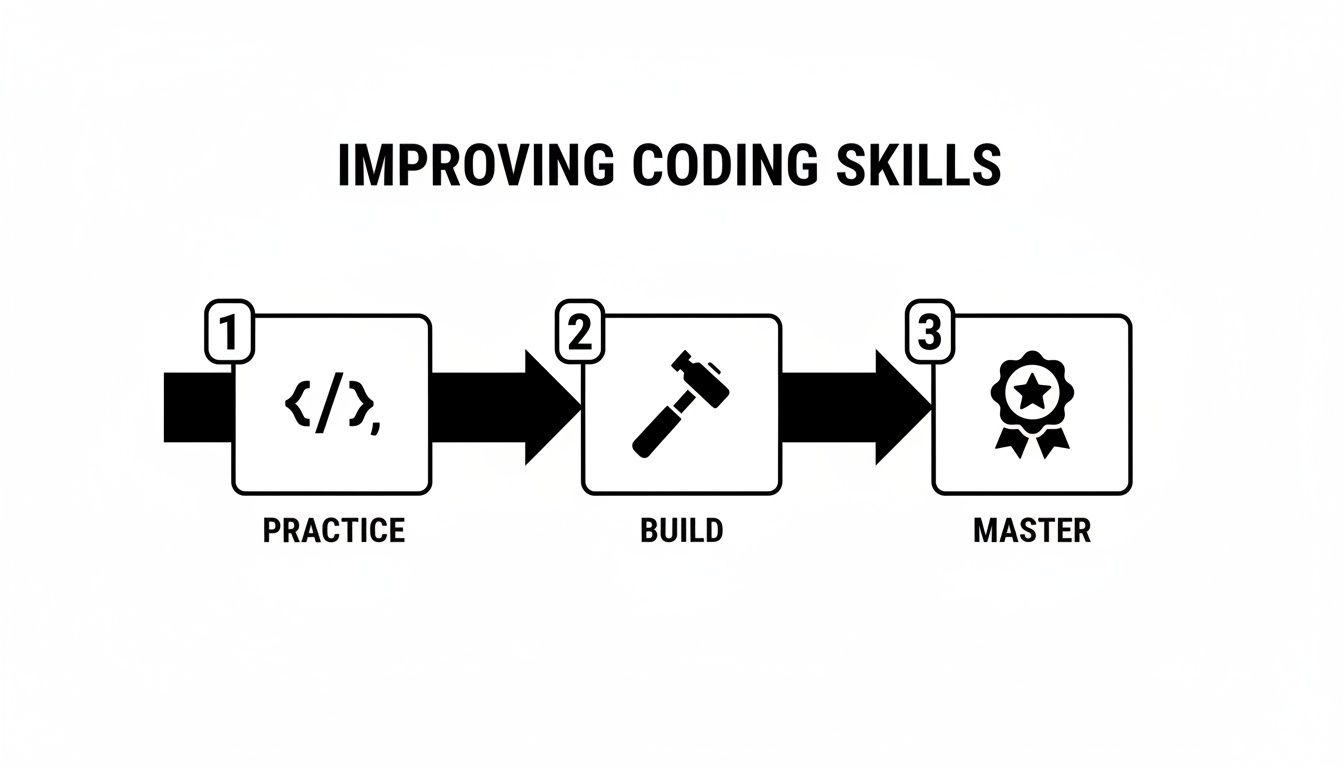
Instead of getting lost in abstract tutorials, you need an actionable plan. This roadmap is built on three core pillars that directly impact how you're perceived in the job market.
- Deliberate Practice: Shift from aimless coding sessions to targeted exercises that shore up your weaknesses. This is how you prepare for the real challenges you'll face in interviews and on the job.
- High-Impact Projects: Learn to build portfolio pieces that scream "I have in-demand skills!" This gives you compelling talking points for your resume and interviews. High-growth fields, like those listed on specialized job boards for blockchain development, put a massive premium on real project experience.
- Professional Workflows: Master the skills that separate a junior from a senior contributor. This means effective debugging, writing clean and maintainable code, and knowing how to give and receive feedback in code reviews.
Think of this as building career capital. Every line of code you write and every project you finish should be a strategic investment in your future, making you a more competent and marketable developer.
By zeroing in on these areas, you stop learning in a vacuum and start building the exact skills companies are desperate to hire for. This mindset shift is the single most important step you can take.
Building a Deliberate Practice Habit That Works
Putting in the hours is a great start, but coding every day won’t automatically make you a senior developer. The real difference between a good developer and a great one isn't just time—it's the quality and focus of that time. This is where deliberate practice comes into play. It’s a game-changer.
Deliberate practice means you stop coding aimlessly and start attacking your weaknesses with a purpose. It's about systematically identifying the gaps in your knowledge and turning them into strengths. Do you freeze up when faced with recursion? Do API integrations make you sweat? That’s exactly what you should be working on. These aren't just abstract exercises; they're the skills that get you through a tough technical interview or help you deliver on a critical project.
This approach transforms your daily coding from a chore into a powerful career-building machine.
From Aimless Coding to Targeted Improvement
First things first, you need to carve out time for deep, focused work. I’m a huge fan of the Pomodoro Technique—working in sharp, uninterrupted 25-minute sprints followed by a quick 5-minute break. This simple rhythm keeps your concentration high and stops you from burning out, which is when sloppy code and shallow learning creep in.
During these sessions, your goal is to wrestle with problems that are just a little beyond your current comfort zone. This is where platforms like LeetCode can be a goldmine, but only if you use them strategically. Don’t just bounce around picking problems at random.
Instead, zero in on the foundational patterns that show up again and again in real-world software engineering and, not coincidentally, in interviews.
- Two Pointers: A must-know for optimizing problems with arrays and strings.
- Sliding Window: Your go-to pattern for subarray or substring challenges.
- Binary Search: The classic, hyper-efficient algorithm for sorted data.
- Tree Traversal (DFS/BFS): Absolutely critical for navigating complex data structures like trees and graphs.
Getting a solid handle on these patterns gives you a versatile toolkit that hiring managers are actively looking for. It proves you can think about efficiency and write optimized code, not just memorize a few solutions.
Structuring Your Week for Maximum Growth
A sustainable habit needs a smart weekly schedule. You have to mix learning new concepts with reinforcing what you already know. Otherwise, you’ll get stuck in "tutorial hell"—that frustrating cycle where you learn something new one week only to completely forget it the next.
A great developer isn't someone who knows everything; they're someone who has a solid process for learning anything. Your weekly schedule should reflect this, balancing new challenges with the reinforcement of core skills.
A structured weekly plan helps you internalize concepts and apply them consistently. Here’s a sample schedule to give you an idea of how to lay out your week for deliberate practice.
Sample Weekly Deliberate Practice Schedule
| Day | Focus Area | Activity (1-2 Hours) | Career Goal Connection |
|---|---|---|---|
| Monday | Data Structures & Algorithms (DSA) | Solve 2-3 "Two Pointers" problems on LeetCode. Review solutions. | Prepares for technical interviews and improves code efficiency. |
| Tuesday | New Concept: State Management | Read docs for a new library (e.g., Zustand). Build a small counter app with it. | Keeps skills current and expands your toolkit for complex applications. |
| Wednesday | Project Work | Implement a new feature in your portfolio project (e.g., user authentication). | Provides tangible proof of your abilities to employers. |
| Thursday | DSA Review & Application | Revisit a "Binary Search" problem from a few weeks ago without looking at the solution. | Solidifies long-term memory and ensures you truly understand the concept. |
| Friday | Code Review & Debugging | Find an open-source project and review a pull request. Try to understand the changes. | Hones your ability to read and critique professional code. |
| Saturday | Deep Dive or Project Enhancement | Watch a conference talk on system design or refactor a messy part of your project. | Builds deeper, more specialized knowledge. |
| Sunday | Rest & Light Review | Read technical articles or plan the upcoming week's focus areas. | Prevents burnout and keeps learning enjoyable. |
This kind of routine ensures you’re not just learning in a vacuum. You’re practicing, applying, and reviewing—the complete cycle needed for real mastery. You can find more tips for building a standout profile on our career development blog.
Building Projects That Get You Hired
Let's be blunt: tutorials teach you syntax, but projects get you a job. Your portfolio is the single most important asset you have in your job search. It's the concrete proof that you can take what you've learned and build something real. Hiring managers don't just want to know you understand a concept; they want to see you've actually executed it.
This is where you graduate from passive learning to active creation. Every project you build needs to be a strategic move. Don't just pick something because it sounds fun—choose it because it showcases a specific, in-demand skill that companies are desperately looking for. Think of each project as a direct answer to a bullet point on a job description.

Go Beyond the To-Do List App
Every developer has built a to-do list. It's a rite of passage. But if it's the star of your portfolio, you're going to blend in with the crowd. To really catch a hiring manager's eye, your projects need to show some muscle. They should tackle problems that mirror what you'd actually face in a professional setting.
Instead of another basic CRUD (Create, Read, Update, Delete) app, find ideas that force you to wrestle with things like user authentication, state management, and calling external APIs. This is how you prove you're ready for a real engineering role, not just a classroom exercise.
Projects That Map Directly to Job Descriptions
The secret is to work backward from the job description. Find a role you want, look at the required skills, and then build a project that screams, "I have that skill!" You're not just building an app; you're building a compelling story for your resume and a goldmine of talking points for your interviews.
Here are a few ideas, broken down by the skills they showcase.
1. The Full-Stack E-commerce Site
This one is a classic for a good reason. It’s a beast of a project that covers almost every facet of web development, and any recruiter will instantly understand its value.
- Skills Demonstrated: You'll be knee-deep in user authentication, database management (with something like PostgreSQL or MongoDB), complex state management (using Redux or Zustand), and payment gateway integration with the Stripe API.
- Career Impact: This project is your proof that you can own a feature from the database all the way to the UI. It’s an incredibly powerful interview tool, letting you talk about everything from data modeling to handling secure transactions.
2. The Real-Time Chat Application
Modern web apps are all about interactivity. A chat app shows you know how to build the dynamic, responsive experiences users now expect.
- Skills Demonstrated: This is your chance to shine with WebSockets (using a library like Socket.IO), handle multiple concurrent connections, and build an event-driven interface that feels alive.
- Career Impact: Building this signals to employers that your skills are current. You can speak confidently about the headaches of managing real-time data and keeping state synced across many clients—a challenge at the heart of many modern tech stacks.
3. The Data Visualization Dashboard
Every company is drowning in data. A project that can fetch, process, and display that data in a meaningful way is a golden ticket. It demonstrates a skill set that's always in high demand.
- Skills Demonstrated: You'll be fetching data from third-party APIs, cleaning and transforming that data, and then using charting libraries like D3.js or Chart.js to create beautiful, interactive visualizations.
- Career Impact: This project shows you can work with messy, real-world data and turn it into business intelligence. It’s a perfect fit for roles touching on analytics, finance, or SaaS products.
Your portfolio should do the talking for you. A well-executed project with a clean codebase and a live demo is more persuasive than any bullet point on your resume. It’s your proof of work.
Document Your Work Like a Professional
Building the project is only half the battle. A brilliant project with a sloppy presentation can completely fall flat. Your mission is to make it ridiculously easy for a busy hiring manager to understand what you built, why you built it, and what you learned along the way.
Every project in your GitHub repository needs a detailed README.md file. This isn't just a formality; it's your project's sales pitch.
- Clear Project Description: Start with a punchy, one-paragraph summary of what the project is and what problem it solves.
- Live Demo Link: Put this right at the top. Don't make them hunt for it. A live, deployed version is non-negotiable.
- Tech Stack: List the key technologies, libraries, and frameworks you used.
- Features: Use a bulleted list to show off the cool things your application can do.
- Challenges & Solutions: This is pure gold. Briefly describe a tough technical problem you ran into and exactly how you solved it. This showcases your problem-solving chops and gives you perfect stories to tell in an interview.
This level of documentation proves you're more than just a coder. It shows you're an engineer who thinks about communication and maintainability—skills that are absolutely critical for working on a team. It frames your project as a professional product, not a student exercise, and can dramatically change how your skills are perceived.
Level Up Your Code Quality and Collaboration
So, you can make your code work. That's the price of admission. But getting hired and building a real career? That’s all about writing clean, maintainable code that others can actually understand and build upon.
When you're part of a team, you're not just a coder—you're an engineer contributing to a larger product. Your ability to collaborate, hunt down bugs efficiently, and hold yourself to a high standard is what separates the pros from the hobbyists. Recruiters and hiring managers look for these skills specifically, as they signal you're ready to contribute from day one.

Go Beyond Console.log: A Debugging Masterclass
Every developer's first instinct is to litter their code with console.log() or print() statements. It’s a quick-and-dirty way to see what's going on, but let's be honest: it’s like fumbling for a light switch in the dark. It’s inefficient and often masks the real root of the problem. Relying on it in an interview or on the job is a dead giveaway of inexperience.
The real game-changer is mastering your environment's built-in debugger. Tools like the debugger in Chrome DevTools or inside VS Code are your secret weapon. They let you freeze your code's execution at any point, giving you a complete snapshot of your application's state—every variable, the full call stack, the entire program flow.
Think of it this way:
console.logis like taking a single, blurry photo of a moving car to guess its destination. Using a debugger is like having a full video replay with the power to pause, rewind, and check the GPS at any moment.
Learning to set breakpoints and step through your code line-by-line is a genuine superpower. It turns debugging from a frustrating guessing game into a methodical investigation. This is a skill you absolutely should brag about in interviews. Describing how you navigated the call stack to solve a nasty bug is infinitely more impressive than admitting you just added more print statements.
The Art of the Code Review
In any real engineering team, code reviews (or Pull Requests/PRs) are the lifeblood of collaboration. Getting good at this process—both giving and receiving feedback—is one of the fastest ways to improve your coding skills and prove you’re ready for a bigger role.
Giving great feedback isn't about nitpicking or showing how smart you are. It’s about making the code better, together.
- Be Specific and Actionable: Don't just say, "This is confusing." Instead, try, "Could we rename the
datavariable touserProfilehere? I think it would make the intent clearer." - Ask, Don't Command: Frame your feedback as a question. "What do you think about extracting this logic into its own helper function?" opens a discussion, while "Extract this" can feel like an order.
- Praise in Public: If you see a clever solution or a really clean bit of code, say so! Acknowledging good work builds trust and makes the constructive feedback easier to hear.
Receiving feedback well is probably the harder skill. It takes humility. Your code is not you. You have to detach your ego and see feedback for what it is: a free lesson from a teammate who wants the project to succeed. Instead of getting defensive, get curious. Seek to understand their point of view. A candidate who can talk about what they learned from a tough code review is someone every team wants to hire.
Crafting a Professional Git History
Believe it or not, your Git history is part of your professional portfolio. A messy log filled with commit messages like "fix" or "wip" screams disorganization. A clean, well-documented history, on the other hand, tells the story of a methodical engineer who communicates with purpose.
Start adopting a professional Git workflow now, even on your personal projects.
- Atomic Commits: Each commit should be a single, logical unit of change. This makes your work easy to review, understand, and—if something goes wrong—revert.
- Descriptive Commit Messages: Follow a standard format, like the one outlined by Conventional Commits. A great message has a short subject line saying what changed and an optional body explaining why the change was necessary.
- Interactive Rebase: Get comfortable with
git rebase -i. It’s a powerful tool for cleaning up your local commit history before you open a pull request. You can squash small "oops" commits, reword messages, and reorder everything to present a clean, coherent story of your work.
When a hiring manager glances at your GitHub and sees a pristine, professional commit history, it sends an immediate, powerful signal: you're a disciplined developer who gets how teams work. It’s an often-overlooked detail that can make you stand out from the crowd.
Translating Your Coding Skills into Job Offers
All that practice, all those projects—it all leads to this moment. Now, it’s time to shift gears from being a builder to a storyteller and turn your hard-won skills into a compelling job offer. Think of it this way: your technical abilities are the product, and your portfolio, resume, and interview performance are the marketing campaign.
Hiring managers are looking for more than just a coder. They're searching for a future teammate who solves real business problems, communicates clearly, and can contribute from day one. Your job is to make it incredibly easy for them to picture you in that role.
Transforming Your GitHub into a Career Narrative
Your GitHub profile is so much more than a code backup. It’s your professional story, laid out for all to see. When a recruiter lands on your page, they need to immediately see a clear narrative of growth, curiosity, and technical skill. A messy, random assortment of projects just sends the wrong signal.
Start by pinning your most impressive projects—the ones that speak directly to the jobs you want. These are your "hero" projects. Give them polished README.md files complete with live demos, a breakdown of the tech stack, and a quick summary of the challenges you tackled.
Your GitHub is a living resume. Every pinned project and every contribution is a piece of evidence that proves your skills are real and applicable. Don't leave its interpretation to chance; curate it to tell the story you want employers to hear.
This level of care shows professionalism and proves you know how to present your work. It’s a simple step that immediately sets you apart from candidates who just use their profile as a code dump.
Articulating Impact on Your Resume
Here’s a hard truth: your resume is not a laundry list of technologies. It's a highlight reel of the problems you’ve solved and the impact you’ve made. This is a critical distinction that so many developers get wrong.
Instead of just writing, "Built a REST API with Node.js and Express," you have to frame it with context and results.
Try this instead: "Developed a RESTful API for a user management system, resulting in a 30% reduction in data retrieval latency and supporting over 1,000 concurrent users." See the difference? This version shows what you did and, more importantly, why it mattered.
Get in the habit of quantifying your achievements whenever you can:
- Did you improve performance? By how much?
- Did you ship a feature that boosted user engagement?
- Did you refactor code that cut down on server costs?
Even personal projects have an impact you can estimate. For example: "Engineered a caching layer that improved API response times from 800ms to under 200ms during load testing." These are the details that grab attention and give you powerful talking points for your interviews. For a great example of how top companies frame their needs, check out this Senior Software Engineer job description, which focuses heavily on impact and ownership.
Acing the Technical Interview
The technical interview puts your problem-solving process under a microscope. It’s not just about getting the right answer; it’s about showing how you think. Whether you're at a whiteboard or in a system design discussion, your communication is just as important as your code.
Whiteboard and Live Coding Challenges: The golden rule here is to think out loud. Start by making sure you understand the problem and stating your assumptions. Walk the interviewer through your thought process as you weigh different approaches. Talk about the trade-offs—why you're picking one data structure over another, for example. Even if you don't nail the perfect solution, demonstrating a logical, methodical approach is a huge win.
System Design Discussions: These questions test your ability to think at a higher level. You might be asked to design a social media feed or a URL shortener. Start with the big-picture components and then zoom in. You'll want to discuss API design, database choices, caching strategies, and potential bottlenecks. The goal is to show you can think about scalability, reliability, and the system as a whole.
Behavioral Questions: When they ask, "Tell me about a time you had a conflict with a teammate," they’re really testing your collaboration skills. Use the STAR method (Situation, Task, Action, Result) to give your answers structure. Be specific, take ownership of your part, and always focus on what you learned from the experience.
This whole process—from projects to portfolio—is a proven path. Just look at coding bootcamps, which champion these kinds of intensive, outcome-focused strategies. One global report found that roughly 71% of bootcamp graduates landed a job within six months. That’s a strong signal that this kind of focused learning pays off. You can see more data on bootcamp market trends and employment outcomes. By adopting a similar project-based and career-focused strategy, you're setting yourself up for the same kind of success.
Staying Relevant in a Fast-Moving Tech World
Landing your first dev job is a massive win, but don't mistake the finish line for the starting block. This is a marathon. The tech world moves at a dizzying speed, and the best engineers I know are the ones who never stop learning. It’s not just something you do to get hired; it's a core part of the job itself. Real, long-term career growth hinges on your ability to adapt without completely burning yourself out.
This doesn't mean you have to jump on every new JavaScript framework that pops up on Twitter. Honestly, that’s a fast track to exhaustion. The real skill is learning to be deliberate and strategic about where you invest your time.
Build a Learning Habit You Can Actually Stick With
The secret is to weave learning into your life in a way that doesn’t feel like a chore. A few focused hours sprinkled throughout the month will do more for you than a frantic, week-long cram session once a year.
Here are a few habits I’ve seen work wonders:
- Filter the Noise with Newsletters: Find one or two high-quality newsletters and actually read them. Something like TLDR or Bytes does a great job of cutting through the noise and delivering what’s important right to your inbox.
- Follow the Source: Identify the key people and project maintainers in your niche on platforms like X (formerly Twitter) or Mastodon. Their conversations are often a window into where the industry is heading.
- Do a Monthly "Spike": Block out one morning a month to just play. A "spike" is just a short, focused dive into something new—maybe a new AI coding assistant or a Web3 protocol you've been curious about. No pressure, just exploration.
The goal here isn't to master a new technology in a weekend. It's about building a mental map of what's on the horizon. This kind of awareness is what separates good developers from great ones, especially when you get into senior roles and system design interviews.
Lean Into Tech Shifts, Don’t Run From Them
When a major shift happens—like the explosion of AI in software development—it’s easy to feel threatened. But these are opportunities, not threats. As AI starts to handle more of the routine coding tasks, our value shifts to things like complex system design, creative problem-solving, and big-picture thinking.
In fact, some reports estimate that around 39% of a worker's core skills could be outdated in just five years. That's a staggering number, and it underscores why we have to keep learning. You can dig into the data on these trends in reports from organizations like the World Economic Forum.
When you actively learn to use tools like AI assistants, you're not just making yourself more productive today. You're positioning yourself for what engineering roles will look like tomorrow. That constant, intentional growth is what builds a truly resilient and fulfilling career in tech.
Frequently Asked Questions
Even with the best plan in hand, you're bound to have questions. Let's tackle some of the most common ones I hear from developers who are serious about leveling up their coding skills and landing better roles.
How Much Time Should I Actually Spend Coding Each Day?
Forget the 8-hour marathon sessions on weekends. Consistency is king.
Your goal should be 1-2 hours of focused, deep work on your code at least five days a week. This steady, repeated effort builds a much stronger foundation for long-term skill retention than cramming. From a hiring manager's perspective, a GitHub contribution graph that shows consistent daily activity speaks volumes about your dedication and discipline.
The point isn't to burn yourself out; it's to build a sustainable habit. One solid hour spent wrestling with a tough algorithm is worth more than four hours of passively watching tutorials.
Should I Learn Another Programming Language?
This really comes down to where you are in your career. If you're just starting out, my advice is to go deep, not wide. Mastering one language and its entire ecosystem makes you a far more valuable and hireable specialist than being a beginner in five different languages.
But once you've got a solid handle on your primary stack? Absolutely. Learning a second language, especially one with a different paradigm (like picking up a functional language if you're used to object-oriented programming), can fundamentally change how you approach and solve problems. That kind of versatility is a huge plus, especially for senior-level positions.
How Can I Tell if I'm Actually Making Progress?
You need to track tangible outputs—the kind of stuff that matters in a job search. It’s not just about feeling smarter; it's about what you can show a potential employer.
Here’s what to look for:
- Project Complexity: Are you building things you couldn't six months ago? Think user authentication, complex API integrations, or deploying a smart contract to a testnet.
- Code Quality: Look back at your old code. Is your new code cleaner and easier to follow? Are you getting fewer revision requests during code reviews?
- Interview Performance: Are you getting through LeetCode-style problems faster and with more optimal solutions than before?
These aren't just feelings; they are real, measurable signs that your skills are growing in a way that directly translates to career advancement.
Ready to put those new skills to the test? Find your next big opportunity in the Web3, crypto, and blockchain industry on Blockchain Jobs. Check out thousands of curated roles right now at https://blockchain-jobs.com.