remote community manager jobs: Fast-Track Your Application
In the world of Web3 and crypto, a remote community manager isn't just a support role—it's a strategic position absolutely vital to a project's growth. To get hired, you must demonstrate you are the essential bridge between the dev team and a global, decentralized user base. Your ability to build an engaged and loyal following often makes or breaks a project's long-term success, which is why hiring managers are searching for skilled professionals who can deliver tangible results.
What Top Remote Community Managers Actually Do

Forget the old idea of a forum moderator who just deletes spam. Today's remote community manager, especially in Web3, is more like the mayor of a bustling digital city. They’re part strategist, part event planner, and the central communications hub for the entire project—a combination that hiring managers value tremendously.
This role is absolutely critical for a project’s survival. When you’re in a job interview, it's crucial to frame your experience this way. You’re not just a chat moderator; you are a strategic growth driver who cultivates an entire ecosystem. This mindset is what separates top candidates from the rest.
Beyond Moderation: The Core Strategic Duties
A great community manager's day is a mix of proactive engagement and reactive problem-solving. Their work directly impacts user retention, shapes product feedback, and builds the project's reputation from the ground up. From a career standpoint, mastering these duties is your direct path to senior roles like Head of Community or Head of Growth.
Here's a quick look at the core functions you need to master to get hired and promoted.
Core Responsibilities of a Remote Community Manager
| Responsibility Area | Key Activities | Goal for the Business |
|---|---|---|
| Engagement & Events | Organizing AMAs, Twitter Spaces, workshops, contests, and other online events. | Keep the community active, educated, and connected to the project. |
| Feedback Loop | Gathering, filtering, and relaying user feedback, bug reports, and suggestions to the dev team. | Drive product improvements and ensure the project builds what users want. |
| Culture & Safety | Setting the community's tone, enforcing rules, and creating a welcoming, inclusive environment. | Foster a positive culture that attracts and retains valuable members. |
| Content & Communication | Creating announcements, educational guides, and daily content to keep members informed. | Ensure clear, consistent communication and build trust with the user base. |
| Advocacy & Growth | Identifying and empowering super-users, ambassadors, and advocates within the community. | Turn passive users into a powerful force for organic marketing and growth. |
Ultimately, a top community manager's goal is to turn a loose group of users into a powerful, self-sustaining ecosystem. In an interview, you must show you understand this.
Here’s a deeper dive into what that looks like:
- Orchestrating Engagement: Think of yourself as the event planner. You'll be organizing, promoting, and hosting everything from AMAs (Ask Me Anything) with the founders to educational workshops and lively debates on platforms like Twitter/X Spaces or Discord stages.
- Being the Voice of the Community: You are the vital link between the users and the core team. This means collecting, synthesizing, and presenting user feedback, bug reports, and general sentiment to the product and development teams so they can make informed decisions.
- Cultivating Culture: You’re essentially the chief culture officer. It’s your job to set the tone, enforce community guidelines, and create an inclusive, positive space where members feel a real sense of belonging and ownership.
A top community manager transforms a loose group of users into a powerful, self-sustaining ecosystem. This evolution from simple moderation to strategic leadership is precisely why demand for skilled professionals is so high.
The Remote and Web3 Context
Working remotely adds another layer of complexity—and opportunity. Since Web3 communities are global and operate 24/7, the ability to manage your time effectively and communicate asynchronously is non-negotiable. This is a huge selling point in interviews; showing you can self-manage and maintain a presence across time zones is a massive plus.
The broader remote job market saw significant momentum in early 2025, with remote postings growing 67% from January to May. While this trend cooled slightly in the third quarter with a 4% decrease, the demand for skilled remote talent remains strong. You can learn more about these remote hiring trends and how they impact different industries.
Ultimately, understanding the true impact of this role is your greatest asset. In any interview for remote community manager jobs, speak confidently about how you don't just manage conversations—you build assets, gather intelligence, and drive the project's mission forward. That’s what gets you hired.
The Skills That Get You Hired
So, what does it really take to land a top-tier remote community manager job in Web3? It’s about more than just loving crypto and hanging out on Discord. Recruiters and hiring managers are looking for a specific, powerful mix of technical know-how and people skills.
Think of it like this: the project's Discord or Telegram isn't just a chatroom; it's their digital home. They need to trust you to be the architect, builder, and security guard—not just another resident. To get the job, you need to prove you can build a digital ecosystem from scratch, keep it safe, and make it a place people genuinely want to be. It's one thing to list "Discord" on a resume, but it's another to show you can turn a quiet server into a buzzing hub of loyal advocates.
Mastering the Essential Hard Skills
Hard skills are your bread and butter—the tangible, technical things you can do. When you're in an interview, you can't just say you know how to do something; you have to explain the result of your work. These skills are what get your application moved to the top of the pile.
A great way to build this experience is by starting a small side project or even volunteering for a DAO. Just make sure to document everything. This turns abstract abilities into a portfolio of real-world accomplishments that will impress hiring managers.
- Platform Mastery (Discord & Telegram): Anyone can send a message. True mastery means you can architect a Discord server with sophisticated roles, set up bots to shut down raids, and use platforms like Telegram for clean, effective announcements. Hiring managers want to see you can build a community hub that’s both secure and easy to navigate.
- Data and Analytics: Gut feelings are nice, but data wins interviews. You need to be comfortable using tools to track key metrics—member growth, engagement rates, sentiment, you name it. Saying "I grew our Discord from 5k to 15k by launching an ambassador program, which boosted our 30-day retention by 20%" is a world away from just saying "I'm good at growing communities." One gets you hired, the other gets you a "thanks, we'll be in touch."
- Content Creation: You are the project's voice. This means writing sharp announcements, breaking down complex ideas into simple educational content, and running social media campaigns that actually get people talking.
The candidates who stand out don't just list their skills—they tell stories. Frame your experience as a series of problems you've solved. Show a clear line from your actions to the community's success.
Unpacking the Crucial Soft Skills
If hard skills get you the interview, soft skills get you the job. And in a remote role, they’re ten times more important. A hiring manager is looking for someone who can handle the wild, often emotional, social dynamics of a Web3 community with a steady hand.
Senior-level roles, like this Senior Community Support Manager position at Consensys, often call these skills out directly. They're looking for leadership and the ability to handle pressure. These are the traits that build trust, inspire loyalty, and ultimately protect the project's reputation.
- Strategic Communication: This goes way beyond good writing. It's about knowing what to say, when to say it, and on which platform. It’s about translating a dense technical update for a non-technical audience one minute and then summarizing user frustrations for the dev team the next.
- High-Stakes Conflict Resolution: Let's be real, Web3 communities can be intense. FUD (Fear, Uncertainty, and Doubt) is a constant threat, and market swings can make people anxious. You have to be the calm in the storm—the person who can de-escalate tension, address problems head-on, and keep the peace without censoring your members.
- Empathy and Cultural Awareness: You're not managing a local club; you're leading a global community. Empathy is what allows you to connect with people from different backgrounds, understand their unique perspectives, and build an inclusive space where everyone feels welcome. This is the foundation of any community built to last.
Build a Portfolio That Stops Recruiters in Their Tracks

Your resume tells people what you were responsible for, but a portfolio proves what you can actually do. In the crowded world of remote community manager jobs, a killer portfolio is your single greatest advantage. It’s what makes you leap off the page, transforming you from just another applicant into a candidate who gets real, tangible results. It’s what stops a recruiter mid-scroll and makes them pick up the phone.
A truly great portfolio doesn't just display what you did; it tells a compelling story about why it mattered. This is your shot to frame every single experience—even the informal stuff—as a strategic win. Recruiters are drowning in applications and spend only seconds on each one, so your portfolio needs to scream "I drive growth and engagement" from the very first glance.
Turn Your Tasks into Triumphs with Case Studies
The absolute best way to structure your portfolio isn't as a random collection of screenshots, but as a series of punchy case studies. Each one should zero in on a specific challenge you tackled, the actions you took to solve it, and the measurable results you delivered. This "problem-solution-outcome" format is a language every hiring manager understands, showing them you’re a professional who thinks in terms of impact.
And here’s the thing: you don’t need a formal job title to build these. Did you volunteer to moderate a friend’s growing Discord? That’s a case study. Started a niche Telegram channel that actually took off? That’s another one.
Put yourself in the recruiter's shoes. They aren't hiring someone to just "manage a Discord." They need someone to grow an ecosystem, boost user retention, and turn lurkers into loyal evangelists. Your portfolio has to prove you're that person.
Here’s a simple, powerful template to follow for each project:
- The Challenge: Kick things off by setting the scene. What was the problem? For example, "A new DeFi project’s Discord server felt like a ghost town, with only 5% of members actively participating."
- My Solution: Get specific about what you did. "I developed and ran a three-week 'Learn-to-Earn' campaign featuring daily quizzes, a content creation contest, and a final AMA with the lead dev."
- The Results: This is the money shot. Hit them with hard numbers. "The campaign shot up daily active users by 40%, sparked over 500 pieces of user-generated content, and boosted positive sentiment by 15% (tracked via sentiment analysis)."
What Should You Actually Put in Your Portfolio?
Your portfolio needs to be a visual, data-packed story of your skills. Don't just tell a hiring manager you can create awesome content; show them. You want to include a mix of different assets that highlight your range. This gives them concrete proof that you can handle a demanding role like a Community and Social Media Manager.
Key Pieces to Showcase
| Component | Description & Example | Why It's a Must-Have |
|---|---|---|
| Community Growth Sprints | A short report showing how you grew a server from 500 to 5,000 members in three months. Include screenshots of key announcements and analytics dashboards. | This demonstrates your ability to attract and keep members, which is a core goal for any Web3 project. |
| High-Engagement Content | A collection of your greatest hits: a viral Twitter thread that broke down a complex topic, a blog post that got tons of positive comments, or a contest that blew up. | It shows you’re creative and know how to grab an audience's attention and start a real conversation. |
| Event Management Highlights | A one-page summary of a Twitter Space or AMA you hosted. Feature the number of attendees, key questions asked, and screenshots of positive community feedback. | This proves you’re organized, composed under pressure, and can be a trusted public face for a project. |
| Moderation & Crisis Control | A brief, anonymized example of how you shut down a FUD storm or resolved a nasty community conflict. Focus on your communication and problem-solving process. | This builds massive trust. It shows hiring managers you can handle the inevitable chaos of Web3 communities with a cool head. |
When you meticulously document your wins and frame them around strategic impact, your portfolio does more than just list what you’ve done. It tells the story of the value you bring, making it crystal clear to any hiring team that you’re the solution they’ve been searching for.
Where to Find High-Quality Remote Community Jobs
Knowing where to look is half the battle. If you want to land a great remote community manager job, you can’t just browse the usual massive job sites. The best Web3 opportunities rarely show up there. Instead, you need to be hunting where the real action is—in the niche, crypto-native corners of the internet.
Think of your job search less like filling out applications and more like an intelligence-gathering mission. You need to be embedded in the ecosystem, listening to the conversations, and positioning yourself to be in the right place at the right time. The best roles are often found long before a public job description ever gets posted.
Start with Niche Web3 Job Boards
Forget the endless, soul-crushing scroll on Indeed or Monster. Your first stop should always be job boards built specifically for the blockchain industry. These platforms are curated, which means you're going to find serious projects looking for serious talent, not a sea of spam and low-ball offers.
Why are these boards your best starting point? Crypto-native companies go to these boards first because they attract candidates who already get the culture. A listing here is a signal that they're serious about finding talent that's already in the know.
Use these sites for more than just applying. They're a fantastic research tool. Keep an eye on which projects are hiring frequently—it’s a clear sign of rapid growth. You can find some incredible roles on these platforms, like this Web3 Social Media & Community Marketer position.
Go Deeper: Uncover Hidden Gems on Discord and X
The real secret job market for community managers lives on Discord and X (what we used to call Twitter). Honestly, this is where the magic happens. The sharpest projects often hire directly from their own communities, rewarding the most active and helpful members with roles before they even think about writing a formal job ad.
On X, your feed is your intelligence stream. Follow founders, core team members, and the VCs who fund the space. They often drop hints about hiring needs on their personal accounts first, giving their followers a massive head start. A quick, targeted search for phrases like "community manager hiring" or "hiring a CM" can turn up roles you’d never find otherwise.
The best job opportunities aren't applied for; they're created through reputation. Become an invaluable member of a community you love, and you'll find that roles start finding you.
For Discord, the strategy is all about genuine engagement. Lurking won't cut it.
- Join the servers of projects you actually use and believe in.
- Jump into conversations, ask smart questions, and offer helpful answers.
- Be the person who welcomes new members and helps them get their bearings.
Think of this as your live audition. When a hiring manager sees you’re already adding value and acting like part of the team, the interview becomes a formality.
Don't Sleep on LinkedIn for Strategic Networking
I know, I know. A lot of Web3 folks dismiss LinkedIn as too "corporate." But here’s the thing: recruiters and hiring managers absolutely use it to find and vet candidates. You’d be foolish to ignore it. Make sure your profile is sharp and packed with the keywords you see in top-tier job descriptions.
But don't just sit there waiting for connections. Use LinkedIn for surgical outreach. Find the Head of Community or Head of People at a project that excites you and send a message. Keep it short, personalized, and show you've done your homework.
Here’s a template that actually gets a response:
"Hi [Name], I've been following [Project Name]'s work on [mention something specific, like their new governance model] and am really impressed. My background in growing [Your Specific Skill, e.g., DeFi communities from 1k to 20k members] aligns with your mission. If you ever have a need for a community strategist, I'd welcome the chance to connect."
This one simple act transforms you from just another applicant in the pile to a proactive professional who is now on their radar. It’s a small move that can completely change the trajectory of your job search.
To help you decide where to focus your energy, here’s a quick breakdown of the main platforms.
Job Hunting Platform Comparison
Each platform has its own rhythm and purpose. While niche job boards are great for seeing what's officially open, the real alpha often comes from being active on social platforms.
| Platform | Best For | Pros | Cons |
|---|---|---|---|
| Web3 Job Boards | Finding active, publicly listed roles. | High signal-to-noise ratio; curated opportunities from serious projects. | Can be competitive; you're often applying alongside many other candidates. |
| Discord | Building reputation and finding unannounced roles. | Direct access to core teams; opportunity to "audition" for a role by adding value. | Time-intensive; requires genuine, long-term participation. |
| X (Twitter) | Early access to opportunities and networking. | Real-time job posts from founders and VCs; great for staying on the pulse. | Very noisy; opportunities can be fleeting and easy to miss. |
| Professional networking and targeted outreach. | Excellent for identifying key decision-makers and professional vetting. | Often seen as less "crypto-native"; outreach needs to be highly personalized. |
Ultimately, a balanced approach is your best bet. Spend some time on the job boards to get a lay of the land, but invest the majority of your effort in building your reputation on Discord and X. That's where you'll find the opportunities that can truly define your career.
Nail the Interview and Get That Offer
Your portfolio might get your foot in the door, but the interview is where you really close the deal. This is your chance to show the team that you have the strategic mind and steady hand to run a global, often chaotic, Web3 community. It’s where you move beyond the resume and let them see how you think, solve problems, and handle the heat—the real job of a remote community manager.
Think of the interview as a two-way street. It’s not just about you answering their questions. The questions you ask are just as important. Insightful, well-researched questions show you’re already thinking like a partner, not just another candidate blasting out applications.
Preparing for the Tough Questions
Web3 hiring managers are going to throw real-world scenarios at you. They want to see your instincts in action, not a perfectly rehearsed answer they found on a blog. Be ready to talk through messy situations that reveal how you’d handle a crisis or steer a difficult conversation.
One of the all-time classics you’re almost guaranteed to get is, "How would you handle a coordinated FUD attack?"
A weak answer sounds something like, "I'd stay calm and reassure everyone." That’s not a plan. A strong answer lays out a clear, step-by-step framework that shows you’ve been in the trenches before.
Here's how you could break it down:
- Isolate & Acknowledge: "First things first, I'd get the conversation into a dedicated channel—like #announcements-discussion—to stop the panic from spreading everywhere. Then, I’d post a quick message acknowledging we've seen the concerns and are looking into it. That immediately shows we're on top of it."
- Verify & Sync: "Next, I’d be in a private channel with the core team to get the real story. Is this a legitimate problem or just well-crafted misinformation? Knowing the truth is everything."
- Communicate & Clarify: "Once we have the facts, I'd help draft one single, clear, and honest statement from the official project account. We'd hit the FUD head-on without getting defensive."
- Amplify & Re-engage: "Finally, I'd activate our community ambassadors and mods to spread the official response. The goal is to drown out the noise with the truth and quickly pivot the conversation back to something positive and productive."
This kind of structured response proves you can think clearly when everything is on fire.
Tell a Great Story with the STAR Method
For those behavioral questions like, “Tell me about a time you grew an engaged community,” the STAR method (Situation, Task, Action, Result) is your secret weapon. It stops you from rambling and forces you to tell a tight, data-driven story.
- Situation: "The project's Discord had 10,000 members, but it was a ghost town. Only about 8% of users were active on any given day."
- Task: "My mandate was to boost daily active users by 30% in one quarter and make the place feel less like an airport terminal."
- Action: "I rolled out a three-part plan: a weekly educational workshop, a 'project of the week' spotlight led by community members, and a new onboarding bot that actually guided new people instead of just spamming them."
- Result: "After 90 days, we'd increased daily active users by 42%. We also tracked a 15% jump in positive sentiment, and the new onboarding flow improved 30-day retention by 20%."
A candidate who speaks in metrics is infinitely more compelling than one who just lists their duties. Data transforms your experience from a list of tasks into a story of real business impact.
Bring a 30-60-90 Day Plan
Want to completely blow the hiring team away? Walk into the interview with a simple, one-page 30-60-90 day plan. It shows you’re not just kicking tires—you’ve already been thinking seriously about how you’d succeed in the role. It doesn’t need to be perfect, but the initiative alone speaks volumes.
- First 30 Days (Learn & Listen): My focus is total immersion. I’ll be meeting the team, reading every piece of documentation I can find, and just hanging out in the community to understand its culture, its pain points, and its biggest fans. My goal here is to get a baseline for all the key metrics.
- Next 30 Days (Plan & Experiment): Based on what I learned, I'll start running small-scale experiments. Maybe it's a new content series or a quick engagement event. I'll be testing a few hypotheses to see what actually gets a reaction from the community.
- Final 30 Days (Execute & Scale): With data from my experiments, I’ll develop and launch my first real community campaign. At the same time, I’ll be formalizing feedback loops with the product team and presenting a full strategic roadmap for the next quarter.
Showing up with a plan like this proves you’re not just looking for a paycheck—you’re ready to start delivering value from day one. In a field this competitive, that level of preparation can easily be the thing that gets you the offer.
Salary Insights and How to Negotiate Your Worth
Alright, let's talk about the part everyone's thinking about: the money. Getting this right is about more than just a paycheck; it's about making sure your compensation reflects the immense value you bring to a Web3 project. Don't leave cash on the table by being unprepared.
So, what's a realistic number? The market for remote community managers has a pretty wide range. On average, you're looking at a monthly salary between $4,800 to $7,800, with some of the top-tier roles pulling in as much as $15,000.
Annually, the broader field hovers around $65,000, but your experience level really moves the needle. If you're just starting out, expect something in the $35,000 to $50,000 range. Got a few years of solid wins under your belt? Mid-level managers typically command $50,000 to $70,000. You can dig deeper into these remote community manager salary ranges on Dynamite Jobs to get a feel for the current market.
Understanding the Full Web3 Compensation Package
In Web3, your base salary is just the beginning. The most compelling offers are a mix of cash and project ownership, giving you a real stake in the game. This is where your negotiation skills can truly shine.
- Base Salary (Fiat): This is your steady, reliable income paid in USD or a similar stable currency. It’s the foundation that covers your bills, no matter what the crypto market is doing.
- Token Allocations: This is where things get exciting. Many projects will offer you a bag of their native tokens, usually on a vesting schedule. Think of it as earning equity over time.
- Performance Bonuses: These are often tied to hitting clear targets—like blowing past a community growth goal or nailing a big product launch.
Your total compensation is a direct reflection of the value you create. When you negotiate, don't talk about what you need. Talk about the growth, engagement, and tangible results you're going to deliver to their ecosystem.
Actionable Negotiation Tactics to Maximize Your Offer
Negotiation is a muscle. The more you prepare, the stronger it gets. Walking into that conversation with solid data, confidence, and a clear game plan is non-negotiable. Your killer portfolio and how you aced the interviews? That's your leverage.
Just look at how much the competition can change from one month to the next. The chart below shows the number of applicants gunning for these roles in late 2025.
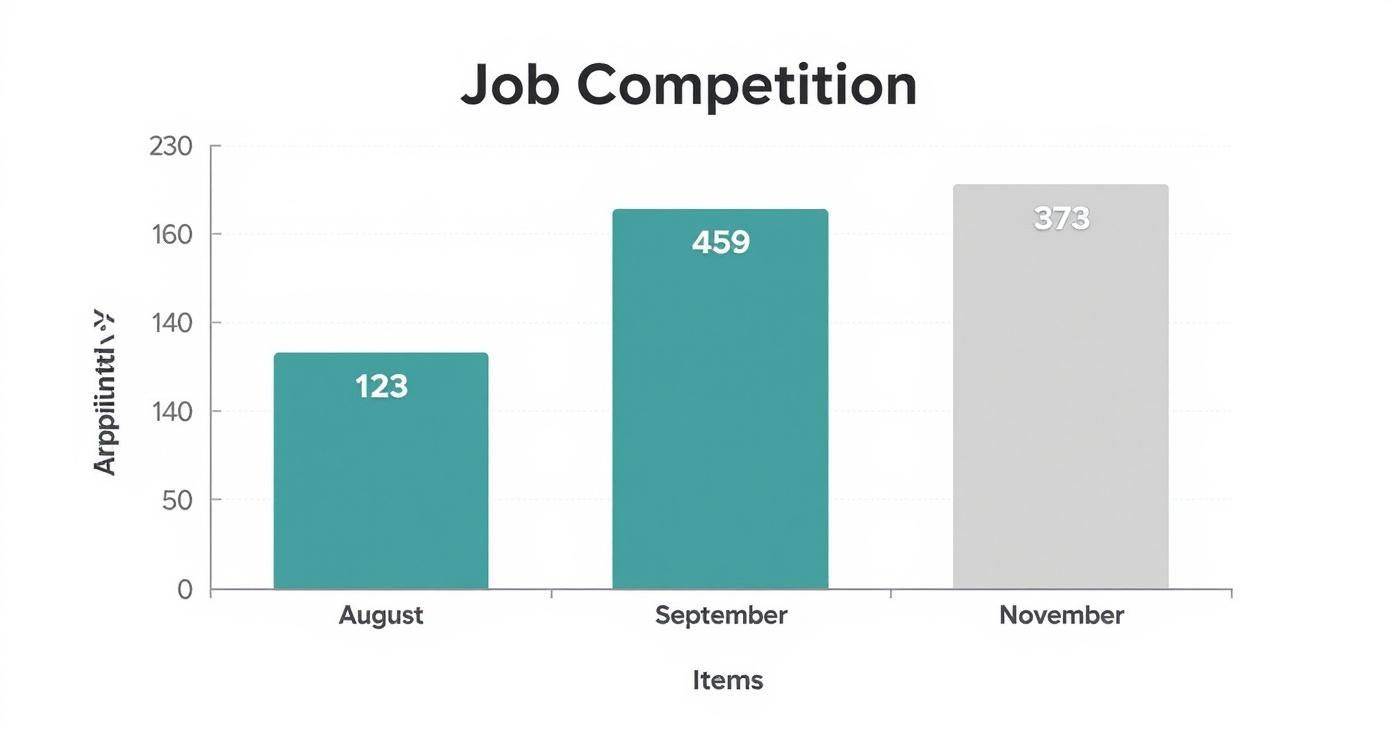
With the applicant pool jumping around like that, you can see why having a strong negotiation strategy is critical once you have an offer in your hands.
Framing Your Counter-Offer
When the offer comes in, the first thing you do is thank them and ask for a day or two to look it over. This simple step stops you from making a snap decision and gives you breathing room to build a smart, data-driven counter.
- Anchor to Your Value: Kick things off by restating how excited you are about the opportunity. Then, immediately tie your request to the value you've already proven. For example: "Based on my track record of growing Discord communities by over 300% and the 90-day growth plan we outlined..."
- Use Market Data: Bring your research to the table. A simple line like, "My research shows that for a remote Web3 role with this scope, a base salary in the [Your Target Range] range is competitive," shows you’ve done your homework.
- Be Specific and Confident: Don't be vague. Instead of a weak, "I was hoping for a bit more," state your number with confidence: "I would be thrilled to accept if we can align on a base salary of $XX,XXX."
- Negotiate Beyond Salary: What if they can't budge on the base salary? Pivot. This is your chance to ask for a bigger token allocation, a sign-on bonus, or even a guaranteed performance review in six months. It shows you’re flexible but serious about being compensated fairly.
Common Career Questions Answered
Trying to land a top-tier remote community manager job in Web3 can feel like navigating a maze. Let's cut through the noise and tackle the questions I hear most often from aspiring CMs. My goal here is to clear up the confusion so you can move forward with confidence.
Do I Need a Degree to Get Hired?
Honestly, no. A degree is almost never the deciding factor in Web3. I've been on hiring panels where a degree wasn't even mentioned. What really moves the needle is proof you can do the job.
Hiring managers want to see your skills in action. A killer portfolio that shows how you've grown and engaged a community will beat a diploma every single time. Focus your energy on building that real-world proof, because that’s what will get you hired. Your career in this space is all about the results you can deliver, not the credentials on a piece of paper.
How Do I Get Experience Without the Title?
This is the classic chicken-and-egg problem, but the solution is simple: create your own experience. Don't wait for someone to give you the title.
Find a project you're passionate about and volunteer to moderate their Discord. Start your own server for a niche hobby you love. The key is to treat it like a real job and meticulously document everything.
Track member growth week over week. Screenshot examples of great conversations you facilitated. Run a small event and analyze what worked and what didn't. This isn't just practice—this is the raw material for your portfolio and the exact stories you'll tell in an interview.
What Red Flags Should I Look for in Job Postings?
You can spot a bad fit from a mile away if you know what to look for. Be very cautious of job descriptions with super vague goals, especially anything that says your sole responsibility is to "make the project go viral." That's a huge red flag that the team doesn't actually understand what a community manager does.
Here are a few other things to watch out for:
- Shady compensation details. If they won't give you a clear salary range, that’s a problem.
- The "always-on" expectation. Any mention of being available 24/7 is a sign of a toxic culture with no respect for work-life balance.
- A chaotic hiring process. If they're disorganized from the start, imagine what it’s like to work there.
A serious project will have clear expectations, respect your personal time, and have a professional process for bringing on new team members. Trust your gut.
Is Community Management a Good Long-Term Career?
Absolutely, and I can't stress this enough. Community management is a cornerstone of any successful Web3 project, not just some dead-end support role. It's a strategic position with a ton of room for growth.
I’ve seen great community managers climb the ladder to become Head of Community, Head of Growth, and even move into high-level marketing or product roles. The skills you master—empathy, communication, strategic thinking, and understanding user behavior—are incredibly valuable and transferable. This isn't just a job; it's a launchpad for a serious leadership career.
Ready to find that next role? Blockchain Jobs is my go-to recommendation for crypto-native professionals. They connect top talent with the best projects in the space. You can explore hundreds of remote-friendly roles and find your perfect fit today at https://blockchain-jobs.com.