NFTs Jobs in 2026: Roles, Salaries, and How to Get Hired
Stop treating NFT jobs like a shortcut into easy money. In 2026, nfts jobs are not about mint hype, meme culture, or a Discord role with a cool title. They're about whether you can ship product, work with smart contracts, handle compliance, support growth, and keep your resume relevant after the boom faded.
That matters because the market has already sorted itself. UK vacancy data shows 0 permanent jobs citing “NFT” in the six months to 3 March 2025, down from 5 in the same period of 2024 and 57 in the same period of 2023, according to ITJobsWatch's NFT job tracker. The median annual salary for those UK roles also fell from £75,000 in 2023 to £60,000 in 2024, a 20% year-on-year decline in the same dataset. If you want a long-term career in this space, you need to think like a recruiter, not a speculator.
The Post-Hype Reality of NFT Careers
The old advice still floating around is dead simple and mostly wrong. It says NFT careers are for artists, community managers, and people who can hype a drop in Discord. That was never the full picture, and it's even less true now.
The market is smaller, but the work is broader
Current job feeds show NFT-related openings across backend engineering, product management, legal, compliance, marketing, and operations, not just creative roles. That shift matters because it changes what employers screen for. If you can already function in traditional tech, finance, legal ops, or growth, you're closer to hireable than someone who only knows how to talk about profile-picture collections.
Practical rule: If your background only overlaps with hype culture, you're underqualified. If it overlaps with shipping software, managing risk, or coordinating teams, you have something real to sell.
The broader market context explains why hiring feels uneven. Kraken's compilation of NFT market data cites DappRadar figures showing NFT trading volume reached $3.9 billion in Q1 2024, up 50% from Q1 2023, while sales volume rose 13% to 11.6 million in the same period, according to Kraken's NFT statistics overview. That kind of swing creates bursts of demand, then pauses, then selective hiring. It does not create a stable, broad-based labor market.
Transferable skills now beat “NFT native” branding
The smartest candidates are not trying to look like they were born inside Web3. They're showing they can transfer from adjacent fields. A strong engineer can point to production deployments, token logic, and platform reliability. A strong marketer can point to community growth systems and launch coordination. A strong legal candidate can point to compliance workflows and risk handling.
The lesson is blunt. Employers in this space still need people who can execute under ambiguity, but they're less interested in mythology than they were in 2022. If you're entering now, stop leading with enthusiasm and start leading with proof.
Breaking Down the Major NFT Job Categories
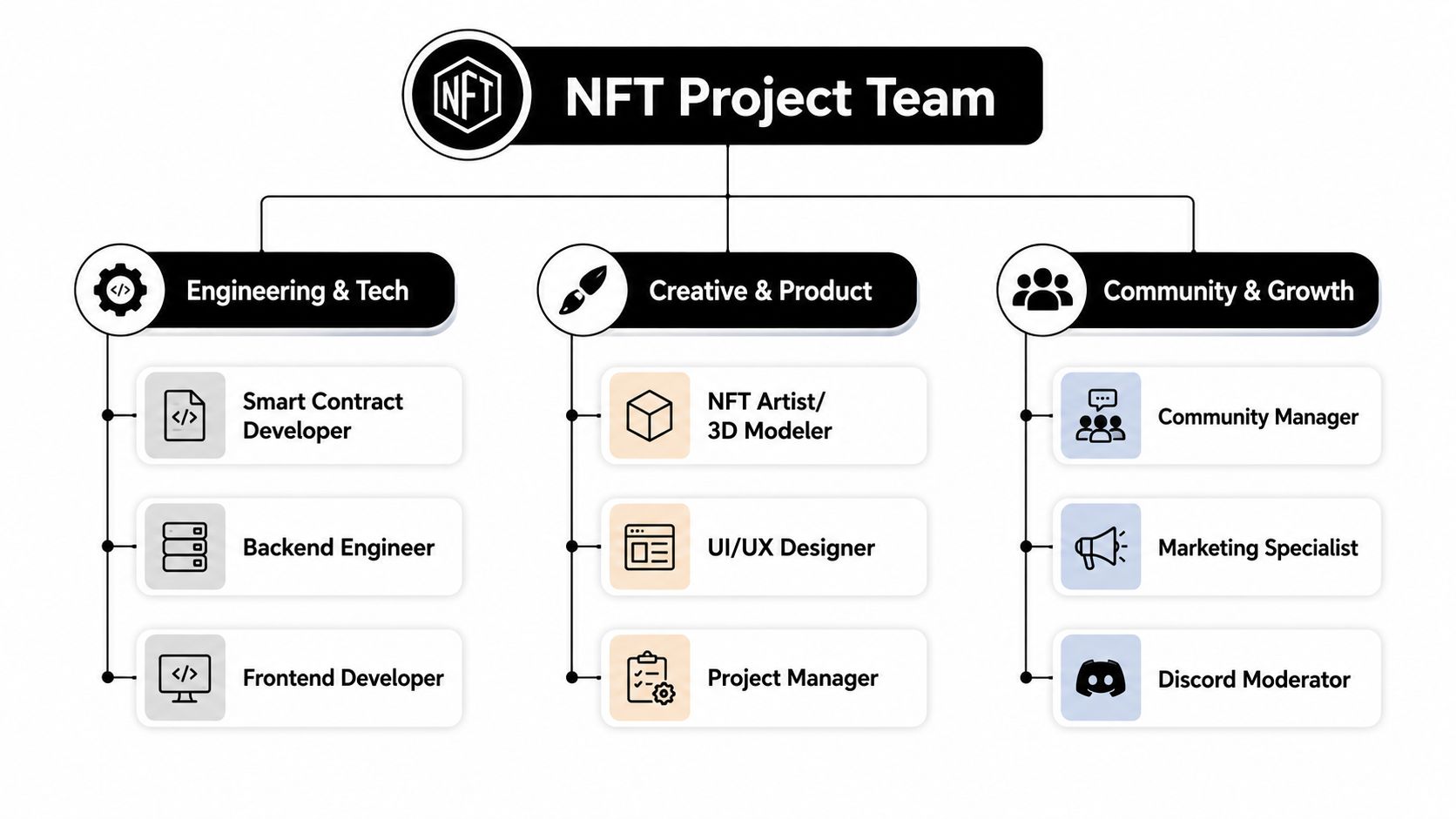
The structure is simpler than the jargon suggests. Most NFT project teams fall into three buckets, Engineering & Tech, Creative & Product, and Community & Growth. The labels change from company to company, but the actual work looks familiar to anyone who has shipped software, managed launches, or handled customers in a volatile market.
Engineering roles go far beyond minting
Smart contract developers and backend engineers are still the most technical hires, and the bar is well above basic ERC-721 familiarity. A senior NFT engineer posting lists ERC-721, ERC-1155, ERC-2981, and ERC-6551 as core competencies, along with deployment to mainnet EVM chains such as Ethereum and Polygon, according to this senior NFT engineer posting. That tells you the job has moved past simple token issuance into royalties, semi-fungible batching, and token-bound account design.
Frontend developers sit between product and engineering. They build wallet-connected flows, mint pages, collection dashboards, and transactional interfaces that do not confuse users. Backend engineers handle API integrations, metadata handling, indexing, payments, and reliability. If you have worked in SaaS or fintech, you already understand most of the operating discipline here.
Creative and product roles need more than taste
NFT artists and 3D modelers still matter, but they do not carry a project on their own. Teams need UI/UX designers who can reduce wallet friction, product managers who can coordinate launch plans, and project managers who can keep creative, engineering, and business teams aligned. The job is not to make things look cool. It is to make them usable for people who are nervous about signing a transaction.
For candidates with a design background, role filters like Web3 design roles on Blockchain Jobs are a better fit than generic NFT search results. Web3 teams care less about abstract aesthetics and more about whether your interface helps users trust the flow.
Community, marketing, legal, and operations are real functions
Community managers run engagement, moderation, and contributor coordination. Discord moderators keep channels usable, enforce rules, and catch issues before they spill into public channels. Marketing specialists handle launch messaging, creator outreach, and positioning. Legal and compliance roles matter more than many job seekers expect, especially where ownership, licensing, and records integrity intersect.
The U.S. National Archives says NFTs are being explored in records management and identity contexts because they can act as a tamper-evident digital certificate of ownership or authenticity, which is directly relevant to verification workflows in adjacent careers, according to the Archives' April 2024 briefing paper. The GAO defines an NFT as a digital certificate of ownership representing a digital or physical asset, according to GAO-22-105990. That is why legal and records-minded candidates should stop treating this category as collectibles-only.
NFT Salary Trends and Hiring Market Data
NFT compensation has settled into a more realistic range, and anyone still pitching 2022-style upside is selling nostalgia. The useful question is where the pay still matches the risk, and which roles can support a real career instead of a short-term gamble.
Salary and demand benchmarks
Coursera's NFT careers guide gives a practical set of anchors for role types and pay. It names back-end developers, blockchain consultants, Ethereum developers, community managers, and NFT project managers, and lists U.S. salary figures of $152,000 for back-end developers, $136,000 for blockchain consultants, $99,000 for Ethereum developers, and $70,000 for NFT project managers, according to Coursera's NFT jobs guide. ZipRecruiter's NFT job summary reports an average U.S. hourly pay of $56.85 as of June 17, 2026, with most workers earning between $45.19 and $67.31 per hour, according to ZipRecruiter's NFT jobs page.
Use those figures as a negotiating baseline, not a guarantee. The market pays differently depending on whether the role is technical, operational, or tied to a launch phase.
| Role | Median Annual Salary | Hourly Rate Range | Market |
|---|---|---|---|
| Back-end Developer | $152,000 | Not stated | U.S. |
| Blockchain Consultant | $136,000 | Not stated | U.S. |
| Ethereum Developer | $99,000 | Not stated | U.S. |
| NFT Project Manager | $70,000 | Not stated | U.S. |
| NFT Roles, average | Not stated | $45.19 to $67.31 | U.S. |
The hiring market is specialized and competitive
Analysts at Kraken note that Web3.Career reports an average of 48 new NFT jobs posted per month, about 143 applicants per job, and 69% remote roles, according to Kraken's cited hiring data. That is a tight market. Volume is low, competition is high, and generic applications get buried fast.
The UK picture points in the same direction. ITJobsWatch recorded 0 permanent NFT jobs in the six months to 3 March 2025, after 5 in the prior year and 57 in 2023, and it tracked the median annual salary falling from £75,000 to £60,000, according to ITJobsWatch. That is what a maturing niche looks like. Openings narrow, pay pressure shows up, and employers get far more selective about whether your skills map to actual production work.
What the market is really telling candidates
NFT jobs are still a small slice of Web3 employment, but the hiring profile is much more serious than the old listicles made it look. The strongest roles go to people who can ship systems, explain trade-offs clearly, and work under uncertainty without drama. If you want to stand out, bring proof, not hype.
Recruiters also care about adjacent experience that translates cleanly into a Web3 workflow. A candidate with content operations or creator-facing experience can be more useful than someone who only knows the vocabulary. If your background includes community programs, growth writing, or launch coordination, point hiring managers to content writing roles on Blockchain Jobs when the fit is closer to communications than code.
For market-facing roles, tangible assets matter. A short portfolio page, a launch breakdown, or even media kit examples from revid.ai can help show how you package value, shape messaging, and present a project with discipline. That kind of evidence does more for your candidacy than another vague claim about being “passionate” about NFTs.
Building a Portfolio That Gets You Hired
Most candidates lose here because they submit a resume and call it enough. It isn't. In NFT hiring, the portfolio is the filter that tells me whether you've done the work or just talked around it.
Show evidence that matches the job family
Engineers need deployed examples, not theoretical claims. If you've built token contracts, show the deployment context, what standard you used, what problem it solved, and what happened after launch. A recruiter wants to know whether you've handled mainnet reality, not whether you've read about it.
Designers should show wallet-connected flows, transaction screens, onboarding states, and error handling. Link to actual files or case studies that show how you simplified the user path. If you've worked in adjacent product design, pull out the part where trust, clarity, and conversion were the primary constraint.
Community managers need screenshots or dashboards that prove they moved engagement, moderated crises, or structured launch communications. Marketing candidates should show campaign assets, creator outreach processes, and launch calendars. Legal and compliance candidates should show policy drafts, workflow documentation, or regulatory frameworks they've helped build.
Rule of thumb: If a hiring manager can't see the problem you solved, they won't credit the result.
Build proof, even if you have no NFT job history
You don't need a prior NFT title to look credible. You need a live or public project, a process case study, a skills sample, and some kind of result signal. A GitHub repo, a published design file, a community launch log, or a compliance memo can all work if they're clean and specific.
For marketers and community candidates, media-style case study layouts help a lot. Good examples of this format are similar to media kit examples from revid.ai, because they package proof in a way hiring teams can scan quickly. Use that same logic for your own work, clear assets, concise outcomes, and no filler.
The same principle applies to content-focused candidates. If you're aiming at roles like content writing jobs on Blockchain Jobs, your portfolio should show audience fit, topic fluency, and evidence that you can write for a technical buyer without sounding theatrical. “I like Web3” is not a portfolio item.
Where to Find and Apply for NFT Jobs
The post-hype NFT market punishes lazy job hunting. If you are still refreshing general job boards first, you are already behind. Start with specialized listings, then sort by function before you apply.
Focus your search on platforms where these roles are posted
Use a dedicated Web3 board like Blockchain Jobs to find roles across engineering, design, marketing, legal, operations, and adjacent functions. The point is not just relevance. It is speed and filtering. Category pages and recent postings help you spot openings before the applicant pile gets too large.
That matters because NFT hiring is specialized and applicant-heavy, as noted earlier. If a board surfaces product, compliance, or backend roles alongside NFT-specific openings, you can search by function instead of chasing only collection-driven titles. That is the right way to work a market where job titles shift but the skill requirements stay familiar.
Tailor applications to the function, not the buzzword
A generic NFT cover letter gets ignored. A strong application says exactly which problem you solve. If you are an engineer, mention the stack, standards, and deployment environments you have handled. If you are a marketer, explain the campaign metrics, audience types, and launch cadence you have worked with. If you work in legal or operations, explain what you structured, reviewed, or reduced risk on.
Use informational interviews to understand project structure before you apply. Ask who owns launch readiness, who handles approvals, who coordinates community, and whether the role is tied to a single drop or a longer product roadmap. Those questions tell you more than the job description ever will.
Do not ask if the company is “innovative.” Ask what gets measured, who approves release work, and how long the team expects the function to exist.
Prepare for the interview questions that matter
Technical interviews in this space are usually about execution under ambiguity. Expect questions about smart contracts, wallet UX, product tradeoffs, moderation, or launch coordination depending on the role. Cultural interviews often focus on whether you can work with distributed teams, respond quickly in public channels, and stay useful when the market turns.
If you cannot explain your own work without hype language, you are not ready. NFT hiring managers spot that immediately. They want people who can work across product, community, and technical constraints without turning every answer into a pitch deck.
Evaluating Job Stability and Long-Term Career Viability
The blunt truth is simple. NFT jobs are not equally stable, and some are real careers while others are campaign work dressed up as a career path. Candidates need to tell the difference before they get attached to a title.
Stable roles versus temporary roles
Protocol engineering, infrastructure, legal compliance, and operations are the roles most likely to last. Those functions keep a business running whether the market is hot or cold, and they usually carry into other parts of Web3, fintech, and wider tech.
Campaign-driven community work and launch marketing are different. They can be useful, but they are often tied to a drop, a collection cycle, or a short product window. If the project depends on speculative revenue, your job stability probably does too.
Practical test: If the role still makes sense when the next launch window slips, it is probably real. If it disappears the moment hype cools off, it is a gig.
Questions you should ask in interviews
Ask about runway, team structure, and what happens after the launch. Ask whether the role is full-time, contract, or tied to specific milestones. Ask who owns retention, who owns product support, and whether the function has a budget beyond one campaign. If the answers are vague, treat that as a warning.
The freelance and remote side of the market is real, but that does not make every contract worth taking. Remote NFT work can help with flexibility, yet it also brings more noise and competition. Use freelance work to build proof, then move toward functions that can survive the next market cycle.
The structural data backs up that caution. UK permanent NFT jobs fell to 0 in the six months to 3 March 2025, and the salary moved down to £60,000 in 2024 from £75,000 in 2023, according to ITJobsWatch. That is not a market where you should assume permanence. It is a market where your function has to justify itself every time.
Your Action Plan for Landing an NFT Role
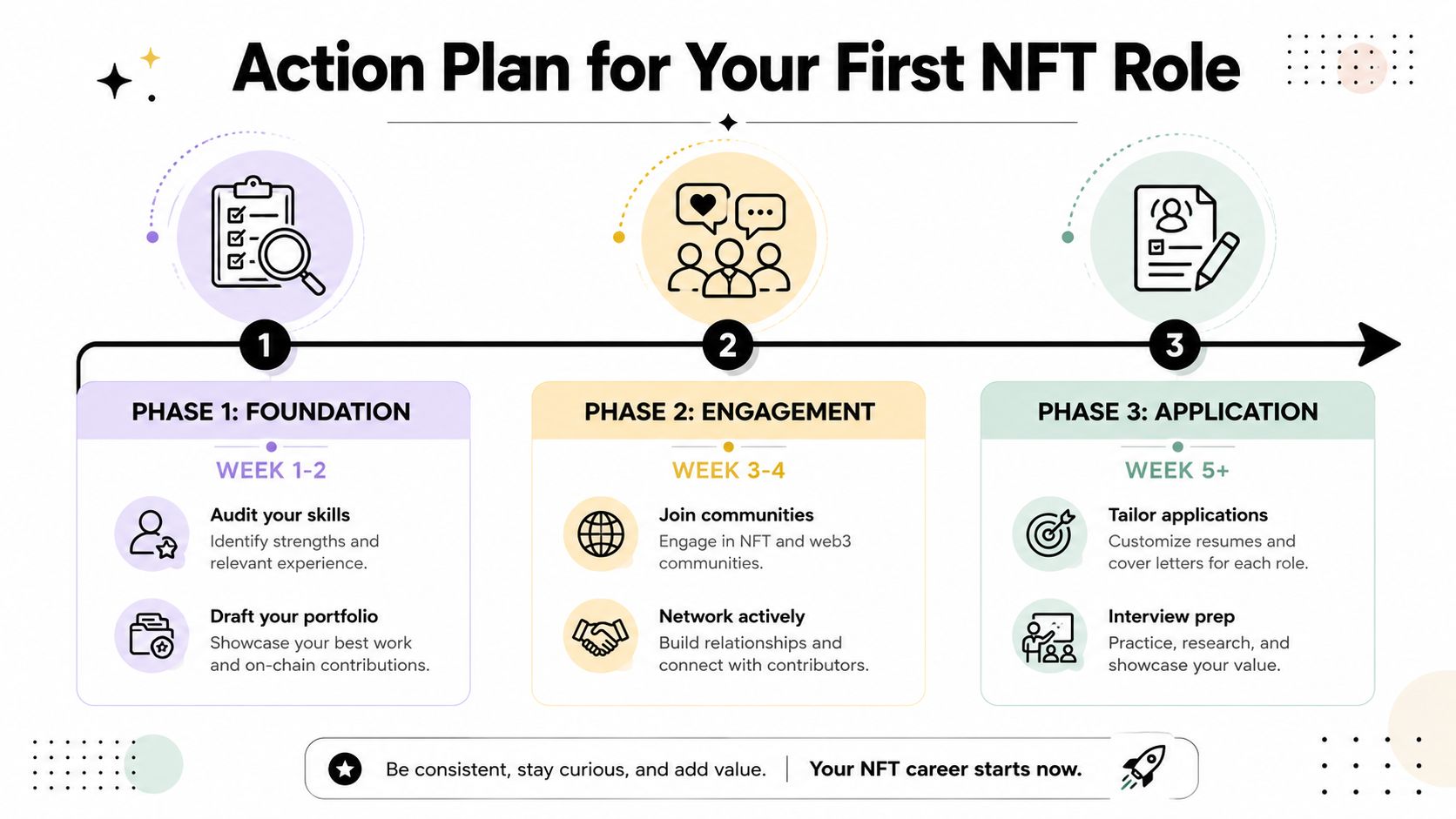
Start with the job family you can prove, not the one that sounds coolest. Over the next two weeks, tighten your portfolio around one role path, one contract or deployment example, and one written case study. In weeks three and four, reach out to hiring teams, join niche communities, and apply only where your evidence matches the role.
By week five and beyond, stop submitting generic applications. Tailor every resume to the function, track interview feedback, and adjust your portfolio based on what gets asked repeatedly. If you already have DeFi or broader blockchain experience, frame it as production evidence, because NFT hiring managers care about whether you can ship, support, and explain your work.
Blockchain Jobs gives you a cleaner way to search this market, with roles across engineering, design, marketing, legal, operations, and more, plus a recently added feed that helps you spot openings before they disappear. If you're serious about landing an NFT role in a post-hype market, visit Blockchain Jobs and start by filtering for the function you can prove.