Your Guide to Landing Programming Jobs for Beginners
It feels like a Catch-22, doesn't it? You can't get a programming job without experience, but you can't get experience without a job. I've seen countless new developers get stuck in this loop. But breaking in isn't about some secret handshake; it’s about having a smart, focused plan that makes you look like a great hire.
This guide will give you that plan. We’ll cut through the noise and show you exactly how to take your coding skills from a hobby to a career, focusing on what hiring managers actually care about.
Your Realistic Guide to Getting Hired as a New Developer
Let's be real: breaking into tech today is tough, but it's absolutely doable. The secret isn't learning a dozen programming languages. It’s about having a clear strategy that gets you out of "tutorial hell"—that endless cycle of watching courses without actually building anything. Hiring managers don't care how many tutorials you've finished; they want to see what you can build.
The market has definitely shifted. A few years ago, companies were hiring junior developers in droves. Now, with powerful AI coding assistants, the bar for entry-level talent is higher. A 2025 Stanford University study found that people aged 22 to 25 hold 20% fewer entry-level programming jobs than they did just three years ago. You can dig into the research on the changing job market to see the data for yourself. This isn't meant to discourage you. It means you must be more strategic than the competition to prove you're a valuable investment.
Navigating the Modern Hiring Landscape
So, how do you stand out when you're competing against hundreds of other applicants? You lean into your strengths as a beginner. You have a fresh perspective, an incredible hunger to learn, and none of the bad habits that seasoned developers sometimes pick up. Believe it or not, hiring managers are actively looking for that raw potential, because it's a sign of a future top performer.
The most successful junior developers aren't the ones who know the most. They're the ones who learn the fastest and can clearly explain how they solve problems. It’s all about showing you can think like an engineer, which is the core skill they're hiring for.
This is where your portfolio comes in. It needs to tell a story about who you are as a problem-solver. Forget the cookie-cutter calculator apps. Build something that tackles a real problem, even a tiny one you have yourself. That kind of project shows initiative and a product-focused mindset—two things every engineering team desperately needs and looks for in interviews.
Your Strategic Path Forward
To make this feel less overwhelming, we’re going to break down the entire job search process into a few core pillars. Think of each section as one step in a complete plan to make you the candidate they can't ignore.
Here’s what we’ll cover:
- Choosing the Right Entry-Level Role: We'll look at different programming jobs for beginners—Front-End, Back-End, QA—so you can pick a path and tailor your application to what hiring managers for that role expect.
- Building a Job-Winning Portfolio: I’ll show you what hiring managers really look for in your projects and how to present your work to pass the initial resume screen.
- Mastering the Interview Process: We’ll get into practical tips for crushing both the technical coding challenges and the behavioral questions that show you’re a good team fit.
- Finding and Applying for Opportunities: You’ll learn where the best entry-level jobs are hiding and how to write an application that actually gets read by a human.
To kick things off, let's get you on a schedule. The first three months of a job search are the most critical. Having a structured plan prevents you from drifting and ensures you're always making progress that will impress recruiters.
Here’s a simple action plan to guide your first 90 days.
Your First 90-Day Job Search Action Plan
| Phase | Key Action | Why It Matters for Hiring |
|---|---|---|
| Month 1: Foundation (Days 1-30) | Build 2 portfolio-worthy projects that solve a real problem. Focus on clean code and a live demo. | This is your proof. It shows you can go beyond tutorials and build functional applications, which is the #1 thing managers look for to justify an interview. |
| Month 2: Polish & Network (Days 31-60) | Refine your resume, polish your LinkedIn/GitHub, and start networking. Attend one virtual meetup and connect with 5 recruiters. | A strong online presence makes you discoverable. Networking opens doors to unlisted jobs and referrals, which have a much higher interview-to-hire rate. |
| Month 3: Apply & Interview (Days 61-90) | Apply to 10-15 well-researched jobs per week. Practice coding challenges and mock behavioral interviews. | Consistent, targeted applications beat shotgunning 100+ resumes. Practice builds the confidence needed to perform well when it counts in a live interview setting. |
Think of this table as your north star. It's not about doing everything at once, but about taking consistent, deliberate steps. By the end of 90 days, you won't just be a person who codes; you'll be a legitimate job candidate with the proof to back it up.
Choosing Your First Role in Programming
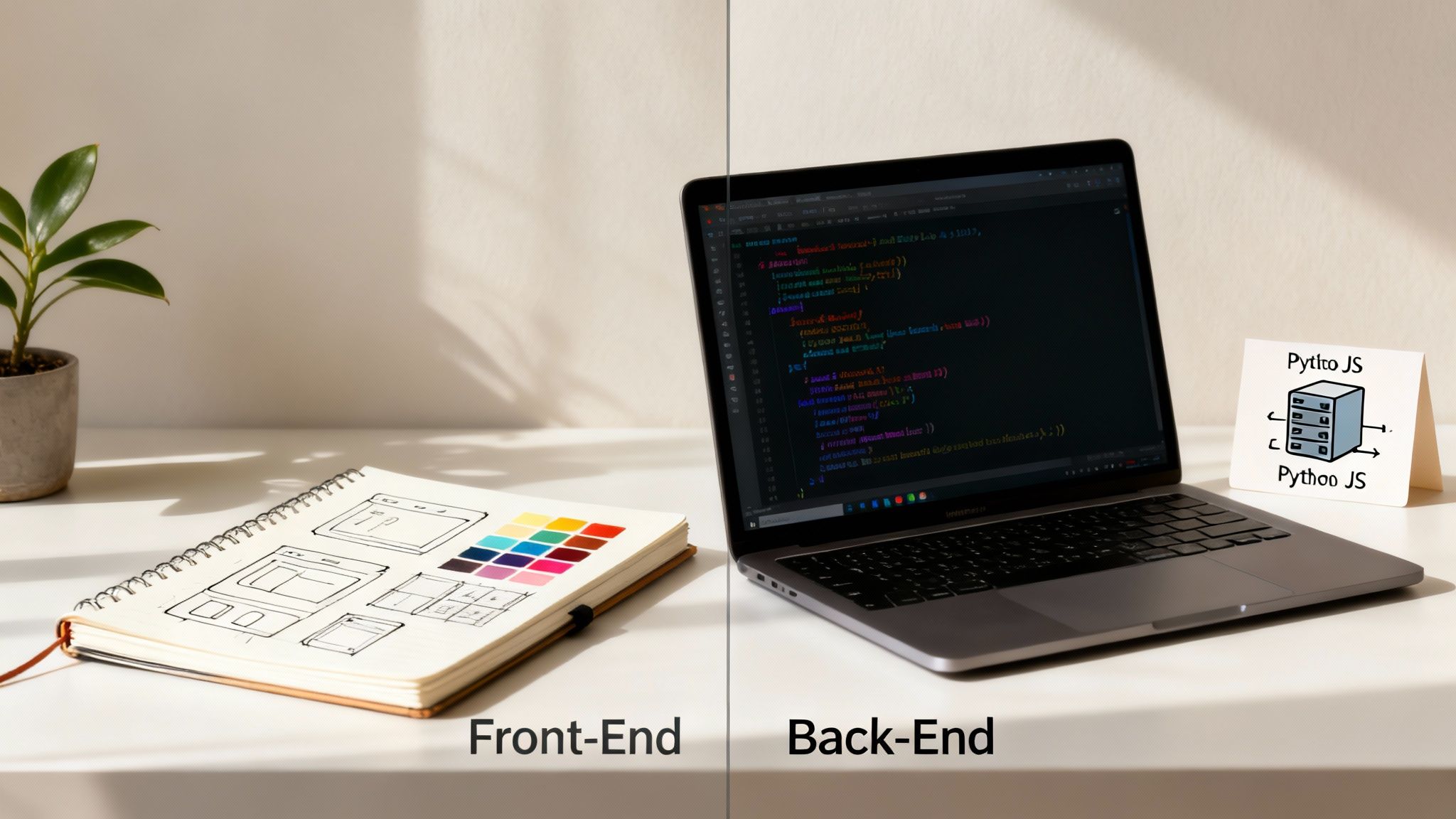
Stepping into the world of programming can feel like walking into a massive building with a hundred different doors. Each door leads to a unique career path, and figuring out which one to open first is a huge decision for your long-term progression.
It's a common mistake to think all developer jobs are the same. In reality, they require wildly different skills, attract different kinds of thinkers, and solve completely different problems. When a hiring manager looks at your application, they need to see that you understand the specific challenges of their role, not just that you know how to write code.
Let’s pull back the curtain on the most common entry points for new developers so you can align your skills with the right jobs.
The Front-End Developer: The Architect and Designer
Think of a website as a new house. The Front-End Developer is both the architect who draws up the blueprints and the interior designer who makes the space feel like a home. Their entire world revolves around what the user sees, touches, and experiences.
Your job is to bring static design mockups to life, turning them into a functional, intuitive, and beautiful website or app. It's a very visual and creative role that has a direct, immediate impact on how people feel when they use a product, a key concern for any business.
- Core Technologies: You’ll be spending your days with HTML, CSS, and JavaScript. To build the complex, dynamic interfaces users expect today, you'll also need to get comfortable with a framework like React, Angular, or Vue.js.
- Business Problems You Solve: You’ll be tackling questions like, "How can we make our checkout process simpler to stop people from abandoning their carts?" or "Is our website easy for people with disabilities to use?" Answering these questions in an interview shows you think beyond just the code.
The Back-End Developer: The Engineer and Plumber
If the front-end is everything you can see and touch in the house, the Back-End Developer builds the hidden infrastructure that makes it all work: the foundation, the plumbing, and the electrical grid. They are the masters of the server, the database, and the application's core logic.
This role is less about pixels and more about data, logic, and efficiency. You're the one who makes sure that when a user flips a switch on the website, the lights actually turn on. This is where the core business value is often created.
A strong back-end is the foundation of any successful application. It’s where the core business logic lives, where data integrity is paramount, and where scalability is engineered. From a hiring perspective, we look for beginners who grasp how data flows through a system.
Your code is what allows a user to log in and see their specific profile information, not someone else's.
- Core Technologies: This is the realm of languages like Python, Java, Node.js (which lets you run JavaScript on a server), and Ruby. You'll also need to know your way around databases like PostgreSQL or MongoDB and understand how to build APIs to send data to the front-end.
- Business Problems You Solve: You'll be the one figuring out, "How can we securely handle thousands of payments every minute without crashing?" or "What's the fastest way to pull a user's entire order history from our database?"
The Full-Stack and QA Roles
As you browse programming jobs for beginners, you'll also see roles that cover both sides of the coin or focus purely on making sure everything works perfectly.
A Full-Stack Developer is like the general contractor who can handle the plumbing and the interior design. They have a solid understanding of both front-end and back-end development, allowing them to work on any part of an application. For example, a role like this Junior Full-Stack AI Engineer might ask you to build a user interface in React and also connect it to a Python-based AI model.
Then you have Quality Assurance (QA) Engineers. Think of them as the home inspector. They don't build the house, but they go through it with a fine-toothed comb to find every single crack, leak, or flaw before anyone moves in. They write automated tests and perform manual checks to hunt down bugs, ensuring the software is reliable and works exactly as it should. This is an excellent entry point to a development career as it teaches you how to think critically about code and systems.
Building the Skills That Get You Hired
So, you're ready to land your first programming job? Great. But let's get one thing straight: knowing how to write a bit of code is just the starting point. It’s not enough to get you hired.
Hiring managers are looking for the whole package—a mix of real technical chops and the professional skills to back them up. They need to see that you can not only build things but also be a solid member of their engineering team from day one. They are hiring a colleague, not just a coder.
The reality is, the competition for entry-level roles has gotten fierce. Since 2011, the number of computer science graduates and career-changers has more than doubled in the US alone. This flood of new talent has pushed the unemployment rate for recent CS grads to 6.1%, a number that should tell you one thing: you need to be strategic and stand out. You can read more about the trends affecting young developers on Stack Overflow.
This isn't to scare you, but to get you focused. You need to build the skills that companies actually care about and are willing to pay for.
Mastering the Technical Fundamentals
Before you can even think about solving complex business problems, you have to get the basics down cold. These are the non-negotiables, the absolute essentials. Any hiring manager will assume you have these skills, and not having them is an instant dealbreaker in a technical screen.
Proficiency in One Core Language: Forget being a jack-of-all-trades. Your goal is to become a master of one. Pick a language that aligns with the jobs you want—like JavaScript for front-end or Python for back-end—and go deep. Knowing one language inside and out is way more impressive than having a superficial understanding of five.
Version Control with Git: In the world of software development, Git is how teams work together without stepping on each other's toes. You absolutely must know how to create a repository, commit your changes, write clear commit messages, and manage branches. It proves you can slot into a collaborative workflow, a key concern for any manager.
Understanding Data Structures & Algorithms: No one expects you to be a competitive programming wizard, but you do need to grasp the fundamentals. Knowing the difference between an array and a hash map (or a dictionary) and when to use each is crucial for writing efficient code. This is the most common subject of technical interviews.
These skills are the price of admission. They’re the foundation everything else is built on.
Developing the Soft Skills That Close the Deal
Technical skills will get your resume noticed, but it’s the soft skills that will get you the job offer. In an era where AI can write boilerplate code, your ability to think critically, communicate clearly, and learn on the fly is what truly sets you apart and signals your career potential.
A junior developer who can clearly explain their thought process while solving a problem is often more valuable than one who silently arrives at a perfect answer. We hire for potential, and communication is the clearest signal of that potential.
These aren't just buzzwords to put on a resume. You have to demonstrate them. It’s about proving you have these qualities through every interaction you have during the hiring process, from the first email to the final interview.
A Hiring Manager's View of Essential Skills
When a hiring manager sits down to review candidates, they're looking for specific signals that show you're ready for the job. It's not just about what you know, but how you apply it and how you present yourself.
Here's a breakdown of what they're really looking for and how you can show them you've got it.
| Skill Category | Examples | How to Demonstrate in an Interview |
|---|---|---|
| Technical Acumen | Git/GitHub, a core programming language (e.g., Python, JavaScript), basic data structures. | Explain your portfolio projects clearly, detailing the "why" behind your tech choices. Solve a coding challenge live, talking through your approach step-by-step. |
| Problem-Solving | Debugging tricky code, breaking down a large feature into smaller tasks, approaching unfamiliar errors. | When asked a technical question, don't just give the answer. Describe how you would approach it, what questions you'd ask, and how you'd test your solution. |
| Communication | Explaining a technical concept to a non-technical person, writing clear documentation, asking clarifying questions. | Listen carefully to the interviewer's questions. Ask for clarification if needed. Articulate your project goals and outcomes concisely and confidently. |
| Eagerness to Learn | Actively seeking feedback, learning new technologies for a project, reading documentation. | Talk about a time you were stuck and how you figured it out. Mention a new technology you're currently learning and why it will help you contribute to their team. |
At the end of the day, hiring a junior developer is a bet on their future. By showing you have both the technical foundation and the soft skills to grow, you make yourself a safe bet. You’re no longer just someone who can code; you’re someone who can become an essential part of the team.
Your Roadmap from Learning to Getting Paid
Theory is important, but a paycheck is better. Knowing how to code is one thing; turning that skill into a career is a completely different ballgame. Far too many beginners get stuck because they see the job search as one giant, impossible task.
The trick is to stop thinking of it that way. Instead, see it as a series of smaller, manageable steps that naturally build on each other. This isn't about spamming your resume into the void. It’s a deliberate process designed to turn you into the exact candidate a hiring manager is excited to find.
You'll move from learning abstract concepts to building tangible proof of your skills, and finally, to walking into the interview process with confidence.
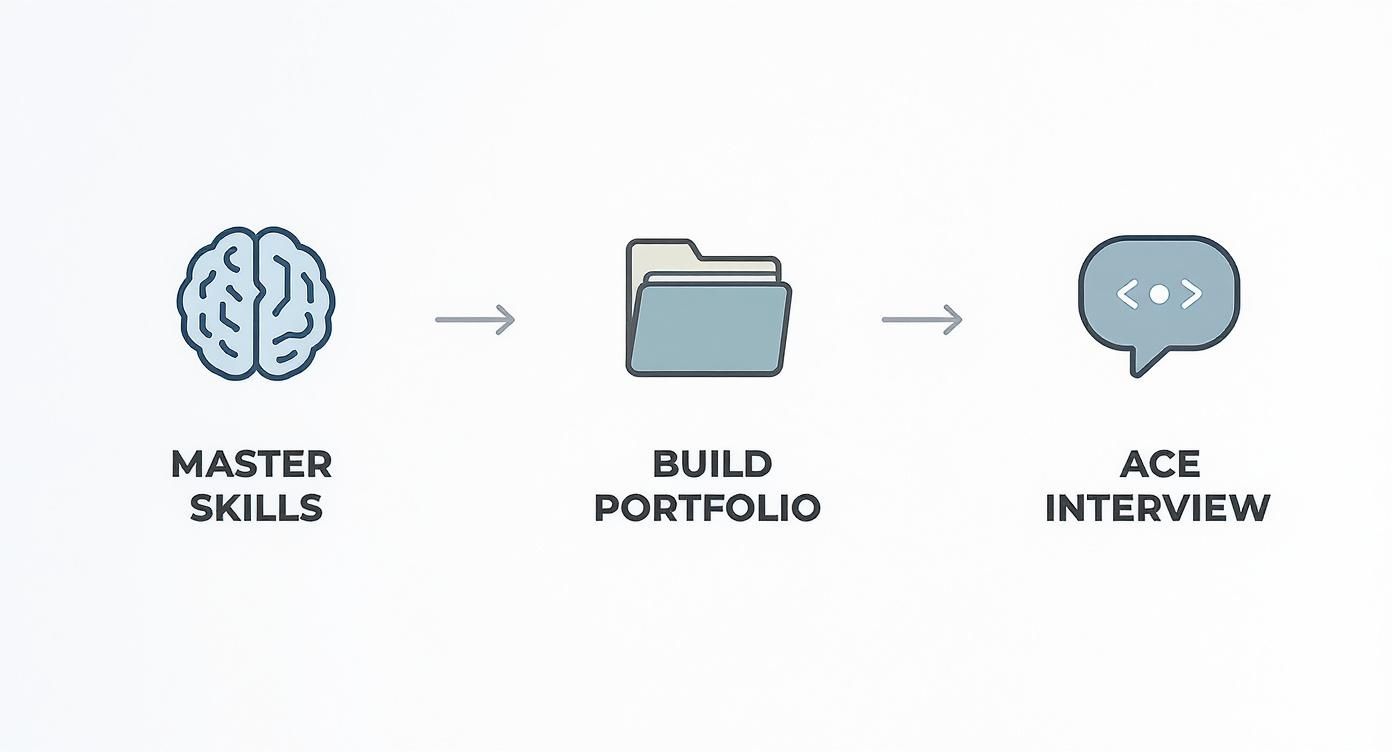
Each of these stages—mastering skills, building a portfolio, and acing the interview—directly answers the questions every hiring team is asking.
Step 1: Build a Job-Winning Portfolio
Your portfolio is, without a doubt, the most important part of your job search. It's your proof. A resume tells someone you can code; a portfolio shows them. A generic project you copied from a tutorial is instantly forgettable. But a unique project that solves a real-world problem? That starts a conversation and makes a great talking point in an interview.
The goal here is 2-3 polished projects. Remember, quality beats quantity every time.
- The Personal Problem-Solver: Build a small, simple app that fixes something annoying in your own life. This could be anything from a tool to track your job applications to a script that sorts your messy download folder. It shows you have initiative and think like a product owner.
- The Real-World Clone (with a twist): Pick a feature from a popular app and recreate it, but add your own unique spin. This proves you can understand how existing systems work and think critically about how to improve them.
- The Collaborative Contributor: Jump into an open-source project. Seriously, even fixing a typo in the documentation or tackling a "good first issue" bug shows you can use Git and work inside a team's codebase. That’s a massive green flag for employers.
For every project, make sure it’s hosted live somewhere and that your code is clean and well-commented on your GitHub profile. Hiring managers will look, and a messy repo can be a red flag.
Step 2: Craft a Resume That Beats the Bots
Here's a reality check: before a person ever sees your resume, it’s almost certainly going through an Applicant Tracking System (ATS). These are the robotic gatekeepers that filter out applications that don't seem to match the job description. Your first mission is to get past them.
This means you need to tailor your resume for every single application. Read the job description like a detective and mirror its language. If it asks for “JavaScript” and “React,” you better believe those exact keywords need to be on your resume.
Your resume has two audiences: the machine and the human. Structure it with clear, scannable sections for the ATS, but write the project descriptions to tell a compelling story for the hiring manager who reads it next.
Once you’re past the bot, a human will give it a glance—often for less than 10 seconds. Make those seconds count. Use bullet points with strong action verbs. Instead of saying "Wrote code for a weather app," say "Developed a responsive weather application using the OpenWeatherMap API to deliver real-time forecasts." One is passive; the other frames you as a results-oriented problem-solver.
Step 3: Network Like a Human, Not a Spammer
Networking isn't about awkwardly sliding into DMs and asking strangers for a job. It's about building real, genuine connections in the tech world. The goal is to become a known, helpful name, so when an opportunity pops up, you're the person they think of first. Employee referrals are the #1 source of hires for many companies.
Start by just being helpful.
- Engage in Online Communities: Find the Discord servers, subreddits, or Slack channels where developers in your niche hang out. Answer questions when you can, and ask smart, thoughtful questions when you’re stuck.
- Connect on LinkedIn: Follow engineers and recruiters at companies you admire. When you send a connection request, add a short, personalized note mentioning a project they worked on or a recent post they wrote.
- Attend Virtual Meetups: Plenty of tech groups host online talks and workshops. Show up, participate in the chat, and connect with a few other attendees afterward.
These small, consistent interactions build your reputation. A referral from a trusted employee is the single most powerful way to land an interview, and these are the relationships that earn you one.
Step 4: Prepare for the Interview Gauntlet
The interview process for programming jobs for beginners is a multi-stage marathon, not a sprint. You'll usually face a technical screen, a coding challenge, and at least one behavioral interview.
First up is the technical screen, which is usually a quick call with a recruiter or engineer just to make sure you know the basics. Next comes the coding challenge, where you'll solve problems on a platform like HackerRank or LeetCode. Practice your data structures and algorithms, but more importantly, practice thinking out loud. Interviewers care less about the perfect answer and more about how you approach the problem.
Finally, the behavioral interview is where you prove you’re someone they’d want to work with. Prepare a few stories using the STAR method (Situation, Task, Action, Result) for questions like, "Tell me about a time you were really stuck on a problem." This demonstrates that you're self-aware, resilient, and eager to learn—the three most important qualities hiring managers look for in any junior developer.
Finding and Applying for Your First Tech Job
Okay, your skills are sharp and your portfolio is ready to go. Now comes the exciting part: finding that first job. The thing is, your dream job probably won’t just fall into your lap. You need a smart strategy to find the best programming jobs for beginners. Just spamming hundreds of applications on massive job boards is a fast track to frustration and burnout.
Let’s try a different approach. Put yourself in the shoes of a hiring manager for a second. They're looking for people who are actually interested in their company and the problems they're trying to solve. That means you need to ditch the scattergun approach and focus your energy where it’ll make a real difference.
Broaden Your Search Beyond Generic Job Boards
Big job platforms are a fine place to start, but they’re also where everyone else is looking, making them incredibly competitive. The key is to diversify your search to uncover those hidden gems and roles that aren't getting thousands of applicants. Think of it like building a balanced investment portfolio, but for your career.
Major Platforms (The Foundation): Absolutely use sites like LinkedIn and Indeed, but be strategic about it. Set up very specific alerts for titles like "Junior Developer" or "Entry-Level Software Engineer." More importantly, start following companies you genuinely admire. Engage with their posts—it helps get you on their radar before your resume ever lands on their desk.
Specialized Hubs (The Growth Stocks): This is where you find the higher-quality, more relevant listings. AngelList is fantastic for startup roles where you can get your hands dirty and make a real impact. Stack Overflow Jobs connects you directly with companies that respect deep technical skills. And if you're leaning into the decentralized world, a specialized board is non-negotiable. For a solid list of curated Web3 roles, you might be interested in exploring the jobs available on Blockchain Jobs.
Unconventional Strategies to Get Noticed
Honestly, the most effective way to land that first role often involves bypassing the formal application process entirely. Your real goal is to connect with people—the engineering managers and senior developers who actually make the hiring decisions, not just the HR gatekeepers.
The best job opportunities are rarely posted publicly. They are filled through referrals and networking. Every connection you make is a potential door to a role that hundreds of other applicants will never even see.
This takes a bit more effort and some detective work, but the payoff can be huge.
Target Companies and Connect with People
Instead of just searching for jobs, start searching for companies that excite you. This proactive approach immediately makes you stand out because it shows you're passionate and have done your homework.
Follow the Open-Source Trail: Do you love using a particular open-source tool or library in your personal projects? Find out which companies sponsor or contribute to it. These organizations have already signaled that they value the exact technologies you're skilled in, which makes you a much more natural fit for their team.
Attend Virtual Meetups and Demos: Look for online events, webinars, or product demos related to your tech stack. These are networking goldmines. You can ask smart questions during the Q&A and then connect with speakers or other attendees on LinkedIn afterward. A simple move like this transforms you from just another random applicant into a familiar face.
By combining a broad search with these targeted, people-first strategies, you shift from being a passive job seeker to an active candidate. You start creating your own opportunities, building a network that can speak for you, and seriously boosting your odds of landing that all-important first role in tech.
Building a Future-Proof Programming Career

Landing that first programming job is a massive achievement. It’s the moment all your hard work pays off. But in the world of tech, it’s really just the starting line. The skills that get you hired today might not be enough to keep you competitive five years from now. A truly resilient, long-term career is built on a foundation of constant learning and strategic skill development.
The market is already sending clear signals about this. While the U.S. Bureau of Labor Statistics projects software development jobs to grow by a huge 17% by 2033, it also expects traditional "computer programmer" roles to shrink by 6%. The takeaway? General coding isn't enough anymore. The future belongs to specialists who solve high-value business problems. You can check out the full labor statistics on the BLS website to see the data for yourself.
Specializing in High-Demand Fields
To build a career that lasts, you need to go deep. Think of your fundamental coding skills as the launchpad—now it's time to pick your destination. Carving out a niche in a high-growth area is the smartest move you can make for your career progression.
- AI Integration: Learning to work with AI, not against it, is no longer optional. This means getting good at using AI coding assistants to speed up your workflow and, more importantly, understanding how to plug AI models into the applications you build.
- Cybersecurity: Every new line of code is a potential new vulnerability. Developers who can write secure code from the ground up and help defend against digital threats are incredibly valuable and in high demand.
- Cloud Computing: Modern businesses run on the cloud. Whether it's AWS, Azure, or Google Cloud, knowing how to build, deploy, and manage applications on these platforms is a non-negotiable skill for many top jobs.
Building Your Professional Brand
Your professional brand is more than a resume; it’s your reputation. It’s what tells the world that you're curious, adaptable, and always learning. Start building it from day one to attract future opportunities.
The most valuable engineers aren't just experts in a single technology. They are experts in learning and applying new technologies to solve business problems. Your ability to adapt is your greatest long-term asset.
Make a habit of sharing what you’re learning. Write about your projects on a personal blog, contribute to open-source, or just stay active in online developer communities. Reading articles and career advice from sources like the Blockchain Jobs blog can also keep you sharp. This kind of consistent effort proves to employers that you’re not just looking for a job—you’re passionate about your craft. That makes you a much more compelling hire for the long haul.
Got Questions About Landing Your First Programming Job?
Trying to break into the tech world can feel like you're navigating a maze. Everyone seems to have a different opinion, and it's tough to know which advice to follow. Let's cut through the noise and tackle the questions I hear most often from aspiring developers.
These are the same hurdles that trip up a lot of people just starting out. Getting clear, straightforward answers will help you focus your energy and approach the job hunt with a lot more confidence.
Do I Really Need a Computer Science Degree?
Honestly? No. A four-year degree is no longer the gatekeeper it once was for many programming jobs for beginners. While a CS degree gives you a solid theoretical background, what hiring managers really want to see is what you can actually do.
A killer portfolio with a few polished projects speaks volumes—often louder than a diploma. If you can prove you know your way around your chosen language, understand fundamentals like version control, and can actually solve problems, you're in the game.
As someone who has been on the hiring side, I can tell you that a self-taught developer with a compelling GitHub and a genuine passion for building things is often way more interesting than a recent grad with a perfect GPA but no hands-on experience.
How Many Projects Should I Have in My Portfolio?
Think quality, not quantity. It’s far better to have 2-3 impressive projects that you can talk about in-depth than a dozen half-baked tutorials. Each project should be a story you can tell during an interview.
The whole point is to show you can take an idea from a concept to a finished, working product. Make sure each project has:
- A Clear Purpose: It should solve a real (even if small) problem. This shows you think like a problem-solver, not just a coder.
- Clean, Readable Code: Someone will look at your code. Make it easy for them to understand by keeping it organized and well-commented. This shows you can work on a team.
- A Live Demo: This is a must. Give them a link so they can see your application in action. It removes all doubt that you can deliver.
How Long Will It Take to Get My First Job?
This is the big one, and the real answer is... it varies. Your timeline depends on a bunch of factors, like your background, how much time you can commit, and what the job market is doing. Generally, most people who are serious about their search find something in 3 to 9 months.
But here's the thing: you're not just a passenger on this ride. You can seriously speed things up by consistently learning, polishing your portfolio, making real connections with people in the industry, and being smart about which jobs you apply for. It's not just about getting a job; it's about starting a career.
Ready to stop searching and start applying to the best roles in the decentralized world? Blockchain Jobs curates the latest openings in Web3, from engineering to product management. Find your next opportunity today.