
Blockchain Marketing Guide: Channels, Metrics and Rules

You're preparing a Web3 campaign, or an interview for the role that runs it. The goal is community growth, the dashboard shows more followers, and someone wants to launch paid ads. But you still need to answer the harder questions: who is really using the product, which claims can you prove, and what must users understand before they act?
Blockchain marketing works best when transparency and compliance are part of acquisition, not checks added afterward. For your career, that means learning to connect channels with verified outcomes and defensible decisions, rather than presenting reach alone as evidence of success.
What Blockchain Marketing Means Today
Blockchain marketing means promoting products, communities, and brands that run on blockchain. It also includes using blockchain features, such as verifiable records, to substantiate claims buyers care about.
Think of a shop that posts its receipts on a public noticeboard nobody can erase. Shoppers can inspect the record, but they still need help understanding what each receipt proves. Your job isn't to advertise the shop. It's to explain the trust mechanism without overstating it.

Separate the product from the proof
A wallet campaign might explain how someone uses the product. A provenance campaign might show how someone checks a product's history. These are different marketing jobs, even when both involve blockchain.
A durable record isn't automatically a truthful input. Recording a supplier's claim on-chain doesn't independently establish that the supplier told the truth. Marketers must distinguish what the technology preserves from what another party verifies.
Practical rule: Explain what buyers can check, who supplied the underlying information, and what the evidence doesn't establish.
Understand the adoption gap
Blockchain wasn't mainstream marketing infrastructure in early 2023. In Digiday+ Research's survey of 388 agency, brand, retailer, and publisher professionals, 16% were investing in or using blockchain, 71% considered it irrelevant to their business, and NFTs were the most common application at 64%, principally for brand awareness.
Governance offered another reason to experiment. Deloitte's technology-trends research found blockchain advertising adoption among regulation-focused CMOs at 35%, compared with 21% among other respondents.
The practical reading is narrower than the hype: community-facing experimentation had advanced further than broad operational integration. For candidates, that creates distinct positioning choices. You might specialize in explaining a protocol, supporting an active community, or coordinating verifiable advertising records. In interviews, name which problem you solve rather than treating blockchain knowledge as a marketing discipline by itself.
Four Channels and Where Each One Fits
Marketing channels compared by job, stage, KPI and risk
| Channel | Core job | Best stage | Typical KPI | Main risk |
|---|---|---|---|---|
| Community | Turns holders into active advocates | Pre-launch to post-launch | Active contributors and 30-day retention | Bots and fake engagement inflating counts |
| Content | Explains the protocol and earns search and trust | Awareness and education | Organic sessions, time on page, email signups | Technical errors and unverifiable claims |
| Paid | Buys reach for one defined action | Launch bursts and conversion pushes | Cost per qualified action and conversion rate | Platform bans and missing risk disclosures |
| Partnerships | Borrows credibility from exchanges, audit firms, and creators | Growth and listing phases | Partner-sourced signups and co-branded reach | Reputational spillover if a partner fails |
Use this comparison to match a channel to a specific audience need, rather than copying another project's distribution mix.
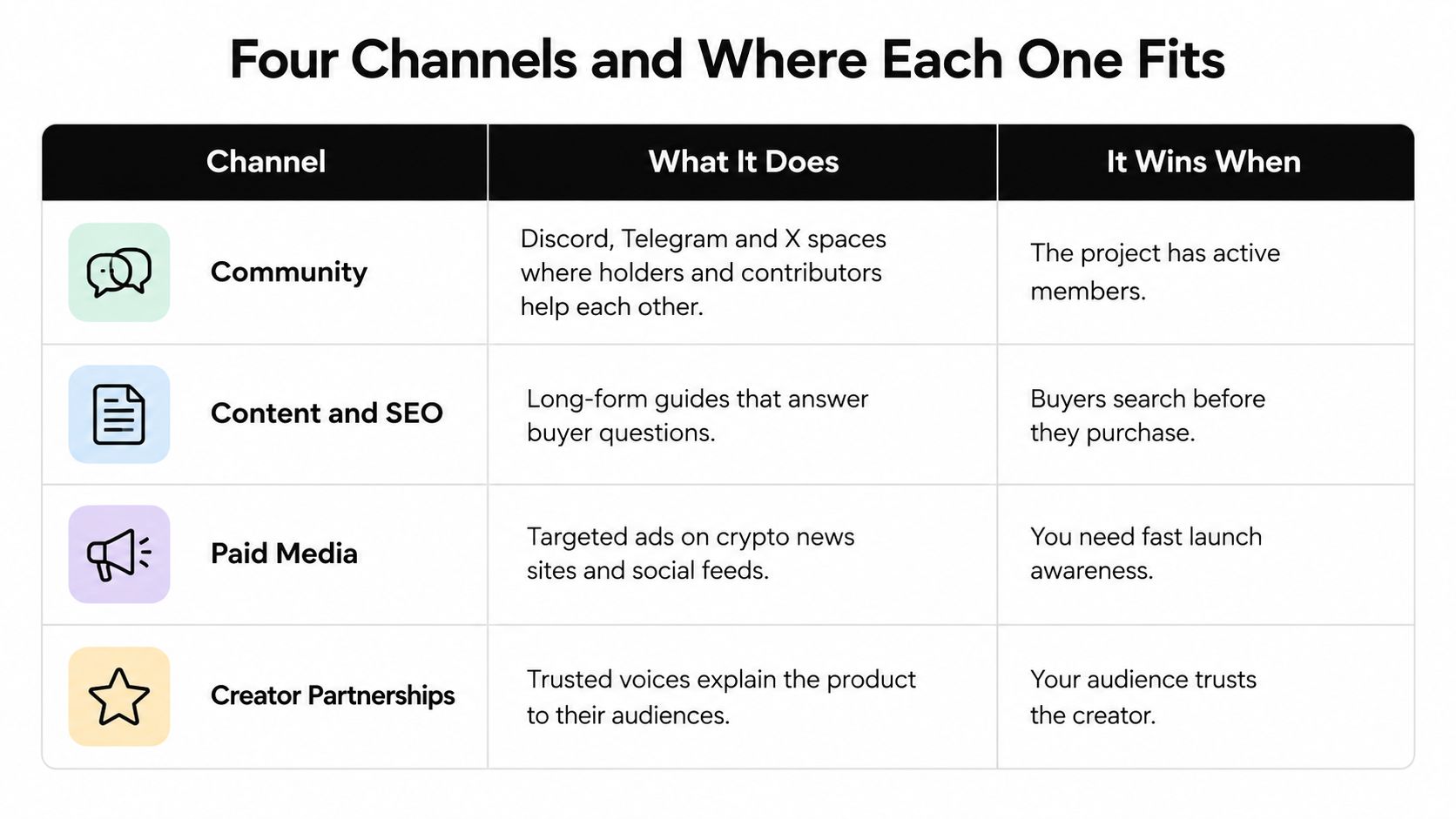
Begin with explanation and participation
For a pre-product protocol, I'd prioritize content supported by community. Publish documentation and explainers that answer what the protocol does, who should try it, and what remains unfinished. Use Discord office hours, Telegram discussions, and X conversations to discover where the explanation fails.
Community work should give people something useful to do. Ask testers to reproduce an onboarding problem, help another member, or discuss a proposed feature. A large room of silent accounts isn't the same as a functioning contributor network.
Content and SEO suit questions people actively search for. Treat them as a sustained publishing effort, not an instant launch substitute. For a portfolio, show how a recurring support question became an explainer and which outcome you chose to evaluate.
Add reach only when the destination is ready
Paid media can support a launch burst once claims, targeting, disclosures, and the landing page have been reviewed. Choose a defined action, such as completing an eligible signup, rather than buying undirected traffic.
Partnerships fit when another organization already serves the audience you need. A wallet integration, exchange relationship, or creator explanation can introduce the product in a relevant setting. An audit firm's involvement, however, shouldn't be presented as a blanket endorsement of safety or investment quality.
- Pre-product: Use education to clarify the proposition and community conversations to test understanding.
- Token launch: Consider short paid bursts only after the promotional review is complete.
- Established protocol: Evaluate partnerships alongside retention and existing-user education.
For broader planning, use a Web3 marketing strategy to connect positioning, distribution, and ownership. Choose one primary channel and one supporting channel before attempting everything at once.
A video resource can complement your written channel plan:
In interviews, explain the channel you deliberately postponed. That decision can demonstrate budget judgment more clearly than a list of platforms you've used.
Metrics That Show Whether Campaigns Work
Core Web3 marketing metrics by goal
| Goal | Metric | How to measure | Warning sign |
|---|---|---|---|
| Awareness | Share of voice in category conversations | Compare social-listening mentions against named competitors | Mention spikes without improved sentiment |
| Community health | 30-day active contributors | Members who post or react during the window divided by total members | Membership rises while participation stays flat |
| Acquisition | Cost per qualified signup | Spend divided by verified or wallet-connected signups | Cheap clicks with almost no conversion |
| Trust | Trust lift | Survey before and after exposure to verifiable proof | Low-information users show no change |
| Compliance quality | Risk-warning recall | Ask ad recallers whether they remember the warning | Poor recall despite strong ad recognition |
| Retention | Repeat on-chain action rate | First-time users completing another action within 90 days | Participation falls after rewards end |
These are proposed reporting definitions, not universal industry standards. Document the window, denominator, eligibility criteria, and exclusions before launch so colleagues can reproduce your calculations.
Pair every visibility measure with an outcome. Share of voice should sit beside sentiment or qualified acquisition. Membership should sit beside participation. Otherwise, someone can present a bigger audience while avoiding the question of whether anyone used the product.
Measure comprehension, not just exposure
Research provides a useful reason to test proof rather than merely display it. Across three experiments involving 1,995 participants examining blockchain retail tracking, tracking increased perceived quality, retailer trust, and purchase intentions; the quality effect was strongest with limited product information and wasn't significant when information was already abundant.
That doesn't establish a guaranteed conversion gain for a protocol campaign. It suggests a test: expose comparable audiences to different explanations, then assess whether people understand the evidence and judge the product differently.
Don't claim a trust improvement just because you published a verification page. Ask whether people understood it and changed their assessment.
A before-and-after survey can provide directional feedback. A comparison group offers a stronger way to separate the effect of the proof from other campaign changes. If an informed audience shows no additional benefit, don't keep presenting transparency as an incremental lift without evidence.
Verify before presenting
Use on-chain data analytics to connect campaign activity with relevant product actions, while documenting attribution limits.
- Check identities carefully: Deduplicate wallets where your method allows, but don't assume a unique wallet equals a unique person.
- Review contribution quality: Human-score a sample of replies for relevance instead of counting every reaction as advocacy.
- Explain exclusions: Separate internal tests, suspicious activity, and reward-only behavior from your principal result.
For hiring managers, a reproducible measurement note is useful portfolio evidence. Include what you counted, what you excluded, and what you still can't confidently attribute.
Compliance Limits Every Campaign Must Respect
Promotion rules by jurisdiction and what they require
| Jurisdiction | Rule | Core requirement | Who it reaches |
|---|---|---|---|
| European Union | MiCA crypto-asset advertising rules, fully applicable from 30 December 2024 | Correct, clear, non-misleading; recognizable as advertising; risk information where applicable | Crypto-asset issuers, service providers, and their promoters |
| United States | Securities Act Section 17(b) | Disclose the nature, source, and amount of compensation for promoting a security | Paid influencers, affiliates, and ambassadors |
| United States | SEC Rule 206(4)-1, applicable since 4 November 2022 | Written agreement above $1,000 over 12 months, subject to applicable exceptions; required status, compensation, and conflict disclosures | Investment advisers using testimonials and paid endorsements |
| United Kingdom | FCA financial promotion regime for cryptoassets | Fair, clear, non-misleading promotions, risk warnings, and a cooling-off period for first-time investors | Firms and promoters targeting UK consumers |
The EU timing and advertising requirements accompany the consumer-confidence research discussion of MiCA and crypto promotions. For US campaigns, Section 17(b)’s compensation-disclosure requirements and the investment-adviser marketing rule's dates, agreement threshold, and endorsement controls concern different activities. Don't treat either as a universal rule for every crypto post.
Convert rules into launch checks
Start with product classification, audience location, and the identity of the promoter. Have qualified counsel confirm which requirements apply. For EU-facing material, review whether the advertisement is identifiable and whether its claims and applicable risk information are clear.
For US securities promotions, document the compensation relationship. For investment-adviser endorsements, check the relevant disclosures, supervision, promoter eligibility, and agreement requirements rather than assuming a sponsorship label alone is sufficient.
The consumer-confidence research linked above reports that 8% of UK respondents used cryptoassets, while advertising recall declined from 5% in 2024 to 3% in 2025. Among people recalling an advert, 39% remembered its warning, including 27% of women and 43% of men. That's a research reference point, not a universal campaign pass mark.
Test practical changes before scaling:
- Warning placement: Put the risk warning above the call to action and assess comprehension.
- Creator disclosure: Put the sponsorship label in the opening line, then check the full applicable disclosure requirements.
- Local destinations: Build jurisdiction-specific landing pages with the appropriate eligibility and review controls.
Career signal: A marketer who can explain why a promotion shouldn't launch yet demonstrates judgment, not resistance to growth.
Clearer warnings may reduce clicks while improving the quality of informed signups. Treat that as a hypothesis to test, not a promised result.
Web3 marketing hiring signals combine conventional marketing skills with crypto-native fluency. Add regulatory literacy to that combination: preserve approvals, escalate uncertainty, and explain your decisions. Across markets, use the strictest applicable standard as a baseline, but still obtain local review. This isn't legal advice.
Audience Segmentation and Proof Framework
Match the explanation to the reader's technical literacy, not just their interest in crypto. Someone can own tokens without understanding a contract address or audit scope.
The framework below separates the audience before selecting evidence and distribution.
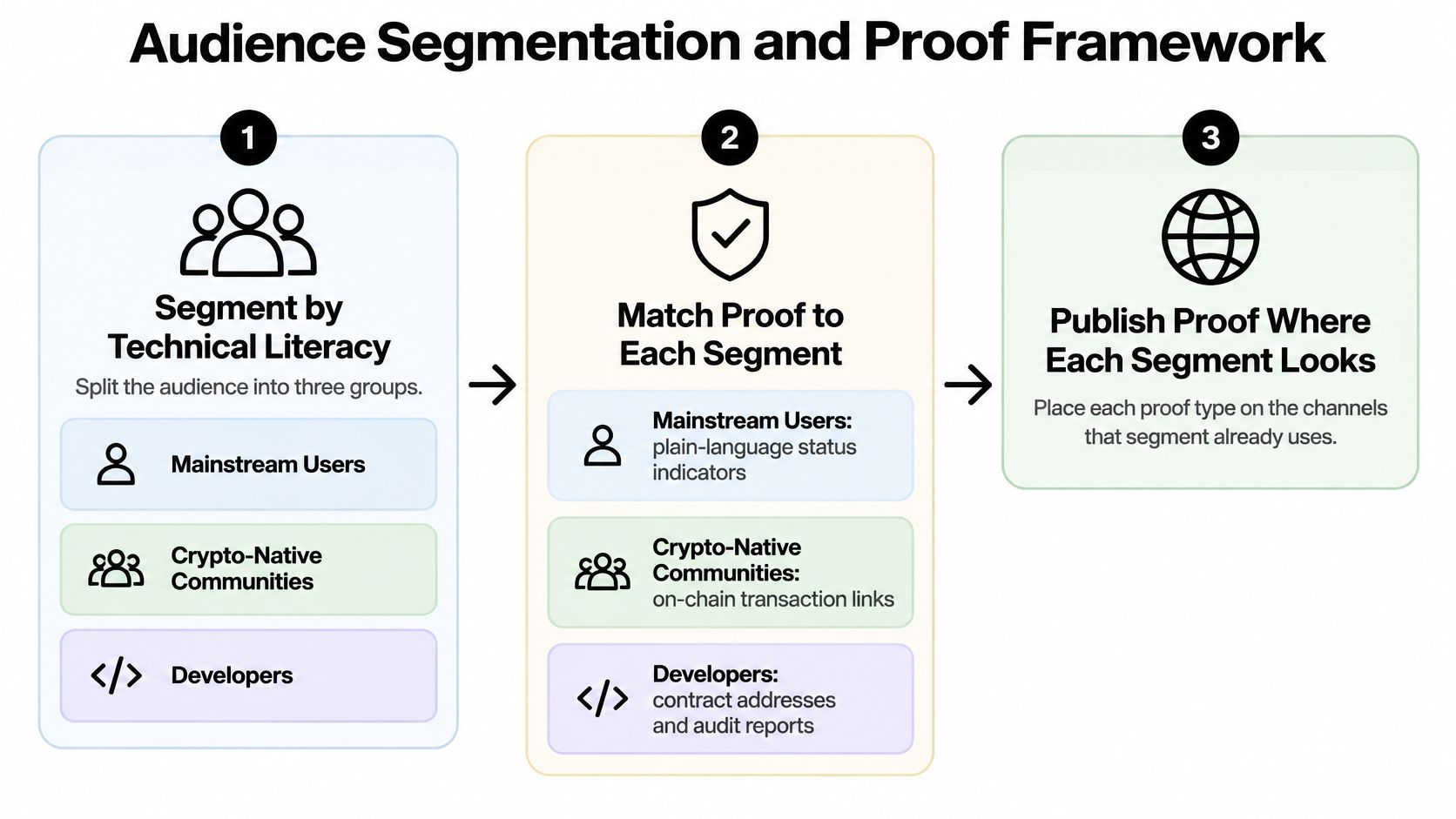
Match evidence to understanding
Segment by technical literacy. Distinguish mainstream users, crypto-native communities, and developers through interviews or onboarding questions. Ask what they'd check before trusting a claim instead of assuming their job title establishes their knowledge.
Choose proof they can interpret. Give mainstream users a plain-language verification summary. Offer crypto-native users relevant transaction histories. Provide developers with contract addresses, audit reports, and protocol explanations, including limitations.
A Vietnamese e-commerce study of blockchain affordances and trust found positive associations between trust and perceived transparency (β = 0.29) and security (β = 0.25); its model explained 61% of trust variance, and blockchain literacy strengthened both relationships.
These are associations within that study, not predicted campaign uplifts. They support testing different explanations rather than expecting every audience to respond to the same technical detail.
Control disclosure and friction
Decide what belongs where. Don't publish personal customer details on an immutable record merely to demonstrate transparency. Consider selective disclosure, off-chain attestations, or third-party verification, with privacy and legal review. Keeping identifiers off-chain isn't a complete compliance solution, but it avoids making public permanence the default.
Compare understanding with effort and cost. Record how many steps users need to reach useful proof, where they abandon the process, and whether they interpret the result correctly. Test a concise proof page against a more technical version before commissioning an elaborate interface.
Budget deserves the same scrutiny. In a 2025 study of 150 marketing professionals, respondents identified implementation costs (70%), technological complexity (65%), and integration difficulties (60%) as barriers. Compare an on-chain implementation with a verified off-chain alternative before committing spend.
| Audience | Proof element | Suggested placement |
|---|---|---|
| Mainstream users | Status indicator with a short explanation of scope | Product consideration page |
| Crypto-native communities | Transaction links and issuance history | Community updates and proof hub |
| Developers | Contract addresses, audit scope, technical documentation | Developer documentation |
For a portfolio, include this audience-to-proof map alongside your copy. It shows how you translate technical evidence into usable information without assuming more disclosure is always better.
Web3 Case Studies and What Each Teaches
These are illustrative composite scenarios, not reported company results. They combine research themes with hypothetical launch problems so you can evaluate the decisions without mistaking imagined outcomes for benchmarks.

Illustrative ecosystem launch
A layer-1 ecosystem has an expanding audience but few people trying its product. The marketer replaces general announcements with an explainer series, a small ambassador program, and Discord office hours focused on actual setup problems.
The reporting changes too. Instead of leading with followers, the team tracks active contributors and records which support questions prevent participation. No improvement is assumed: the campaign must demonstrate useful activity before the marketer calls it successful.
The lesson is activity over headcount. In an interview, explain how you'd distinguish helpful ambassadors from accounts that only repeat promotional messages.
Illustrative wallet expansion
A wallet preparing an EU campaign starts with earn-while-you-hold language and an immediate signup button. The marketer pauses distribution, removes unsupported return promises, and sends the revised claims for review.
The new version places risk information before the call to action, labels creator sponsorships, and routes audiences to country-specific pages. The intended outcome is a cleaner funnel with better-informed signups, not a claimed increase in conversion.
The lesson is to assess conversion quality alongside volume. A strong candidate would propose tracking eligibility, comprehension, support requests, and complaints rather than celebrating clicks alone.
Illustrative provenance campaign
A consumer-goods brand wants customers to inspect the provenance of a product line. Instead of publishing customer identifiers, the team creates a readable verification page with an optional path to hash-level evidence.
The team tests whether shoppers understand who verified the source information and what the record proves. It also compares the proposed interface with a simpler verified off-chain option, using the cost and privacy trade-offs discussed earlier.
The lesson is that proof needs an owner, an audience, and a boundary. Deloitte's governance findings also support treating verification as an accountability decision, not merely a campaign theme.
Across these scenarios, the interview-ready sequence is consistent: identify the risk, define the audience, choose the outcome, and only then select the channel. Present hypothetical work as hypothetical. Clear reasoning doesn't need a fabricated success story.
Turn Blockchain Marketing Skills Into Your Next Role
Hiring signals in Web3 marketing roles
The role dataset linked in the compliance discussion provides the following snapshot. These categories describe that dataset, not a forecast of the entire hiring market.
| Signal | Figure | What it means for you |
|---|---|---|
| Social media marketing requested | 165 listings | Show community growth with real numbers |
| Content marketing requested | 156 listings | Include explainers for nontechnical readers |
| Content strategy requested | 120 listings | Show an editorial plan tied to a measurable goal |
| Product marketing share | 25% | Consider this if you can explain tokenomics and positioning |
| Growth marketing share | 17% | Demonstrate acquisition tests and reporting |
| Content marketing share | 8% | Pair writing with community or product skills |
Build evidence around a core discipline, then add relevant platform fluency. Product marketing might pair with tokenomics explanations. Growth marketing might pair with wallet onboarding analysis. Community work might pair with Discord operations, Telegram support, and X communications.
Your portfolio should explain your contribution, not just display finished assets. Include the audience problem, the decision you owned, the measurement method, and the constraints. Use actual results only when you can substantiate them and have permission to share them.
Show your review process in interviews
When asked how you'd run a creator campaign, describe an operational workflow. Record compensation, identify the applicable rules, use approved disclosures, screen promoters where required, retain review evidence, and escalate uncertain claims.
Then explain who approves what. You don't need to impersonate counsel; you need to show that you know when specialist review is necessary and can keep production organized around it. This is relevant to progression into marketing operations, partnerships, and leadership.
Use a blockchain marketing jobs guide to compare role expectations with the evidence you already have. Close the gaps through focused work rather than collecting unrelated platform credentials.
- Build a two-case portfolio. Include a community result you can verify and a compliance-reviewed campaign. If you lack production experience, label a simulation clearly and don't invent results.
- Choose a specialization. Use the hiring snapshot as a starting point, then compare product, growth, and content responsibilities against your strengths.
- Apply deliberately this week. Search current community, content, and marketing openings, select two suitable roles, and tailor each application around a relevant decision and supporting evidence.
Blockchain Jobs offers category-tagged Web3 opportunities, including marketing, community, and content roles, with remote-friendly positions. Visit Blockchain Jobs to compare current openings and find roles where your channel judgment, measurement skills, and compliance awareness match the work.