DevOps Infrastructure Engineer: Duties, Skills and Pay
Your last pull request touched a container image, a Helm value and a CI job, and you spent more time waiting on the pipeline than writing code. Somewhere in that wait sits a career question: is the person who owns that pipeline, the cluster and the alerts doing engineering, or just looking after tools?
It's engineering, and it's judged by outcomes you can measure: how often changes ship, how fast service returns after a failure, and how much of the environment can be rebuilt from code. It's also one of the few jobs where a candidate can prove senior-level judgment inside a single interview exercise.
What follows is the weekly work, the parts that change on blockchain teams, and what hiring managers check before they believe any of it.
What a DevOps Infrastructure Engineer Does Every Week
A release is ready, but the deployment fails because the production environment differs from staging. The infrastructure engineer traces the mismatch, fixes the underlying configuration and makes the correction repeatable. Much of the job is preventing that kind of failure from turning into a recurring surprise.
The week typically includes six areas of work:
- Provisioning from versioned code. Define networks, clusters, databases and storage in Terraform, Pulumi or CloudFormation. Review changes in pull requests and apply them through a pipeline, so the environment can be recreated without relying on undocumented console edits.
- Build and deployment pipelines. Configure GitHub Actions, GitLab CI, Jenkins or Argo CD to test changes, build images and deploy releases. A rollback path matters as much as a successful deployment.
- Observability. Use Prometheus, Grafana, Datadog or OpenTelemetry to collect metrics, logs and traces. Tune alerts to identify conditions that require action, rather than paging engineers for every transient spike.
- Secrets, access and policy. Use tools such as HashiCorp Vault, cloud IAM and Open Policy Agent to control credential access and reject changes that violate policy before they reach production.
- Reliability and on-call. Maintain runbooks, review incidents and take part in an on-call rotation. PagerDuty or Opsgenie can route alerts, but the responder still needs clear steps for diagnosis and recovery.
- Cost visibility. Apply tagging policies and use tools such as Kubecost to identify which teams and environments drive spending. That context helps teams weigh infrastructure cost against reliability and delivery needs.
| Duty | Typical tools | What good looks like |
|---|---|---|
| Provisioning | Terraform, Pulumi, CloudFormation | A new environment can be created from versioned configuration without undocumented manual steps |
| Pipelines | GitHub Actions, GitLab CI, Jenkins, Argo CD | Changes pass through tests and deployment checks, with a usable rollback path |
| Observability | Prometheus, Grafana, Datadog, OpenTelemetry | Alerts point to symptoms that need investigation, not every CPU fluctuation |
| Secrets and policy | Vault, cloud IAM, Open Policy Agent | Credentials are controlled and policy violations are caught before deployment |
| On-call | PagerDuty, Opsgenie, runbooks | The responder has clear steps for finding the relevant dashboard and diagnosing the issue |
| Cost control | Kubecost, tagging policy, budgets | Significant spending can be traced to an owning team or environment |
Infrastructure as code connects these duties. The 2018 Accelerate State of DevOps report found that 44% of cloud adopters agreed or strongly agreed their environment configuration and deployments used only scripts and version-controlled information, with no manual steps beyond approvals. The report also found that organizations using IaC were 1.8 times more likely to belong to the elite software-delivery performance group. The practical benefit is a reviewable, repeatable change in place of an undocumented server fix. That supports environment consistency, auditability and disaster recovery.
What done looks like: A change is proposed in a pull request, reviewed by another engineer, applied through a pipeline and reproducible without undocumented manual steps.
Good infrastructure work makes routine deployments uneventful and gives responders a clear path through incidents. Hiring managers look for evidence of those habits: versioned configuration, tested deployment and rollback steps, useful alerts, and runbooks that explain what to do when a system fails.
To compare how employers describe the work, find cloud infrastructure jobs and note which responsibilities each listing emphasizes.
How the Role Differs From Cloud, SRE and Platform Work
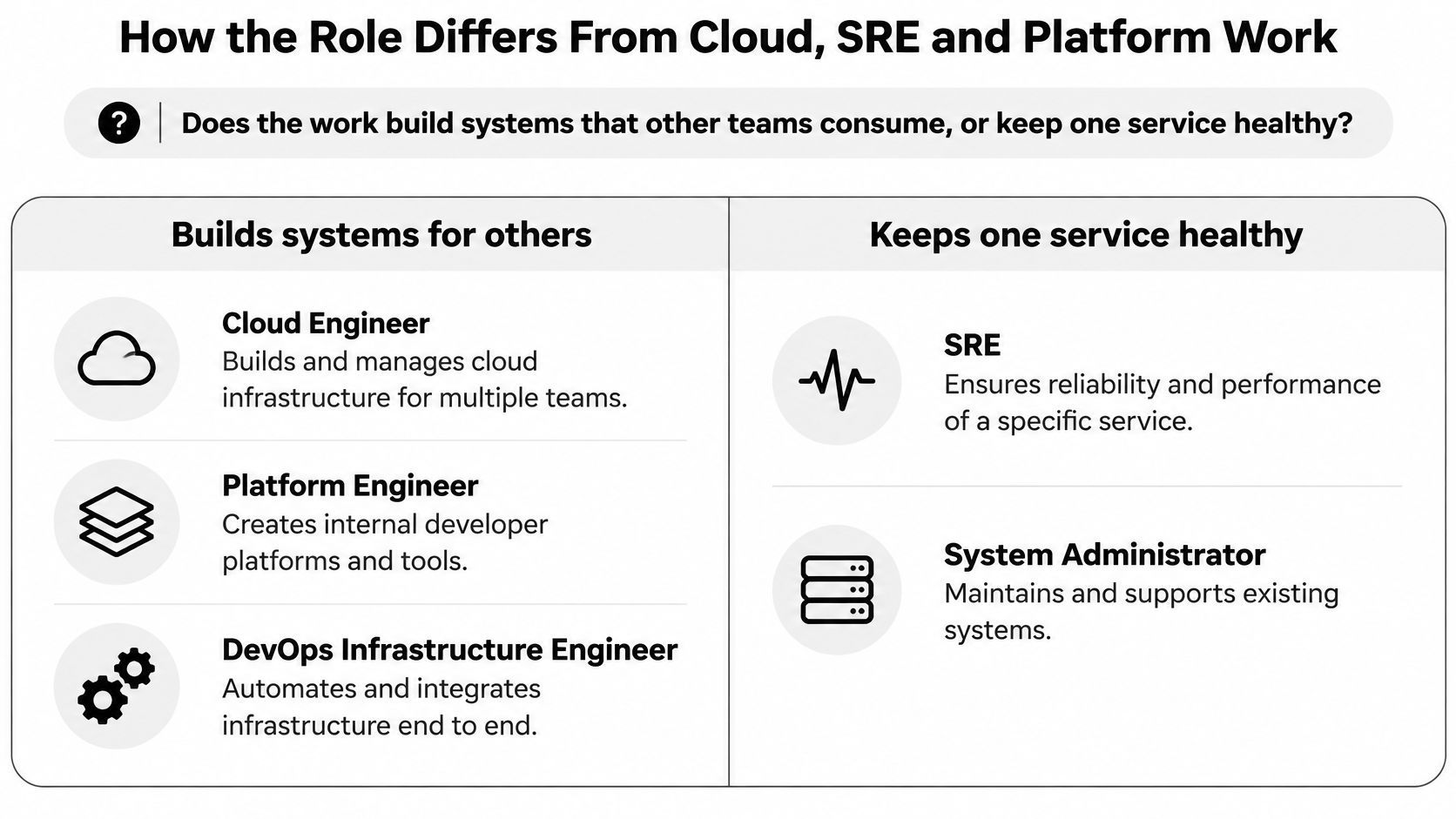
The titles overlap heavily, and plenty of companies use them interchangeably. The tiebreaker that survives contact with a job description is one question: does this role build systems that other teams consume, or keep one service healthy?
A cloud engineer ships landing zones and account structures. A site reliability engineer ships service-level objectives, error budgets and incident reviews for a service they're accountable for. A platform engineer ships golden paths and self-service templates that product teams use without filing a ticket. The DevOps infrastructure engineer sits closest to the third, with one foot in the second on the night the pager goes off.
Hiring has moved toward the platform side of that split. VMware's 2025 State of Platform Engineering report, which surveyed 518 engineers across industries, geographies and seniority levels, found that standardizing infrastructure provisioning through an internal developer platform was the top priority for 28.3% of respondents, ahead of improving developer experience and productivity at 26% and Infrastructure as Code at 20.3%. The same report lists CI/CD, Infrastructure as Code and Kubernetes as core capabilities for 72.8%, 66.6% and 64.8% of respondents.
| Role | Primary focus | Overlap with DevOps infrastructure | Typical output |
|---|---|---|---|
| DevOps infrastructure engineer | Automating environments and delivery pipelines | Core role | Reusable IaC modules and pipelines |
| Cloud engineer | Designing and running cloud accounts and services | High, especially networking and IAM | Landing zones and account structures |
| Site reliability engineer | Service-level objectives and production reliability | High on monitoring and incidents | SLOs, error budgets and incident reviews |
| Platform engineer | Internal developer platforms for product teams | High on IaC and self-service | Golden paths and self-service templates |
| Systems administrator | Maintaining servers, networks and user access | Low to medium | Patching schedules and access administration |
Where you start shapes the first step more than the destination. A systems administrator brings troubleshooting and access discipline and needs pipeline fluency. A developer brings review habits and needs networking depth. A cloud architect brings account design and needs hands-on cluster work.
The hiring signal is simpler than any of that. Platform-leaning employers ask how you'd turn a repeatable pattern into a self-service workflow and how you'd measure whether it reduced friction. SRE-leaning employers ask what your error budget would be and which alerts you'd delete. Answer the wrong question well and you still sound like you applied for a different job.
Core Skills Expected at Each Career Level
Job descriptions recycle the same ten tools. What separates a junior from a senior isn't the length of the tool list, it's the scope of what you're trusted to change alone. The rows below are a fair ladder to measure yourself against.
| Skill | Junior | Mid-level | Senior |
|---|---|---|---|
| Linux and scripting | Bash or Python for routine tasks | Automation shared across teams | Standards for script and tooling review |
| Infrastructure as code | Modifies existing Terraform modules | Owns reusable modules with tests | Sets module versioning and review policy |
| CI/CD pipelines | Fixes failing pipeline jobs | Designs pipelines with rollback | Governs pipelines for several teams |
| Containers and Kubernetes | Deploys a workload from manifests | Operates clusters, upgrades and networking | Multi-cluster strategy and capacity planning |
| Cloud networking and IAM | Reads VPC and role configuration | Designs segmented networks and least-privilege roles | Multi-account security architecture |
| Observability | Reads dashboards and writes basic alerts | Defines SLIs and actionable alerts | Sets monitoring standards and SLOs |
| Security practice | Follows secret-handling rules | Rotates credentials and scans images | Writes threat models and policy-as-code |
| Communication | Writes clear pull requests | Leads incident handoffs | Shapes roadmaps and trade-off decisions |
Kubernetes appears in most postings because it's in most production estates. The Cloud Native Computing Foundation's 2024 Annual Survey reported that 91% of organizations used containers in production, up from 80% in 2023, and that production Kubernetes usage reached 80%, up from 66% the year before.
Why the Kubernetes row carries the most weight
Interviewers rarely ask for a definition of a pod. They hand you a manifest and watch what you notice: the missing resource limits, the liveness probe that will restart a healthy app under load, the rollout strategy that takes the whole service down for thirty seconds. Then they describe a crashing pod and listen for the order of your checks. That's an operational reasoning test disguised as a tool question.
For blockchain teams, container skills map onto running highly available nodes, RPC services and indexers across cloud and hybrid environments. If you're building that skill deliberately, this guide to infrastructure as code for blockchain teams covers the parts that differ from a generic web stack.
The newest row is reviewing machine-written change
The 2025 DORA report, which surveyed nearly 5,000 technology professionals, found that 90% use AI at work and more than 80% report productivity gains, while about 30% report little or no trust in AI-generated code. That gap is now an infrastructure problem. Generated code still has to pass tests, secrets scans and policy checks before it deploys, and the engineer who wires those gates is the one who decides whether the speed gain survives contact with production.
Rule for self-assessment: claim the highest row where you can name a result you produced, not the highest row where you've read the documentation.
Say your release takes 40 minutes. Splitting the test suite into parallel stages and caching dependencies can plausibly bring it under 10, and that single change is worth more in an interview than three certifications, because you can describe what you measured before and after.
Where Blockchain Teams Change the Job
At 3 a.m., an application's RPC provider starts returning stale blocks. The application team sees failed reads and user complaints. The infrastructure engineer has to determine whether the chain is reorganizing, an in-house node is lagging, or the provider is throttling requests. Each cause calls for a different response, so monitoring must distinguish them before an incident starts.
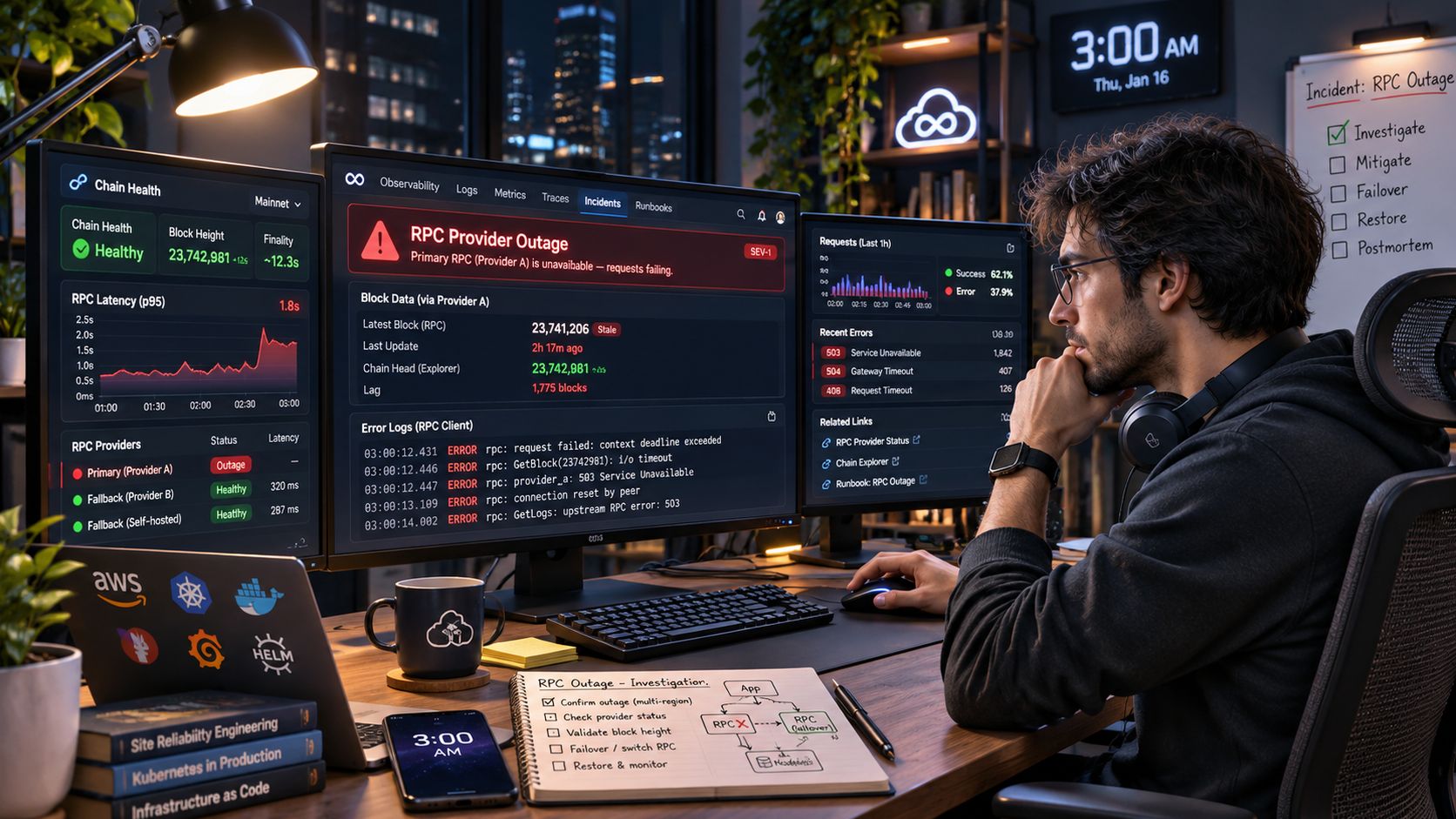
Blockchain infrastructure adds failure modes that ordinary web-service autoscaling cannot fix. Reorganizations can replace recent blocks, node clients can behave differently after upgrades, and applications may rely on RPC providers the team does not control.
| Concern | Why it differs | What the engineer does |
|---|---|---|
| Chain reorganization | Recent blocks can be replaced after a fork | Sets confirmation depth in applications and alerts on reorg depth |
| Node client diversity | Different clients behave differently under upgrades | Tests upgrades on staging nodes and pins client versions |
| RPC availability | Applications depend on third-party or self-run endpoints | Configures provider failover and handles rate limits |
| Key custody | A leaked signing key can drain funds immediately | Uses hardware-backed storage or a managed signer, with a rehearsed rotation process |
| Archival data | Full chain history grows to multiple terabytes | Sizes pruned and archive nodes and tiers storage |
| Cross-chain dependencies | Bridges and oracles can fail outside the team's code | Monitors dependencies and adds circuit breakers |
| Network-wide degradation | The fault may lie in the chain, not the application | Uses runbooks to distinguish network faults from application faults |
Key custody carries a different level of risk from routine service configuration. Signing keys belong in hardware-backed storage or a managed signer, never in a CI variable or environment file. A documented rotation process should be rehearsed: a misconfigured IAM role can disrupt service, while a leaked validator key can put funds at risk.
Choosing between self-hosted and managed RPC depends on the team's needs. Self-hosting can suit teams that need control over data locality, regional latency, or costs at high request volumes. Managed RPC can suit smaller teams and early products that do not want to operate another service. Either way, evaluate availability, rate limits, failover behavior, and operational ownership. The 2025 DORA research argues that internal platforms deliver value through quality and governance, not adoption alone. Apply the same scrutiny to a managed provider as to infrastructure you build.
A runbook cannot repair someone else's chain. It can help the on-call engineer identify the fault, isolate its impact, and communicate what the team can and cannot control.
That distinction is the practical deliverable: clear checks for node health, RPC behavior, application errors, and network conditions. Teams with a runbook for separating those failure modes can respond with less guesswork, without changing protocol code. In a portfolio, show the alerts, decision points, and recovery actions, not just a diagram of the infrastructure.
How Employers Test Infrastructure Skills in Interviews
Interviews test whether you can automate and integrate systems end to end, not whether you memorized a provider's menu. The 2024 State of DevOps report describes the platform-engineering skill set as process automation, strong system-integration knowledge, CI/CD familiarity, end-to-end performance testing and performance monitoring. Every exercise below maps back to one of those.
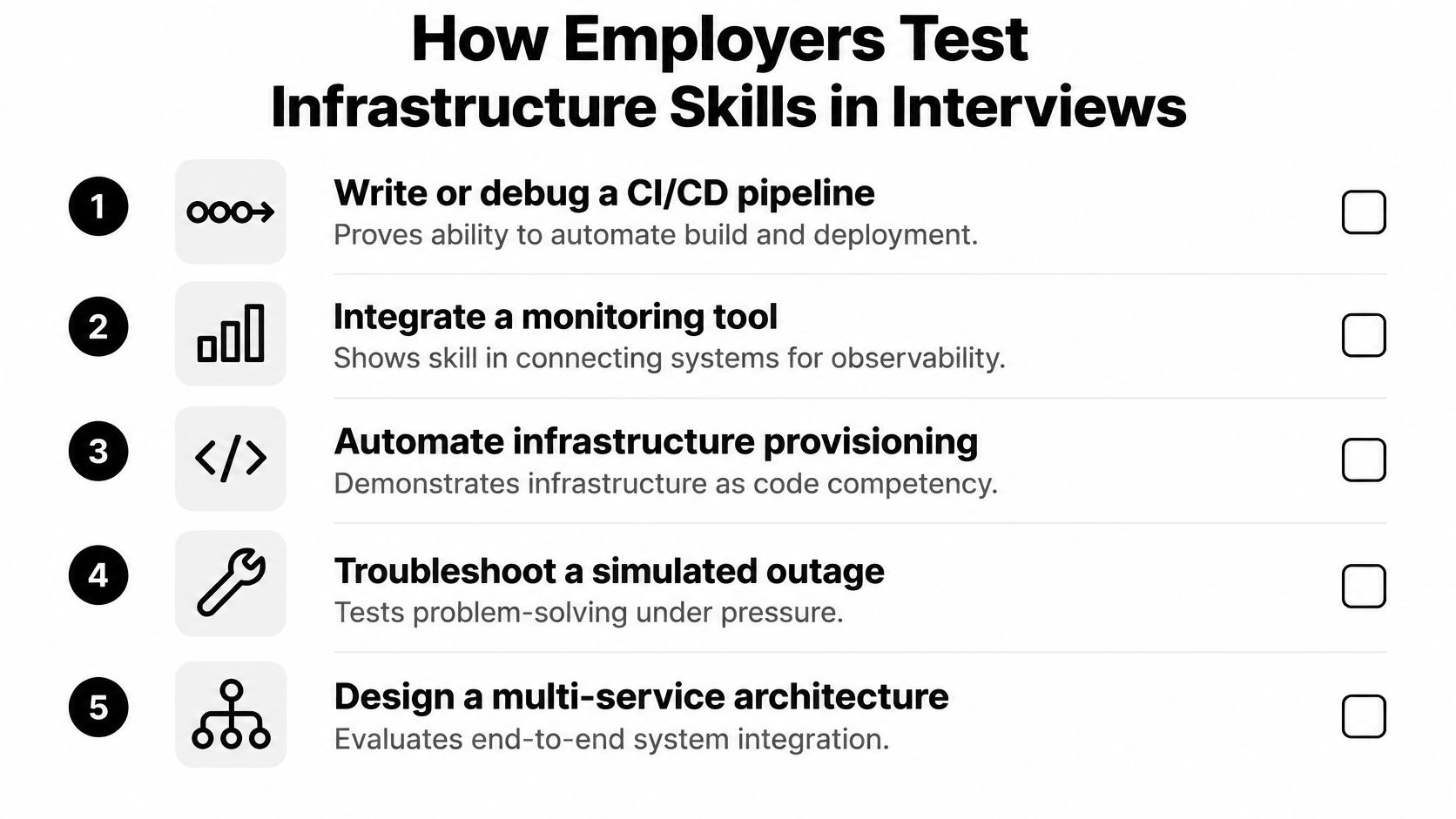
- Write or review Terraform for a small network and a database. They're checking whether you segment subnets, whether the database is reachable from the internet, and whether you reach for a module or copy 300 lines.
- Design a deployment pipeline with a rollback gate. The gate is the whole test. Anyone can describe a build step; the candidate who explains how a bad release gets reversed in two minutes is the one who has been on call.
- Explain how two services communicate. DNS, load balancers, timeouts, retries and what happens when the retry storm hits. Vague answers here read as inexperience.
- Define two or three service-level indicators for an RPC endpoint. Success rate and p95 latency are the floor. The stronger answer distinguishes stale reads from errors, because an endpoint returning old blocks is not technically failing.
- Diagnose a failed release from logs and traces. They want the order of your investigation and the first three things you'd check, not a lucky guess.
What a portfolio has to prove
A repository with a reproducible environment beats a list of certificates. Add a disaster-recovery target written as recovery time and recovery point objectives, one dashboard screenshot with real panels, and a page of threat model covering keys, network exposure and supply chain. Four artefacts, each answering a question the interviewer would otherwise have to guess at.
Red flags are consistent across interviewers. A tool list with no outcomes, a description of a project with no mention of what broke, and no rollback plan in a pipeline story all suggest someone who has watched infrastructure rather than owned it.
Before you go in, prepare three numbers from your own work: how often you deploy, how long recovery took on your last real incident, and one cost reduction you can attribute to a change you made. If you want to rehearse the behavioral half under pressure, these sample interview questions for candidates are a reasonable warm-up before the technical round.
Salary Benchmarks and Career Progression
Pay figures for this role come from two different kinds of measurement, and mixing them up is how people walk into a negotiation with the wrong anchor. Stack Overflow's 2024 Developer Survey put the worldwide median salary for DevOps specialists at $72,611, based on 22,677 salary responses. The 2025 edition of the same survey lists $89,427 for DevOps engineers and professionals worldwide, alongside $92,786 for AI and machine learning engineers.
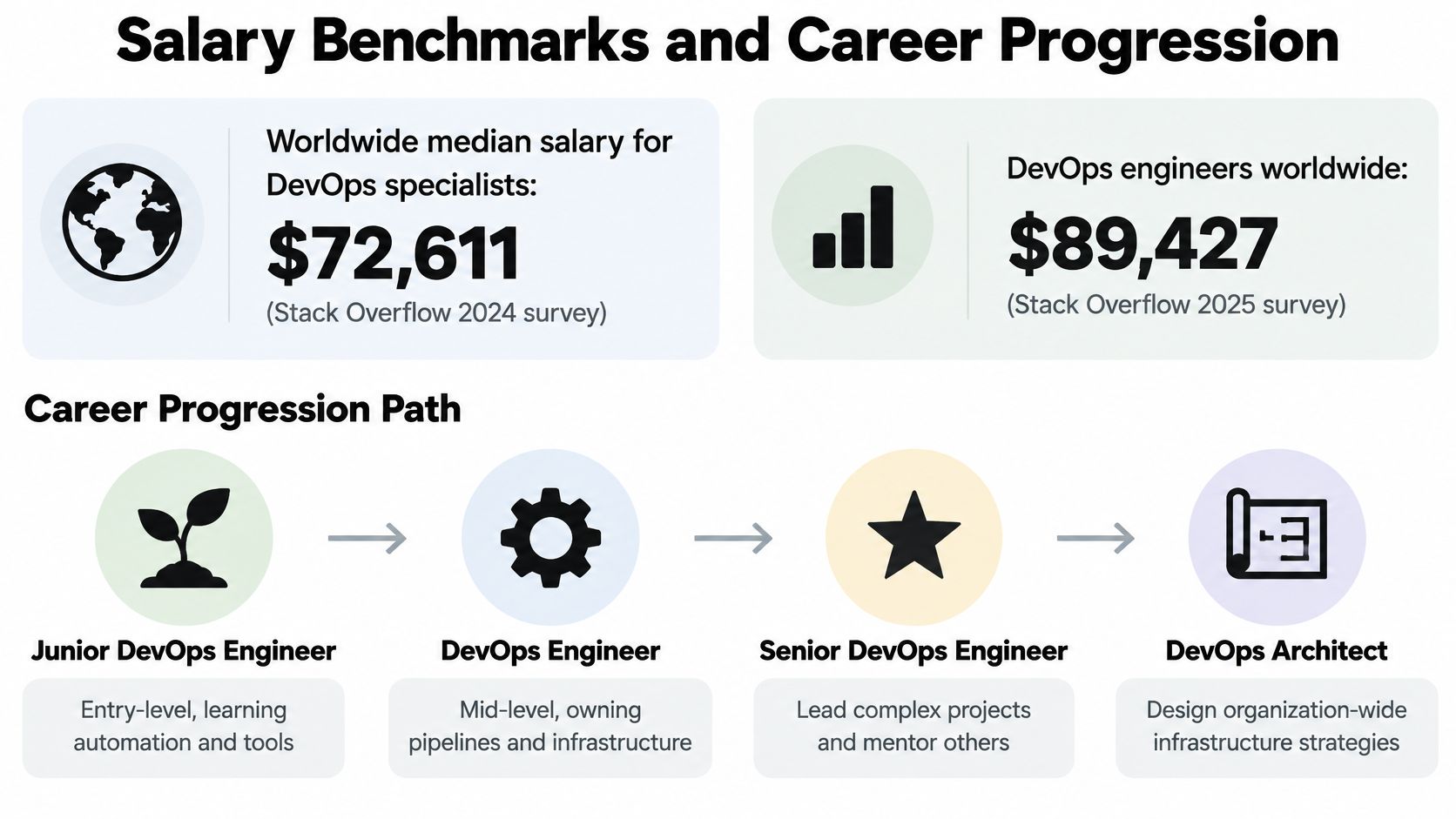
Official wage data sits higher because it measures a different population. The occupation grouping that covers most DevOps roles had a median annual wage of $130,160 in May 2024, according to a 2026 analysis of DevOps hiring costs. A survey median reflects self-reported global respondents; an official figure reflects one country and one occupational bucket. Anchor on whichever one you can name out loud, and say which it is.
Demand points the same direction as the pay. Mend's 2025 DevOps statistics roundup reported that DevOps engineer roles had grown 75% on Indeed and 50% on LinkedIn. Meanwhile the BLS Occupational Outlook Handbook projects employment for network and computer systems administrators will decline 4% from 2025 to 2035, partly because software developers working in DevOps absorb the tasks, while still producing about 13,400 openings a year as organizations replace departing staff.
| Figure | Value | Source and year | How to use it |
|---|---|---|---|
| Worldwide median salary, DevOps specialists | $72,611 | Stack Overflow 2024 | Survey baseline, not a guarantee |
| Worldwide compensation, DevOps engineers | $89,427 | Stack Overflow 2025 | Compare with peers by region |
| US median wage, occupation group covering most DevOps roles | $130,160 | BLS May 2024, cited in 2026 industry analysis | Official benchmark for offers |
| Projected employment change, network and computer systems administrators, 2025-2035 | -4% | BLS | Signals demand for automation skills |
| Annual openings, network and computer systems administrators | About 13,400 | BLS | Shows replacement demand |
| Growth in DevOps engineer roles | 75% on Indeed, 50% on LinkedIn | Mend, 2025 | Demand signal, not pay data |
Read those two demand figures together and the career signal is hard to miss. Manual administration is shrinking while automation-heavy work grows, which is exactly the split the first section of this article described.
Progression depends on scope, not tenure. Engineering carries 1,624 open roles on Blockchain Jobs, and 1,696 roles on the site are tagged Senior, so the volume of hiring sits above the entry band. That's why a salary conversation works better when you pair a benchmark with evidence: a deployment frequency you improved, an incident you shortened, a bill you cut. For a closer look at how the numbers move between levels, this breakdown of how much a DevOps engineer makes is worth reading before you name a figure. If you're still weighing whether to specialize at all, these software development and AI career routes show where adjacent paths lead.
Pick Your Entry Route and Apply With Evidence
Choose a route that builds on skills you already have. A systems administrator can automate a server build with Terraform and add a pipeline with a tested rollback. A developer can start with containers and a single-node Kubernetes cluster, then write the deployment manifests and pipeline. A blockchain engineer can deploy a testnet node, monitor it, and document how to recover a corrupted data directory.
Turn that work into evidence with a 90-day project:
- Choose an environment you can rebuild repeatedly.
- Put its configuration in a repository with a README a stranger can follow.
- Add a deployment pipeline with a manual approval gate before production.
- Create a dashboard and two alerts that point to actions a person can take.
- Write a recovery runbook and practise the procedure.
- Publish a short write-up with before-and-after measurements.
For your job search, browse Blockchain Jobs' DevOps & Infrastructure category and filter for remote roles if that suits your situation. The site lists 6,934 open roles across crypto, DeFi and Web3, including 4,171 remote roles. Match your project to two or three requirements in a listing, then make the most relevant duty clear in your application summary. If you're targeting your first role, use this guide to entry-level DevOps jobs to focus your search.
A finished project with clear measurements gives hiring managers concrete evidence to assess quickly. Show what you built, how it handles failure, and what changed after your work.
Blockchain Jobs groups openings into role categories, including DevOps & Infrastructure. Browse the listings and filter by level to find roles that fit your experience. Explore Blockchain Jobs and prepare a portfolio project that speaks directly to the requirements in a listing.