
Quantitative Finance Internship: Your Fast-Track to Landing Top Roles

Breaking into quantitative finance is tough, but a quantitative finance internship is your best shot. It’s one of the most intellectually challenging—and financially rewarding—career paths out there. To get your foot in the door, you must demonstrate a specific mix of advanced math, sharp computer science skills, and a genuine passion for financial markets that you can prove in an interview.
This isn't just another generic guide. Think of this as your playbook, packed with actionable advice on what it actually takes to get hired and turn that internship into a full-time offer.
The Reality of a Modern Quant Internship
Quantitative finance has exploded beyond its Wall Street roots to become a major force in global markets. For you, this means internship opportunities are more structured, more competitive, and pay better than ever before. We're going to break down the exact technical skills, portfolio projects, and interview strategies that make a candidate hirable.

Unlike traditional finance roles where networking can open doors, quant finance is a true meritocracy. It’s all about what you can prove. Hiring managers need to see concrete evidence that you can solve incredibly complex problems and write clean, efficient code. Your journey to an offer starts months, even years, before you apply. It begins with building a rock-solid technical foundation that can withstand the pressure of a rigorous interview process.
What to Expect From the Hiring Process
The interview process is a multi-stage gauntlet designed to test your analytical horsepower and your grit. Honestly, it’s less about your GPA and more about how you think. From a hiring perspective, every stage is a filter designed to weed out candidates who can't perform under pressure.
Here’s a taste of what’s coming:
- Intense Technical Screens: Get ready for timed coding challenges on platforms like HackerRank and phone screens packed with brain teasers on probability, statistics, and algorithms. These are designed to quickly assess your baseline problem-solving skills.
- Deep Dive Project Discussions: Interviewers will pick apart your personal projects. Be prepared to defend your methodology, walk through your code line by line, and justify every decision you made. This is where you prove you can do the work.
- Behavioral and Fit Interviews: Firms need to see a genuine spark—a passion for the markets and proof that you can handle the pressure of working in a high-stakes team environment. They are assessing if you'll thrive or crumble.
Over the past ten years, the number of formal quant internships has skyrocketed as systematic trading and quant-focused funds have grown. Big names like Point72, DRW, and Marshall Wace now post hundreds of roles each year. Many of these summer programs offer compensation that easily runs into five figures. You can see what top firms are looking for in their quantitative research intern programs.
The modern quant firm isn't just looking for someone who can ace a math test. They are hunting for creative problem-solvers who can translate abstract models into profitable strategies, especially in emerging areas like decentralized finance. Your career progression depends on this ability.
This guide will walk you through every step, from building a resume that gets past the first filter to crushing the final-round "superday." We'll also dive into the exciting intersection of quant finance and crypto, looking at unique opportunities like this Graduate DeFi Algorithmic Trader role, so you’re ready to position yourself for the future of finance.
Building Your Core Quant Skill Stack
A quant internship isn't won in the interview room. It's the direct result of the hard work you put in months—even years—beforehand to build a rock-solid technical foundation. Hiring managers aren't just looking for bright students; they’re looking for candidates who have deliberately stacked the specific, high-impact skills needed to find an edge in the markets.
Your ability to prove you have a deep, practical mastery of mathematics, computer science, and finance is what will get you hired over a sea of smart applicants.

This goes way beyond listing courses on a resume. It’s about having knowledge so ingrained that you can apply it under pressure to solve the kind of complex, open-ended problems you'll face every single day on a trading desk.
To help you focus your efforts, this table breaks down the core technical domains and connects them to what you'll actually be doing—and what you'll be asked in an interview.
Essential Quant Skills and Their Practical Applications
| Skill Domain | Key Concepts | Real-World Application | Common Interview Focus |
|---|---|---|---|
| Probability & Statistics | Conditional probability, expected value, common distributions, stochastic processes, brain teasers | Modeling asset price movements, calculating portfolio risk, backtesting trading strategies | Solving probability puzzles on the spot (e.g., coin flips, dice games) to test your logical process. |
| Linear Algebra | Vectors, matrices, eigenvalues, eigenvectors, matrix decomposition (e.g., SVD, PCA) | Portfolio optimization, risk factor analysis, dimensionality reduction for large datasets | Explaining the intuition behind PCA and its application in risk management; solving matrix manipulation problems. |
| Calculus | Derivatives, integrals, differential equations, stochastic calculus (Ito's Lemma) | Pricing options and other derivatives, modeling interest rate dynamics | Deriving key parts of the Black-Scholes model, explaining Ito's Lemma and its relevance to financial modeling. |
| Programming (Python) | Data structures (arrays, hash maps), algorithms, NumPy, Pandas, Scikit-learn | Building and testing models, data cleaning and analysis, implementing machine learning signals | "LeetCode" style problems, analyzing time/space complexity, and practical data manipulation tasks relevant to finance. |
| Programming (C++) | Pointers, memory management, low-level optimization, object-oriented programming | Developing high-frequency trading (HFT) systems, building ultra-low-latency execution logic | Questions on performance optimization, memory allocation, and system design for high-speed applications. |
| Finance & Market Knowledge | Options theory (Greeks), risk metrics (VaR, Sharpe ratio), market microstructures | Evaluating strategy performance, understanding derivative contracts, developing execution algorithms | Explaining option pricing concepts and demonstrating commercial awareness through market-making scenarios. |
As you can see, the path is clear. Each technical skill has a direct line to a real-world problem that quant firms need to solve. Let's break down these areas even further.
The Mathematical Bedrock of a Quant
While a STEM degree is the usual starting point, true preparation goes much deeper than your coursework. Recruiters will actively probe your understanding of the "why" behind the formulas. They want to see your intuition for numbers and your ability to think probabilistically on your feet.
Here's how to build a hirable foundation:
- Probability & Statistics: This is completely non-negotiable. You need a second-nature grasp of concepts like conditional probability, expected value, and common distributions. Practice solving brain teasers involving coin flips or dice rolls until you can articulate your logic clearly under pressure.
- Linear Algebra: Absolutely essential for working with large datasets and understanding many machine learning algorithms. Concepts like eigenvalues and eigenvectors aren't just academic—they're fundamental to techniques like Principal Component Analysis (PCA) used daily in risk modeling. Be ready to explain the why and how.
- Calculus & Differential Equations: This is especially critical for any role touching derivatives pricing. A solid handle on concepts like stochastic calculus (think Ito's Lemma) is a massive advantage and a clear signal of a serious candidate ready for advanced roles.
A favorite interview tactic is to present a simple-sounding probability puzzle. The goal isn't just to see if you get the right answer. It’s to evaluate how you structure your thinking, state your assumptions, and communicate your logic—key skills for career progression in a collaborative quant team.
Must-Have Coding and Software Skills
Your math genius is useless if you can't implement your ideas in clean, efficient code. Modern finance runs on technology, and your programming fluency is a direct proxy for how much value you can add from day one of your internship.
You need to be proficient in at least one, and ideally both, of these languages:
- Python: The undisputed king of quant research and data science. Your skills must go beyond basic scripting to include mastery of core libraries like NumPy for number crunching, Pandas for data wrangling, and Scikit-learn for machine learning. This is the toolkit for turning ideas into testable models.
- C++: The gold standard for high-performance systems where every nanosecond counts. If you're aiming for roles in high-frequency trading (HFT), deep C++ knowledge is often a strict prerequisite. This signals you can work on the most performance-critical parts of the business.
Beyond just the language, you have to master data structures and algorithms. Expect to be grilled on the time and space complexity of your code. Interviewers need to know you can write solutions that are not just correct, but also scalable and efficient. This focus on technical depth is why 60–80% of quant interns come from majors like math, computer science, and engineering. You can see these requirements in action by looking at real postings for quantitative technology internships.
Connecting Your Skills to the Financial Markets
Finally, you have to prove you actually care about finance. You don't need a finance degree, but you absolutely must speak the language of the markets. This is even more true for roles in crypto, where the domain knowledge is highly specific. For a great example, check out the skills required for this Java Quant Developer FX & Crypto role.
Focus on understanding the concepts that bridge your technical skills to real-world money-making problems. This means knowing options pricing theory (like the Black-Scholes model) and key risk metrics (like VaR or the Sharpe ratio). This practical knowledge shows you're not just an academic—you're ready to apply your brainpower to solve real financial challenges, which is the core of the job.
Crafting a Project Portfolio That Gets You Hired
Your resume lists your skills, but your project portfolio is where you prove them. For a quantitative finance internship, a generic GitHub filled with half-finished class assignments just won't cut it. Hiring managers are looking for tangible evidence that you can actually apply your technical skills to solve messy, finance-related problems from start to finish.
Think of a well-executed project as your best interview talking point. It’s a real-world demonstration of your ability to source and clean data, implement a mathematical model, critically analyze the results, and then communicate what you found. That’s the core workflow of a quant, and this is your chance to show some genuine passion for the markets that goes beyond your coursework.
The secret isn't building some revolutionary, flawless algorithm. It’s about showcasing a rigorous, thoughtful, and well-documented process that mirrors how real quant teams work.
Project Ideas That Demonstrate Quant Skills
To really stand out, you need to move past basic data analysis and get your hands dirty with projects that have direct financial relevance. Be prepared—interviewers will absolutely grill you on your methodology, so pick something you can defend from every possible angle.
Here are a few ideas that align with what hiring managers are hunting for:
- Backtest a Simple Trading Strategy: Grab some historical crypto data from an API and backtest a classic strategy like a moving average crossover or mean reversion. Document every step meticulously, including how you handled data biases, your assumptions on transaction costs, and performance metrics like the Sharpe ratio and maximum drawdown. This shows you think like a practitioner.
- Implement an Option Pricing Model: Fire up Python and build a Monte Carlo simulation to price a European option. This project screams that you understand stochastic processes and can translate a theoretical model into functional code. Crucially, be prepared to discuss the model’s limitations and when it might fail in the real world.
- Analyze Market Microstructure: Dig into the bid-ask spread or order book dynamics for a specific asset. This kind of project shows you’re interested in the nuts and bolts of trading and execution, a perspective that’s highly valued for many quant roles and shows a deeper level of interest.
Presenting Your Work for Maximum Impact
How you present your project is just as important as the code itself. Your GitHub repository needs to be treated like a professional deliverable, not a messy code dump. It's the first thing a hiring manager will look at after your resume.
A project that is 90% complete but well-documented and clearly explained is infinitely more valuable than a "finished" project with sloppy code and zero context. The goal is to demonstrate your thought process, not just spit out a final answer. This is what interviewers want to dissect.
Structure your project repositories for absolute clarity. Every project needs a detailed README.md file that explains the "why," the data source, your methodology, and a summary of your key findings.
Use Jupyter Notebooks to weave together code, visualizations, and narrative explanations into a compelling story. This approach makes your work easy for a non-technical recruiter or a busy hiring manager to digest, proving you can communicate complex ideas effectively—a non-negotiable skill for career progression in quant finance. Positions like a Quantitative Engineer at Blockchain.com often look for this exact blend of technical execution and clear communication.
Nailing Your Application Strategy for Top Firms
Firing off the same generic resume to dozens of firms is the fastest way to get your application tossed. I've seen it happen time and time again. This scattergun approach just screams that you haven't done your homework. To actually get noticed, you need a smart, targeted strategy that you put into motion months before any deadlines are even announced.
Your Resume: The Six-Second Pitch
Think of your resume as your opening argument, and you've got about six seconds to make your case. Every single line has to count, and the secret is to quantify everything to show impact.
Don't just say you "worked on a backtesting project." That tells a hiring manager nothing. Instead, say you "Improved backtest simulation speed by 15% through code vectorization, enabling faster strategy iteration." Now that gets my attention. Specific numbers and tangible impact are what separate the top candidates from the rest of the pack.
And please, tailor your resume for the role. A resume for a Quant Researcher position needs to scream statistical modeling and alpha generation projects. If you're going for a Quant Developer spot, I want to see your C++ skills, low-level systems knowledge, and your grasp of solid software engineering principles front and center.
Where to Find the Real Opportunities
The best quant roles aren't always posted on the big, mainstream job boards. Sure, you need to check your university career portal and the company websites, but the real gems are often hidden a layer deeper.
Dig into specialized job boards that focus specifically on quantitative finance and crypto. These are absolute goldmines for finding roles at elite hedge funds and prop trading firms that don't always advertise widely.
Your network is your early warning system. An internal referral won't guarantee you a job—you still need the technical chops—but it can absolutely be the thing that gets your resume past an automated filter and in front of a real person.
When you network, don't just ask for a job. That's a rookie mistake. Instead, reach out to alumni from your school who are working at firms you're interested in. Ask them smart questions about their day-to-day, what they're working on, and what skills they use most. These conversations give you priceless intel for your interviews and, if you make a good impression, can often lead to a referral.
Mastering the Application Timeline
Here’s something that trips up a lot of students: the recruiting cycle for quant internships starts way earlier than you think. The top-tier firms often open their applications in late summer or early fall for the following summer. If you wait until spring, you're just too late.
Here’s a rough timeline for your job search campaign:
- Summer (The Year Before): Finalize your key portfolio projects and polish your resume. Start building a target list of firms and networking with alumni.
- Early Fall: Applications go live. Submit your polished, tailored applications to your top-choice firms the moment they open to get ahead of the crowd.
- Mid-to-Late Fall: This is peak season for first-round interviews and coding challenges. Be prepared to juggle multiple interview processes at once.
- Winter: This is when the final round "superdays" happen and offers start rolling out.
It's a marathon, not a sprint. By getting everything in order months ahead of time, you put yourself in a position to be confident and prepared when the starting gun fires.
Cracking the Quant Interview
The quantitative finance interview isn't just a test of what you know; it's a high-stakes performance designed to see how you think, especially when you're under pressure. It's a grueling, multi-stage gauntlet that relentlessly filters for raw analytical horsepower, creative problem-solving, and pure mental stamina. To get an offer, you need a prep strategy that goes way beyond memorizing formulas.
This video provides a great overview of the entire application journey, breaking down the key phases from polishing your resume to making the right connections.
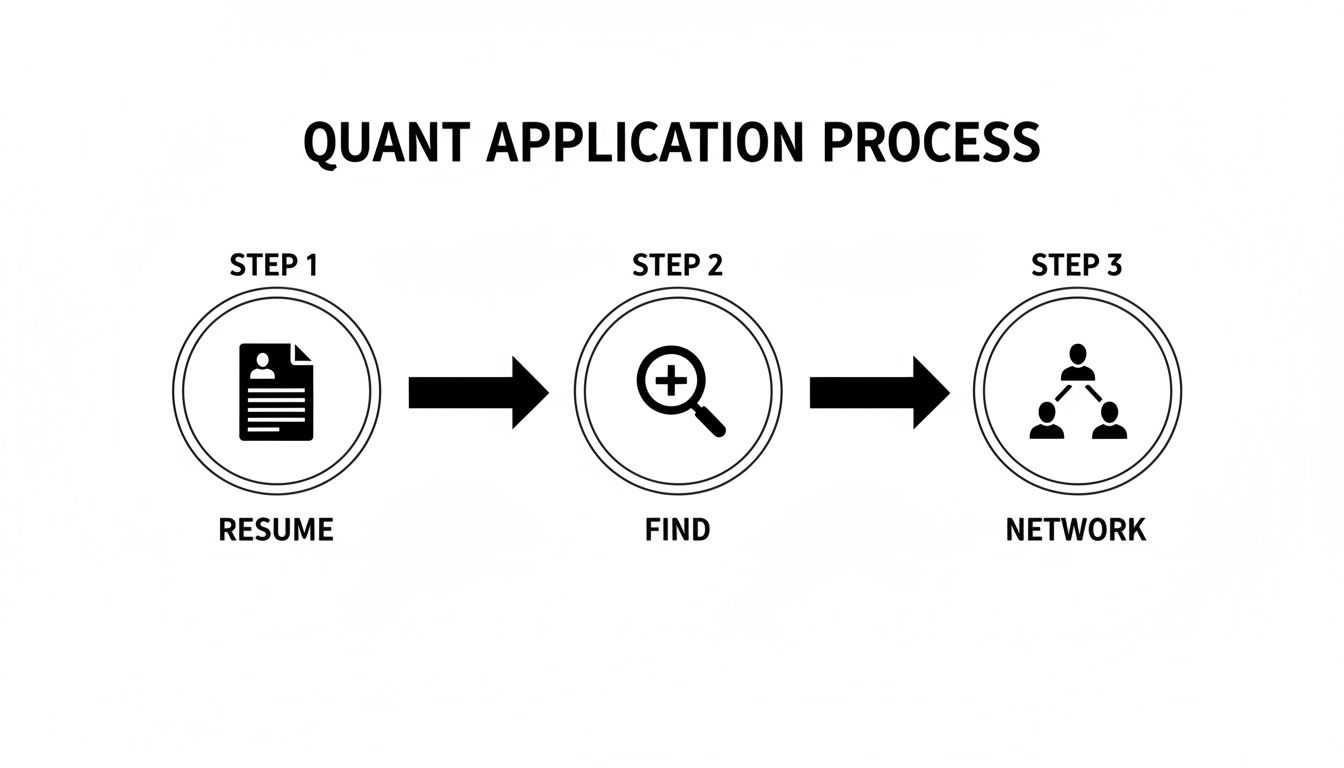
As you can see, a successful application is really a sequence of strategic moves. Your resume gets your foot in the door, a targeted search lands you in the right interviews, and networking often gives you the critical edge you need to stand out.
The Technical Gauntlet
The heart of the process is a series of intense technical hurdles. You should be ready for several rounds, usually starting with online coding tests before moving on to live, face-to-face interviews with senior quants.
Here's how to prepare for what you'll be up against:
- Brain Teasers & Probability Puzzles: These aren't just for fun. They're a direct line into your mental agility and probabilistic intuition. The key is to practice thinking out loud. Break down the problem, state your assumptions, and walk the interviewer through your logic step-by-step.
- Coding Challenges: Expect "LeetCode" style problems that zero in on data structures and algorithms. The bar is high—a correct solution is good, but an optimal one is what they're looking for. Be ready to defend the time and space complexity of your code on the spot.
- On-the-Job Simulations: Many firms now use a mini-project in the final rounds. They might hand you a messy dataset and ask you to build a simple predictive model or analyze a trading strategy. This is their way of seeing if you can deliver practical results and how you handle ambiguity.
Beyond the Technical: Nailing the Behavioral Fit
While technical chops are the price of admission, firms also need to know you can handle their unique, high-pressure environment. That's where behavioral questions come in, and they can make or break your candidacy.
The "Why this firm?" question is a classic filter. A generic answer is a massive red flag. You need to show you've done your homework by referencing their specific investment philosophy, the types of strategies they're known for, or even a recent research paper one of their quants published. This proves you have genuine interest and see a future with them.
This is your chance to show you're not just a coder who stumbled into finance. Be ready to talk about a trading idea you've developed or a recent market event that caught your eye. They want to see that you live and breathe this stuff, as that passion is what fuels long-term success in the industry.
What to Expect From the Internship Project Itself
If you land the role, the real test begins. A quantitative finance internship is a structured trial by fire, designed to see if you have what it takes to get a full-time offer.
Most programs run for 8–12 weeks and are built around a core project with clear milestones. You’ll be assigned a real-world problem—anything from cleaning massive datasets and engineering new features to back-testing a novel trading signal.
Your performance will be judged on concrete metrics: the quality and efficiency of your code, the empirical results of your analysis (like the Sharpe ratio of your backtest), and your ability to rigorously document and reproduce your experiments. Many internships wrap up with a formal presentation to senior managers where you must defend your work. Success is measured in numbers, whether that's model accuracy or a demonstrable improvement in simulated P&L. This is your chance to prove your value for a return offer.
To get a better feel for how these roles are structured, take a look at the details of a typical quantitative research internship program.
Common Questions About Quant Internships
Trying to land a quant internship can feel like you're navigating a maze. As you get deeper into the prep, the same questions tend to pop up again and again. Getting straight answers from a hiring perspective is the best way to focus your energy where it actually counts.
Let's break down some of the most common questions, with answers geared toward what hiring managers actually want to see.
Do I Need a PhD for a Quant Internship?
Not necessarily, but the degree you hold often dictates the type of role you're best suited for. From a career progression standpoint, this is a key distinction.
- For Quantitative Researcher roles: A PhD (or at least a research-heavy Master's) in a field like physics, math, or statistics is often preferred. These roles require the deep theoretical background needed to invent new models and find novel trading signals from data.
- For Quantitative Developer roles: A strong Bachelor's or Master's in Computer Science is usually the key. The focus is on rock-solid implementation, optimizing systems, and building the high-speed infrastructure that powers every trade.
That said, I've seen some truly exceptional undergrads from top STEM programs break in. They almost always have something extra to show for it, like a mind-blowing personal project or a top ranking in a competitive programming contest that proves their exceptional ability.
What Is the Biggest Mistake Candidates Make?
By far, the most common pitfall is failing to talk through your thought process. Interviewers are less concerned with you nailing the "right" answer on the spot and far more interested in seeing how you think under pressure.
Just blurting out a final number to a probability question tells them almost nothing. You have to walk them through it. Explain your assumptions, show your logic, and detail how you built your way to the conclusion. Another huge red flag? A complete lack of interest in the markets. You absolutely must be ready to talk intelligently about a recent market trend or a trading idea you've kicked around to show you're genuinely engaged.
I've seen candidates with the wrong answer get moved to the next round over someone who got it right but couldn't explain their logic. How you think is the real test of your potential as a future quant.
How Important Is Networking?
The quant world is definitely more of a meritocracy than investment banking, but smart networking still gives you a serious leg up. Your skills are what get you the job, but networking is often what gets your resume looked at in the first place.
A referral won't save you if you bomb the technical questions. What it can do is get your application out of the algorithmic filter and in front of a real person, giving you a chance to prove yourself. Going to career fairs, winning a trading competition, or reaching out to alumni on LinkedIn are all effective ways to get on a firm's radar.
Can I Get an Internship Without a Finance Background?
Yes, absolutely. In fact, it's pretty standard. The top quant firms are filled with people from physics, pure math, and computer science who had zero formal finance training.
The hiring philosophy is simple: it’s much easier to teach a brilliant physicist about options pricing than it is to teach a finance major about stochastic calculus. Your technical depth is your greatest asset. What you do need to show is a real passion for applying those skills to financial puzzles. This is where your portfolio projects and well-reasoned interview answers make all the difference in convincing a hiring manager you're the right fit.
Ready to dive into the world of Web3 and DeFi? Blockchain Jobs is the go-to job board for roles in the crypto space, from quant trading to protocol engineering. Check out the curated listings and connect with the innovative companies building the future of finance. Find your next opportunity at https://blockchain-jobs.com.