Senior QA Engineer Salaries: A 2026 Web3 vs Tech Guide

A lot of salary guides flatten senior QA engineer salaries into one neat average. That’s lazy, and it’s expensive if you’re job hunting.
The sharper reality is this. In 2026, average annual total compensation for Senior QA Engineers in the United States ranges from $129k to $334k, with an overall average of $158k based on 1,513 verified profiles, and the highest reported salary reaches $490k according to 6figr salary data for Senior QA Engineers. If you’re testing smart contracts, building automation around DeFi workflows, or owning release quality in a security-sensitive product, you should not benchmark yourself against a generic QA average and call it a day.
I recruit across Web3 and broader tech. I’ve seen strong senior QA engineers underprice themselves because they focus only on base salary, ignore equity mechanics, and treat token grants like Monopoly money. I’ve also seen candidates walk away from excellent offers because they didn’t know how to value upside, risk, and remote arbitrage correctly.
This isn’t a generic roundup. It’s a practical guide for people who want to earn more, negotiate better, and make smarter career moves across traditional tech and blockchain.
Your Guide to Senior QA Engineer Salaries in 2026
Top-end compensation for senior QA engineers reaches far beyond the average, and that gap gets wider in Web3.
Your real benchmark is not a national midpoint already covered above. It is the pricing for your risk profile, product domain, and revenue impact. A senior QA engineer in traditional SaaS is usually paid for test automation, release confidence, and defect prevention. A senior QA engineer in Web3 can be paid for those same skills plus security awareness, protocol-level failure prevention, and the ability to test products where one missed edge case can have financial consequences.
That difference changes how you should approach the market.
If you are staying in traditional tech, optimize for strong base salary, predictable bonus structure, and equity with clear refresh policies. If you are moving into blockchain, treat every offer as a mix of cash compensation, upside, and risk. Token grants can create real wealth. They can also distract candidates from a weak base, thin benefits, or vague vesting terms.
Use the market to your advantage. Review active Web3 QA and test engineering roles to see how teams describe ownership, tooling, and compensation philosophy. Then compare that against your current scope. If your experience covers automation architecture, API validation, CI reliability, release gating, and security-sensitive testing, you should position yourself above generic senior QA ranges.
Do not copy salary advice written for broad QA hiring. It misses the hard part. You need a valuation method for unlike-for-like offers. Compare cash to cash first. Then assess equity or tokens separately based on vesting, liquidity, dilution, lockups, and whether the business has a realistic path to growth. That is how experienced candidates avoid taking a flashy offer that pays less in practice.
Global pay adds another layer. Location still shapes compensation in traditional companies, while many Web3 teams hire remote-first and price more aggressively around skill scarcity. For a useful regional reference point outside the US, review Dubai automation test lead pay. It is a reminder that title alone never tells you what an offer is worth.
The engineers who earn more ask better questions early. What are you paying me to own? What failure will cost you the most? How much of this package is stable, and how much is speculative? Ask those questions before you discuss compensation numbers. It gives you a stronger anchor and a far better deal.
The Senior QA Salary Landscape Today
The spread between a mid-tier Senior QA offer and a top-tier one is wide. What closes that gap is not the title. It is the combination of ownership, technical depth, domain risk, and how the company structures pay.
That distinction matters more in Web3 than in traditional tech. In a standard SaaS company, compensation is usually easier to benchmark because cash is the main signal. In Web3, two offers with similar headline numbers can have very different real value once you account for token volatility, vesting, and whether the company is paying you for execution or for protecting a high-risk product from expensive failures.

What actually moves your pay
The market rewards Senior QA engineers who reduce risk at scale.
If you own release quality across multiple services, build automation that engineering trusts, and catch failures before they hit production, you should expect better pay than someone whose work stays limited to test execution. The biggest salary jumps usually go to engineers who influence delivery decisions, not just test outcomes.
Here is what hiring teams pay up for:
- Broad ownership. Quality strategy, release gating, CI signal health, defect triage, and cross-team influence.
- Strong automation judgment. Building and improving frameworks across UI, API, integration, and regression layers without relying on constant direction.
- High-risk product exposure. Payments, infrastructure, security-heavy platforms, and blockchain products where defects are expensive and public.
- Technical communication. The ability to challenge weak release assumptions, quantify risk, and push engineering teams toward better quality systems.
Web3 adds another premium layer. Teams often want one person who can test smart contract interactions, validate APIs, understand wallet flows, and work comfortably in remote, fast-moving environments. If that is your profile, do not price yourself against generic QA salary bands.
Why averages mislead experienced candidates
Average salary figures are useful for basic orientation. They are weak tools for pricing a strong candidate.
A Senior QA engineer at a public company may get a clean package with solid base pay, bonus, and equity. A Senior QA engineer at a token-funded startup may get a lower base, a larger upside story, and far more ambiguity. Those are not equivalent offers, even if the recruiter presents them that way.
Your job is to sort offers into two buckets first. Stable compensation and speculative compensation. Cash belongs in the first bucket. Tokens, startup equity, and performance payouts belong in the second. Evaluate them separately.
If you are screening current openings, review live quality assurance roles in blockchain. You will see quickly which companies want a test executor and which ones are really hiring a quality owner who can protect product velocity and platform trust.
If you’re evaluating international opportunities or calibrating remote market differences, a market-specific reference like Dubai automation test lead pay can help you compare compensation logic outside the US.
Seniority alone does not raise your pay. Risk reduction, system ownership, and business impact do.
A practical way to place yourself
Use this lens before you enter a compensation discussion:
| Factor | Lower end of range | Higher end of range |
|---|---|---|
| Ownership | Executes assigned testing | Owns strategy, framework, release quality |
| Automation | Maintains existing scripts | Designs and scales test systems |
| Domain | Generic product QA | Security-sensitive, infra, fintech, Web3 |
| Communication | Reports bugs well | Influences engineering decisions |
| Hiring market | Local, limited options | Multiple competitive interview tracks |
Score yourself.
If you land in the right-hand column in three or more rows, push for top-band cash compensation before you even discuss upside. That is the move strong candidates miss, especially when switching from traditional tech into blockchain. They get distracted by token potential and underprice the skills that should already command a premium in base salary.
Breaking Down Your Total Compensation Package
A compensation package is not a salary number. It’s a structure. If you don’t break that structure apart, you can’t compare offers properly.
Most senior QA engineers look first at base salary because it feels concrete. That makes sense, but it’s only the foundation. Bonus, equity, benefits, and vesting terms can change the overall value of an offer dramatically.

Base salary is your floor
Base salary is the part you can count on showing up in your paycheck. That’s why I tell candidates to protect it aggressively.
If a company tells you to “focus on upside,” but the base is weak, be careful. Upside is useful. Rent is more useful.
A strong base matters even more in Web3 because token values can swing, vesting may take time, and liquidity can be uncertain. If the base doesn’t reflect your level, you’re subsidizing the company’s risk.
Bonus is the middle layer
Bonuses sound simple, but they often aren’t. You need to know whether the bonus is discretionary, formula-based, tied to company performance, tied to your review rating, or tied to milestones that may shift.
Ask direct questions:
- What triggers payout
- How often the company has historically paid bonus
- Whether the target is guaranteed, discretionary, or mixed
- Whether payout is prorated in your first year
If a recruiter can’t explain the bonus clearly, discount it mentally. Vague bonus language should never carry the same weight as guaranteed cash.
A bonus isn’t real comp until you understand who controls it and what has to happen for you to receive it.
Equity comes in different flavors
At this point, many good candidates get lost.
In traditional tech, equity usually appears as RSUs or stock options. RSUs are generally easier to understand. They’re company shares granted to you over time, usually on a vesting schedule. Options give you the right to buy shares later at a set strike price, which can be attractive but requires more interpretation.
Think of base salary as the house you live in. Think of equity as land nearby that might become very valuable. It can be excellent. It can also remain theoretical for a long time.
Here’s the practical difference:
| Component | What it means | What to watch |
|---|---|---|
| Base salary | Guaranteed cash compensation | Market rate, location adjustments |
| Bonus | Variable cash on top of base | Performance conditions, payout history |
| RSUs | Shares that vest over time | Vesting cadence, refresh policies |
| Stock options | Right to buy shares later | Strike price, expiry, liquidity path |
Vesting is where offers become real
Vesting tells you when compensation becomes yours. A grant headline can sound great, but the schedule decides whether it’s useful.
Read the offer for:
- Cliff terms. Some plans require you to stay through an initial period before anything vests.
- Vesting cadence. Monthly, quarterly, and annual schedules feel very different in practice.
- Acceleration terms. If the company is acquired or your role changes, what happens?
- Exit mechanics. If you leave, how long do you have to exercise options?
A mediocre-looking offer with clean vesting and a strong base can beat a flashy package with slow vesting and fuzzy rules.
Benefits still matter, especially late in a career
Senior engineers sometimes dismiss benefits because they’re focused on headline cash. That’s a mistake.
You should inspect parental leave, health coverage, retirement support, equipment policies, professional development budgets, PTO norms, and remote work setup. A company that underinvests in those areas often underinvests in people generally.
This is also a hiring signal. Sloppy offer paperwork, unclear benefits explanations, and evasive answers during closing usually predict internal mess after you join.
If you can’t explain each line of your offer back to the recruiter in plain English, don’t sign it yet.
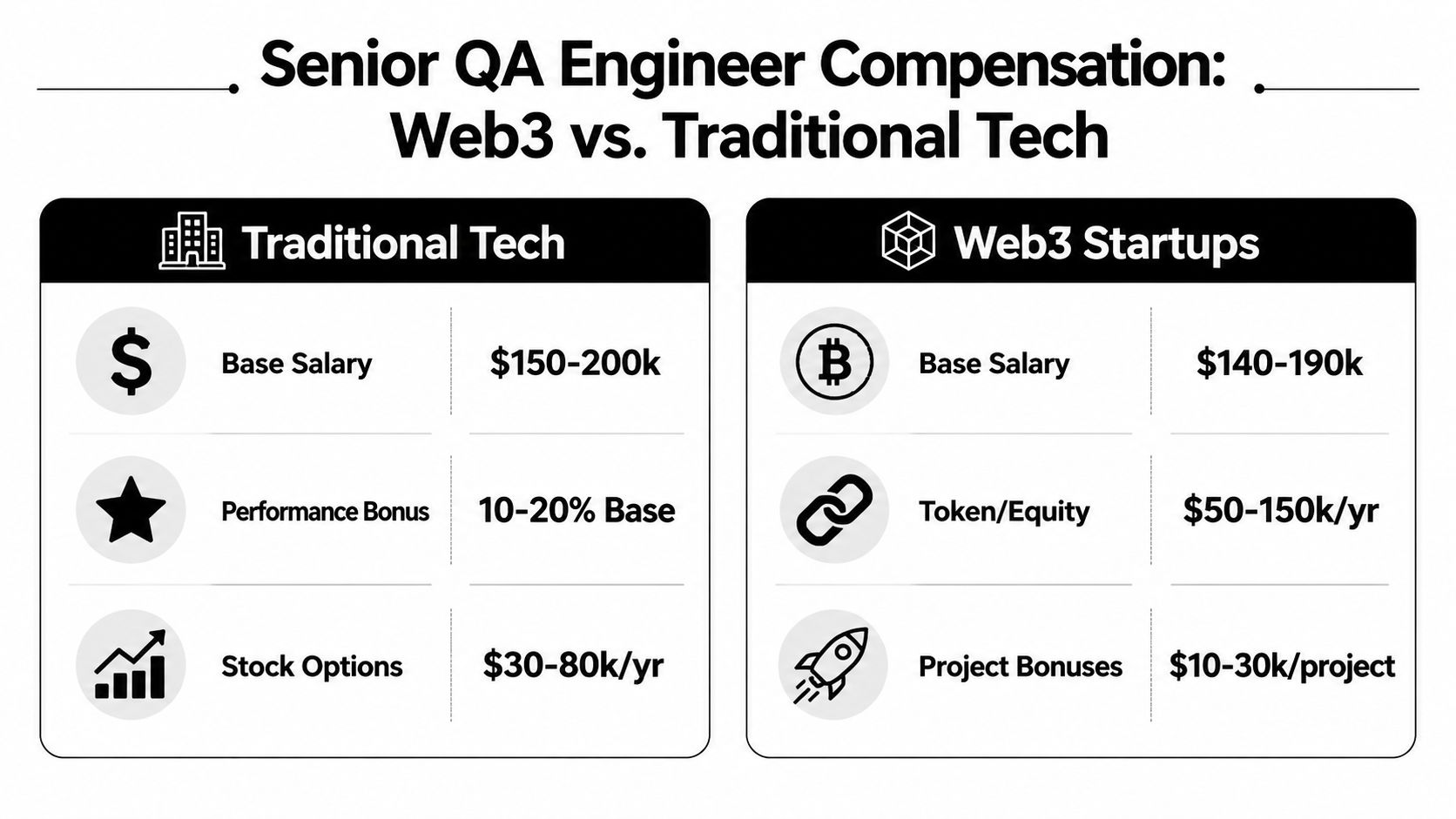
Web3 vs Traditional Tech Salary Comparison
Traditional tech and Web3 don’t just pay differently. They reward different kinds of risk tolerance.
Traditional tech usually offers cleaner compensation structures, more stable planning, and a better-defined ladder. Web3 often offers broader ownership, faster responsibility, and a more volatile upside profile. Neither is automatically better. The right choice depends on your financial goals, your appetite for uncertainty, and how strongly your skills map to protocol-level quality problems.
Geography works differently in each market
One of the clearest differences shows up in location strategy. According to Comparably’s Senior QA Engineer salary data, San Jose, CA commands a 97% premium over the US average at $204,720, compared to a national median of $105,000. The same source notes that most Senior QA Engineers earn between $95,500 and $109,300, while the top 10% exceed $214,000 annually.
In plain terms, traditional tech still heavily reflects tech-hub pricing.
Web3 often doesn’t. Remote-first blockchain companies regularly hire outside major hubs because they care more about specialized capability than office geography. That creates opportunity for candidates in lower-cost markets. If you can test smart contracts, validate wallet interactions, pressure-test cross-chain flows, or build reliable automation around dApps, you may be able to capture top-tier compensation without living in Silicon Valley.
That’s one of the few areas where Web3 can beat traditional tech structurally. Remote arbitrage is real when the role is hard to fill.
Side-by-side compensation logic
The fastest way to compare offers is to stop looking for one winner and compare each component on its own.
| Component | Traditional Tech (e.g., FAANG, SaaS) | Web3 (e.g., DeFi Protocol, DAO) |
|---|---|---|
| Base salary | Usually more standardized and easier to benchmark | Can be competitive, but varies more by stage and treasury philosophy |
| Bonus | Often formalized with review cycles | Less consistent, sometimes replaced by milestone or project upside |
| Equity | RSUs or options with familiar legal frameworks | Token grants, options, equity, or a hybrid structure |
| Liquidity | Usually clearer in public companies | Often uncertain, delayed, or market-dependent |
| Job scope | More specialized | Often broader and more ambiguous |
| Hiring process | More structured | Faster, less uniform, sometimes chaotic |
You can review a live example of a crypto-native opportunity in this senior QA engineer role at LI.FI via Blockchain Jobs. Even one listing will show you how different the scope can feel from a typical SaaS QA role.
The token question
Here’s the blunt truth. Most candidates either overvalue tokens because they dream about upside, or undervalue them because they’re uncomfortable with crypto.
Both reactions are sloppy.
Treat token compensation as a separate risk asset. Don’t use the company’s internal enthusiasm as your valuation model. Ask how the grant is denominated, what the vesting schedule is, whether there’s a cliff, whether tokens are locked after vesting, what the liquidity path looks like, and whether you can sell any portion on vest.
If those answers are vague, discount the token piece heavily.
If a company wants you to accept token risk, they need to explain token mechanics with the same clarity a public company would use for RSUs.
When traditional tech is the better move
Traditional tech is usually better if you need stable cash flow, predictable career ladders, and a package you can explain to a mortgage lender without a long side conversation.
It also tends to be a better fit if:
- You want a narrower role with deep ownership of test architecture rather than broad startup firefighting.
- You’re optimizing for brand signaling from a well-known company on your resume.
- You prefer structured review cycles and cleaner internal leveling.
When Web3 is worth the jump
Web3 is compelling when you want to stretch your scope and you can evaluate technical risk better than the average candidate.
It’s especially attractive if:
- You enjoy messy systems and can work across frontend, backend, infra, and protocol behavior.
- You understand blockchain primitives well enough to test wallet flows, transaction states, indexing issues, and smart contract edge cases.
- You can stomach volatility without depending on the upside to justify your monthly budget.
The right way to compare a Web3 offer against traditional tech is not “Which headline number is larger?” It’s “Which package still looks good after I haircut the uncertain pieces?”
Do that thoroughly, and the answer usually becomes clear.
The Skills That Command Premium Salaries
Top-end senior qa engineer salaries don’t go to people who merely know testing. They go to people who remove uncertainty from releases that matter.
That means your earning power depends less on title inflation and more on whether you can own complex quality problems without supervision. In practice, that splits into two lanes. The first is high-impact QA engineering in traditional tech. The second is specialized QA for Web3 systems where failure can hit funds, transactions, and trust.

What hiring managers pay for in traditional tech
Most companies say they want “automation experience.” That phrase is too vague to be useful. What they pay for is someone who can build test systems that survive product change.
High-value skills include:
- Framework ownership. Building and maintaining Playwright, Cypress, Selenium, or mixed UI and API automation that the rest of the team can trust.
- API fluency. Working comfortably with Postman, contract validation, auth flows, and service-level regression.
- CI integration. Wiring test suites into GitHub Actions, GitLab CI, Jenkins, or similar delivery pipelines so failures become actionable instead of noisy.
- Debugging discipline. Separating product defects from flaky tests, bad data, race conditions, and environment issues quickly.
- Cross-functional influence. Pushing quality left, improving acceptance criteria, and preventing bugs before test execution starts.
If you want to accelerate your progress in the current tooling shift, it’s worth reviewing approaches like Monito's no-code testing agent. Not because no-code replaces senior QA judgment, but because strong engineers now need to understand where AI-assisted testing helps and where it creates blind spots.
What commands a premium in Web3
Web3 employers don’t pay more because the space is trendy. They pay more when the QA surface is painful.
The premium skills are the ones that help teams ship safely in systems with wallets, signing flows, smart contracts, indexing layers, RPC inconsistency, chain-specific behavior, and irreversible user actions.
A strong Web3 QA profile usually includes some mix of:
| Skill area | Why it matters in hiring |
|---|---|
| Smart contract test literacy | You can validate behavior instead of only UI outcomes |
| Wallet flow testing | You understand connection states, signatures, approvals, and failure paths |
| dApp integration testing | You can test frontend, backend, and on-chain interactions together |
| Security-aware QA | You catch dangerous edge cases, not just cosmetic bugs |
| Toolchain familiarity | Hardhat, Foundry, and blockchain debugging workflows make you faster |
A live benchmark for role expectations is this automation QA engineer opening at CoinMarketCap Ltd. Study the overlap between automation fundamentals and domain-specific product testing. That overlap is where compensation separates.
Strong Web3 QA engineers don’t just ask, “Does the feature work?” They ask, “What happens if the wallet disconnects, the transaction stalls, the indexer lags, and the user retries?”
The real differentiator is systems thinking
The candidates who get paid best are rarely the ones with the longest tool list. They’re the ones who can explain tradeoffs.
For example, if you can tell a hiring panel why a Playwright suite should cover high-signal user paths, why API assertions should carry more of the regression load, and why a blockchain product needs environment-aware test design because chain state isn’t static, you sound senior. Because you are.
Build toward that level with a portfolio that shows:
- Test architecture decisions, not just test scripts
- Failure analysis examples, especially flaky test diagnosis
- Release-risk thinking, including where automation ends and manual exploration begins
- Domain depth, whether that’s fintech, infra, or blockchain
Tools get you interviews. Judgment gets you paid.
How to Negotiate Your Senior QA Engineer Offer
Most candidates negotiate too late and too softly.
They wait until the offer arrives, react to the number, and ask for “a bit more.” That’s not negotiation. That’s hoping the recruiter helps you. Sometimes they will. Usually, they’ll protect the company’s budget.
A good negotiation starts before first interview. You need a target range, a walk-away point, and a clear explanation for why your value sits where it does.
Start with your market story
Your story must be stronger than your salary expectation. Recruiters can challenge a number. It’s harder to challenge a pattern of evidence.
Build your case around:
- Scope. What quality systems have you owned?
- Complexity. What kinds of products and risks have you handled?
- Technical depth. Which automation, API, CI, or blockchain testing skills reduce team risk?
- Business impact. How do you help teams ship with fewer surprises?
You don’t need invented metrics to make this persuasive. You need clarity.
Say it like this:
“I’m targeting compensation that reflects senior-level ownership. I build automation systems, improve release confidence, and work effectively in products where regressions have real user and business impact.”
That framing is stronger than “I saw some salary numbers online.”
Control the compensation conversation early
If a recruiter asks for your current salary, don’t anchor yourself to yesterday’s number.
Use one of these responses:
If you want to redirect
“I’m focused on the market value of this role and the scope you need. If we’re aligned there, I’m happy to discuss the right package.”
If they push for a range
“For roles at this level, I’m considering opportunities based on total compensation, scope, and upside. I’d like to understand your band before narrowing in.”
If you’re moving into Web3
“I’m evaluating both traditional and Web3 opportunities, so I’m comparing full package design, not just base salary.”
That last line matters. It signals you’re not naive about token-heavy offers.
Build your counteroffer like an operator
Never send a vague counter. Break it into components.
Use this framework:
| Component | What to say |
|---|---|
| Base | “I’d like to revisit base to better reflect the level of ownership expected in this role.” |
| Bonus | “Can you clarify target bonus and whether there’s flexibility there if base is fixed?” |
| Equity or tokens | “I’d like more detail on grant sizing, vesting, and how you expect me to value this piece.” |
| Sign-on | “If salary constraints are real, is there room for a sign-on to close the gap?” |
| Level | “I want to confirm the level is calibrated correctly given the scope discussed.” |
Many candidates leave money behind. They negotiate only base when the company may have flexibility on sign-on, equity, or level.
Questions you must ask on a Web3 offer
Web3 negotiation is not just salary negotiation with crypto vocabulary. It’s a different exercise.
Ask these questions directly:
- Is the token grant denominated in units or a dollar value
- What reference point is used to determine value
- What is the vesting schedule
- Is there a cliff
- Are vested tokens immediately liquid or subject to lock-up
- What happens to unvested grants if the role changes or the company restructures
- Is token compensation replacing market cash or supplementing it
If the team can’t answer those questions clearly, assume the uncertain portion is worth less than they say.
Don’t negotiate token compensation on optimism. Negotiate it on mechanics, liquidity, and downside protection.
Sample closing script
Here’s a practical version you can adapt:
“I’m excited about the role and I can see the fit. To sign confidently, I need the package to better reflect the scope, especially around ownership of automation strategy, release quality, and the domain complexity we discussed. I’d like to explore movement on base first. If that’s constrained, I’m open to discussing sign-on, equity, or token structure to close the gap.”
That script works because it’s firm without sounding theatrical.
A few mistakes to stop making
- Don’t apologize for negotiating. Senior candidates are expected to.
- Don’t negotiate against yourself. State the ask, then stop talking.
- Don’t obsess over one line item. The strongest package may come from adjusting multiple components.
- Don’t accept unclear token language. Ambiguity always favors the employer.
- Don’t reveal desperation. Even if you need the job, don’t negotiate like you do.
Good negotiation isn’t aggression. It’s disciplined clarity.
Charting Your Career and Compensation Path
If you want stronger senior qa engineer salaries, stop thinking like a tester shopping for openings and start thinking like a specialist managing scarce value.
Traditional tech rewards consistency, structure, and predictable delivery. Web3 rewards adaptability, domain fluency, and comfort with ambiguity. Both can pay well. The better path is the one that matches your risk tolerance, your technical strengths, and the kind of work you want to be known for.
You do not need to become a smart contract auditor to earn more in blockchain. But you do need to understand enough about wallets, transactions, protocol behavior, and security-sensitive user flows to sound credible in serious hiring conversations. On the traditional side, you need more than framework familiarity. You need systems judgment.
The candidates who win over time do three things well:
- They build portable skills in automation, API testing, CI, debugging, and release strategy.
- They choose environments intentionally instead of chasing the flashiest brand or token story.
- They negotiate from evidence because they know what problem they solve and what that’s worth.
Your salary is not a verdict on your worth. It’s a snapshot of how well you’ve positioned, explained, and defended your value in the market.
Own that process, and your compensation usually improves with it.
If you’re ready to turn that strategy into a real move, browse roles on Blockchain Jobs. It’s one of the easiest ways to find Web3 opportunities across QA, engineering, product, security, and other crypto-native teams that understand the market you’re entering.