
Smart Contract Developer Salary: A Guide for Your Next Career Move

A smart contract developer's salary can start around $120,000 for a junior role and soar well past $250,000 for seasoned experts. This isn't just another tech job salary; it's a premium that reflects the high-stakes world these developers operate in, where they are literally building the digital vaults of the new economy.
For anyone looking to hire top talent or advance their own career in Web3, understanding these numbers is the first step. The high compensation reflects the immense responsibility of securing millions in assets with code. It’s a specialized, high-demand skill set, and the pay is a direct result of that.
What Is a Typical Smart Contract Developer Salary
If you're looking to hire or get hired in this space, you need to understand the compensation landscape. A smart contract developer's salary is a direct measure of the immense responsibility they carry. Think about it: they aren't just writing app features; they're crafting self-executing financial agreements. One tiny bug, one overlooked vulnerability, can lead to catastrophic, irreversible losses.
That inherent risk is precisely why companies are willing to pay top dollar for developers they can trust. For those building a career, this means a path with serious earning potential. Your pay grows right alongside your proven ability to handle complexity, which is what hiring managers and interviewers are trying to gauge.
From Junior Coder to Senior Architect
Your career path—and your paychecks—will be marked by clear milestones in skill and responsibility. To advance, you must demonstrate not just years of experience, but a proven ability to handle more complex challenges and eventually lead major projects.
Here's a quick breakdown of what that journey looks like from a hiring and progression perspective:
- Junior Developers: You'll likely start by supporting existing projects. This means your interviews will focus on your ability to write tests, hunt down bugs, and work within established codebases. Your grasp of fundamentals like Solidity or Rust will be tested, but so will your passion for Web3, often demonstrated through personal projects on GitHub.
- Mid-Level Developers: At this stage, you're expected to build and deploy smart contracts independently. To get hired or promoted to this level, you must prove you can optimize for gas efficiency and contribute to code audits. Your ability to ship secure, reliable code is what directly translates to a higher salary.
- Senior Developers: As a senior, you are the architect. In interviews, you'll be evaluated on your ability to design entire systems, lead security audits, and mentor other developers. Your compensation reflects this strategic vision and your role in safeguarding the company's assets and reputation.
The table below breaks down what you can generally expect to earn at each of these stages.
Smart Contract Developer Salary by Experience Level
This table outlines the typical annual salary ranges for smart contract developers based on their years of experience and role seniority, providing a benchmark for both job seekers and hiring managers.
| Experience Level | Years of Experience | Annual Salary Range (USD) |
|---|---|---|
| Junior Developer | 0-2 Years | $120,000 – $150,000 |
| Mid-Level Developer | 2-5 Years | $150,000 – $200,000 |
| Senior Developer | 5+ Years | $200,000 – $250,000+ |
As you can see, the jump from one level to the next is significant. This isn’t a field where you coast; continuous learning and proven skill directly translate to higher earning potential.
This infographic gives you another way to visualize the salary benchmarks you can expect as your career progresses.
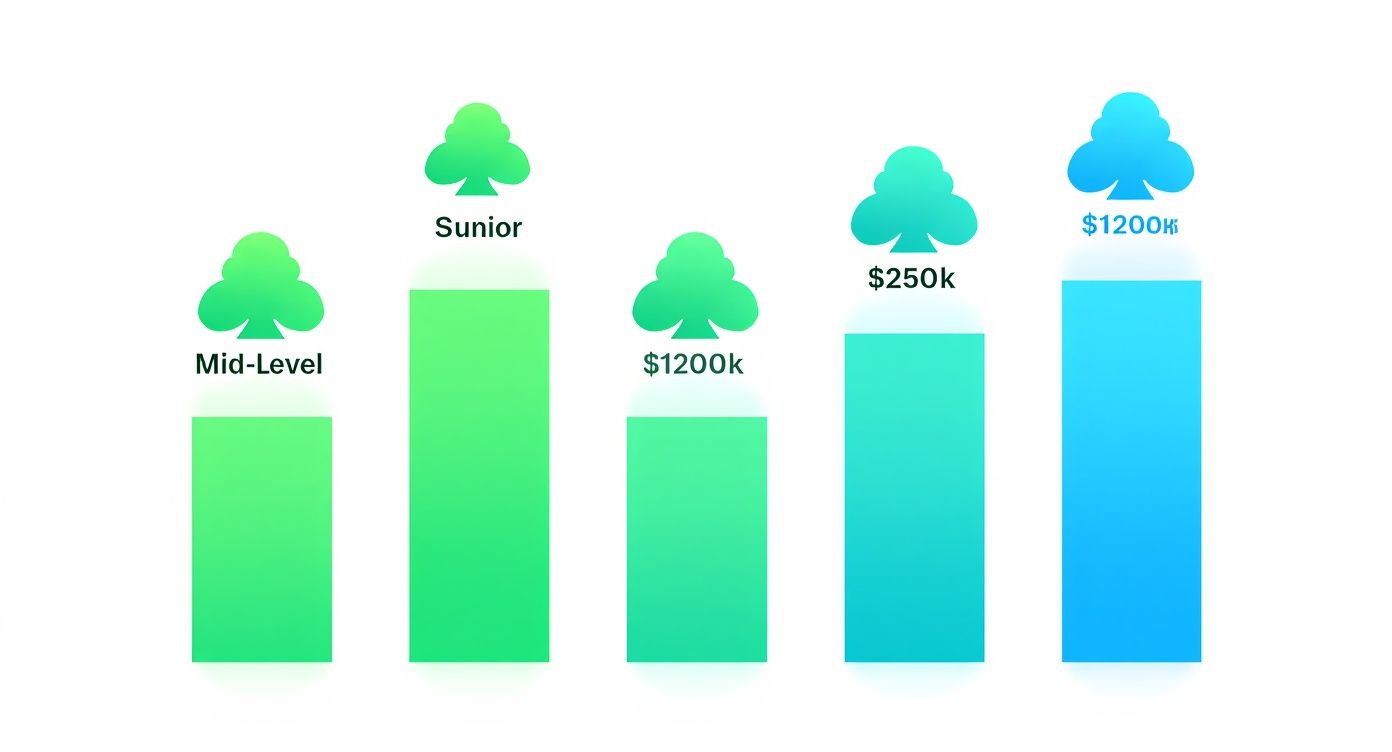
The message is clear: the financial incentives for honing your skills are huge. Whether you're heading into an interview or a performance review, use these numbers as a guide to know your worth and negotiate effectively.
Key Factors That Shape Your Earning Potential

While salary averages provide a useful starting point, your actual earnings depend on specific skills and career choices. From a hiring manager's perspective, they aren't just paying for the title "Smart Contract Developer." They're paying for a specific mix of technical skill, real-world experience, and your ability to solve their problems.
Nailing these variables is how you negotiate a better offer and map out a career path that keeps you in demand. The languages you master, the blockchains you've built on, and where you choose to work all directly impact your paycheck.
Your Technical Toolkit and Platform Specialization
The bedrock of your earning power is your technical skill set. Simply put, proficiency in the right languages and platforms acts as a massive salary multiplier. Companies want to hire developers who can jump in and contribute immediately, and specialization is the clearest signal of deep expertise they look for in interviews.
For example, being fluent in Solidity is still the industry standard thanks to Ethereum's dominance. It's a must-have for most roles. However, demonstrating expertise in Rust can make you a standout candidate for teams building on Solana or Polkadot, often translating into a more competitive salary offer due to lower supply.
But it’s about more than just the language. Here are the core competencies that truly move the needle on a smart contract developer's salary:
- Blockchain Protocol Expertise: Are you an Ethereum wizard who understands the EVM inside and out? Or have you specialized in Layer-2s like Arbitrum or high-speed chains like Solana? Deep, hands-on knowledge of one ecosystem is a powerful selling point in an interview.
- Security and Auditing Skills: In a space where a single bug can vaporize millions, developers with a security-first mindset are invaluable. If you can speak to your experience with tools like Slither or MythX and have participated in code audits, you can command a serious premium.
- Web3 Integration: Knowing how to write a contract is one thing; knowing how to connect it to a larger application is another. Skills with libraries like Ethers.js or Web3.js for front-end integration, or a solid understanding of oracles, make you a far more complete—and valuable—candidate.
A strong GitHub portfolio showcasing audited, gas-optimized contracts is often more persuasive in an interview than any resume line item. It's direct proof you can deliver secure, efficient code—the two most important qualities a hiring manager seeks.
The Impact of Employer Type
The kind of company you work for plays a huge part in your total compensation. To advance your career, it's crucial to understand how different organizations structure their offers and what that means for your financial growth.
A well-funded DeFi startup, for instance, might offer a competitive base salary plus a hefty chunk of token incentives, giving you massive potential upside tied to the project's success. On the other hand, an established corporation using blockchain for its supply chain will likely offer a higher, more stable base salary with traditional benefits, but with less of that lottery-ticket potential.
Here’s how to weigh your options based on employer type:
- Venture-Backed Startups: These companies are in a sprint to build and ship, creating a high-risk, high-reward environment. They typically offer competitive salaries and significant equity or token packages to attract top talent.
- DAOs (Decentralized Autonomous Organizations): Compensation in a DAO can be more fluid, often coming as project-based grants paid in stablecoins or governance tokens. This path offers flexibility and a direct stake in the project but may lack the predictability of a traditional salary.
- Established Tech and Finance Companies: Large, traditional firms entering Web3 often pay top dollar to bring in proven talent. These roles offer stability and excellent benefits but might come with more corporate bureaucracy and less creative freedom.
The role of a smart contract developer is a highly sought-after position, and the pay reflects that. Entry-level developers with under two years of experience typically earn $80,000 to $120,000, while mid-level pros can command $140,000 to $180,000. Once you hit the senior level with over five years of experience, you're often leading teams or architecting complex systems and can earn upwards of $187,000 to $250,000 or more. You can find more detailed salary statistics and explore current compensation trends to get a better feel for your market value.
How Location Impacts Developer Salaries
Where you work still makes a big difference in your paycheck, but the concept of "location" in Web3 is evolving. While your physical address matters, the explosion of remote-first companies is changing the compensation game, opening up massive opportunities for developers to land a top-tier salary regardless of their zip code.
From a hiring manager's perspective, this means the talent pool is now global. For you, the job seeker, it means you can compete for a San Francisco-level salary while living somewhere with a much lower cost of living. Understanding this dynamic is key to maximizing your career potential.
Major Tech Hubs Still Set The Bar High
It’s no secret that traditional tech hubs like San Francisco and New York still lead the pack with the highest salaries. These cities are packed with venture capital and well-funded projects, creating intense competition for a limited pool of elite local developers that naturally drives salaries sky-high.
For example, a senior smart contract developer in San Francisco can easily see offers hitting or even exceeding $200,000 a year, often 10-15% higher than in other major U.S. cities. This premium reflects both the high cost of living and the concentration of high-value projects. This isn't just a U.S. phenomenon—global financial centers like London and Singapore have become hotspots for DeFi and institutional blockchain work, pushing their salaries to be competitive on the world stage. You can see what top-tier compensation looks like by checking out roles like this Lead Developer position in London.
The Remote Work Revolution in Web3
The Web3 ethos is built on decentralization, and its hiring practices reflect that. A huge chunk of blockchain companies now operate as fully remote or remote-first, which is a game-changer for salary negotiations and career planning.
It disconnects your paycheck from your local cost of living. A talented developer in a smaller city can now realistically apply for—and land—a job with a company that benchmarks its pay to a major tech hub.
Here’s the breakdown of what this really means for your career:
- For Job Seekers: Your geographic location is no longer the main roadblock to a top salary. Your portfolio, your GitHub activity, and how you perform in the interview are what truly count.
- For Hiring Managers: You can pull talent from anywhere, but you have to be ready to offer globally competitive pay to attract the best of the best.
In the Web3 job market, your value is increasingly tied to your proven skills and the security of the code you ship—not your proximity to a physical office. This levels the playing field for talented developers everywhere.
A Global Look at Salary Benchmarks
To give you a clearer picture of what to expect, here’s a quick comparison of average salaries for mid-level smart contract developers across different regions. Whether you're getting ready to negotiate an offer or budgeting for a new hire, this should help set a baseline. Notice how remote roles are often right up there with the highest-paying cities.
Global Smart Contract Developer Salary Comparison
| Region | Average Annual Salary Range (USD) |
|---|---|
| San Francisco, USA | $150,000 – $200,000+ |
| New York, USA | $145,000 – $190,000 |
| London, UK | $130,000 – $180,000 |
| Remote (USA-Based Co.) | $130,000 – $170,000 |
| Singapore | $120,000 – $175,000 |
| Berlin, Germany | $110,000 – $160,000 |
| Emerging Markets | $70,000 – $120,000 |
Ultimately, while major hubs still hold a slight edge, the data makes one thing crystal clear: remote work has democratized access to high-paying jobs, giving you the power to build a great career from almost anywhere.
Understanding the Market Forces Behind Your Paycheck

A smart contract developer's salary isn't a fixed number. It's constantly in motion, influenced by the broader crypto market. Market sentiment—whether it's a bull or bear market—creates powerful currents that affect hiring, project funding, and ultimately, your compensation.
Understanding these forces is crucial for managing your career. It helps you anticipate hiring freezes, know when to negotiate harder, and understand the context behind a company's offer. In a booming market, companies are flush with cash and scrambling to launch new projects. This creates a feeding frenzy for the small pool of skilled developers, causing salaries to skyrocket.
Conversely, when the market pulls back, funding tightens and some projects pause hiring. However, the core demand for developers who can build secure and efficient infrastructure never truly disappears. The best projects continue to build, meaning opportunities always exist for those with real expertise.
The Crypto Market Cycle and Your Career
The biggest external factor shaping your earning potential is the crypto market's boom-and-bust cycle. Salary trends for smart contract developers are tightly linked to blockchain market performance and crypto prices. Job openings, for instance, often mirror the price of Ethereum (ETH). As ETH climbs, so does investor interest, and companies start hiring aggressively, driving salaries up. You can learn more about how market trends impact Web3 salaries to see the data for yourself.
This connection offers a strategic advantage. By keeping an eye on market cycles, you can time your job hunt or your request for a raise much more effectively.
Here’s a breakdown of how these cycles typically affect hiring:
- Bull Market: When venture capital is flowing freely, startups are desperate to hire fast. This often leads to inflated salary offers, large signing bonuses, and generous token packages to capture the momentum.
- Bear Market: When the market cools, the focus shifts from hyper-growth to long-term survival. Companies become more selective, prioritizing developers with deep skills in security and optimization. The total number of jobs might dip, but the demand for top-tier talent remains strong.
"A bear market is a builder's market." You hear this a lot in Web3, and it's true. This is when the serious, well-engineered projects prove their worth, and the developers behind them become invaluable.
Long-Term Projections and Future Stability
Looking beyond short-term volatility, the future for smart contract development looks incredibly solid. This technology is expanding beyond its crypto-trading niche into supply chain management, digital identity, and real-world asset tokenization. This wider adoption signifies a maturing industry and a stable, long-term career path.
In fact, the global smart contract market is expected to hit $73 billion by 2030. This signals a massive, sustained demand for skilled developers, which will almost certainly keep pushing salaries upward. This isn't just about crypto speculation; it's about blockchain technology becoming a fundamental part of the global economy.
For your career, this means that while the market will always have its swings, the underlying need for your skills is on a clear growth trajectory. By continuously honing your expertise, particularly in high-demand areas like security and scalability, you're setting yourself up for a durable and very rewarding career, no matter what the market is doing today.
Strategies to Negotiate a Higher Salary
Knowing the market rate for a smart contract developer is one thing; successfully securing a top-tier package in an interview is another. In Web3, negotiation isn't just about asking for more money; it’s about proving you’re the solution to a company's most expensive problems.
The key is to reframe the conversation. You're not a cost; you're an investment. Hiring managers are looking for someone who can shield their protocol from a multimillion-dollar exploit and build rock-solid systems that attract users and capital. When you can demonstrate you’re that person, you hold all the cards.
Showcase Your Security-First Mindset
In an industry where a single line of bad code can evaporate millions, a portfolio of secure, audited smart contracts is your most powerful negotiating tool. Don't just list your projects—tell their stories. In an interview, explain the specific security patterns you implemented, the attack vectors you anticipated and mitigated, and the gas optimizations you engineered.
This directly addresses what keeps protocol founders up at night. A link to your GitHub with clean, well-documented code is essential. But if you've been through professional audits or participated in bug bounties, lead with that. It's tangible proof that you can be trusted with the keys to the kingdom, making it much easier to justify a premium salary.
Here’s how to put your security skills on full display in your job search:
- Audited Projects: Name the contracts that have passed professional security audits. Mention the firm and discuss any critical findings you helped resolve.
- Gas Optimization: Provide specific examples where you significantly reduced transaction costs, proving you understand the economic impact of your code.
- Testing Coverage: Discuss your rigorous testing methodology. High test coverage gives employers the confidence they need to deploy your code.
Specialize in High-Demand Niches
Generalists are useful, but specialists get paid. The world of smart contracts is incredibly broad, so carving out a reputation in a hot area like DeFi or NFTs gives you massive leverage. These fields have unique complexities, meaning developers with proven experience are both rare and incredibly valuable.
For example, a developer who deeply understands the math behind automated market makers (AMMs) or the security risks in lending protocols can command a much higher salary. The same applies to someone who has built intricate NFT systems with staking or dynamic metadata. To see what specialized skills companies are looking for, analyze job descriptions like this Senior Solidity Developer position.
Your specialization is your anchor in any negotiation. When you can confidently say, "I have direct experience building and securing the exact type of protocol you're developing," you stop being just another candidate. You become the obvious solution.
Negotiate Beyond the Base Salary
In Web3, your compensation is rarely just a base salary. Many protocols, especially early-stage ones, offer packages that include token incentives, which can easily eclipse the value of your salary over time. It's critical to understand and negotiate these components.
While junior developers might start in the $80,000 to $110,000 range, it's not uncommon for senior engineers to clear $300,000 or more in total compensation. For freelancers and DAO contributors, retainers of $3,000 to $10,000 per month are standard, but the real wealth is often built through token allocations that appreciate as the project succeeds.
When you reach the offer stage, assess the entire package:
- Base Salary: Your guaranteed cash compensation.
- Token Vesting: Your equity in the protocol, earned over a set period. Ask about the vesting schedule and cliff.
- Performance Bonuses: Payouts in stablecoins or native tokens for hitting development milestones.
By understanding all these moving parts, you can structure a deal that matches your risk appetite and rewards you for the long-term value you’re there to create.
Where to Find High-Paying Developer Jobs

Knowing your worth is half the battle; finding roles that meet your salary expectations is the other. The best smart contract developer positions are rarely found on mainstream job boards. They are typically posted on niche platforms where Web3 projects specifically seek out specialists.
To be effective, you need a targeted job search strategy. Focus on the platforms and communities where top DeFi, NFT, and infrastructure projects are actively hiring. Knowing where hiring managers are looking is the first step toward landing an interview for a role with a top-tier smart contract developer salary.
Web3 Native Job Boards
Mainstream job boards are often ineffective for a Web3 career; they lack the necessary focus. Your best strategy is to start on platforms built by and for the industry itself. These sites filter out the noise, connecting you directly with companies that understand your skills and are willing to pay for them.
Dedicated platforms like Blockchain Jobs are goldmines for vetted opportunities, catering specifically to the talent needs of the decentralized economy.
On these boards, you'll find listings from:
- Venture-backed startups building the next major DeFi protocol.
- Established DAOs hunting for core developers.
- Big tech companies spinning up their own blockchain divisions.
Specialized Recruiters and Talent Agencies
As the Web3 space has matured, so has its hiring infrastructure. A new wave of recruiting firms now focuses exclusively on blockchain talent. These headhunters have deep networks and are often the gatekeepers for senior roles that are never publicly posted.
Connecting with a reputable Web3 recruiter can be a significant career accelerator. They act as your agent in the job market, matching your unique skills—whether it’s security auditing or Layer-2 scaling solutions—with well-funded companies ready to pay a premium for that expertise.
For senior developers, a specialized recruiter is often the fastest path to leadership roles. They understand the nuances of negotiating complex compensation packages, including token incentives and equity, ensuring you secure an offer that reflects your full value.
Online Communities and Professional Networks
Web3 is built on community. Platforms like Discord, Telegram, and X (formerly Twitter) are not just for project updates—they are buzzing with job opportunities. It's incredibly common for founders and lead engineers to post job openings directly in their community Discord server or announce a hiring push on X.
Being an active, value-adding participant in these spaces is one of the most powerful career-building activities you can undertake. When you contribute to technical discussions, participate in governance, or help others solve problems, you build a public track record. This visibility often leads to inbound opportunities, with hiring managers contacting you directly. A strong online presence serves as a living resume, showcasing your expertise 24/7.
Frequently Asked Questions
Thinking about a career as a smart contract developer brings up a lot of questions—about salary, what skills you really need, and where the job can take you. Let's tackle some of the most common ones so you can walk into interviews with confidence and map out your next move.
What Are the Most Essential Skills to Get Hired?
To get hired, you need more than just coding chops. Hiring managers are looking for developers who grasp the high-stakes nature of blockchain—its unique security risks and the economic reality that one bug can cost millions.
Proving you have this specific mix of skills is what directly bumps up your starting smart contract developer salary.
- Core Programming Languages: You absolutely must know Solidity for anything on Ethereum or other EVM chains. It's the baseline. Knowing Rust is quickly becoming a huge advantage, especially for roles in the Solana or Polkadot ecosystems.
- Security Best Practices: This is non-negotiable. You need a deep understanding of common vulnerabilities like reentrancy attacks and integer overflows. If you have experience with security tools like Slither or MythX, make sure it’s front and center on your resume.
- Development Frameworks: You need to show you can build, test, and deploy efficiently. That means hands-on experience with tools like Hardhat, Foundry, or Truffle is expected.
- Web3 Libraries: Smart contracts don't exist in a vacuum. You'll need to know how to connect them to front-end applications, which means working with JavaScript libraries like Ethers.js or Web3.js.
Do I Need a Formal Degree to Become a Smart Contract Developer?
Honestly, no. A formal computer science degree isn't a hard-and-fast rule in this field. While it can give you a solid foundation, the Web3 world cares much more about what you can build and prove.
In the world of smart contracts, your GitHub profile is often more important than your diploma. A portfolio showcasing well-tested, gas-optimized, and secure code is the most powerful tool you have in a job interview.
Many of the top-earning developers in this space are self-taught or pivoted from other software engineering roles. Your ability to ship secure, production-ready code is what truly gets you hired.
What Is a Typical Career Path for Smart Contract Developers?
The career ladder for a smart contract dev is all about moving from writing code to owning architecture. As you progress from junior to senior, you’ll shift from simply executing tasks to defining the entire strategy.
- Junior Developer (0-2 years): At this stage, you’re in the trenches. You'll focus on writing unit tests, squashing bugs in existing contracts, and helping with smaller feature rollouts. It's all about learning the codebase and mastering security fundamentals.
- Mid-Level Developer (2-5 years): Now you're building. You’ll be trusted to develop and deploy new smart contracts from the ground up, optimize them for gas efficiency, and become a key voice in code reviews.
- Senior Developer (5+ years): At this level, you’re an architect. You'll be designing entire smart contract systems, leading security audits, mentoring junior devs, and making critical, high-stakes decisions that define the future of a protocol.
Every step up this ladder brings a substantial pay bump, directly tied to the massive impact you have on a project's security and success.
Ready to find your next opportunity? At Blockchain Jobs, we connect top talent with the best companies in the Web3 ecosystem. Explore curated roles in DeFi, NFTs, and core infrastructure by visiting our job board.