Your Career Launchpad for Becoming a Web 3 Developer
So, you’re hearing the term Web3 developer everywhere, but what does it actually mean for your career? In short, a Web3 developer builds for the decentralized web. They are the architects engineering applications that run on blockchains, prioritizing user ownership, transparency, and security.
Unlike a traditional developer working within centralized systems, a Web3 developer is building a new digital frontier. For a hiring manager, this means you're not just a coder; you're a pioneer expected to navigate a rapidly evolving and high-stakes environment.
What a Web 3 Developer Actually Does

Let’s cut through the buzzwords from a job perspective. When a company wants to hire a Web3 developer, they're looking for someone who can build applications that don't rely on a central server or authority. This is a huge mental shift from the siloed, company-controlled apps of Web 2 and a key point to demonstrate in interviews.
Here’s a practical way to frame it for career progression:
A traditional Web 2 developer is like an architect building a skyscraper for a single corporation. That company owns the building, controls access, and stores all the data inside. Think about how Meta runs its platforms or how your bank manages its app—it’s all centralized.
A Web3 developer, on the other hand, is more like a city planner designing a public square. They lay down the foundational rules and infrastructure—the pavement, the benches, the public bylaws—that allow anyone to come, set up a stall, interact, and trade freely within a shared, transparent system. The planner doesn’t own the activity; they just enable it. This shift from "controlling" to "enabling" is what top companies are hiring for.
To clarify how this impacts your job search, let's compare the roles directly from a hiring perspective.
Web 2 vs Web 3 Developer Role Comparison
| Aspect | Web 2 Developer (The Centralized Architect) | Web 3 Developer (The Decentralized Builder) |
|---|---|---|
| Core Goal | Build and maintain applications on company-owned servers. | Build applications that run on a public, decentralized network. |
| Data Control | Data is stored in private, centralized databases (e.g., AWS, Google Cloud). | Data lives on a distributed, public ledger (the blockchain). |
| Trust Model | Users trust the company to manage data and execute logic correctly. | Trust is placed in the code (smart contracts) and the network's consensus. "Code is law." |
| Primary Focus | User interface (UI/UX) and server-side logic (backend APIs). | Smart contract security, blockchain interaction, and wallet integration. |
| Tech Stack | JavaScript, Python, Java; React, Angular; MySQL, MongoDB. | Solidity, Rust; Ethers.js, Web3.js; IPFS, The Graph. |
This table highlights the fundamental shift in mindset and technical focus that recruiters look for. A Web3 developer's work is inherently public and has irreversible consequences, making security and precision paramount skills to prove in an interview.
Core Responsibilities from a Hiring Perspective
When a Web3 company posts a job opening, they’re not just looking for a coder. They need someone to solve incredibly complex problems related to trust, security, and governance in an environment where no single person is in charge.
A top-tier Web3 developer understands they are not just writing code; they are architecting economic systems and digital communities. Your ability to articulate this in an interview will set you apart. The goal is to build applications that can run securely and predictably on their own, without a central administrator.
This requires a unique skillset that goes far beyond typical software engineering. Here’s what a hiring manager expects you to be able to do:
- Smart Contract Development: This is the core competency. You’ll be writing, rigorously testing, and deploying smart contracts. These are self-executing agreements with rules baked into the code, and they power everything from DeFi to NFTs. Your proficiency here is your primary value proposition.
- Decentralized Application (dApp) Creation: You'll build the apps that people actually use. This means connecting a familiar frontend (what the user sees) to a decentralized backend powered by smart contracts. This is a critical skill to demonstrate with portfolio projects.
- Protocol Engineering: In more senior or specialized roles, you could be working on the blockchains themselves. These engineers, like a Protocol Engineer at a leading L2 solution, focus on making the core network faster, cheaper, and more secure. This is a high-impact, high-reward career path.
Ultimately, companies hire Web3 developers to build systems that are transparent, resistant to censorship, and truly owned by their users. That’s the core value you bring to the table in this job market.
What's in a Web3 Developer's Toolkit?
To get hired as a Web3 developer, knowing the theory behind blockchain isn't enough. You have to be able to build. Hiring managers are looking for developers who can prove they have hands-on experience with the specific tools used to create secure and scalable decentralized applications.
Think of your tech stack as your resume in action. Each tool, from the programming language you choose to the infrastructure you rely on, tells a story about what you can build. Let's open up the toolbox and look at the essentials companies expect you to know.
Core Programming Languages
Everything starts with the language you use to write smart contracts. This decision dictates which blockchain ecosystems you can work in and, by extension, which companies will be interested in you. Your language choice is a strategic career move.
Solidity: If you want to build on Ethereum or any EVM-compatible chain (think Polygon, Avalanche, or Arbitrum), Solidity is your language. It was built specifically for smart contracts. A solid grasp of Solidity is a prerequisite for over 80% of Web3 jobs, particularly in DeFi and NFTs. When a job description says "Smart Contract Engineer," they mean "Solidity expert."
Rust: Known for its performance and safety, Rust is the go-to for high-speed blockchains like Solana, Polkadot, and Near. If a company is building a high-frequency trading system or a protocol that needs massive scale, they're probably using Rust. Having Rust on your resume signals to recruiters that you’re ready for high-performance challenges.
Your choice here isn't just about syntax; it's about picking your ecosystem and career trajectory. Want to join the massive, established world of Ethereum? Learn Solidity. Excited by the bleeding edge of performance? Dive into Rust.
The Bridge Between Your App and the Blockchain
You've written a smart contract. Now, how does a regular web app talk to it? This is where special JavaScript libraries come in—they act as the crucial communication link between the user's browser and the blockchain.
From a hiring manager's perspective, knowing just Solidity isn't enough. You must be able to connect smart contracts to a user-facing application. Without this skill, you can only build one half of a dApp, making you a less valuable candidate.
Two libraries are industry-standard and expected knowledge in interviews:
- ethers.js: A lean, complete library for interacting with the Ethereum ecosystem. Developers love ethers.js for its clean design and reliability. It’s the favorite for many modern development teams and a great skill to showcase.
- web3.js: The original Ethereum JavaScript library, backed by the Ethereum Foundation. While some find web3.js more complex, its long history means it’s baked into countless established projects, making it a valuable and marketable skill.
In an interview, you’ll likely be asked how you'd get a user's wallet balance or call a smart contract function. Confidently explaining how you'd use one of these libraries to sign transactions and work with contract ABIs is a huge green flag for any technical recruiter.
Your Digital Workbench: Development Frameworks
You could write and deploy smart contracts without help, but it would be slow, painful, and risky. Development frameworks provide a structured environment to compile, test, and deploy code safely and efficiently. Using them is a sign of professionalism.
- Hardhat: A super flexible and popular Ethereum development environment. Hardhat is known for its excellent testing capabilities, a built-in local network for debugging, and a ton of useful plugins.
- Truffle: Part of the wider Truffle Suite, this framework has a rock-solid reputation. Truffle offers a complete package for building, testing, and managing your project's assets.
Showcasing projects in your portfolio built with Hardhat or Truffle signals to employers that you take testing and security seriously. That’s a massive deal when a single bug could put millions of dollars at risk and a key trait they hire for.
Putting It All Together: Scaling and Infrastructure
A professional Web3 developer knows a dApp must perform well and stay connected. This is where you need to understand Layer-2 scaling solutions and infrastructure—skills that distinguish senior candidates.
Experience with Layer-2 solutions like Arbitrum or Optimism shows you’re thinking about the user experience and scalability, not just the code. You understand how to build apps that won't get bogged down by slow transaction times or high gas fees.
Finally, you need to know about infrastructure providers like Alchemy or Infura. These services are the backbone of most dApps, providing a reliable node connection. Knowing how to use these services is a practical, must-have skill every employer looks for.
Your Roadmap to Landing a Web 3 Developer Job
Knowing the tools is one thing; building a career is another. To land a job as a Web 3 developer, you need a strategic plan.
This is a clear, three-phase roadmap designed to take you from aspiring builder to hired professional. Each phase builds directly on the last, turning your skills into undeniable proof for hiring managers.
Actionable 3-Phase Web 3 Developer Roadmap
| Phase | Objective | Key Actions & Skills | Outcome for Job Seekers |
|---|---|---|---|
| 1 | Master the Fundamentals | Learn Solidity or Rust, blockchain principles (consensus, transactions), and core development frameworks like Hardhat or Foundry. | You can hold a technical conversation and pass initial coding screens. You're no longer just an enthusiast; you're a builder-in-training. |
| 2 | Build a Job-Winning Portfolio | Create 2-3 unique dApps that solve a real problem (e.g., identity, DeFi dashboard, simple DAO). Go beyond basic tutorials. | You have tangible proof of your skills on GitHub. Your portfolio does the talking and shows hiring managers what you can actually do. |
| 3 | Gain Visibility and Credibility | Contribute to open-source projects, actively participate in DAOs or developer Discords, and share your learning publicly. | You're not just an applicant; you're a known member of the community. Recruiters start to notice you, and you build a valuable network. |
Let's break down each phase with a focus on getting hired.
Phase 1: Master the Fundamentals
Before you can build, you need a rock-solid foundation. This phase is non-negotiable and is what gets you past the first technical screen. Deep understanding beats surface-level knowledge every time in an interview.
Your first move is to pick a smart contract language and go deep. Choose Solidity for the Ethereum ecosystem or Rust for high-performance chains like Solana. Simultaneously, you must understand the "why" behind blockchain.
Here are your key actions:
- Go Deep on a Language: Don't just learn syntax. Understand design patterns, critical security practices (like Checks-Effects-Interactions), and gas optimization. These are common interview topics.
- Understand Blockchain Mechanics: Get familiar with consensus mechanisms (Proof-of-Work vs. Proof-of-Stake), the purpose of a Merkle Tree, and the lifecycle of a transaction. You will be asked about this.
- Get Comfortable with Frameworks: Set up a local development environment using Hardhat or Truffle. Practice writing, compiling, and, most importantly, testing your smart contracts. A strong testing methodology is a huge plus for employers.
The outcome here is technical literacy. You’ll be able to confidently tackle basic coding challenges and prove you speak the language of Web3.
Phase 2: Build a Job-Winning Portfolio
A resume tells a hiring manager you can do something. A portfolio shows them. In Web 3, your portfolio is your primary hiring asset. It's your personal "proof-of-work," demonstrating how you apply skills to build real things.
Your goal is to create two to three unique, high-quality projects. A simple NFT minting dApp from a tutorial won't cut it. You need to build something with a clear purpose that demonstrates you can handle complexity.
This diagram shows the basic flow of a dApp, a concept you must be able to explain in an interview.
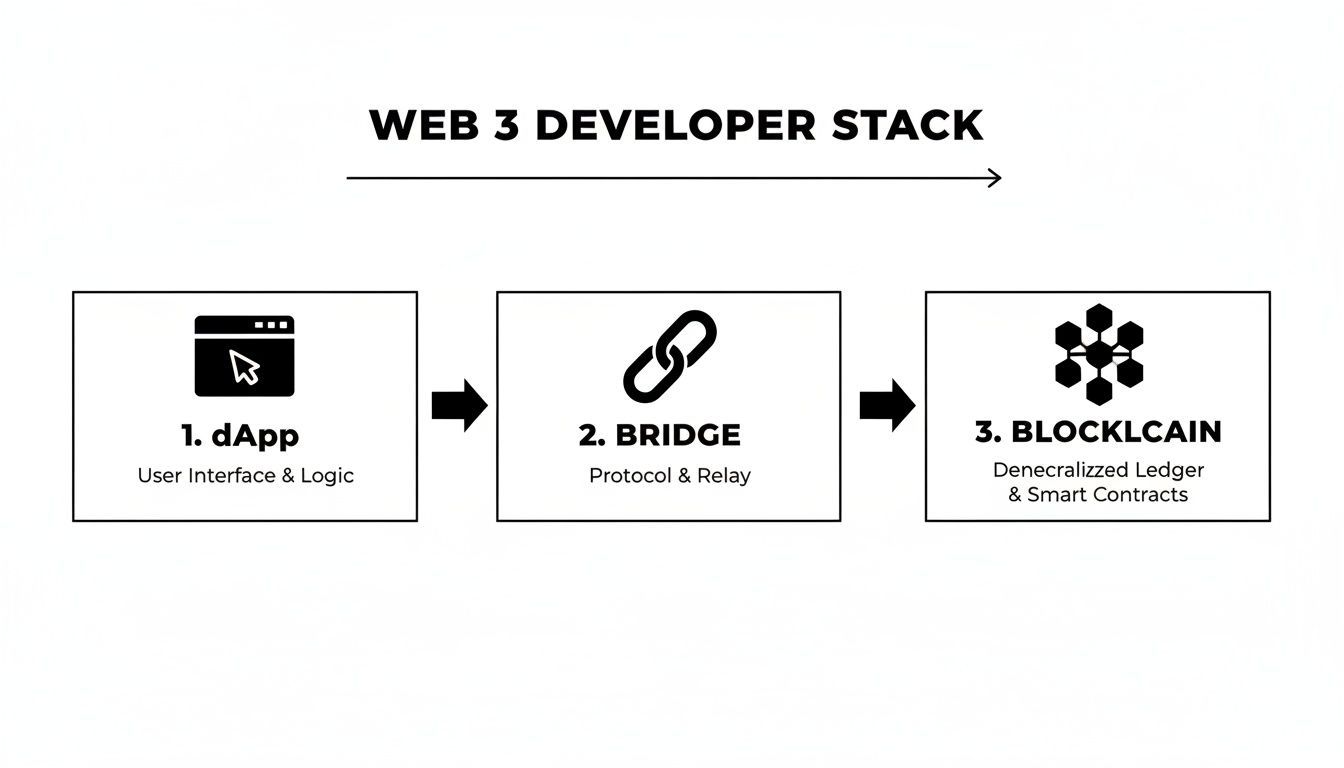
As you can see, the "bridge"—libraries like ethers.js or web3.js—is the critical piece that lets your frontend talk to the on-chain smart contracts.
Need project ideas that impress recruiters?
- Decentralized Identity Manager: A dApp where users manage their own on-chain identity attributes. This shows you understand data management and access control.
- Simple Yield Farming Dashboard: An interface that pulls data from and interacts with a major DeFi protocol like Aave or Compound. This proves you can work with complex, existing contracts.
- On-Chain Voting System: A basic DAO contract where token holders can create and vote on proposals. This demonstrates your grasp of governance concepts.
The best portfolio projects solve a problem you personally find interesting. Your passion will shine through in your code and make it much easier to discuss enthusiastically in an interview.
By the end of this phase, you'll have a GitHub profile that acts as your primary credential. When you start applying for Web3 engineering roles on Blockchain Jobs, you can link directly to your work.
Phase 3: Gain Visibility and Credibility
With a solid foundation and a strong portfolio, the final step is to become an active participant in the ecosystem. This is about building a reputation and making connections that lead to job opportunities. In a community-driven industry, your network is as valuable as your resume.
This phase is about engaging with the community to show you’re committed.
Here’s how to do it:
- Contribute to Open-Source: Find a project on GitHub you admire and start small. Fix a typo in the docs, help with issues, or tackle a "good first issue." These public contributions show you can collaborate on a team.
- Participate in DAOs and Discords: Jump into the developer channels for protocols that interest you. Ask smart questions and help others. This is how you get noticed by potential employers.
- Share What You Learn: Write a short blog post or Twitter thread explaining a concept you just figured out. Teaching solidifies your knowledge and builds your personal brand as an expert.
Completing this phase turns you from just another applicant into a known entity. You're no longer a resume in a pile; you're a contributing member of the Web 3 community—exactly the kind of person companies want to hire.
Decoding Web3 Developer Salaries and Demand
Let's talk career motivation: the compensation. The demand for talented Web3 developers is high, and the supply hasn't caught up. This imbalance has created a fierce job market where companies pay a premium for the right talent.
Before negotiating an offer, you need to understand your market value. We're not just talking about base salary; the entire Web3 compensation package can look very different from a traditional tech role. Knowing this will help you maximize your career's financial outcome.
Analyzing Web3 Salary Benchmarks
Web3 developer salaries are often in a completely different league than their Web2 counterparts. This is a direct result of niche skills, the high-stakes security of smart contracts, and the massive value these developers create.
You'll find that Web3 developers often make 30-60% more than their Web2 peers. Blockchain engineer salaries typically start in the $95K-$180K range, but that's before factoring in the hefty equity and token packages that often come with the job. You can dig deeper into industry compensation trends to get a full picture for your negotiations.
Why the huge premium? A good Web3 developer isn't just a coder; they are an architect of a financial system where a single bug could lead to millions in losses. Companies are paying for that level of expertise and meticulous attention to detail.
For an employer, a great Web3 developer isn't just another line item on the budget. They are a direct investment in the security and long-term viability of the entire protocol. That’s the mindset driving these competitive salaries.
Beyond the Base Salary: A Look at Total Compensation
In Web3, your base salary is just the start. The real potential often lies in equity and token allocations. This structure is designed to make you a true owner in the project you’re building—a powerful negotiating point.
- Base Salary: Your guaranteed income, usually falling between $120,000 to over $250,000 for senior developers.
- Equity: Common in startups, stock options give you a piece of the company itself.
- Token Allocations: This is the game-changer. Many projects will give you a stash of their native crypto token. These tokens usually vest over time. If the project succeeds, the value of your tokens could far exceed your base salary.
When you receive an offer, evaluate the entire package. A slightly lower base salary might be a smart trade for a generous token allocation in a project with high growth potential.
Global Demand and the Rise of Remote-First Culture
The hunt for Web3 talent is global. The decentralized ethos of the technology has led to a remote-first work culture. This is a huge advantage for your career.
This means you can work for a leading DeFi project in Europe from your apartment in Asia. Companies want the best person for the job, regardless of location. The sheer number of remote roles means your career isn’t tied to your zip code. This flexibility is a huge perk, allowing you to find a role that fits your life. What matters to hiring managers is what you can build, not where you build it from.
How to Nail the Web3 Developer Interview

A Web3 developer interview is more than a coding test. Companies aren't just hiring a programmer; they're vetting a potential steward for their protocol. The process is designed to test your technical chops, your security mindset, and your grasp of the decentralized ethos.
The process usually starts with a recruiter call to gauge your passion and fit. From there, you’ll face technical rounds mixing classic computer science with blockchain-specific problems. Be ready for live coding and take-home assignments designed to test real-world skills.
Mastering the Technical Interview
This is where you prove you can build secure, efficient systems that handle real money. The conversation will quickly pivot to Web3 challenges where a single mistake has financial consequences. Interviewers need to see that you code defensively and anticipate potential attacks.
Here are the key areas you absolutely have to nail:
- Smart Contract Security: You must be able to spot and explain common vulnerabilities like reentrancy attacks, integer overflow/underflow, and front-running. A top-tier answer doesn’t just define the problem; it involves coding a fix, such as using the Checks-Effects-Interactions pattern.
- Gas Optimization: Getting code to run is easy. Getting it to run cheaply is what separates pros from amateurs. Expect questions on how to reduce gas costs, like using
calldatainstead ofmemoryor packing variables into a single storage slot. This shows a senior-level understanding. - Blockchain Fundamentals: You need to explain core concepts with clarity. Be ready to whiteboard how a consensus mechanism like Proof-of-Stake operates or trace the lifecycle of a transaction from a user's wallet to its final inclusion in a block.
The demand for developers who can do this is intense. The Web3 job market in early 2026 is on fire, with over 460 full-time positions posted in January alone. This signals a massive talent rush. For Web3 builders, a stacked GitHub profile speaks louder than a resume. Companies want to see what you’ve built, especially if you're a junior developer showing a keen interest in DeFi mechanics or DAO governance. You can learn more about the current Web3 hiring trends to see how you can get an edge.
Demonstrating the Web3 Mindset
Beyond pure technical skill, interviewers are looking for the "Web3 mindset." It's about showing you’re bought into the core principles of decentralization, user ownership, and transparency. They want to hire builders on the same mission, not just mercenaries looking for a paycheck.
Your portfolio is your proof-of-work, but your ability to articulate the "why" behind your projects is your proof-of-passion. An interviewer needs to see that you're intellectually curious about the future of a decentralized web.
To show you have this mindset, be prepared to talk about:
- Your Portfolio Projects: Explain why you built something, the problem you solved, and the trade-offs you made. What would you do differently now? This demonstrates critical thinking.
- Industry Trends and Opinions: Have a thoughtful opinion on big topics like Layer-2 scaling solutions, decentralized identity, or DAOs. This proves you’re engaged in the ecosystem beyond just your code.
- Asking Insightful Questions: When it's your turn, ask about their governance model, security audit process, or vision for community ownership. This shows you’re thinking like a long-term partner, not just a short-term employee.
Where to Find the Best Web 3 Developer Jobs
You've built the skills and a solid portfolio. Now, where do you find a great Web3 job? To be effective, you need to go where Web3 companies are actively hiring.
Niche job boards are your secret weapon. A platform like Blockchain Jobs is built specifically for this space, meaning every listing is from a serious company that needs qualified Web3 talent. This targeted approach saves you time and connects you with hiring managers who understand what a Web 3 developer does.
Strategically Filtering for Your Ideal Role
A successful job hunt is about precision. Instead of browsing aimlessly, filter aggressively to find roles that are a perfect match for your skills and career goals. This shows employers you're serious and know your value.
Use the platform's tools to zero in on what matters:
- Technology Stack: Filter for Solidity if you’re focused on EVM chains, or Rust if you're targeting ecosystems like Solana. This ensures you only see relevant jobs.
- Area of Focus: Are you passionate about DeFi, gaming, or infrastructure? Searching by category helps you find a team working on problems you genuinely care about.
- Location and Work Style: The vast majority of Web3 roles are remote. You can easily find amazing fully remote Web3 developer jobs that allow you to work from anywhere.
This isn't just about making your search easier; it’s about positioning yourself as a specialist. When you apply for a role that's a perfect fit, your chances of landing an interview skyrocket because you look like the exact solution to their problem.
Web3 is a global industry. In 2025, Asia became the epicenter of developer activity, making up 36.4% of all global contributions. This has created a huge demand for remote engineers skilled in Solidity, Rust, and layer-2 solutions. You can dive deeper into these global Web3 developer trends on mexc.com.
By focusing on dedicated platforms and using smart filters, you can turn a passive job search into an active career strategy. Set up alerts, polish your profile, and start applying with confidence.
Questions on Every Aspiring Web3 Developer's Mind
Jumping into a new field brings up questions. For Web3, these range from technical hurdles to career strategy. Let's tackle the big ones with actionable answers.
Do I Really Need a Computer Science Degree?
Short answer: No. In Web3, what you can do and what you've built matter far more than a formal degree. A strong GitHub profile showcasing your smart contracts and dApps will get a hiring manager's attention much faster than a diploma. Many of the best developers in this space are self-taught. Your focus should be on building a portfolio that proves you can solve real-world problems on the blockchain.
How Long Does It Realistically Take to Get Hired?
This depends on your starting point and commitment. If you're already a Web2 developer, you can likely make the transition in 3-6 months. You just need to learn the blockchain-specific concepts and tools. For someone starting from scratch, a 9-12 month timeline is more realistic. The key is consistent daily effort: building unique portfolio projects and getting active in the community.
What Are the Biggest Mistakes I Should Avoid?
From a hiring manager’s perspective, a few common slip-ups can sink your chances. Avoiding these will give you a significant advantage.
The single biggest mistake is not taking smart contract security seriously enough. A bug in a regular app is an inconvenience. A bug in a smart contract is a potential multi-million dollar exploit. Recruiters are looking for people who demonstrate a security-first mindset from the very first line of code.
Here are other common missteps to avoid in your job hunt:
- Forgetting the "Why": Don't just learn to code; understand the economic incentives and game theory behind Web3. You'll be asked about this in interviews.
- Cookie-Cutter Portfolios: Avoid filling your GitHub with projects everyone has done from a tutorial. Build something original that solves a unique problem.
- Coding in a Vacuum: The Web3 community is everything. Network and build a reputation. It shows employers you're committed to the space long-term.
Ready to turn those new skills into a career? Blockchain Jobs is the best place to find your first—or next—role in the decentralized world. Start exploring Web3 developer jobs today!