7 Top Smart Contract Development Company Options for Your 2026 Project

Building a decentralized application requires a specific kind of expertise that goes beyond typical software development. The choice between hiring individual developers and partnering with a specialized smart contract development company often determines a project's security, scalability, and ultimate success. This decision is a critical one for product managers, founders, and even engineers looking to join a high-performing team.
Engaging a dedicated firm provides access to a collective pool of knowledge, battle-tested security protocols, and cross-functional teams that individual hires may lack. These companies have established processes for auditing, rigorous testing, and deployment across multiple blockchain ecosystems, reducing the risk of costly exploits. For those managing a project, this means a more predictable development lifecycle. For developers seeking career growth, joining such a firm offers a chance to work on high-stakes projects and learn from seasoned auditors and protocol architects.
This guide is designed to cut through the noise. We will profile leading firms like ConsenSys, Nethermind, and ChainSafe, offering a clear view of their core strengths, technical stacks, and notable projects. You will find actionable insights into their engagement models and what makes each a potential fit for your specific needs, whether you're looking to hire a team or get hired by one. Each entry includes direct links and a focused breakdown to help you make an informed decision quickly. Think of this as your shortlist for finding the right partner to build secure, efficient, and reliable smart contracts.
1. ConsenSys (Solutions + Diligence)
As one of the foundational pillars in the Ethereum ecosystem, ConsenSys provides an end-to-end service suite that combines enterprise-grade development with top-tier security. Founded by Ethereum co-founder Joseph Lubin, the company’s deep roots in the protocol give it a unique advantage. For organizations looking for a deeply integrated partner, ConsenSys offers both custom smart contract development through its Solutions team and rigorous security auditing via ConsenSys Diligence.
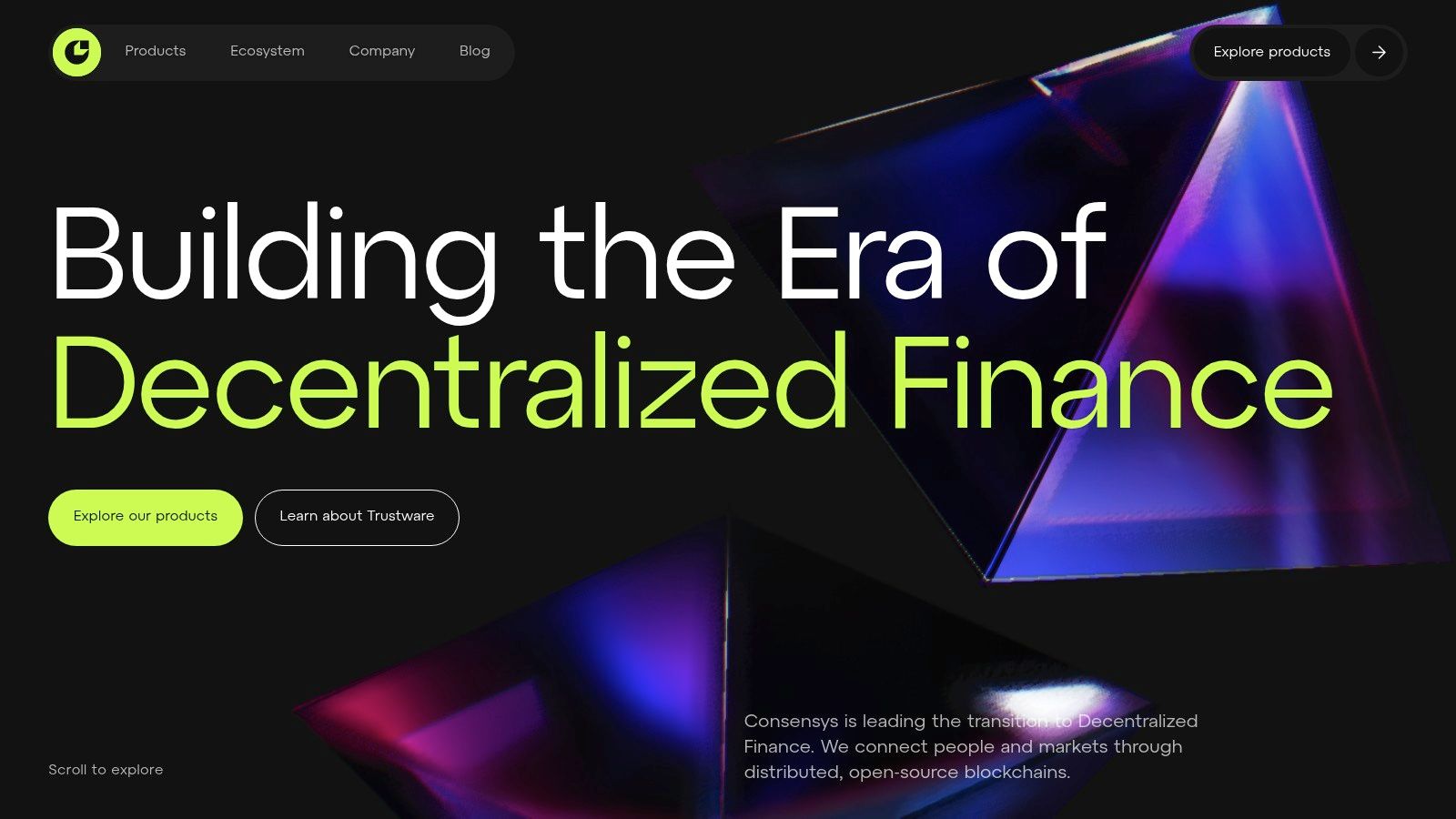
This dual structure is what sets ConsenSys apart. Instead of outsourcing security audits to a third party after development, a project can engage ConsenSys for a unified workflow. This approach ensures security considerations are baked into the development lifecycle from the beginning, not bolted on at the end. Their expertise extends across the entire Ethereum stack, from infrastructure like Infura and clients like Besu/Teku to the widely used MetaMask wallet. This holistic view of the ecosystem makes them an excellent smart contract development company for complex, enterprise-level projects that require tight integration with multiple Web3 components.
Engagement and Strengths
Engagement with ConsenSys is typically geared toward large-scale enterprise clients or well-funded protocols. The process begins with an in-depth advisory and solution design phase, followed by custom development, deployment, and ongoing support.
Key Offerings:
- Full-Stack Ethereum Development: They build everything from core protocol layers to user-facing dApps.
- Enterprise Advisory & Training: ConsenSys helps large organizations understand and implement blockchain technology, offering structured training programs.
- ConsenSys Diligence Security Suite: This is a major differentiator. It includes manual audits, fuzzing, static analysis, and automated tools like MythX to secure smart contracts against vulnerabilities.
Career and Hiring Perspective
Working at ConsenSys is a significant career milestone for any Web3 professional. Their rigorous engineering standards and deep involvement in core Ethereum projects mean their developers are highly respected. For those interviewing, showcasing a deep understanding of EVM fundamentals, gas optimization, and advanced security patterns is critical. The company's structure offers career paths not just in development but also in protocol research, security analysis, and enterprise consulting. Prepare to discuss specific EIPs or demonstrate experience with formal verification tools to stand out in their hiring process.
| Feature | Details |
|---|---|
| Primary Blockchains | Ethereum, EVM-compatible chains, Enterprise Quorum |
| Security Focus | Integrated audits, fuzz testing (Diligence), MythX |
| Engagement Model | Project-based, retainer, enterprise advisory |
| Ideal For | Enterprises, DeFi protocols, public sector entities |
Website: https://consensys.io/
2. Nethermind
Nethermind is a formidable research and software engineering firm best known for its high-performance Ethereum execution client. This deep, protocol-level expertise forms the foundation of its service offerings, which span smart contract engineering, rigorous security audits, and specialized development in advanced ecosystems like Starknet. For projects pushing the boundaries of Web3, especially in L2s and zero-knowledge systems, Nethermind provides a rare combination of core infrastructure knowledge and application-layer development skill.
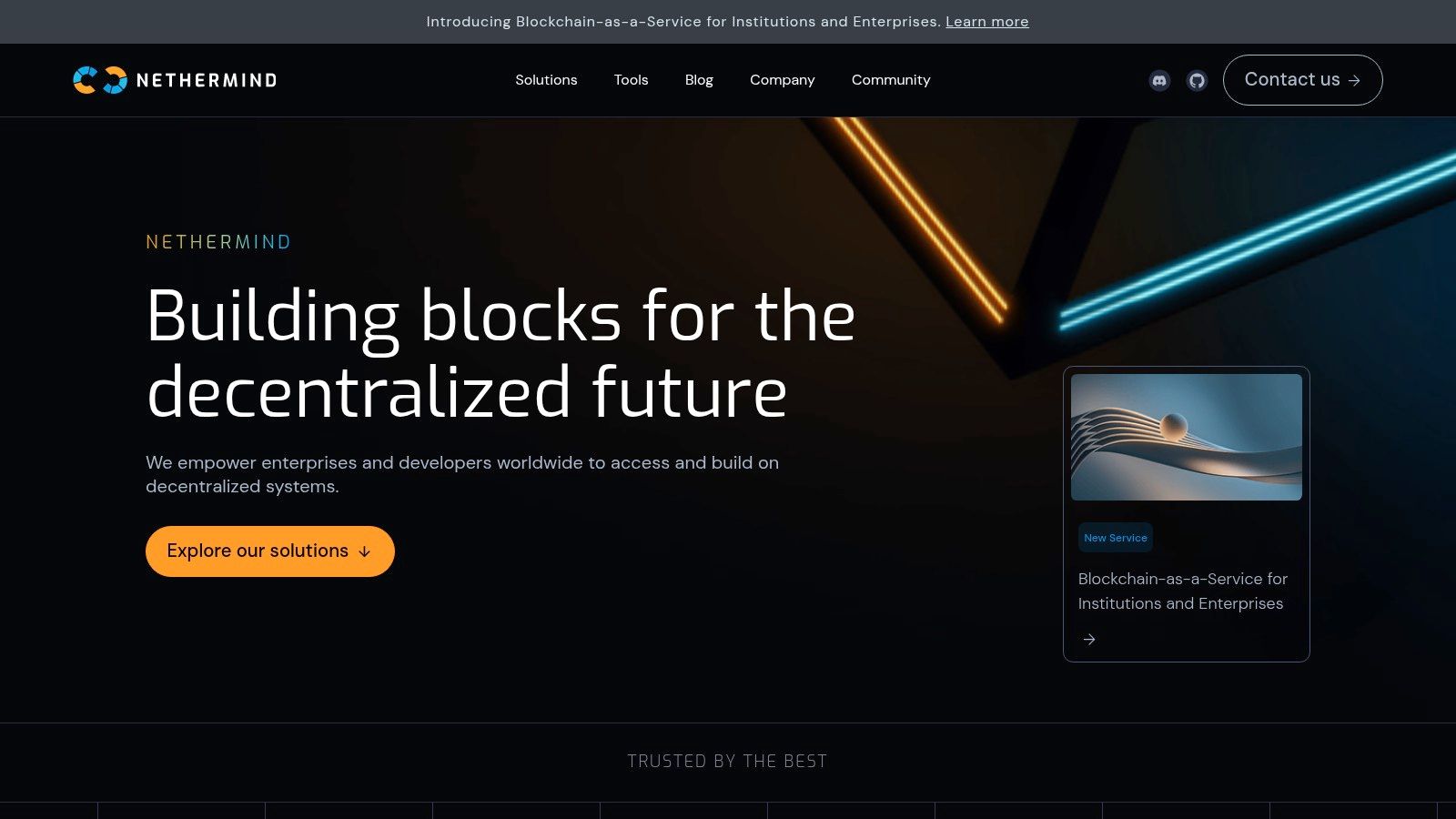
Unlike agencies that focus solely on dApp development, Nethermind’s work on its own execution client gives the team an intimate understanding of the EVM's inner workings. This translates into highly optimized and secure smart contracts. Their expansion into the Starknet ecosystem with Cairo development and formal verification also places them at the forefront of ZK rollups. This makes Nethermind an exceptional smart contract development company for teams building complex DeFi protocols or L2 infrastructure that demands both performance and verifiable correctness.
Engagement and Strengths
Engaging with Nethermind is ideal for technically demanding projects that require more than standard smart contract creation. Their process is engineering-driven, focusing on a deep dive into protocol mechanics, security implications, and long-term scalability. Their cohesive structure, where the same organization handles core engineering and security audits, provides a unified and efficient workflow.
Key Offerings:
- End-to-End Smart Contract Engineering: Full lifecycle development from architecture to deployment, specializing in Solidity/EVM and Cairo/Starknet.
- Nethermind Security: Provides comprehensive audits, formal verification, and cryptography consulting, ensuring contracts are secure against sophisticated attacks.
- ZK and L2 Specialization: Deep expertise in building and auditing solutions using zero-knowledge proofs and developing for Layer 2 networks.
Career and Hiring Perspective
A role at Nethermind is highly sought after by engineers who want to work on core blockchain infrastructure and challenging ZK-related problems. The company values deep technical knowledge, particularly in systems programming, cryptography, and protocol design. For developers aiming to join, demonstrating proficiency in Rust or Cairo alongside a strong Solidity foundation is a significant advantage. Interview questions will likely test first-principles thinking about protocol design, not just framework knowledge. Showcasing open-source contributions to core clients or ZK libraries on your resume will set you apart.
| Feature | Details |
|---|---|
| Primary Blockchains | Ethereum, Starknet, EVM-compatible chains |
| Security Focus | Audits, formal verification (Clear), cryptography consulting |
| Engagement Model | Project-based development, security audits, research contracts |
| Ideal For | L2 protocols, advanced DeFi projects, core infrastructure |
Website: https://www.nethermind.io/
3. ChainSafe
ChainSafe stands out as a protocol-agnostic engineering firm deeply embedded in the open-source community. Instead of focusing on a single ecosystem, their expertise spans Ethereum, Polkadot, Filecoin, and more, making them a top choice for projects requiring multichain functionality from day one. ChainSafe’s approach is rooted in co-development, where they partner with teams to architect, build, and launch complex systems, from core protocol clients to cross-chain gaming applications.
Their deep infrastructure experience is a significant advantage. By maintaining core protocol clients and building interoperability tools like bridges, ChainSafe’s developers have a fundamental understanding of how different blockchains communicate. This knowledge is invaluable for a smart contract development company because it reduces integration risks and ensures that applications are built on a solid, cross-chain-ready foundation. This is particularly relevant for DeFi, NFT, and gaming projects that aim to capture users across multiple Layer 2s and ecosystems.
Engagement and Strengths
Engaging with ChainSafe often feels like augmenting your team with deeply experienced protocol engineers. Their model is collaborative, focusing on building sustainable, open-source solutions alongside their clients. They are well-suited for technically complex projects that demand more than just standard dApp development.
Key Offerings:
- Multichain Smart Contract Development: Expertise in Solidity, Rust, and Go allows them to build for EVM and non-EVM environments.
- Cross-Chain Interoperability: They specialize in building and implementing bridges and multichain solutions, a critical component for modern Web3 applications.
- Protocol Engineering: ChainSafe contributes to and maintains core clients for major networks, including Lodestar (Ethereum), Gossamer (Polkadot), and Forest (Filecoin).
- Web3 Gaming & dApp Co-Development: They partner with teams to deliver end-to-end solutions, from smart contract logic to front-end integration.
Career and Hiring Perspective
For developers, working at ChainSafe provides exposure to the foundational layers of multiple blockchains—a rare and valuable career accelerator. Their open-source ethos means much of their work is public, allowing you to build a strong, verifiable portfolio. When hiring, ChainSafe looks for individuals with a deep curiosity for protocol mechanics and a proven ability to contribute to complex, collaborative codebases. To impress in an interview, be prepared to discuss the trade-offs between different consensus mechanisms or cross-chain messaging protocols. This demonstrates the systems-level thinking they value over narrow application-layer skills.
| Feature | Details |
|---|---|
| Primary Blockchains | Ethereum, Polkadot, Filecoin, Cosmos, Mina Protocol |
| Security Focus | Protocol-level security, best practices in cross-chain design |
| Engagement Model | Co-development, project-based, long-term retainers |
| Ideal For | Multichain protocols, Web3 gaming, infrastructure projects |
Website: https://chainsafe.io/
4. LeewayHertz
LeewayHertz stands out as a full-service software development firm that has built a dedicated and robust practice around blockchain and smart contracts. Based in the US, they offer an end-to-end development cycle that appeals to both startups and established enterprises needing a single partner to handle everything from backend contract logic to frontend UI/UX. This integrated approach is particularly valuable for organizations that lack an in-house design or engineering team to build the user-facing components of a decentralized application.
Unlike firms that focus exclusively on on-chain logic, LeewayHertz positions itself as a partner that can build the entire product. Their ability to pair complex Solidity development for DeFi, DAOs, and token standards with traditional front-end and systems integration makes them a practical choice. For projects needing a turnkey solution, this smart contract development company provides a structured delivery process that covers architecture, development, integration, and deployment, reducing the coordination overhead of managing multiple vendors.
Engagement and Strengths
Engaging with LeewayHertz typically begins with a discovery and scoping phase where they define the complete product architecture, not just the smart contracts. This process is beneficial for clients who have a strong business idea but need technical expertise to translate it into a functional dApp. Their documented methodology provides clarity and predictability throughout the project lifecycle.
Key Offerings:
- Turnkey dApp Development: They deliver complete decentralized applications, including smart contracts, front-end interfaces, and necessary backend integrations.
- Broad Tokenization Services: Expertise covers the full spectrum of token standards, including ERC-20 (fungible), ERC-721/1155 (NFTs), stablecoins, and governance tokens.
- Structured Tooling and Processes: The team is proficient with standard development and analysis tools like Solgraph, Doxity, and Evmdis to ensure code quality and maintainability.
Career and Hiring Perspective
For developers, LeewayHertz offers a path to work on complete product builds rather than isolated smart contract gigs. This environment is ideal for full-stack engineers looking to deepen their Web3 expertise. When interviewing, candidates should highlight their ability to connect on-chain logic with off-chain systems and user interfaces. Demonstrating experience with both Foundry/Hardhat and a modern front-end framework like React or Vue.js is a significant advantage. Be ready to discuss how you would architect a full dApp, including the off-chain components, to show you can think beyond just the smart contract layer.
| Feature | Details |
|---|---|
| Primary Blockchains | Ethereum, Hyperledger Fabric, Corda, Tezos |
| Security Focus | Code review and testing; third-party audits are standard |
| Engagement Model | Project-based turnkey delivery, dedicated teams |
| Ideal For | Startups and enterprises needing full dApp development |
Website: https://www.leewayhertz.com/
5. Applied Blockchain (Silent Data)
Applied Blockchain stands out as an engineering studio focused on privacy-preserving Web3 applications for regulated industries and enterprise clients. With offices in London and Porto, they bridge the gap between institutional finance and decentralized technology, delivering custom smart contracts that prioritize confidentiality. Their core offering, Silent Data, is a privacy-enabled Ethereum L2/app-chain stack that integrates confidential computing, making them a go-to partner for complex projects like Real-World Asset (RWA) tokenization and compliance-heavy DeFi.
What makes Applied Blockchain a unique smart contract development company is its combination of smart contract engineering with confidential computing technologies like Intel SGX and privacy oracles. This allows them to build solutions where data can be used in on-chain computations without being publicly revealed, a critical requirement for banks, asset managers, and other institutions handling sensitive information. Instead of treating privacy as an afterthought, their ready-made blueprints for tokenization and DEXs are designed from the ground up to operate within strict regulatory frameworks, incorporating features for AML and security token standards.
Engagement and Strengths
Engaging with Applied Blockchain is ideal for organizations that require more than just a standard smart contract; they need one that operates with verifiable confidentiality. Their process often involves deep collaboration to architect solutions that meet specific compliance and privacy needs. Their enterprise references and public testimonials show a track record of delivering for demanding clients.
Key Offerings:
- Privacy-Enabled Smart Contracts: Development that combines blockchain logic with confidential computing for use cases like private auctions or shielded transactions.
- RWA Tokenization Solutions: Expertise in asset tokenization with built-in compliance, using standards like ERC-3643.
- Silent Data L2/App-Chain: A managed mainnet or private app-chain that provides a ready-to-use environment for building confidential dApps.
- Enterprise Web3 Integration: Assisting large brands and regulated institutions in building and launching Web3 products that respect data privacy.
Career and Hiring Perspective
For developers interested in the intersection of privacy, enterprise blockchain, and finance, Applied Blockchain presents a compelling career path. Their work demands a rare skill set: deep EVM knowledge, an understanding of cryptographic principles, and familiarity with confidential computing. When interviewing, be prepared to discuss how to design systems that handle sensitive data on-chain and demonstrate an awareness of the compliance challenges in TradFi. Having a project in your portfolio that uses a ZK library or deals with confidential data would make you a standout candidate. This is a role for engineers who want to solve real-world institutional problems.
| Feature | Details |
|---|---|
| Primary Blockchains | Ethereum, EVM-compatible chains, Silent Data (L2/App-chain) |
| Security Focus | Confidential computing, privacy oracles, AML/compliance integrations |
| Engagement Model | Custom project development, enterprise consulting |
| Ideal For | Financial institutions, asset managers, enterprises needing RWA tokenization |
Website: https://www.appliedblockchain.com/
6. Altoros
Altoros is a US-headquartered engineering firm that brings a structured, enterprise-grade discipline to the world of Web3. Specializing in delivering blockchain solutions across Ethereum, Quorum, and Hyperledger, Altoros is ideal for organizations that need predictable delivery cycles and thorough documentation. Their approach is built around a documented delivery framework, making them a reliable partner for integrating blockchain technology into existing corporate environments.
What distinguishes Altoros is its formal, multi-stage engagement process that moves from kickoff and requirements gathering to development, QA, acceptance, and ongoing support. This systematic approach is particularly valuable for regulated industries or complex projects involving both Web2 and Web3 systems, such as asset finance platforms or IoT integrations. For businesses needing a smart contract development company that can speak the language of traditional software development lifecycles (SDLC) while delivering on blockchain’s potential, Altoros bridges the gap effectively.
Engagement and Strengths
Engaging with Altoros feels familiar to traditional enterprise software procurement. The process is transparent, with clear milestones, deliverables, and artifacts at each stage. This makes them a strong choice for companies where stakeholder buy-in and project predictability are paramount. While they are fully capable of building from scratch, their strength lies in integrating blockchain components into larger, established systems.
Key Offerings:
- Documented Delivery Framework: A structured, six-stage process ensures clarity and accountability from start to finish.
- Multi-Stack Expertise: Proficiency across public (Ethereum), private (Quorum), and permissioned (Hyperledger) blockchains allows them to recommend the right tool for the job.
- Enterprise Integration: Deep experience in connecting blockchain solutions with existing corporate IT infrastructure, databases, and IoT networks.
Career and Hiring Perspective
For developers and project managers with a background in traditional enterprise software, Altoros represents an excellent entry point into the Web3 space. The company values structured thinking, clear communication, and process-oriented execution. In an interview, demonstrating your ability to manage complex project requirements, write meticulous documentation, and collaborate within a formal development framework would be highly advantageous. Professionals who can translate business needs into technical specifications and explain complex blockchain concepts to non-technical stakeholders will thrive here. Experience with Agile or Scrum methodologies is a must.
| Feature | Details |
|---|---|
| Primary Blockchains | Hyperledger Fabric, Ethereum, Quorum, Corda |
| Security Focus | Follows secure SDLC practices; third-party audits recommended |
| Engagement Model | Project-based, dedicated teams, enterprise consulting |
| Ideal For | Enterprises, regulated industries (finance, healthcare), IoT |
Website: https://www.altoros.com/
7. Horizen Labs
Horizen Labs positions itself at the frontier of blockchain engineering, specializing in zero-knowledge (ZK) cryptography and building bespoke, high-performance blockchains. As a US-led firm, they cater to enterprises and ambitious crypto projects that require privacy-aware applications and custom layer-2 or app-chain solutions. Their core value proposition is integrating advanced cryptographic principles directly into the architecture, rather than treating them as an afterthought.
This focus on ZK systems makes Horizen Labs a distinct smart contract development company for projects where data privacy, scalability, and computational integrity are non-negotiable. They design systems that can reduce proof verification costs while maintaining robust security. This expertise is particularly relevant for constructing modular L2s or app-chains where performance and privacy tradeoffs must be carefully balanced from day one. For organizations building in regulated industries or handling sensitive user data, Horizen Labs provides a pathway to implement blockchain technology without compromising on confidentiality.
Engagement and Strengths
Engaging with Horizen Labs is a bespoke process, tailored to projects that have complex architectural needs. They are not a generalist agency; their strength lies in deep cryptographic engineering and custom blockchain design. The process typically starts with a deep dive into the project's technical and business requirements, with a strong emphasis on privacy and scalability from the initial discovery phase.
Key Offerings:
- Zero-Knowledge Engineering: Deep expertise in zk-SNARKs and other ZK proof systems to build privacy-preserving smart contracts and applications.
- Custom L2 & App-Chain Development: They architect and deploy modular blockchains and layer-2 solutions tailored to specific application needs.
- Enterprise Blockchain Solutions: Focus on building performant, secure, and compliant systems for large-scale enterprise use cases.
Career and Hiring Perspective
For developers and cryptographers, Horizen Labs represents an opportunity to work on the cutting edge of applied cryptography. A career here involves tackling some of the hardest problems in blockchain, such as efficient ZK proof generation and modular blockchain architecture. When interviewing, you must demonstrate a profound understanding of cryptographic primitives, L2 scaling solutions, and systems-level engineering. Showcasing experience with Rust or Go, and a solid grasp of distributed systems is essential. Be prepared to discuss the theoretical underpinnings of ZK-SNARKs vs. ZK-STARKs to prove your depth of knowledge.
| Feature | Details |
|---|---|
| Primary Blockchains | Ethereum, Custom L2s/App-chains, ZK-focused EVMs |
| Security Focus | Cryptographic integrity, formal verification for ZK circuits |
| Engagement Model | Bespoke project-based engagements, enterprise partnerships |
| Ideal For | DeFi with privacy needs, enterprises, L2 protocols |
Website: https://horizenlabs.io/
Top 7 Smart Contract Development Companies Comparison
| Provider | 🔄 Implementation complexity | ⚡ Resource requirements | 📊 Expected outcomes | 💡 Ideal use cases | ⭐ Key advantages |
|---|---|---|---|---|---|
| ConsenSys (Solutions + Diligence) | High — end‑to‑end design, dev, audit | High — enterprise budgets, cross‑team delivery | Robust, audit‑hardened EVM deployments | Enterprise DeFi, permissioned/public Ethereum projects | ⭐ Deep Ethereum pedigree; integrated security toolchain |
| Nethermind | High — protocol/client + smart‑contract work | High — specialized engineers for clients & ZK | High‑performance clients, formally verified components | L2s, high‑stakes DeFi, ZK and formal verification projects | ⭐ Strong core engineering; multichain + security in‑house |
| ChainSafe | Medium — cross‑chain and client maintenance | Medium — OSS contributors + co‑dev teams | Interoperable multichain tooling and reliable infra | Multichain dApps, gaming, cross‑chain integrations | ⭐ Protocol‑agnostic, strong infra & interoperability experience |
| LeewayHertz | Medium — turnkey UI + smart‑contract delivery | Medium — US‑based dev teams, front‑end + back‑end | Complete product delivery (UI, contracts, integrations) | Startups and enterprises needing turnkey dApps | ⭐ Clear delivery process and US presence |
| Applied Blockchain (Silent Data) | High — privacy stack + confidential computing | High — privacy engineers, SGX/oracle integrations | Privacy‑enabled tokenization and compliant app‑chains | RWA tokenization, regulated institutions, compliance‑heavy projects | ⭐ Ready privacy blueprints; enterprise compliance experience |
| Altoros | Medium — documented enterprise delivery framework | Medium — multi‑stack teams, global delivery | Predictable, documented enterprise integrations | Mixed Web2/Web3 enterprise projects, asset finance, IoT | ⭐ Enterprise‑friendly process with clear milestones |
| Horizen Labs | High — ZK architectures and custom L2 design | High — ZK/crypto specialists and engineering teams | Privacy‑aware, performant L2/app‑chain solutions | Projects needing ZK expertise, custom app‑chains | ⭐ Deep ZK and privacy engineering expertise |
Making Your Choice: From Vendor Selection to Your Next Career Move
The journey to find the right smart contract development company is more than just a procurement process; it's a strategic decision that shapes your product’s security, scalability, and future success. We've explored a range of top-tier firms, from industry giants like ConsenSys and Nethermind, known for their deep contributions to core infrastructure, to specialized teams like ChainSafe and Horizen Labs, who bring focused expertise to specific ecosystems. Each company presents a unique blend of technical prowess, security auditing rigor, and project management style.
Your final decision hinges on aligning a partner's strengths with your project's specific needs. A startup building a novel DeFi protocol on Ethereum might find a perfect fit with Nethermind, given their extensive experience with core client development and security audits. Conversely, a team focused on multi-chain interoperability might gravitate toward ChainSafe's proven track record in building bridges and diverse ecosystem tools. The key is to move beyond brand recognition and dissect their case studies, technical documentation, and community contributions.
Actionable Takeaways for Your Hiring Process
When evaluating a potential smart contract development company, your vetting process should be as rigorous as if you were hiring a C-level executive. These partners become custodians of your protocol's logic and your users' assets.
Here are the critical steps to take now:
- Revisit Your Requirements: Armed with the insights from this guide, refine your project requirements document. Clearly define your target blockchain(s), required programming languages (Solidity, Rust, Cairo), and, most importantly, your security and audit expectations.
- Conduct Technical Due Diligence: Go beyond the sales pitch. Ask to speak directly with the engineers who would be assigned to your project. Pose specific questions about their experience with EIP-4337 for account abstraction or their approach to mitigating reentrancy attacks in complex multi-contract systems. Their answers will reveal their true depth of knowledge.
- Validate Past Performance: Don't just read the case studies on their website. Use a block explorer to examine the on-chain history of projects they've built. Look at the transaction volume, the smart contract code (if verified), and any security incidents associated with those protocols. This provides an unbiased view of their work's real-world performance.
From Hiring a Vendor to Building Your Career
Understanding what makes a top smart contract development company is also a powerful tool for your own career growth. The standards these firms set are the standards you should aspire to, whether you're a developer, a product manager, or a security researcher.
Key Insight: The criteria used to evaluate an elite development firm are the same criteria that define a top-tier Web3 professional. Mastering security best practices, contributing to open-source projects, and demonstrating a deep understanding of multiple blockchain architectures will make you an invaluable asset.
If you're a developer preparing for interviews, study the open-source repositories of firms like ChainSafe or ConsenSys. For product managers, analyzing the go-to-market strategies of projects launched by Horizen Labs or LeewayHertz provides a masterclass in Web3 product delivery. The excellence of a leading smart contract development company serves as a direct roadmap for what the industry values and where you should focus your professional development. This knowledge transforms your job search from a passive application process into a strategic career move, positioning you to join or even compete with the very best in the field.
Ready to find your place among the teams building the future of decentralized technology? The next great opportunity at a leading smart contract development company or a groundbreaking Web3 startup is waiting. Explore curated roles for engineers, product managers, and security experts on Blockchain Jobs. Visit Blockchain Jobs to connect with the teams shaping the next generation of the internet.