
7 Companies Hiring Blockchain Developers in 2026
You're probably staring at the same problem teams hit right now. The role says blockchain developer, but the practical question is whether the company wants protocol depth, smart-contract shipping, infra reliability, or a broader technical operator who can work inside a Web3 product team. That's why the best applications aren't sprayed across generic boards, they're matched to the hiring funnel, the stack, and the interview loop. For a quick contrast on how teams organize this work, see Web3 design agency vs in-house.
1. Blockchain Jobs
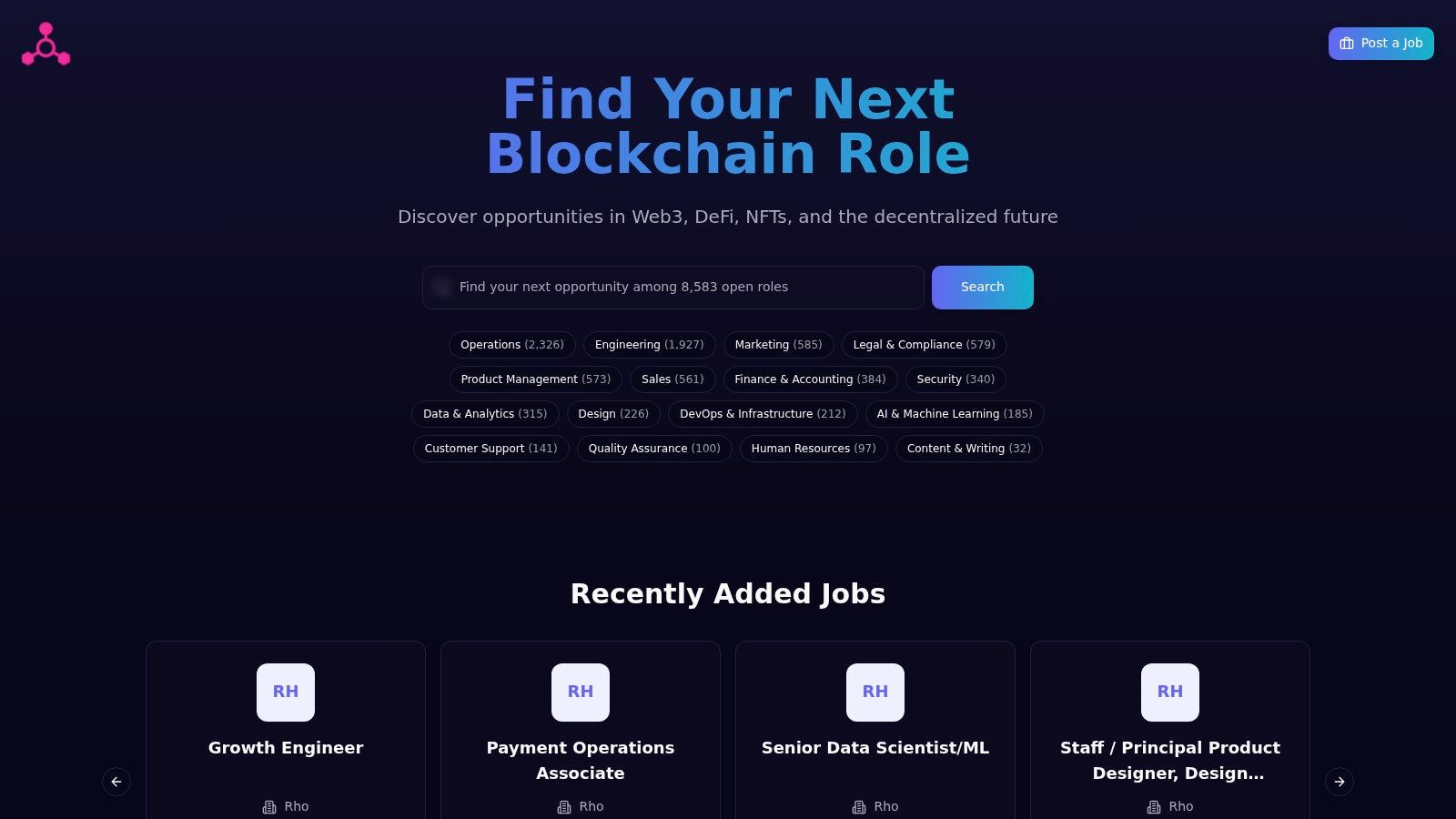
Blockchain Jobs gives candidates a focused way to find companies hiring blockchain developers across the Web3 stack. Its listings cover smart-contract engineering, backend development, protocol infrastructure, security, and platform work, so you can compare teams without sorting through unrelated software roles.
The category structure also exposes what an employer needs. Engineering, Operations, Product, Design, Marketing, Legal & Compliance, Finance, Security, and AI/ML are separated, helping you distinguish a protocol engineer opening from a technical operations role. That matters during application screening because blockchain employers often use "developer" for work involving nodes, data pipelines, custody systems, or internal platforms.
The Recently Added feed helps applicants prioritize active openings. Listings span New York, London, Hong Kong, India, Europe, and fully remote teams, giving you an early view of location and eligibility constraints. The Recently Filled section shows that recognizable Web3 employers use the board, although a filled listing is only a signal to research the employer's current hiring process.
Use the board to filter by the team you want to join, then prepare for the likely interview loop. Protocol roles may test consensus and distributed systems. Smart-contract roles usually require security reasoning and testing discipline. Infrastructure roles tend to focus on observability, incident response, and deployment trade-offs. Operations candidates can also learn to manage contingent workers efficiently when hiring needs change across projects.
Practical rule: senior engineers should start with protocol, infrastructure, and security listings. Early-career candidates can use adjacent backend or QA roles to build relevant production experience.
The board is useful because it offers:
- A specialized audience: applicants already familiar with crypto-native systems and terminology.
- Targeted inventory: category labels and recent postings make active roles easier to prioritize.
- Remote coverage: global listings help candidates check location requirements before applying.
- Hiring signals: filled postings and recognizable employers provide context for market activity.
Pricing is not clearly shown on the main listings page, so employers may need to open the pricing flow or begin a post to see the cost. Before applying, review the jobs in blockchain guide to compare role types and decide which interview track matches your experience.
2. Coinbase
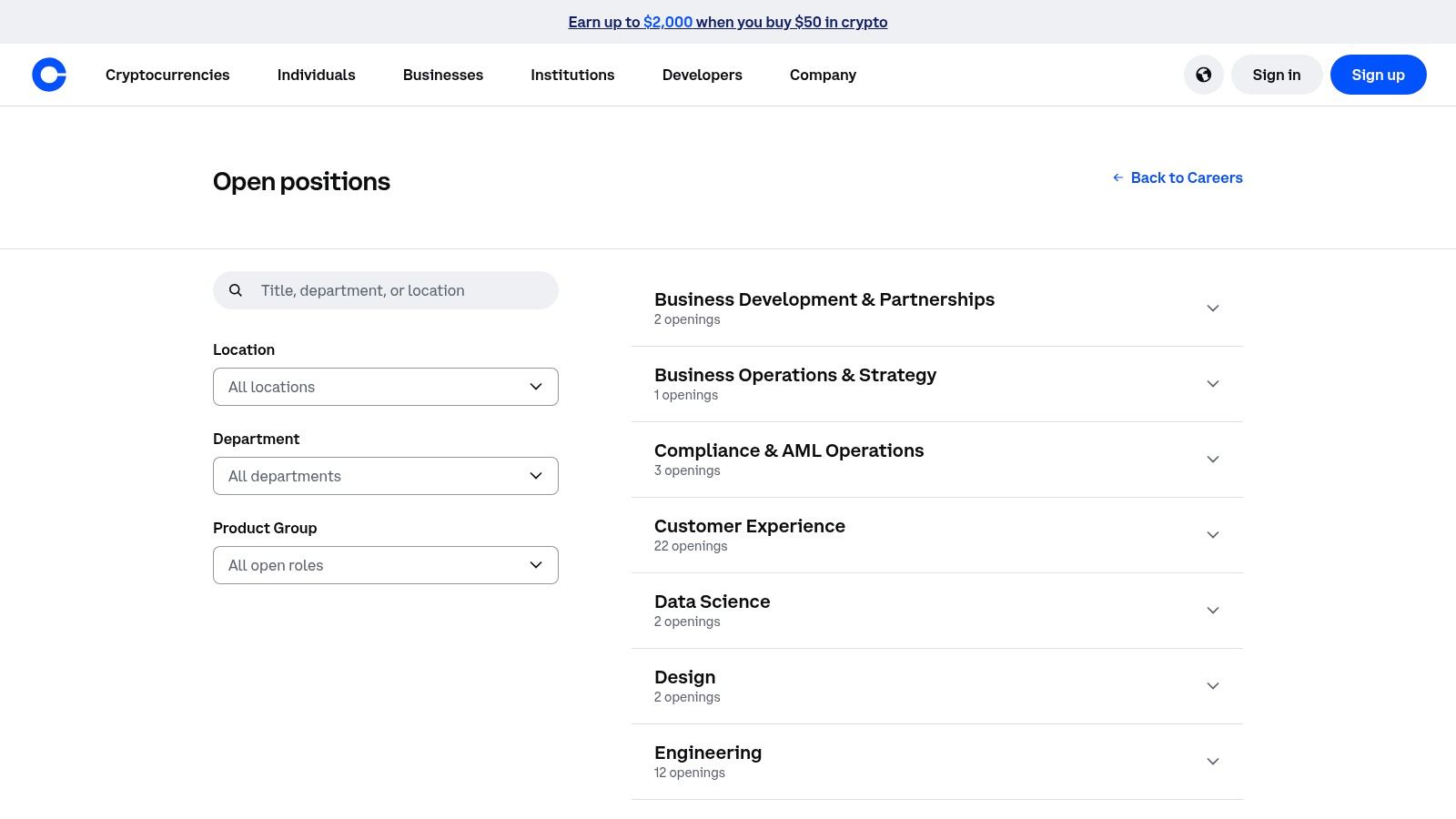
Coinbase is the safer bet if you want blockchain work with large-scale production pressure. Its engineering roles often touch blockchain nodes, developer platforms, and systems that need to stay reliable under real user load, which makes it a strong fit for engineers who've already shipped infrastructure or backend systems at scale.
The interview loop usually rewards candidates who can talk clearly about distributed systems, reliability, and the trade-offs that come with serving a huge user base. If you're coming from traditional backend or platform engineering, that's a real advantage here, but you still need to show you understand blockchain-specific operational concerns. For select roles, there's US-remote eligibility, which helps if you're not near a major hub.
Who should apply
This is a better move for mid-level to senior engineers than for early-career candidates. The company's regulated environment means change management can be slower, so you should expect more scrutiny around security, systems design, and operational rigor. If you want a role where your work is visible and the blast radius is real, Coinbase is a strong option.
The best preparation here is not a flashy demo. It's a clean explanation of how you'd keep nodes healthy, services observable, and production systems boring in the best possible way.
What tends to stand out in interviews:
- Node and platform fluency: Be ready to discuss blockchain node architecture and developer tooling.
- Security awareness: Expect pressure around custody-grade and compliance-sensitive systems.
- Systems thinking: Be able to reason about scale, reliability, and failure modes.
- Remote discipline: If you're applying to a US-remote role, prove you can operate autonomously.
The upside is obvious, you get exposure to systems that matter and a hiring brand that carries weight. The downside is that the process can be rigorous, especially for systems-heavy roles where the bar is closer to infrastructure engineering than “Web3 app developer.” Website: Coinbase Careers
3. Ripple
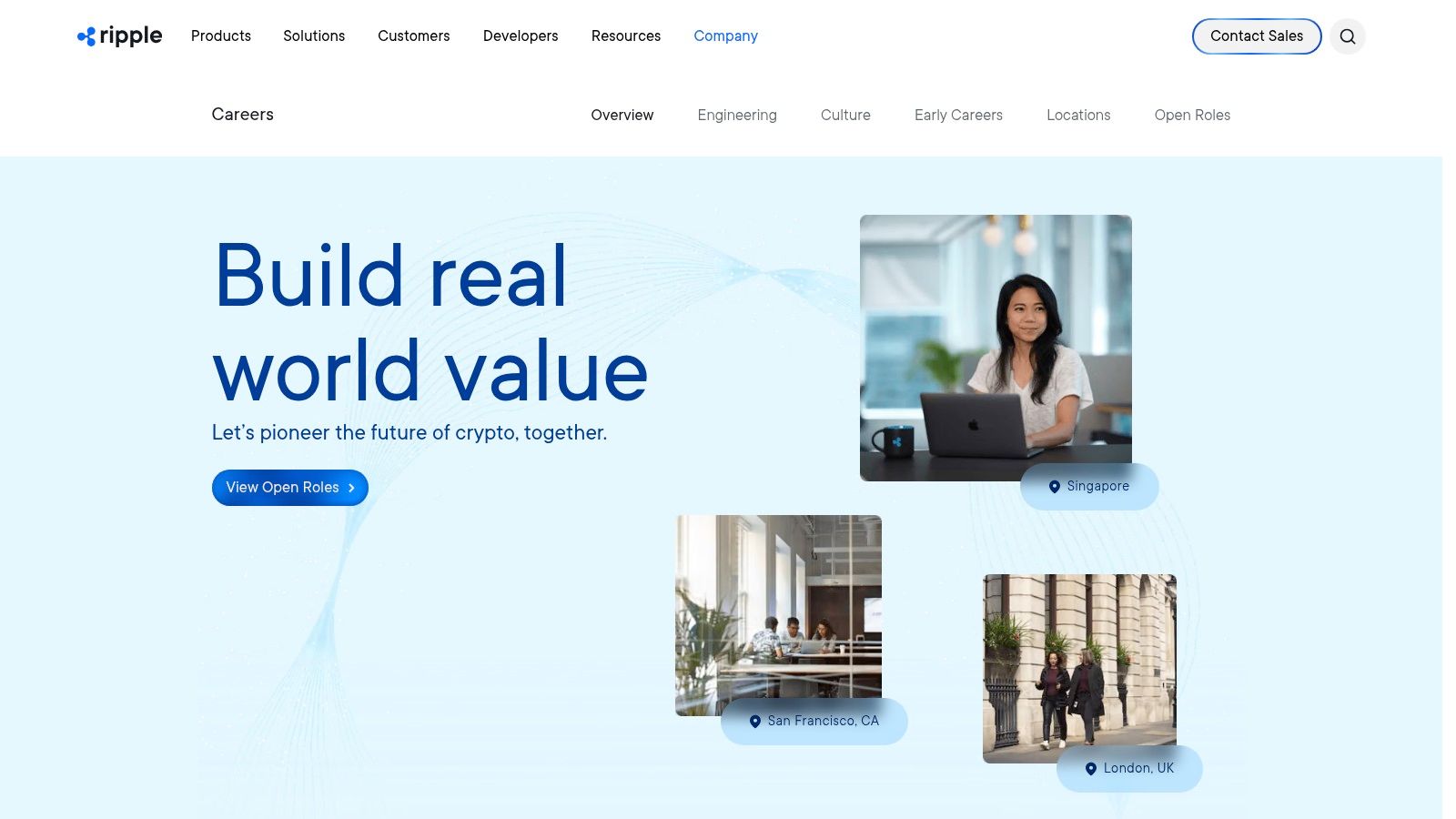
A payments engineer joining Ripple may spend less time on consumer wallet features and more time on settlement, ledger reliability, and enterprise integrations. That focus shapes both the hiring funnel and the work itself. Candidates need to connect blockchain design decisions with operational controls, customer requirements, and regulated payments infrastructure.
Openings can span platform engineering, security, RippleX, and ledger-focused teams. Early-career developers may find enterprise product engineering a more accessible entry point than protocol development. Senior engineers should look for roles closer to ledger infrastructure, security boundaries, or systems that support payment flows.
Your interview preparation should start with the system, not a coding exercise. Be ready to explain payment rails, trust boundaries, failure handling, and reliability under compliance constraints. Open-source work can strengthen your application when it shows familiarity with ecosystems relevant to settlement or payments.
Remote eligibility depends on the role and location. Ripple's global footprint creates options beyond one regional office, but candidates should confirm where each team can hire before investing time in the process. Remote work may also require clear communication across distributed engineering and product groups.
Use this quick filter before applying:
- Best fit: Mid-level and senior engineers seeking enterprise blockchain experience.
- Interview focus: Ledger architecture, security, reliability, and payment-system trade-offs.
- Career stage: Suitable for protocol-adjacent specialists and engineers transitioning into enterprise blockchain.
- Trade-off: Regulatory and market conditions can change priorities and hiring timelines.
The company suits engineers who want production constraints to shape their blockchain work. If you need context on how DeFi roles differ from enterprise protocol positions, top DeFi projects provides a useful comparison. Website: Ripple Careers
4. Uniswap Labs
Uniswap Labs suits engineers who want direct protocol exposure alongside products serving active DeFi users. Its teams work across the Uniswap Protocol, backend services, applications, security, and release engineering. That range gives candidates a route from product delivery toward protocol ownership, while still demanding careful execution.
Apply selectively by team. Protocol and security interviews are likely to examine adversarial thinking, smart-contract edge cases, attack surfaces, and user protection. Product-facing roles may test API design, debugging, and release judgment as well. Solidity syntax helps, but interviewers will want you to explain why a design remains safe when assumptions fail.
A strong application shows evidence across layers. Describe a contract, backend service, deployment process, or incident you handled, then explain the trade-offs behind your decisions. Engineers who can move between protocol logic and product constraints are better positioned for a lean DeFi organization.
Interview rule: explain why each design choice remains safe under adversarial conditions.
Remote-friendly roles can suit distributed candidates, but eligibility depends on the position and hiring location. Communication across protocol, product, and security workstreams matters because decisions often cross team boundaries.
Use these signals to prioritize the application:
- Best fit: Mid-level and senior engineers seeking direct DeFi protocol exposure.
- Interview focus: Smart-contract security, adversarial systems, backend integration, and deployment safety.
- Remote eligibility: Confirm the role's location requirements before applying.
- Career stage: Strong for engineers ready to take broader ownership beyond one application layer.
- Trade-off: High ecosystem impact comes with fast-moving priorities and a demanding security bar.
To separate smart-contract work from broader application engineering, use this guide to learn Solidity language. For a wider comparison of DeFi employers and technical environments, review top DeFi projects. Website: Uniswap Labs Careers
5. Chainlink Labs
A production incident affecting oracle data can expose weaknesses across several protocols at once. That operating environment makes Chainlink Labs a strong target for engineers who want to build oracle infrastructure, cross-chain data systems, and reliability tooling. The work suits Web2 platform engineers moving into Web3 because systems design and operational judgment matter as much as blockchain familiarity.
Openings can span backend, infrastructure, protocol, and Web3-focused teams. Candidates should expect interviews to test reliability engineering, security boundaries, distributed-systems design, and failure handling. Smart-contract experience helps, but the stronger signal is knowing how services behave when validators, networks, or external data sources cannot be assumed trustworthy.
The company's infrastructure reaches multiple ecosystems, giving engineers broader exposure than a role tied to one application. That reach brings trade-offs. Production failures can affect dependent protocols, and cryptoeconomic security adds a difficult learning curve for engineers coming from conventional cloud systems.
Prioritize the application if you can explain an outage, recovery decision, or distributed-system trade-off in precise technical terms. Show how you would monitor oracle inputs, isolate faults, and protect downstream consumers under adversarial conditions. For preparation, review this guide to learn Solidity language, then connect contract behavior to the backend systems supporting it.
Remote eligibility depends on the specific opening and hiring location, so confirm those requirements before applying. Distributed collaboration is part of the job, particularly across protocol, security, infrastructure, and product teams.
- Best fit: Experienced backend, infrastructure, and Web3 engineers moving toward foundational blockchain systems.
- Interview focus: Oracle security, cross-chain architecture, reliability, and incident response.
- Remote eligibility: Check each role's location and hiring terms.
- Career stage: A strong match for senior-minded engineers ready for wider infrastructure ownership.
- Trade-off: Broad ecosystem impact comes with high reliability pressure and complex security assumptions.
Website: Chainlink Labs Careers
6. ConsenSys
A MetaMask wallet issue can become an infrastructure incident for a large user base. That operating scale makes ConsenSys a strong target for engineers who want Ethereum work tied to real product usage. Teams span wallet software, developer platforms, and protocol-adjacent infrastructure through products such as MetaMask and Infura.
The hiring funnel is broad and competitive. Openings commonly cover consumer applications, APIs, platform services, and blockchain engineering, with many roles offering US-remote eligibility. Check the location and employment terms for each posting rather than treating remote work as a company-wide policy.
Team placement changes the interview. MetaMask candidates should prepare for product engineering, wallet security, signing flows, and failure handling. Infrastructure candidates need to discuss service reliability, API design, observability, and how backend behavior affects Ethereum users. Protocol-facing roles may test transaction mechanics and the practical limits of Ethereum tooling.
A useful preparation exercise is to trace one user action from wallet interface to RPC request and on-chain confirmation. Explain where latency, incorrect state, or a failed provider response can appear, then describe the safeguards and recovery path. That answer shows systems judgment better than a list of libraries.
The main trade-off is breadth versus competition. Engineers can move among wallet, infrastructure, and developer-platform teams, but prominent roles attract applicants with strong Ethereum contributions and visible production work. Candidates at mid-level and above usually gain the most from this range, while junior applicants should show shipped projects rather than only course certificates.
- Best fit: Engineers with Ethereum, wallet, platform, or backend experience.
- Interview focus: Wallet security, developer APIs, distributed services, and reliability.
- Remote eligibility: Many US-remote roles, subject to each posting's requirements.
- Career stage: Mid-level to senior engineers seeking broader product and infrastructure exposure.
Lead your application with a concrete Ethereum contribution, an incident you handled, or an architecture decision you can defend. Review current openings through ConsenSys Careers.
7. Circle
A payment flow that crosses blockchains, compliance checks, and institutional settlement needs engineers who can reason about both on-chain behavior and production operations. Circle hires for that intersection, with work spanning stablecoins, payments, tokenization, and blockchain systems infrastructure.
The open teams include platform SREs and software engineers. Interviews are therefore likely to test reliability, data handling, service design, and platform judgment alongside blockchain fundamentals. Pure smart-contract experience may help, but it is not the only route into the funnel. Select teams offer US and remote-eligible opportunities, so check the location rules on each posting before applying.
Circle suits engineers moving from fintech, payments, or infrastructure-heavy product teams into blockchain. Those backgrounds transfer well when the role involves settlement services, operational controls, or regulated financial products. Candidates should also expect security and compliance requirements to shape technical decisions and delivery speed.
The trade-off is scope versus process overhead. You gain exposure to stablecoins, compliance, and global payments, with problems tied to institutional use cases. Priorities can change with regulation and market conditions, so applicants should show that they can adapt architecture and execution without sacrificing reliability.
Prepare one example of a service you operated under strict reliability or compliance requirements. Explain the failure modes, monitoring, controls, and decisions you made under pressure.
- Best fit: Infrastructure, platform, payments, and fintech engineers.
- Interview focus: Reliability, compliance-aware engineering, data, and blockchain infrastructure.
- Remote eligibility: Available on select teams, depending on the posting.
- Career stage: Mid-level to senior engineers with fintech or platform experience.
Review current roles through Circle Careers.
Top 7 Blockchain Employers Comparison
| Platform | Complexity (🔄) | Resource needs & Speed (⚡) | Expected outcomes (⭐ / 📊) | Ideal use cases (💡) | Key advantages |
|---|---|---|---|---|---|
| Blockchain Jobs | 🔄 Low, simple posting & discovery workflow | ⚡ Low–Moderate, fast reach to niche talent; pricing gated | ⭐ Targeted hires; 📊 High relevance, moderate volume for non‑crypto roles | 💡 Hire crypto‑native engineers, product, and ops; timely listings | Specialized Web3 audience; large active inventory; strong social proof |
| Coinbase | 🔄 High, rigorous, compliance‑heavy hiring processes | ⚡ High, production‑scale infra; lengthy interviews | ⭐ High quality impact; 📊 Large user/market visibility | 💡 Systems-level blockchain infra, custody, developer platforms | Strong engineering standards; visibility on consumer & institutional scale |
| Ripple | 🔄 Medium‑High, enterprise/regulatory constraints | ⚡ High, enterprise integrations and compliance effort | ⭐ Enterprise impact; 📊 Real‑world payments & settlement outcomes | 💡 Cross‑border payments, ledger engineering, enterprise product work | Direct exposure to payment rails; RippleX open‑source contributions |
| Uniswap Labs | 🔄 Medium‑High, protocol & security hiring bar | ⚡ Medium, lean teams, rapid iteration cadence | ⭐ High protocol influence; 📊 Outsize ecosystem impact | 💡 DeFi primitives, DEX protocol and UX/product engineering | Protocol‑level work; open‑source impact; remote‑friendly benefits |
| Chainlink Labs | 🔄 High, cryptoeconomic & oracle reliability demands | ⚡ High, on‑call/reliability focus; research→prod pipeline | ⭐ Critical to interoperability; 📊 Strong DeFi infrastructure role | 💡 Oracle security, cross‑chain data, middleware infra | Central role in DeFi interoperability; strong R→P pipeline |
| ConsenSys | 🔄 Medium, multi‑product organization with shifting priorities | ⚡ Medium‑High, large user base (MetaMask/Infura) demands scale | ⭐ High reach; 📊 Broad platform impact across wallets & infra | 💡 Wallets, developer APIs, Ethereum client and infra engineering | Ship code used by millions; lateral movement across teams |
| Circle | 🔄 High, compliance and financial‑grade processes | ⚡ High, stablecoin & payments infra require robustness | ⭐ Institutional impact; 📊 Influence on tokenization/settlement | 💡 Stablecoin infrastructure, payments rails, SRE/platform roles | Exposure to compliance‑forward use cases; influence on standards |
Turning These Openings Into Your Next Offer
Choose two or three employers whose engineering teams match your experience, whether that's protocol and security work, infrastructure and node operations, or wallet and developer tooling. For each one, review the role type, confirm remote eligibility on the employer page, and prepare for the interview style the role implies. Then track applications by employer and revisit the list every quarter, because open roles and team priorities change quickly across the Web3 sector.
If you're comparing interview prep with the role mix above, system design templates for interviews can help you sharpen the architecture side before you apply. The strongest move is to stop treating every blockchain job as the same opportunity and start applying like a specialist.
Blockchain Jobs gives you a focused way to find real engineering openings instead of generic crypto noise. If you want a cleaner path to roles that match your stack, visit Blockchain Jobs and use the board to target the teams that are hiring for your level.