Web3 Developer Job Description Template and Skills Guide
One in three crypto developers now works across multiple chains, compared with fewer than 10% in 2015, according to Electric Capital's 2024 Developer Report. That shift makes a generic “crypto experience” requirement less useful: a strong Web3 developer job description names the chain and the work the hire will own, while recognizing that protocol skills can transfer across ecosystems.
Treat the posting as a risk document, not just a list of qualifications. It should tell candidates what they'll build, what security and on-call responsibilities come with the role, and whether their location and compensation terms fit before they reach late-stage interviews.
Copy-Ready Web3 Developer Job Description Template
The old line “crypto experience required” leaves a candidate guessing about the chain, engineering track, and production risk. Write for a multi-chain labor market instead: Electric Capital found that developers with at least two years of crypto experience grew 27% in 2024 and produced 70% of all code commits. The report also found that 39,148 developers explored crypto during the year, while the overall developer population declined 7% year over year. Those figures support a practical distinction in a posting: ask for demonstrated ownership and transferable protocol skills, not familiarity with one ecosystem's name alone.
Use this table as a fill-in draft. Replace the example lines with the role's actual scope, stack, and terms.
| Template section | What to write | Example line |
|---|---|---|
| Role title and track | Name the engineering track and primary ecosystem. | Smart Contract Engineer (EVM), Protocol Team |
| Mission summary | State in one sentence what the code secures or ships. | Build and maintain lending contracts that custody user funds. |
| Core responsibilities | List five to seven outcomes, each with a clear owner. | Own deployment, upgrades, and monitoring for two mainnet contracts. |
| Required skills | Include only skills needed to deliver the work safely. | Solidity, Hardhat or Foundry, and property-based testing. |
| Preferred skills | Name useful adjacent tools or ecosystem familiarity, not hidden requirements. | Rust and Anchor experience; Slither or Echidna. |
| Chains and environment | Identify target networks, Layer-2s, and relevant RPC infrastructure. | Ethereum mainnet and two EVM Layer-2 networks. |
| Security and on-call duties | State audit, incident, monitoring, and key-handling responsibilities. | Joins the on-call rota; holds no privileged key alone. |
| Eligibility and pay | List eligible countries, employment type, cash pay, and token terms. | Remote within listed countries; cash base plus a vesting token grant. |
Turn the core responsibilities into accountable outcomes. “Contribute to smart contracts” says little; “own deployment scripts, release checks, and post-deployment monitoring for the lending contracts” tells applicants what they'll be responsible for. Separate required skills from preferred ones, too. If the team can't ship without Foundry, put it in the required column. If the team can train a qualified engineer on a secondary chain, don't make that chain a filter.
A blank field is a decision deferred, and candidates will notice. Unspecified key access, remote eligibility, or token terms often push basic questions into late interviews, after both sides have spent time on a role that may not fit. For a useful process for assigning ownership and keeping hiring steps consistent, see recruitment process guidance from MakeAutomation.
Before publishing, run three checks. Can a candidate identify the track, target chain, and on-call duty from the first screen? Does every required skill map to the work the role involves? And can the candidate understand the pay and eligibility terms without waiting for a recruiter call?
Web3 Engineering Tracks and What Each One Owns
A Web3 developer posting fails when it describes a team instead of a role. The title can cover application work, contract code, protocol components, audits, infrastructure and cryptography, and each carries a different blast radius when something breaks. Smart-contract work appears across many postings, but Solidity sits beside Rust, Move, cloud and container tooling, zero-knowledge proofs and audit work rather than standing for the whole job.
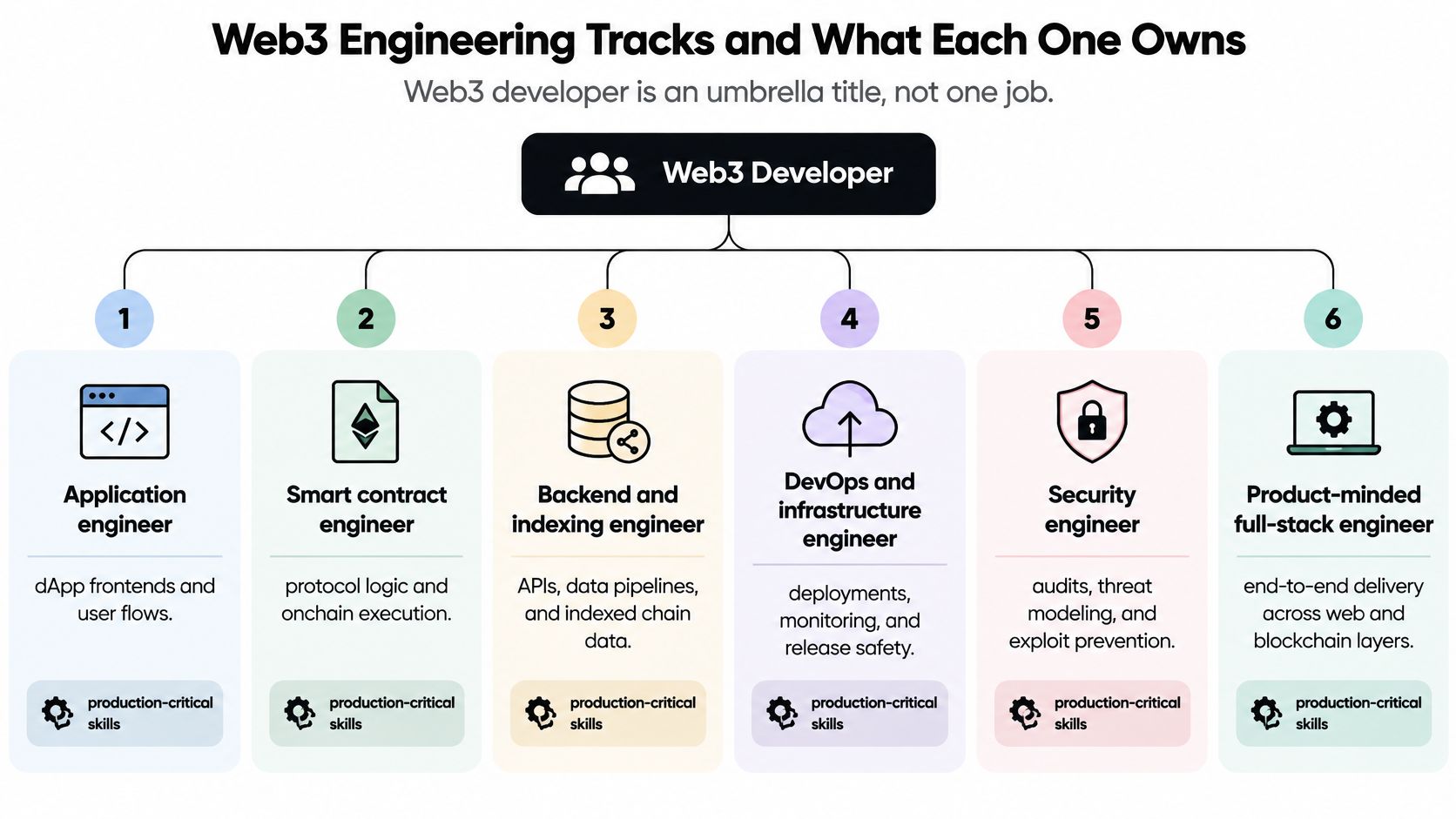
Choose one primary track and write the ownership boundary before the skill list. The boundary is the risk control: who can deploy, who can pause, who holds keys, who answers the page, and who signs off after an incident. These six tracks cover distinct production responsibilities:
Application engineer. Owns dApp front ends, wallet connections, RPC calls and transaction user experience. The role is accountable for clear behavior when transactions fail, stall or return ambiguous states, so list TypeScript, wallet integration and API handling as production-critical only if the engineer will support them in production.
Smart-contract engineer. Owns Solidity or Rust programs, deployment scripts, upgrades and automated tests. Name the chain and framework, then state whether the engineer ships to production, prepares releases for another owner, or shares upgrade authority through review or multisig controls.
Protocol engineer. Builds or maintains client software, consensus-adjacent components, bridges or cross-chain messaging. The posting should name the protocol layer and the failure modes the engineer owns: liveness, finality assumptions, message ordering, replay risk or dependency failures.
Smart-contract security engineer. Leads audits, threat modeling, fuzzing and vulnerability assessment. Define the authority clearly: review only, remediation ownership, release gates, incident response, or a combination with named handoffs.
Infrastructure engineer. Owns nodes, indexers, key-management systems and production-service reliability. State the deployment environment, alert ownership, backup and recovery duties, on-call rota and whether the role ever touches privileged keys alone.
Cryptography engineer. Designs or implements zero-knowledge proof systems, circuits and signature schemes. Say whether the work is research, production implementation or both, and who carries the risk when a proof, key ceremony or signature flow reaches users.
Syntax alone is not a proxy for Web3 readiness. A candidate may know Solidity and still lack the security and operational judgment needed for contracts that hold user funds. Mark each skill production-critical or preferred, and say how it will be evaluated. The description should let applicants compare their experience with the actual risk profile: the chain they will touch, the authority they will hold, the duties that follow them after release, and the jurisdiction and pay terms that decide whether they can accept the job.
Chain Stacks, Languages and Toolchains by Ecosystem
Name the target stack before listing frameworks. Ecosystem scale differs enough to change what "experienced" means: Electric Capital's developer ecosystem summary counts 8,925 developers in the EVM ecosystem, roughly 3.6 times the Solana Virtual Machine stack's 2,499. A posting that says "EVM experience" without naming the production network leaves the security model ambiguous, since mainnet and each Layer-2 carry different finality, upgrade control, and bridge exposure the hire will own.
| Stack | Languages | Common tooling | Scale from research |
|---|---|---|---|
| EVM (Ethereum and EVM networks) | Solidity, Vyper | Hardhat, Foundry | About 8,925 developers in the EVM ecosystem |
| Ethereum Layer-2 networks | Solidity | Foundry, Hardhat, chain RPC tools | A large share of Ethereum developer activity now runs on Layer-2 networks |
| Solana (SVM) | Rust | Anchor | About 2,499 developers in the SVM ecosystem |
| Move-based chains | Move | Move CLI and chain SDKs | Name the target Move chain and its SDK in the posting |
Tool names alone don't tell a candidate how the team ships. Name the framework and where it sits in the workflow, then specify three parts:
- Development and testing: the test framework and the local chain or simulator used to build and exercise contracts before deployment.
- Reading on-chain data: the RPC provider and indexer the role depends on, plus who responds when the provider degrades or the indexer falls behind tip.
- Release and verification: the deployment scripts and the source-verification process the engineer will use when shipping.
Every stack still requires engineers to reason about blocks, consensus, finality, fee markets, keys, and signatures. The implementation differs, but an application's behavior depends on when transactions are included, when state counts as final, and how fees shape a user flow. Ask candidates to explain those trade-offs on the chain they will use, not on one they studied for the interview.
For multi-chain roles, list one primary stack and name any secondary network the team supports. Account models, execution environments, fee mechanics, and cross-chain security transfer between ecosystems, so assess them as transferable skills rather than letting them substitute for naming the actual chain. A blockchain development tools guide helps hiring teams compare which tools belong in the stack description before the posting goes live.
Security, Testing and Gas Skills to Require

A Solidity requirement does not prove someone can write secure contracts. Start the assessment with reentrancy: an untrusted contract calls back into a function before the original invocation finishes, which can allow repeated withdrawals if the contract updates state too late. Ask candidates to describe the safe order: validate inputs first, update state second, then make external calls. This is the checks-effects-interactions pattern; a mutex-style guard can provide another control.
For a smart-contract role, require evidence of NatSpec documentation, pull-request review, independent code review, automated tests, events for critical operations, and post-deployment monitoring. The Ethereum smart-contract security guidance treats reentrancy, access control, gas inefficiency, and economic attacks as core verification concerns. For DeFi-facing jobs, add explicit expectations for oracle dependencies, economic-attack analysis, and incident-response readiness. State which duties belong to the engineer and which are handled by a dedicated security team.
A practical testing requirement names methods, not just “strong testing.” The Ethereum security documentation on testing and analysis recommends combining unit tests, property-based testing, static analysis, and dynamic analysis. A posting can require candidates to explain how Slither, Echidna, or Medusa checks run on every pull request, and how the team monitors deployed contracts for signs of compromise.
Gas belongs in the job description because execution costs shape user experience and transaction reliability. On Ethereum, slots are 12 seconds under normal validator operation, blocks target 30 million gas and can reach 60 million, and a standard ETH transfer uses 21,000 gas. If execution runs out of gas, state changes revert but the supplied gas is consumed, as Ethereum explains in its block and gas documentation. Require engineers to profile critical functions, document gas budgets, add regression checks to CI, and test batching, minting, liquidation, or settlement paths where relevant.
Use the following as acceptance criteria, not a wish list. Ask a candidate to explain the failure mode, demonstrate a test or review method, and describe what they'd monitor after release. The smart-contract security engineering guide offers additional context for defining the responsibilities of a security-focused role.
Seniority Levels and How Candidates Move Up
Define seniority by scope of ownership, not years alone. A junior engineer ships small, tested features under review. A mid-level engineer owns a module and its test suite. A senior engineer owns a protocol release through regressions and audits, while a staff or lead engineer sets security standards and chain strategy across the team.
| Level | Scope of ownership | Evidence expected | Interview signal |
|---|---|---|---|
| Junior | Builds tested features under review | Course projects, testnet deployments, one public repository | Explains a transaction they wrote |
| Mid | Owns a module and its test suite | Contracts shipped to testnet or mainnet, peer-reviewed pull requests | Writes an invariant or property test |
| Senior | Owns protocol releases from design through regressions and audits | Multi-release ownership, audit findings closed, incident handling | Explains past regressions and design trade-offs |
| Staff or lead | Sets security standards, chain strategy, and the team's hiring bar | Cross-chain delivery, postmortems, written threat models | Designs a system that spans two chains |
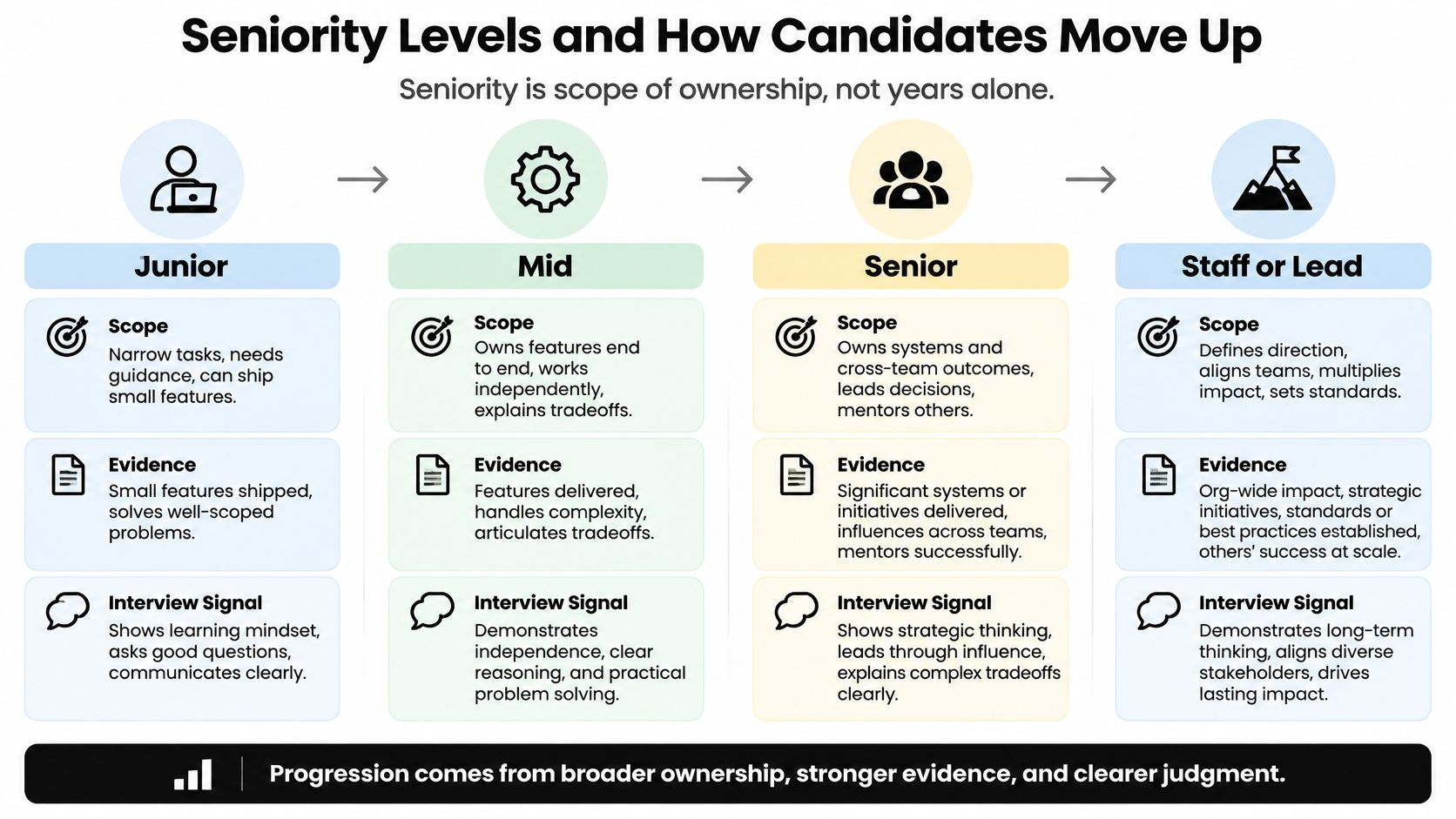
Career progression means broader responsibility and stronger evidence. Moving from one stack to another can support that case: a candidate might port a token contract from an EVM Solidity codebase to a Solana Rust program, or build a cross-chain integration. The proof is the design and execution, not the technology names on a résumé.
Hiring managers can use available role counts as context, not as a measure of candidate quality. Blockchain Jobs lists 56 mid-level, 1,696 senior-level, and 284 director-level blockchain and Web3 jobs. Candidates should match each résumé claim to the level it supports: shipped contracts and test suites for mid-level ownership, release decisions and resolved audit findings for senior scope, and cross-team security standards for staff or lead work.
Publish a salary band for each level. If you can't, list the components clearly, such as base salary, token grant, and vesting, rather than presenting an unexplained total. Candidates should be ready to show shipped contracts, mainnet deployments, audit findings they resolved, and incident reports they wrote.
Interview Tasks That Test Real Protocol Work
A practical interview tests whether a candidate can reason about production behavior, not whether they can recall obscure opcodes. Use focused tasks with clear pass signals. Suggested time limits below are interview-design choices, not measures of candidate seniority.
| Task | What it tests | Strong answer signal |
|---|---|---|
| Fix a reentrancy bug in a withdraw function, 20 minutes | Security ordering and locks | Names the vulnerable external call, reorders state updates, and adds a guard |
| Write a property-based test for a token balance invariant, 25 minutes | Testing depth | States the invariant, generates random inputs, and catches a seeded bug |
| Profile gas on a batch function, 20 minutes | Cost reasoning | Identifies storage writes and external calls as the main cost drivers |
| Explain who pays for a failed transaction, 10 minutes | Execution lifecycle | Says the sender pays for the work done, even when state changes revert |
| Walk through a past release with regressions, 20 minutes | Ownership and tenure | Describes the regression, its root cause, and the design trade-off made afterward |
| Deploy to a testnet and verify the source, 30 minutes | Deployment process | Explains compile, deploy, and verify steps, and why verification isn't testing |
Ask experienced candidates to walk through one system they maintained across multiple releases. What regressions did they handle? What design trade-off did they make later, and why? Electric Capital's 2024 report found that developers with at least two years of crypto experience grew 27% year over year and produced 70% of all code, making sustained contributions and shipped repositories more useful signals than course completion alone, according to the report's developer experience findings.
Score the reasoning, not the vocabulary. A candidate who identifies the failure mode before proposing a fix shows better engineering judgment than someone who only lists tools. Replace trick questions with practical ones: who pays gas, why did a transaction revert, and how does deployment verification differ from functional testing? Ethereum's developer documentation on testing, compiling, deploying, and verifying contracts describes the lifecycle these questions should probe.
Keep take-homes safe and bounded. Run them on a testnet or in an environment the hiring team controls, and never ask candidates to handle real keys or funds.
Compensation, Remote Terms and Accountability to Disclose
“Remote” doesn't tell candidates whether they can legally work for the company, what they'll be paid, or whether they'll hold signing authority. The Web3 skills and employer expectations discussion highlights how often postings leave jurisdiction, employment type, token compensation, working-hour overlap, and operational accountability unclear.
Write the cash base and token component separately. For a token grant, state the vesting schedule, cliff, lockup, liquidity assumptions, and applicable tax treatment. Name the employment type, such as employee, contractor, or foreign entity, and list eligible countries. Sanctions, securities rules, data protection, and payroll constraints can make a role unavailable in places that a broad “remote” label appears to include.
Then spell out the accountability: will the engineer deploy immutable contracts, handle privileged keys, participate in audits, respond to exploits, support regulatory reviews, or work on financial products subject to jurisdiction-specific controls? State working-hour overlap and on-call expectations as well. These details help candidates understand the operational and legal responsibilities before the interview.
Blockchain Jobs listings show the employer, location, salary range when given, role category, and contract type; 4,171 open roles are remote. For practical context on regional hiring and team setup, see this guide to building a Latin American engineering team. For salary planning, use the blockchain jobs salary guide, then publish the compensation structure the role offers.
Publish a Job Description Candidates Can Trust
Before publishing, employers should confirm the track, chain, security duties, on-call expectations, interview tasks, and pay fields are complete. Check that every required skill maps to work the hire will own, and that the interview tests those same skills. A candidate should be able to decide whether to apply from the first screen.
Candidates can use the posting as a checklist, too. Match each required skill to evidence such as a shipped repository, a deployment, an audit finding, or an incident report. If there's a gap, name a project that could close it, such as a testnet application or a property-based test suite.
Applying remains a meaningful route into the industry: 40% of respondents in the 2024 Consensys and YouGov Web3 Workforce Survey said they entered Web3 by applying for jobs, according to the survey findings. Candidates can sign up for daily email alerts for new blockchain and Web3 jobs, and employers can use the employer section's Post a Job, Dashboard, Pricing, and Advertising links.
Publish only after the security and pay fields are complete. Those details determine whether applicants can legally take the role and safely carry its responsibilities.
Explore Blockchain Jobs to compare Web3 engineering roles by their responsibilities and technical requirements. If you're hiring, use the employer section to post a role with its track, security duties, and compensation terms clearly stated.