Blockchain Jobs Salary Guide: Ranges, Remote Pay and Offers

A headline blockchain salary range can look useful while telling you almost nothing about the offer in front of you. A reported range from roughly $45,000 to $375,000, for example, bundles different roles, experience levels, locations, and forms of pay into one span. The useful question isn't what a blockchain job pays. It's how much of the package is guaranteed, how much depends on future or uncertain value, and what that package means where you live.
That distinction matters whether you're interviewing for a Solidity role, assessing a security position, or setting compensation bands as a hiring manager. The figures below are market benchmarks, not promises: use them to frame questions, then compare roles with similar responsibilities and terms.
Why Blockchain Salaries Vary So Widely
A blockchain salary isn't a single number. It's a package assembled from base cash, variable cash, token grants, and sometimes equity. Those components can have very different levels of certainty and usefulness to a candidate.
Base cash is the fixed salary paid under the employment agreement. Variable cash includes compensation such as a bonus that depends on performance or other conditions. A token grant provides digital assets under specific grant terms, while equity represents an ownership interest subject to its own terms. Neither should automatically be treated like cash in the bank.
A grant's stated value doesn't tell you when you can access it or what it may be worth when you can. Vesting is the schedule under which a grant becomes available to you. Lockups can restrict when you can sell or transfer assets. Total compensation is the combined package, but adding cash and potential asset value together can obscure how much is guaranteed.
Ask what the number includes
Before comparing two salary figures, check whether they describe base salary alone or include bonus, equity, or tokens. Then ask how the non-cash components vest, whether sale restrictions apply, and what valuation assumptions the employer used. A large headline total can look compelling while leaving the candidate with modest guaranteed cash and uncertain future value.
Location matters, too. Employers may set a single global rate for remote workers, or adjust pay according to the employee's location or the employer's hiring bands. So a remote role doesn't necessarily offer location-neutral pay, and the same title can correspond to different cash offers in different jurisdictions.
Use the right benchmark for the question
The figures in this guide serve different purposes. Function benchmarks help match a specialty to a role; seniority benchmarks help assess career stage; regional averages provide context for location; and compensation reports illustrate how packages can shift between cash and tokens. None is a substitute for reading the offer itself.
For any salary figure, ask three questions: How much is guaranteed cash? How much is variable or token-based? What is the package worth where the candidate lives? Candidates can use the answers to prioritize negotiation points. Hiring managers can use them to publish clearer ranges and avoid comparing unlike roles as though they were interchangeable.
Blockchain Salary Ranges by Job Function
Engineering accounted for roughly 67% of reported headcount in a compensation dataset covering 85 crypto companies and about 3,400 employee or candidate data points, according to CryptoRank's compensation dataset reporting. That concentration makes job-function comparisons useful, but the label “blockchain developer” still covers work with sharply different technical demands.
The figures below are reported annual base salary ranges, not total compensation or guaranteed offers. The zero-knowledge figure is an upper-end benchmark for scarce expertise, not a typical target for cryptography candidates.
| Role tier | Reported base salary range | Main pay drivers |
|---|---|---|
| Entry-to-mid-level blockchain developer | Approximately $80,000–$150,000 | Experience, programming language, and role scope |
| Senior smart-contract engineer | Commonly $160,000–$250,000 | Security responsibility, protocol complexity, and demonstrated expertise |
| Elite zero-knowledge cryptographer | Up to $300,000 | Specialized cryptography and zero-knowledge systems expertise |
These ranges come from an engineering compensation benchmark summarized in Yahoo Finance's crypto salary analysis. They describe market ranges, not fixed rates. Use the relevant tier to set a cash baseline, then assess any variable pay or token grants separately.
Why the specialties don't price alike
Application developers and protocol engineers do different work. Protocol, cryptography, and security roles can command higher base pay because they require specialized expertise, and mistakes in financial smart contracts or security-sensitive systems can cause irreversible losses. Employers therefore assess threat modeling and security judgment alongside coding ability and distributed-systems experience.
Language requirements narrow the comparison further. A hiring manager should specify whether a position centers on Solidity application development, protocol work in Rust or Golang, or cryptographic systems. Candidates should ask which systems they will own and what security responsibilities they will carry.
A posting outside these ranges needs context. It may reflect unusual scope, an employer's pay policy, or a package with variable compensation or tokens. Compare the role's duties with the closest function tier, and separate guaranteed base pay from the other components before judging the offer.
Salary Benchmarks by Seniority Level
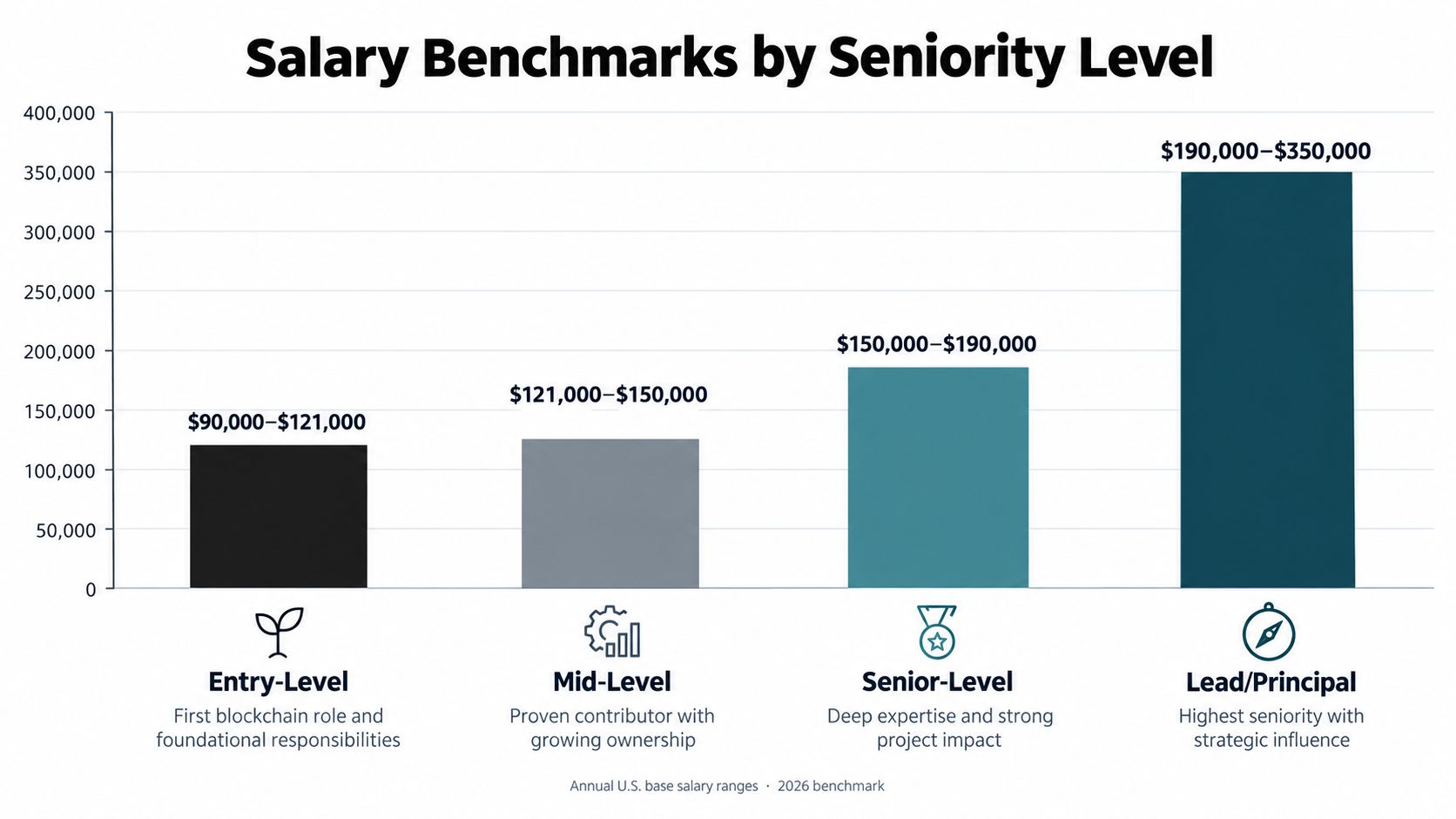
A salary range only becomes useful when the candidate's experience and expected scope match the level behind it. A 2024 compensation analysis reported a clear progression from entry-level roles through executive or director positions. Its averages are reference points, not automatic targets: a candidate's responsibilities and the employer's definition of seniority still matter.
| Seniority level | Reported salary range | Reported average |
|---|---|---|
| Entry-level | Approximately $89,000–$138,000 | About $113,000 |
| Mid-level | $123,000–$172,000 | About $147,000 |
| Principal or senior | $172,000–$222,000 | About $197,000 |
| Executive or director | $208,000–$264,000 | About $236,000 |
The bands and averages are from the 2024 compensation analysis published by Binance. The analysis places the typical transition to principal or senior level at roughly seven to eight years of experience. That's a useful orientation, not a promotion rule: years alone don't demonstrate the scope or judgment expected at a higher level.
What changes as responsibility grows
At entry level, candidates should be ready to demonstrate foundational implementation skills, such as Solidity fundamentals or an understanding of consensus concepts. Interviewers may look for reliable coding, careful testing, and a sound explanation of how the work fits into a larger system. An offer near the entry-level average is more informative when the role's scope is foundational.
Mid-level candidates are expected to contribute with less direction and take ownership of increasingly complex work. The practical interview signal is not just familiarity with tools, but the ability to explain tradeoffs, troubleshoot implementation choices, and deliver features that fit the team's architecture.
Senior and principal candidates need to show a broader form of responsibility. They may be assessed on system design, protocol ownership, security judgment, and the ability to guide technical decisions. For an interview, prepare examples that demonstrate how you handled a consequential design choice or managed risk, not only what code you wrote.
Executive and director compensation reflects leadership scope as well as technical background. Candidates should clarify whether the role leads teams, sets technical direction, owns delivery, or carries broader organizational responsibility. Hiring managers should make those expectations explicit, so an offer is compared with the right level instead of relying on title alone.
Geographic and Remote Pay Adjustments
A regional salary average describes a market context, not what every remote candidate should expect. In the second half of 2024, average salaries were $183,294 in North America, $127,646 in Europe, and $112,328 in Asia, according to the Calyptus Web3 salary report. The figures show a regional spread, but they don't determine an individual offer.
Role comparisons also matter within a region. In that same reporting, smart-contract developers averaged $172,297, while backend developers averaged $147,177. Backend compensation ranged from $30,000 to $275,000, with the middle half earning between $90,000 and $187,500. Those broad figures make a single “blockchain salary” average a weak guide for any specific candidate.
Ask how the company sets remote bands
Remote employers generally need to explain which policy governs the offer. Some may pay the same rate for a role regardless of the employee's location; others may apply geographically adjusted bands. The word “remote” by itself doesn't tell you which approach the company uses.
A candidate should ask whether the salary band is tied to the job's responsibilities, the employer's location, the employee's residence, or a combination of those factors. If a recruiter provides a broad range, ask which portion applies to your location and experience, and whether benefits or payroll terms change by jurisdiction.
For a practical way to think about how income and living costs interact, candidates can explore geographic arbitrage strategies. The point isn't to treat a regional average as a personal target. It's to compare the offer with local expenses, employment terms, and the opportunities available to you.
Remote role availability is only one part of the decision. Candidates can also search remote Web3 roles while checking whether each employer publishes location rules or a salary range. When a listing leaves those details unstated, bring the questions to the first recruiter conversation rather than waiting until the offer stage.
Reading Token, Equity and Cash Compensation
A package with a large total-compensation headline can still be difficult to evaluate if it relies on assets that aren't immediately usable. Start by separating guaranteed cash from variable cash, tokens, and equity. Then assess what must happen before each component becomes available and whether you can access its stated value.
Crypto pay conditions changed during 2024 and early 2025. Dragonfly's report found that average crypto-company salary fell 18% year over year to about $144,000, while token grants declined 75%; the same reporting put engineering and crypto-engineering roles at roughly 67% of total headcount. These findings are summarized in BeInCrypto's coverage of crypto job trends. They describe the dataset and period covered, not a forecast or a guaranteed outcome for an individual role.

Put each component on its own line
Ask the employer to separate base salary, variable cash, signing bonuses, token grants, and equity in writing. For an incentive, request the conditions that govern payment or ownership. For grants, clarify the vesting schedule, any lockup, the valuation assumptions, and the terms that would apply if you leave or the company changes ownership.
A token amount quoted at a particular valuation isn't equivalent to cash salary. Its practical value depends on the grant terms and whether you can sell or otherwise use the asset when it vests. Equity has different terms, but it also needs its own valuation and access assumptions. Compare packages using fully diluted and risk-adjusted values, not just the headline total.
Crypto salary payments can also involve digital assets rather than grants. Pantera Capital's 2024 Blockchain Compensation Survey found that the share of respondents receiving at least part of their salary in cryptocurrency rose from 3% in 2023 to 9.6% in 2024, and that USDC and USDT were the dominant payment methods among those accepting crypto compensation. The survey is available from Pantera Capital. Crypto salary remained a minority arrangement, so candidates should clarify which currency will be used for regular payroll and how conversion, payroll, and tax treatment work.
For a broader view of roles in decentralized organizations, candidates can review this guide to decentralized jobs. Use it alongside a written offer breakdown, not as a substitute for reviewing the actual grant and employment terms. A sensible comparison starts with cash you can count on, then assigns a separate, cautious value to compensation that depends on vesting, liquidity, or future performance.
How to Negotiate a Blockchain Job Offer
A strong offer is a set of terms, not one headline number. Negotiate each part against the role's scope and your priorities, then compare guaranteed cash, variable pay, and any token or equity compensation separately.
Request a complete breakdown before comparing offers
Ask the recruiter to put the package in writing. Confirm the base salary, bonus structure, payment currency, and any conditions attached to variable pay. For token or equity grants, request the grant size, vesting schedule, lockups, valuation assumptions, and change-of-control terms.
Negotiation rule: Set your minimum acceptable guaranteed cash first. Assess variable pay and grants as separate components, with their conditions and risks stated clearly.
For international offers, confirm the payroll jurisdiction, tax treatment, benefits, and location-based salary policy. These terms affect the value of the cash offer and can make two similar salaries difficult to compare.
Tie your ask to evidence and priorities
Use the function and seniority benchmarks earlier in this guide to set a range for the role. Explain how your experience matches its level, citing relevant responsibilities such as protocol ownership, security reviews, system design, or team leadership. If the offer falls below your range, ask whether the difference reflects location policy, role scope, or the mix of cash and variable compensation.
Set priorities before negotiating. If the base salary is fixed, you could ask for a defined bonus formula or clearer grant terms. If a large share of the package depends on tokens, focus on the conditions that determine when and how you receive them.
Hiring managers can apply the same approach when setting an offer. State the cash range, explain any location adjustments, and describe token terms separately. Clear terms make the offer easier to assess and give both sides a specific basis for negotiation.
Comparing Where to Find Pay Data and Roles
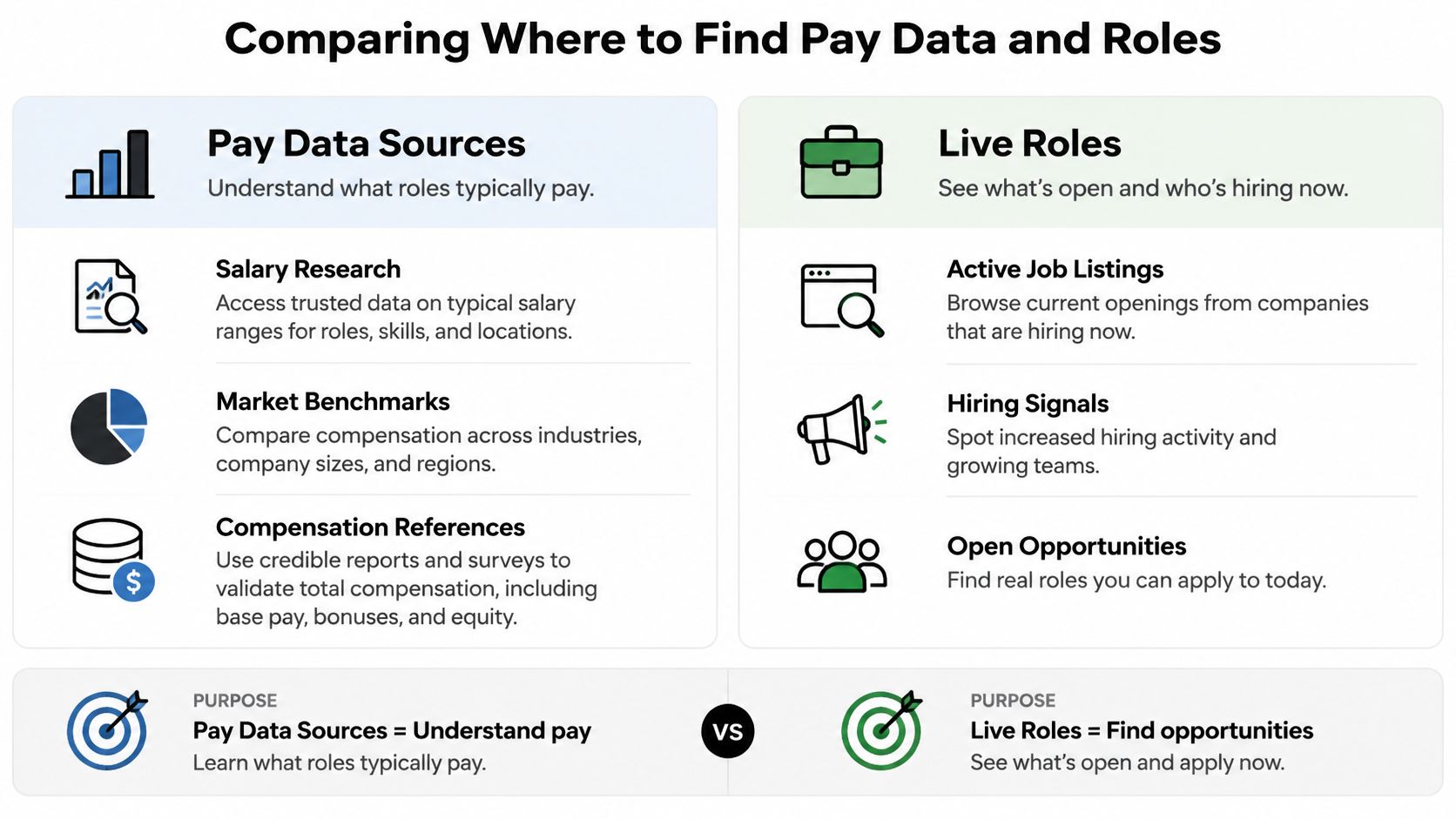
Salary surveys and job listings answer different questions. A survey offers aggregated compensation observations that can help set expectations for a function, seniority, or region. A live listing shows what a specific employer is advertising for an open role, if the employer discloses pay. Neither alone tells you whether a particular offer is competitive on every dimension.
Start with surveys when you want context for a negotiation or a hiring band. Check the role, location, date, and whether the figures describe base salary or total compensation. Use job postings to see what employers are hiring for now, how they describe responsibilities, and whether they provide compensation details. Treat an undisclosed range as a question to ask, not as evidence that the role matches a particular benchmark.
Use categories to find comparable openings
Blockchain Jobs is a dedicated job board for Web3 roles. Its category tags include Engineering, Security, DevOps and Infrastructure, Legal and Compliance, Finance and Accounting, and Product Management, alongside other functions across the ecosystem. Candidates can use its remote-friendly filter and Recently Added Jobs feed to narrow a search to relevant openings. Examples in the feed include a Backend Engineer II role at Tala, a Product Manager role at Prometheum, and an Associate General Counsel role at Uniswap Labs.
Category tags make comparisons more useful when they keep the scope consistent. An engineering candidate can focus on engineering roles rather than comparing their offer with unrelated operations or marketing positions. Employers can use the Post a Job option to reach people searching for crypto-native opportunities.
For a broader set of resources and role-finding options, candidates can review this guide to Web3 websites. Whichever source you use, record the employer, role, location policy, and pay components alongside the listed range. That simple record helps distinguish a market benchmark from a live employer's terms, and prevents token-inclusive totals from being compared directly with base salaries.
Quick Reference and Next Steps for Your Search
A useful blockchain salary comparison has three parts: the role benchmark, the candidate's level and location, and the structure of the offer. A strong headline number is not enough if you don't know how much is guaranteed or when the rest becomes available.
Use this checklist when you're preparing for an interview or reviewing an offer:
- Match the specialty: Compare the role with the relevant engineering tier, and check whether the work involves application development, protocol engineering, security, or cryptography.
- Match the level: Use the seniority range that best reflects the actual scope. Focus on ownership and judgment as well as years of experience.
- Confirm the location policy: Ask whether the employer uses a global rate or location-adjusted bands, and which band applies to you.
- Separate pay components: Record base cash, variable cash, signing bonuses, tokens, and equity as distinct items.
- Read grant terms: Check vesting, lockups, valuation assumptions, liquidity, and what happens if your employment ends or the company changes ownership.
- Check the comparison basis: Establish whether each published figure is base salary or total compensation, and whether it reflects the same role, location, and seniority.
- Prepare interview evidence: Be ready to explain your technical decisions, system design, security judgment, and level of ownership in terms that match the role.
Turn the benchmark into a shortlist
Before applying, choose the category that matches your function and decide whether remote-friendly roles are relevant to your search. Use the Recently Added Jobs feed to identify openings, then compare each listing with the closest function and seniority benchmark. Note whether the employer has stated a cash range and token terms; if not, prepare questions for the first recruiter conversation.
For hiring managers, the same process improves job postings. Define the role's scope, show the cash range, and explain any location adjustments or variable compensation. Candidates can then make a more informed decision before the interview, while employers can focus conversations on fit and expectations instead of clarifying basic package details late in the process.
Choose a role category, build a shortlist of relevant openings, and review each package using the checklist before you interview. That turns a broad search for blockchain jobs salary information into a specific application plan, with the right questions ready before an offer arrives.
Browse Blockchain Jobs to find Web3 openings across engineering, security, product, and other functions. Filter for remote-friendly positions where relevant, review recently added roles, and compare each listing's stated compensation with the benchmark that matches your experience and location.