Blockchain Development Tools Hiring Teams Expect in 2026
A candidate's take-home contract passes every unit test, then fails on a mainnet fork because the test setup never accounted for a token that rebases its balances. That gap says more than whether the candidate can write Solidity. It shows whether they can reproduce production conditions, investigate unexpected behavior, and explain what their tests do not cover.
That's why blockchain development tools shape hiring across engineering, security, and DevOps roles. A protocol team needs people who can test invariants and reason about execution; an application team needs reliable deployment and data access; a security team needs engineers who can triage analyzer results instead of treating every warning as a verdict. The ecosystem has matured, too: Electric Capital's 2024 Developer Report counted 23,613 monthly active crypto developers in November 2024, with developers who had at least two years of crypto experience producing 70% of code commits.
The ten tools below are grouped by the problems they solve, from contract development and security checks to RPC access, indexing, and transaction debugging. For each, the useful interview question is not “Have you used it?” but “What did you build with it, what failed, and why did you choose that workflow?” For a broader view of developer tooling, see Zemith's developer productivity tool comparison.
1. Foundry
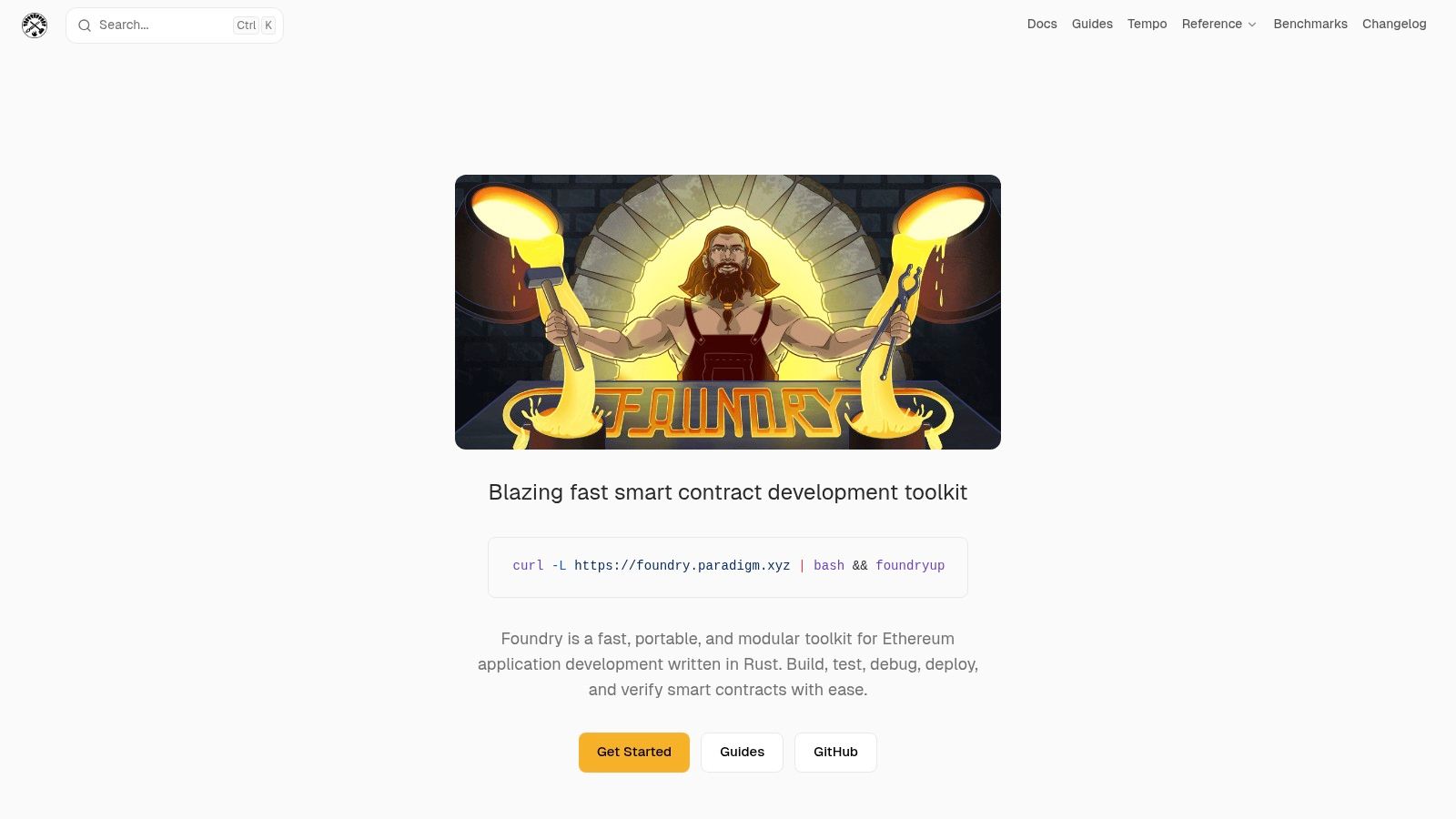
Foundry is a strong choice for Solidity developers who want testing and automation close to the contract code. Its Rust-based toolchain includes Forge for compiling, testing, fuzzing, and benchmarking; Cast for sending transactions and querying chain data; Anvil for a local node and live-network forks; and Chisel for interactive Solidity experiments. The Foundry documentation describes a workflow that can span dependency management, tests, deployment, and scripted chain interaction.
For a protocol engineer, Foundry's clearest signal is not familiarity with a command. It's whether the candidate can write a meaningful invariant, reproduce an edge case on a fork, and use fuzzing to challenge assumptions their hand-picked test cases missed. A useful interview exercise asks them to explain what a test proves, what state it relies on, and how they'd make the result repeatable in CI.
Hiring signal: A good Foundry project shows the whole loop: dependencies, deterministic tests, fuzz cases, gas measurements, and deployment scripts.
Foundry runs tests quickly and keeps much of the workflow in Solidity, which is attractive for performance-sensitive DeFi and security work. The trade-off is that developers coming from JavaScript tooling may find its conventions less familiar, and frontend or deployment integrations can need extra setup. Candidates should also be ready to explain how they debug a failed fork test, not just how they start Anvil.
2. Hardhat
Hardhat fits teams that build contracts alongside JavaScript or TypeScript applications. It combines Solidity compilation and automated testing with a local development network, stack traces, debugging, and deployment through plugins and related tools. Its official site points developers toward an extensible workflow, useful when a contract repository shares dependencies or conventions with a web application.
A full-stack candidate can use Hardhat to show how contract changes move through application tests, deployment scripts, and verification workflows. In an interview, ask them to trace a failing transaction from the frontend call into the contract error. A strong answer distinguishes a bad ABI or argument from a contract revert, a stale deployment, and a network configuration mistake.
Hardhat's broad plugin ecosystem is a practical advantage, but it can also become a maintenance burden. Plugin-heavy projects need deliberate dependency management, and configuration can become difficult to follow as a repository grows. Large test suites may also feel slower than a more contract-native setup.
A candidate who can explain why a plugin is in the build, how it's versioned, and what breaks if it changes is showing more than framework familiarity.
Hardhat matters most for junior full-stack engineers and application teams that already work in Node.js. For a protocol-focused role, the hiring signal is stronger when the candidate can also discuss test coverage, deployment repeatability, and the limits of local-network tests rather than presenting framework choice as a security guarantee.
3. Remix IDE
Remix lowers the barrier to trying Solidity. The browser-based IDE lets a developer edit and compile a contract, deploy it through an integrated interface, connect a wallet, and inspect deployed contracts without first assembling a local toolchain. Its plugin options can support debugging, verification, and security analysis.
That makes Remix useful in an interview when the task is to explain a short contract or demonstrate a quick prototype. A candidate can show how a function changes state, inspect the transaction, and discuss what they'd test next. For a junior developer, the ability to move from a code snippet to a clear explanation is a real signal of fundamentals.
The limitation is reproducibility. A browser workflow is convenient, but it doesn't by itself show how the candidate manages dependencies, runs tests in CI, or coordinates changes in a shared repository. Larger production codebases usually need a repository-based framework and a repeatable build process.
Use Remix as a starting point, not as proof of production readiness. If a candidate prototypes a contract in Remix, ask how they'd move it into a tested project, pin compatible dependencies, and reproduce the deployment. That transition reveals whether they understand engineering beyond the editor.
Remix is most useful for learning, teaching, and quick inspection. It can help a candidate build confidence before interviews, but a production role calls for evidence that they can also work with version control, automated tests, and deployment scripts.
4. OpenZeppelin Contracts
OpenZeppelin Contracts provides reusable Solidity implementations for common patterns, including ERC-20, ERC-721, and ERC-1155 tokens, role-based access control, ownership, governance, and upgradeability. Teams use these components to avoid rebuilding standard behavior, but reuse doesn't remove the need to understand the contract's configuration or application-specific risks. See the OpenZeppelin Contracts library for its documented components and ecosystem.
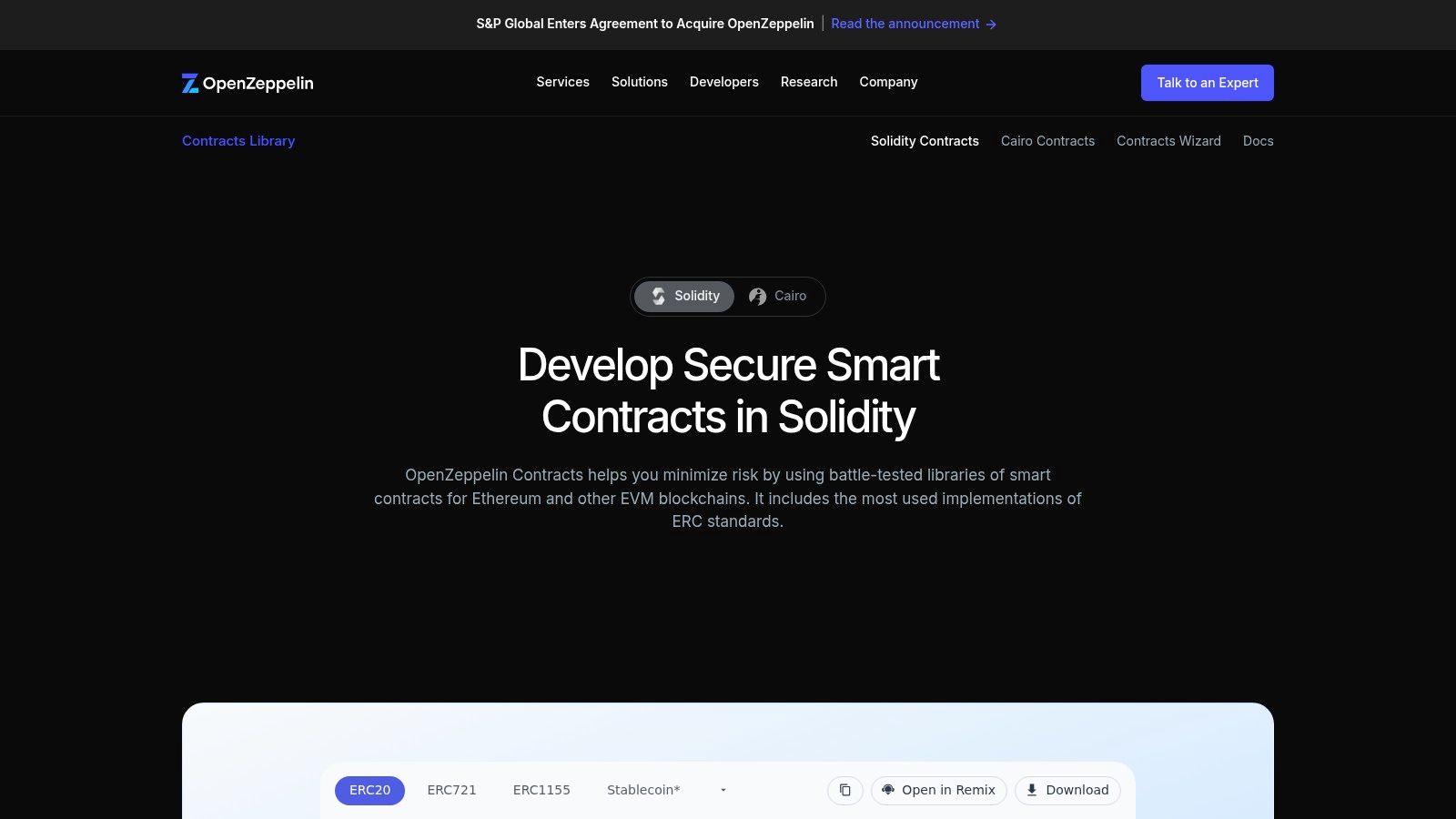
In an interview, a candidate who chooses a library implementation should be able to explain why it fits the use case, which version they selected, and how they tested their own extensions. “I used a standard token contract” isn't enough if the project adds custom transfer rules, privileged roles, or upgrade paths. Ask what assumptions the library doesn't cover for their application.
Practical rule: Reuse standard building blocks, then test the custom behavior that sits around them.
Upgradeable contracts deserve particular scrutiny. They introduce operational and security complexity, so candidates should explain who can authorize upgrades, how storage compatibility is checked, and what happens if an upgrade goes wrong. Core Contracts are free, but teams still need to plan for compatible versions and application-specific review.
For a deeper look at how common implementations work, use these smart contract examples as a starting point for interview discussion. OpenZeppelin is most relevant to junior developers learning established patterns and production engineers implementing tokens or access control. Hiring teams should reward understanding and careful adaptation, not the mere presence of a familiar import.
5. Slither
Slither is a Solidity static-analysis framework that fits naturally into command-line checks and CI. It can flag common code and security issues, expose structural information, and support custom detectors. The Slither repository describes its analysis workflow and makes it a practical option for teams that want routine checks before a manual review.
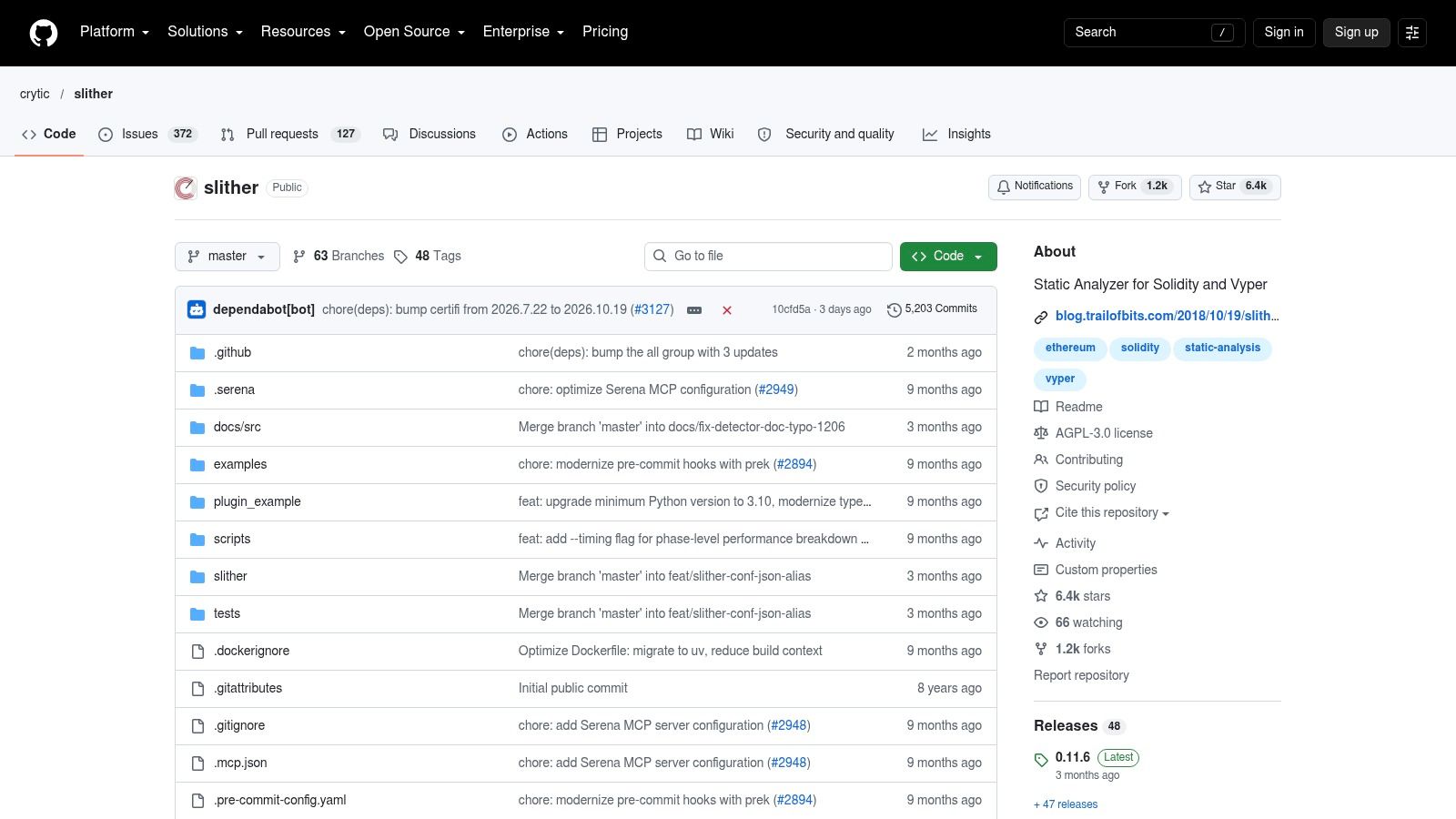
The interview signal comes from triage. A candidate who runs Slither and blindly copies every finding into a fix list hasn't demonstrated security judgment. Ask them to walk through a warning, identify the relevant code path, decide whether the issue is real in context, and explain how they'd verify the fix.
Static analysis can produce false positives, and it can't prove that a contract is secure. Treat the output as evidence to investigate, not a pass/fail badge. Teams should also make the tool part of a repeatable workflow, so developers see actionable results during ordinary changes rather than only when an audit is near.
- For security roles: Look for a candidate who can explain a finding and its exploitability.
- For DevOps roles: Look for reliable CI integration and useful failure reporting.
- For junior roles: Look for the ability to understand warnings and ask precise follow-up questions.
Slither is mainly focused on Solidity and EVM-oriented code, so it won't cover every chain or language a multi-chain team uses. Pair its output with human review, tests, and other analysis. Candidates comparing approaches can also consult this guide to a smart contract vulnerability scanner.
6. Alchemy
Alchemy provides managed RPC access, developer APIs, monitoring, and blockchain data services. Its endpoints let applications read from and submit transactions to supported networks without the team operating every node itself. APIs for token balances, NFT data, transactions, and wallet activity can also reduce the need to build supporting data infrastructure from scratch. Explore the Alchemy developer platform for its infrastructure and application tools.
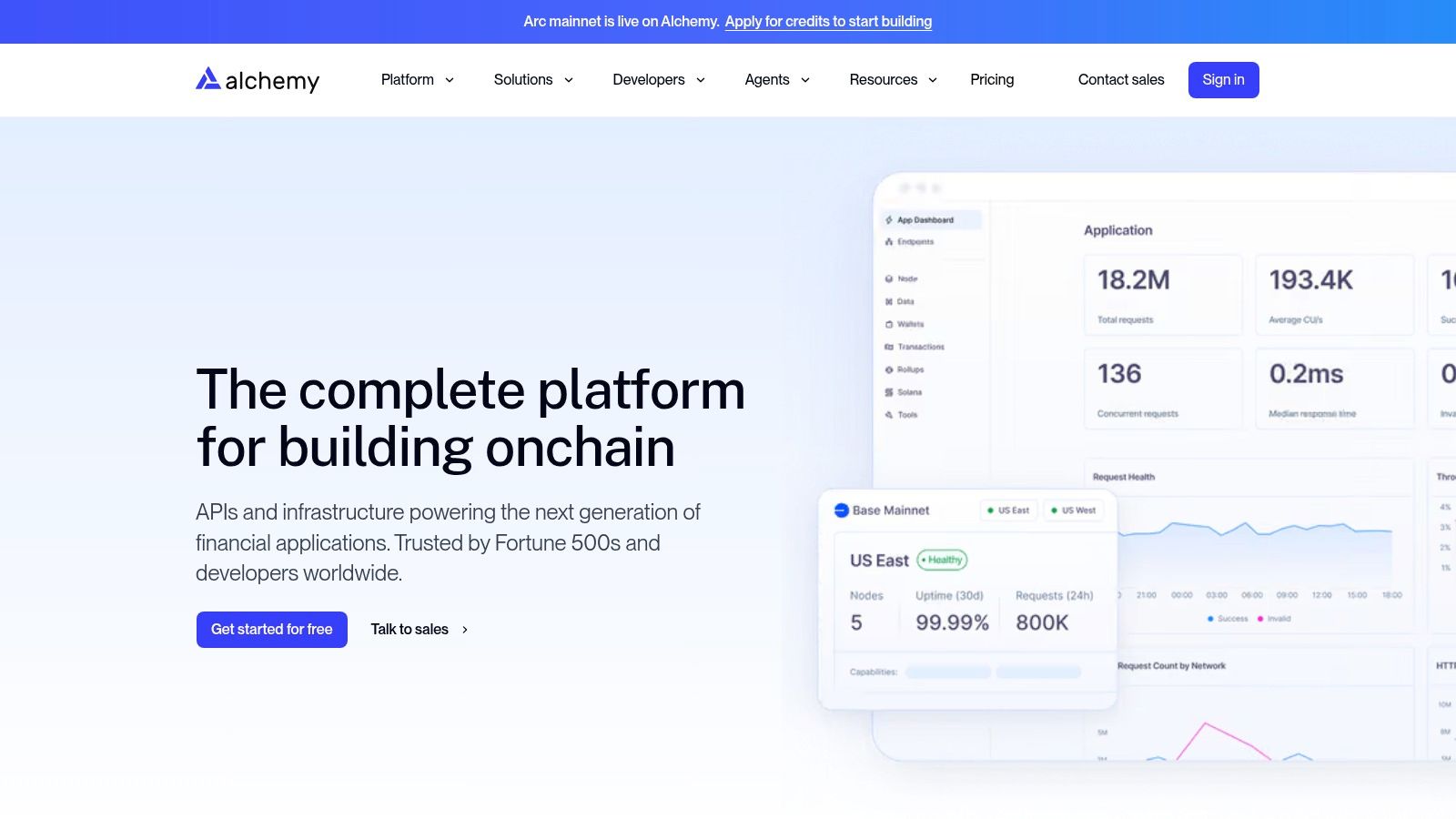
The hiring signal is how a candidate reasons about dependency and failure. A good answer doesn't stop at “the provider gives us an RPC URL.” It explains how the application detects errors, handles rate limits, protects credentials, and responds when the provider is unavailable. A candidate should be able to justify a managed provider for a given workload and explain whether a fallback is appropriate.
Managed infrastructure helps a team launch without taking on node operations, but convenience comes with usage-based costs and concentration risk. Teams should watch request patterns, understand which API features the application depends on, and avoid tying core business logic to one provider's response format without a reason.
Alchemy matters most for application engineers and DevOps candidates responsible for reliable chain access. Ask candidates to describe a failed transaction investigation: what they checked in the application, what they inspected in provider logs or dashboards, and how they distinguished an RPC issue from a contract revert. For a wider perspective on automated checks and review workflows, compare code quality tools.
7. Infura
Infura offers managed RPC access and APIs for reading from and submitting transactions to Ethereum and other supported networks. It's a straightforward route for teams that need application connectivity without running their own nodes, and its connection to the Consensys and MetaMask ecosystem can suit projects already using those tools. The Infura platform outlines its developer infrastructure.
An interviewer can use Infura to test whether a candidate understands the boundary between an application and its node provider. When a transaction doesn't appear as expected, the candidate should check the request, response, chain configuration, transaction hash, and contract behavior instead of treating every failure as a provider outage. They should also know when an application needs a backup endpoint.
Infura can be a familiar fit for Ethereum-oriented teams, but network coverage may not suit every multi-chain product. Usage limits and pricing depend on traffic and plan, so engineers need to understand how the application's access pattern affects the service. Don't accept “we can switch providers later” without asking what the code would need to change.
For junior application engineers, a clear explanation of RPC requests and transaction lifecycle is more valuable than name-dropping a provider. For DevOps candidates, look for monitoring, graceful failure behavior, and a credible fallback plan. Infura is infrastructure, not a substitute for understanding the chain your application interacts with.
8. QuickNode
QuickNode is a managed infrastructure option for teams connecting to several networks through one provider. It offers RPC endpoints, node and dedicated infrastructure options, APIs and add-ons, plus a dashboard for monitoring traffic and endpoint performance. Its developer platform is aimed at teams moving from development and staging toward production infrastructure.
A useful candidate exercise is to describe a multi-chain deployment pipeline. Ask how they separate network configuration across environments, check that a contract is deployed to the intended chain, and handle an endpoint that returns an error or stale response. The quality of the answer reveals whether the candidate has operated a real workflow or only copied an RPC URL into a local project.
Broad coverage and faster setup can help teams avoid running every node themselves. The trade-offs are provider dependence, costs that can rise with throughput, and differences in features or performance across networks. EVM compatibility makes it easier to reuse familiar contracts and tools, but it doesn't erase chain-specific behavior. A 2025 analysis of Electric Capital's developer data reported that roughly one in three crypto developers works across multiple chains, a practical reason to test portability rather than assume it.
QuickNode is most relevant to multi-chain application and DevOps roles. Strong candidates can describe how they test failover and monitor endpoint health, while protocol engineers should also be able to explain where chain-specific assumptions remain in their code.
9. The Graph
The Graph organizes blockchain events and contract data into queryable APIs, commonly through subgraphs. Applications can request structured historical data rather than repeatedly fetching and assembling raw events themselves. That can simplify dashboards, governance interfaces, analytics, and data-heavy DeFi applications. The The Graph developer platform provides documentation for building and querying subgraphs.
For a data or application interview, ask a candidate to explain their schema choices. What entities do they index? Which events update them? How do they handle a schema change or a gap between an on-chain event and its availability through a query? A good answer connects the API shape to what the application needs, instead of treating GraphQL as a substitute for data modeling.
Subgraphs need maintenance, and data may not appear immediately after every chain event. Complex applications may still require a custom indexer or complementary provider. Candidates should know which data can safely be read from an index and which actions need a direct on-chain check.
A strong indexing discussion covers both the query the frontend needs and the event-processing assumptions behind the result.
This tool is especially useful for backend, data, and Web3 product engineers who need to turn on-chain activity into application features. Hiring teams can use on-chain data analytics as a topic for discussing indexing choices, and candidates can explore Polymarket subgraph data to see how a real dataset can support analysis. The practical signal is whether they understand data freshness, schema design, and when an indexer is the wrong source of truth.
10. Tenderly
Tenderly helps developers debug, simulate, and monitor smart-contract activity. It can show execution traces, help reproduce failed transactions, simulate state changes before broadcasting, and support forked environments that reflect realistic chain state. The Tenderly platform complements a framework such as Foundry or Hardhat rather than replacing it.
The opening scenario is exactly where transaction debugging earns its place. A test passes, a forked run fails, and the engineer needs to inspect the call trace, state, and revert reason instead of guessing. In an interview, ask the candidate to explain what they'd inspect first, how they'd decide whether the failure comes from contract logic or external state, and what regression test they'd add afterward.
Tenderly can provide useful visibility during development and after deployment, but it doesn't replace formal tests, security review, or a full development framework. Advanced functionality may require a paid plan, so teams should decide which capabilities matter to their workflow before depending on them.
For protocol engineers, the signal is disciplined diagnosis: reproduce, isolate, understand, then test the fix. For DevOps and security candidates, look for an account of how monitoring and alerts turn an unexpected transaction into a useful incident response. A candidate who explains the debugging sequence clearly is showing a skill that transfers beyond any one platform.
How the 10 blockchain development tools differ by category, interface, cost model, and best use
| Item | Category | Interface | Cost Model | Best For |
|---|---|---|---|---|
| Foundry | Smart contract development toolkit | Command-line tools and Solidity workflows | Free and open source | Fast Solidity testing, fuzzing, and protocol development |
| Hardhat | Smart contract development environment | JavaScript and TypeScript tooling | Free and open source | Full-stack EVM teams and plugin-based workflows |
| Remix IDE | Solidity development IDE | Browser-based editor and deployment interface | Free browser IDE | Learning Solidity and quick prototyping |
| OpenZeppelin Contracts | Smart contract library | Solidity components and operational tooling | Core library is free | Reusing standard token, access control, and governance contracts |
| Slither | Smart contract static analyzer | Command-line and CI workflows | Free and open source | Finding Solidity issues during development and CI |
| Alchemy | Blockchain infrastructure provider | RPC endpoints, APIs, and dashboard | Usage-based; advanced features may require paid plans | Connecting applications to networks without self-hosting nodes |
| Infura | Blockchain infrastructure provider | RPC endpoints and APIs | Plan- and usage-dependent | Ethereum access, especially for teams using Consensys tools |
| QuickNode | Blockchain infrastructure provider | RPC endpoints, APIs, and dashboard | Pricing may rise with usage | Multi-chain applications needing managed node infrastructure |
| The Graph | Blockchain data indexing protocol | GraphQL APIs and subgraphs | Free to start; usage-based query fees | Querying structured historical blockchain data |
| Tenderly | Smart contract debugging and monitoring platform | Web-based debugging, simulation, and monitoring tools | Advanced features may require a paid plan | Debugging transactions and monitoring deployed contracts |
Each column answers a different hiring question. Category shows where a candidate spends their working hours, and the cost model reveals whether they can justify paying for a managed provider or a hosted platform when a free alternative exists. A junior candidate who defaults to paid infrastructure without a reason reads differently from a protocol engineer who picks Foundry for its fuzzing speed or a security candidate who wires Slither into CI before a reviewer asks.
Turn Your Tool Stack Into Interview Evidence
A hiring manager reads "Foundry, Hardhat, Slither" on a résumé and learns almost nothing. A small working project gives an interviewer something concrete to inspect and gives you a structured way to explain decisions. Build a simple contract application with one development framework, one static analyzer, and one RPC or data provider. Write tests that capture expected behavior, then document the failures you hit along the way.
Record what broke, how you reproduced it, what evidence isolated the cause, and what changed after the fix. If a transaction reverted, say whether the fault sat in contract logic, configuration, provider behavior, or an assumption about external state. If an analyzer raised a warning, show how you judged its relevance and how you validated the result. Interviewers use these artifacts to probe judgment: why you picked a managed RPC provider over a self-hosted node, how you handled a finding that turned out to be a false positive, what you did when a test passed locally but failed on a fork.
Adapt the project to the role you want:
- For a junior role: Use Remix to learn the contract flow, then move the code into Foundry or Hardhat. Show that you can explain basic contract behavior, run repeatable tests, and walk through the deployment path.
- For a protocol engineering role: Use Foundry to demonstrate Solidity-native tests, fuzzing, invariants, and fork-based debugging. Be ready to discuss your assumptions about external contracts and chain state.
- For a security-focused role: Add Slither to CI, triage its findings, and pair static analysis with meaningful tests. Explain what the tool can establish and where its analysis stops.
- For a DevOps role: Use a managed RPC provider such as Alchemy, Infura, or QuickNode and document how you monitor requests, handle errors, and plan for provider failure. Show how deployments differ across development, staging, and production.
- For a data or application role: Build a subgraph on The Graph or another indexing workflow and explain how your application handles data freshness and schema changes.
Tool choices also signal fit for the work a company needs done. Multi-chain teams value portable tests and careful handling of network differences. Ethereum application teams need strong contract-to-frontend integration. Security teams need people who can wire checks into CI and act on the results. Even widely used libraries change status: the Ethereum Foundation's Q1 2025 allocation update described a structured Web3.js sunset and migration-support plan, a reminder to assess maintenance and migration paths alongside features.
Match your project and interview stories to open roles, including listings on Blockchain Jobs, which are organized by category. A clear explanation of one project's trade-offs can show more engineering judgment than a long list of frameworks.
Blockchain Jobs connects candidates with opportunities across engineering, security, DevOps, product, data, and other Web3 fields, with category-tagged listings and remote-friendly roles. Use your project and toolchain evidence to focus your search, then visit Blockchain Jobs to find roles that fit your next career step or reach crypto-native employers.