What Is a Community Manager? Your 2026 Career Blueprint
A community manager is the person who builds and nurtures a brand’s online world. They are the strategic force responsible for creating a digital space where people connect, share, and feel a sense of belonging. For anyone building a career, this role is a powerful blend of digital diplomacy, growth strategy, and customer advocacy—skills that are highly sought after.
This isn't just a social media moderator role. A community manager is the architect of a digital ecosystem, and landing this job or hiring for it requires a deep understanding of its strategic value.
More Than Just a Social Media Moderator
Let's clear up a common misconception: a community manager doesn’t just post company updates and delete spam comments. From a career perspective, think of them as a strategic leader for a digital user base. Their job is to design and maintain an environment where conversations thrive, relationships form, and genuine brand loyalty is built from the ground up.
Mastering this role is a fantastic career move because it cultivates a mix of soft skills and technical know-how that companies are desperate for, making you a valuable asset in job interviews.

A Strategic Powerhouse for Business
For hiring managers, it's critical to understand that you're not just filling an entry-level spot. You’re hiring a strategic partner who will directly influence customer retention, product development, and brand perception.
For job seekers, the career outlook is bright. The U.S. Bureau of Labor Statistics projects that employment for related social and community service managers will grow 6% between 2024 and 2034. That translates to an average of 14,100 new job openings every single year.
This value is reflected in the paycheck. The average salary in the U.S. is around $68,770 plus bonuses, especially for candidates with demonstrable expertise in platforms like Discord and Telegram. You can explore the official BLS data to get a fuller picture of this career path's potential.
A great community manager doesn't just manage a community; they cultivate an asset. They transform a passive audience into an active, engaged network that provides invaluable feedback and drives organic growth. In an interview, explaining how you achieve this is key to landing the job.
To bring it all together, here’s a quick overview of what this dynamic role looks like today. Whether you're preparing for an interview or writing a job description, this table breaks down the essential pillars of the modern community manager.
Community Manager Role at a Glance
| Core Function | Primary Goal | Key Platforms (2026) |
|---|---|---|
| Engagement & Moderation | Foster a positive, active, and safe environment for all members. | Discord, Telegram, Reddit, Brand Forums |
| Content & Programming | Create and schedule events, discussions, and content to keep the community vibrant. | Twitter Spaces, Livestreams, AMAs, Contests |
| Advocacy & Feedback | Act as the voice of the community internally, funneling insights to product and marketing teams. | Common Room, Orbit, Canny, Jira |
| Growth & Outreach | Attract new members and build relationships with other communities and influencers. | Collabs, Social Media, Partner Events |
In short, this role sits at the intersection of people, product, and marketing, making it one of the most exciting and impactful positions for anyone looking to build a career in a forward-thinking organization.
A Day in the Life of a Community Manager
So, what does a community manager actually do all day? Forget the idea of just posting memes. The job is a constant balancing act between putting out immediate fires and strategically planting seeds for future growth. Understanding this daily rhythm is crucial for both hiring managers evaluating candidates and aspiring professionals preparing for the role.

Most mornings kick off in reactive mode. You're diving straight into the community hubs—scanning Discord, Telegram, and Reddit to get a pulse on the community's mood. Did last night's product update cause confusion? Is a company announcement being celebrated or criticized? Your first job is to be present: answering questions, steering conversations, and flagging urgent bugs.
This is where you build credibility. By showing up consistently, you prove to members their voices matter. It’s also why a common interview question is, "Tell me about a time you handled negative community feedback." Hiring managers want to see if you have the composure and strategy to handle pressure.
Shifting from Reactive to Proactive
Once the morning's urgent tasks are handled, the focus shifts. This is where you trade your firefighter hat for an architect's helmet. The afternoon is all about building—creating value and laying the groundwork for what's next.
This proactive work is what separates a good community manager from a great one. It’s how you tie community engagement directly to business goals and prove your strategic worth, which is essential for earning promotions and advancing your career.
The real impact of a community manager isn't just in what they say, but in the systems they build. It's about turning chaotic feedback into actionable reports and transforming casual members into dedicated advocates. This is the value you must demonstrate in interviews.
Here’s a look at what that proactive work often involves:
- Content & Event Planning: You’re building out a content calendar with weekly themes, discussion starters, and online events like AMAs (Ask Me Anything) with project founders. This demonstrates forward-thinking and organizational skills.
- Feedback Synthesis: This is a critical function. You gather user feedback and package it into a clear, structured report for the product team. In doing so, you become the official voice of the user, a highly valuable position.
- Identifying Leaders: You’re constantly on the lookout for super-engaged members. These are your future ambassadors—people you can empower to help onboard new users and champion the community, scaling your own impact.
- Analyzing Metrics: You live in the data. You track KPIs like engagement rates, member growth, and sentiment scores to prove the community's health and justify its ROI to leadership.
This strategic thinking defines senior roles, like a Senior Community Specialist position. The career path is strong, with jobs in this corner of digital marketing projected to see 6% growth through 2032. This demand is fueled by the explosion in digital ad spending and leads to solid salaries, as confirmed by Robert Half's research on in-demand marketing roles. For those in Web3, this work is even more significant, as it directly impacts the value of the ecosystem.
The Skills and Tools That Define Elite Performance
What separates a good community manager from a truly great one? It comes down to a unique mix of technical chops and genuine people skills. If you're looking to hire top talent or become a leader in the space, you need to know what this toolkit looks like. For job seekers, highlighting these skills with concrete examples is how you stand out.
The best community managers are like master architects. They need the blueprints and engineering knowledge (hard skills) to build the structure, but also the vision and understanding of human flow (soft skills) to make it a place people actually want to be.
The Essential Hard Skills and Tooling
Let's start with the hard skills—the concrete, measurable abilities you need on day one. These are the skills you list on a resume and will be asked to demonstrate in an interview. From a hiring manager's perspective, they’re non-negotiable.
To be a top candidate, you must master:
- Data Analysis: It’s not enough to just "feel" the community's vibe. You need to dig into data with tools like Common Room or Orbit to track engagement, measure community health, and prove your work is impacting the business's bottom line. This is how you justify your role and budget.
- Project Management: A thriving community runs on well-executed campaigns. Using tools like Asana, Trello, or Notion to organize everything shows you can drive a long-term strategy, not just put out daily fires.
- Technical Platform Management: You have to know your environment inside and out. This means expertly configuring complex platforms like Discord, setting up roles, managing permissions, and implementing bots to automate tasks and keep the community running smoothly.
This is where you connect the dots for a hiring manager. Don't just list the tools you know. Show the impact. For instance: "I used Common Room to identify our top 1% of contributors. We built an ambassador program around them, which led to a 30% increase in user-generated content and reduced my moderation time by 10 hours a week."
The Soft Skills That Differentiate Leaders
While hard skills get you the interview, soft skills land you the job and get you promoted. These are the instincts that are tough to teach but are absolutely essential for navigating the messy, wonderful world of human interaction.
These are the game-changers for career progression:
- Empathy and Diplomacy: This is your ability to truly hear your members and validate their concerns, especially when things go wrong. Imagine a product launch fails and users are angry. An empathetic manager de-escalates by calmly acknowledging the frustration and transparently explaining the team's response plan.
- Strategic Communication: This is knowing what to say, how to say it, and when to stay silent. This skill shows up when you’re crafting clear announcements, mediating arguments between members, or advocating for the community in strategy meetings with executives.
- Resilience and Crisis Management: Can you stay level-headed when the community is in an uproar? True leaders have a plan. In an interview, show that you can create and execute a communication strategy during a crisis without losing your cool. This is a top-tier skill.
At the end of the day, an elite community manager is a hybrid. They have the technical know-how to manage the platform and the emotional intelligence to lead the people. To climb the ladder in this field, focus on demonstrating both.
Web3 Community Management Versus Traditional Roles
While the heart of the job—building relationships—is the same, a Web3 community manager plays a completely different ballgame. A traditional role is like being a fan club president; a Web3 role is like being a co-founder and city planner. The goals, tools, and stakes are worlds apart.
If you’re hiring for this role or looking to break into the blockchain space, understanding these differences is non-negotiable for success.
Traditional vs Web3 Community Management
To really grasp the shift, let's put the two roles side-by-side from a career perspective. A community manager for a SaaS company focuses on supporting a finished product. They might run a LinkedIn group to answer user questions and reduce support tickets. The goal is loyalty to a product.
In Web3, the community is the product. A DeFi or DAO community manager isn't just fostering loyalty; they're cultivating collective ownership. This changes everything about the job.
Here’s a breakdown of how the roles stack up for a job seeker or hiring manager:
| Aspect | Traditional Community Manager | Web3 Community Manager |
|---|---|---|
| Primary Goal | Drive product adoption, reduce support costs, and increase customer retention. | Foster a sense of collective ownership, drive governance, and grow the ecosystem. |
| Key Platforms | LinkedIn, Facebook Groups, brand forums, Reddit. | Discord, Telegram, Twitter (X), and governance forums. |
| Core Focus | User satisfaction and brand loyalty. | Community empowerment, decentralization, and shared identity. |
| Value Creation | Enhances the value of a company’s product or service. | Directly contributes to the value of the network or protocol itself. |
| Success Metrics | Engagement rates, reduced churn, customer satisfaction scores (CSAT). | Governance participation, active wallet count, ecosystem health, treasury growth. |
As you can see, a Web3 manager is less of a brand advocate and more of a digital city-planner, building the infrastructure for a self-sustaining community. This is a more strategic, and often more lucrative, career path.
A New Breed of Responsibilities
This core difference in ownership introduces responsibilities you simply don’t find in a traditional tech job. For instance, a Web3 community manager does more than just relay feedback—they actively facilitate governance.
They’re on the ground floor, helping community members draft and debate proposals on platforms like Snapshot. Their job is to ensure the decentralized decision-making process is fair and transparent, requiring a unique mix of technical know-how and interpersonal finesse.
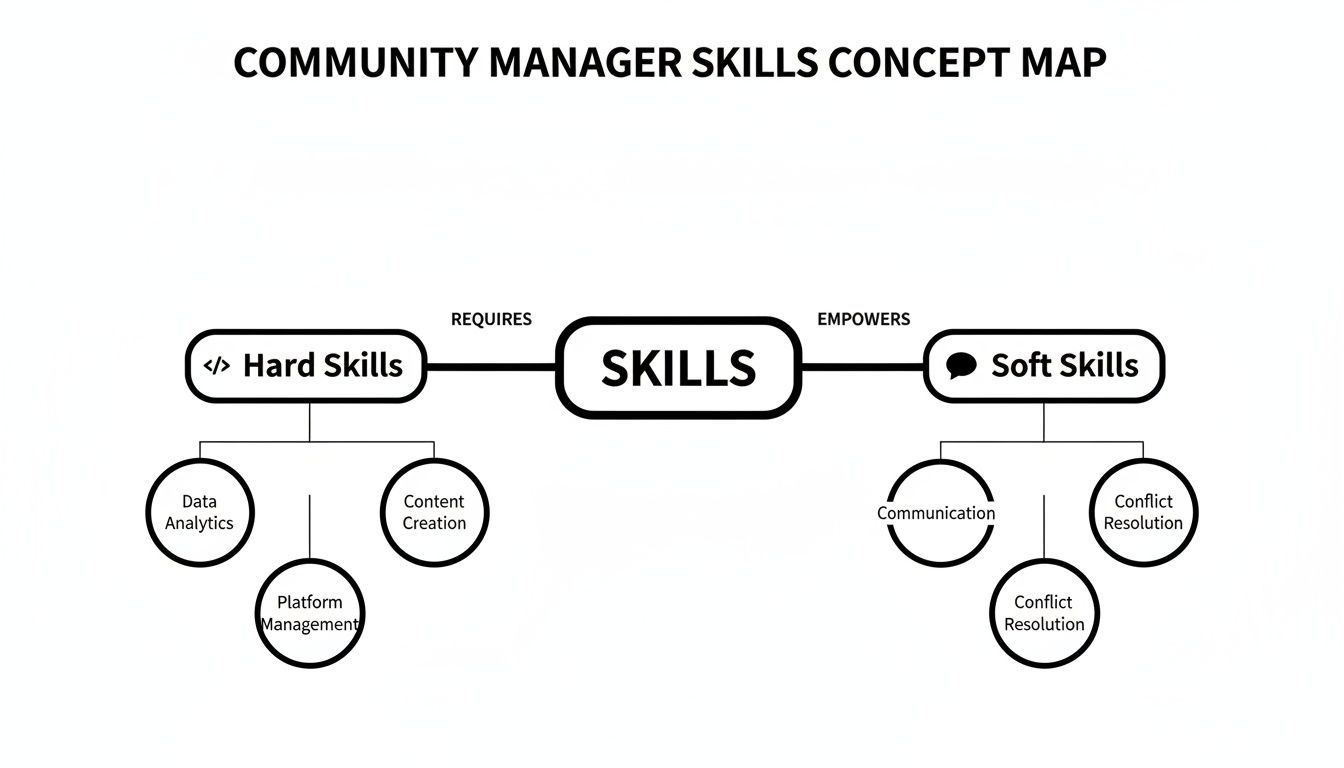
As the map shows, you need the hard skills to navigate the tech but the soft skills to lead the people. Demonstrating both is key to landing a top Web3 community role.
Higher Stakes and Unique Challenges
The challenges in Web3 are also far more intense because real money is on the line, instantly. A Web3 community manager must be a security hawk, relentlessly educating members on how to spot the sophisticated phishing attacks and scams designed to drain their wallets.
For anyone hiring, this is where you separate the talkers from the doers. In an interview, ask a candidate: "Walk me through the exact steps you would take to protect a brand-new community member from common scams in Discord." Their answer will reveal their real-world, battle-tested expertise.
Success in Web3 isn't just about likes and comments; it's about the health of a digital economy, the level of participation in governance, and the strength of a shared mission. Being able to articulate this is crucial for career advancement.
What's the Career and Salary Path for a Community Manager?
Community management is more than just a job—it’s a career springboard. It’s a role that can launch you into senior positions in marketing, product, and high-level strategy. Understanding this career arc is key for both ambitious professionals and the managers who hire them. It's a journey from hands-on work in the trenches to setting the vision from the top.
Most people start as a Junior Community Manager or Community Moderator. This is where you prove your fundamentals. You'll spend your days engaging with members, answering questions, and keeping the community safe. Your main objective here is to master genuine conversation and earn the trust of your members, building a strong foundation for your career.
Moving Up to Senior and Lead Roles
Once you’ve proven you can handle the day-to-day pulse of the community, the natural next step is a Senior Community Manager or Community Lead role. This is where your job becomes more strategic. You’re no longer just moderating chats; you’re owning entire initiatives, like planning a quarterly content calendar, organizing online events, or building reports that show other teams what the community is really thinking.
This is your chance to show how community drives the business forward. For example, instead of just saying "engagement went up," a senior manager will show how their AMA with the product team led to a 15% drop in support tickets about a confusing new feature.
The secret to getting that promotion is tying your work directly to business goals. Document everything. Show how your quick thinking during a crisis saved key members from churning, or how your ambassador program generated a goldmine of content for the marketing team.
Reaching the Top: Leadership and Beyond
From a senior position, the path splits toward leadership roles like Head of Community, Director of Community, or even Director of Ecosystem Growth in the Web3 space. At this level, you’ve graduated from daily execution. You are now the architect of the entire community vision.
Your focus completely shifts to high-level strategy and leadership:
- Defining the Roadmap: You'll create the entire community strategy, ensuring it aligns with company goals like entering new markets or driving product innovation.
- Building Your Team: You will hire, train, and mentor the next generation of community managers, scaling your impact.
- Owning the Budget: You'll manage the community's finances, making critical decisions on which tools, platforms, and programs get funded.
- A Seat at the Table: You become the official voice of the community in executive meetings, using member insights to influence everything from product features to corporate strategy.
Looking ahead, the financial rewards are significant. Based on current data, salaries for these roles in 2026 are projected to range from $65,000 for entry-level positions to well over $150,000 for director-level roles, especially in hot sectors like blockchain. When it's time to negotiate, come prepared with a portfolio that proves exactly how much value you've delivered to the bottom line.
How to Hire Your Next Great Community Manager
Hiring the right community manager isn't about ticking boxes on a resume. You're looking for a strategic partner who will build and nurture the soul of your brand online. Your hiring process must dig deeper to find someone with genuine vision and the grit to handle real-world challenges.
First, your job description must attract top talent. Frame the role around its impact. Instead of just listing tasks like "moderate Discord," use language like "drive user retention through community programs" or "own the feedback loop that shapes our product roadmap." This signals you're hiring a leader, not just a moderator.
Going Beyond the Standard Interview
Once you have a shortlist, generic interview questions won't work. You must use situational questions that reveal how a candidate thinks under pressure.
The goal is to see their thought process in action. A great community manager connects everything they do back to real business goals. Their answers should reflect this.
Try asking questions designed to reveal that strategic mindset:
- "Tell me about a time you managed a major community crisis. What was your plan, what was the outcome, and what would you do differently next time?"
- "If you started tomorrow, what are the first three metrics you would track to prove the value of our community in your first 90 days? Why those metrics?"
- "Describe how you've used community feedback to change a product. Walk me through the process from collecting the feedback to getting team buy-in and measuring the impact."
Evaluating a Candidate's Portfolio
A portfolio is where you see proof of capability. Don't just look for pretty content; look for the strategy behind it. The best portfolios will showcase data-driven growth plans, examples of initiatives that started from a community idea, and reports that clearly synthesize user feedback for other teams.
They should be able to explain the "why" behind every project, linking their work directly to measurable outcomes like user retention, lead generation, or product improvement. If you're hiring in Web3, finding someone with relevant experience is crucial. It’s worth looking at job posts like this Community Manager role to see what leading projects prioritize.
Ultimately, you're not just filling a role. You're searching for a leader who can build a powerful asset for your brand, measure its success, and help it grow.
How to Land Your First Community Manager Job
So, you want to turn your passion for building communities into a full-time career? The good news is that you don't need a decade of experience to get your foot in the door. What you do need is a smart plan to show, not just tell, what you can do.
Hiring managers are looking for proof of your skills. Your first move is to build a portfolio that showcases your abilities, even if you’ve never held the official title.
Build Experience Before You Get the Job
The best way to impress a hiring manager is to show up with results already in hand. You can start creating value for communities right now, and this hands-on experience is infinitely more compelling than a polished resume.
- Volunteer Strategically: Find a project you believe in and offer to help moderate their Discord or Telegram. This isn't just about answering questions; it's about learning to handle real-time community dynamics and identifying opportunities for improvement.
- Create a Sample Strategy: Pick a brand you admire and draft a complete community strategy for them. Map out a three-month content calendar, brainstorm engagement campaigns, and define the KPIs you'd use to track success. This shows you can think strategically, a key skill for interviews.
- Start Your Own Community: This is the ultimate proof of initiative. Create a Discord server or subreddit for something you're passionate about. Growing a community from zero is the single best way to demonstrate your skills in moderation, content creation, and growth.
Imagine being in an interview and saying, "I grew my personal Discord for retro gaming fans from 0 to 500 members in three months by running weekly tournaments and establishing a moderator program." That statement is more powerful than any bullet point on a resume. It proves initiative and delivers concrete results.
Tailor Your Application and Network
Once you have tangible projects, it's time to apply. Don't just send a generic resume. Frame your past experiences through a community lens. Did you work in customer service? Highlight your experience in empathy and de-escalation. Did you organize local meetups? That’s event management and logistics skills.
Networking is just as important. Become an active, helpful member of the communities you want to work for. Answer questions, offer thoughtful feedback, and build real relationships. When a position opens up, you'll be a familiar, trusted contributor, not a random applicant.
For anyone aiming for Web3, it’s critical to understand the unique demands of roles like a Community Manager in the crypto industry. The responsibilities often go far beyond typical social media management. By taking these steps, you can confidently prove your value and land that first fantastic community manager role.
Ready to find your place in the future of the internet? Blockchain Jobs is the premier job board for finding roles in Web3, crypto, and blockchain technology. Start your search today.