
Is Web3 the Future of Work and the Internet

Crypto development is becoming a multichain profession, not a collection of isolated blockchain communities. That matters more to a career decision than the latest token rally: builders can move between ecosystems, but employers still need people who can turn infrastructure into products customers use.
Is Web3 the future? My assessment is that its most credible future isn't wholesale replacement of the internet. It's regulated, embedded infrastructure inside financial products, identity services, and applications whose users may never need to understand the underlying blockchain. For candidates and hiring managers, the useful question is which skills make that version work, and which jobs depend on speculation continuing.
Why This Question Matters Right Now
Electric Capital's 2024 Developer Report analyzed 902 million code commits across 1.7 million repositories, found 39% average annual developer growth since Ethereum launched in 2015, and recorded 39,148 people exploring crypto development during 2024; it also identified 23,613 monthly active developers, with approximately one in three working across chains, versus fewer than 10% in 2015, while Solana attracted 7,625 new developers, compared with Ethereum's 6,244, representing 83% year-over-year growth for Solana, and Ethereum retained the lead in total developer activity on every continent (Electric Capital's developer analysis).
That's evidence of a substantial technical community. It isn't evidence that every protocol has a sustainable business, that every developer is employed, or that every vacancy will survive a difficult funding environment.
The infographic frames the ecosystem visually; the developer evidence above is the basis for the career conclusions here.

Separate ecosystem strength from employer strength
The multichain shift changes how I'd evaluate talent. A candidate who understands transaction execution, security assumptions, and settlement can explain how their knowledge transfers. A candidate whose entire identity rests on enthusiasm for a particular chain has a narrower case.
Likewise, Solana's new-developer momentum doesn't establish that it offers better employment prospects for every specialty. Ethereum's broader activity doesn't guarantee that an individual employer has customers or a disciplined hiring plan.
Career filter: Treat developer participation as evidence that a field deserves investigation, not as permission to skip employer due diligence.
Before accepting a role, ask:
- What pays for the product? Distinguish customer demand from a roadmap financed by token appreciation.
- What will I own? Look for responsibility for a system, customer outcome, or operational process.
- What remains transferable? Prefer work that develops security judgment, infrastructure competence, product reasoning, or institutional expertise.
For hiring managers, the implication is equally practical. Recruit against the system you need to operate, not the ecosystem you want associated with your company. A durable builder community makes hiring possible. It doesn't make a weak job definition useful.
What Web3 Actually Is and Why the Layers Matter
A useful working definition of Web3 is software that combines user-facing applications with blockchain-based execution and verifiable settlement. Think of it as a stack of independent verification, not a single blockchain expected to do everything.
The architectural distinction is easier to see as separate layers.

For a familiar starting point, compare Web1 and Web2 before adding the blockchain components. In an interview, the objective isn't to declare that earlier internet models are obsolete. It's to explain which responsibilities your proposed architecture moves, retains, or makes independently verifiable.
Map the architecture to the work
At the application layer, designers and product managers decide what users need to accomplish. Wallet interactions, transaction status, error handling, and understandable permissions belong in that conversation.
The execution layer processes application logic. Smart-contract developers and protocol engineers need to explain what happens when code behaves unexpectedly, not just demonstrate a successful transaction.
Below that, data availability and settlement concern the evidence needed to verify activity and establish its accepted outcome. Infrastructure engineers, DevOps specialists, and security researchers should be able to identify the dependencies between those functions.
| Architectural concern | Interview question | Relevant job families |
|---|---|---|
| Application experience | Can users understand what they're approving? | Product, design, customer support |
| Execution | How is application behavior tested? | Smart-contract engineering, security |
| Infrastructure | How do operators detect and recover from failures? | DevOps, infrastructure, data |
| Settlement | When should the product treat an action as final? | Protocol engineering, risk, product |
For a financial application, Yield Seeker's stablecoin yield explained offers an adjacent topic to examine through this architecture. Use the exercise to separate the product's financial proposition from the software and operational assumptions supporting it.
A video can complement that whiteboard exercise.
The strongest interview answer connects layers through a user journey. Explain who submits an action, who processes it, what evidence supports it, and how the application communicates completion. Then identify which team owns each failure mode.
The Blockchain Trilemma and What It Means for Real Products
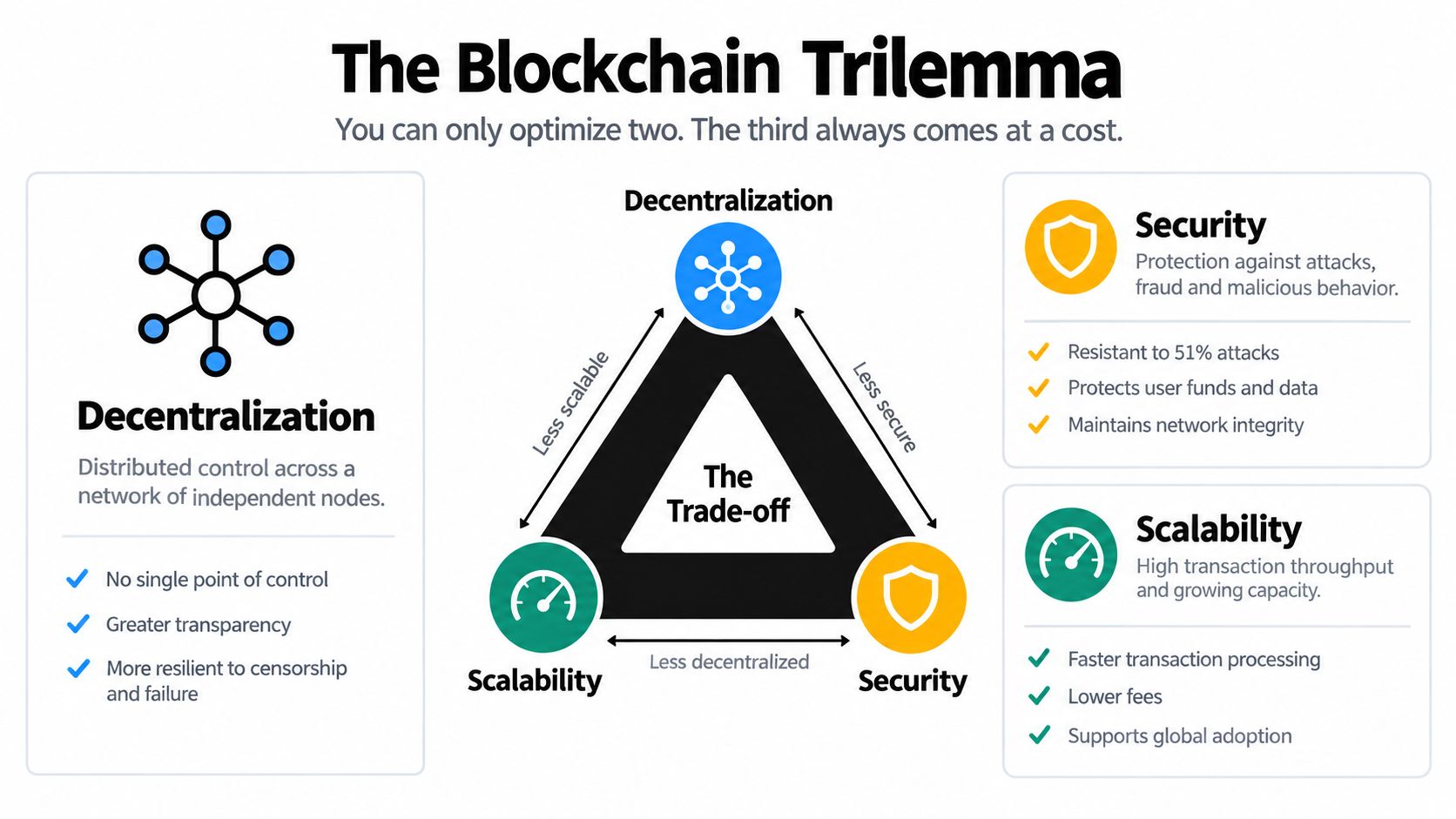
More independent validators can improve resistance to manipulation while increasing communication and verification overhead. That's the structural trade-off among decentralization, security, and scalability described by the Bank for International Settlements, which also explains how scarce block space and congestion can raise fees and exclude price-sensitive users.
For a product team, this isn't an abstract philosophical disagreement. It's a constraint on who can afford to use the service and what reliability the team can promise.
Compare designs by what users must trust
Rollups, batching, application-specific chains, and data-availability systems are engineering responses to these constraints. They shouldn't be assessed as interchangeable scalability labels. Each design requires a team to explain where execution happens, what evidence remains available, and which operators users depend on.
| Evaluation lens | Incomplete answer | More useful answer |
|---|---|---|
| Performance | Maximum advertised throughput | Successful completion under realistic load |
| Economics | Typical transaction fee | Total cost of completing the intended action |
| Trust | A decentralized branding claim | Named operators, permissions, and verification paths |
| Reliability | Normal-operation demo | Recovery behavior when dependencies fail |
Candidates preparing for infrastructure or protocol interviews should rehearse these comparisons. For consensus-related roles, understanding what staking means in cryptocurrency provides useful context, but terminology alone won't demonstrate architectural judgment.
The more revealing exercise is to defend a compromise. If your design depends on a restricted operator set, explain why, what powers those operators hold, and how users can verify or challenge their behavior.
Benchmark cost per successful user action, not just transactions per second.
That benchmark should include retries, failed attempts, and the path to usable settlement. A technically cheap operation can still be a poor product experience if the user needs repeated attempts or can't tell whether it succeeded.
For employers, I'd make this reasoning part of the interview rather than asking candidates to rank chains. Ask a product manager to define acceptable latency and finality. Ask an engineer to identify bridge risk and validator concentration. Ask both how they'd detect whether a scaling decision preserved independent verification or merely relocated trust.
A Concrete Proof Point in Protocol Engineering
Ethereum's Dencun upgrade provides a concrete example of infrastructure work with product consequences. EIP-4844 introduced temporary blob data and a separate blob-fee market, allowing rollups to publish compressed transaction data without competing directly with ordinary transactions for permanent calldata space; the reported analysis describes blobs remaining available for roughly 18 days before pruning and finds that introducing three target blobs reduced an L2 leader fee from $0.2107 to $0.0095, a 95.5% reduction (analysis of EIP-4844 and rollup fees).
The engineering change is worth examining visually before translating it into hiring requirements.

The important distinction is between making data available for verification and requiring every piece of transaction data to occupy permanent storage. The upgrade changed that cost structure. The reported fee measurement is a specific result, however, not a promise that every application or user receives the same reduction.
Translate the engineering win into operational questions
For a payments or trading product, lower data-publication costs can make smaller actions more economically plausible. But a product manager still needs to account for the complete user journey rather than treating a protocol-level improvement as the final customer price.
Temporary availability also makes archival and recovery planning important. Rollups still require scrutiny of sequencer and bridge assumptions, and cheaper activity doesn't eliminate the possibility of renewed congestion.
I'd ask a prospective employer to show how the team monitors:
- Sequencer availability. Who responds when transaction ordering or submission stops behaving normally?
- Proof latency. How does the team distinguish an accepted submission from the settlement state the product requires?
- Data recovery. What records must remain recoverable, and who tests the recovery process?
- Peak-load costs. What happens to the product's economics when demand increases?
These questions create useful portfolio opportunities. An infrastructure candidate could build monitoring around a rollup's dependencies. A product candidate could document transaction states and their implications for customer messaging. A security candidate could model what happens when an operator or recovery service fails.
The career lesson isn't to learn a named upgrade. It's to demonstrate that you can trace a protocol change through operating costs, failure handling, and product requirements. That's a stronger contribution than repeating a fee-reduction headline.
Adoption Is Not a Binary Choice
A 2025 survey of more than 1,500 industry professionals, retail participants, and first-time users found that 75.4% didn't currently use Web3 wallets, yet 87% felt confident or were open to regulated Web3 services, and 87.1% would use or consider such services through a bank; 59.5% viewed protocol-level compliance and transferable KYC credentials positively, with another 35.4% tentatively positive (survey coverage on trust and Web3 adoption).
These findings challenge the assumption that people must reject established institutions before they'll accept blockchain-based products. They describe attitudes within a surveyed group, not proven purchasing behavior or a representative forecast for everyone.
The more plausible middle path
My interpretation is that embedded Web3 deserves more attention than replacement Web3. Users may accept blockchain infrastructure through an institution they already understand while declining to manage a standalone wallet themselves.
That doesn't prove banks will become the dominant distribution channel. It does make institutional integration a serious career thesis rather than a compromise candidates should dismiss.
Web3 adoption may depend less on persuading users to abandon trust than on giving them better ways to evaluate whom they're trusting.
For hiring, that changes the candidate profile. Protocol expertise remains relevant, but employers pursuing institutional products should also assess whether people can work across technical, legal, operational, and customer boundaries.
Consider the interview differences:
- Compliance and legal candidates should explain how they'd turn a policy requirement into reviewable product requirements, including exceptions and escalation.
- Identity specialists should be ready to discuss credential portability alongside privacy, access, and recovery.
- Institutional product managers should demonstrate how they'd coordinate approval, onboarding, support, and risk ownership.
- Engineers should explain where a compliance control operates and what happens when it blocks an otherwise valid action.
A useful portfolio exercise is an architecture decision record for a compliant application. Describe which elements remain independently verifiable, which depend on an institution, and why each dependency exists. Don't claim a design is legally compliant without appropriate review.
The harder conclusion is that decentralization isn't a sufficient hiring specification. Employers need people who can explain where decentralization provides meaningful value and where accountable institutions remain necessary. Candidates who can defend those boundaries have a clearer professional proposition than candidates who treat every institutional dependency as failure.
Why Retention and Friction Matter More Than User Counts
A 2025 study involving 1,005 Web3 users and 660 founders and business executives found that 37.08% of users cited financial incentives as their primary motivation, while identifying wallet creation, private-key management, and unpredictable transaction fees as persistent onboarding friction (research into crypto consumer utility).
Financial incentives aren't automatically evidence of a bad product. The problem is analytical: rewarded participation doesn't establish that customers would return without the reward. A hiring plan built on that assumption can confuse acquisition activity with durable demand.
Distinguish participation from recurring utility
I'd evaluate a prospective employer through the behavior it wants users to repeat. Completing a payment, managing a business workflow, or recovering access creates a different product question from collecting a reward for opening an account.
| Signal | What it establishes | What remains unanswered |
|---|---|---|
| Incentivized sign-up | The offer attracted participation | Would the user join without the reward? |
| Transaction activity | An action occurred | Did it solve a recurring problem? |
| Repeat task completion | Someone returned to do useful work | Is the experience preferable to alternatives? |
| Successful recovery | A user regained access | Is recovery safe and understandable? |
The distinction matters for career progression. I'd favor roles that let a candidate demonstrate reduced confusion, safer actions, or better task completion over roles measured only by reward-driven participation.
That includes UX research, account abstraction, wallet recovery, security, analytics, and product management. None is automatically secure employment. The advantage is that candidates can connect their work to a specific user problem and show how they evaluated the outcome.
Apply the filter to a job posting
Before applying, underline the verbs in the responsibilities. Does the company want someone to investigate abandonment, improve recovery, test permissions, or understand repeat behavior? Or does every responsibility lead back to increasing activity without examining its quality?
Ask the interviewer what they measure after incentives end. If they don't know, follow up by asking whether the role has permission and access to investigate.
For marketing and community candidates, this isn't an argument to abandon the field. It's a reason to build stronger evidence: customer education that helps users complete a task, feedback that changes a product decision, or research that distinguishes temporary interest from repeat demand.
How to Prepare for a Web3 Job Interview Today
A 2025 employer survey found 86.21% of respondents hiring or seeking entry-level talent in operations and business development, compared with 51.72% for technical roles and 48.28% for research, and ranked quick learning and self-direction above basic Web3 knowledge and English proficiency (Web3 employer survey findings). These are respondent shares, not a breakdown of all vacancies.
Separately, an analysis of more than 80,000 postings from over 15,900 companies reported that descriptions requiring AI workflows increased from 2% in 2021 to 14% in 2025 (Web3 hiring intelligence report). Prepare a verified workflow example, not an unsupported claim that you're proficient with AI.
Web3 Interview Preparation by Role
The technical topics below align with role-specific reporting on blockchain skills.
| Role | Core Languages | Must-Rehearse Topics | Portfolio Signal |
|---|---|---|---|
| Smart-contract developer | Solidity | Reentrancy, testing, gas optimization, upgradeability | Contract with tests and documented trade-offs |
| Protocol developer | Rust or Go | Memory safety where applicable, performance, consensus | Implementation with benchmarks and failure analysis |
| Security researcher | Target codebase language | Threat modeling, auditing, fuzz testing | Reproducible finding and regression test |
| Operations or business development | Not necessarily coding-based | Execution, ambiguity, partner evaluation | Project showing decisions and outcomes |
| Research or product | Role-dependent | Evidence quality, requirements, measurement | Decision memo with explicit limitations |
Prepare an example of learning independently, an example of resolving uncertainty, and an example of changing course after evidence contradicted your assumptions. State your own contribution precisely.
For AI-assisted work, demonstrate test generation, documentation, analysis, or review with human verification. Explain what information you withheld, how you checked outputs, and which decisions remained yours. You don't need to name a tool to demonstrate a controlled process.
Use ParakeetAI's mock interview practice to rehearse concise explanations and follow-up questions. Pair that rehearsal with a practical guide to getting a Web3 job, then tailor your evidence to the actual responsibilities rather than memorizing generic blockchain answers.
What a Future-Proof Web3 Career Actually Looks Like
No Web3 career is future-proof in the literal sense. A more defensible goal is to become useful under different adoption scenarios: specialist infrastructure, institutionally distributed products, or applications that succeed without asking customers to become crypto enthusiasts.
My conclusion is conditional. Web3 has a credible future where independent verification improves a real process and teams can manage the operational and human costs. The evidence doesn't justify assuming it will replace the existing internet wholesale.
Build a specialty employers can examine, supported by adjacent knowledge that helps you make better decisions.
Choose a stack, ship something that addresses a recurring problem, and document its limitations. If you're not an engineer, produce an equally concrete artifact: an operational runbook, product study, risk assessment, or research memo.
Then practice explaining what you decided, what you verified, and what you'd change. The central career question isn't whether you believe in Web3. It's whether you can make a particular implementation worth using.
Blockchain Jobs connects candidates with Web3 opportunities across engineering, product, operations, security, legal, and compliance, and gives employers a dedicated place to post roles. Visit to compare responsibilities against your strongest evidence, shortlist positions solving problems you understand, and prepare a relevant project discussion before applying.