What Is a Security Audit? Types, Steps and Career Skills
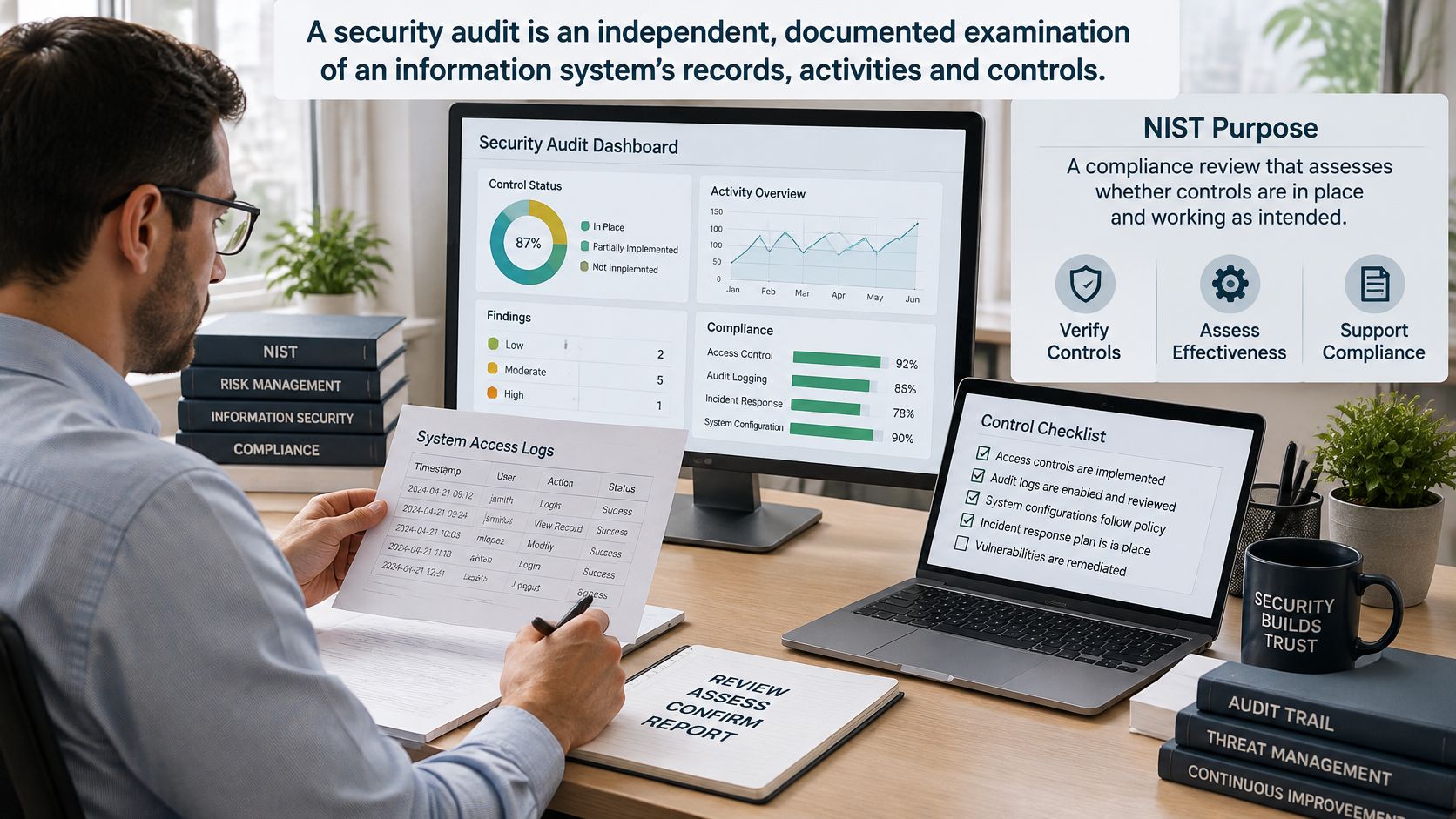
A security audit is an independent, documented examination of whether security controls are implemented and operating as intended. A 2024 Grant Thornton internal audit survey found that 91% of surveyed organizations reported sufficient cybersecurity risk coverage in their internal audit plans. That belief still needs support from records, not a logo.
A protocol engineer has a launch date, a compliance lead is answering a customer questionnaire, and a job seeker sees “audit experience” in a posting. Each faces a different question: what evidence shows controls are working, and what remains unknown? An audit is one assurance layer alongside scans, tests, monitoring, and daily operations. It cannot replace them or stand in for your judgment in a hiring conversation. Knowing which question each layer answers, and how to collect and explain evidence, is useful both for security work and career progression.
What a Security Audit Is and How It Differs From a Scan
The NIST glossary treats a security audit as an independent, documented examination of an information system's records, activities, and controls. The point is to judge whether controls are adequate, check compliance with security policies and operating procedures, identify breaches in security services, and recommend corrective changes.
A vulnerability scan is like checking a smoke alarm's battery today. An audit is the building inspector reading the wiring plans, the electrician's logs, and the fire-drill records. A scan asks if a known weakness is present right now. A penetration test asks whether someone can walk a defined path. An audit asks whether safeguards are designed, implemented, and operating as intended.
ThreatExploit AI's guide to testing differences is worth reading before you brief a manager, because scanner output and an exploit story answer different questions.
| Assessment | Question it answers | Scope | Typical output |
|---|---|---|---|
| Vulnerability scan | Is a known weakness present right now? | Hosts, software versions and configurations | List of detected issues with severity ratings |
| Penetration test | Can an attacker exploit a specific path? | Defined targets and attack scenarios | Exploit narrative and proof of concept |
| Security audit | Are safeguards designed, implemented and operating as intended? | Controls, processes, records and systems in scope | Documented findings tied to controls, with corrective actions |
Evidence usually includes access-control records, configuration standards, incident-response procedures, risk registers, logs, backup practices, vendor reviews, and interviews with control owners. Those controls protect confidentiality, integrity, and availability.
If the question is whether a known weakness exists in contract code right now, start with a smart contract vulnerability scanner. If the question is whether safeguards hold up over time, you need an audit.
Types of Security Audits and When Each One Applies
Pick the audit from the event that creates the risk, not from a vendor menu. Each type below answers a different question and produces different evidence a customer, investor, or hiring manager can inspect.
| Audit type | Core question | Typical evidence | Usual trigger |
|---|---|---|---|
| Smart-contract code audit | Does the code behave safely under attack? | Source code, tests and deployed bytecode | Before launch or a major upgrade |
| Infrastructure and key-management audit | Are keys, cloud access and monitoring controlled? | Access logs, key-custody procedures and IAM configuration | Custody launch or new signers |
| SOC 2 compliance audit | Are controls designed and operating across a review period? | Policies, dated access reviews and change tickets | Customer or investor requirement |
| Internal security audit | Does the security program meet governance expectations? | Risk register, control test results and board reporting | Annual audit plan |
| Protocol governance audit | Can privileged actions be abused? | Multisig settings, role changes and timelock configuration | Before enabling admin powers or upgrades |
A smart-contract code audit reads source, tests, and the bytecode you deploy, before users send funds. An infrastructure and key-management audit looks at custody, cloud identity, privileged keys, and monitoring. A SOC 2 examination uses the AICPA Trust Services Criteria of security, availability, processing integrity, confidentiality, and privacy, as the AICPA description of the criteria sets out. A Type 1 report asks whether controls are suitably designed as of a date. A Type 2 report also asks whether they operated through a review period, which is why dated samples matter more than a policy PDF.
Internal audits test the program against governance expectations. Protocol governance audits ask who can change parameters, upgrade contracts, or move treasury funds. If you're comparing attack-style testing with control testing, blockchain penetration testing shows where a test stops and an audit starts. Teams choosing a control set can use Vigil Security's notes on choosing the right security compliance framework before they lock scope.
Practical rule: Start from the event that creates risk, then ask which evidence would convince a customer or a hiring manager. Many teams need two types, such as a code review before launch and an operations review after.
Cost and Timeline Drivers for a Security Audit
Price and calendar follow scope. Write the scope before you request quotes, or you'll compare unlike proposals.
- Code size. Count contracts, lines, and external libraries the reviewer must read.
- Complexity. Lending logic, bridges, oracle use, and cross-contract calls add hours.
- Privileged surface. Every admin role, multisig signer, upgrade path, and timelock needs a look.
- Deployment verification. Matching deployed bytecode to reviewed source is separate work and needs its own slot.
- Remediation and retest. Each fix can trigger another pass, and a redeploy stretches the calendar.
- Compliance reporting. A design check at one date is shorter than a review period that needs dated evidence for the whole window. That period sets the timeline by itself.
Published prices swing with firm and scope, so ask for a quote tied to a written scope, the tested commit, a retest allowance, and a delivery date. Build the schedule backward from launch. An audit that finishes after deployment can't protect that release. In an interview, walking through these drivers shows you can plan assurance work, not only perform it.
How a Security Audit Runs From Scope to Retest
NIST SP 800-53A describes four core activities: prepare, plan, conduct, and analyze. The seven steps below are how that lifecycle looks on a protocol team, and why each one exists.
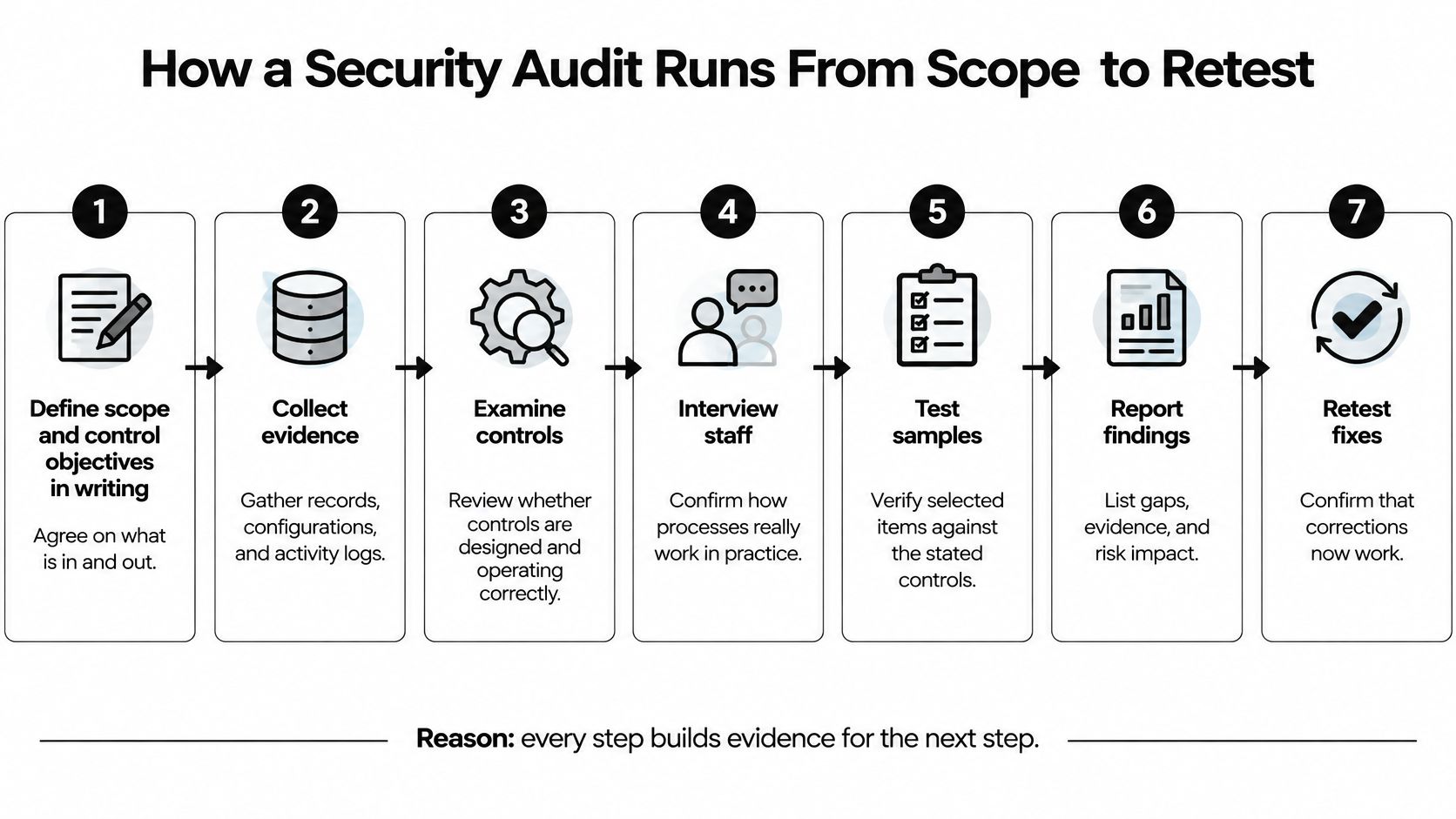
- Write scope and control objectives. Agree what is in and what is out so nobody treats an exclusion as a surprise finding.
- Collect artifacts and trace them. Gather configuration records, access logs, and test results, then tie each item to the control it supports. A policy with no sample is a gap.
- Examine, interview, and test. Read the documents, talk to control owners, and compare actual behavior with the expected result.
- Record each finding. Capture severity, exploit preconditions, affected functions or components, and the evidence.
- Name owners and deadlines. An open item without a person and a date stays open.
- Retest before you close. Confirm the fix on the commit you claim is fixed.
- Issue the report. Include scope, exclusions, the tested commit, and anything still unresolved.
NIST SP 800-53 Rev. 5 recommends sending audit logs to a separate system or medium. If an attacker compromises the environment under review, they shouldn't be able to rewrite the trail you need later.
The short walkthrough below shows how a team talks through scope before the first evidence request.
A finished file has traceable evidence, closed findings with retest notes, and a dated sign-off. That's the packet you hand a customer, and the story you can tell in a job interview without inventing a clean result.
Common Findings and How Auditors Catch Them
No single method finds every issue. Research on Ethereum security describes static analysis, dynamic analysis, machine learning, graph-based techniques, and formal verification, and it stresses that correct code still isn't a secure system. Economic design and operations can fail too.
Static analysis flags patterns such as reentrancy, unsafe arithmetic, unchecked external calls, and access-control weaknesses. It often misses business-logic errors, bad incentives, oracle manipulation, upgrade hazards, and interactions among contracts. Those need threat modeling and manual review because the tool lacks the product's intent.
| Finding | Typical example | Best detection method |
|---|---|---|
| Reentrancy | External call made before balances are updated | Static analysis plus manual review |
| Access-control weakness | Admin function missing a role check | Manual review and privileged-role tests |
| Unchecked external call | Return value of a token transfer ignored | Static analysis |
| Business-logic error | Reward formula mints more tokens than intended | Manual review and invariant testing |
| Oracle manipulation | Price read from a thin liquidity pool | Threat modeling and adversarial testing |
| Upgradeability hazard | Proxy admin key can replace logic without a delay | Deployment review and admin-role analysis |
How a careful review is built
A practical workflow compares source to bytecode, reviews dependencies, runs adversarial cases, checks invariants, and manually walks privileged state changes. Read a finding for severity, preconditions, and whether a proof of concept exists. A report that is only tool output, with no manual validation, is a shallow review.
When a report lands, triage by severity and preconditions and confirm the proof reproduces. Fix the root cause on a dated branch and request a retest of that commit. Keep the closure evidence, then publish scope, exclusions, and open items instead of leaning on an audit badge. In an interview, describe one finding you handled this way. That response skill is what interviewers test.
What an Audit Cannot Guarantee
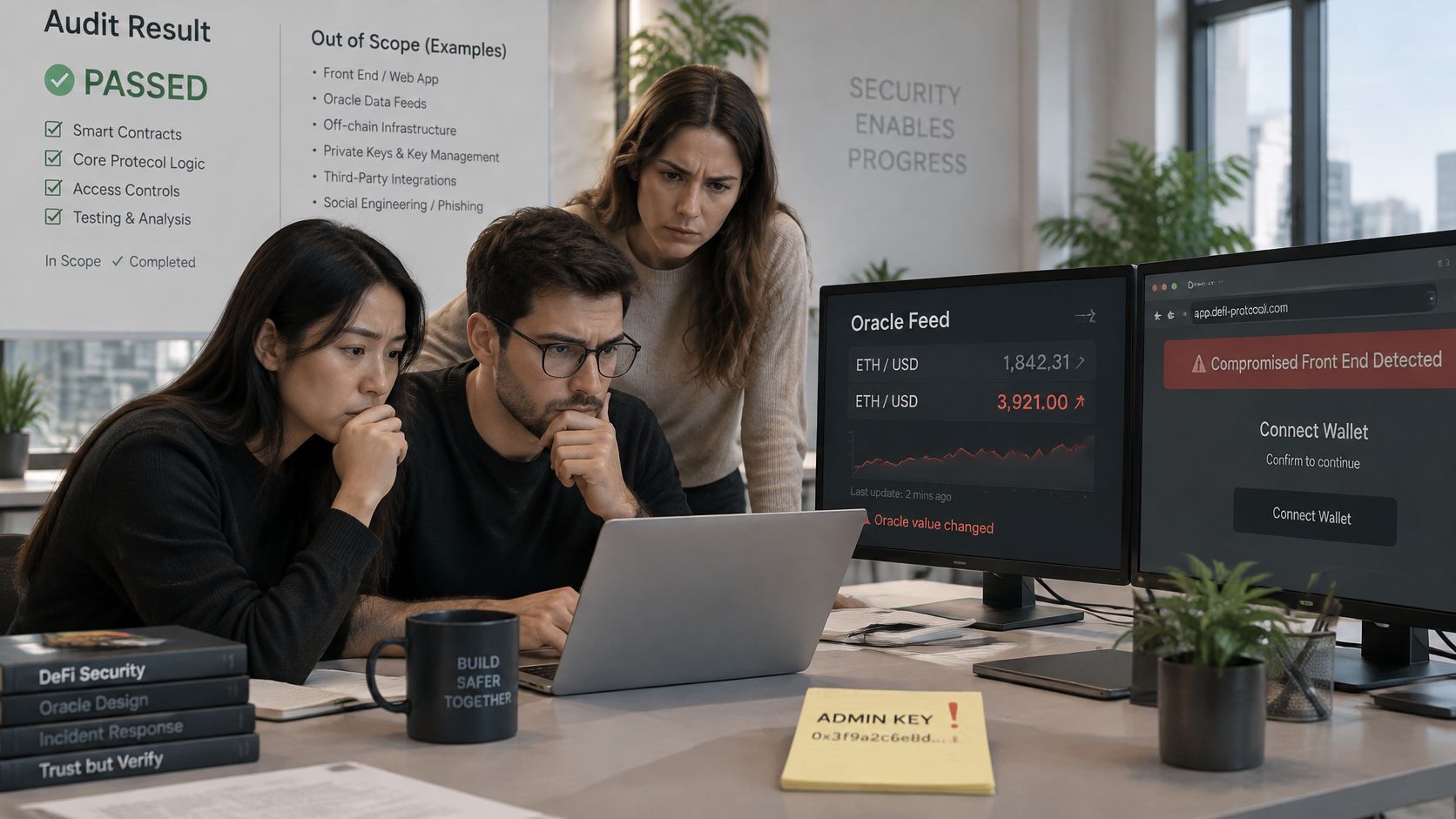
Say a team celebrates a clean report, then loses funds through a leaked admin key, a manipulated oracle, or a compromised front end. The audit did what it was scoped to do. The loss sat outside that scope.
Private-key compromise, administrator abuse, oracle manipulation, bridges, front ends, cloud infrastructure, and daily operations often sit outside a code review. Empirical research on blockchain incidents argues that taxonomies overemphasize smart-contract defects and underplay human-driven exploits, key compromise, and off-chain failures. It found reported incidents declined from 56 in 2021 to 38 in 2025, while average loss per incident rose from about $28.7 million in 2023 to $60.3 million in 2025. Fewer incidents doesn't mean lower risk.
Who owns what remains
Engineering owns the code. DevOps owns deployment and keys. Security owns monitoring and incident response. Legal and operations own disclosure and continuity. After any audit, ask three questions: who holds the admin keys, what triggers an alert, and who can pause the system.
An audit proves what was reviewed, on the commit reviewed, at the time reviewed.
Hiring managers who treat auditing as a cross-functional job, not a badge on a contract, hire people who can name those residual owners.
How Often to Re-Audit and Monitor Between Reviews
There isn't an annual calendar rule. NIST's continuous-monitoring guidance treats monitoring as keeping awareness of security posture often enough for risk-based decisions, not as one periodic exam.
Audit before launch. Re-audit after material code or dependency changes. Raise the cadence when the system is upgradeable, holds more value, has more privileged administrators, depends on outside services, ships faster, or sits near fresh incident intelligence.
A second audit isn't automatically safer. If a fix needs a contract update, you create a new deployment. That artifact must be reviewed, checked against bytecode, and moved through change control. The extra pass can add cost, time, and a new attack surface if deployment is loose.
Between reviews
Track privileged actions, flag unusual transactions, review access changes on a fixed schedule, and keep an emergency plan with named owners. This quarter, re-audit if any of these are true for your system:
- A material code or dependency change landed after the last tested commit.
- A new admin, signer, or upgrade path was enabled.
- Value secured or release pace jumped past what the last scope assumed.
- Incident intelligence showed an attack on a pattern you share.
Findings tracked to closure beat a marketing credential. Security engineering, protocol operations, DevOps, compliance, and incident response all own a piece of that cadence.
Audit Skills by Career Level and Your Next Step
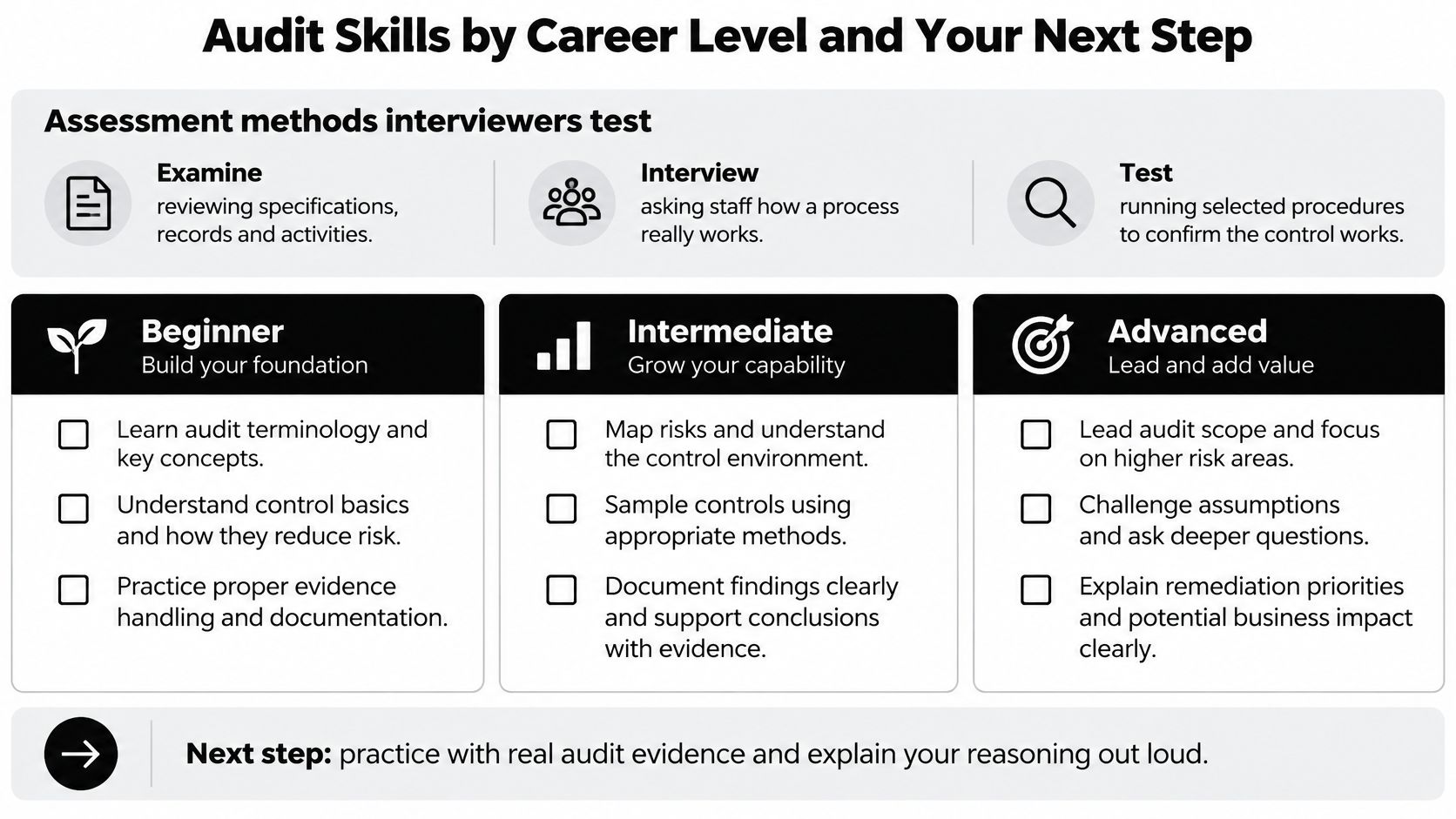
Interviewers test three methods from NIST's assessment guidance. Examine means reviewing specifications, mechanisms, activities, and records. Interview means asking staff how a process really works. Test means running the object under set conditions and comparing actual behavior with the expected result.
A clean example is an access review. Read the access-control policy, ask the system owner how approvals work, then try an unauthorized request and see if it's blocked. Candidates who only recite framework names stall here.
What each level should show
Junior candidates collect evidence and run a structured interview without wandering off the control. Mid-level candidates pick the mix of examine, interview, and test, then explain a finding so an engineer and a product manager both follow it. Senior candidates judge whether a control works, rank residual risk, and brief executives on what to fix first.
Map the control to an outcome. Least-privilege access supports confidentiality. Deployment validation supports processing integrity. Grant Thornton's 2024 internal audit survey is a reminder that cybersecurity coverage is now a normal audit-plan topic, so expect questions about evidence, not slogans.
Build a small portfolio from a public report. Rebuild its scope and evidence list, then write one finding with a fix and a retest plan. Prepare two stories: one about collecting evidence, and one about explaining a gap to someone who doesn't read code. If you're coming from testing, explore the quality assurance career path and notice how evidence, retests, and clear defect write-ups transfer.
Pick one path next: code, infrastructure, compliance, internal, or governance, and match your current skills to that row. Read each posting for audit type, tools, and reporting line. Listed roles by job category include Product Management (450), Sales (414), Marketing (400), Finance & Accounting (384) and Security (353), so compare the blockchain security jobs category against neighboring functions before you apply.
Blockchain Jobs lists Web3 roles where audit skills show up in security, compliance, engineering, and operations work, from control testing to remediation follow-up. Use the category filters to see how those jobs describe evidence, tools, and reporting lines. Visit Blockchain Jobs and compare open security listings with the audit path you chose.