Hiring NFT Developers: Your Step-by-Step Playbook for 2026
You've got a product idea, a launch target, and a shortlist of developers who all claim NFT experience. Then the technical interview starts, and the differences become obvious. One candidate can explain token standards but has never shipped a secure contract. Another has strong frontend skills but can't reason through wallet failures, gas costs, or royalty behavior. A third looks perfect on paper yet can't show verifiable production work.
Hiring NFT developers is difficult because the role has moved beyond writing Solidity and connecting a wallet. You're hiring for security judgment, blockchain-specific architecture, product integration, and the ability to operate safely in a market that still has real transaction activity but far less tolerance for careless launches.
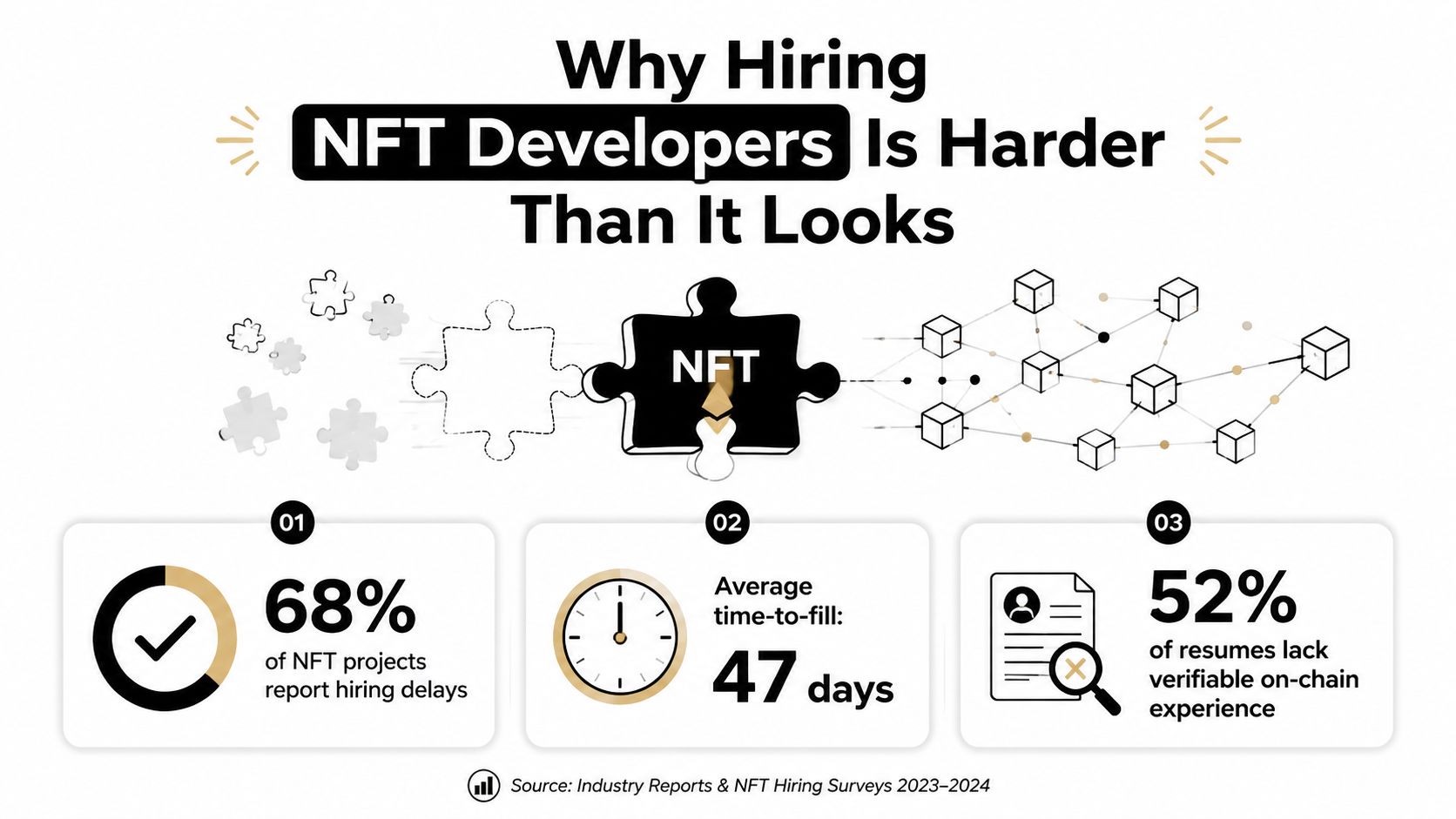
Why Hiring NFT Developers Is Harder Than It Looks
The NFT market created a substantial hiring signal during its boom. Global NFT sales reached about $24.9 billion in 2021, compared with about $94.9 million in 2020, while around 28.6 million wallets traded NFTs that year, according to Reuters' report on NFT sales and market growth. Another market study cited in the same context reported roughly $17.6 billion in NFT trading in 2021, up from $82 million in 2020, a rise of more than 21,000%.
Those figures matter for hiring because they represent a genuine product cycle, not just social-media excitement. NFT teams needed engineers who could build minting systems, marketplaces, smart contracts, wallet integrations, royalty logic, and infrastructure that could survive sudden demand. By 2022, DappRadar-based reporting showed about $24.7 billion in organic trading volume and roughly 101 million NFT trades, compared with about 58.6 million trades in 2021, as reported by Cointelegraph's coverage of the DappRadar report.
The broader engineering market makes the search more specialized. A 2022 market report identified 223 active Ethereum protocols and 151 active Cardano protocols, while developer activity grew by 16% in Polkadot and 131.7% in Cosmos. The same report highlighted a 440% increase in Solana transaction activity and a 315% increase in ImmutableX activity, all of which affect the pool from which NFT infrastructure teams recruit. These developers may be considering protocol engineering, DeFi, security, or infrastructure roles rather than an NFT position with a vague title.
That's why a job post saying “NFT developer wanted” performs poorly. Experienced candidates want to know whether they'll own a Solidity contract, a React minting flow, a marketplace integration, or a complete product surface. Before sourcing, define the chain, deliverable, security responsibility, and relationship between the role and the rest of the team. Resources such as the Blockchain Jobs career and hiring blog can help you understand the wider market, but your hiring brief still needs to describe the work precisely.
Which NFT Role Should You Hire For
NFT developer describes several jobs with different risk profiles and ownership boundaries. Choose the role based on where failure would be most expensive, rather than searching for one person who claims to cover every part of Web3. A contract engineer may be poorly suited to a polished minting flow, while a frontend specialist should not modify production token logic without the right security experience.
| Role | Primary Focus | Typical Deliverable |
|---|---|---|
| Smart-contract engineer | On-chain rules, permissions, security, deployment | Tested ERC-721 or ERC-1155 contracts with deployment documentation |
| Minting and frontend developer | Wallet flows, transaction feedback, user experience | Responsive minting interface with wallet, network, and error handling |
| Marketplace integrator | Listings, transfers, metadata, APIs, platform compatibility | Marketplace integration that synchronizes ownership, pricing, metadata, and events |
Smart-contract engineer
Hire this role when the main business risk sits on-chain. The engineer owns contract design or extension, permission boundaries, upgrade decisions, and the process for testing and deploying changes. They also need to communicate with product, legal, and operations teams because admin powers, royalty behavior, and collection rules affect users and operations beyond the repository.
Use deployed addresses, repository history, testing habits, and responses to audit findings to separate production experience from tutorial familiarity. The interview should focus on how the candidate makes and reviews security decisions. Deeper requirements for Solidity, token standards, and gas optimization belong in the role scorecard, not in a generic title.
Minting and frontend developer
Choose this role when the product's main exposure is the buyer's transaction experience. Ownership covers wallet connection, network switching, signing prompts, gas estimates, mint limits, transaction status, failed transactions, and responsive behavior. The developer may work across React or a comparable frontend stack and Web3 libraries such as ethers.js or Web3.js.
The risk is misleading feedback, not just unattractive screens. Test whether the candidate can distinguish a rejected signature from a reverted transaction, prevent false success states, and explain failures without exposing private information. They should understand the contract interface well enough to integrate safely, while the contract engineer remains accountable for core on-chain logic.
Marketplace integrator
Marketplace work connects product behavior with protocol and third-party infrastructure. Assign this role when the project depends on listings, transfers, metadata, ownership synchronization, external APIs, or more than one marketplace or chain. The key risk is inconsistent state between the project database, the chain, and outside platforms.
Ask how the candidate would handle stale metadata, delayed indexing, chain reorganizations, unsupported royalty behavior, and mismatched ownership or listing data. For multi-chain roadmaps, prioritize judgment about integration boundaries and recovery procedures over familiarity with one platform's API. This role reduces operational surprises after launch, but it should not absorb security ownership that belongs with the smart-contract engineer.
Skills You Should Require by NFT Role Type
Start with the deliverable, then define how you will evaluate the person responsible for it. A useful job description connects each task to observable decisions, review evidence, and failure handling rather than repeating a list of blockchain keywords.

Assessment for smart-contract roles
For a smart-contract engineer, use a code review instead of another generic coding test. Provide a small contract containing an access-control mistake, unsafe external call, flawed supply limit, or withdrawal problem. Ask the candidate to identify the risk, explain its impact, propose a fix, and describe the test that would catch it.
A strong interview also tests standards judgment. Ask how they would verify an ERC-721, ERC-1155, or EIP-2981 royalties implementation against its intended behavior, including cases where marketplace support or enforcement differs. The candidate should explain which assumptions belong in the contract, which belong in application code, and which require operational controls.
Test gas decisions with a concrete scenario. Ask the developer to compare storage writes, batch minting, calldata, and off-chain computation, then explain the security and maintenance trade-offs. The cheapest transaction is not automatically the best design. Require evidence from tests, pull requests, audits, or deployment notes rather than accepting tool names as proof.
Red flags include confident answers that never mention failure paths, tests that cover only successful transactions, and claims that royalties or permissions are guaranteed by a marketplace. Vague explanations of upgradeability, pausability, or key management deserve a second review before hiring.
Assessment for frontend and minting roles
Evaluate the interface through a recorded walkthrough or a short integration task. Give the candidate a wallet connection, signing request, rejected transaction, reverted transaction, failed RPC call, and incorrect network. Ask them to show the user-facing state for each case and explain how they prevent a false success message.
Review signing prompts, address validation, dependency updates, and malicious-link or injected-value handling. The candidate should also explain how gas estimates can change and why a displayed fee should not become an unreliable fixed promise. Judge the clarity of the recovery path, not only whether the mint button works.
Assessment for marketplace work
Use a state-reconciliation exercise. Give the candidate delayed indexing, stale metadata, a chain reorganization, a webhook failure, or conflicting ownership data from an external marketplace. Ask how they detect the mismatch, preserve an audit trail, retry safely, and decide which state requires confirmation from the chain.
Review GitHub evidence for readable commits, tests, issue discussions, deployment notes, and meaningful contributions. A long framework list proves little. A careful pull request shows how the person reasons about production risk, communicates uncertainty, and works with adjacent technical and non-technical teammates.
Where to Source NFT Talent Beyond Generic Job Boards
Senior NFT engineers rarely respond well to broad job posts that treat Web3 as a fashionable label. Source around the technical problem instead. A contract-security role should reach people who contribute to smart-contract repositories, discuss audits, or build in chain-specific communities. A frontend role may be better matched through open-source work, hackathon projects, and active developer groups.
Use a focused sourcing loop:
Search specialized communities. Look in Web3 forums, Discord servers, protocol communities, and technical working groups. Don't drop a generic vacancy into a discussion. Describe the architecture problem, the chain, and the ownership the person would receive.
Inspect open-source contribution networks. GitHub activity can reveal whether someone has worked with Solidity, Foundry, Hardhat, indexing, wallet libraries, or chain-specific tooling. Verify that the work belongs to the candidate and ask them to explain a meaningful pull request.
Attend technical events and hackathons. These environments show how candidates reason under constraints and collaborate with unfamiliar teammates. A hackathon submission isn't proof of production readiness, but it gives you a useful starting point for a deeper conversation.
Use specialist recruiters when the role is highly constrained. A recruiter who understands smart contracts can filter for security and deployment experience before your engineering lead spends time on interviews.
The labor market rewards speed, but speed shouldn't mean skipping verification. One 2026 hiring analysis estimated 300 to 400 applicants per frontend Web3 engineering opening, with roughly 8,000 to 12,000 active positions competing for attention among 150,000 to 200,000 active job seekers. Those figures come from the Web3 hiring analysis on applicant competition. Treat them as a signal to remove unnecessary delays, not as a reason to lower your technical bar.
Your own process should acknowledge how candidates search. Tools for a modern job hunt with AI can help applicants organize opportunities, which means employers need clearer role descriptions and more distinctive technical conversations. Publish the opening where specialized engineers can find it, including engineering-focused blockchain vacancies, then reply quickly to candidates who meet the core requirements.
How to Vet NFT Developers with Security-First Interviews
A good NFT interview asks candidates to make decisions under realistic constraints. Generic algorithm puzzles may show problem-solving ability, but they won't tell you whether someone can protect mint permissions or reason about a failed transaction after deployment.
Begin with a portfolio review. Ask the candidate to select one contract, integration, or production incident and explain the original requirements, the alternatives they rejected, the tests they wrote, and what they'd change now. Verify deployed addresses and repositories where possible. You're looking for ownership, not polished storytelling.
A practical contract rubric
For a smart-contract role, score the candidate across five areas:
- Token mechanics: Can they implement ERC-721 and ERC-1155 correctly, explain supply controls, and handle token URI behavior?
- Library judgment: Do they know when to use OpenZeppelin rather than writing custom primitives?
- Security analysis: Can they identify reentrancy, overflow, unsafe external calls, and access-control errors?
- Testing maturity: Do they use unit, fuzz, invariant, fork, and coverage testing rather than relying only on a successful local deployment?
- Deployment discipline: Can they explain environment separation, admin-key handling, verification, rollback planning, and audit feedback?
Ask questions that expose reasoning. “How would you prevent an unauthorized mint?” is more valuable than “What is access control?” Follow with, “What would you test if an admin role were compromised?” and “Which assumptions would you document before deployment?”
Test trade-offs, not memorization
Strong candidates should compare Ethereum mainnet with relevant L2 options, custodial with non-custodial wallets, and custom contracts with audited libraries. They should discuss gas optimization without sacrificing readability or safety. They should also explain how a royalty design using EIP-2981 interacts with marketplace behavior instead of promising that a standard automatically guarantees payment.
A short take-home assignment can include a deliberately flawed minting contract and ask the candidate to identify risks, write tests, and propose a safer patch. Pay the candidate for substantial work, provide a clear time boundary, and review the reasoning live afterward. You're testing communication and judgment as much as syntax.
For security-focused recruiting, compare your rubric with blockchain security engineering roles involving Solidity, Rust, and Golang. The interview should end with a written recommendation that separates must-fix vulnerabilities from design preferences.
Interview standard: Never hire because a candidate can ship a mint. Hire when they can explain how they'll prevent, detect, and contain failure.
NFT Developer Salaries, Contract Models, and Total Cost
Compensation should reflect the risk carried by the role, not just the number of lines of code. Current benchmark data places the average yearly NFT developer salary at $125,000, with a range from $60,000 to $250,000. The same NFT developer salary benchmark places average hourly compensation at about $65, with a range from $31 to $130.
Those figures are reference points, not automatic offer prices. A developer who only integrates a minting interface shouldn't be evaluated like an engineer responsible for upgradeable contracts, cross-chain infrastructure, incident response, and audit remediation. Define the scope first, then benchmark the relevant skill combination and geography.
The contract model changes your total cost and your risk profile:
- Full-time hiring fits a product with continuing protocol ownership, repeated releases, or a long security roadmap. It gives the developer context and makes accountability clearer.
- Fractional hiring works when you need senior architecture and review but don't yet have enough ongoing work for a permanent specialist.
- Agency delivery can help when the team lacks Web3 leadership, although you need clear ownership of repositories, keys, documentation, and post-launch support.
- Contract hiring suits a defined integration or short build, provided the handoff includes tests, deployment records, and operational runbooks.
Recent reporting found that over 70% of Web3 hires in 2025 were contractors, particularly across DeFi, NFT, and DAO ecosystems, as described by The Crypto Recruiters' Web3 hiring trends report. The same report stated that smart-contract engineer demand rose 32%, Rust developer demand rose 40%, and zk engineer demand rose 51% in 2025. That mix makes a low-cost generalist tempting, but security and infrastructure gaps can make the final build more expensive through rework, audits, delays, and incidents.
When comparing compensation across adjacent roles, use a relevant benchmark for React Native developer rates only as a comparison point, not as a substitute for Web3-specific evaluation. Pay for the responsibility you're assigning, and put progression in writing so strong engineers don't leave for a better-defined protocol or security role.
Onboarding NFT Developers for Secure and Scalable Builds
A new hire needs access to the architecture, threat model, deployment process, and product constraints before touching production code. Onboarding should make unsafe assumptions visible early, especially when the developer joins remotely or enters a codebase built by several contractors.
Start with security and dependencies
Give the developer the current threat model, audit history, dependency inventory, access-control map, and incident procedures. Review private-key responsibilities, environment boundaries, admin roles, upgrade paths, pause functions, and withdrawal logic. Don't wait for the first sprint to discover that nobody knows who can upgrade a contract.
Use a safe deployment path
Create a sandbox that mirrors the important production assumptions. Have the developer deploy to a testnet, exercise wallet flows, inspect emitted events, and document failure recovery before any mainnet release. Require reproducible builds, automated tests, dependency review, and a clear approval path for contract changes.
Walk through the codebase as a product
The architecture session should cover contracts, frontend, backend services, indexers, metadata storage, analytics, and external marketplace integrations. Explain which data comes from the chain, which data is cached, and which user actions can fail or remain pending. This context helps engineers make decisions that support the product rather than optimizing one isolated component.
Define the first sprint and the career path
Give the developer a contained first milestone, a named reviewer, and written acceptance criteria. Pair contract changes with review, tests, and documentation, not just feature completion. After the first release, hold a technical retrospective that covers security findings, delivery friction, and the developer's preferred growth direction, whether that's protocol engineering, infrastructure, security, or product-focused Web3 work.
A practical onboarding plan also protects retention. Security-minded engineers want authority to raise concerns, realistic deadlines, and credit for reliability work that users never see. If leadership rewards only launch speed, careful developers will either disengage or move to teams that value production discipline.
Blockchain Jobs connects Web3 employers with specialized talent across engineering, security, product, operations, and other blockchain functions. Visit Blockchain Jobs to post a focused NFT role or find candidates who understand the technical and organizational demands of secure Web3 products.