What Is Proof of Work and Why It Still Matters in 2026

You've joined a mining pool or layer-one team, opened the repository, and someone asks why a mempool policy change could influence orphan rates. The question sounds narrower than it is. A useful answer requires you to connect transaction selection, block propagation, hash rate, difficulty, confirmation behavior, and the economic cost of rewriting history.
That's the answer to what is proof of work. It isn't just a puzzle miners solve. It's a way to make participation costly, verification cheap, and agreement possible without a trusted coordinator. If you're preparing for a protocol, mining, security, product, or compliance interview, you need to explain those mechanics in operational terms, not repeat a slogan.
Why Understanding Proof of Work Matters Before Your First Web3 Interview
Your first week on a Web3 team may involve reviewing a pool dashboard, tracing a reorganization, or reading a change to transaction relay rules before you write any production code. A junior engineer who understands only hashing may miss why slower propagation can increase the chance that two miners produce competing blocks, or why a change in transaction selection can affect block templates and operational metrics.
Start with four questions:
- How often should blocks appear? Bitcoin targets roughly one block every 10 minutes.
- How much hash rate is competing? A miner's chance of finding a block follows its share of total network hash rate.
- How does the network respond to changing participation? Bitcoin adjusts difficulty every 2,016 blocks, roughly every two weeks.
- What does confirmation mean? A transaction becomes harder to reverse as additional valid blocks accumulate, but PoW finality remains probabilistic rather than an instant cryptographic guarantee.
Those answers shape onboarding decisions. A protocol engineer needs to know which consensus rules are safety-critical. A security researcher needs to model reorganizations, eclipse conditions, and majority-hash-rate threats. A mining operations engineer needs to connect uptime and electricity costs to expected production. A product manager needs to explain why a confirmation setting changes user experience and settlement risk.
Interview habit: Don't define PoW as “miners solve puzzles.” Explain what the puzzle costs, what nodes verify, and how the resulting cost changes the attacker's options.
Candidates should also separate protocol mining from regulated activity. The SEC staff statement on certain proof-of-work mining activities addressed certain solo and pool mining activities involving covered crypto assets under securities law. It didn't resolve tax, money transmission, licensing, employment, or local regulatory questions.
The sections that follow map directly to skills hiring teams test. You'll move from the hash puzzle to the mining loop, then to economics, comparative consensus design, energy analysis, attack modeling, and role-specific preparation. For engineering openings, reviewing protocol and blockchain engineering roles can help you translate that knowledge into the vocabulary employers use.
The Core Idea Behind Proof of Work
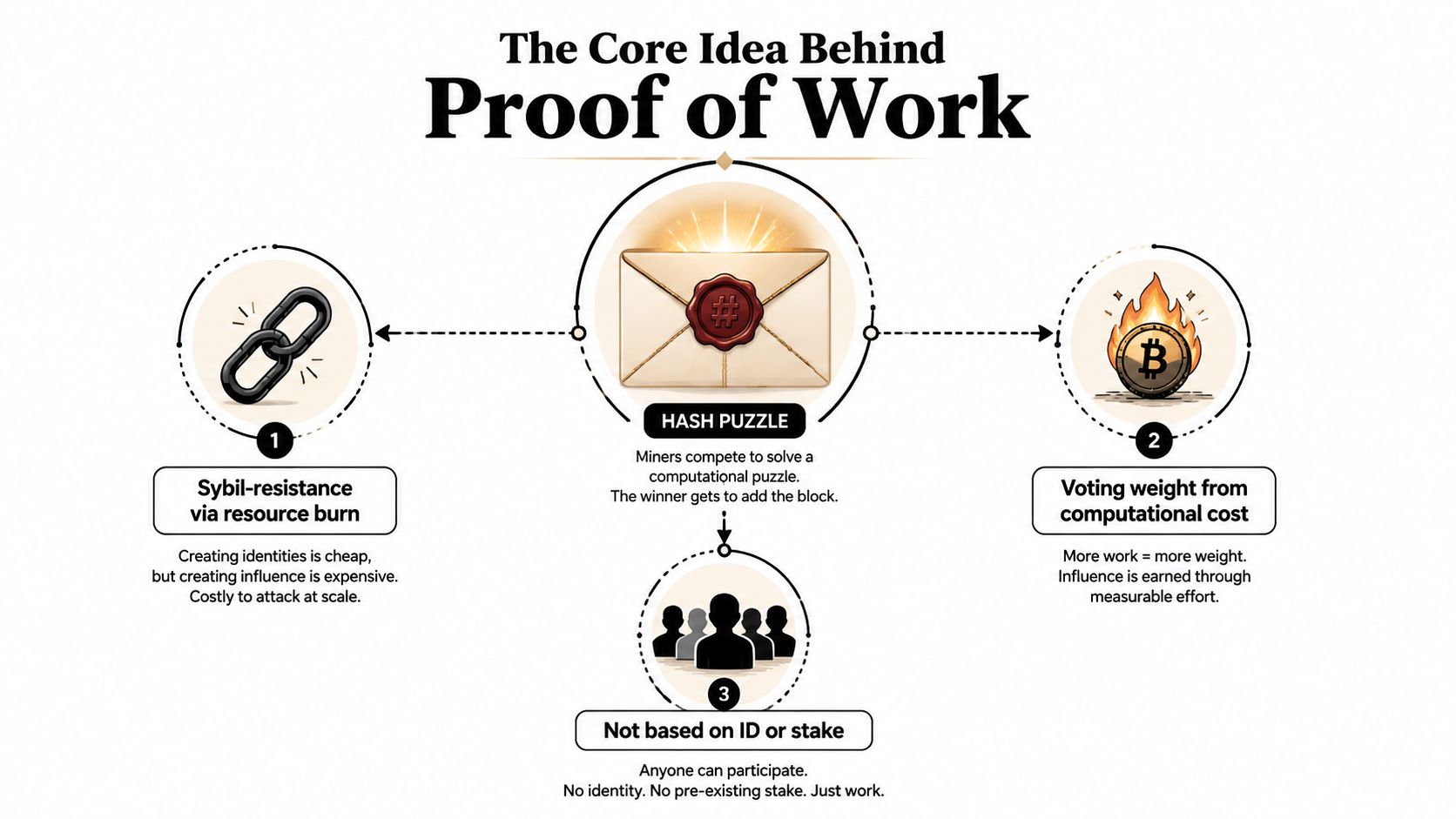
Proof of Work is an economic security mechanism and a Sybil-resistance system. Instead of trusting an identity, a reputation, or a quantity of staked capital, the network gives influence to participants that commit computational work and electricity. An attacker can create many fake identities cheaply, but creating convincing PoW requires spending real resources.
Use a sealed envelope as the mental model. Each miner prepares a candidate block, seals the relevant information into a header, and keeps changing a small field called the nonce. Every attempt produces a hash. The miner succeeds only when the resulting digest is numerically below the current target.
Bitcoin uses double SHA-256 hashing, commonly called SHA-256d, for this work. The target changes with network difficulty, so miners aren't aiming for a permanently fixed answer. They're searching for an output that satisfies the current threshold.
Hard to produce, easy to check
Mining is expensive because a miner may need to perform a large number of hash attempts before finding a valid result. Verification is cheap by comparison. A node hashes the proposed header, checks the target, validates the transactions, and confirms that the block extends a valid chain.
That asymmetry matters. If producing and checking work cost the same, every node would face the same burden as the miner. If producing work were cheap, an attacker could flood the network with competing histories. PoW makes block proposals costly while allowing independent nodes to reject invalid proposals quickly.
PoW isn't encryption, and it isn't a database lock. Hashing doesn't hide the block's contents. The mechanism commits the miner to a costly search, then lets other participants verify the result without trusting the miner's identity.
Why the cost supports agreement
Bitcoin's original design combined PoW with a longest-chain rule. Transactions become timestamped by hashing them into a chain, and changing an earlier block requires redoing the work for that block and every later block. The foundational explanation appears in the Bitcoin white paper overview, which records the white paper's release on October 31, 2008, and Bitcoin's first block on January 3, 2009.
For an interview, connect three layers: resource cost, chain selection, and verification. That connection is more useful than memorizing terminology because it explains why PoW can coordinate independent nodes without a central voting authority.
How Cryptographic Mining Actually Works Step by Step
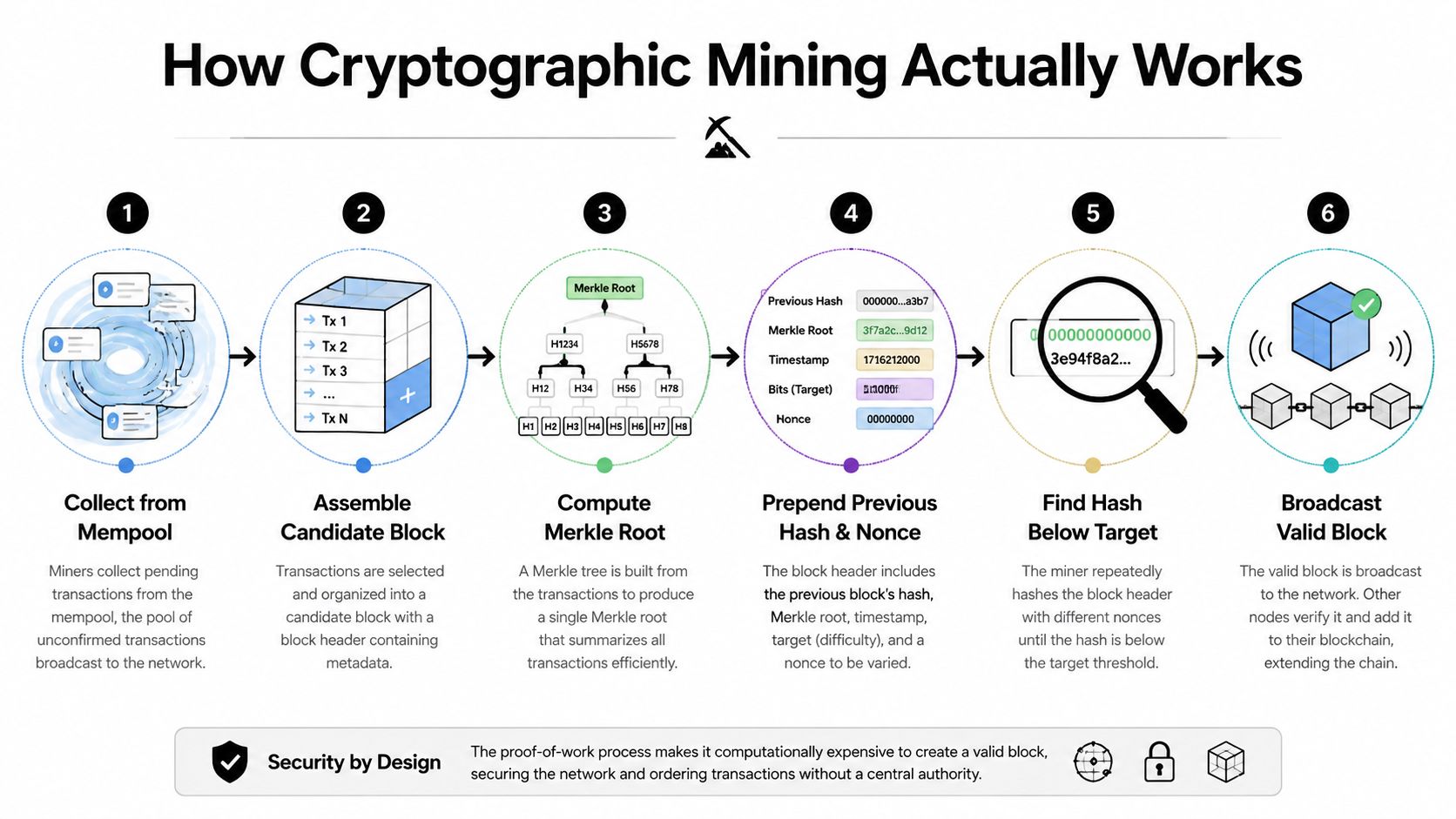
Mining begins with transactions waiting in a mempool. A miner selects transactions according to its policy, checks their validity, and assembles a candidate block. The block contains transaction data, a reference to the previous block, and a header whose fields commit the miner to the proposed history.
The process is easier to understand as a loop:
- Collect transactions. The miner receives transactions from peers and chooses which valid transactions to include.
- Assemble the candidate block. The miner creates a coinbase transaction for the block subsidy and transaction fees, subject to the network's consensus rules.
- Compute the Merkle root. The miner hashes transactions into a tree and places the resulting root in the block header. The Merkle root commits the header to the selected transaction set.
- Build the header. The header includes the previous block hash, the Merkle root, a timestamp, version information, and the nonce.
- Search below the target. Hardware changes the nonce and related header data, repeatedly applying SHA-256d until the digest meets the current target.
- Broadcast the winner. The miner sends the block to peers, which validate the proof, transactions, and chain connection before relaying it.
What miners and nodes do differently
A mining machine performs the expensive search. A full node doesn't repeat that search. It checks that the block hash satisfies the target, confirms the previous-block reference, validates the coinbase transaction, verifies transaction rules, and determines whether the block belongs to the preferred valid chain.
Mining may happen solo or through a pool. A solo miner keeps the full block reward when successful but faces irregular revenue. A pool gives participants coordinated work and distributes proceeds according to the pool's accounting rules. Large facilities use specialized hardware, including ASICs, while engineers may also encounter FPGA systems or general-purpose components in research and supporting infrastructure.
Hash rate is the common operational unit for describing aggregate search capacity. It helps teams compare miner performance, estimate contribution to a pool, and reason about the probability of finding a block. It doesn't guarantee a fixed income because network difficulty, fees, hardware availability, electricity cost, and downtime also matter.
What to recite in an interview: “The coinbase transaction pays the miner's subsidy and included fees. The Merkle root commits the header to the transaction set. Nodes verify the resulting proof without reproducing the search.”
A winning block still isn't automatically safe. Peers may receive another valid block first, and temporary competing branches can produce an orphan or reorganization. For a practical view of how mining operators think about infrastructure and adjacent compute markets, this crypto mining pivot guide offers useful career context without replacing protocol fundamentals.
Difficulty Adjustment, Halvings, and Miner Economics
Bitcoin uses difficulty adjustment as a feedback loop. The protocol targets one block about every 10 minutes and recalibrates after 2,016 blocks, roughly every two weeks, as described in the technical explanation of difficulty adjustment. If miners collectively find blocks too quickly, difficulty rises. If they find them too slowly, difficulty falls, with protocol bounds limiting abrupt changes.
Take one retarget window. The network observes the elapsed time between the first and last block in the window, compares that interval with the expected interval, and adjusts the next target through a ratio. If new ASIC capacity enters during the window, blocks may arrive faster before the next adjustment. The following target then becomes harder. If a major outage removes hash rate, blocks may arrive slowly, and the next adjustment reduces the work required per block.
The revenue side of the equation
Bitcoin's block reward began at 50 BTC per block, halves every 210,000 blocks, and stood at 3.125 BTC per block as of 2024, according to this technical mining summary. The predictable halving schedule compresses the subsidy over time, so operators must evaluate whether fees, hardware efficiency, and electricity contracts can support continued production.
Mining teams therefore monitor more than blocks found. They track hash rate, rejected shares, stale work, machine temperature, power draw, firmware behavior, pool payouts, fee composition, and treasury liquidity. A new hire may be asked to build a dashboard that distinguishes a hardware failure from a network-wide difficulty change.
PoW and PoS through an operator's lens
The comparison below uses the criteria that commonly appear in consensus interviews.
| Criterion | Proof of Work | Proof of Stake |
|---|---|---|
| Security budget | Computation and electricity fund block production | Staked capital supports validator participation |
| Energy | Resource-intensive by design | Usually avoids the same mining workload |
| Hardware | Mining hardware, firmware, cooling, and power infrastructure | Validator servers, key management, and reliable operations |
| Attack model | Attacker needs substantial hash rate and operating capacity | Attacker needs sufficient stake or influence over staked capital |
| Penalties | Lost electricity, equipment use, opportunity cost, and potentially stranded hardware | Protocol penalties may include slashing for defined validator behavior |
| Team design | ASIC, pool, infrastructure, energy, and firmware specialists | Validator operations, staking, cryptography, and staking-product specialists |
For operators who want a clearer Spanish-language treatment of this feedback loop, como afecta la dificultad minera is a useful supplementary resource. Candidates applying for ASIC validation engineering roles should be ready to connect retarget behavior to test plans, thermal constraints, and performance validation.
Proof of Work vs Proof of Stake for Builders and Hiring Managers
The easiest comparison is also the least useful: PoW uses energy, while PoS uses stake. Hiring teams need a more precise distinction. Each design creates a different security budget, attack surface, hardware profile, and set of operational failure modes.
PoW makes block production depend on ongoing expenditure. The technical discussion of PoW security describes a system where miners spend computation and electricity to propose blocks, while nodes verify them cheaply. A miner's probability of finding a block follows its share of total hash rate, so security is tied to physical infrastructure and operating costs.
PoS replaces that resource race with capital commitment and validator rules. A validator's influence depends on stake and protocol participation, while the network may impose slashing for defined misbehavior. That can provide different forms of accountability, but it also makes key management, validator availability, delegation, governance, and stake concentration central engineering concerns.
What interviewers want candidates to distinguish
A PoW protocol engineer might be asked how an attacker acquires or rents hash power, how a reorganization changes user risk, or why difficulty must respond to changing participation. A PoS candidate may face questions about validator attestations, stake-weighted voting, equivocation, slashing, and the difference between economic and protocol finality.
Team composition follows those threat models. A mining organization hires people who understand ASIC controllers, power procurement, pool protocols, cooling systems, and fleet reliability. A staking organization needs validator operations engineers, cryptography specialists, custody experts, and product engineers who can represent staking risks clearly to users.
Neither model eliminates economic assumptions. PoW depends on honest cumulative hash power exceeding an attacker's hash power. PoS depends on assumptions about stake distribution, validator incentives, governance, and recovery from faults. A strong hiring manager tests whether a candidate can name those assumptions instead of presenting either consensus model as universally superior.
Hiring signal: The strongest answer doesn't ask which consensus mechanism is “best.” It asks which resource, failure mode, and operating team the network is prepared to manage.
Energy Use, Efficiency Gains, and the Honest Debate
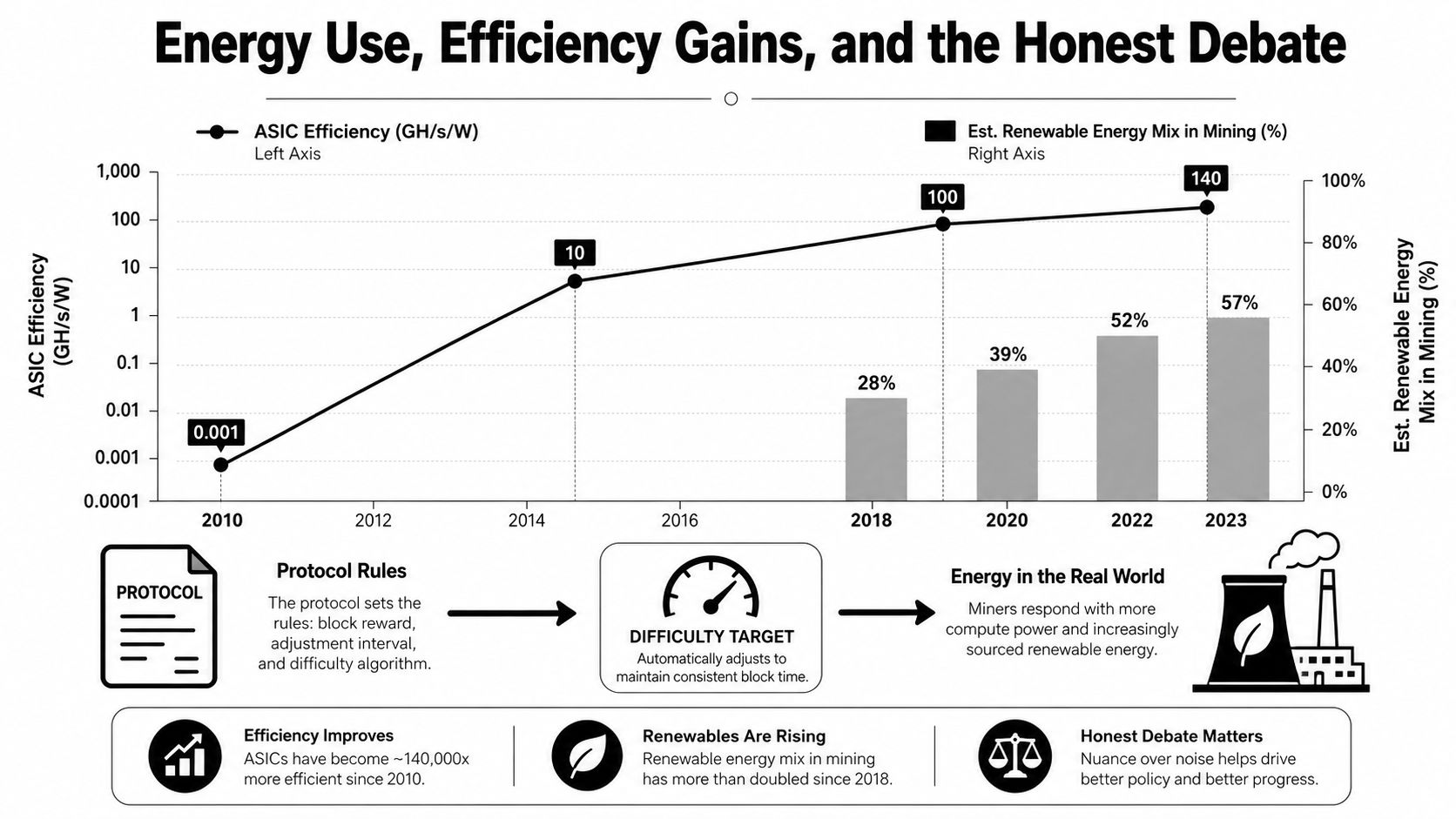
The protocol specifies a target and a chain-selection rule, not a fixed number of watts. Total energy use emerges from miner competition, hardware efficiency, electricity prices, facility design, and the amount of hash power operators find economically viable.
Bitcoin mining remains resource-intensive. Cambridge research has estimated Bitcoin mining electricity use in a range of about 43 to 194 terawatt-hours per year, while later estimates often cluster around 120 to 200 TWh annually. A 2025 estimate of 211.58 TWh represented roughly 0.83% of global electricity consumption, as summarized in the Cambridge electricity-use research. Those figures are estimates, and their differences show why analysts must state their methodology rather than cite one universal number.
A transaction-level estimate can make the issue more tangible. An ACM-reported estimate puts one Bitcoin transaction at about 830 kWh and describes Bitcoin mining as 0.29% of annual global electricity consumption in the cited estimate. Transaction-level allocation is analytically different from measuring the electricity used by the whole mining network, so candidates should explain the distinction in policy interviews.
Three questions sustainability teams should ask
- What powers the facility? Energy source affects emissions, but the answer depends on the local grid and the operator's actual procurement.
- What happens to the hardware? ASIC turnover can create e-waste concerns, especially when older machines no longer compete economically.
- What value does the compute provide? Mining can consume electricity that might otherwise support households, industry, or other digital workloads.
Efficiency work doesn't make those questions disappear. Operators may use stranded hydroelectricity, capture energy from otherwise flared gas, improve cooling, or reduce voltage and frequency where the hardware permits it. A 2025 paper proposed a PoW improvement designed to reduce energy consumption by at least 50 percent while retaining the same security and decentralization properties, though that proposal represents research rather than a universal deployed outcome. A separate 2025 industry projection estimated about 173 TWh of Bitcoin mining energy consumption and a 52.4% renewable share, under its stated assumptions, as reported in recent PoW efficiency coverage.
The credible interview answer is neither “PoW is harmless” nor “PoW is automatically wasteful.” Separate protocol design, energy mix, hardware efficiency, network geography, and opportunity cost.
Security Threats Every PoW Engineer Must Understand
A merchant accepts a payment, but the attacker is already mining a conflicting transaction that spends the same inputs elsewhere. This double-spend attempt depends on how quickly transactions propagate, the attacker's hash-rate share, the number of confirmations, and the merchant's acceptance policy. Chain-selection rules decide which history remains canonical.
The larger threat is majority hash power. An attacker controlling more hash power than honest miners can build a private branch that catches up more reliably and reorganize recent history. That power does not create valid coins from nothing or bypass every consensus rule. It can, however, support transaction censorship, payment reversal, or selective rewriting while the attacker can sustain the operation.
The Bitcoin white paper explains why changing an earlier block requires repeating the work for that block and every later block. Revisit the Bitcoin white paper reference when an interview asks why more confirmations increase confidence without providing absolute certainty.
Threats below the majority threshold
PoW security also includes attacks that require less than majority hash power:
- Eclipse attacks: An attacker isolates a node from honest peers and supplies a manipulated view of network activity.
- Mempool manipulation: An adversary exploits relay behavior, transaction ordering, or fee policies to influence what miners receive.
- Pool block withholding: A participant submits shares that prove useful work but withholds a valid block, reducing the pool's expected rewards.
- Timejacking: Malicious peer time information distorts a node's timestamp view and can affect validation behavior.
Each threat points to a concrete control. Engineers can harden peer selection, monitor unexpected reorganizations, validate pool shares more carefully, constrain timestamp handling, and test Stratum v2 job-negotiation paths. Security reviewers must also check whether these safeguards introduce censorship or liveness risks.
Threat-model discipline: State the attacker's resource, objective, observable signal, and protocol control. “A 51% attack is possible” does not provide enough detail for a design review.
That discipline also shapes hiring. A security candidate may need to discuss consensus behavior, mining infrastructure exposure, incident response, and secure implementation in one interview loop. The senior blockchain security engineering path reflects that breadth. Prepare by linking each threat to a detection signal, a mitigation, and the trade-off the team must accept.
Proof of Work Roles and How to Stand Out in 2026
PoW knowledge becomes valuable when you can turn it into an artifact. A hiring team can assess a regtest fork, a clear incident analysis, or a working economics model more easily than a list of terms.
| Role Family | Core Function | Top Interview Topic |
|---|---|---|
| Protocol engineer | Consensus rules, block validation, mempool policy, and chain behavior | Difficulty-retarget edge cases and orphan-rate attribution |
| Mining infrastructure SRE | Pool connectivity, Stratum operations, fleet reliability, and ASIC environments | Job negotiation, stale shares, uptime, and proxy tuning |
| Security and consensus research | Threat modeling, adversarial analysis, and protocol assurance | Reorganizations, eclipse resistance, and PoW economic security |
| Product or BD | Mining-pool products, energy partnerships, and customer-facing strategy | Curtailment decisions, fee markets, and miner economics |
Build evidence for the role you want
A protocol candidate should create a small forked regtest environment, alter a consensus or mempool parameter safely, and document the resulting behavior. The point isn't to claim production readiness. It's to demonstrate that you can observe block timing, transaction relay, chain selection, and reorganization behavior.
A mining infrastructure candidate should write a postmortem for a hypothetical fleet outage. Include detection signals, affected workers, stale or rejected shares, escalation steps, and the distinction between a pool problem and a network-wide difficulty change.
A research candidate should produce a threat model that names assumptions and separates majority-hash-rate attacks from peer-layer attacks. A product or BD candidate should prepare a hashprice spreadsheet that tests revenue sensitivity to subsidy changes, fees, power costs, uptime, and difficulty.
A practical preparation checklist
- Explain the loop aloud: mempool, candidate block, Merkle root, header, nonce search, broadcast, validation.
- Draw the security budget: show which costs an honest miner pays and which costs an attacker must repeat.
- Practice the comparison: answer PoW versus PoS using security budget, energy, hardware, and slashing.
- Prepare one artifact: bring a regtest fork, postmortem, dashboard mock-up, or economics spreadsheet.
- Ask operational questions: find out whether the role owns consensus code, fleet reliability, compliance analysis, or customer risk.
In 2026, strong candidates won't treat PoW as historical vocabulary. They'll show how a target adjustment affects production, how a reorganization affects users, how energy assumptions affect compliance, and how those realities determine team design.
Blockchain Jobs offers a focused way to find Web3 openings across engineering, infrastructure, security, product, compliance, and related functions. Visit Blockchain Jobs to search for roles where your PoW knowledge can become practical experience and to position your next interview around the work teams need.