NFT Benefits for Web3 Careers: A Practical Guide
NFTs can provide verifiable ownership, machine-verifiable provenance, and automated secondary-market compensation. They can also support conditional rights and new monetization paths, but buying one doesn't automatically give you copyright or unrestricted commercial use.
If you're prepping for a Web3 interview, that single distinction already matters. A hiring manager who asks what NFTs do is rarely looking for hype language. They want to know whether you understand how token ownership, licensing, marketplace design, and royalties work together in products people can ship.
Why NFT Benefits Matter for Your Web3 Career
You can answer “what are the nft benefits?” in one sentence, but the better answer is the one that shows judgment. Ownership, provenance, royalties, licensing, and utility are the core business benefits, and each one maps to a different hiring signal. Engineering teams want to know if you understand token standards and metadata. Product teams want to know if you can turn scarce digital assets into a usable experience. Compliance teams want to know if you can separate token control from legal rights.
That's why nft benefits matter beyond the asset itself. If you can explain what the token proves, what it doesn't prove, and where the user value comes from, you sound like someone who can work across smart contracts, UX, policy, and operations. That's a stronger signal than saying you “get NFTs.”
Practical rule: if you can't explain the rights attached to an NFT in plain language, you're not ready to spec the product or defend it in an interview.
For job seekers, this becomes a portfolio advantage. A candidate who can talk through minting, resale logic, and license boundaries is easier to trust than someone who only lists “NFT experience” on a résumé. That credibility is part of how you build a differentiated personal brand that hiring teams remember.
If you're scanning the market, it also helps to look at roles that sit near this work, not just the headline token projects. The best clues often show up in adjacent listings like NFT-focused roles on Blockchain Jobs, where actual hiring need is often product judgment, marketplace operations, or legal coordination rather than pure speculation.
Understanding NFT Ownership and Provenance
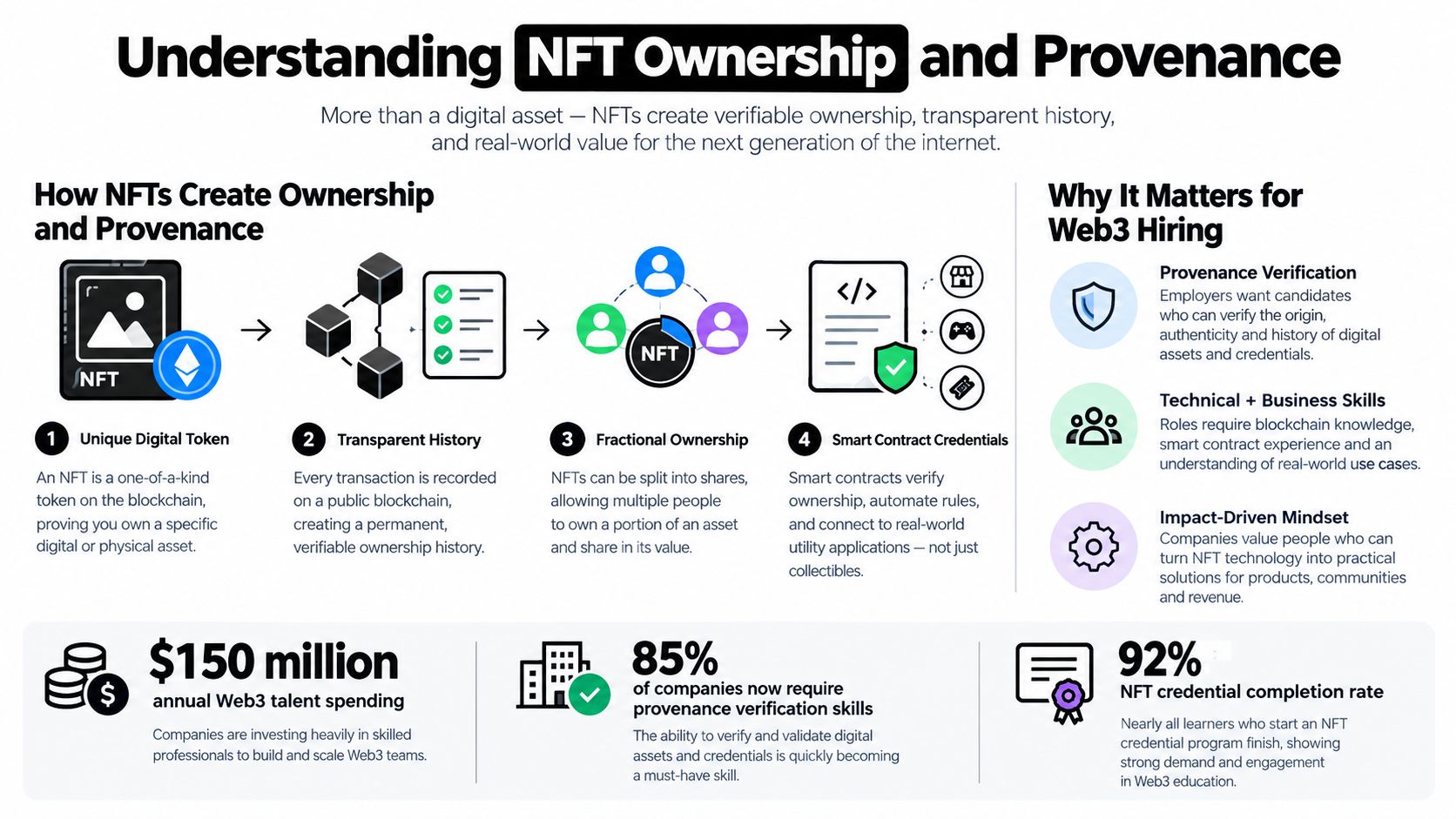
NFTs create value by giving buyers a publicly verifiable ownership trail. Once a token is minted or transferred, that history is recorded on-chain and can be checked later, which helps buyers assess authenticity and origin. In practice, that means an NFT can act like a blockchain-based certificate tied to an asset, while the underlying file itself can still be copied elsewhere. The token does not automatically transfer copyright unless the contract says so, a point confirmed in the academic literature on NFT ownership and provenance (source study).
What hiring managers listen for
In interviews, the useful answer isn't “NFTs are unique.” It's whether you can explain why uniqueness matters operationally. A backend engineer might describe how token IDs, metadata, and transfer events work together. A product manager should be able to explain why provenance reduces verification friction in a marketplace flow. A compliance candidate should be able to discuss how a public audit trail helps with authenticity checks while still requiring off-chain verification for actual physical objects.
The sharpest candidates also understand the implementation limits. Blockchain permanence doesn't prove that the original off-chain data was truthful. If the minting process was flawed, the chain can preserve a bad claim just as permanently as a good one. That's a useful interview point because it shows you understand where engineering ends and governance begins.
Ownership history is valuable, but only if the token is reliably bound to the asset people think they're buying.
For role prep, this is the section to use when discussing metadata architecture, wallet custody, and auditability. If you can walk a hiring panel through why provenance matters to a marketplace, museum, registry, or enterprise workflow, you're demonstrating practical system thinking, not just Web3 vocabulary. For a technical comparison that often comes up in those conversations, a useful reference is ERC-20 vs ERC-721 on Blockchain Jobs.
Why provenance shows up in real products
Provenance is most convincing when the product has a real reason to care about it. Marketplaces use it for authenticity checks. Museums and registries use it for chain-of-custody style records. Supply-chain systems use it for traceability and tamper-resistant history, which is why enterprise buyers tend to care less about hype and more about whether the token history can be trusted in practice.
That's the interview edge. If you can describe where the token's history is strong, where it's weak, and what has to happen off-chain, you sound ready to help build a system instead of just trading in one.
How NFT Royalties Create Recurring Revenue
Programmable royalties are one of the clearest nft benefits for creators and marketplace builders alike. Smart contracts can route a percentage of qualifying secondary sales back to the creator, so the system can support recurring compensation without manual invoicing. In research summarized in a 2024 academic study, approximately $1.8 billion in NFT resale royalties had been collected by October 2022, and 27% of that amount went to the ten leading collections (academic study). The same study cites evidence that 44% of creators were motivated to join NFT platforms because of the prospect of resale royalties (academic study).
Why this matters in hiring
A candidate who understands royalties can talk about more than creator upside. They can explain fee routing, marketplace enforcement, and how secondary flows affect revenue models. That matters to product teams because royalty policy changes user behavior. It matters to finance teams because royalty, primary sale, and withdrawal flows all need reconciliation. It matters to operations teams because support tickets often begin when users think a royalty is guaranteed and discover that marketplace implementation controls the outcome.
Treat royalties as an ecosystem feature, not a promise written in stone.
That distinction is important in interviews. Royalty execution depends on marketplace and contract implementation. Users can trade through venues that ignore royalty logic, and that means “programmable” doesn't always mean “universally enforced.” If you're applying for a role near NFT marketplaces, it helps to be specific about where the payment logic lives, how it's displayed to users, and what happens when a sale occurs off the preferred venue.
How to speak about royalties credibly
Strong answers usually cover three layers. First, the contract logic, which can define a percentage and recipient address. Second, the marketplace policy, which can support or bypass that logic. Third, the user-facing disclosure, which should tell buyers and sellers what will happen on transfer. That's the kind of detail hiring managers trust because it shows you can spot operational risk before it turns into a support issue.
For candidates in finance or ops, the practical interview question is often simpler than it looks. Can you explain how primary revenue, secondary revenue, marketplace fees, and withdrawal constraints differ? If you can, you're already speaking the language of real NFT infrastructure rather than a collector's forum.
NFT Ownership vs Copyright and Licensing Rights
The biggest NFT mistake is assuming the token and the underlying IP are the same thing. They aren't. Legal scholarship is clear that an NFT generally proves control or ownership of the token itself, while copyright, reproduction, distribution, and commercialization rights remain with the creator unless the purchase agreement or license explicitly transfers them (legal scholarship). That's why a buyer can hold a token and still have very limited legal rights over the image, music, or software linked to it.
The four layers to separate
A useful interview answer breaks the issue into four parts. The token is the on-chain asset. The linked media is the file or work referenced by the token. Ownership of the token means control of that blockchain entry. Copyright in the media is a separate legal right unless it's transferred in writing. If you can explain those layers cleanly, you'll sound credible to legal, compliance, and product teams.
That distinction becomes even more important when marketplace terms conflict with contract language. A smart contract can automate a transfer, but it can't rewrite copyright law. If off-chain media disappears, the token may still exist while the user experience falls apart. If a platform's terms limit use, the buyer's rights may be narrower than the promotional page implied. That's why identifying what your business owns is a useful discipline for anyone building or buying around NFTs.
Hiring signal: candidates who can read a license summary and explain what the buyer may reproduce, resell, or commercialize are more valuable than candidates who only talk about minting.
What to check before you say a project has value
For a hiring manager, the right checklist is simple and concrete. What exactly does the buyer receive. Who owns the copyright. Are commercial rights included or excluded. Does resale change anything. Which jurisdiction applies. And where is that stated, in the token metadata, the purchase terms, or a separate license agreement.
If you can answer those questions, you're already speaking like someone who can protect the company from avoidable mistakes. That's especially relevant for candidates aiming at legal, compliance, brand, and product roles. For a broader framing of this issue in career terms, the Blockchain Jobs guide on intellectual property protection is a good companion reference.
Composability and Real-World NFT Utility
NFTs become durable when they do more than sit in a wallet. The strongest nft benefits show up when tokens connect to membership, access, governance, credentials, or other systems that people use in everyday life. That's where the career signal changes too. Employers aren't impressed by “collectible” alone, they want people who can build or operate something useful.
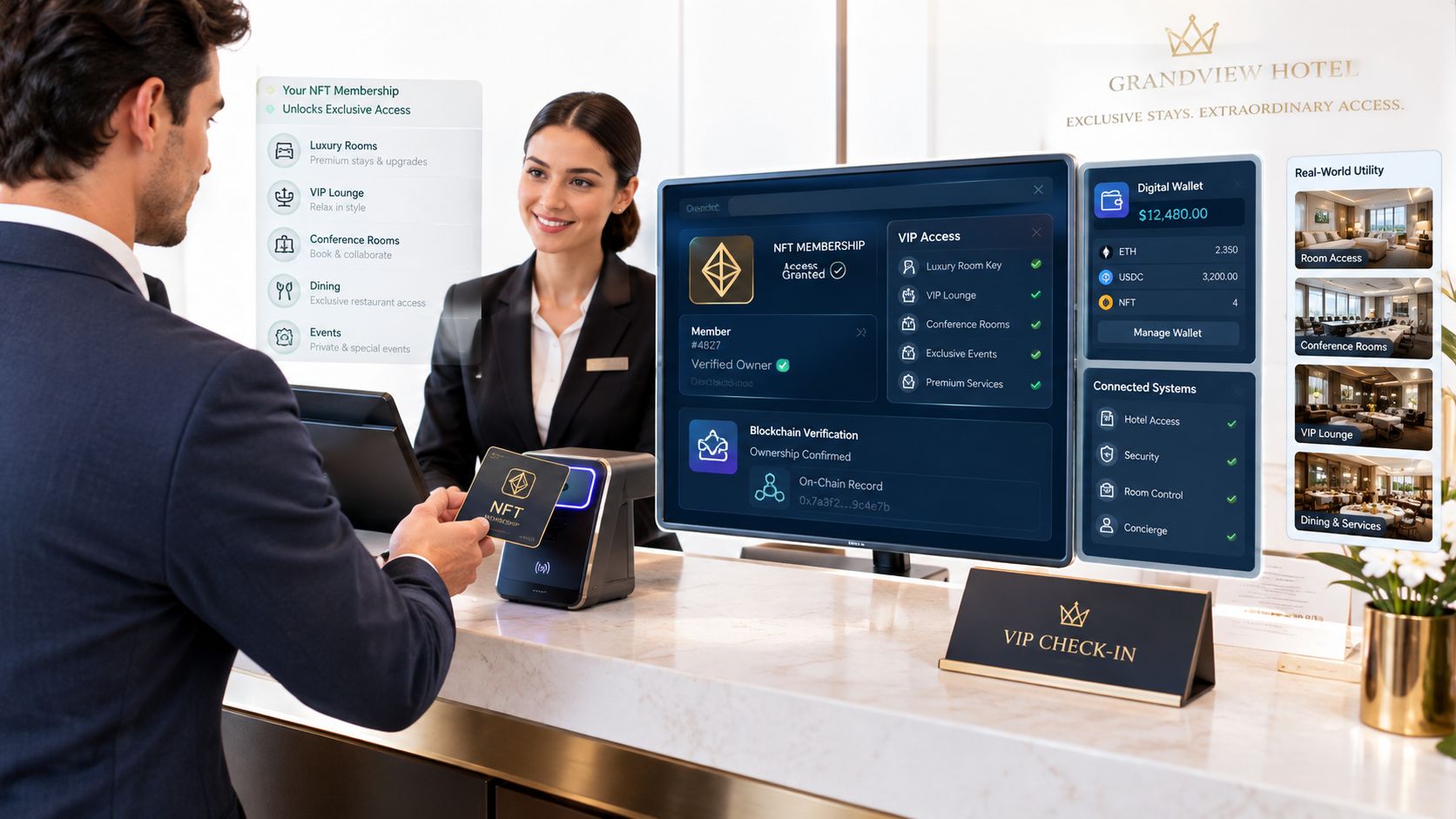
A good way to think about utility is to separate transferable benefits from issuer-dependent benefits. Transferable benefits include provenance, verifiable membership, credentials, tickets, and resale. Issuer-dependent benefits include discounts, events, software access, or voting rights that can disappear if a project changes its terms or closes. That distinction matters in product interviews because it shows whether you can design for long-term value instead of short-lived promotion.
What durable utility looks like
Utility works best when it sits on top of a reliable service. A token that grants access to a hotel lounge, an event, a gated community, or a software tier has to connect to a system people trust. If wallet custody is confusing, transaction fees are high, or keys are lost, the practical value drops fast. That's why NFT utility often depends as much on UX, support, and compliance as on the contract itself.
The less glamorous part is usually what hiring teams care about most. Can the product handle resets, revocation, and edge cases. Can operations staff explain what happens when a user changes wallets. Can design make the benefit obvious without overpromising permanence. Those are real product questions, not crypto slogans.
Where the ecosystem thinking shows up
Composability also matters because it lets the token interact with other systems. A single NFT can support access today and resale later. It can act as a membership credential in one context and a governance key in another. That makes the work attractive to engineers, product managers, designers, and community operators who know how to build around actual user behavior instead of speculation.
The main career lesson is simple. Teams that build durable utility need people who can handle both product detail and ecosystem design. That's a different skill set from chasing momentum, and it's the one employers keep paying for when hype cools off.
How to Turn NFT Knowledge Into Career Progression
The best portfolio artifact is one that proves you understand the mechanics behind the token. Include the contract address, chain, minting method, metadata location, royalty logic, and a plain-language rights summary. If you're interviewing for smart-contract, product, legal, or compliance work, that bundle tells a hiring manager far more than a screenshot of a collectible ever could.
A strong case study should also show trade-offs. Explain what the buyer gets, what they don't get, and what happens if the marketplace changes its policy. If you can do that clearly, you've shown practical Web3 judgment, not just enthusiasm. That's exactly the kind of signal that helps candidates move from junior curiosity to credible operator.
The safest NFT portfolio is the one that makes rights, costs, and dependencies legible at a glance.
For interviews, prepare one story that covers provenance, one that covers royalties, and one that covers licensing. Those three stories map neatly to engineering, product, compliance, and finance conversations. If you can connect the token standard to business logic and user impact, you'll stand out in a crowded hiring market.
If you're looking for roles where NFT literacy matters, Blockchain Jobs is a practical place to start. You'll find Web3 openings across engineering, product, legal, compliance, operations, and more, which makes it easier to match your NFT knowledge to the kind of work teams are hiring for right now.