
7 Web3 Jobs Backend Developer Roles to Apply for in 2026
You've got three years building Go services that handle real traffic, you can reason about consistency, queues, and database bottlenecks, and you want a Web3 backend role. You search backend developer on a general board and get a wall of full-stack listings at non-crypto companies, many of them mostly React work with an API attached. The actual jobs backend developer candidates want in crypto are scattered, mislabeled as software engineer, platform engineer, or protocol engineer, and buried under generic results.
That's why you need a different mix. A dedicated Web3 board narrows you to blockchain employers first, startup platforms surface early teams that hire generalists under broad titles, and general sites catch exchanges and fintech firms that never post on niche boards. Region and remote filters matter just as much, because a role listed as remote may still require overlap with a specific time zone or legal residence in one country. If you're applying across borders, career guidance for remote tech applicants helps you sort those constraints before you invest in a take-home. The broader market supports the effort, since the U.S. Bureau of Labor Statistics projects 15.8% employment growth for software developers from 2024 to 2034, adding 267,700 jobs, a category that includes many backend roles. Use the seven sources below with deliberate search terms on each, rather than running one query everywhere.
1. Blockchain Engineering Jobs
A backend opening at a crypto company may be listed as an engineering role rather than a backend job. Blockchain Engineering Jobs brings those sector-specific listings together, with 1,624 open engineering roles across blockchain and Web3. Backend titles sit alongside protocol, infrastructure, and DevOps roles, so check the description for the systems work you want.
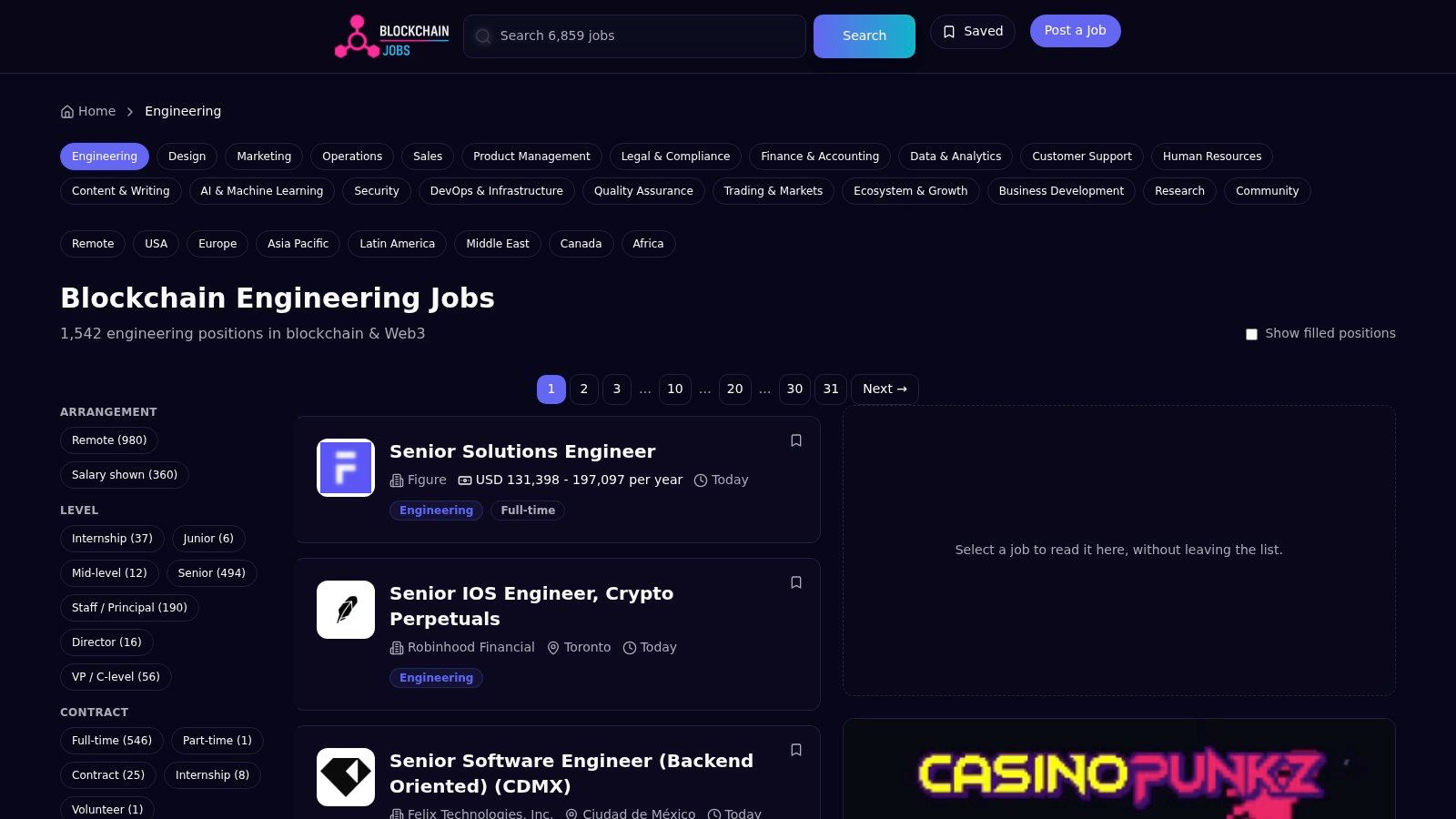
The category page makes sector relevance easy to spot, while the listing details are needed to assess compensation and work location. Jobs are grouped by Remote, USA, Europe, Asia Pacific, Latin America, Middle East, Canada and Africa. Use those regions to narrow the search, then open promising listings to check their salary range when provided, location, role category, and contract type.
How to Search It Without Missing Backend Work
Search by the work, not just the title. Teams may describe backend responsibilities as API engineer, indexing engineer, node infrastructure, or wallet backend. Pair a language with a systems term, such as Rust indexer, Go RPC, TypeScript wallet, or Python data pipeline. Then look for responsibilities involving transaction workflows, signing, or chain data rather than generic CRUD.
- Strengths: The engineering category concentrates roles at blockchain and Web3 employers, including openings with backend titles.
- Weaknesses: The category preview may not show compensation or exact work location, so inspect each listing.
- Best use: Search the category for backend-adjacent titles, then filter candidates by the systems responsibilities and location details in their listings.
For a closer look at back-end developer jobs in Web3, compare the role's operational scope with your experience. A staff indexer role may expect ownership of reorg handling, while a mid-level wallet role may focus on authentication and RPC integration.
Practical rule: If a listing mentions finality, reorgs, nonce management, or key management, prepare to explain failure handling alongside API design.
2. LinkedIn Jobs
LinkedIn Jobs is where larger crypto firms, exchanges with compliance teams, and adjacent fintech companies post because their recruiters already live there. You can search by title, location, company, and skills, then filter by seniority, employment type, salary, and remote status. Employer profiles and mutual connections, where they're available, give you a route to a warm introduction that a cold application form doesn't.
The problem is dilution. A broad backend search returns full-stack and loosely related roles, reposted listings, and expired postings that still look live. Verify every promising result on the employer's own careers page before you tailor anything.
Search Terms That Cut Through LinkedIn Noise
Use quoted phrases and exclusions in the title field. Try "backend engineer" Web3, "software engineer, backend" crypto, or your stack plus distributed systems, and filter to past week so you aren't competing with a month of applicants. Remote expectations need checking too, since the 2025 Stack Overflow Developer Survey with more than 49,000 responses indicated nearly one-third of developers worked remotely, which means most backend roles still carry location conditions worth reading carefully.
Job alerts are the key value here. Save two or three narrow searches and let LinkedIn notify you, then spend your manual time researching the team. Look at who's on the engineering roster, whether backend is a distinct function or one person doing everything, and whether recent hires stayed. That context tells you more about career progression than the bullet list of frameworks in the posting.
3. Dice
Say you want contract work, or you're a Java or Python engineer open to consulting through a staffing firm before landing direct employment. Dice fits that lane. It's technology focused, listings commonly show location and employment type, and some postings disclose pay or hourly rates upfront, which saves a screening call. You'll find full-time, contract, and hybrid roles side by side.
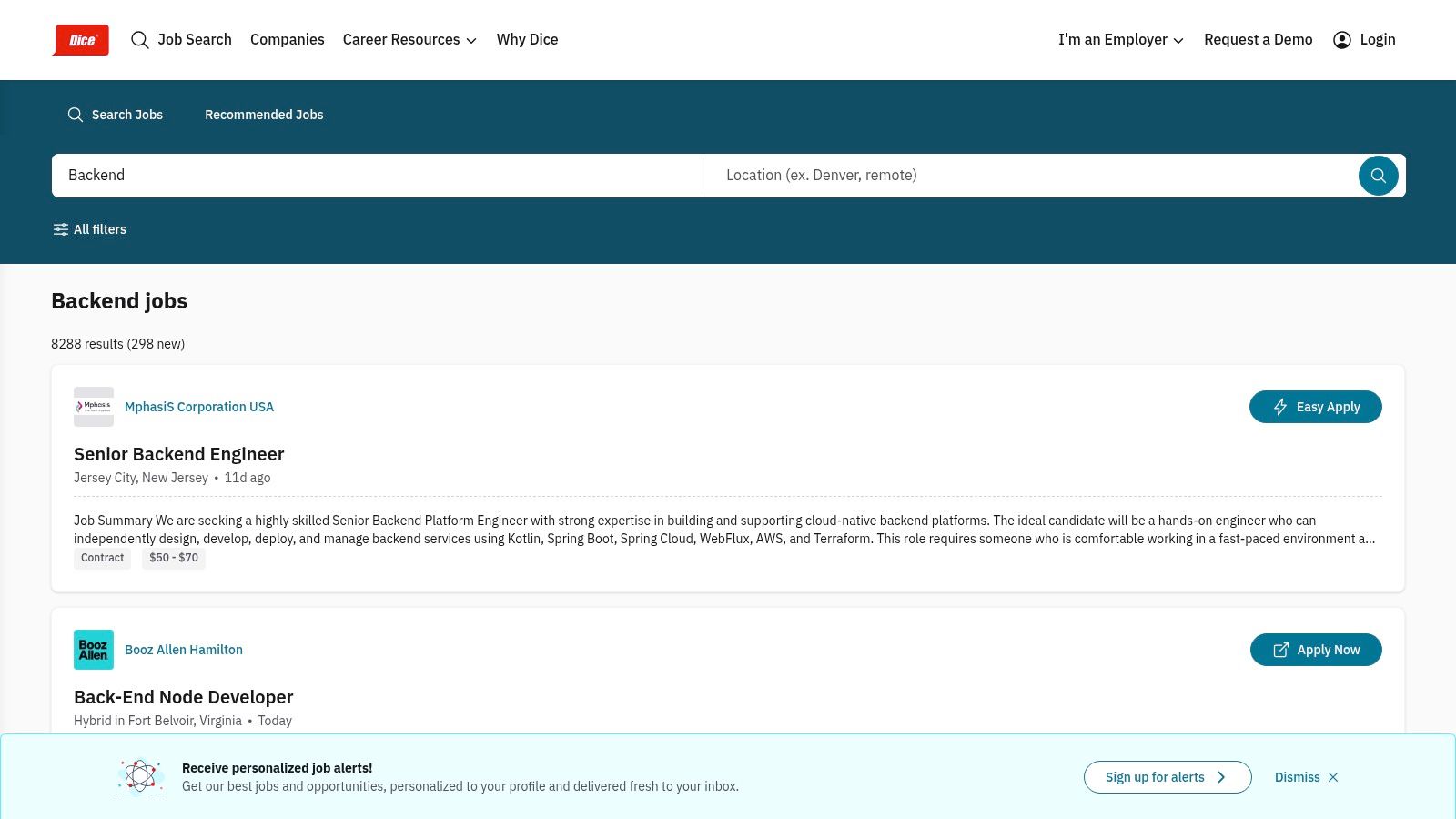
Search Dice by technology first, title second. Its results skew toward skill-specific requirements, and that matches how backend postings are written, since Skillen job-posting data shows Python in 39.5% of postings, Docker in 37.5%, Java in 35.4%, and CI/CD in 34.4%. Query your primary language plus Docker or Kubernetes and you'll surface production roles that a plain backend title search misses, including positions labeled platform or services engineer.
The trade-off is intermediaries. Listings can come from staffing firms and third-party recruiters, duplicates are common, and the end employer, work authorization, and conversion terms aren't always stated.
- Ask early: Who's the end client, and is this contract-to-hire or fixed term?
- Check the rate band: Compare hourly contract pay against salary roles after taxes and benefits, not as a raw number.
- Verify location: Hybrid on Dice sometimes means three fixed days at a client site, not flexible attendance.
I recommend Dice for experienced engineers who want contract optionality, not for juniors. Contractors are expected to be productive immediately, and interview loops are shorter and more blunt about stack depth.
4. Built In
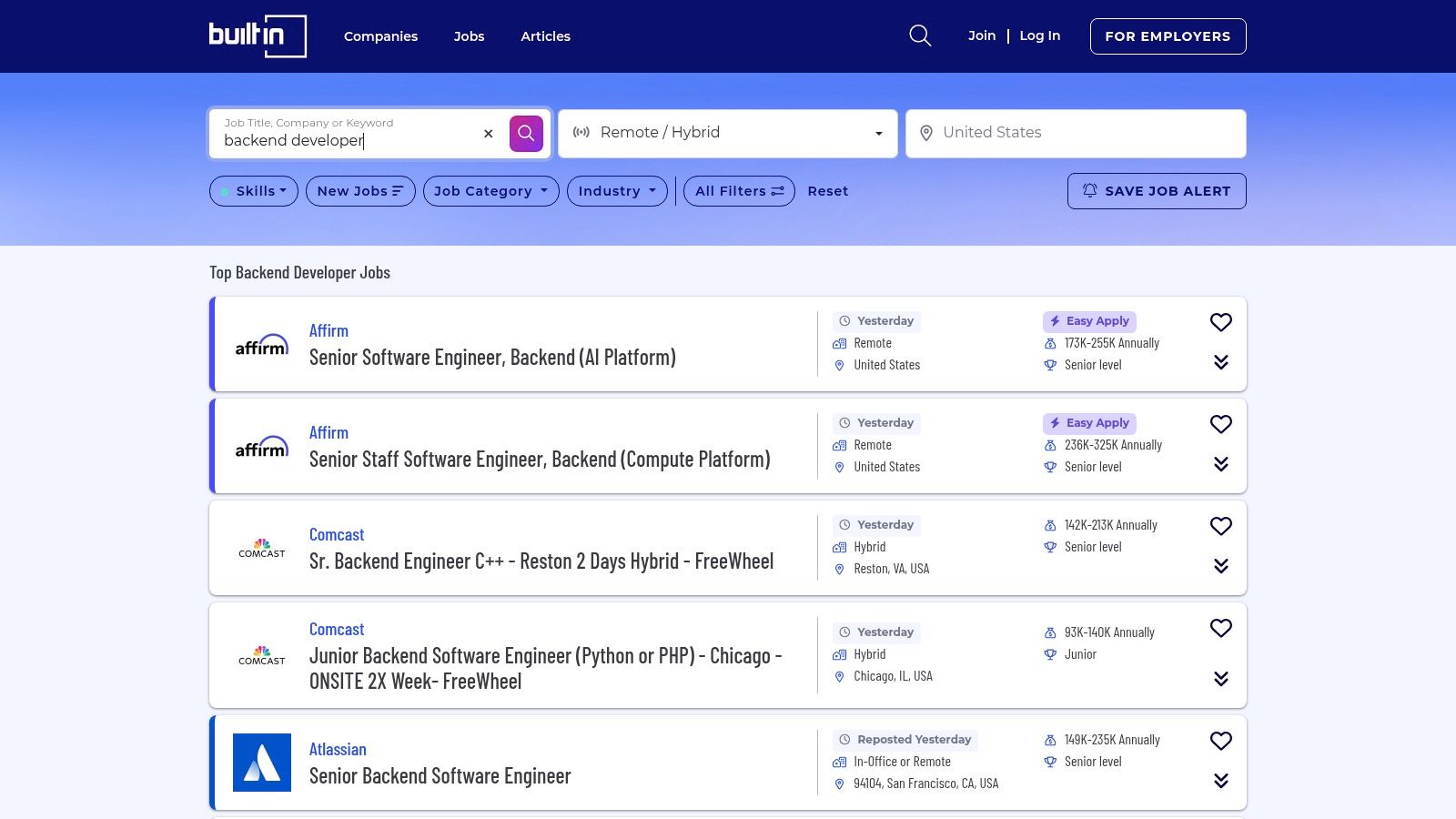
Built In pairs listings with company profiles, which makes it useful when you're evaluating whether a team is worth an interview loop. Backend results cover AI infrastructure, fintech, distributed systems, APIs, and platform engineering. Job cards may show compensation, seniority, and work arrangement, and there's a separate remote view if location flexibility is your hard filter.
That AI infrastructure angle matters now. Backend hiring increasingly tests judgment around AI workloads rather than simple code generation, and Stack Overflow's 2025 survey findings summarized by the Bureau of Labor Statistics release report 84% of developers using or planning to use AI tools, while 46% distrusted AI output accuracy. On Built In, search backend inference, API platform, or data infrastructure to find roles where retrieval pipelines, model services, and cost control sit inside backend scope. Those postings reward engineers who can validate generated SQL, write adversarial tests, and explain observability, which is trainable from strong fundamentals.
Where Built In Falls Short
Coverage is thinner than the big general sites and weighted toward technology firms and established tech hubs. Pay and remote details don't appear on every posting, so you'll sometimes open a strong-looking card and find neither. Treat Built In as a research layer as much as a job source. If a company profile shows a large platform team and recent funding, that's a different progression path than a two-person engineering org where backend also means on-call for everything.
5. Wellfound
A startup backend role may list the title “backend engineer,” while the actual work spans APIs, deployment, monitoring, and incident response. Wellfound's backend engineer listings cover early-stage and growth-stage companies. Job posts may show salary and equity ranges, experience expectations, and location. Your candidate profile also supports direct applications and inbound outreach, so keep it specific to the systems you can own.
Titles blur quickly on small teams. Search for backend skills and responsibilities, then check whether the description includes production ownership alongside feature work. A deployed service with tests, logging, and documented trade-offs gives a founder more evidence than a long technology checklist.
A tutorial API with no deployment, tests, or failure handling reads as a tutorial. A small service that's live, monitored, and documented shows production readiness.
Salary and equity details can help you compare offers, though employers provide them unevenly, and some roles require a specific city. Read what Web3 employers look for when hiring backend developers before pitching yourself to founders. Prepare to explain a system you owned end to end, what failed, and what you changed in response.
6. Y Combinator Jobs
Y Combinator Jobs limits listings to companies in the YC network, which is both its value and its ceiling. You get focused access to smaller teams and early-stage roles, a single candidate profile you can reuse across participating startups, and, on some postings, salary, location, and remote status. Crypto and fintech startups appear here, but you'll miss the broader market by definition.
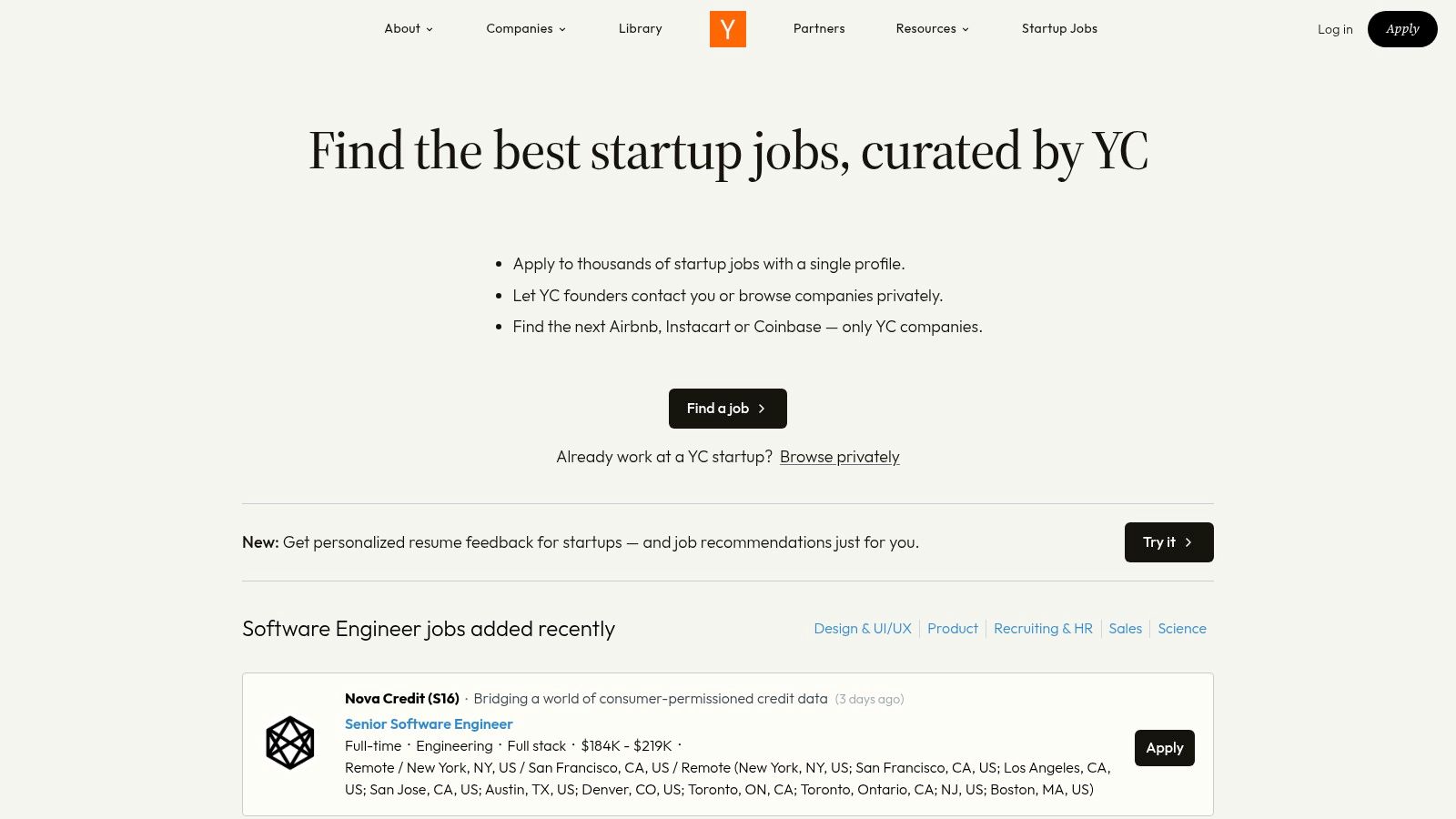
Search behavior matters more here than anywhere else on this list. Backend positions hide under software engineer or full-stack engineer because a six-person company doesn't maintain separate ladders. Search by skill and problem domain instead, terms like infrastructure, APIs, data pipelines, or payments, then read how much of the stack the role owns. If the description is ninety percent server-side with occasional frontend fixes, it's a backend job wearing a generalist title.
Preparing for How These Teams Interview
Small teams interview differently from large ones. In Stack Overflow's 2019 Developer Survey, 80.3% of respondents said senior or management interviewers were involved in their successful interview, and only 39.0% reported writing any code. At YC startups you'll often talk directly with a founder or engineering lead who cares whether you can debug a live problem and explain a design trade-off clearly. Practice narrating your decisions on data modeling, concurrency, and incident response out loud. A polished algorithm drill won't rescue a candidate who can't explain why they chose Postgres over a queue for a given workload.
The reusable profile reduces setup friction, but don't spray identical applications. Two sentences on why that company's technical problem fits your background outperforms volume at this scale of team.
7. Indeed
Indeed is the widest net, and it behaves like one. Indeed surfaces backend postings from direct employers and staffing firms across the U.S., including roles at companies that never touch a niche board. Flexible keyword search is the main tool, because the same job appears as backend engineer, API developer, software engineer, or server-side developer depending on who wrote the posting.
Run several narrower searches instead of one broad one. Combine a title variant with a technology and a domain word, for example API developer fintech, backend engineer Go remote, or software engineer payments platform, and set a posted-date filter so stale listings don't eat your time. Listings may include salary, employment type, and work arrangement, and alerts can track each search separately.
- Duplicates: The same role may appear from the employer and two staffing firms. Apply once, through the employer's own page if you can find it.
- Unnamed employers: Staffing postings may not name the end company upfront. Don't submit documents until you know who receives them.
- Freshness: Verify the posting is still open on the employer's application page before tailoring your resume.
Indeed rewards candidates who show testable evidence, which fits how hiring is shifting. One 2025 skills-based-hiring statistic reports 85% of U.S. employers used skills-based hiring in 2025, so connect each listed skill to an outcome, such as a latency reduction or an indexer recovery improvement, rather than listing frameworks bare. For the compensation side of comparison, our overview of back-end developer salary expectations gives you context before you negotiate. Where a posting shows no range, ask for the band on the first call. You're not being difficult. You're avoiding four interview rounds for an offer you can't accept.
How the seven backend job sources compare for Web3 and remote searches
A backend role may be labeled “platform engineer,” “protocol engineer,” or “software engineer.” Compare each board by how it exposes remote status and compensation, then search beyond the exact title.
| Job Board | Best For | Pay Information | Remote Filter | Coverage |
|---|---|---|---|---|
| Blockchain Engineering Jobs | Engineering roles in blockchain and Web3 | 1,100 open roles show a salary; salary display can be filtered | Remote filter available, showing 4,171 remote roles | Blockchain and Web3 roles across 21 categories |
| LinkedIn Jobs | Broad backend searches with networking tools | Salary filter available; posting details vary | Remote-status filter | Employers across U.S. industries |
| Dice | Technology-focused backend and contract roles | Some listings disclose salary or hourly rates | Work arrangements vary; hybrid roles included | U.S. technology jobs |
| Built In | Backend roles with company and tech-sector context | Some listings disclose compensation | Separate remote-role view | U.S. technology companies and startups |
| Wellfound | Backend roles at startups | Listings may include salary and equity | Remote roles available | Early- and growth-stage startups |
| Y Combinator Jobs | Engineering roles at YC-network startups | Some postings disclose salary | Some postings disclose remote status | Companies in the Y Combinator network |
| Indeed | Broad searches across backend job titles | Some listings include salary | Work arrangements may be listed | U.S. employers and staffing firms |
On Blockchain Engineering Jobs, try backend terms alongside protocol and infrastructure terms. Its category filters can narrow results to Engineering, while the remote filter helps separate location-flexible roles from the broader listings. Salary details are available for some roles, but many postings may not show a range.
Turn This Shortlist Into a Repeatable Backend Job Search
Running seven boards daily is a recipe for burnout and sloppy applications. Pick two or three that match your target, typically one specialist board for Web3 relevance, one startup platform if you want early-stage scope, and one general site for coverage. Save the same backend search terms on each so results are comparable, and turn on job alerts so new matches arrive without daily manual checking. You'll still search actively, but alerts catch the postings that go up between your sessions.
Build your terms around how the work is labeled. A durable set covers title variants and systems language together, such as backend engineer, API engineer, platform engineer, and your primary stack paired with distributed systems, indexing, RPC, or payments. The demand behind those searches is structural, since the Bureau of Labor Statistics projects an average of 115,200 annual openings for software developers from 2024 through 2034. Openings don't equal easy hiring, though. They reward candidates whose applications show production judgment.
Compare Offers Before You Schedule Every Interview
Screen on paper first. Compare salary range, remote terms including time zone overlap and eligible countries, team stage, and on-call expectations before you commit to a loop. The occupation's pay context helps you sanity check numbers, because the Bureau of Labor Statistics release on AI and IT employment reported a 2024 median annual wage of $133,080 for software developers. A startup offer below market with meaningful equity may still suit you, but decide that deliberately, not after five rounds.
Track every application by source. Note which boards produce replies, which produce interviews, and where you get filtered out at resume stage. After a few weeks, cut the source that generates volume without responses and reallocate that time to portfolio work that strengthens the next round of applications. For Web3 specifically, the Blockchain Council's digital asset career guide identifies Solidity, TypeScript, Python, Rust, RPC APIs, wallet connections, and security fundamentals as common requirements, so your progression from conventional APIs toward wallet authentication, event indexing, and transaction workflows maps directly onto what these employers screen for.
Weekly rhythm: Two alert reviews, three tailored applications, one hour improving a deployed project. That beats twenty generic submissions and nothing new to show interviewers.
Keep your saved searches short and current. Job seekers can sign up to get new blockchain and Web3 jobs by email, once a day, which turns the specialist board into a passive feed while you focus your active effort on the two sources producing real conversations. The goal isn't applying everywhere. It's building a small, measured pipeline where each application is credible, each interview is prepared, and your backend evidence keeps getting stronger between searches. That discipline is what converts a board list into an offer.
Browse current backend openings across blockchain, DeFi, and Web3 teams on Blockchain Jobs, filter by region and remote status, and set up daily email alerts so new backend roles reach you as they're posted. Start with the engineering category today and compare each listing's stack and seniority against your own before you apply.